
Judge, 1910-05-14 · page 14 of 16
Judge — May 14, 1910 — page 14: what you’re looking at
What you’re looking at
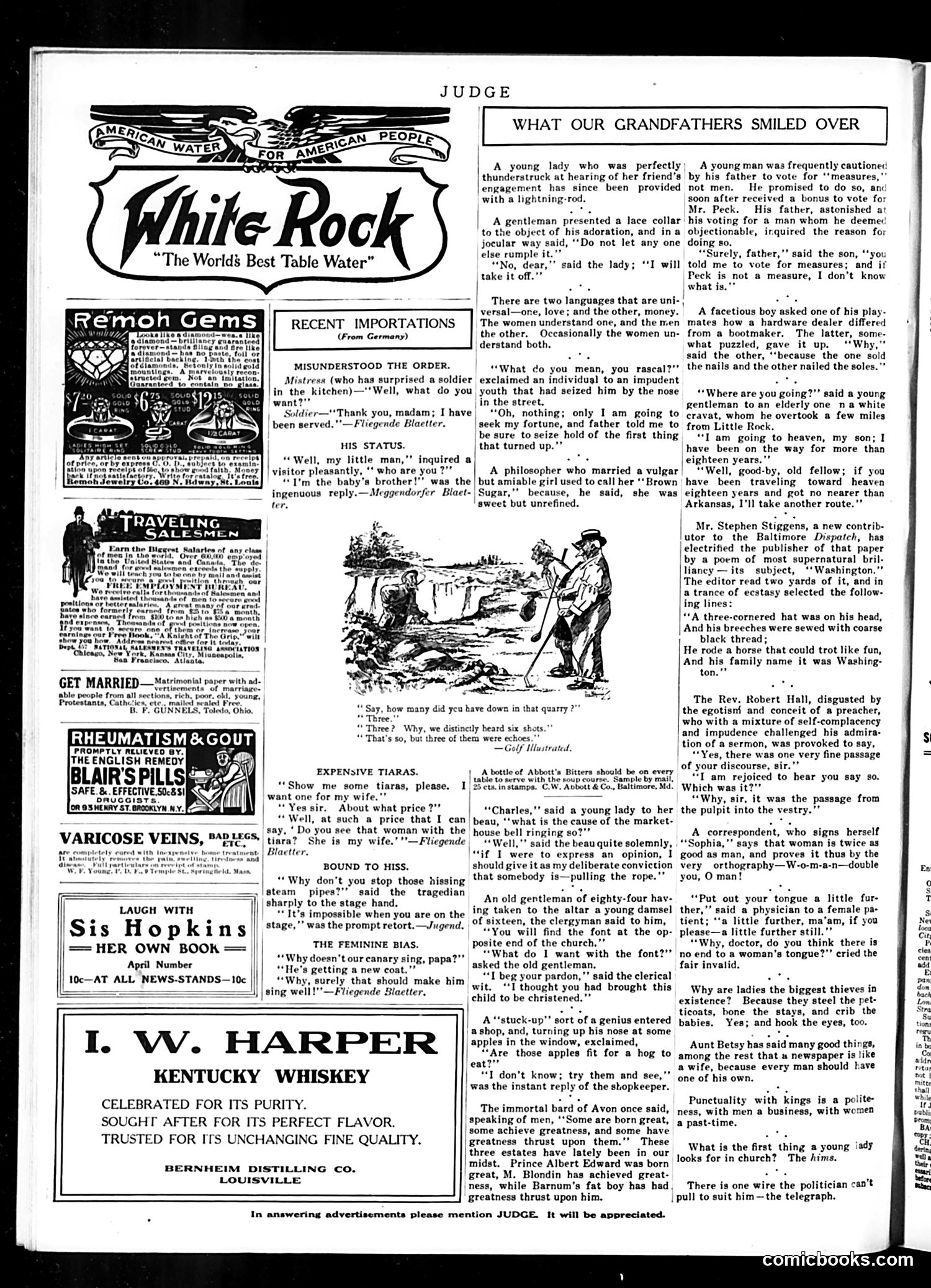
This page from *Judge* contains mostly humorous anecdotes and advertisements rather than political cartoons. The content consists of brief jokes and witty observations typical of late 19th-century American humor magazines. The humor relies on wordplay and social commentary: one anecdote mocks a son who votes for "Mr. Peck" because his father told him to vote for "measures" (policies), not men—treating a person as if he were a policy measure. Another jokes about the difference between a hardware dealer and bootmaker: one "nails" things, the other "nails the soles." The cartoonist's satirical point in the illustrated quarry scene (captioned "Say, how many did you bag down in that quarry?") appears to be social commentary on hunting or perhaps labor practices, though the specific reference is unclear without additional context. The page is primarily filled with period advertisements for patent medicines, whiskey, and matrimonial services—typical *Judge* content aimed at middle-class readers seeking both humor and consumer goods.
📄 Transcribed text from this page (OCR, searchable)
Machine-transcribed from the original scan — historical spelling and the odd misread are preserved.
| A young lady who was perfectly} A young man was frequently cautioned | thunderstruck at hearing of her friend's by his father to vote for ‘*measures,”” engagement has since been provided not men. He promised to do so, anc with a lightning-rod. soon after received a bonus to vote for ~ Mr. Peck. His father, astonished at A gentleman presented a lace collar his voting for a man whom he deemec to the object of his adoration, and ina objectionable, inquired the reason for jocular way said, “Do not let any one doing so. else rumple it.” “Surely, father,"’ said the son, “you “No, dear,”’ said the lady; “I will told me to vote for measures; and if take it off."” Peck is not a measure, I don’t know what is.” There are two languages that are uni- | ove versal—one, love; and the other, money.| A facetious boy asked one of his play- The women understand one, and the men mates how a hardware dealer differed the other. Occasionally the women un- from a bootmaker. The latter, som derstand both. what puzzled, gave it up. y jt said the other, ‘because the one so “What do you mean, you rascal?’’ the nails and the other nailed the soles. MISUNDERSTOOD THE ORDER. Mistress (who has surprised a soldier exclaimed an individugl to an impudent ote in the kitchen)—*Well, what do you youth that had seized him by the nose “Where are you going?” said a young want?”’ in the street. . gentleman to an elderly one na white Soldier—"Thank you, madam; Ihave ‘Oh, nothing; only I am going to cravat, whom he overtook a few miles been served."’—Fliegende Blaetter. seek my fortune, and father told me to from Little Rock. jbe sure to seize hold of the first thing I am going to heaven, my son; I HIS STATUS. | that turned up.’” have been on the way for more than man,"’ inquired a ve jeighteen years."” who are you 2” A philosopher who married a vulgar! ‘Well, good-by, old fellow; if you “I'm the baby’s brother!’ was the | but amiable girl used to call her “Brown have been traveling toward heaven ingenuous reply.—Meggendorfer Blaet-|Sugar,"” because, he said, she was eighteen years and got no nearer than ~ — ter. ‘sweet but unrefined. Arkansas, I'l] take another route.’* “Well, my littl visitor pleasant! Mr. Stephen Stiggens, a new contrib- lutor to the Baltimore Dispatch, has electrified the publisher of that paper by a poem of most supernatural bril liancy —its subject, ‘*Washington. | The editor read two yards of it, and in |a trance of ecstasy selected the follow- ing lines: “*A three-cornered hat was on his head, | And his breeches were sewed with coarse black thread; He rode a horse that could trot like fun, And his family name it was Washing- ton, iexest Salarien of any clam Over GOED emp'oyed | The Rev, Robert Hall, disgusted by the egotisni and conceit of a preacher, Tor who with a mixture of self-complacency GET MARRIED —stsimoniat paper with d- able people from all sections, rich, poor, oll, young, Protestants, Cathetie 7 — “Three? Why, we distinctly heard six shots."" pasgpele és 7 Hi m pudence challenged hie admira- RHEUMATISM & GOUT Titvso botnet em wee ce rei attra 2 . 4 ‘ “Yes, there was one very fine passage PROMPTLY RELIEVED BY. a of your discourse, sir.”” THE ENGLISH REMEDY ox , pugley cnaaige |ubletsseme withthe rupeourte Sampletymal, “I am rejoiced to hear you say so. “*Show me some t ” ime, BLAIR'S PILLS 7 ras, please, 1) Beutiinnss CW.Avbs ees. alin: Which was ie?" willl t one for my wife.” — “Why, sir, it was the passage from A | 8 About what price ?”” | said a young lady to her the pulpit into the vestry.”” I, at such a price that I can the cause of the market- thy say, ‘Do you see that woman with the inging so?” A correspondent, who signs herself VARICOSE VEINS, "*27E5* tiara? She is my wife.’""—Fliegende said the beau quite solemnly, .‘‘Sophia,"" says that woman is twice as y ely ot, | Blaette f I were to express an opinion, | good as man, and proves it thus by the BOUND TO HISS. should give it as my deliberate conviction very _orthography—W-o-m-a-n—double that somebody is—pulling the rope."’ you, O man! — “Why don’t you stop those hissing p ae ie ae ant’ fesedian An old gentleman of eighty-four hav- “Put out your tongue a little fur- | LAUGH WITH aes rapes ten pou are on the ing taken to the altar a young damsel ther,” said a physician to a female pa- les : tage,"” was oat of sixteen, the clergyman said to him, _ tien’ tle further, ma’am, if yo Sis Ho p kim g || tse" ¥8the prompt retort. —Jugend. eye will find the font at the op- please—a little further still."" THE FEMININE BIAS. posite end of the church.” “Why, doctor, do you think there is ow ji ‘What do I want with the font?’’ no end to a woman's tongue?” cried the hy doesn’t our canary sing, Papa?” asied the old gentleman. fair invalid. == HER OWN BOOK = | April Number i fe's getting a new coat. pt cya * . 10c—AT ALL NEWS-STANDS—10c {| “Why, surely that should make him , ., ! beg your pardon,”’ said the clerical ae ; I] | sing well !""—Fliegende Blaetter, wit. “I thought you had brought this Why are ladies the biggest thieves in : - child to be christened. existence? Because they steel the pet- cane : ticoats, bone the stays, and crib the ort of a genius entered babies. Yes; and hook the eyes, too. | A“‘stuck-up’’ ashop, and, turning up his nose at some v v I | A R I I ‘ ; R apples in the window, exclaimed, Aunt Bets: has sa id many good things, I. 2 | ae those apples fit for a hog to among the rest that = newspaper fa like eat? a wife, because every man should have KENTUCKY WHISKEY “I don't know; try them and see,’” one of his own. was the instant reply of the shopkeeper. CELEBRATED FOR ITS PURITY. The immortal bard of Avon once said SOUGHT AFTER FOR ITS PERFECT FLAVOR. speaking of men, “Some are horn grea USTED FOR ITS UNCHANGING FINE QUALITY. Srentueas taret oon dhe” Thee _* TRI h ‘) Ql a greatness thrust upon them.” These what ig the first thing a young isdy Punctuality with kings is a polite- ness, with men a business, with women a past-time. | | |three estates have lately been in our r f i Pri > ‘ looks for in church? The hims. GEANHEING DisViLLaNG Go: midst. Prince Albert Edward was born : Touisv ce great, M. Blondin has achieved great- te f ness, while Barnum’s fat boy has had, There is one wire the politician can’ greatness thrust upon him. | pull to suit him—the telegraph. In answering advertisements please mention JUDGE. It will be appreciated.