
A complete issue · 16 pages · 1910
Judge — April 16, 1910
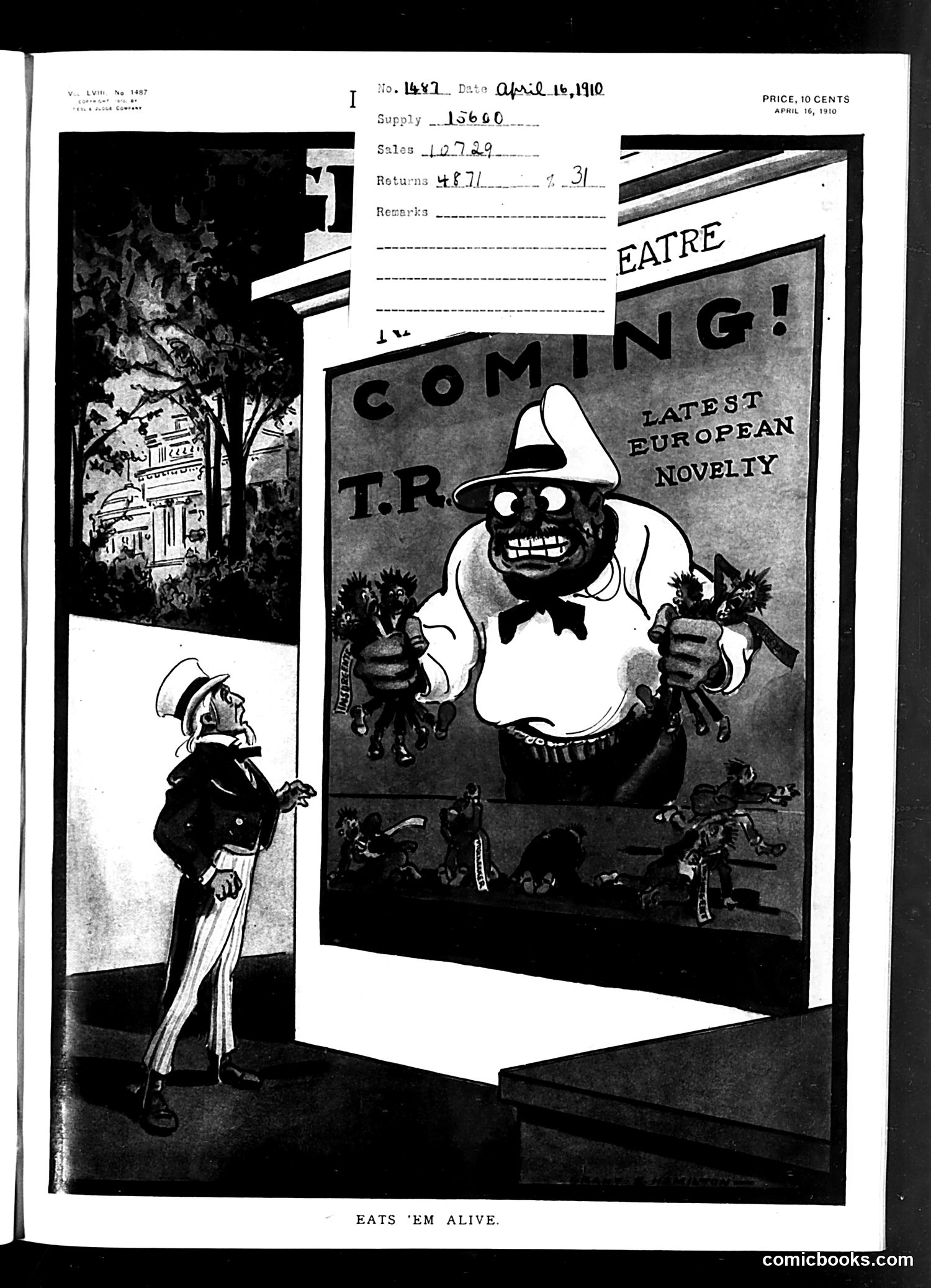
This page shows a theatrical advertisement for "T.R. Coming!" described as "The Latest European Novelty." The central image depicts a grotesque caricatured figure in formal attire (white shirt, bow tie, hat) with an exaggerated grinning face, holding what appear to be small figures or creatures in each hand, suggesting consumption or domination. The "T.R." likely refers to Theodore Roosevelt, whose presidency had recently ended (March 1909). The "eats 'em alive" caption and predatory imagery suggest contemporary anxieties about Roosevelt's aggressive political style and controversial policies. The advertisement frames him as a sensational spectacle—a European novelty act—satirizing both his public persona and Americans' fascination with his combative approach to politics and power.
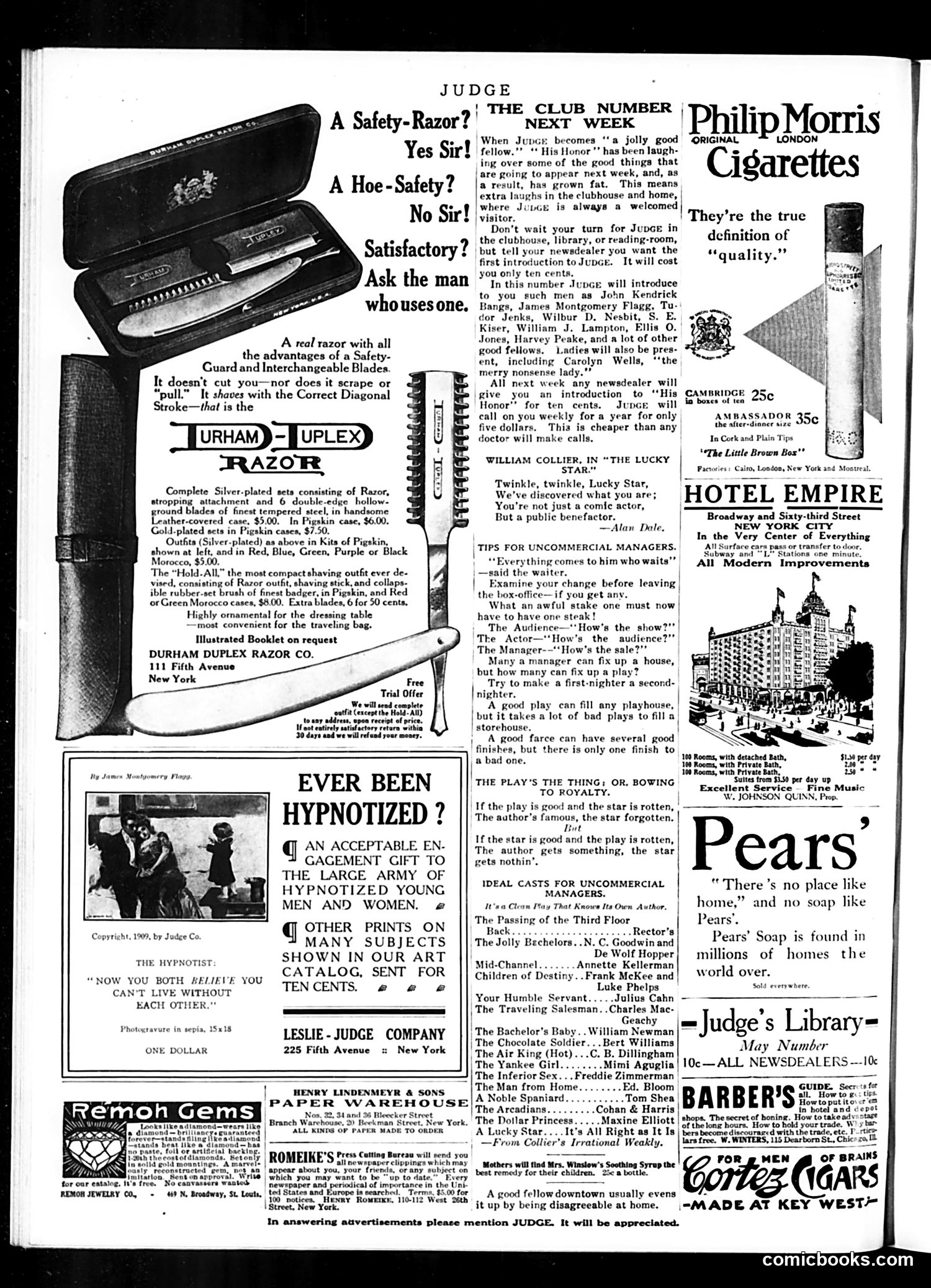
This page is primarily **advertising** rather than editorial content or political satire. The main features are: 1. **Urham-Uplex Razor advertisement** - promoting a safety razor with interchangeable blades 2. **Philip Morris Cigarettes ad** - emphasizing "quality" 3. **Hotel Empire advertisement** - promoting a New York hotel 4. **Pears' Soap ad** - with the famous slogan "There's no place like home" 5. **Judge's Library section** - listing plays and theatrical productions There is one small cartoon image labeled "THE HYPNOTIST" showing a hypnosis scene, but the page is dominated by commercial advertisements typical of early 20th-century magazines. The content reflects consumer products and entertainment of the era rather than political commentary.
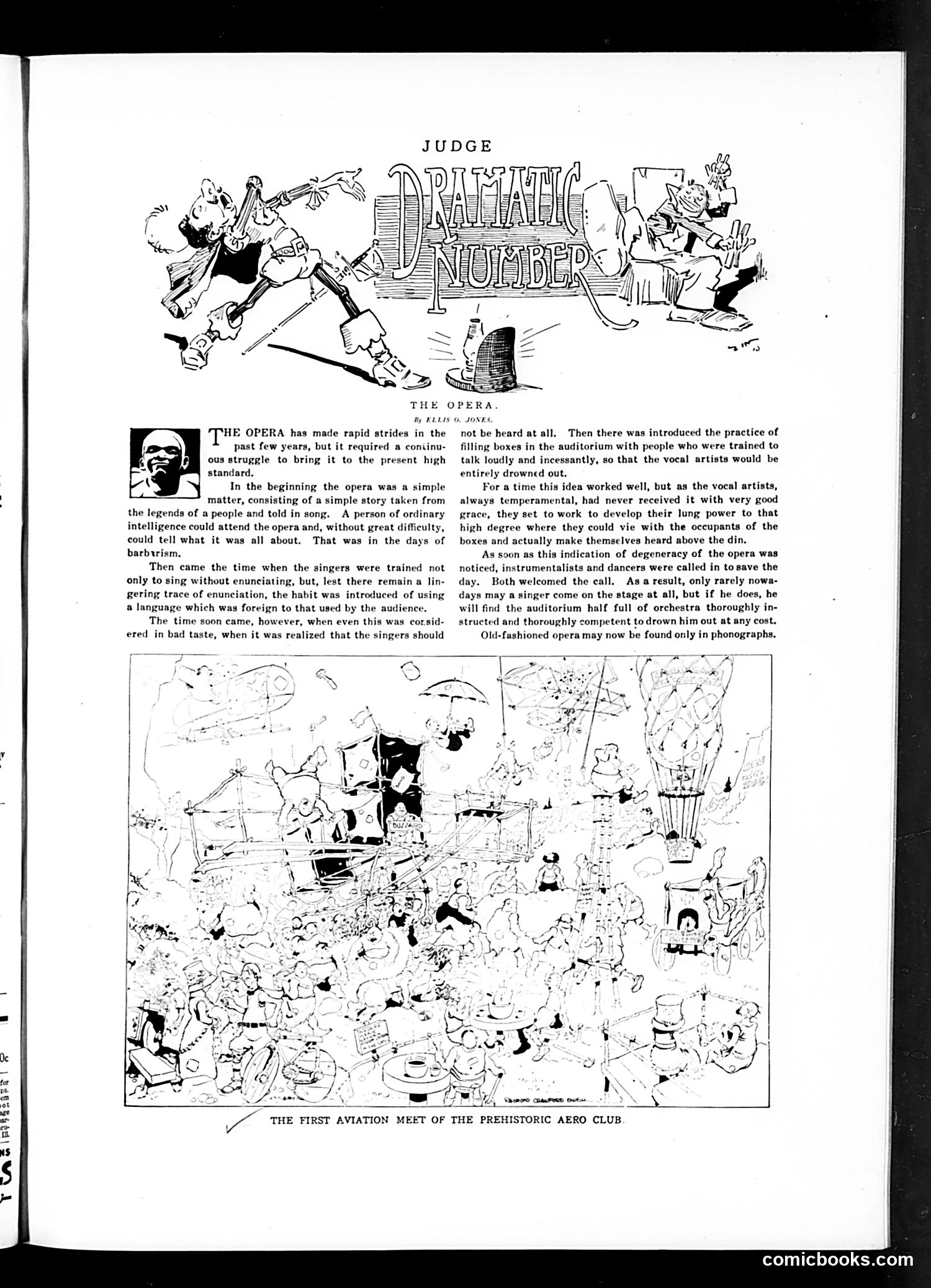
This page satirizes **opera's evolution and modern performance practices**. The title "Drastic Number" appears to mock contemporary opera productions. The text describes opera's historical development—from simple storytelling to elaborate vocal training methods. It critiques a specific trend: filling auditoriums with trained "box fillers" who spoke loudly during performances to create atmosphere, later replaced by instrumental and dance acts when singers proved insufficient. The bottom cartoon, "The First Aviation Meet of the Prehistoric Aero Club," is a separate humorous illustration depicting absurdly primitive flying contraptions—dinosaurs and cavemen attempting flight with ridiculous devices. This visual joke contrasts "prehistoric" technology with modern aviation, likely mocking early aviation meet disasters or incompetent experimental aircraft designs popular in the early 1900s.
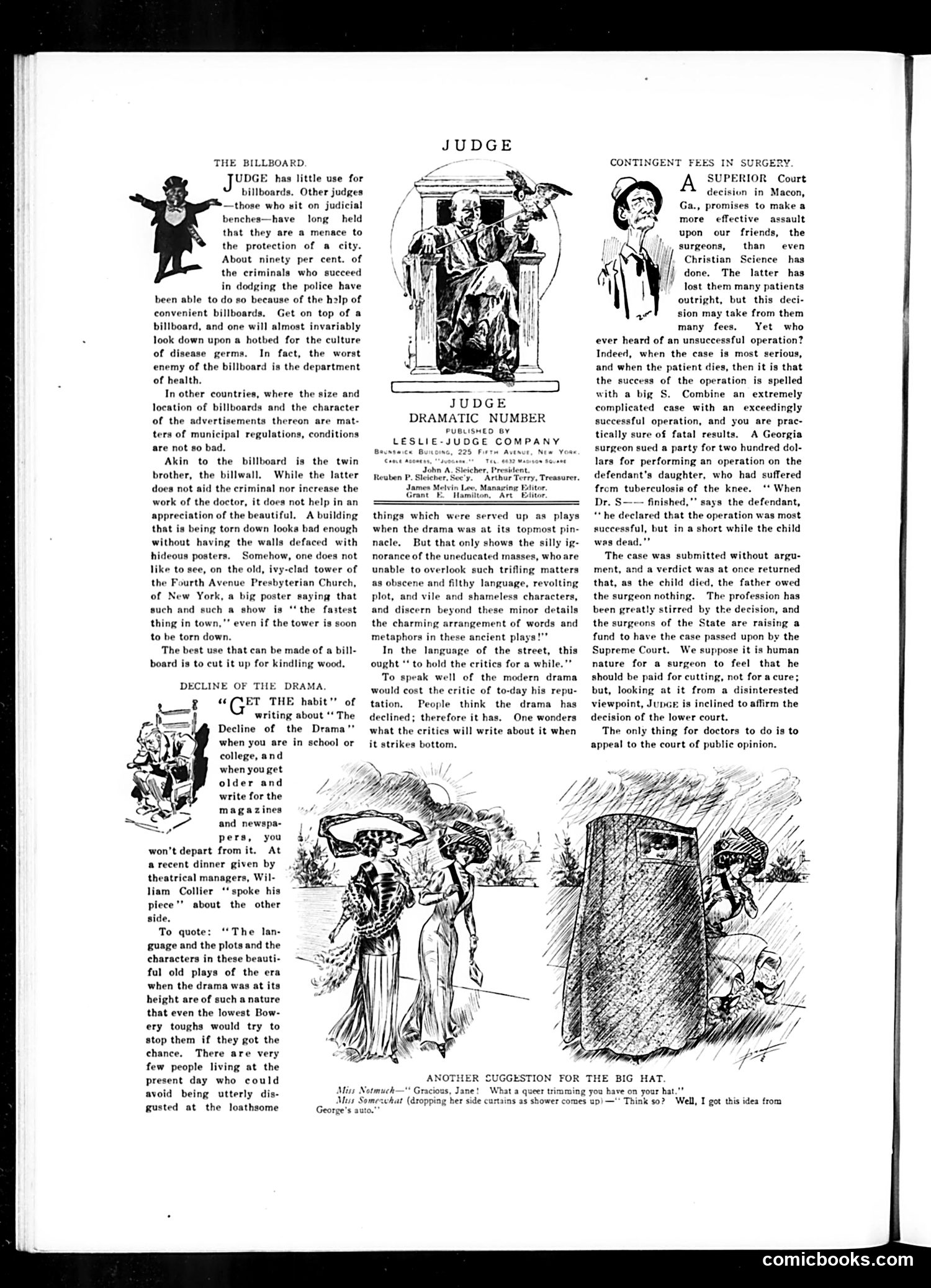
This page contains satirical commentary on two topics: **"The Judge" (left):** Critiques judges as largely useless to billionaires and judges who sit on judicial benches. The piece argues judges are obstacles to city protection and that billboard regulation represents one of their worst failures. **"Contingent Fees in Surgery" (right):** Mocks a Georgia Superior Court decision allowing surgeons to charge contingent fees (payment only if successful). The satire argues this creates perverse incentives—surgeons profit from successful operations regardless of patient outcome. The case described involves a tuberculosis patient who died post-surgery; the surgeon was paid in full despite the fatal result. Judge magazine suggests this ruling represents absurd legal reasoning that prioritizes surgeon profits over patient welfare. Both pieces critique institutional failures and misaligned incentives.
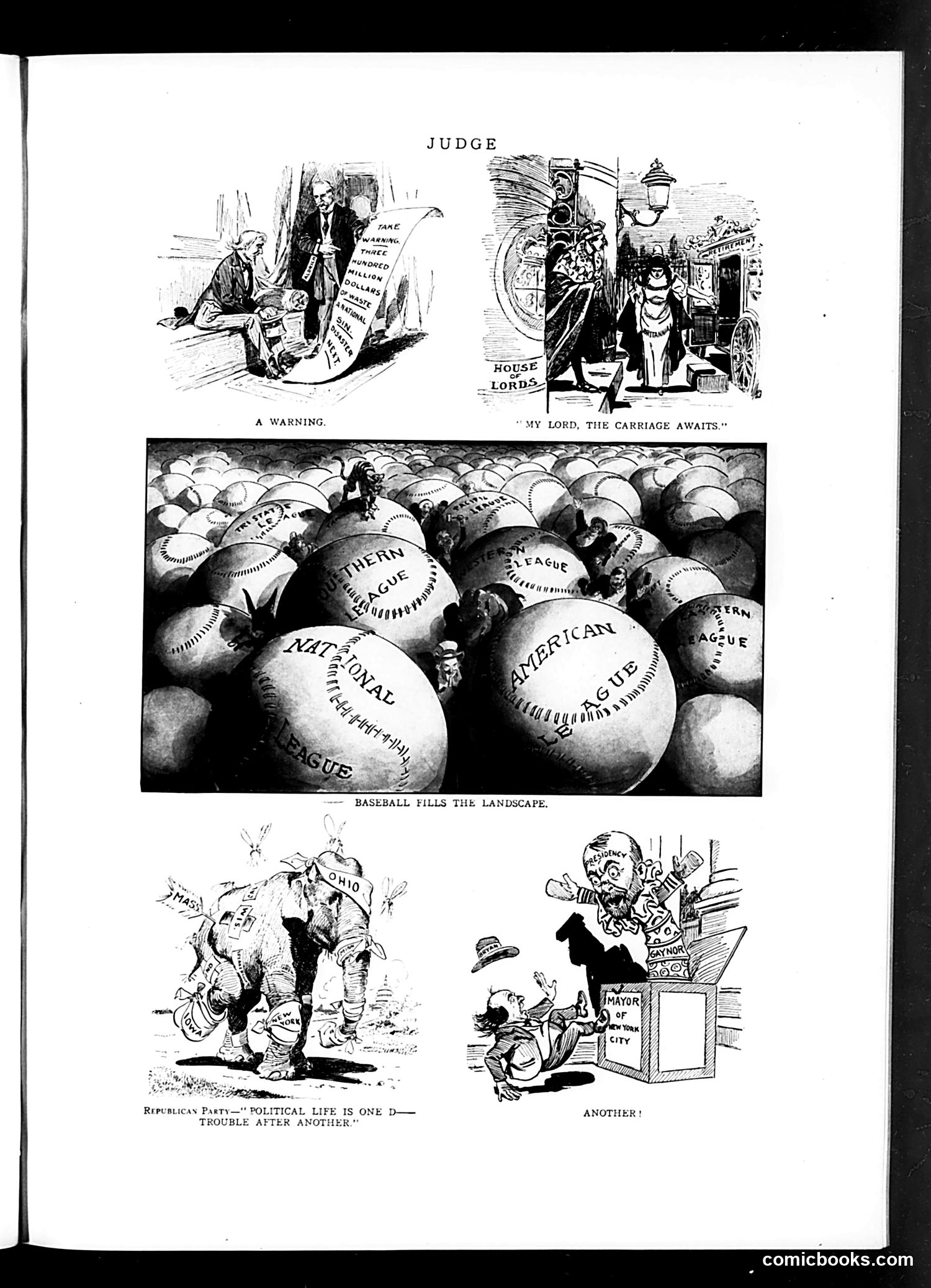
This page contains five separate political cartoons satirizing American politics and baseball's prominence circa early 1900s. **"A Warning"** and **"My Lord, the Carriage Awaits"** appear to mock judicial or political authority figures. **"Baseball Fills the Landscape"** uses giant baseballs labeled with league names (National League, American League, etc.) to suggest baseball's overwhelming dominance in American public consciousness—a commentary on the sport's cultural saturation. **"Republican Party"** depicts political turmoil as endless trouble, suggesting internal Republican Party dysfunction. **"Another!"** shows a figure labeled "Mayor of New York" apparently overwhelmed by cascading problems, satirizing municipal governance struggles. The cartoons collectively critique baseball mania, judicial pretension, and Republican political chaos during this period.
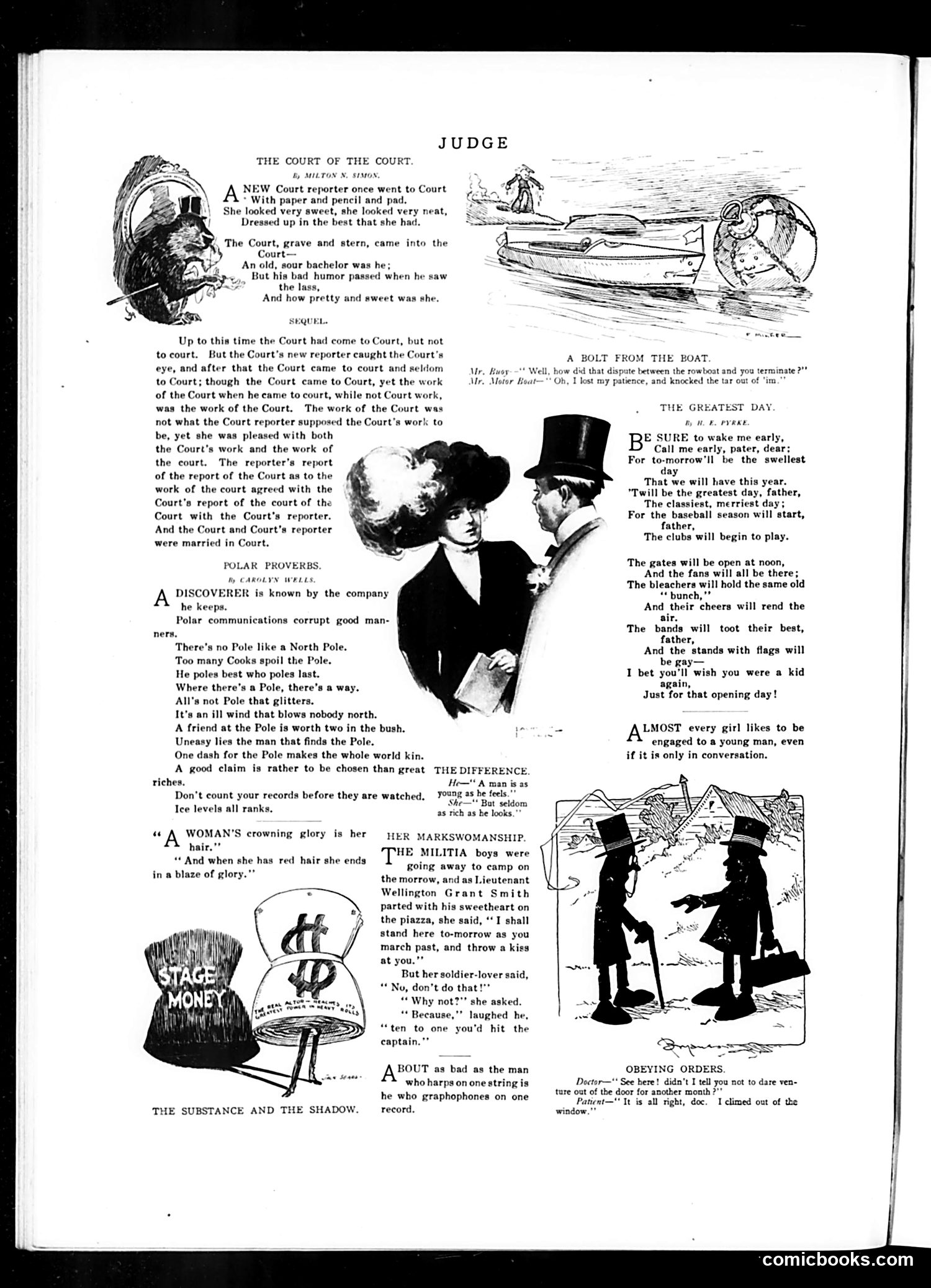
This page contains several satirical pieces typical of early 20th-century American humor: **"The Court of the Court"** is a wordplay joke about a judge who comes to court professionally but begins neglecting his judicial duties after being smitten with an attractive female court reporter. The repeated use of "Court/court" creates verbal confusion satirizing both romantic distraction and judicial negligence. **"Polar Proverbs"** plays on Arctic exploration enthusiasm (likely referencing contemporary polar expeditions), twisting familiar sayings by substituting "Pole" for key words—a lighthearted pun collection rather than serious satire. **"Her Marksmanship"** jokes about a militia officer's girlfriend threatening to throw a kiss as soldiers march past, with the humorous implication she'd likely miss and hit his superior officer instead—poking fun at women's shooting ability (a common prejudice of the era). The remaining pieces are brief one-liners on romance, appearance, and social etiquette. Overall, this is light domestic/social satire rather than political commentary, reflecting Judge's focus on courtship, gender roles, and contemporary leisure activities.
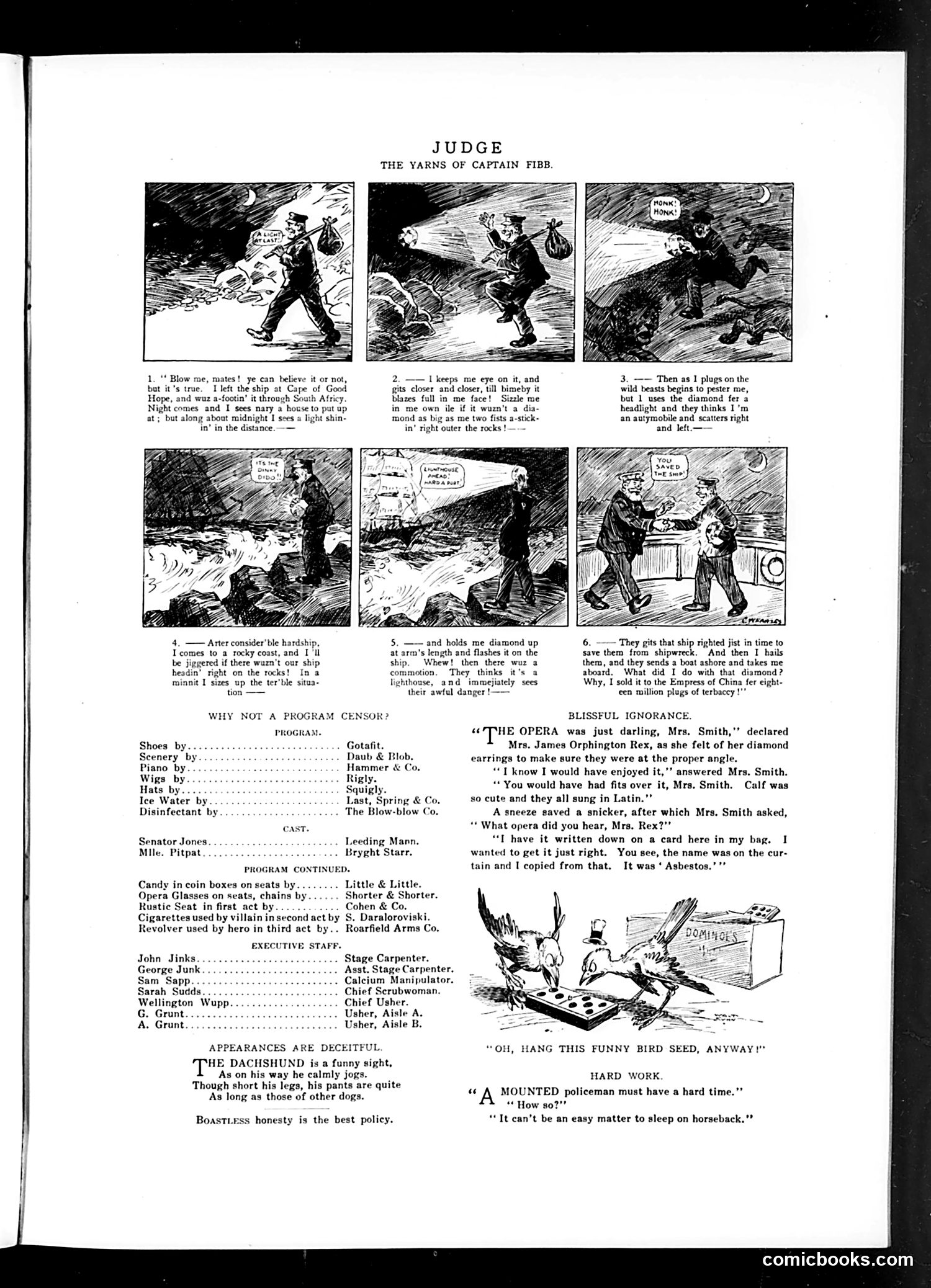
This is a tall-tale comic strip mocking the exaggerated adventure stories common in popular fiction. "Captain Fibb" recounts an implausible rescue: stranded in South Africa, he uses a giant diamond as a headlight to warn a ship away from rocks, then sells it to the Chinese Empress for tobacco. The satire targets two things: first, the absurd implausibility of such narratives (a diamond the size of a fist appearing conveniently in the wilderness); second, the gullible audiences who consume them uncritically. The other page content includes gentle social humor—opera-goers pretending cultural sophistication while mishearing titles, a joke about dachshunds' short legs, and complaints about mounted police discomfort—typical of Judge's light satirical approach to American social pretensions and daily life.
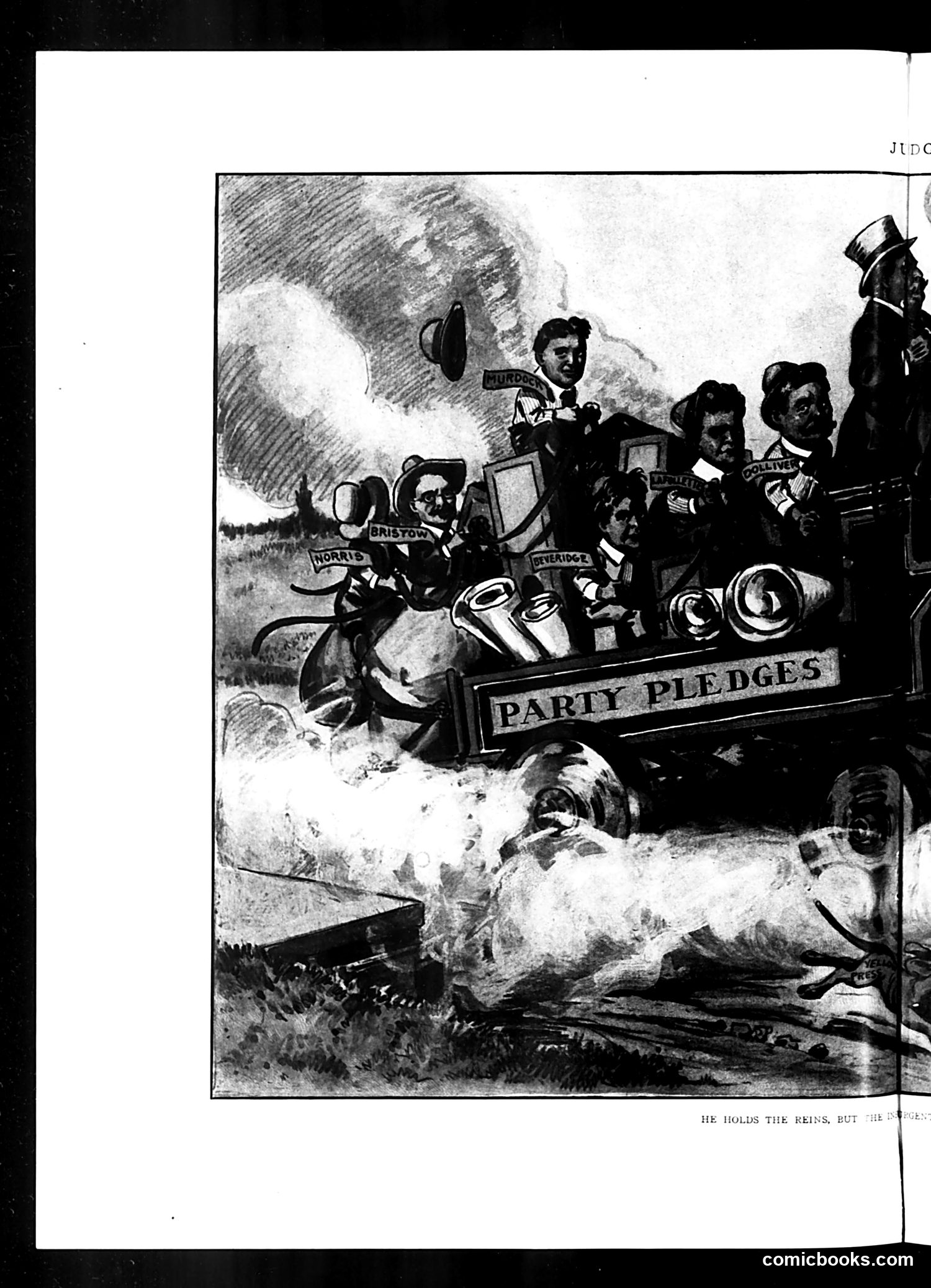
This Judge magazine cartoon depicts a vehicle labeled "PARTY PLEDGES" being driven by figures representing political party leadership. The cartoon's caption—"HE HOLDS THE REINS, BUT"—suggests irony about control and accountability. The imagery shows multiple caricatured figures aboard the pledge-wagon, with what appears to be party officials or candidates. The incomplete caption implies a critique: while one figure ostensibly "holds the reins" (maintains control), the outcome or actual direction remains questionable or out of control. This likely satirizes a political party's promises versus actual delivery, or tensions between party leadership and their stated commitments. Without a visible date, the specific election or figures remain unclear, though the style suggests early-to-mid 20th century American politics.
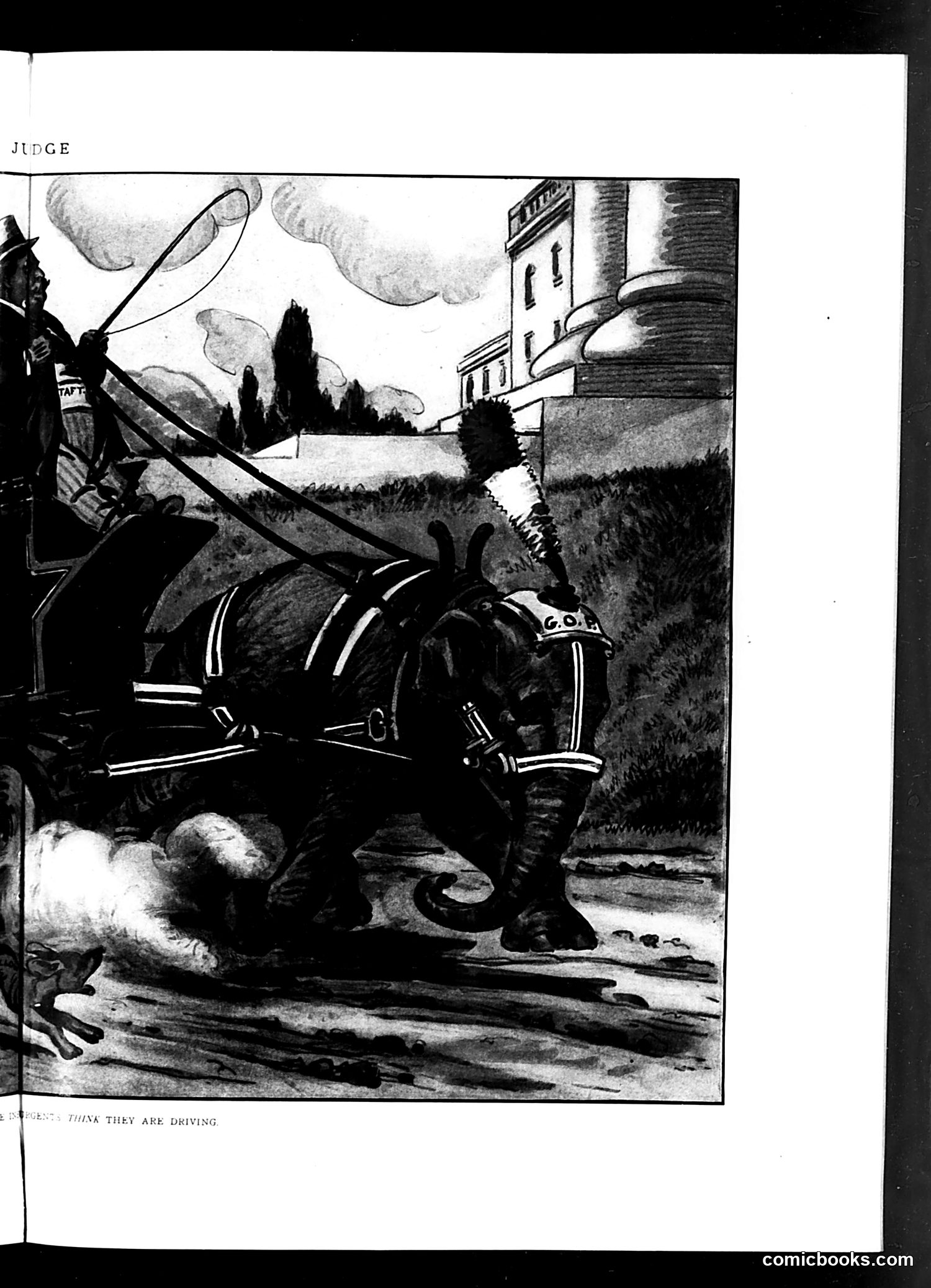
This page from **Judge** magazine shows a cartoon titled "Thus They Are Driving" depicting a figure in military or official dress controlling horses pulling a cart or carriage. The image appears to be political satire about control or management of some institution or group—the "driving" metaphor suggests manipulation or direction. Without the complete caption or surrounding context visible, the specific political target remains unclear. However, the imagery suggests commentary on someone wielding power over others (represented by the horses), likely criticizing how leadership was directing policy or people during this period. The architectural background suggests an official or governmental setting. The full satirical point requires more complete text context to determine accurately.
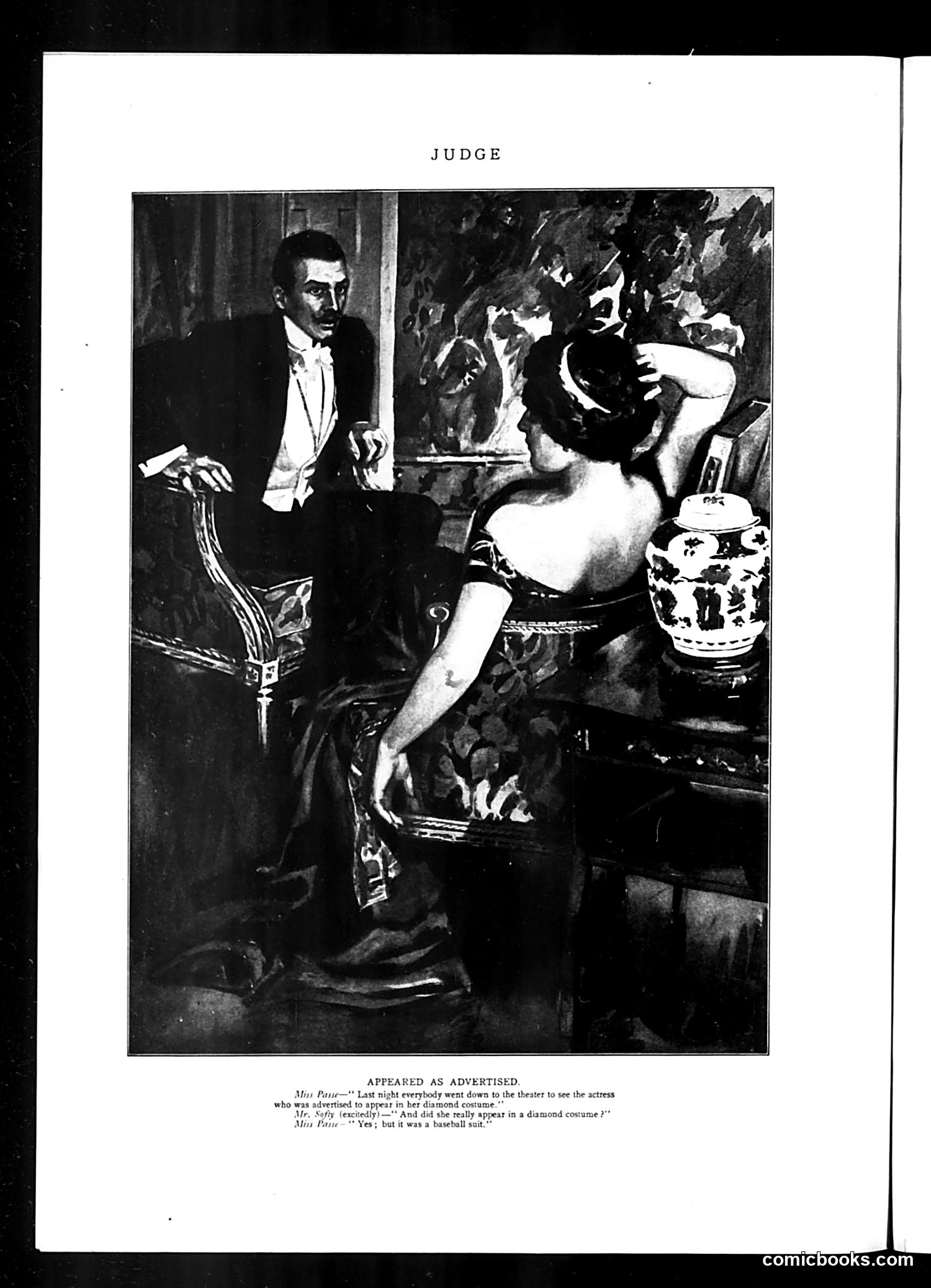
This page presents a satirical scene titled "JUDGE" depicting what appears to be a social commentary on theatrical advertising and public deception. The dialogue suggests a woman was advertised to appear in a "diamond costume" at a theater, drawing crowds of spectators. However, the punchline reveals the costume was actually a "baseball suit"—a deliberate misdirection or bait-and-switch by theater promoters. The cartoon satirizes both the gullibility of theatergoers who believe exaggerated advertisements and the dishonest marketing practices of theatrical producers who use sensational claims (diamonds, elaborate costumes) to attract audiences, only to deliver something mundane. This reflects broader Progressive-era critiques of advertising fraud and consumer deception in entertainment.
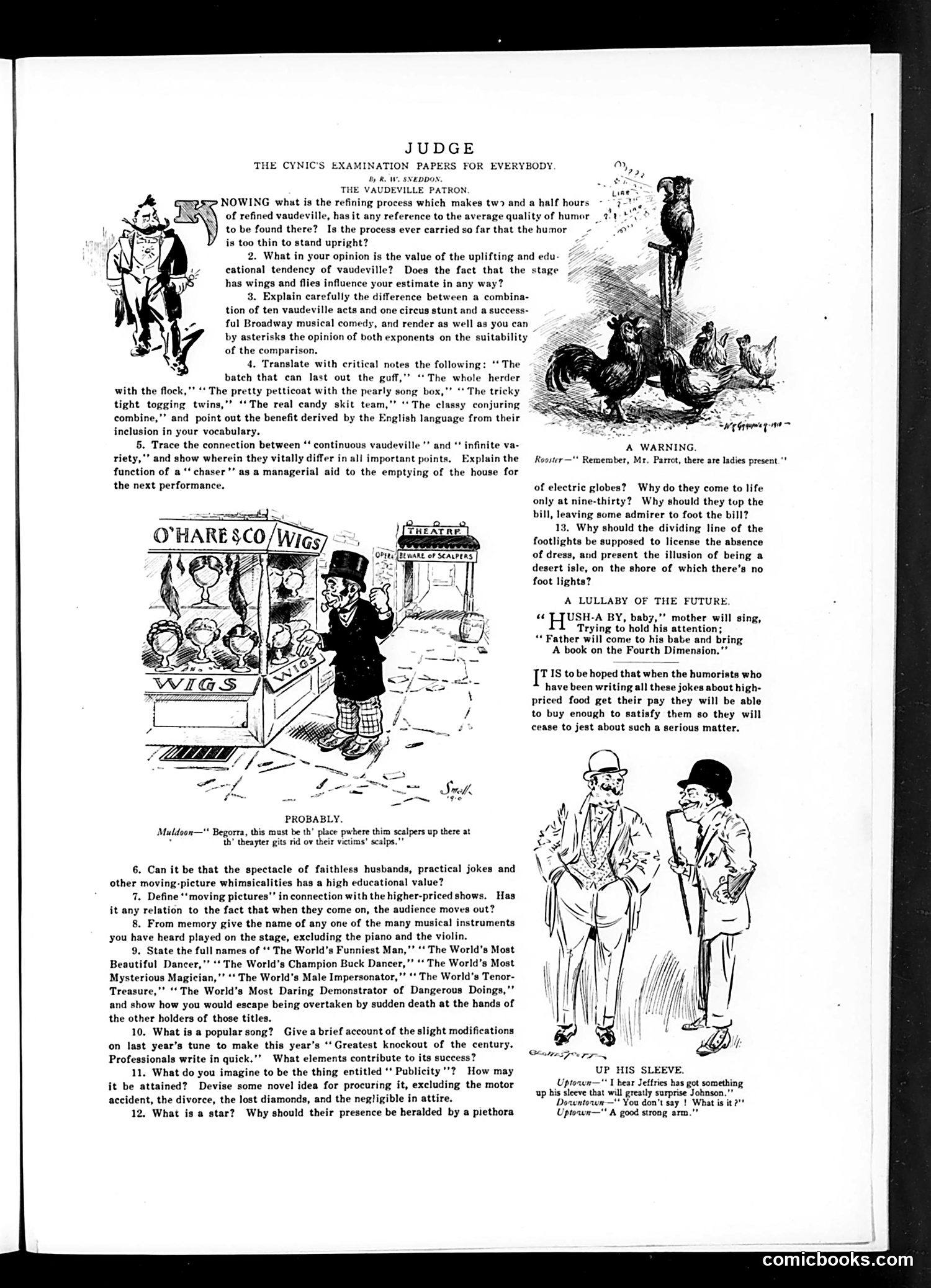
This page from *Judge* magazine contains satirical examination questions about vaudeville, a popular early-20th-century live entertainment format featuring diverse short acts. **The Main Satire:** R. W. Sneddon's "examination papers" mock vaudeville audiences and the industry itself. The questions ridicule: - **Vaudeville's thin humor** ("too thin to stand upright") - **Inflated star billing** — performers claiming absurd titles like "World's Funniest Man" and "World's Champion Buck Dancer" - **Audience behavior** — people leaving when serious acts end ("chaser" acts cleared houses) - **Low artistic standards** — recycled songs, moving pictures as filler, questionable "educational value" **The Cartoons:** Small illustrations show: a theater wig shop (mocking theatrical artifice), a "probably" joke about scalpers, and period-dressed men discussing propriety. **For Today:** This reflects pre-cinema entertainment's precarious status — already seen as lowbrow, disposable, and artistically suspect by educated satirists, even as it attracted mass audiences.
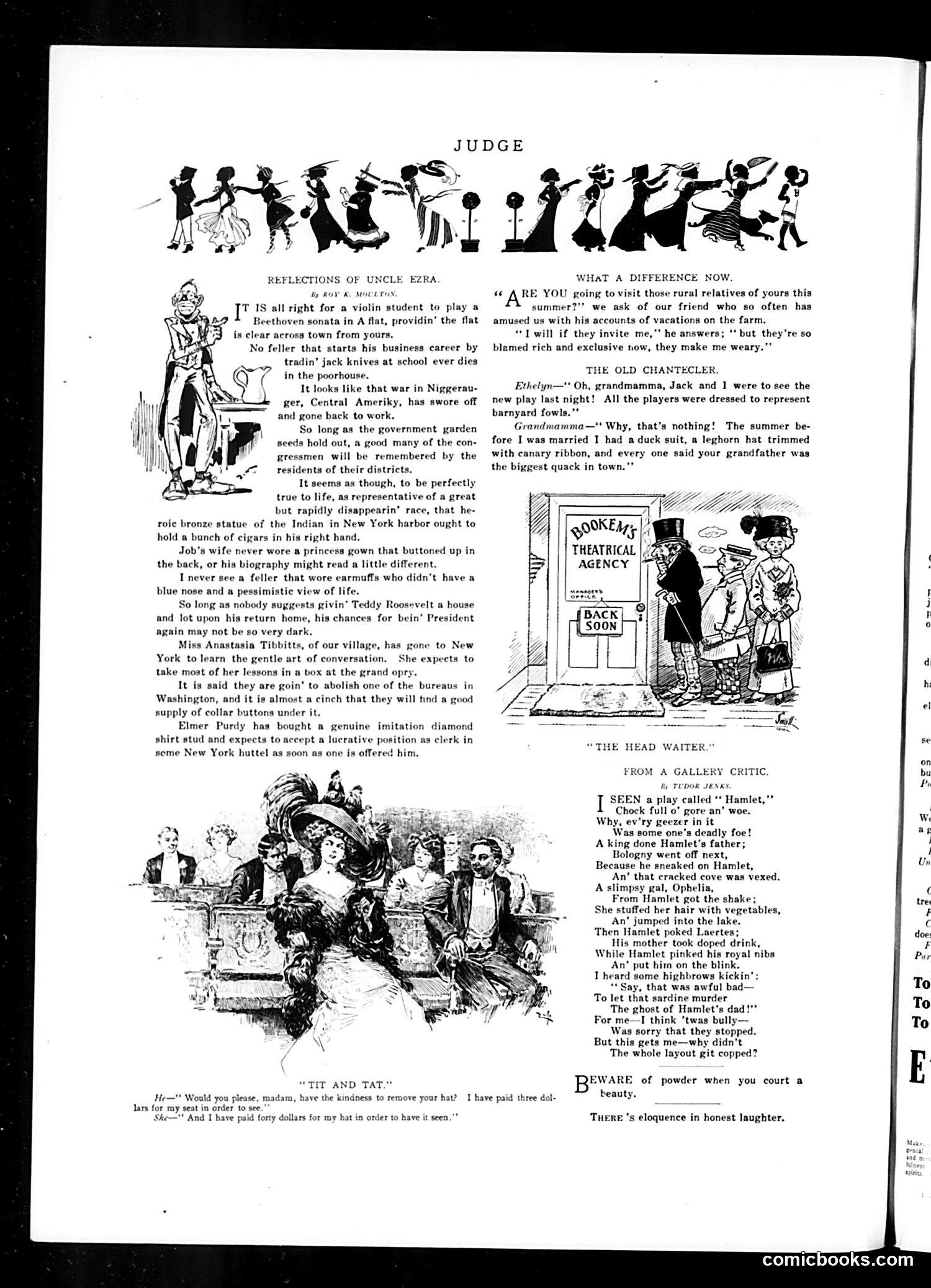
This page contains several satirical pieces typical of early 20th-century American humor: **"Reflections of Uncle Ezra"** presents folksy observations mocking social pretension—particularly rural relatives who've grown wealthy and now act superior, and commentary on a "war in Nicaragua" (appears to reference Central American conflicts). **"The Old Chantecler"** jokes about a theatrical production featuring actors dressed as barnyard fowls, with a grandmother's story of wearing a duck costume at her own wedding—dated humor about theatrical fashion. **"From a Gallery Critic"** crudely summarizes *Hamlet* in slang, mocking both the play's violence and audiences who overanalyze Shakespeare. **"Tit and Tat"** depicts a theater dispute: a man paid for his seat to see the stage; a woman paid for her elaborate hat to be *seen*—satire on vanity and theater etiquette conflicts. The **Brookeyn's Theatrical Agency** cartoon shows theatrical business dealings. Overall, these pieces satirize social climbing, theatrical pretension, and gender-based absurdities with period-specific references and dialect humor typical of Judge's editorial stance.
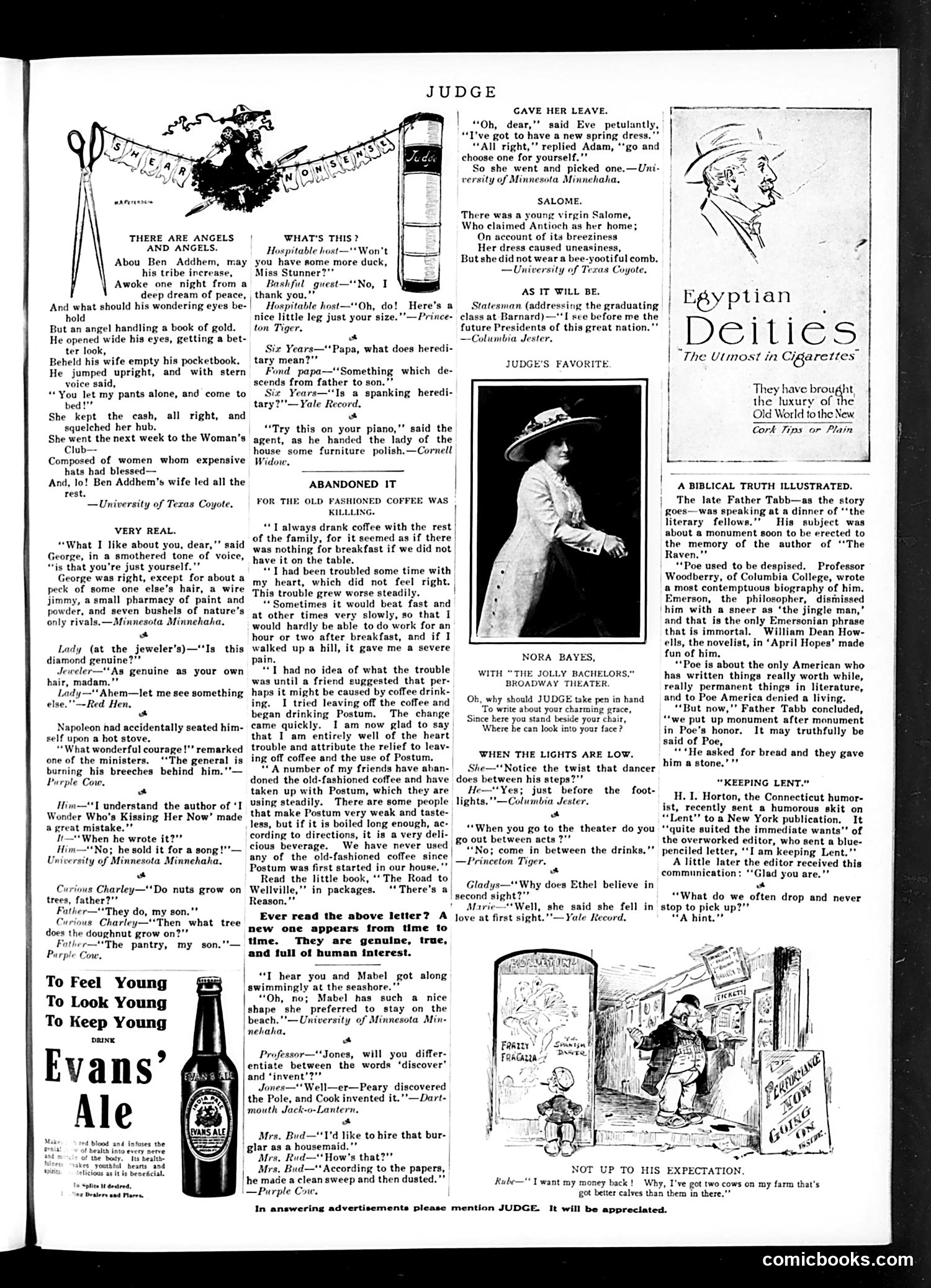
This page contains multiple brief satirical items typical of early 20th-century Judge magazine, along with advertisements. **Notable content:** The "There Are Angels and Angels" piece satirizes marital dynamics—a husband discovers his wife emptying his pocketbook and orders her to bed, but she instead joins an exclusive women's club where she becomes a leader. The satire targets both henpecked husbands and women's conspicuous consumption. "Very Real" mocks women's use of cosmetics and false hair, comparing a jeweler's claim that diamonds are "as genuine as your own hair" to suggest women's appearances are equally artificial. Other brief jokes target marriage, parenting, and social pretense typical of Judge's humor. **Advertisements dominate:** Evans' Ale promotes vitality; a Postum testimonial claims coffee caused heart problems that ceased upon switching to the caffeine-free substitute—a common health claim of the era. The page is primarily **advertising-driven satirical content** rather than focused political commentary.
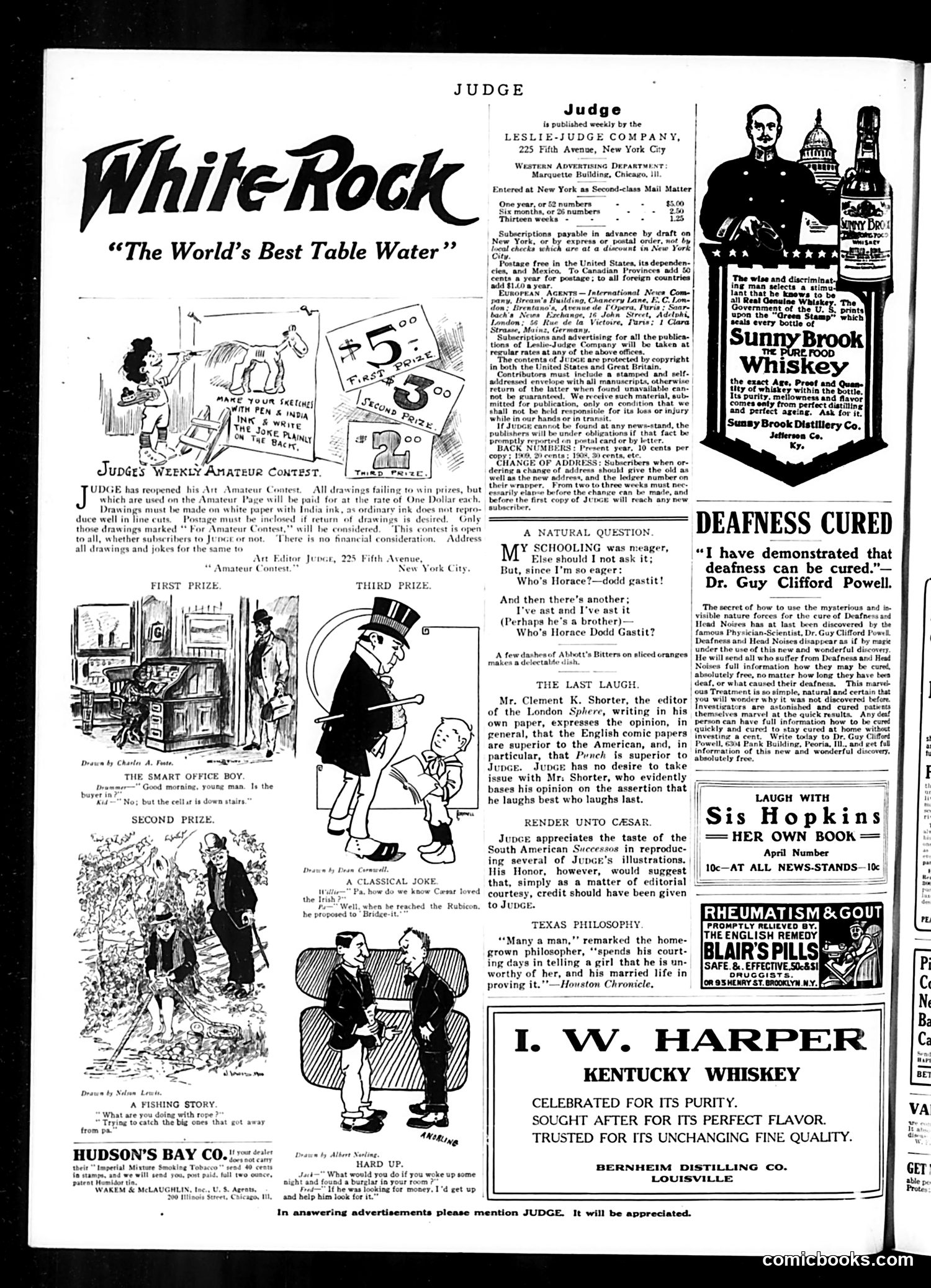
This page from Judge magazine is primarily a **showcase for reader-submitted cartoon contest entries** rather than editorial content. The main feature is an "Art Amateur Contest" soliciting drawings from readers, with examples of winning entries displayed. The cartoons shown are simple **domestic humor jokes** typical of early-20th-century periodicals: - "The Smart Office Boy" plays on naive child logic (a pun about Caesar crossing the Rubicon) - "Hard Up" depicts poverty-era humor (a poor man helping a burglar search for money) - "A Fishing Story" shows a child trying to catch fish with rope, literalizing the phrase "catch the big ones that got away" The page is **heavily weighted toward advertisements**—whiskey products (Sunny Brook, I.W. Harper), patent medicine (deafness cure, arthritis pills), and other goods typical of Judge's revenue model. The editorial content ("A Natural Question," "The Last Laugh," "Render Unto Caesar") appears to be filler material between advertisements and contest announcements. Overall, this represents Judge as primarily a **vehicle for reader participation and paid advertising** rather than original satirical commentary.
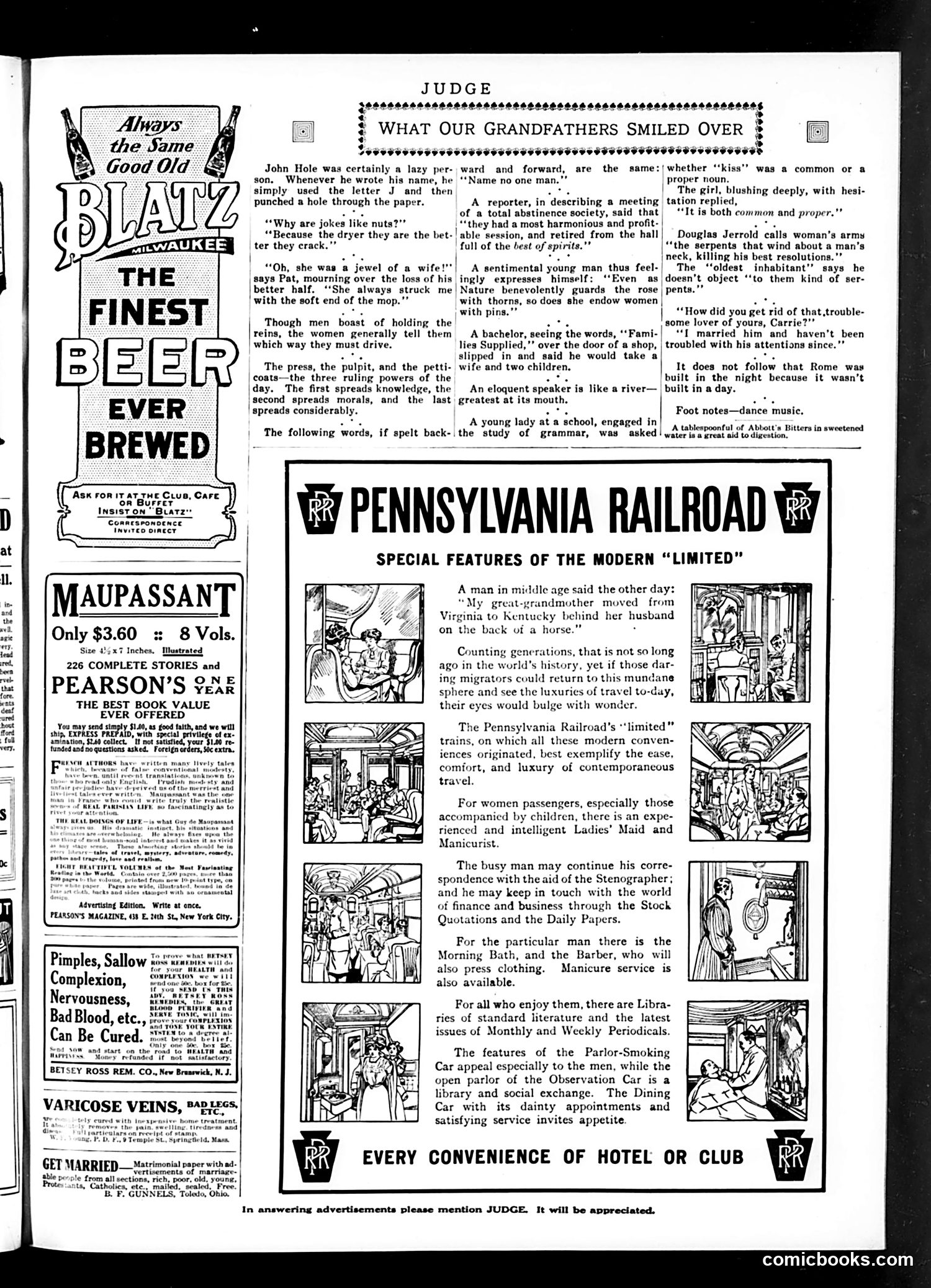
This is primarily an **advertising and humor miscellany page** from Judge magazine, not a political cartoon. The main content consists of brief jokes and witticisms reflecting turn-of-the-century American attitudes. **The humor revolves around:** - **Gender stereotypes**: Women depicted as gossips, nagging wives, and manipulators ("serpents that wind about a man's neck") - **Marriage complaints**: Wives striking husbands with mops, women controlling men despite pretensions otherwise - **Class observations**: Jokes about bachelors, speakers, and social pretense - **Popular culture references**: Douglas Jerrold (19th-century playwright), oblique allusions to absent context **The major ad:** A Pennsylvania Railroad "Limited" train advertisement highlighting luxuries—Ladies' Maid, Manicurist, Stenographer services, Barber—aimed at upper-class business travelers and women. The contrast between ancestors' horse travel and modern rail comfort is presented as progress. **For modern readers:** These jokes reflect deeply embedded sexism normalized in 1900s popular humor, alongside commercial appeals to emerging leisure travel culture and professional services.
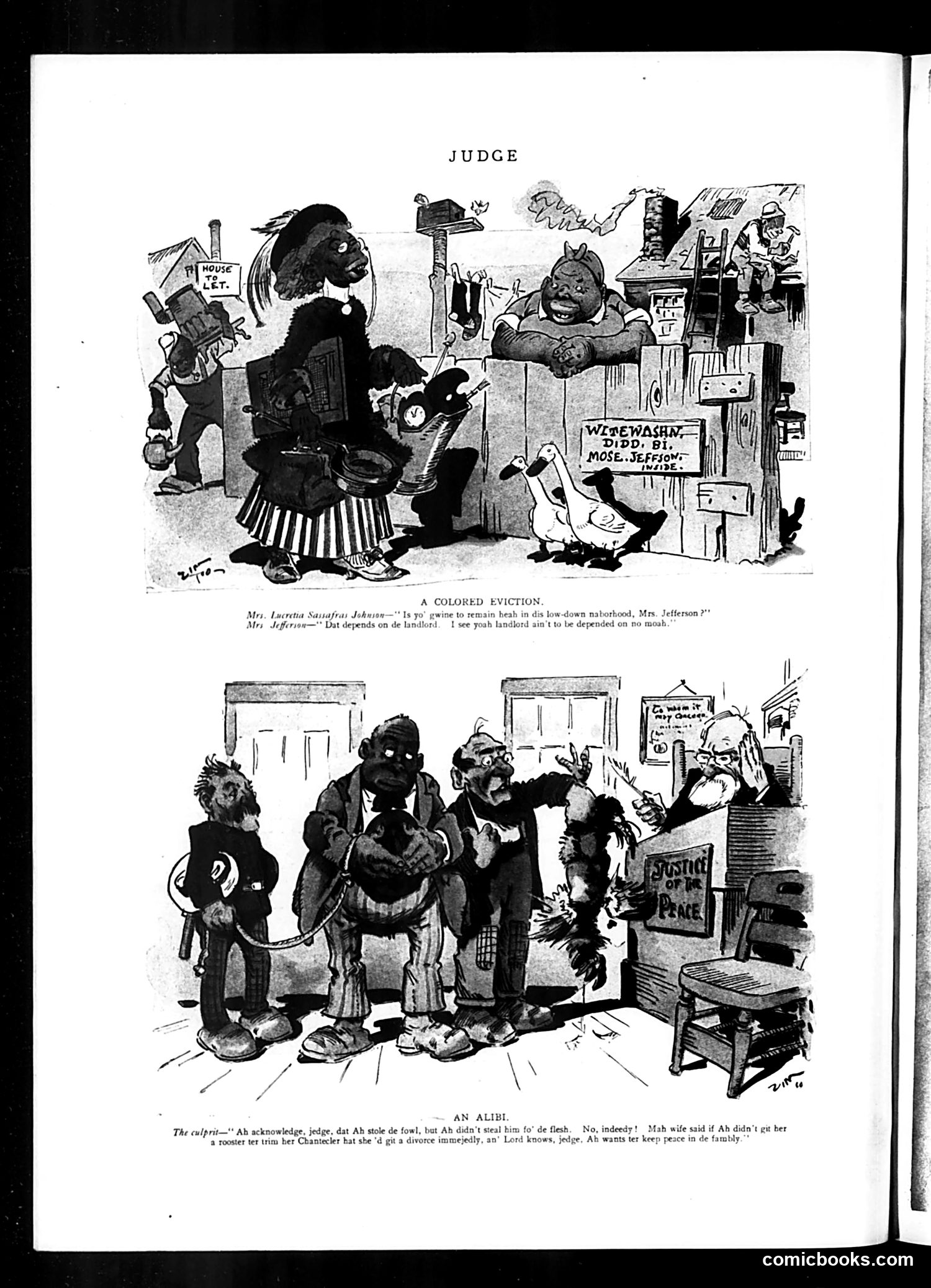
This page contains two cartoons using racist caricature and dialect to satirize African American defendants in legal proceedings. **Top cartoon ("A Colored Eviction"):** Depicts an eviction case where a Black woman ("Loretta Sawdust Johnson") pleads to remain in her home, invoking dependence on her landlord's charity. The satire mocks both the defendant's servility and suggests the absurdity of her plea to a judge. **Bottom cartoon ("An Alibi"):** Shows a Black man defending himself in court for stealing a rooster. His excuse—that his wife needed the bird to trim her hat for fashion—is presented as ridiculous. The satire targets both the defendant's implausible excuse and stereotypes about Black women's vanity. Both cartoons use exaggerated physical features, eye-dialect spelling, and the judicial system as a setup for humor at the expense of Black people. The satire reflects early-20th-century attitudes treating African Americans as subjects of mockery rather than equals before the law.