
Judge, 1910-04-16 · page 4 of 16
Judge — April 16, 1910 — page 4: what you’re looking at
What you’re looking at
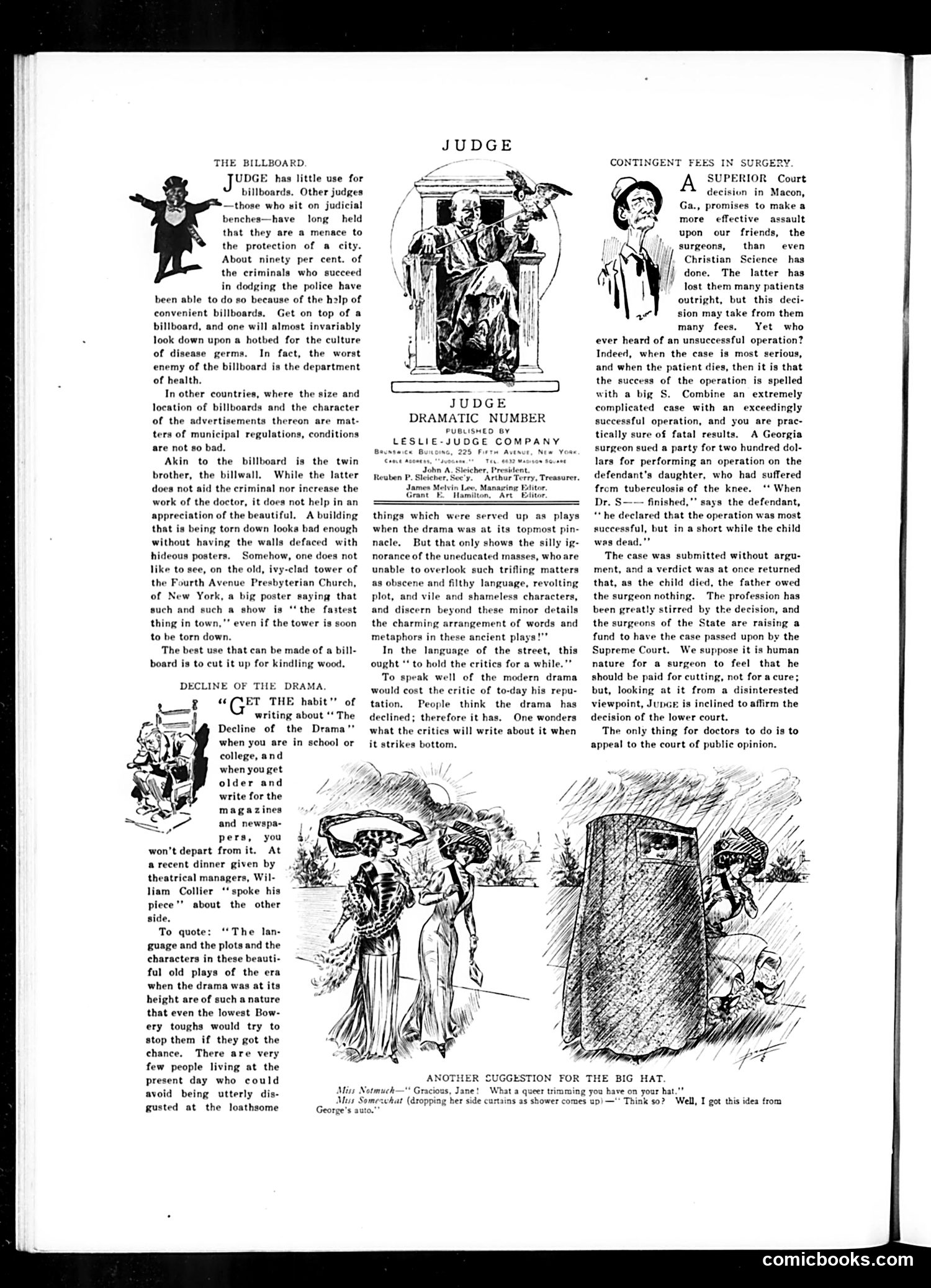
This page contains satirical commentary on two topics: **"The Judge" (left):** Critiques judges as largely useless to billionaires and judges who sit on judicial benches. The piece argues judges are obstacles to city protection and that billboard regulation represents one of their worst failures. **"Contingent Fees in Surgery" (right):** Mocks a Georgia Superior Court decision allowing surgeons to charge contingent fees (payment only if successful). The satire argues this creates perverse incentives—surgeons profit from successful operations regardless of patient outcome. The case described involves a tuberculosis patient who died post-surgery; the surgeon was paid in full despite the fatal result. Judge magazine suggests this ruling represents absurd legal reasoning that prioritizes surgeon profits over patient welfare. Both pieces critique institutional failures and misaligned incentives.
📄 Transcribed text from this page (OCR, searchable)
Machine-transcribed from the original scan — historical spelling and the odd misread are preserved.
THE BILLBOARD UDGE has little use for billboards, Other judges —those who sit on judicial long held are a menace to the protection of a city. About ninety per cent. of the criminals who succeed in dodging the police have been able to do so because of the holp of convenient billboards. Get on top of a billboard, and one will almost invariably look down upon a hotbed for the culture of disease germs. In fact, the worst enemy of the billboard is the department of health. In other countries, where the size and location of billboards and the character of the advertisements thereon are mat- ters of municipal regulations, conditions are not so bad. Akin to the billboard is the twin brother, the billwall. While the latter does not aid the criminal nor increase the work of the doctor, it does not help in an appreciation of the beautiful. A building that is being torn down looks bad enough without having the walls defaced with hideous posters. Somehow, one does not like to see, on the old, ivy-clad tower of the Fourth Avenue Presbyterian Church, of New York, a big poster saying that such and such a show is ‘‘the fastest thing in town,"’ even if the tower is soon to be torn down. The best use that can be made of a bill- board is to cut it up for kindling wood, DECLINE OF THE DRAM. «¢(QET THE habit" of writing about ‘‘ The Decline of the Drama’ when you are in school or college, and when you get older and write for the magazines and newspa- pers, you won't depart from it. At arecent dinner given by theatrical managers, Wil- liam Collier ‘spoke his piece’? about the other side. To quote: ‘The lan- guage and the plots and the characters in these beauti- ful old plays of the era when the drama was at its height are of such anature that even the lowest Bow- ery toughs would try to stop them if they got the chance. There are very few people living at the present day who could avoid being utterly dis- gusted at the loathsome Miss Notmuch Mus S George's auto.’ DRAMATIC NUMBER PUBLISHED BY LESLIE-JUDGE COMPANY ur Terry, Treasurer. Art. Bilitor things which were dup as plays when the drama was at its topmost pin- nacle. But that only shows the silly ig- norance of the uneducated masses, who are unable to overlook such trifling matters as obscene and filthy language, revolting plot, and vile and shameless character: and discern beyond these minor details the charming arrangement of words and metaphors in these ancient plays!’ In the language of the street, this ought *‘ to hold the critics for a while." To speak well of the modern drama would cost the critic of to-day his repu- tation. People think the drama has declined; therefore it has. One wonders what the critics will write about it when it strikes bottom. CONTINGENT FEES IN SURGERY. SUPERIOR Court decision in Macon, Ga., promises to make a more effective assault upon our friends, the surgeons, than even Christian Science has | done. The latter has lost them many patients outright, but this deci- sion may take from them many fee Yet who ever heard of an unsuccessful operation? Indeed, when the case is most serious, and when the patient dies, then it is that the success of the operation is spelled with a big S. Combine an extremely complicated case with an exceedingly successful operation, and you are prac- tically sure of fatal results. A Georgia surgeon sued a party for two hundred dol- lars for performing an operation on the defendant's daughter, who had suffered from tuberculosis of the knee. ‘* When Dr. S—— finished,"* says the defendant, “he declared that the operation was most successful, but in a short while the child was dead."’ The case was submitted without argu- nd a verdict was at once returned that, the child died, the father owed the surgeon nothing. The profession has been greatly stirred by tke decision, and the surgeons of the State are raising a fund to have the case passed upon by the Supreme Court. We suppose it is human nature for a surgeon to feel that he should be paid for cutting, not for a cure; but, looking at it from a disinterested viewpoint, Ju inclined to affirm the decision of the lower court. The only thing for doctors to do is to appeal to the court of public opinion. ment, ANOTHER SUGGESTION FOR THE BIG HAT. “ Gracious, Jane! mewhat (dropping her side cu: What a queer trimming you have on your hat." '$ a5 shower comes up) — Think so? Well, I got this idea from comicbooks.com