
A complete issue · 16 pages · 1910
Judge — April 2, 1910
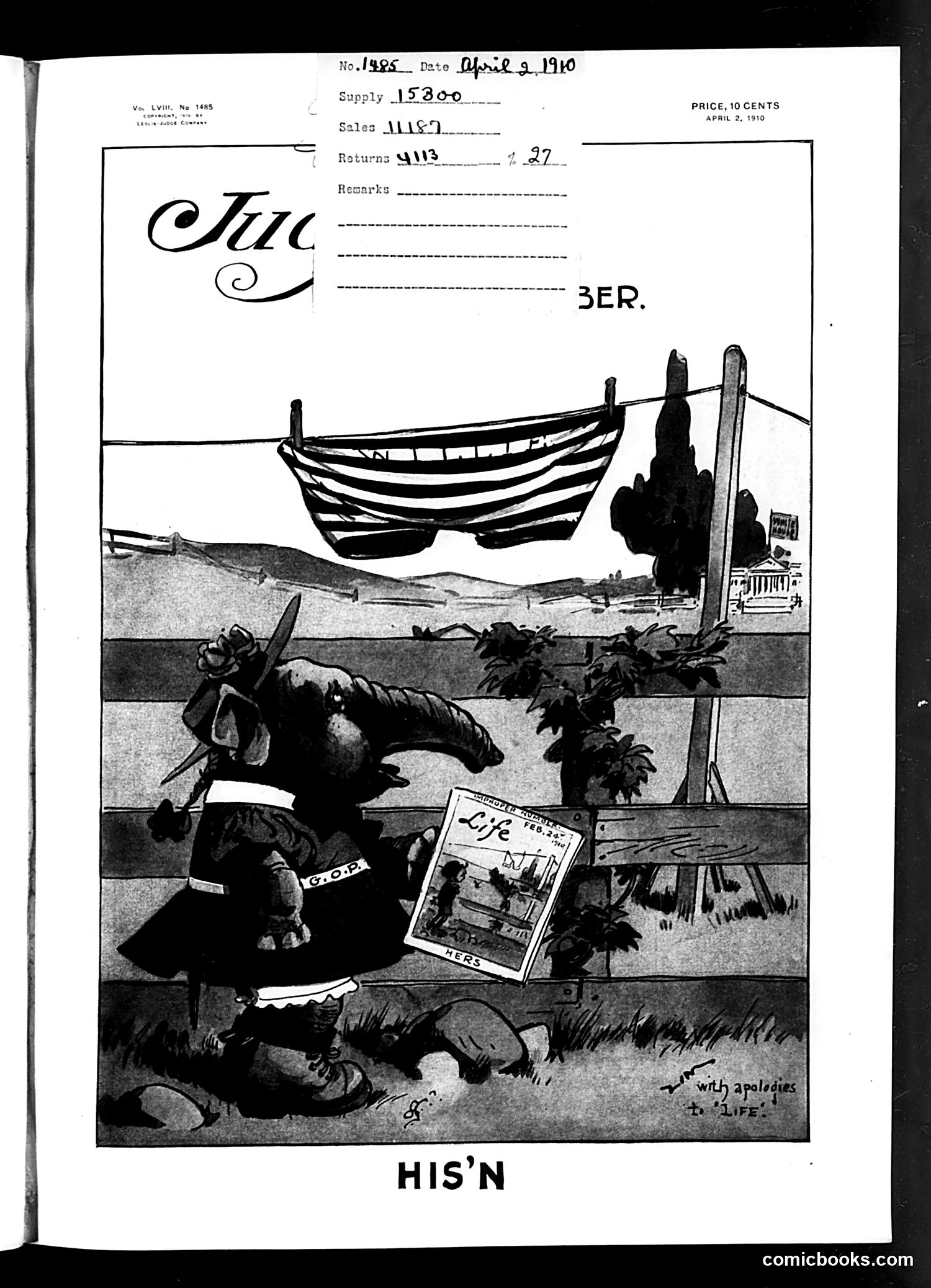
This appears to be a satirical illustration titled "HIS'N" featuring an anthropomorphized donkey or mule character reading what looks like a publication or magazine. The animal is dressed in clothing and positioned near a wooden fence, with a boat visible in the background and plants/vegetation around it. The donkey likely represents a political figure or faction of the era—possibly relating to Democratic Party symbolism, as the donkey was commonly used to represent Democrats in American political cartoons. The figure's rural setting and the object it's reading suggest commentary on political messaging or propaganda directed at rural American voters. The exact political reference is unclear without additional context, but the satire appears to mock how certain political content or candidates appealed to or were received by specific voter demographics in 1910.
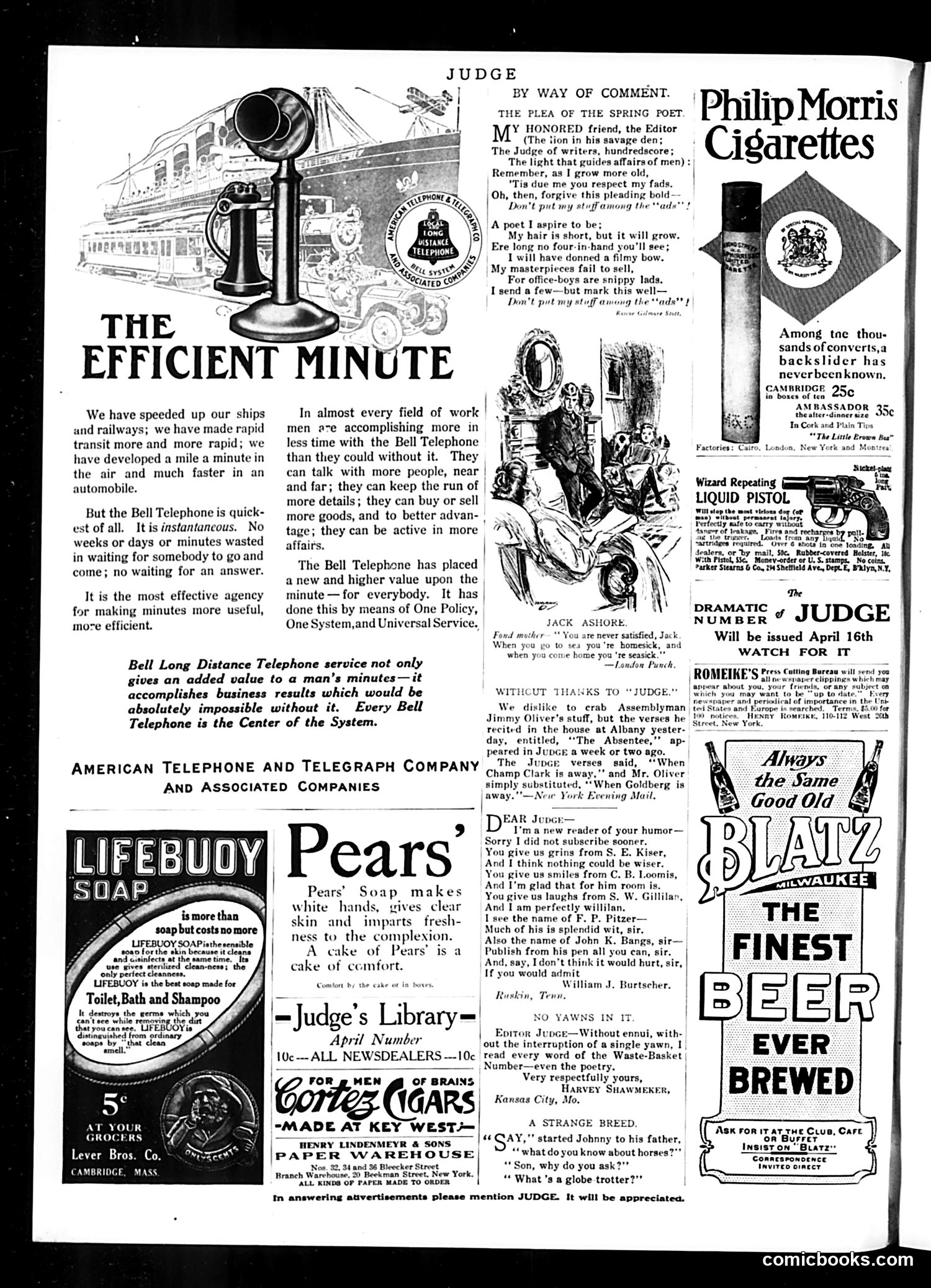
This page is primarily **advertising with minimal editorial content**. The main cartoon, "The Efficient Minute," features a telephone booth and celebrates Bell Telephone's utility for saving time in business. It's not political satire but rather corporate promotional material emphasizing how telephone service enables efficiency. The "Judge's Library" section contains brief humorous reader submissions about poetry and horses—lighthearted filler content typical of the era. The remaining space showcases period advertisements: Lifebuoy Soap, Pears' Soap, Philip Morris Cigarettes, Cortez Cigars, Blatz Beer, and a pistol. These ads reflect early 20th-century consumer culture with their health claims and lifestyle appeals. **Overall**: This is a commercial magazine issue focused on advertising revenue rather than political commentary or satirical cartooning.
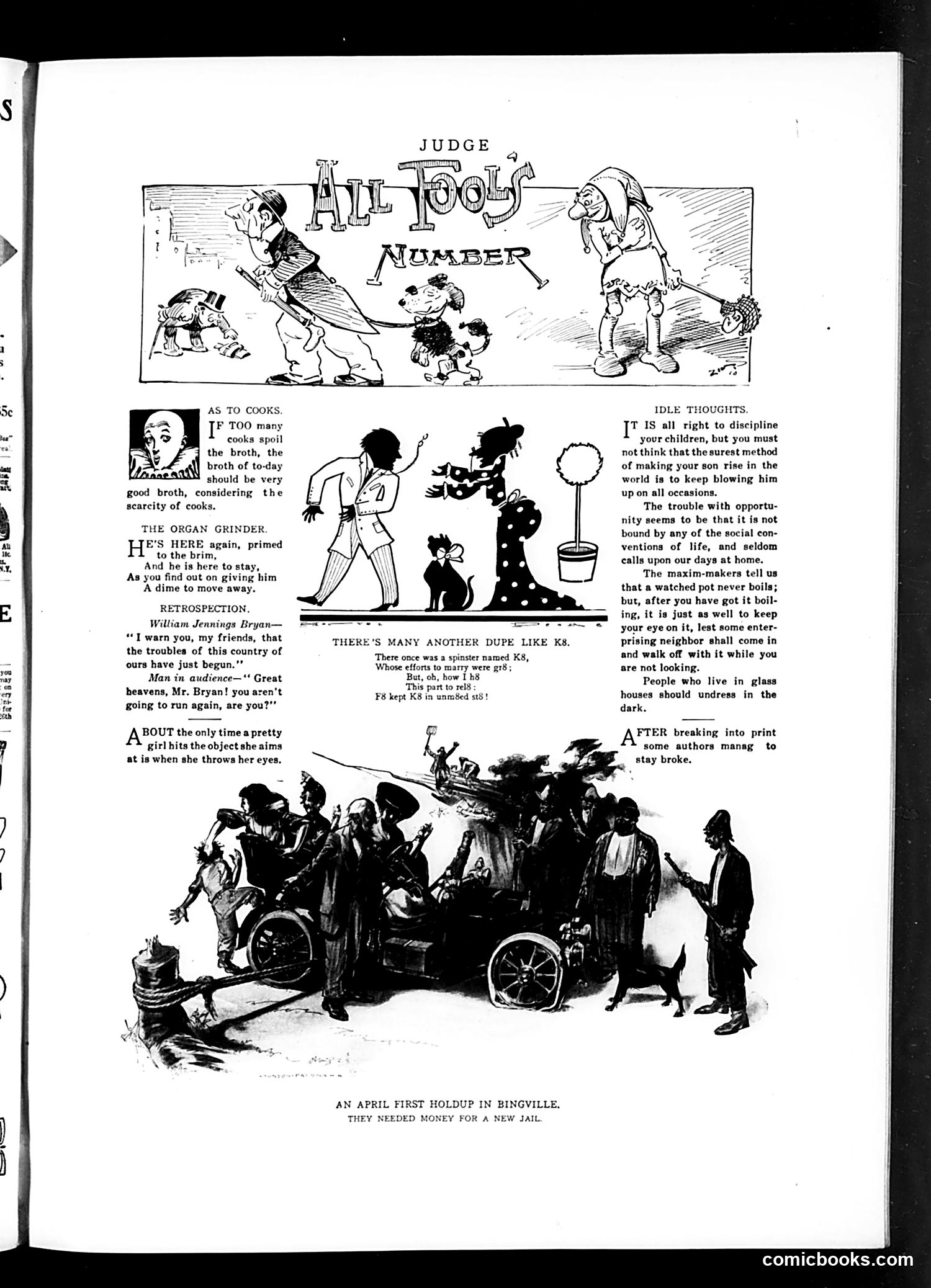
This appears to be an April Fools' issue of Judge magazine, featuring satirical commentary on contemporary life. The header shows whimsical characters engaged in foolish behavior. The content includes: - **"As to Cooks"**: Satirizes culinary incompetence and household management - **"The Opera Critic"**: Mocks pretentious opera criticism - **"Idle Thoughts"**: Social commentary on child-rearing and domestic life, suggesting overly strict discipline produces poor results - **"There's Many Another Dupe Like Ka"**: Appears to reference a specific social figure (name unclear from OCR) - **Bottom illustration**: Shows an "April First Holdup in Bingville" — a humorous robbery scene "needing money for a new jail" The satire targets domestic incompetence, pretentious culture, parenting methods, and small-town foolishness, typical of early 20th-century American humor magazines.
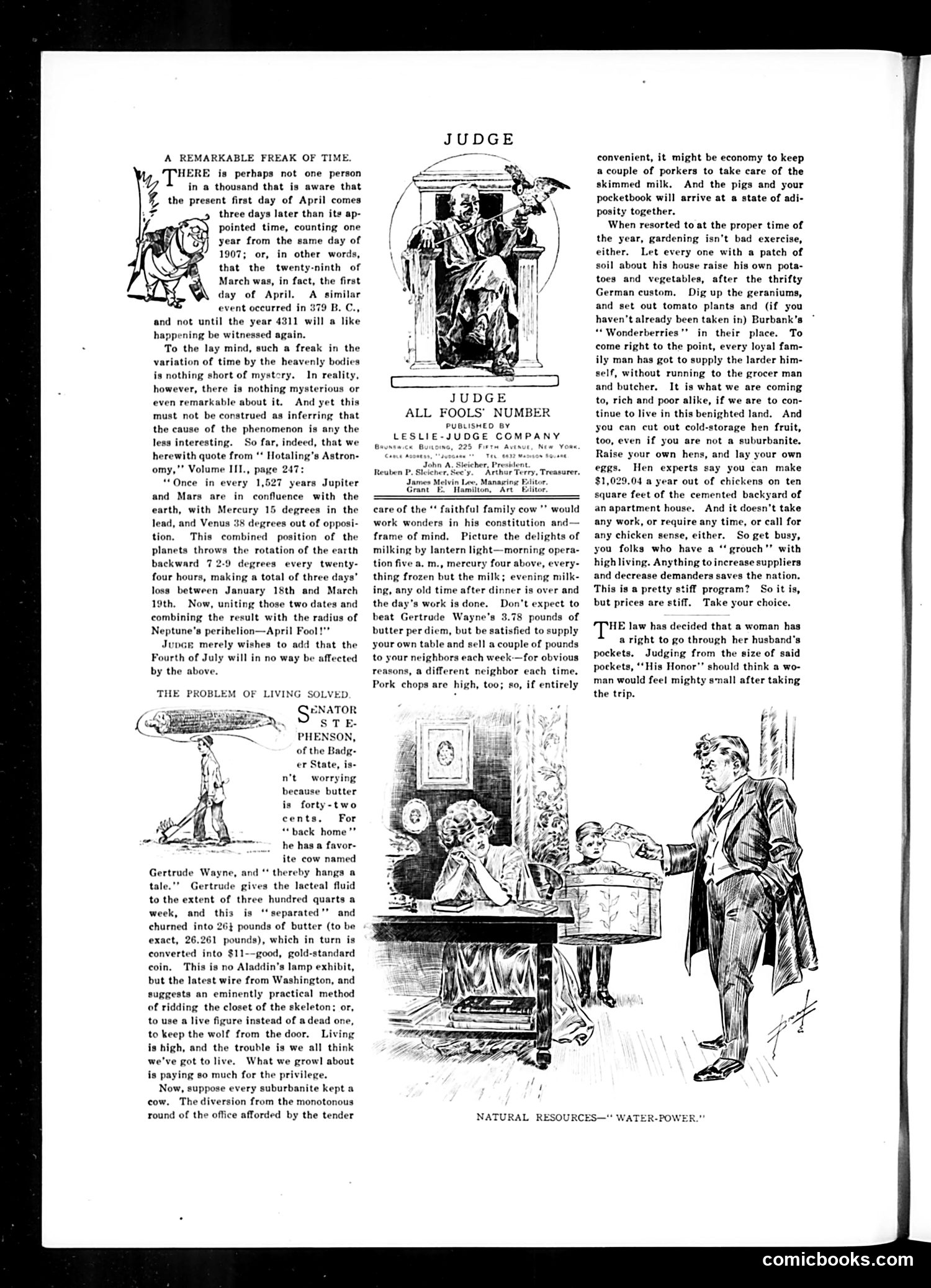
This page from Judge magazine (likely early 1900s based on styling) contains three distinct pieces: **"A Remarkable Freak of Time"** satirizes April Fools' Day, noting the phenomenon occurs yearly on April 1st—a curious historical quirk. **"Judge—All Fools' Number"** is the masthead for this issue, published by the Leslie-Judge Company. **"The Problem of Living Solved"** features Senator S.F. Phenson discussing butter prices (ten cents versus two cents). The cartoon shows him as a self-satisfied politician promoting dairy farming as economic salvation for working people—satire of politicians offering simplistic solutions to poverty and inflation. **"Natural Resources—'Water-Power'"** depicts a water-powered mill scene, likely commentary on industrial labor or natural resource exploitation. The overall theme appears to mock political and economic proposals of the era through humor and caricature.
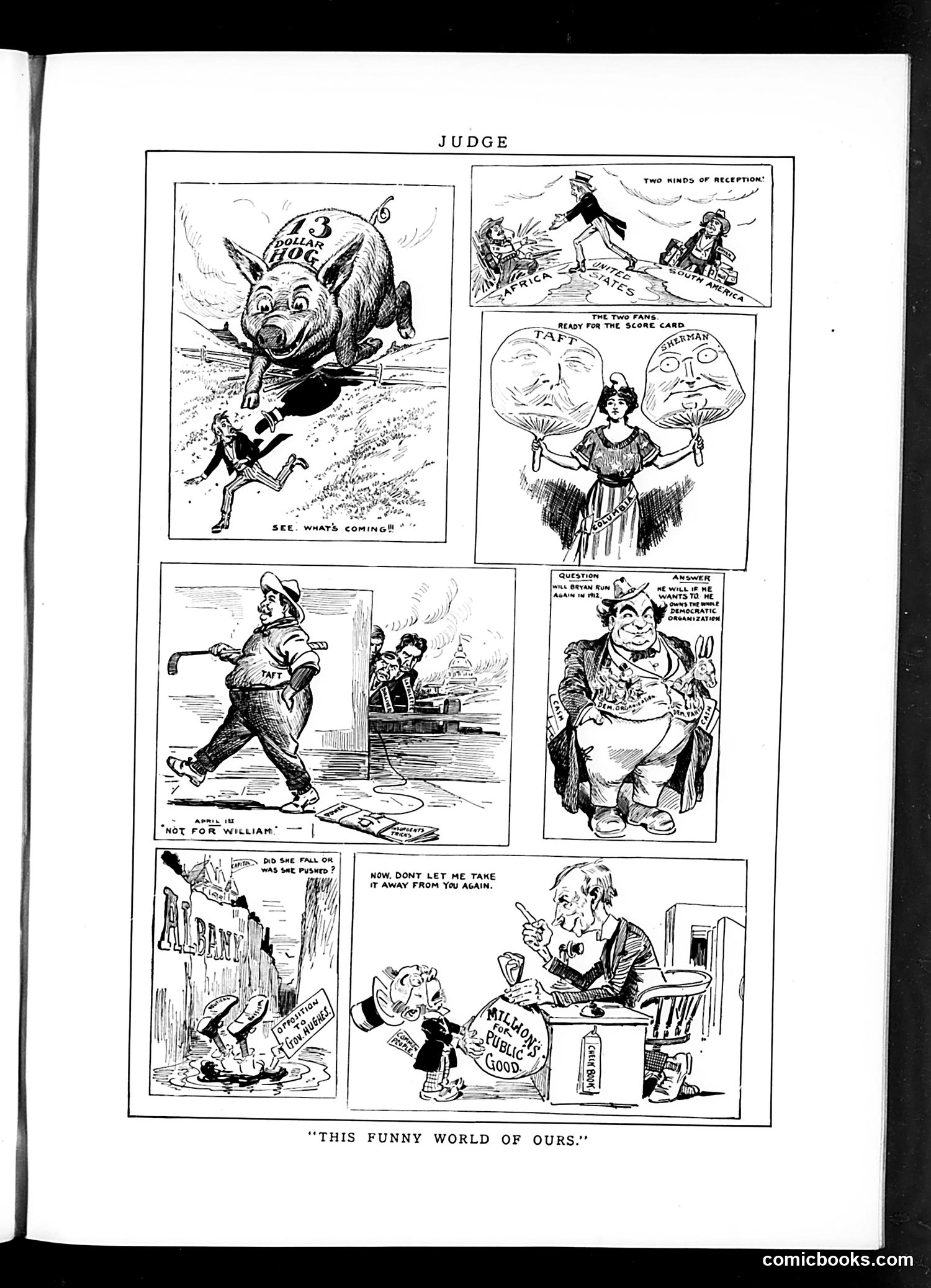
This page from Judge magazine satirizes early 20th-century American politics and governance. The top cartoon "See What's Coming?" depicts a large hog labeled "the Hog" approaching a fleeing figure, likely critiquing corporate monopolies or corrupt business practices threatening the public. "Two Kinds of Reception" shows contrasting welcomes for America, while "The Two Faces Ready for the Score Card" features a woman holding masks labeled "Taft" and "Sherman," suggesting political duplicity or inconsistency. The remaining cartoons address political corruption, with one showing someone attempting to escape, and another titled "Not for William" depicting political maneuvering. The final panel shows an older figure refusing to relinquish "Milk for the Public Good," satirizing resistance to reform or public welfare initiatives. The overall theme critiques political corruption and business malfeasance.
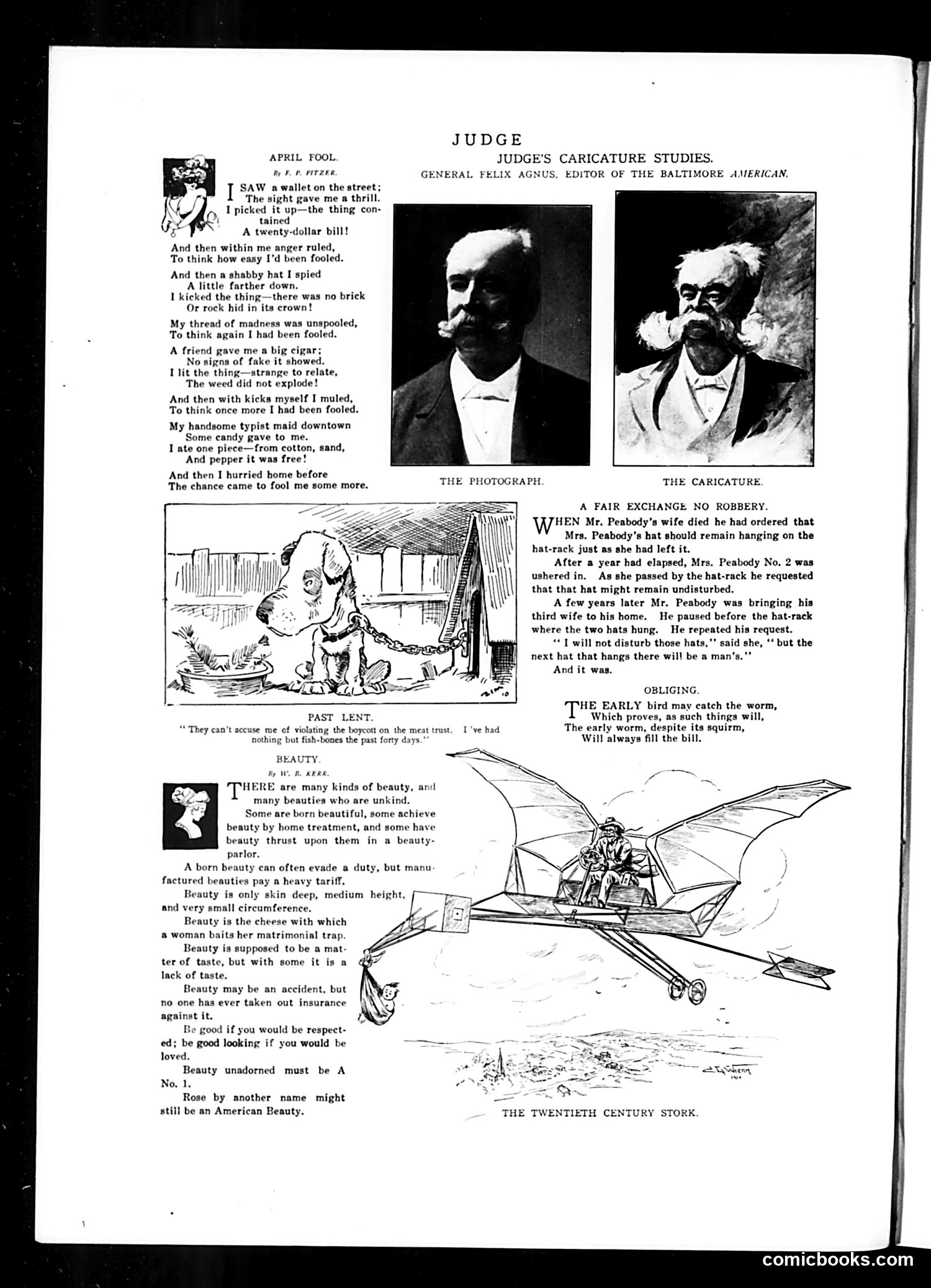
This page contains several satirical pieces typical of early 20th-century American humor: **"April Fool"** (top): A poem about repeated practical jokes—finding a real wallet, a real hat, an unexploded cigar, and real candy—that frustrate the narrator who expected tricks. The joke is the ironic reversal: on April Fool's Day, genuine items disappoint because he anticipates deception. **"Judge's Caricature Studies"**: Features General Felix Agnus, editor of the Baltimore *American*, shown in a photograph and exaggerated caricature. Without additional context, the satire's specific target is unclear. **"A Fair Exchange No Robbery"**: Humorous domestic tale about Mr. Peabody's successive wives and his preserved hat-rack. The punchline: his third wife threatens to hang her *own* hat there (implying infidelity or his demise), inverting his memorial sentimentality. **"Beauty"** and **"The Twentieth Century Stork"**: An essay mocking beauty standards, with an illustration of an airplane delivering a baby—satirizing modern technology replacing traditional imagery. The page is primarily entertainment-focused rather than strictly political.
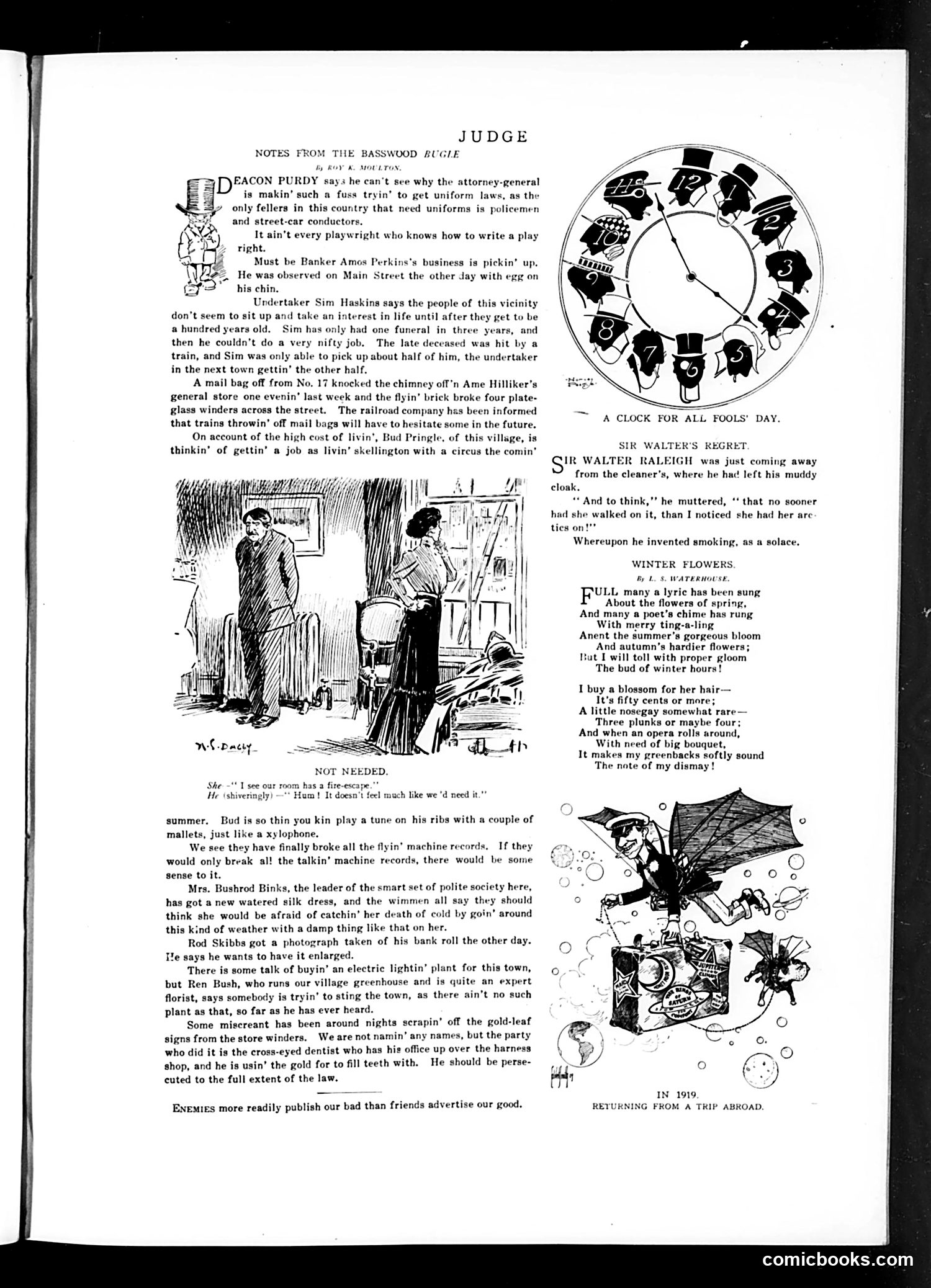
This page from Judge magazine contains small-town humor and social satire typical of early 20th-century American magazines. **Main Content:** The "Notes from the Basswood Bugle" section offers folksy small-town gossip—anecdotes about local characters like Deacon Purdy (critiquing the attorney general's uniform initiatives), Banker Amos Perkins, and Undertaker Sim Haskins. The humor relies on rural stereotypes and local color: complaints about high living costs, a mail bag damaging a store, and pranks by "the cross-eyed dentist." **Cartoons:** - "Not Needed" depicts a couple in a cold room with a fire escape—the joke being the fire escape won't help with freezing temperatures. - A Sir Walter Raleigh anecdote jokes about him inventing smoking after his girlfriend walked on his cloak. - "A Clock for All Fools' Day" shows a circular clock face. - "Winter Flowers" is a poem lamenting expensive bouquets for opera season. The satire targets petty small-town life, vanity, and consumer expenses—typical Judge fare offering middle-class readers gentle mockery of rural and urban foibles.
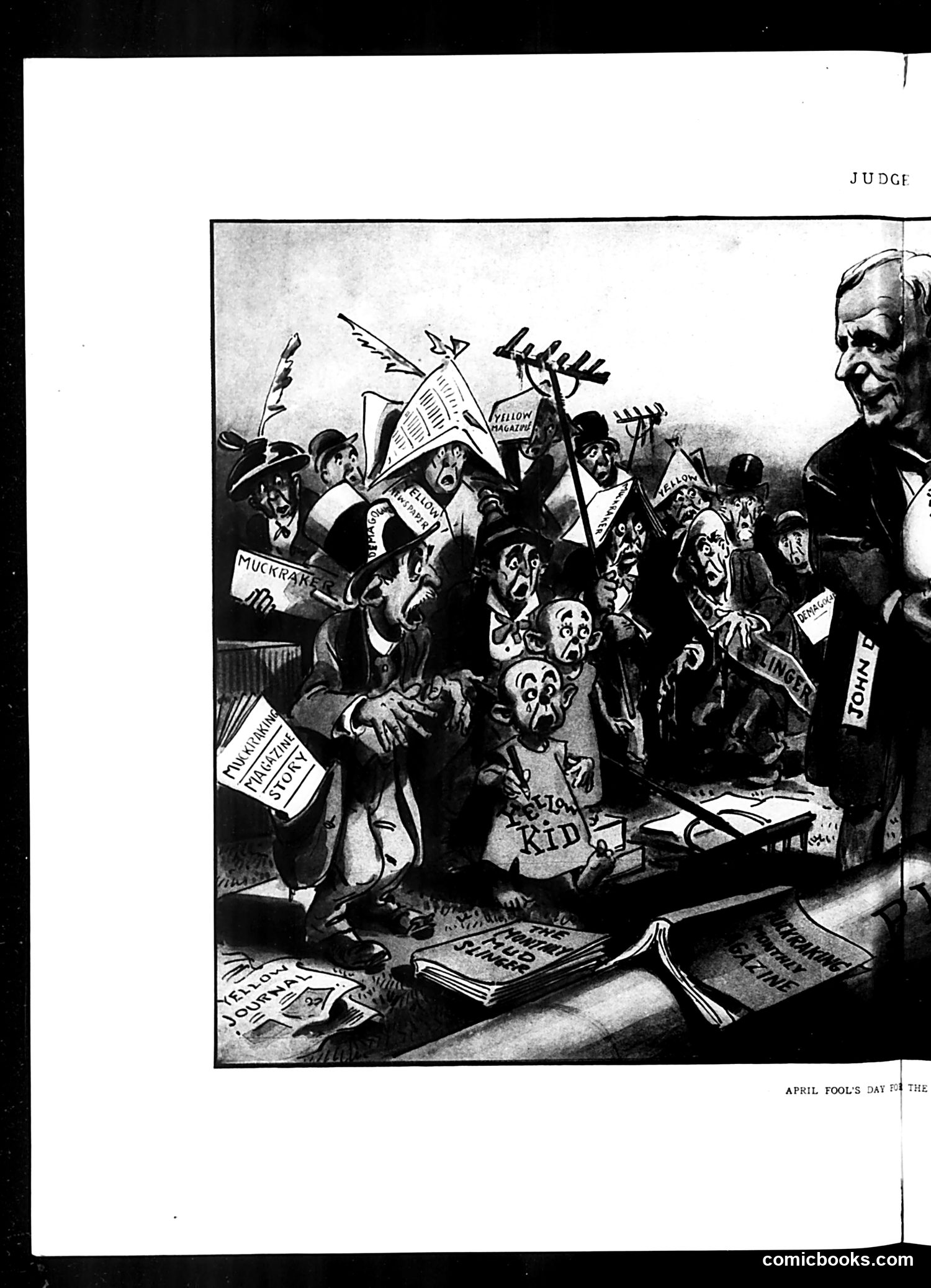
This Judge magazine cartoon satirizes political corruption and muckraking journalism. A stern, authoritative figure (likely a judge or authority) presides over a chaotic crowd of caricatured figures holding newspapers and signs labeled "MUCKRAKE," "MAGAZINE," and other publications. The crowd appears agitated and foolish, with exaggerated facial features suggesting they're being duped or led astray. The satire appears to mock sensationalist journalism and its gullible readers during the Progressive Era's "muckraking" movement, when exposé journalism targeted corporate and political corruption. By titling it "April Fool's Day," the cartoonist suggests the public and press are fools for believing or spreading these stories—or conversely, that such journalistic exposés are themselves tricks. The composition implies criticism of either the journalists or their audiences, though the exact target remains somewhat ambiguous without additional context.
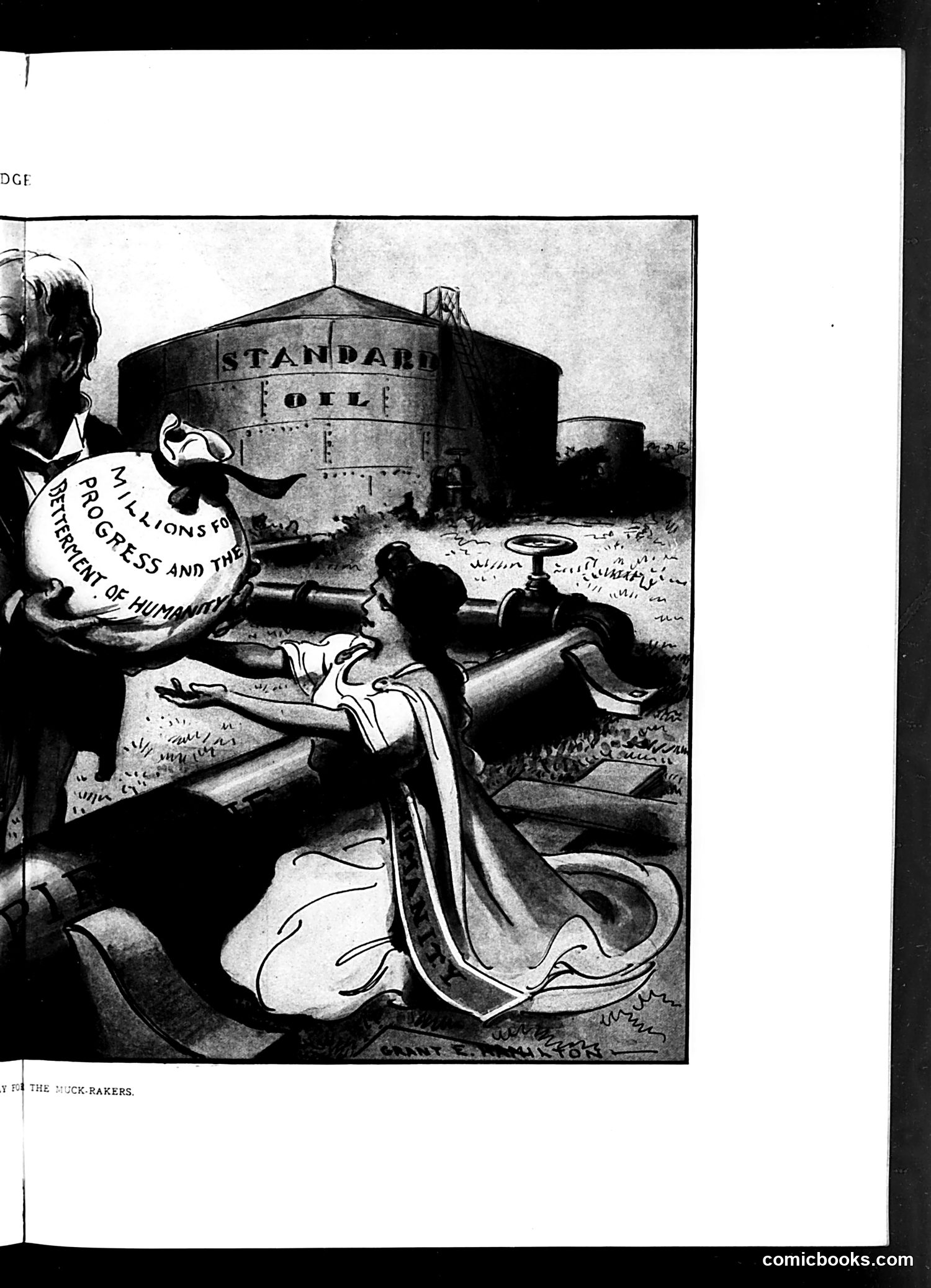
This political cartoon satirizes the **muckraking journalists** of the Progressive Era (early 1900s) — investigative reporters who exposed corporate and political corruption. The image shows a figure wielding large pipes/tools, attacking or "raking" at a **Standard Oil storage tank**, the most prominent target of muckraking exposés. The globe held aloft reads "MILLIONS FOR PROGRESS AND THE BETTERMENT OF HUMANITY," sarcastically suggesting the muckrakers claim noble motives. The satire implies muckrakers were destructive, reckless agitators who — despite their rhetoric about public welfare — were essentially attacking major American industries and institutions. Judge magazine, a conservative publication, appears skeptical of these reformers' actual impact and methods.
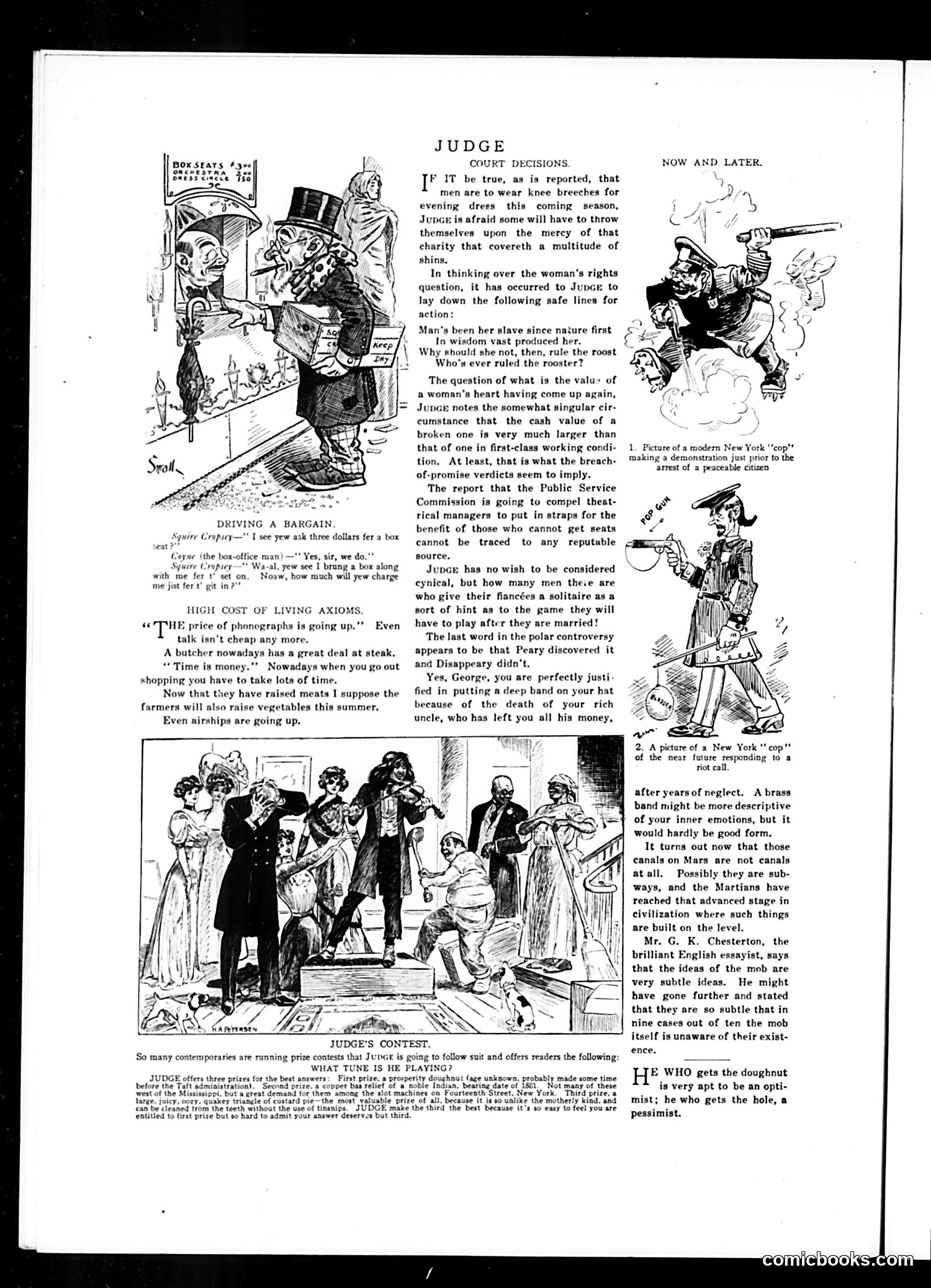
This page contains several political and social commentary pieces typical of early 20th-century American humor: **"Driving a Bargain"**: A rural character (Squire Cropley) attempts to negotiate theater admission by bringing his own box seat, satirizing penny-pinching and the absurdity of cost-cutting logic. **"Court Decisions"**: Judge offers humorous legal commentary on contemporary issues: men wearing knee breeches (fashion criticism), women's rights (presenting traditional gender hierarchy as natural law), and breach-of-promise lawsuits (mocking the high financial settlements awarded to women in such cases). **"High Cost of Living Axioms"**: Satirizes inflation and economic absurdities of the era—rising prices for meat, phonographs, and theater tickets. The cartoons mock both fashionable society and working-class penny-pinchers, while the legal commentary reveals period attitudes toward gender relations and marriage contracts—presenting them with ironic humor that modern readers would recognize as deeply sexist.
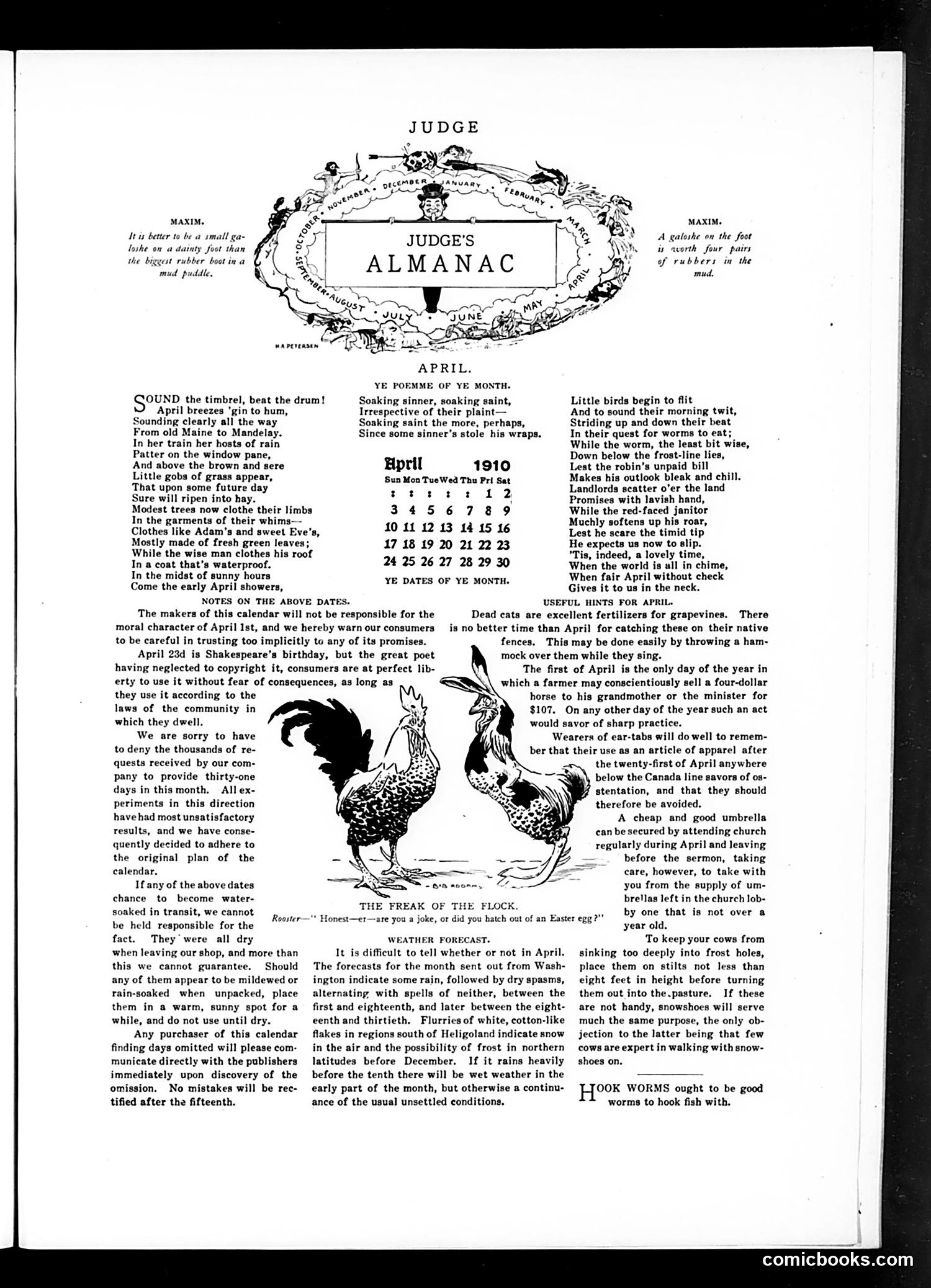
This is the April page from Judge magazine's 1910 almanac—a humorous calendar mixing practical farming advice with satirical commentary. **The main cartoon** ("The Freak of the Flock") depicts two roosters, one appearing oddly different, with the caption joking whether one is "a joke, or did you hatch out of an Easter egg?" This is gentle farmyard humor about odd-looking birds. **The satirical content** targets April Fool's Day traditions and rural life. The "Useful Hints" section mockingly suggests dead cats as fertilizers and claims April 1st is the only day a farmer can legally swindle his grandmother by selling a worthless horse. The advice about ear-tabs (probably wool winter ear coverings) and church umbrellas pokes fun at provincial vanity and petty theft disguised as piety. **The tone** throughout is gently cynical about rural America—poking fun at farmers' scheming, janitors expecting tips, and the absurdity of April weather and customs. The maxims about galoshes reinforce this practical, humorous rural perspective.
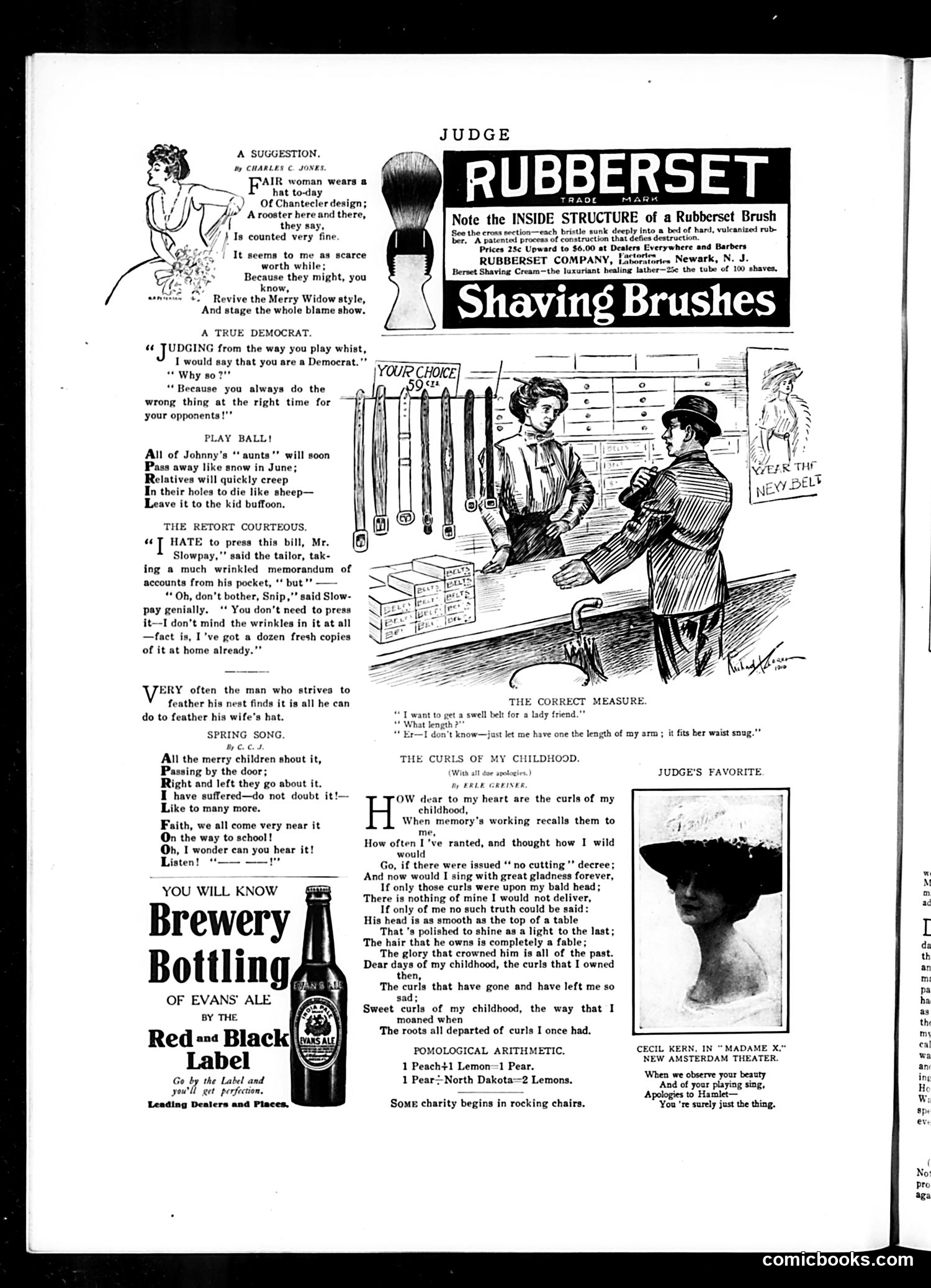
This page from *Judge* magazine comprises mostly **advertisements and light humor pieces** rather than political satire. The main content includes: **Cartoons/Jokes:** - A quip about women's fashionable "Chantecler" hats (featuring rooster designs) potentially reviving the "Merry Widow" style - A "True Democrat" joke playing on Democratic Party stereotypes about poor timing - A piece about a tailor pressing a debtor for payment, where the debtor claims he already has many copies of the bill at home (implying chronic non-payment) - A poem lamenting lost childhood curls, apparently a nostalgic piece **Advertisements:** The page is dominated by ads for **Rubberset Shaving Brushes**, **Evans Ale** (with Red and Black Label), and various other products—typical of early 20th-century magazine monetization. The humor is largely **generic and topical** rather than specifically political—playing on universal themes like creditor disputes, fashion trends, and aging. Without a visible date, the precise historical context remains unclear.
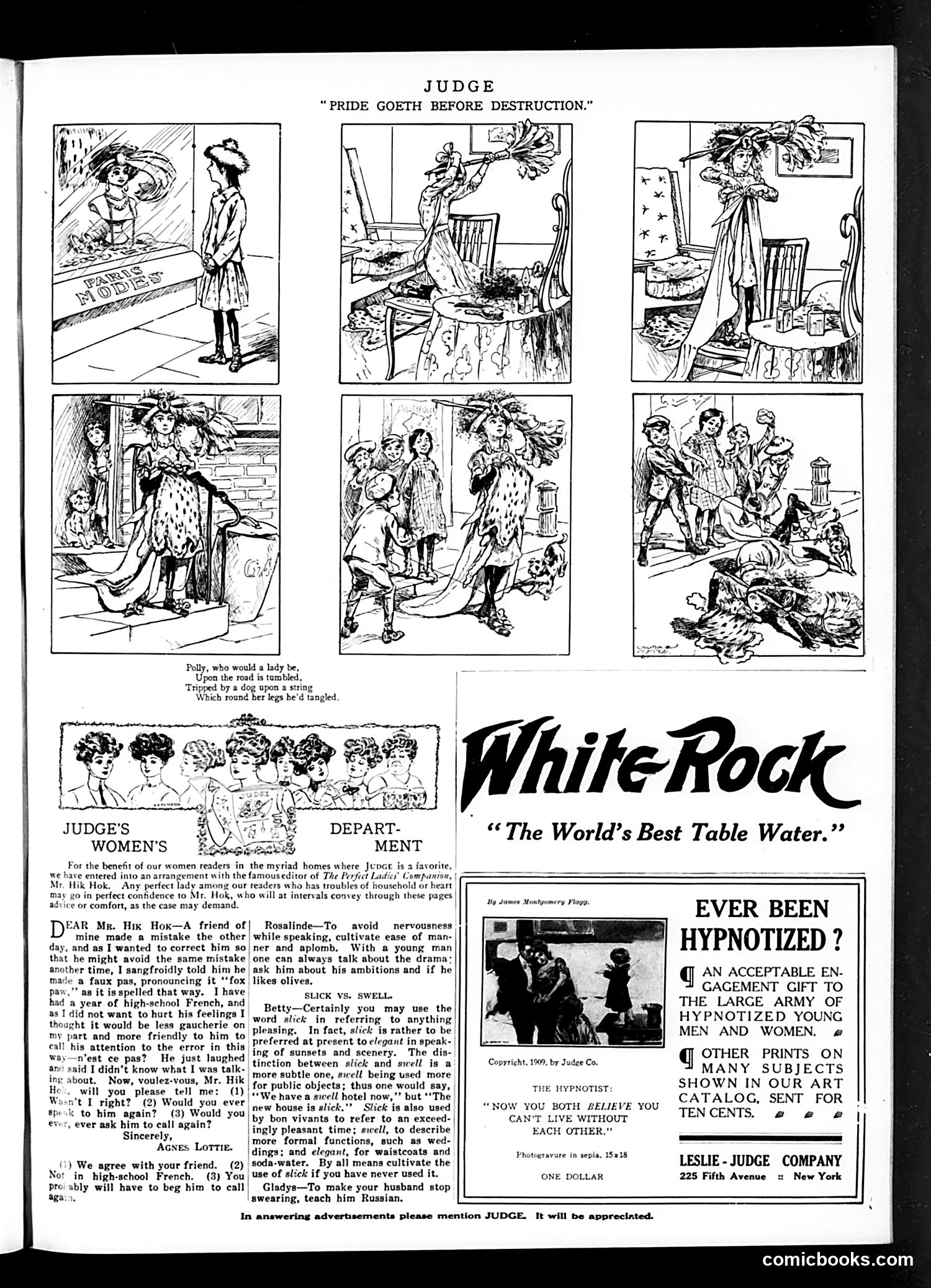
This page contains a six-panel comic strip titled "Pride Goeth Before Destruction" depicting a woman named Polly who attempts to present herself as a refined lady but is humiliated when she trips over a dog's leash on the street. The satire targets pretentious social climbing—her elaborate hat and formal bearing offer no protection against public embarrassment. The page also features "Judge's Women's Department," a satirical advice column where editor "Mr. Hik Hok" offers guidance on etiquette. The humor lies in dispensing contradictory advice about pronunciation (correcting "faux pas") and distinguishing between similar slang terms ("slick" vs. "swell"), mocking both the anxious questioners and the superficial nature of social correctness obsession. The remaining content is advertising, including a White Rock water advertisement and a hypnotism-themed print promotion—typical period commercial matter.
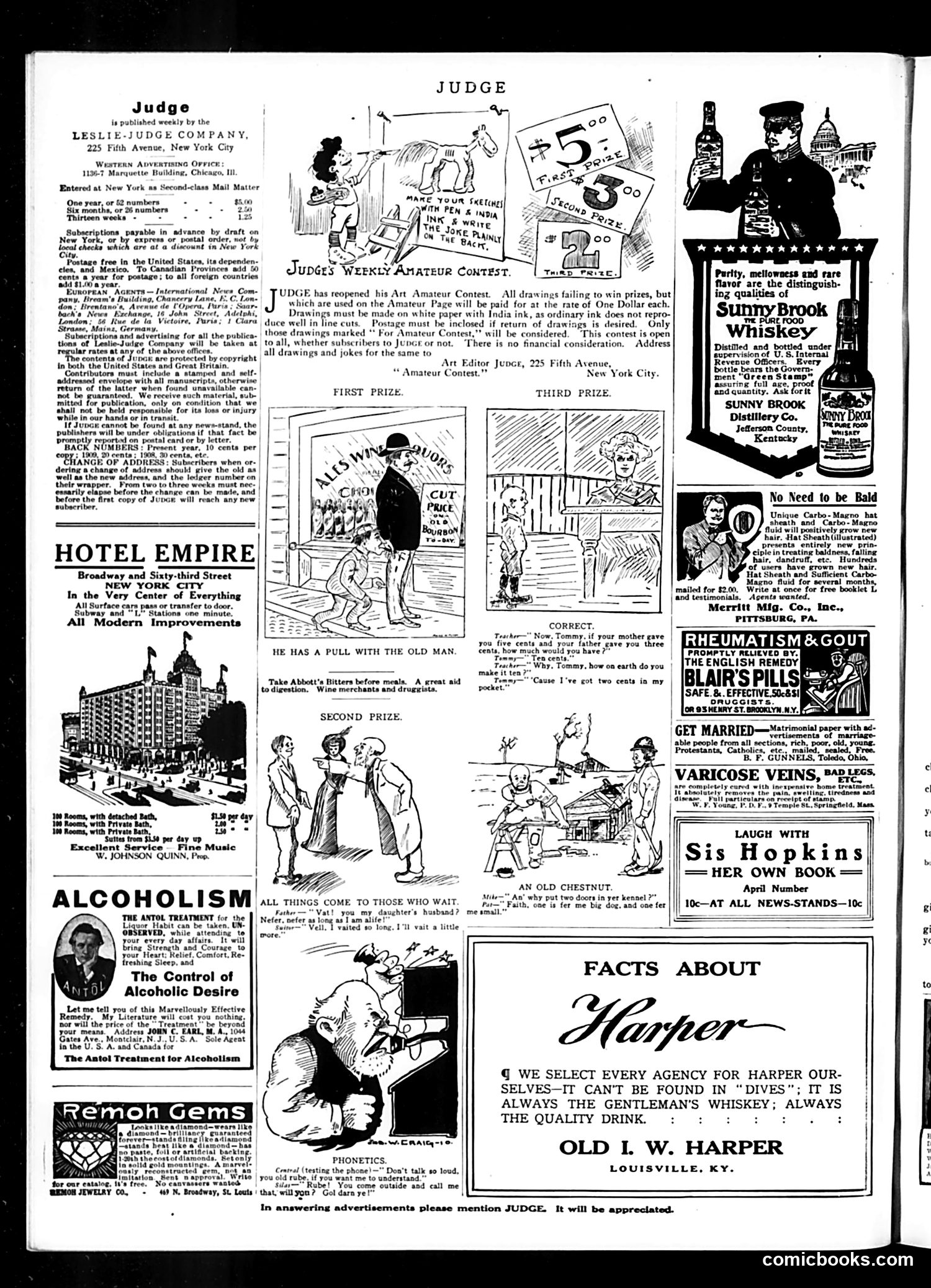
This is primarily an **advertising and administrative page** from Judge magazine, with several contest-related cartoons. The main content is Judge's **reopened Art Amateur Contest**, inviting readers to submit drawings for publication. Winning entries receive payment; all published drawings earn one dollar. The **three cartoon entries** shown are simple, domestic humor gags typical of the era: - "First Prize" depicts a man getting a haircut while his wife watches, captioned about his "pull with the old man" (likely referring to maintaining domestic influence) - "Second Prize" shows street conversation about waiting and time - "Third Prize" features a teacher-student exchange where a child adds up coins incorrectly, revealing he has "two cents in [his] pocket"—simple child humor The page is surrounded by **period advertisements** for whiskey (Sunny Brook), hotels, alcoholism treatments, and matrimonial services—typical commercial content from early 20th-century magazines. The cartoons themselves contain no political commentary, representing light, family-friendly entertainment rather than satirical critique.
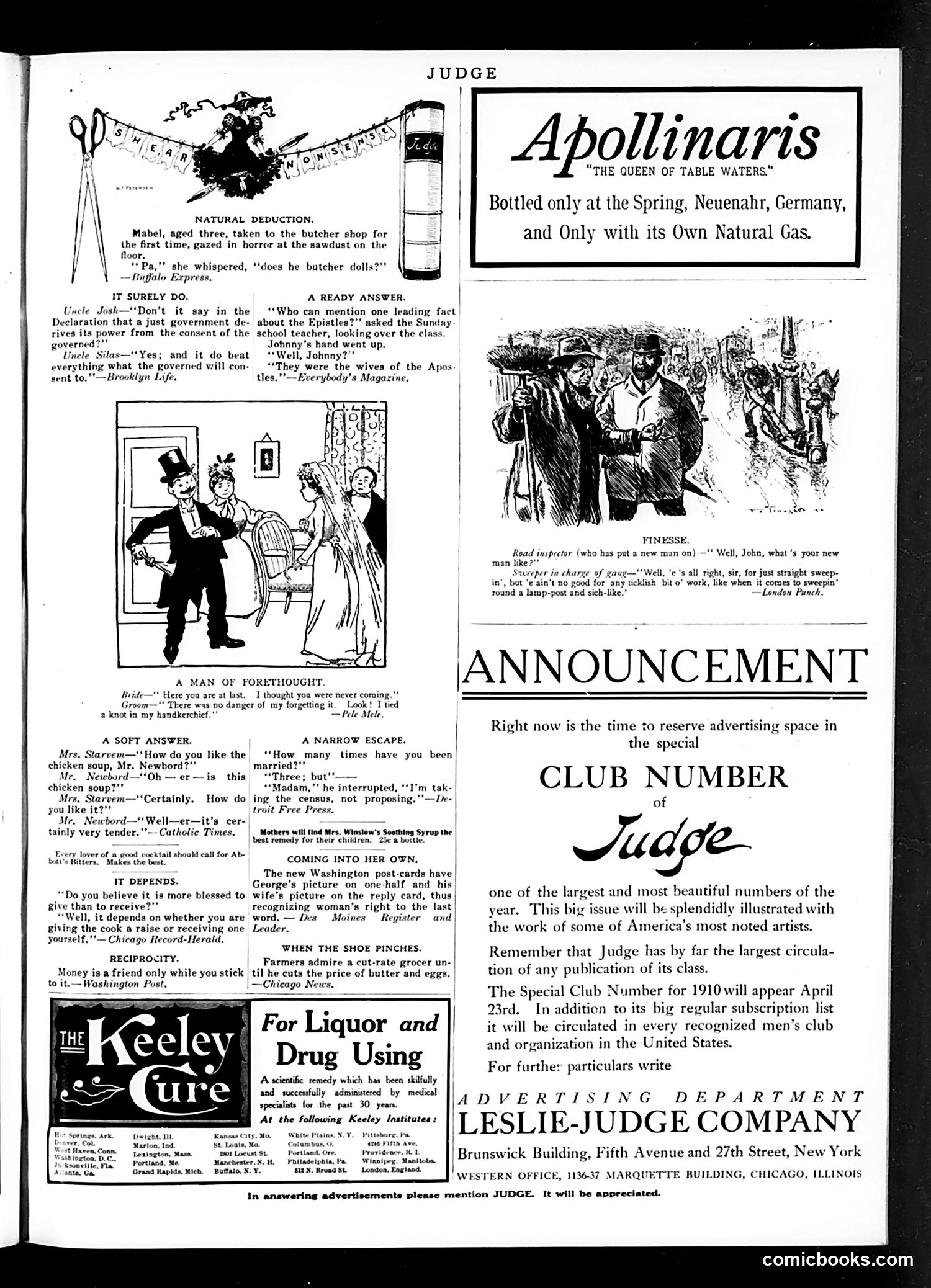
This page contains **multiple short humorous cartoons and jokes** typical of Judge's satirical format, plus advertising. The cartoons mock everyday social situations: - **"Natural Deduction"**: A three-year-old girl, seeing sawdust at a butcher shop, assumes the butcher kills dolls—innocent child logic. - **"A Ready Answer"**: A teacher asks students about the Apostles' wives; Johnny answers "the wives of the Apostles"—a literal, unhelpful response. - **"A Man of Forethought"** and others: Brief domestic/courtship humor about forgetfulness and marriage. - **"Finesse"**: Working-class humor about a road worker's assistant who's adequate for basic sweeping but incompetent with delicate work (avoiding lamp-posts). The page also features an **announcement for Judge's 1910 "Club Number"** (April 23rd), promoting advertising space to reach men's clubs nationwide. The tone is light, domesticated humor—no overtly political content. It's typical turn-of-century American magazine filler.
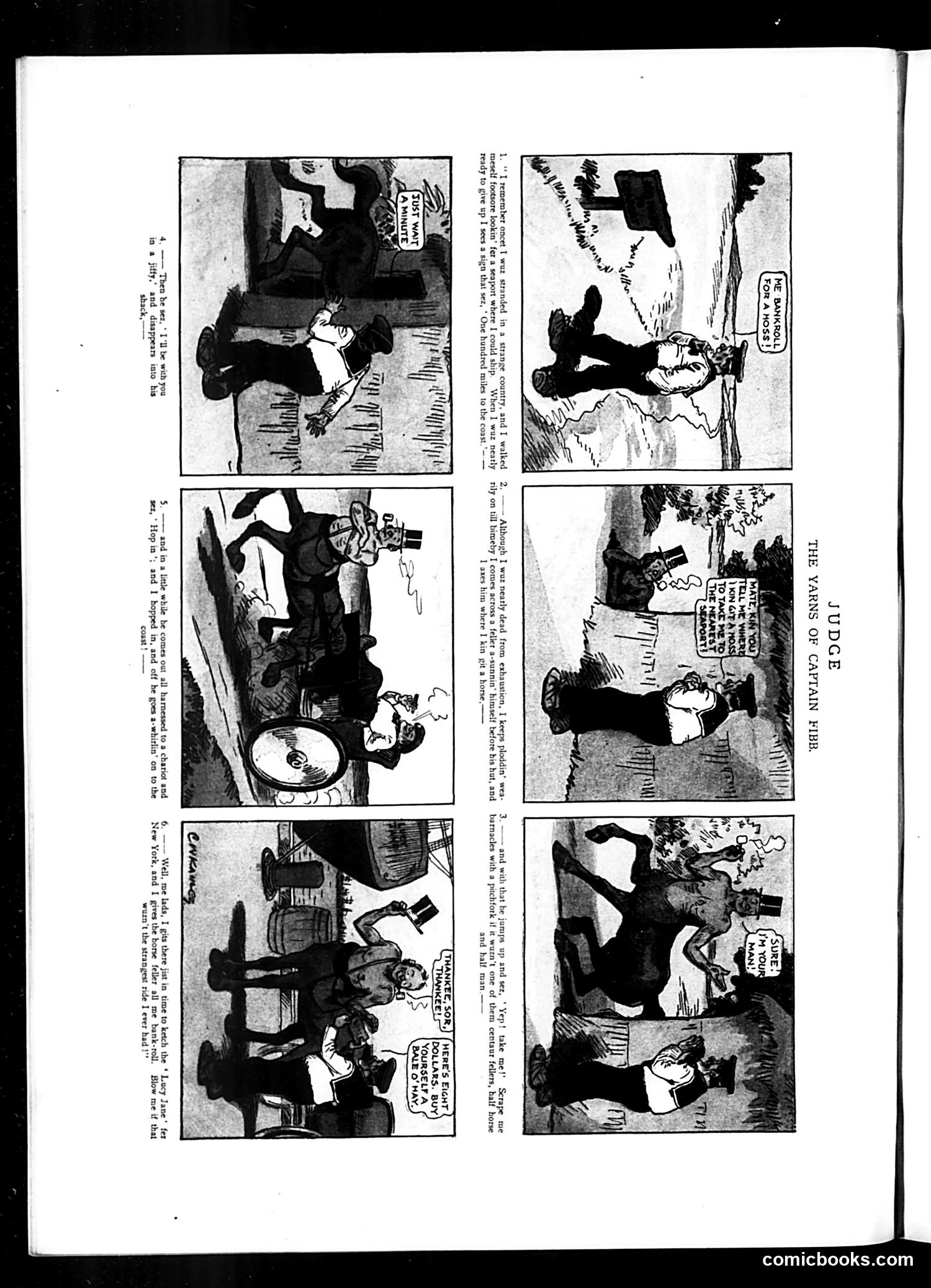
This is a humorous tall tale comic strip featuring Captain Fibb, an apparently nautical character recounting an absurd adventure to shipmates. The narrative follows a classic "shaggy dog story" structure typical of period humor—Fibb claims he was seeking a seaport when he encountered a centaur (half-man, half-horse creature) advertising transportation for "one hundred dollars." The joke relies on the audience's expectation of a logical punchline being subverted: instead of a sensible transaction, Fibb actually *gives his entire bankroll* to this fantastical being for what he describes as "the strangest ride" to New York. The humor derives from Fibb's gullibility and the sheer absurdity of the premise—a working-class sailor being duped by a mythological creature into an outrageously bad deal. This reflects period satirical humor mocking poor financial decisions and tall-tale storytelling conventions popular in early 20th-century American folklore.