
A complete issue · 16 pages · 1910
Judge — March 5, 1910
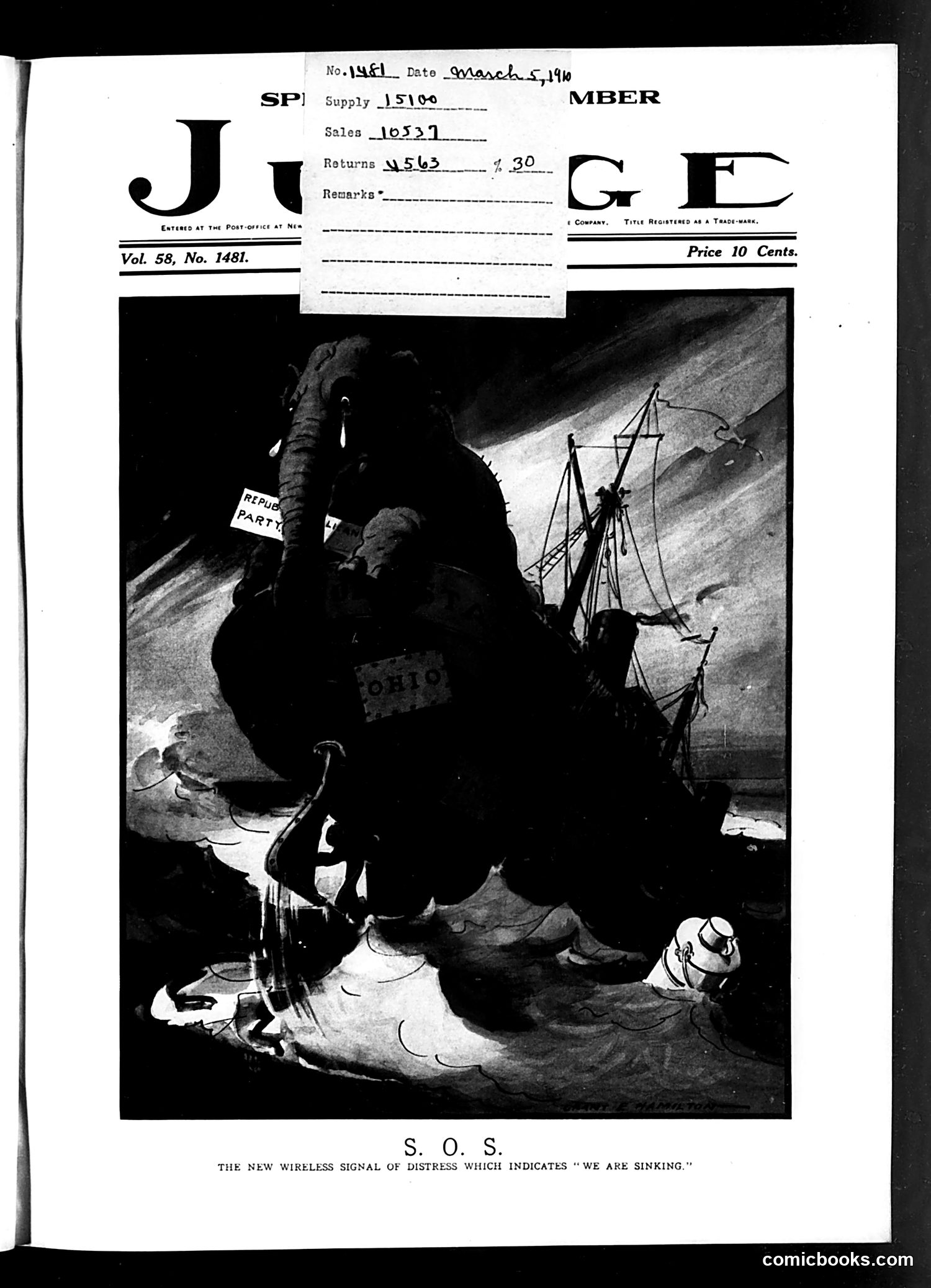
This Judge magazine cover from March 5, 1910 depicts a ship in distress with an elephant on deck sending a wireless distress signal ("S.O.S."). The caption reads: "THE NEW WIRELESS SIGNAL OF DISTRESS WHICH INDICATES 'WE ARE SINKING.'" The elephant likely represents the Republican Party (a traditional political symbol). The image appears to satirize Republican political troubles or crises around 1910—a period of significant party division between President Taft's conservative faction and Theodore Roosevelt's progressive wing, which would culminate in the 1912 party split. The "wireless signal" joke modernizes the distress concept using then-contemporary technology, suggesting the party's situation is dire and urgently broadcasting its problems to the public.
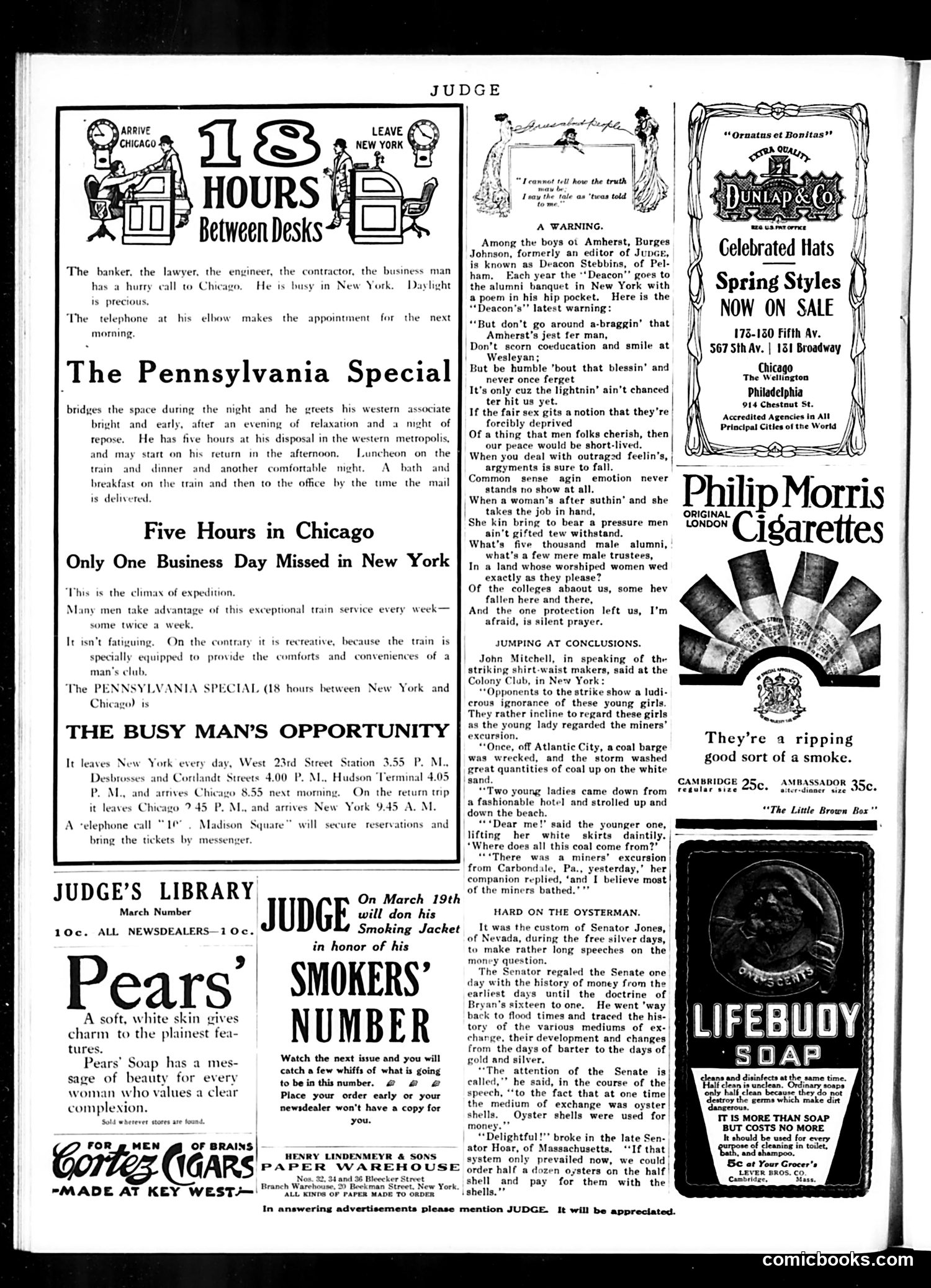
This page is primarily **advertising and editorial content** rather than political satire. The main feature is "The Pennsylvania Special," promoting a luxury train service connecting Chicago and New York in 18 hours, marketed to businessmen as a time-saving convenience. The page includes advertisements for **Philip Morris cigarettes, Dunlap hats, Lifebuoy soap, and Pears' soap**—typical early 20th-century luxury goods. There's a brief satirical item titled "A Warning" about Deacon Sheldon's advice to young alumni, cautioning against vanity and loose morals—gentle social commentary rather than political satire. The content reflects **period concerns**: business efficiency, class status symbols, and moral propriety. Overall, this represents Judge's blend of light social humor with commercial advertising.
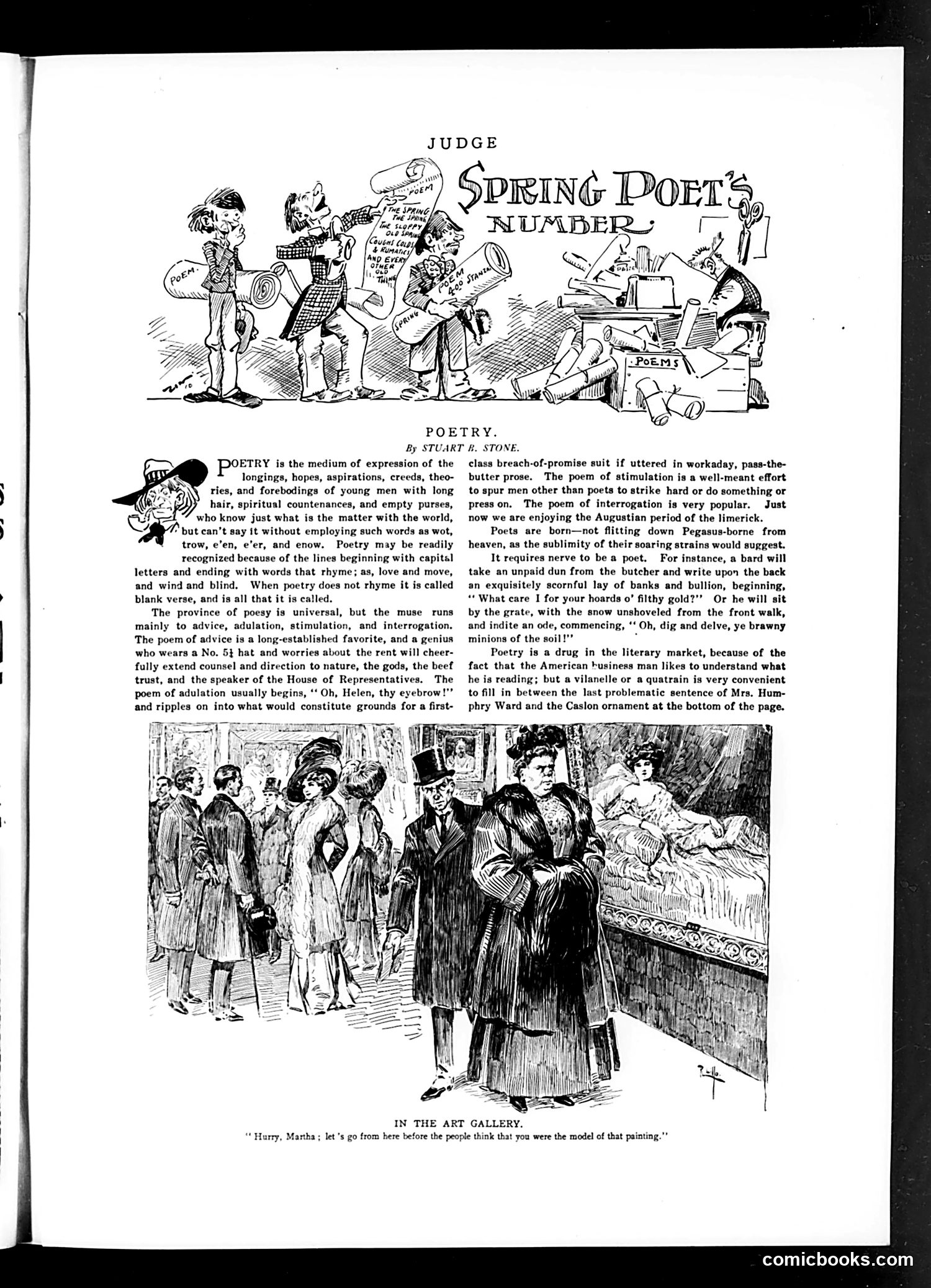
This is primarily a **humorous essay on poetry writing** by Stuart P. Stone, not political satire. The top cartoon depicts various stereotypical poets (long-haired bohemians) submitting work to editors, with scattered papers labeled "POEMS." Stone's text sarcastically critiques amateur poets who flood publications with mediocre verse. He mocks their pretensions—using flowery language to discuss mundane subjects—and notes poetry has become a "drug in the literary market" because American businessmen enjoy reading it during breaks. The bottom illustration, "In the Art Gallery," shows a social scene where someone suggests leaving before people mistake them for the painting's model—a separate joke about aspiring artists. This is **cultural satire about artistic pretension**, not political commentary.
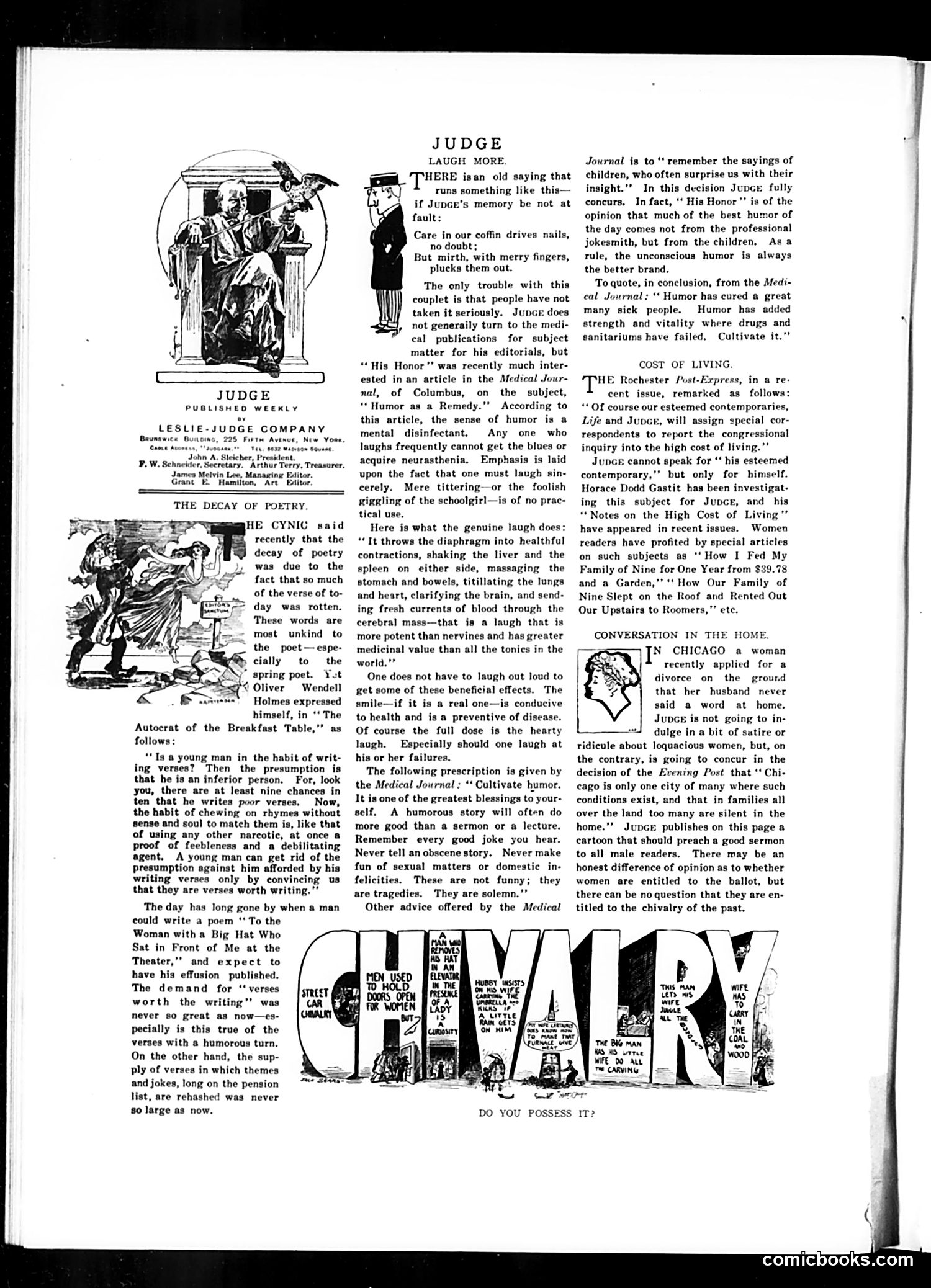
This page contains several distinct pieces. The main "Judge" column discusses humor's medicinal value, citing a *Medical Journal* article claiming laughter benefits health by improving circulation and digestion. The piece argues genuine humor—particularly at one's own failures—is therapeutic. "The Decay of Poetry" criticizes modern verse writing, claiming the demand for humorous poetry has never been greater, yet quality supplies have diminished. It suggests poets should write funny verses more frequently. "Conversation in the Home" presents a domestic dispute where a Chicago woman seeks divorce because her husband never laughed at her jokes, illustrating the page's broader theme: humor's importance to relationships and wellbeing. The large "CITY" cartoon at bottom appears to be a visual gag about urban life, though specifics are unclear from the image quality.
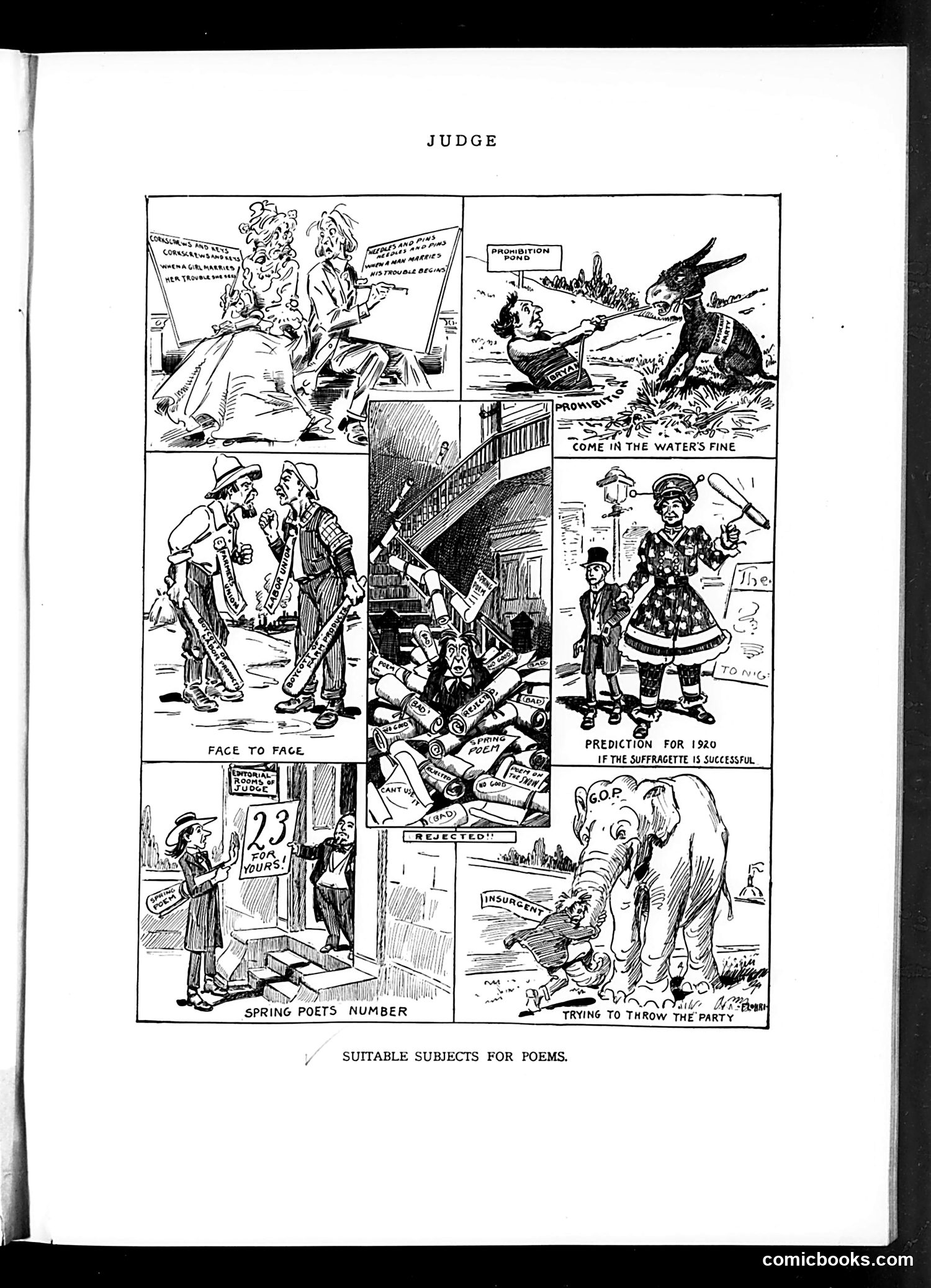
This page presents satirical cartoons titled "Suitable Subjects for Poems," mocking judicial and political figures through exaggerated scenarios. The cartoons appear to reference early 20th-century American politics, likely around 1920 based on the "Prediction for 1920 if the Suffragette is Successful" panel. Key panels include "Prohibition Pond" (referencing alcohol prohibition), "Face to Face" (two judges confronting each other), and "Spring Poets Number" (suggesting judicial commentary). The final panel shows an elephant (Republican symbol) attempting to "throw the party," indicating internal GOP conflict. The satirical intent targets judicial authority, women's suffrage movements, and prohibition politics—contemporary controversies where Judge magazine frequently positioned itself as conservative critic of progressive reforms.
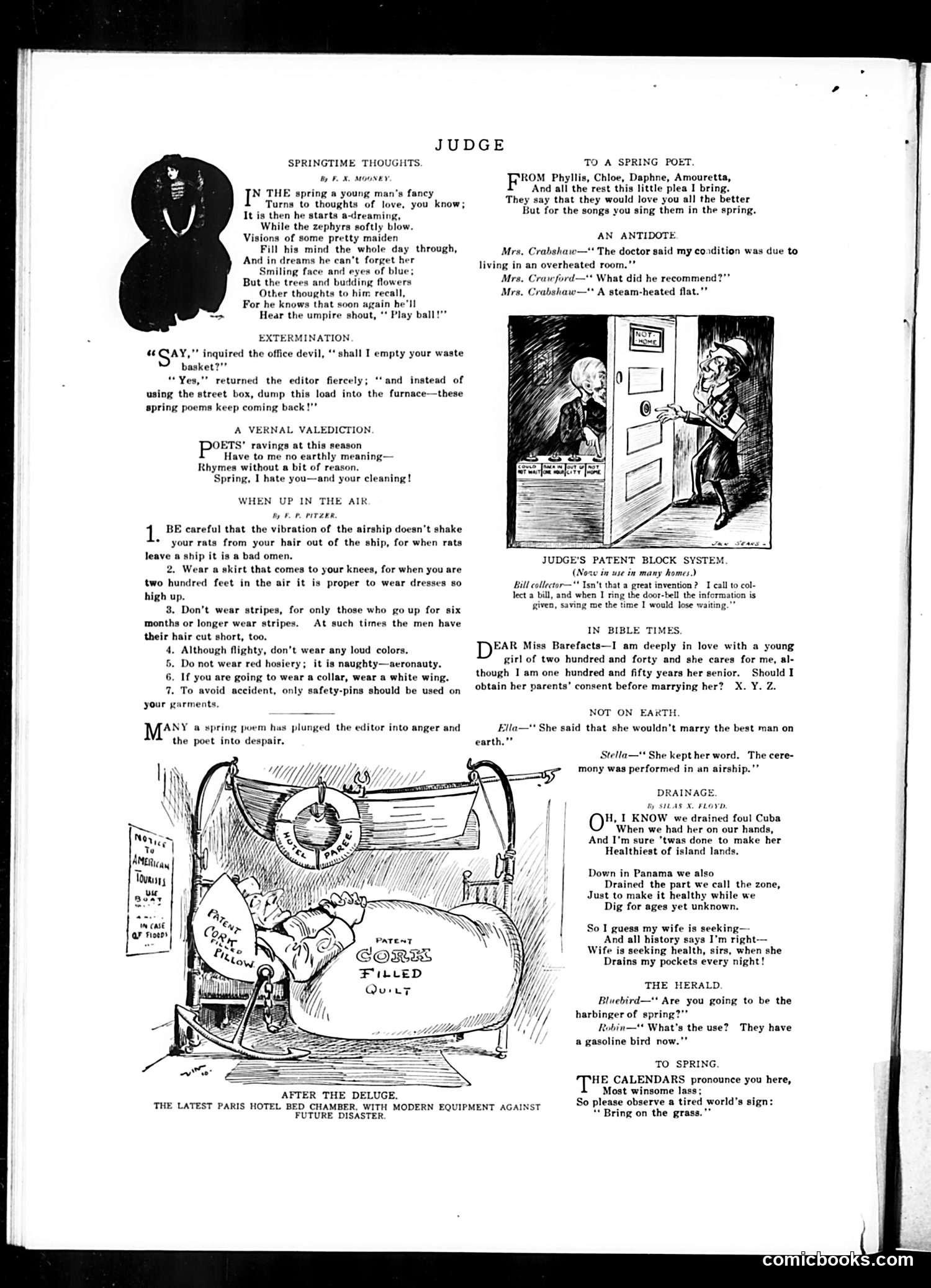
This page from Judge magazine (early 20th century) is primarily **satirical commentary on springtime conventions and contemporary technologies**. Key content: **Spring Poetry Satire**: Multiple pieces mock the cliché of spring poems—the editor literally wants to burn them. The magazine ridicules the sentimental "young man's fancy turns to love" tradition. **Aviation Humor**: "When Up in the Air" offers absurd etiquette rules for airship travel (don't shake rats out, wear proper skirts at altitude), satirizing both the novelty of early aviation and rigid social conventions. **Patent Block System cartoon**: Mocks an invention where a door-bell system provides information to bill collectors—poking fun at over-engineered "solutions" to modern problems. **Other jokes** reference drainage projects in Cuba and Panama (likely Roosevelt-era American expansion), and a "gasoline bird" replacing the traditional robin as spring's herald—suggesting mechanical modernization replacing nature. The overall theme: **traditional spring sentimentality versus modern industrial/mechanical reality**. The magazine critiques both excessive romanticism and the era's obsession with technological "progress."
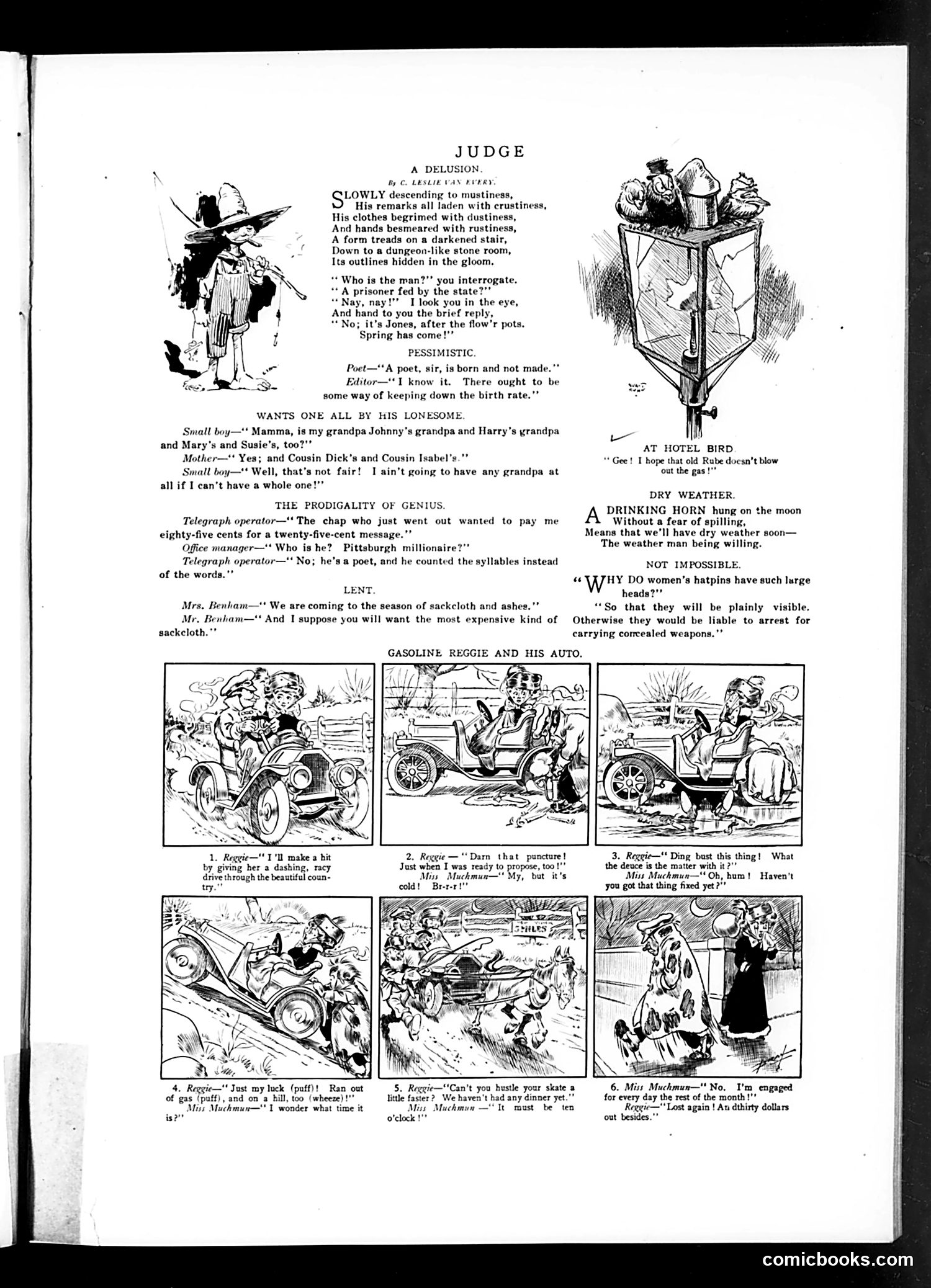
This page contains multiple satirical sketches typical of early 20th-century American humor magazine content: **"A Delusion"** mocks a pessimistic man descending into darkness—revealed to be merely Jones tending flowerpots after spring's arrival. The satire targets melodramatic gloominess. **"Pessimistic"** jokes about an editor's dark suggestion to control population by preventing poets' births. **"Gasoline Reggie and His Auto"** is a six-panel comic strip mocking an inept motorist and his equally incompetent courtship. Reggie's car repeatedly fails (punctures, running out of gas) while he attempts romance, and his date repeatedly accepts other engagements—suggesting automobiles as unreliable status symbols and commenting on dating customs. Supporting items ridicule a poet paying by syllables instead of words, and a brief quip about women's hatpins as "concealed weapons"—referencing early 20th-century anxieties about women's fashion and independence. The overall tone is light domestic and social satire, not political commentary.
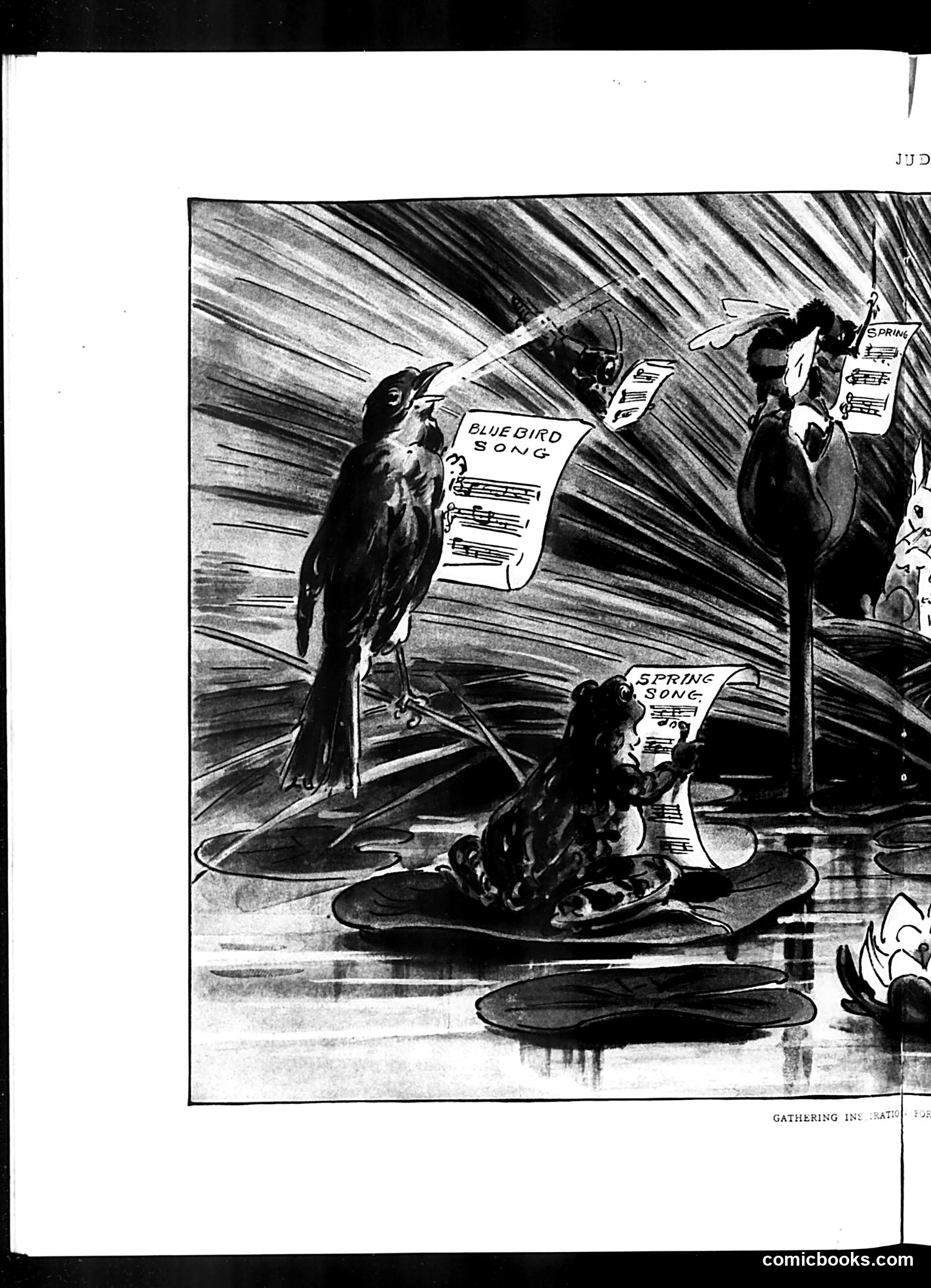
This appears to be a satirical cartoon from *Judge* magazine featuring anthropomorphized birds and frogs in what looks like a musical gathering or performance scene. The visible sheet music is labeled "BLUEBIRD SONG" and "SPRING SONG," suggesting a springtime theme focused on nature's music-makers. The cartoon satirizes something about these creatures performing or "gathering" together—likely commentary on natural behavior, seasonal themes, or possibly social gatherings of the era. The dramatic crosshatching and dynamic composition emphasize movement and activity. However, without clearer text or additional context about *Judge*'s publication date and contemporary events, the specific political or social satire remains unclear. The exact figures being caricatured and the precise point of the joke cannot be determined from the image and OCR text alone.
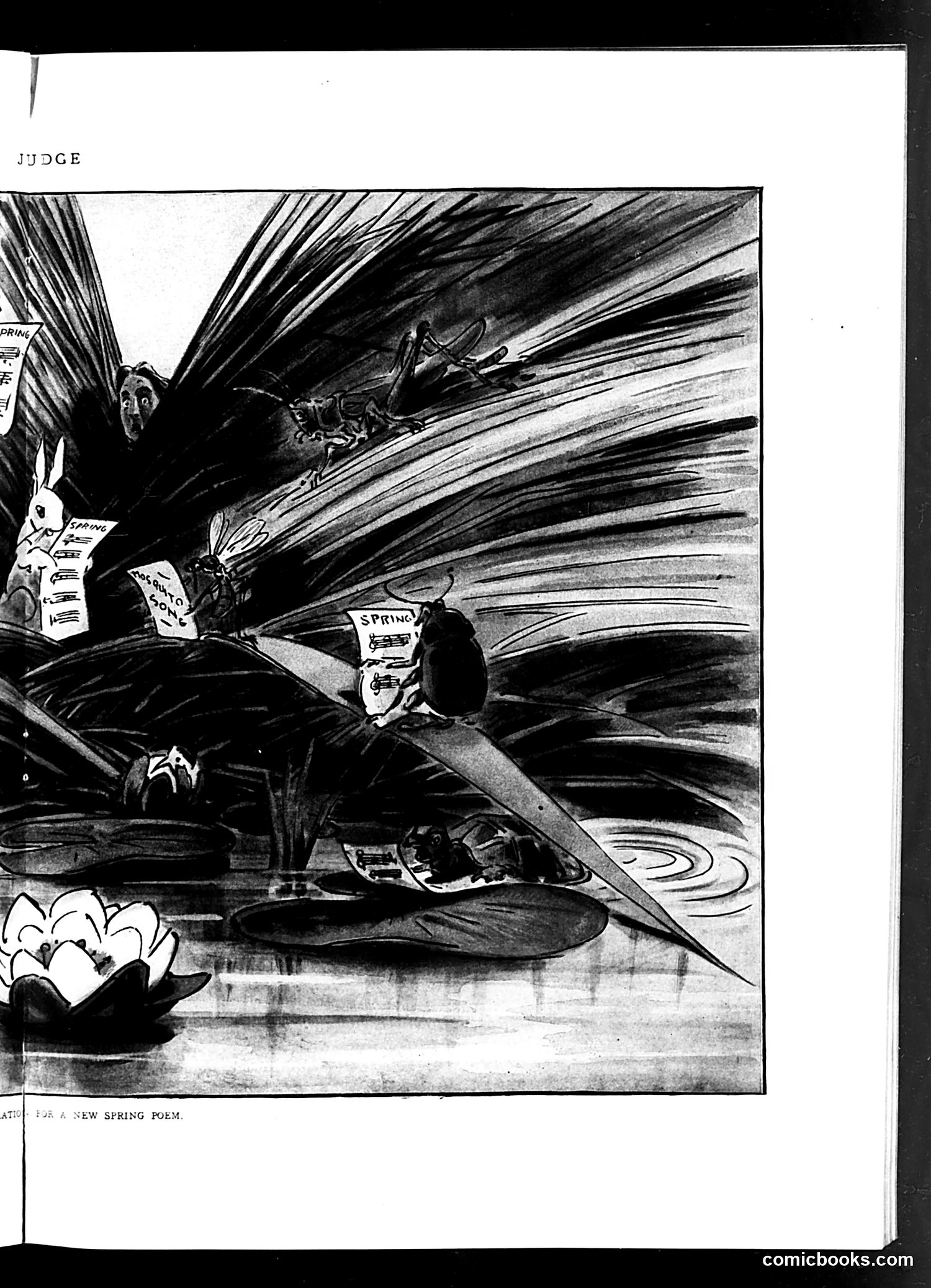
This appears to be a satirical illustration titled "A New Spring Poem" from Judge magazine. The cartoon depicts anthropomorphized insects or creatures labeled "SPRING" emerging explosively from what appears to be a cocoon or chrysalis, with dramatic radiating lines suggesting violent energy or chaos. The figures are rendered in an expressive, dynamic style typical of early-to-mid 20th century political cartooning. The satire likely mocks the conventional literary trope of spring as a gentle, poetic season of renewal. Instead, the cartoon portrays spring's arrival as chaotic and aggressive—perhaps commenting on the jarring, disruptive nature of seasonal change or satirizing overwrought "spring poetry" itself. The specific identities of individual figures are unclear from this reproduction, but the overall message critiques romanticized seasonal imagery.
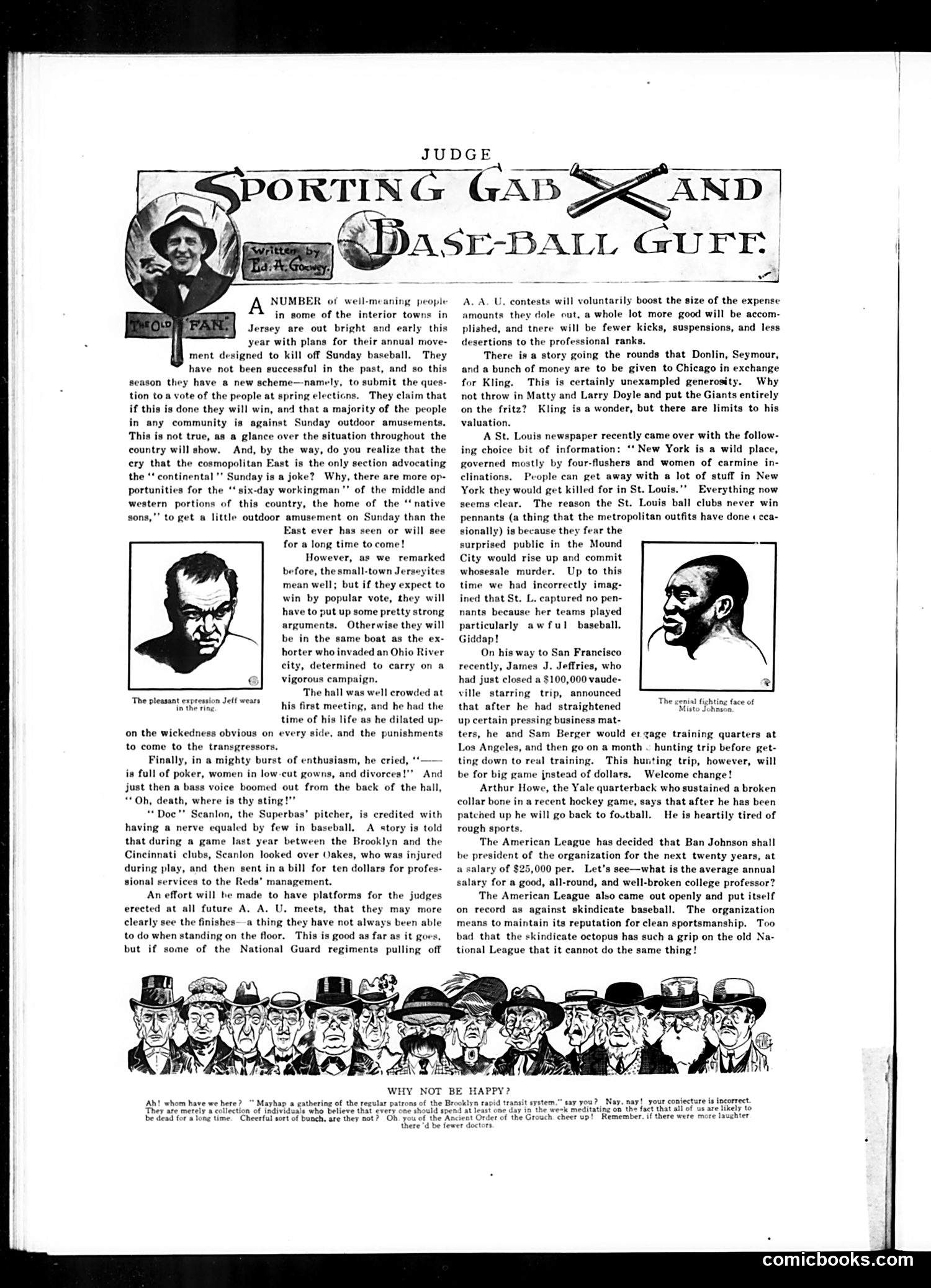
This page satirizes early 1900s debates over **Sunday baseball** in New Jersey. Small-town religious groups sought to ban Sunday games through popular votes, claiming communities opposed outdoor amusements on the Sabbath. Judge's editorial mocks this hypocrisy: the Midwest—home of conservative "native sons"—actually offers *more* Sunday recreation than the "cosmopolitan East." The magazine ridicules the reform effort through an anecdote about a traveling preacher ranting about poker, loose women, and divorce, only to be countered by a voice from the audience asking "Oh death, where is thy sting?"—suggesting moralists are alarmist. The page also includes **baseball gossip**: speculation about player trades (Donlin, Seymour, and money to Chicago for catcher Kling), and a story about pitcher "Doc" Scanlon billing the Cincinnati Reds for "professional services" after injuring an opponent. The bottom **caricature row** depicts the unnamed "gathering of regular patrons" opposing Sunday baseball—depicted as sour, joyless figures.
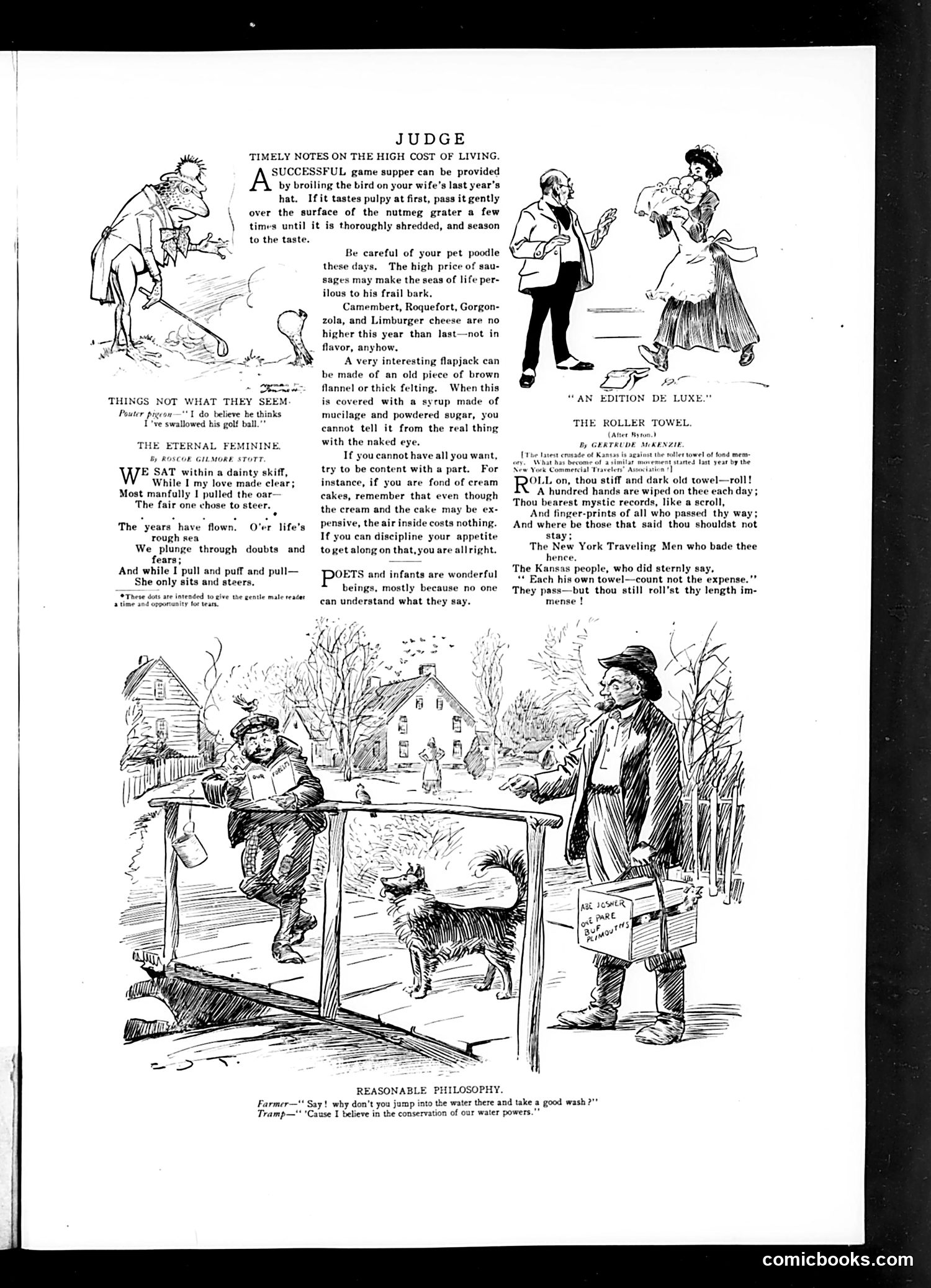
This page from *Judge* magazine contains multiple satirical pieces mocking the high cost of living (likely early 20th century inflation). **Main Content:** The "Timely Notes on the High Cost of Living" section sarcastically suggests absurd economy measures—broiling birds from old hats, making flapjacks from brown flannel, and noting that "air inside" cakes costs nothing. The humor targets widespread economic hardship by exaggerating desperate cost-cutting to ridiculous extremes. **Other pieces** include: - A gender-role cartoon about a couple in a boat—she steers while he rows, a metaphor for wives controlling marriages while husbands do the labor - "The Roller Towel" poem mocking communal towels in public facilities (hotels, boarding houses), which travelers and Kansans objected to on hygiene grounds - A farmer-tramp exchange about "conserving water powers"—likely political satire referencing Progressive-era conservation debates The cartoons and text together satirize economic anxiety, domestic dynamics, and public health concerns of the era.
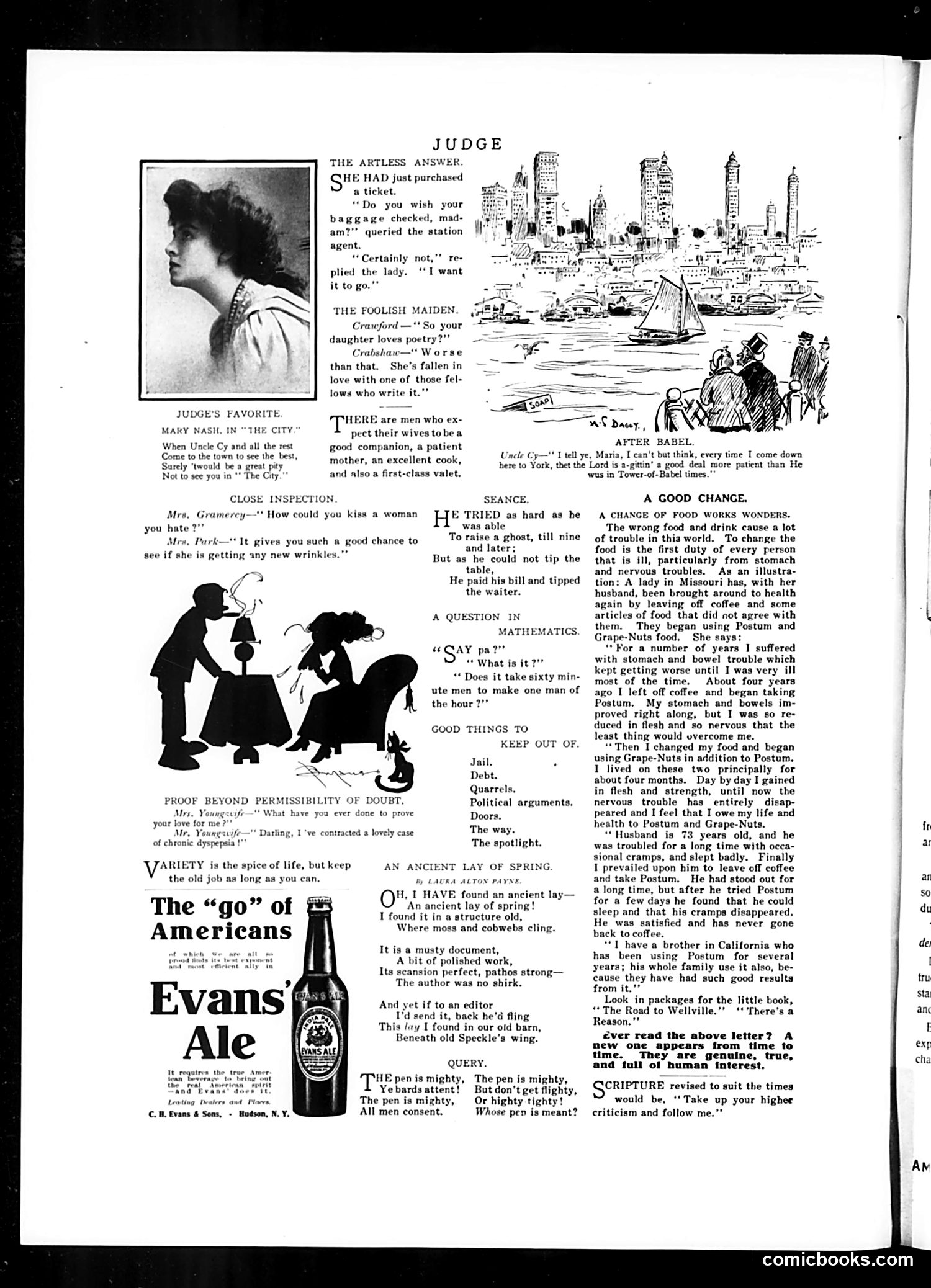
This page from *Judge* magazine contains several short humor pieces typical of early 20th-century American satire: **"The Artless Answer"** mocks a woman's literal interpretation—she doesn't want her baggage "checked" (stored), she wants it to go with her on the trip. **"The Foolish Maiden"** jokes that a young woman has fallen in love with a *poet*—presented as worse than merely loving poetry, suggesting poets were viewed as impractical or undesirable suitors. **"After Babel"** references the Biblical Tower of Babel story, with a rural character suggesting God is more patient now than when he confused human languages. **"A Question in Mathematics"** is a simple pun on "the hour" (sixty minutes). **The right-side content** is primarily a **Postum cereal advertisement** disguised as testimonial articles about food improving health—a common marketing tactic. Postum was a caffeine-free coffee substitute marketed as healthier than regular coffee. The page is largely **commercial content masquerading as editorial humor**.
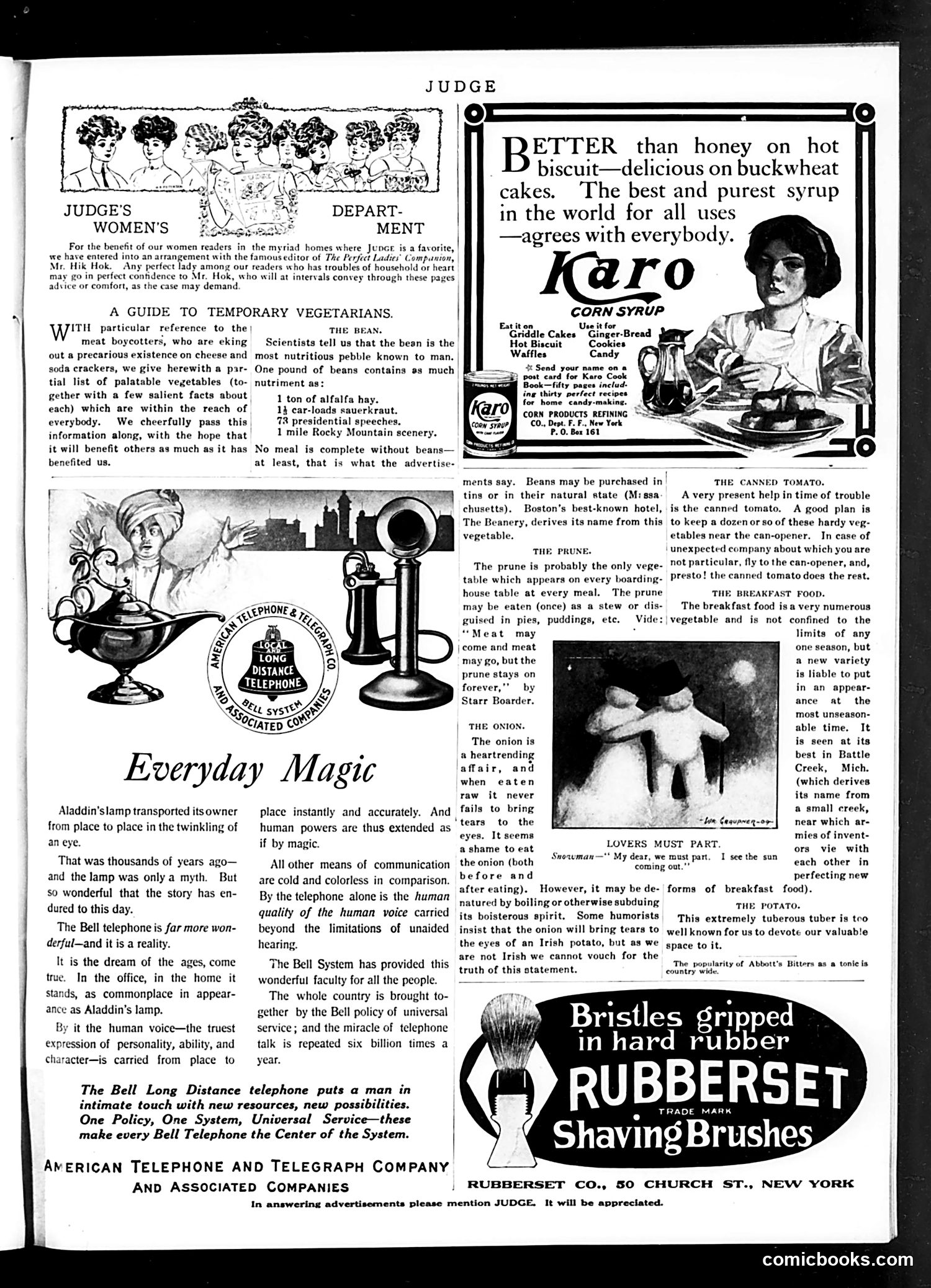
This page from *Judge* magazine combines satirical advice with period advertisements. The main content is a tongue-in-cheek "Guide to Temporary Vegetarians" addressing a **meat boycott movement**—likely early 1900s labor activism or consumer protest. The humor mocks those forced to eat cheaply by exaggerating vegetables' nutritional value (claiming one pound of beans equals "73 presidential speeches" in nutrition). The satirical definitions of beans, prunes, onions, and potatoes use absurdist humor typical of *Judge*'s style. The onion entry jokes about its tear-inducing properties and includes a jab at Irish stereotypes ("Irish potato"). The page also features earnest advertisements for **Karo corn syrup**, a **Bell telephone system** essay romanticizing communication technology, and **Rubberset shaving brushes**—typical early 20th-century product placement. The "Women's Department" framing was common for lifestyle content in this era, positioning domestic/food knowledge as female expertise.
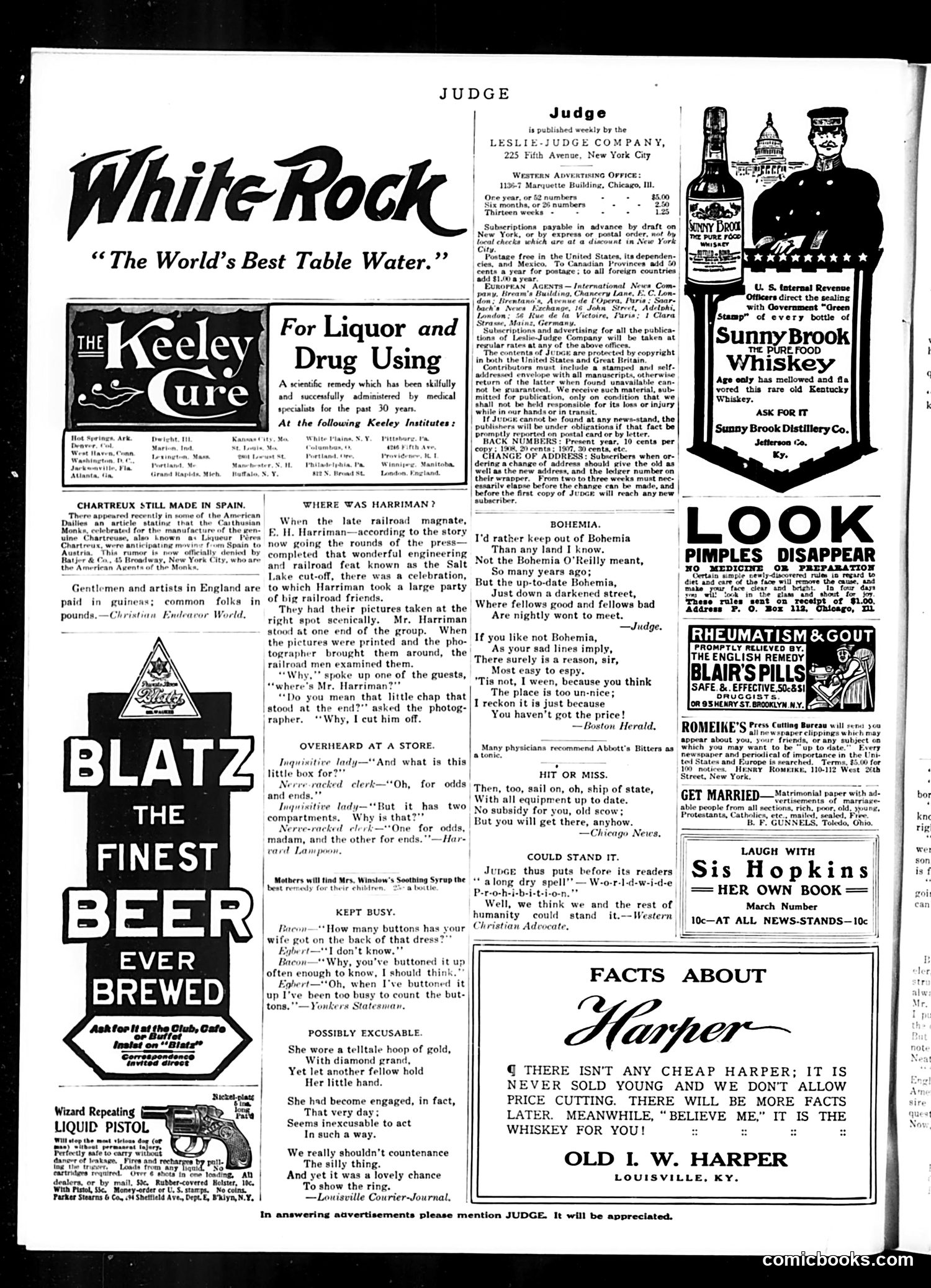
This is primarily an **advertising and editorial page** from Judge, an American satirical weekly. The content mixes humor, advertisements, and editorial commentary typical of early 20th-century magazines. **Key content:** The "WHERE WAS HARRIMAN?" section is a brief anecdote about **E.H. Harriman**, a prominent railroad magnate, who organized a celebratory photo at the completion of the Salt Lake cut-off railroad. The joke concerns a guest who couldn't identify Harriman in the group photograph—a subtle dig at Harriman's relative obscurity despite his industrial prominence. The rest of the page consists of **period advertisements** (Keeley Institute drug cure, Blatz beer, Harper whiskey, various patent medicines) and **brief humorous items** like "KEPT BUSY" (a domestic joke about buttons) and "COULD STAND IT" (wordplay about a ship's voyage). The content reflects Judge's formula: mixing satirical commentary on contemporary figures with light domestic humor and commercial advertising, appealing to educated urban readers of the era.
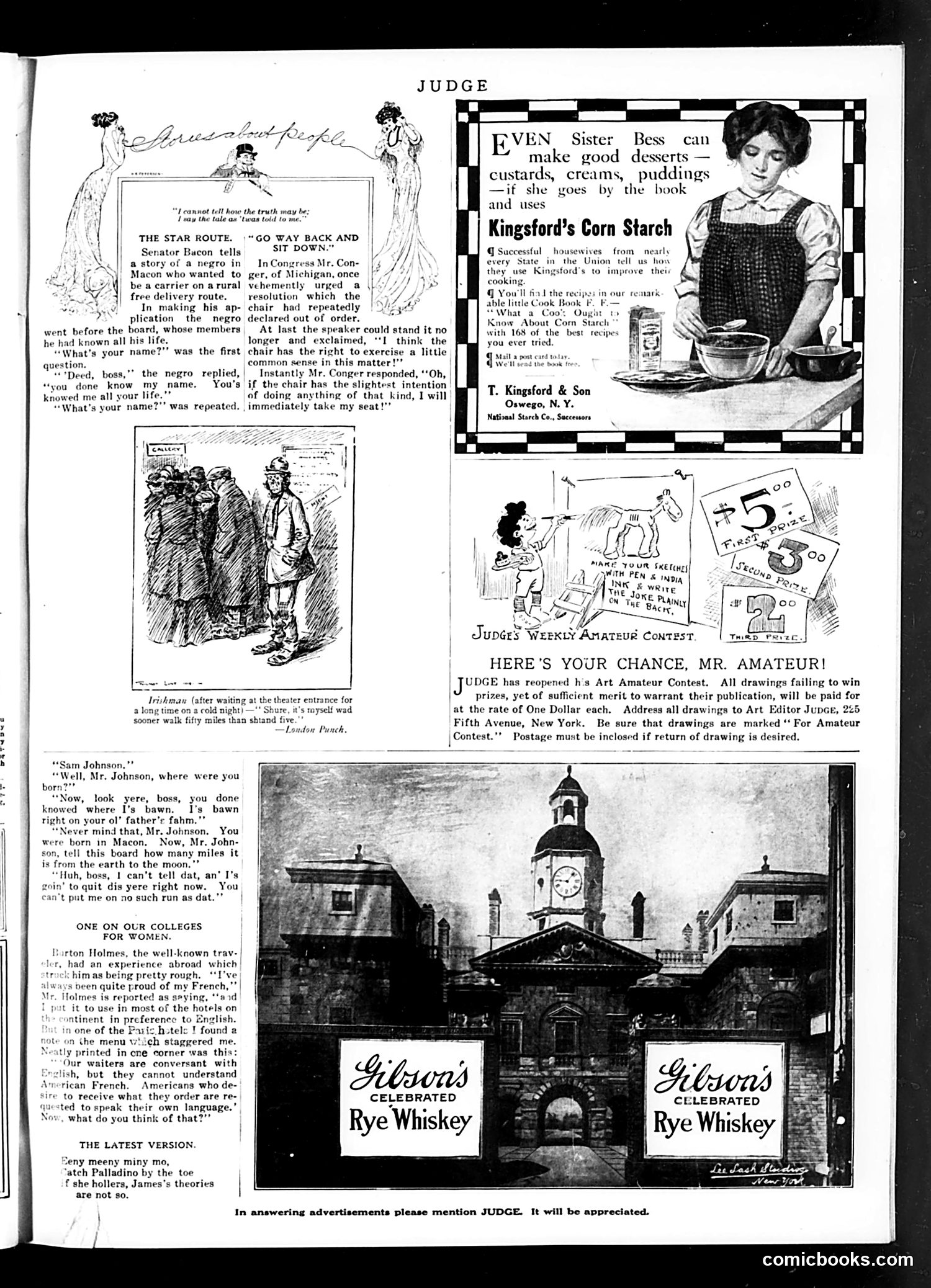
This page combines humor pieces with advertisements, typical of early 20th-century satirical magazines. **"The Star Route"** satirizes bureaucratic absurdity. A Black man applying to be a rural mail carrier is asked progressively ridiculous questions by an indifferent board—"What's your name?" (despite knowing him lifelong), then "How many miles from earth to the moon?" The joke mocks both the arbitrary nature of official procedures and the character's exasperation at impossible demands. It reflects period attitudes treating Black applicants as inherently unsuitable for such positions. **"One on Our Colleges for Women"** jokes about anti-American snobbery abroad. A traveler encounters a Paris hotel menu warning that waiters won't understand "American French" and customers must speak English. The humor targets both European condescension and Americans' linguistic pretensions. The page also features **advertisements** for Kingsford's Corn Starch and Gibson's Rye Whiskey, plus a call for amateur art submissions to Judge's contest at one dollar per accepted drawing.
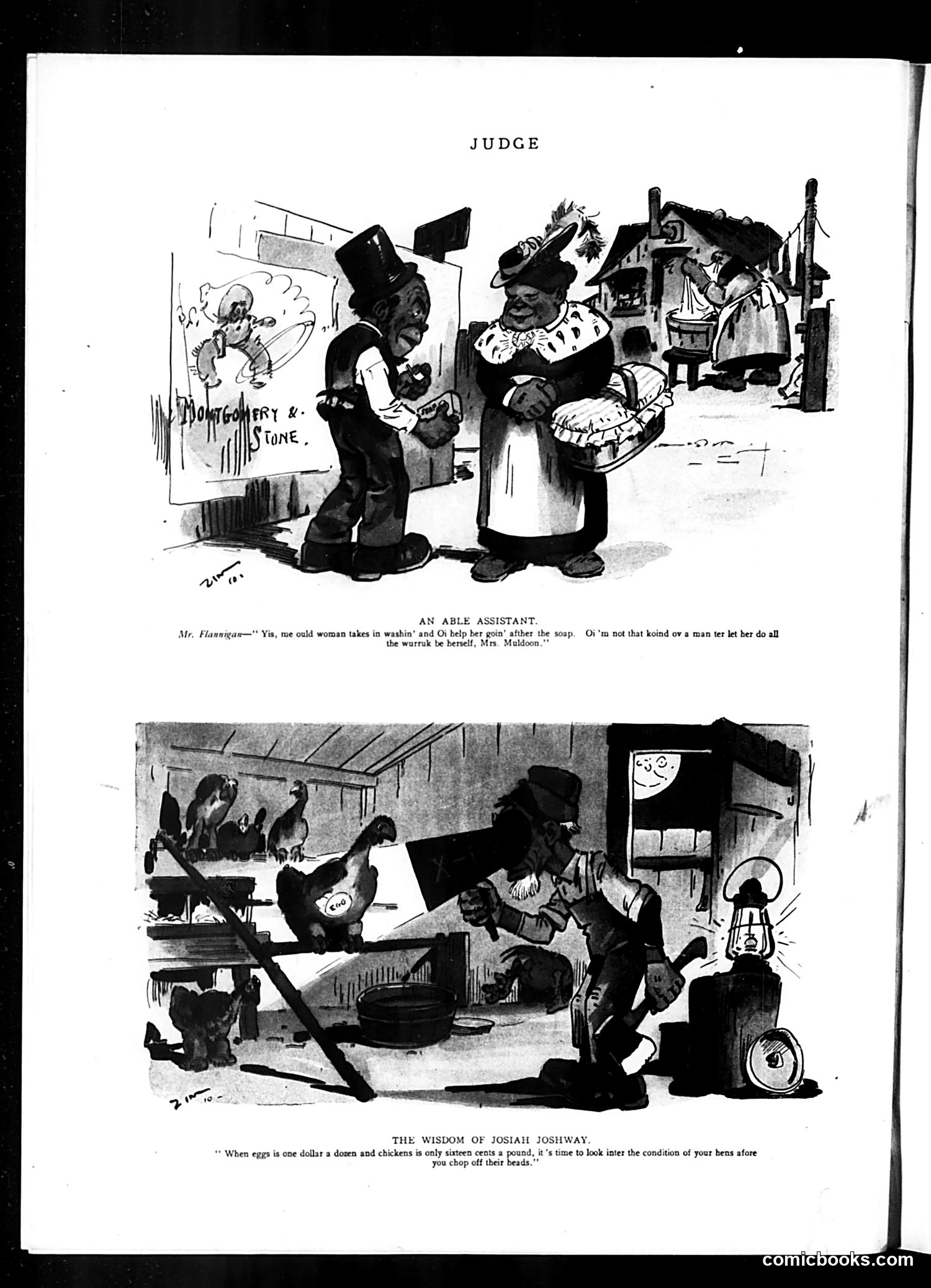
This page contains two satirical cartoons mocking working-class Irish immigrants through exaggerated dialect and stereotypical depictions. **"An Able Assistant"** presents Mr. Flannigan claiming to help his wife with laundry work while using heavy Irish brogue ("Yis," "Oi," "wurruk"). The satire suggests Irish men were lazy or reluctant workers, with the "joke" being that he merely fetches soap—minimal effort presented as remarkable helpfulness. **"The Wisdom of Josiah Joshway"** depicts a rural character offering absurd economic logic: eggs cost $1/dozen but chickens cost only 16¢/pound, yet he recommends examining hens before slaughtering them. The satire ridicules rural/working-class economic reasoning as backwards and illogical. Both cartoons rely on ethnic and class-based humor typical of late-19th/early-20th century American satirical magazines, using caricature and dialect to portray working-class figures as dim-witted or foolish.