
Judge, 1910-03-05 · page 4 of 16
Judge — March 5, 1910 — page 4: what you’re looking at
What you’re looking at
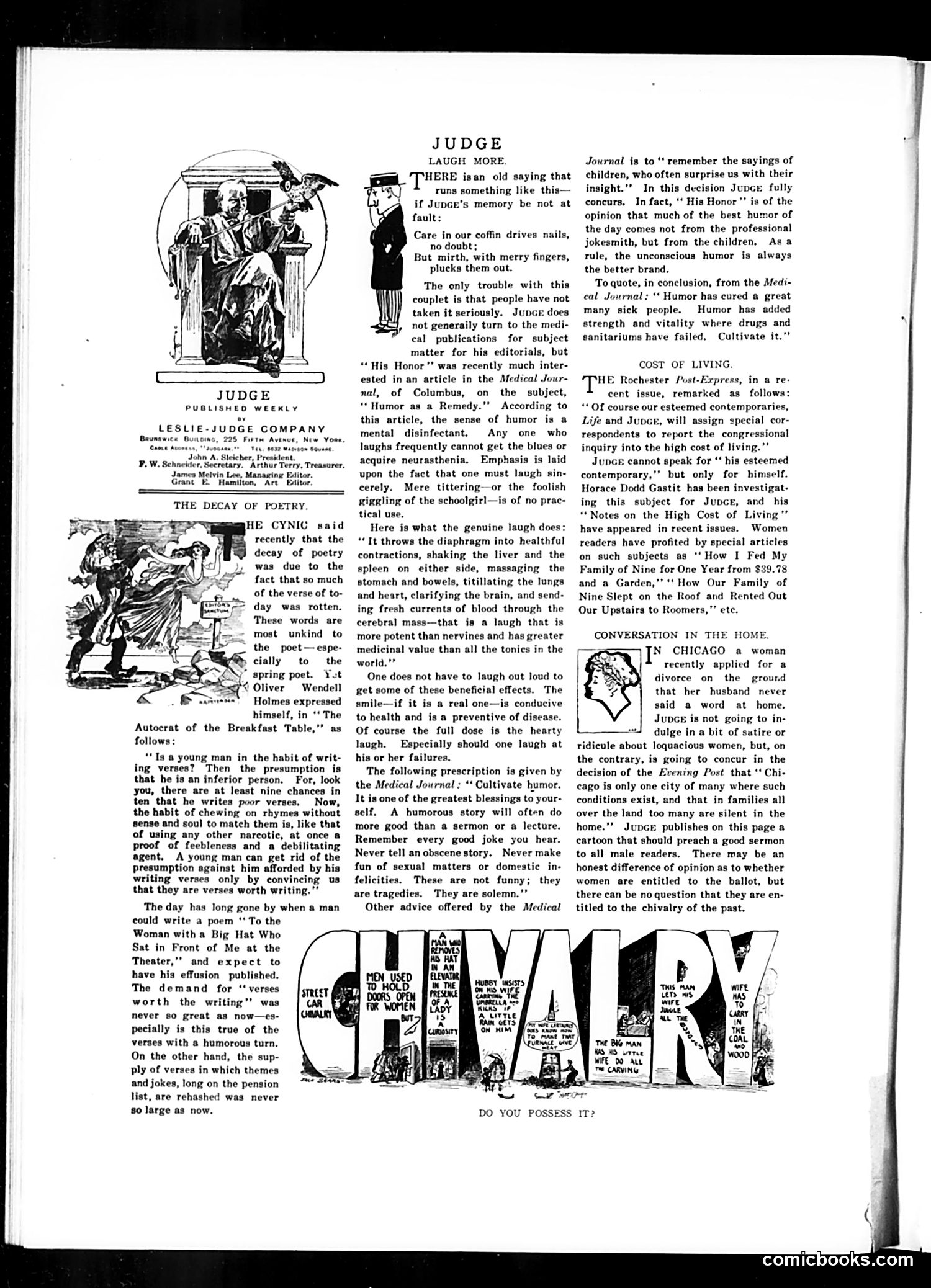
This page contains several distinct pieces. The main "Judge" column discusses humor's medicinal value, citing a *Medical Journal* article claiming laughter benefits health by improving circulation and digestion. The piece argues genuine humor—particularly at one's own failures—is therapeutic. "The Decay of Poetry" criticizes modern verse writing, claiming the demand for humorous poetry has never been greater, yet quality supplies have diminished. It suggests poets should write funny verses more frequently. "Conversation in the Home" presents a domestic dispute where a Chicago woman seeks divorce because her husband never laughed at her jokes, illustrating the page's broader theme: humor's importance to relationships and wellbeing. The large "CITY" cartoon at bottom appears to be a visual gag about urban life, though specifics are unclear from the image quality.
📄 Transcribed text from this page (OCR, searchable)
Machine-transcribed from the original scan — historical spelling and the odd misread are preserved.
PUBLISHED WEEKLY ey LESLIE-JUDGE COMPANY Baunawice Busoimc, 225 Firtw Avenue, New Yoon. Arthur Terry, Treasurer. se Lee, Managing Edlitor. Grant FE. Hamilton, Art Editor. THE DECAY OF POETRY. HE CYNIC said recently that the decay of poetry was due to the fact that so much of the verse of to- day was rotten. These words are most unkind to the poet — espe- . cially to the * spring poet. Yut Oliver Wendell Holmes expressed himself, in ‘* The Autocrat of the Breakfast Table,” as follows: “*Is a young man in the habit of writ- ing verses? Then the presumption is that he is an inferior person. For, look you, there are at least nine chances in sense and soul to match them is, like that of using any other narcotic, at once a proof of feebleness and a debilitating agent. A young man can get rid of the presumption against him afforded by his writing verses only by convincing us that they are verses worth writing.” The day has long gone by when a man could write a poem ‘To the Woman with a Big Hat Who Sat in Front of Me at the Theater," and expect to have his effusion published. The demand for ‘verses worth the writing’? was never so great as now—es- pecially is this true of the verses with a humorous turn. On the other hand, the sup- ply of verses in which themes and jokes, long on the pension list, are rehashed was never 80 large as now. JUDGE LAUGH MORE. gmt THERE isan old saying that as runs something like this— 4 if JupGe’s memory be not at fault: Care in our coffin drives nails, no doubt; But mirth, with merry fingers, plucks them out. The only trouble with this couplet is that people have not taken it seriously. Jupce does not generaily turn to the medi- cal publications for subject matter for his editorials, but “His Honor"? was recently much inter- ested in an article in the Medical Jour- nal, of Columbus, on the subject, “Humor as a Remedy.” According to this article, the sense of humor is a mental disinfectant. Any one who laughs frequently cannot get the blues or acquire neurasthenia. Emphasis is laid upon the fact that one must laugh sin- cerely. Mere tittering—or the foolish giggling of the schoolgirl—is of no prac- tical use. Here is what the genuine laugh does: “It throws the diaphragm into healthful contractions, shaking the liver and the spleen on either side, massaging the stomach and bowels, titillating the lungs and heart, clarifying the brain, and send- ing fresh currents of blood through the cerebral mass—that is a laugh that is more potent than nervines and has greater medicinal value than all the tonics in the world. One does not have to laugh out loud to get some of these beneficial effects. The smile—if it is a real one—is conducive to health and is a preventive of disease. Of course the full dose is the hearty laugh. Especially should one laugh at his or her failures. The following prescription is given by the Medical Journal ; ‘* Cultivate humor. It is one of the greatest blessings to your- self. A humorous story will often do more good than a sermon or a lecture. Remember every good joke you hear. Never tell an obscene story. Never make fun of sexual matters or domestic in- felicities. These are not funny; they are tragedies. They are solemn.’’ Other advice offered by the Medical Journal is to‘ remember the sayings of children, who often surprise us with their insight.” In this decision Jupce fully concurs. In fact, ‘* His Honor” is of the opinion that much of the best humor of the day comes not from the professional jokesmith, but from the children, As a rule, the unconscious humor is always the better brand. To quote, in conclusion, from the Medi- cal Journal: ‘* Humor has cured a great many sick people. Humor has added strength and vitality where drugs and sanitariums have failed, Cultivate it.”” COST OF LIVING. HE Rochester Post-Express, in a re- cent issue, remarked as follows: “+ Of course our esteemed contemporaries, Life and Juvce, will assign special cor- respondents to report the congressional inquiry into the high cost of living.” Jupce cannot speak for “ his esteemed contemporary,"? but only for himself. Horace Dodd Gastit has been investigat- ing this subject for Jupce, and his “Notes on the High Cost of Living’ have appeared in recent issues. Women readers have profited by special articles on such subjects as ‘How I Fed My Family of Nine for One Year from $39.78 and a Garden,’ “* How Our Family of Nine Slept on the Roof and Rented Out Our Upstairs to Roomers,”’ etc. CONVERSATION IN THE HOME. -_. JN CHICAGO a woman recently applied for a divorce on the ground that her husband never said a word at home, Jupce is not going to in- dulge ina bit of satire or ridicule about loquacious women, but, on the contrary, is going to concur in the decision of the Evening Post that ** Chi- cago is only one city of many where such conditions exist, and that in families all over the land too many are silent in the home.’? JupcE publishes on this page a cartoon that should preach a good sermon to all male readers, There may be an honest difference of opinion as to whether women are entitled to the ballot, but there can be no question that they are en- titled to the chivalry of the past. Sr rer DO YOU POSSESS IT?