
Judge, 1910-03-05 · page 3 of 16
Judge — March 5, 1910 — page 3: what you’re looking at
What you’re looking at
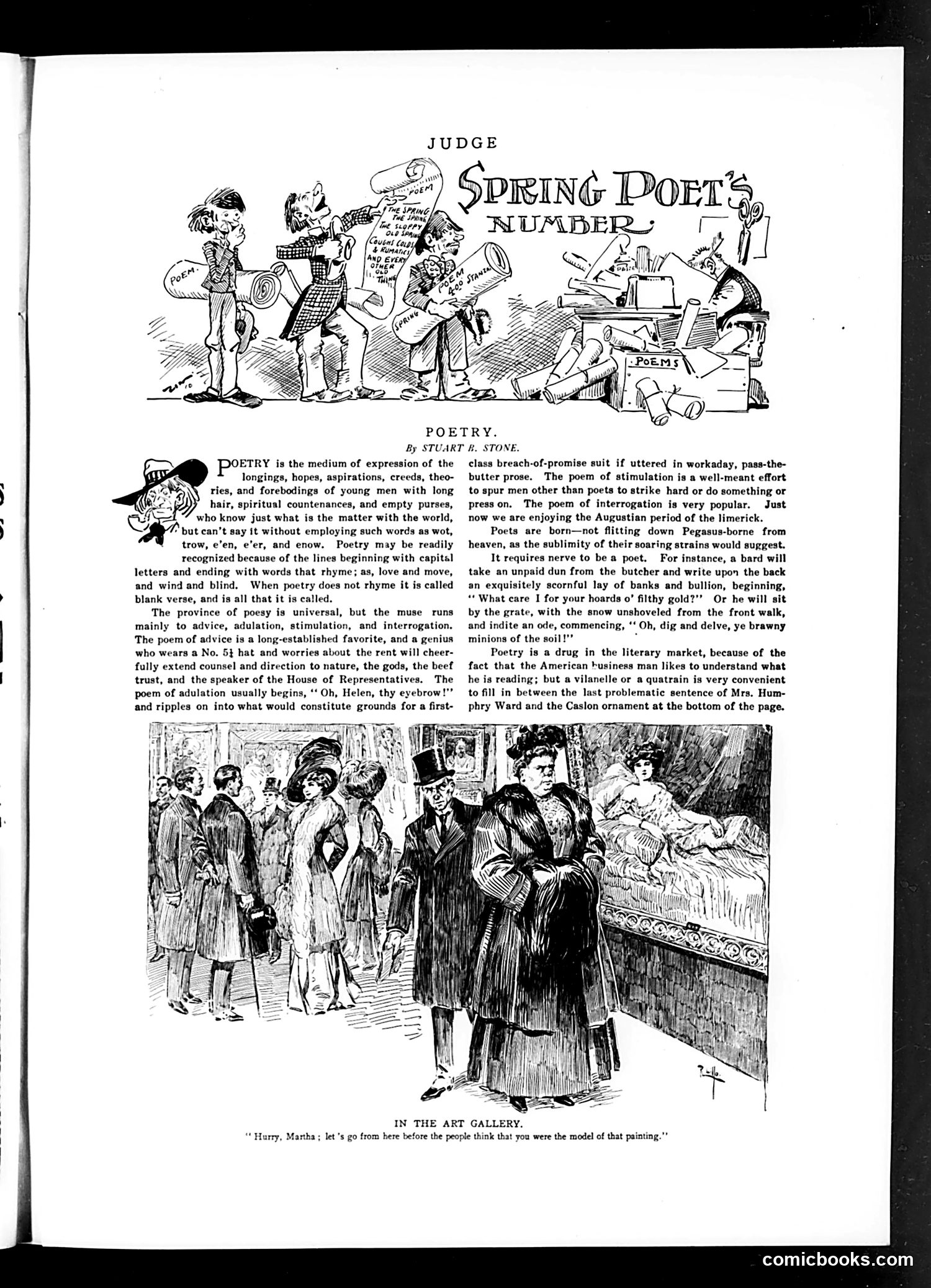
This is primarily a **humorous essay on poetry writing** by Stuart P. Stone, not political satire. The top cartoon depicts various stereotypical poets (long-haired bohemians) submitting work to editors, with scattered papers labeled "POEMS." Stone's text sarcastically critiques amateur poets who flood publications with mediocre verse. He mocks their pretensions—using flowery language to discuss mundane subjects—and notes poetry has become a "drug in the literary market" because American businessmen enjoy reading it during breaks. The bottom illustration, "In the Art Gallery," shows a social scene where someone suggests leaving before people mistake them for the painting's model—a separate joke about aspiring artists. This is **cultural satire about artistic pretension**, not political commentary.
📄 Transcribed text from this page (OCR, searchable)
Machine-transcribed from the original scan — historical spelling and the odd misread are preserved.
PRING DoETS POETRY. By STUART &, STO. pore is the medium of expression of the longings, hopes, aspirations, creeds, theo- ries, and forebodings of young men with long hair, spiritual countenances, and empty purses, who know just what is the matter with the world, but can’t say it without employing such words as wot, trow, e’en, e’er, and enow. Poetry may be readily recognized because of the lines beginning with capital letters and ending with words that rhyme; as, love and move, and wind and blind. When poetry does not rhyme it is called blank verse, and is all that it is called. The province of poesy is universal, but the muse runs mainly to advice, adulation, stimulation, and interrogation. The poem of advice is a long-established favorite, and a genius who wears a No. 5} hat and worries about the rent will cheer- fully extend counsel and direction to nature, the gods, the beef trust, and the speaker of the House of Representatives. The poem of adulation usually begins, ‘‘ Oh, Helen, thy eyebrow!"? and ripples on into what would constitute grounds for a first- ; class breach-of-promise suit if uttered in workaday, pass-the- butter prose. The poem of stimulation is a well-meant effort to spur men other than poets to strike hard or do something or press on. The poem of interrogation is very popular. Just now we are enjoying the Augustian period of the limerick. Poets are born—not flitting down Pegasus-borne from heaven, as the sublimity of their soaring strains would suggest. It requires nerve to be a poet. For instance, a bard will take an unpaid dun from the butcher and write upon the back an exquisitely scornful lay of banks and bullion, beginning, “What care I for your hoards o’ filthy gold?” Or he will sit by the grate, with the snow unshoveled from the front walk, and indite an ode, commencing, ‘Oh, dig and delve, ye brawny minions of the soil!”” . Poetry is a drug in the literary market, because of the fact that the American business man likes to understand what he is reading; but a vilanelle or a quatrain is very convenient to fill in between the last problematic sentence of Mrs. Hum- phry Ward and the Caslon ornament at the bottom of the page. | fi) IN THE ART GALLERY. Martha ; let 's go from here before the people think that you were the model of that painting."’ comicbooks.com