
A complete issue · 16 pages · 1910
Judge — January 1, 1910
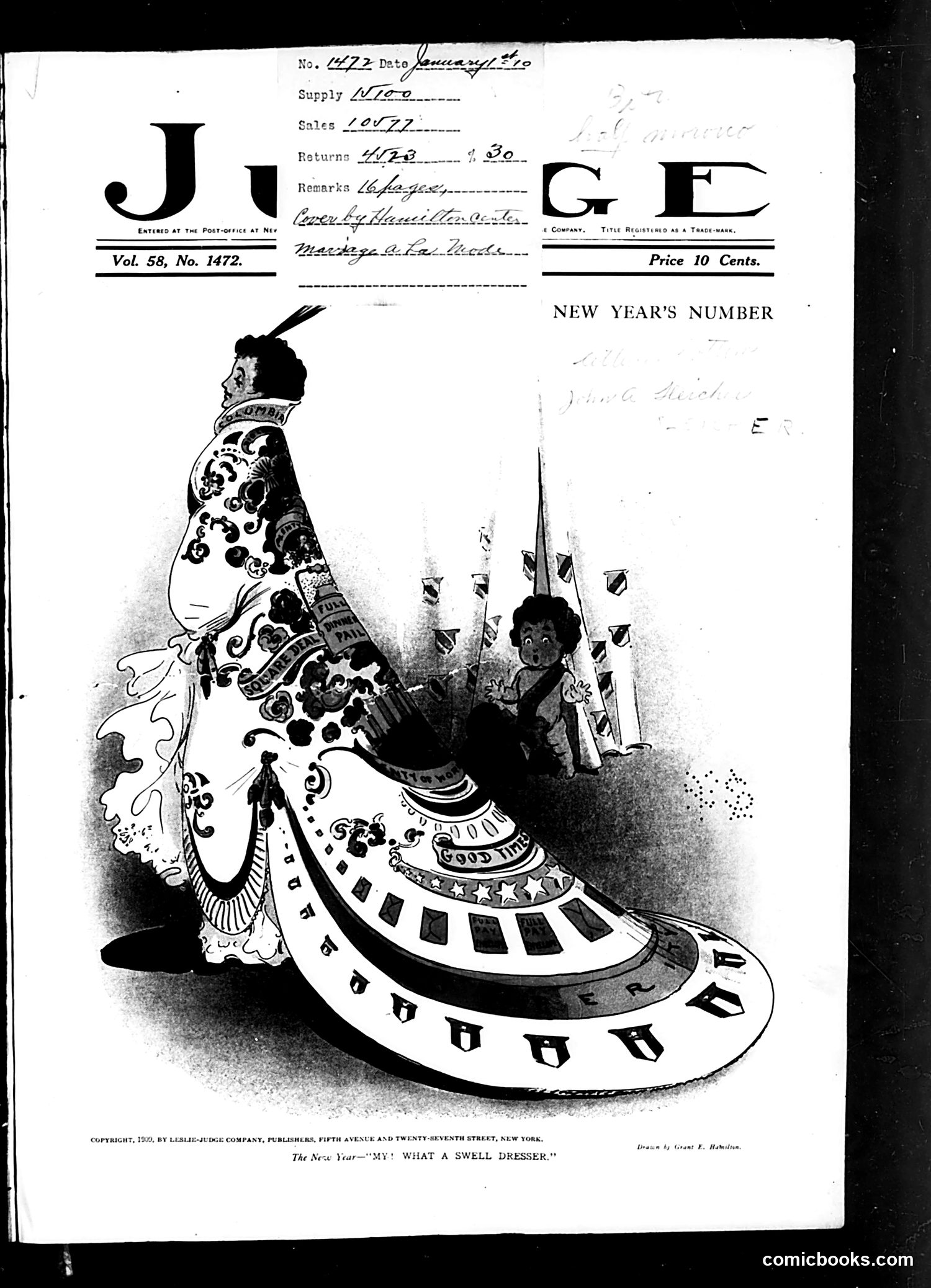
This is Judge magazine's New Year's issue (Vol. 58, No. 1472, dated January 1, 1910). The cover illustration titled "My! What a Swell Dresser" depicts an elaborately costumed figure in ornate, peacock-like formal wear, complete with feathered headdress and decorative train. The satire appears to mock excessive vanity and ostentatious fashion—someone so absorbed in their appearance that they've become absurdly overdressed. The figure's pompous, strutting pose emphasizes the ridicule of vanity. This was typical of Judge's social satire, using exaggerated visual humor to critique contemporary manners and pretension among the wealthy or fashionable classes. The specific identity of the figure remains unclear from the image alone.
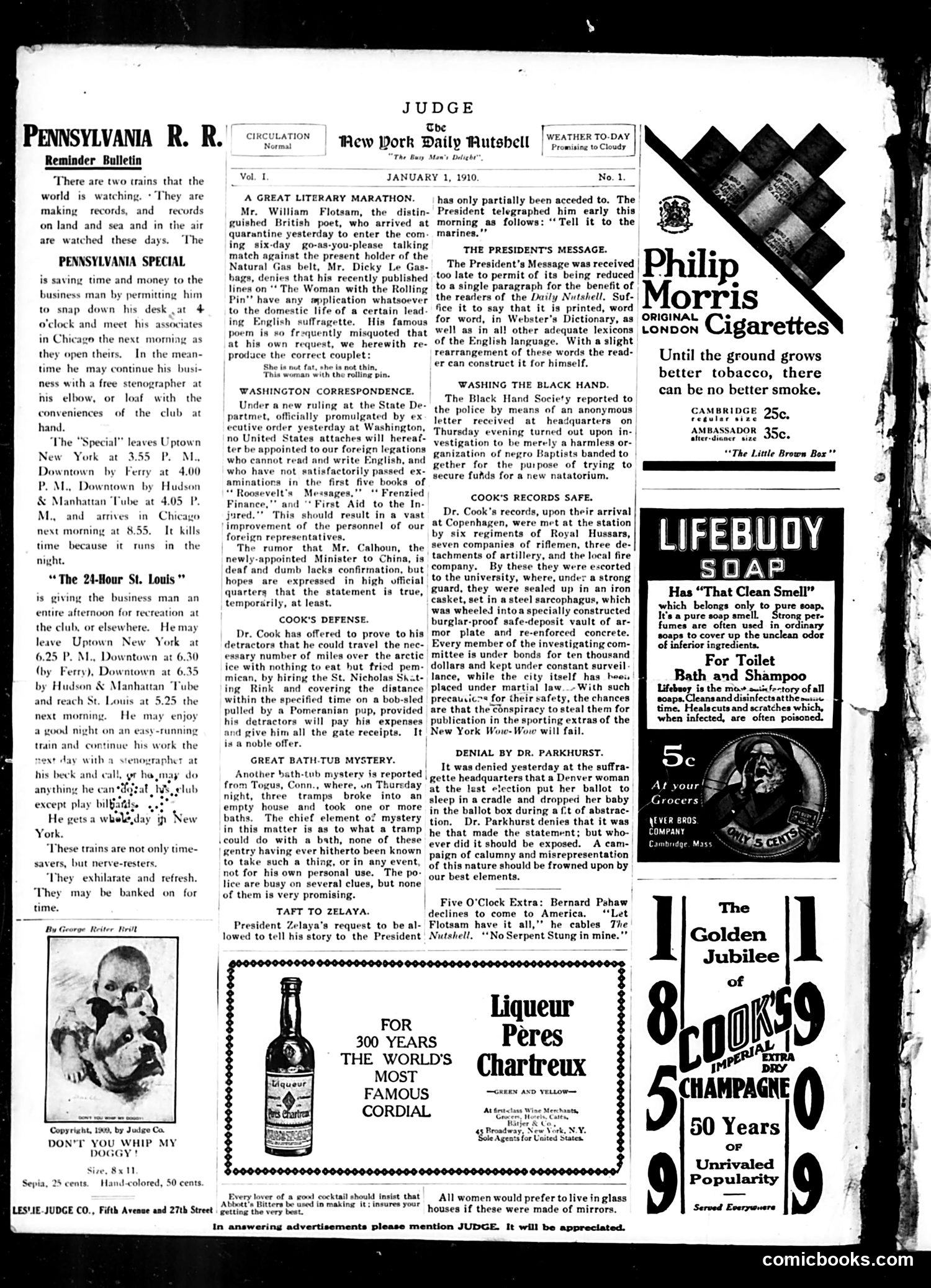
This page is primarily **advertisements and news items** rather than satirical cartoons. The notable content includes: **"Don't You Wish My Doggy"** — A small illustration captioned "Copyright, 1908, by Judge Co." showing a bulldog's face. This appears to be a humorous feature about a pet, though context is unclear from this excerpt. **News Items**: Several brief pieces cover mundane topics—Pennsylvania Railroad schedules, Washington correspondence about foreign negotiations, and Dr. Cook's arctic expedition records. **Advertisements dominate**: Philip Morris cigarettes, Lifebuoy soap, and Liqueur Pères Chartreux liquor occupy significant space. The page reflects Judge's format as a **general-interest satirical weekly** mixing light humor with social commentary and commercial advertising, rather than focused political satire.
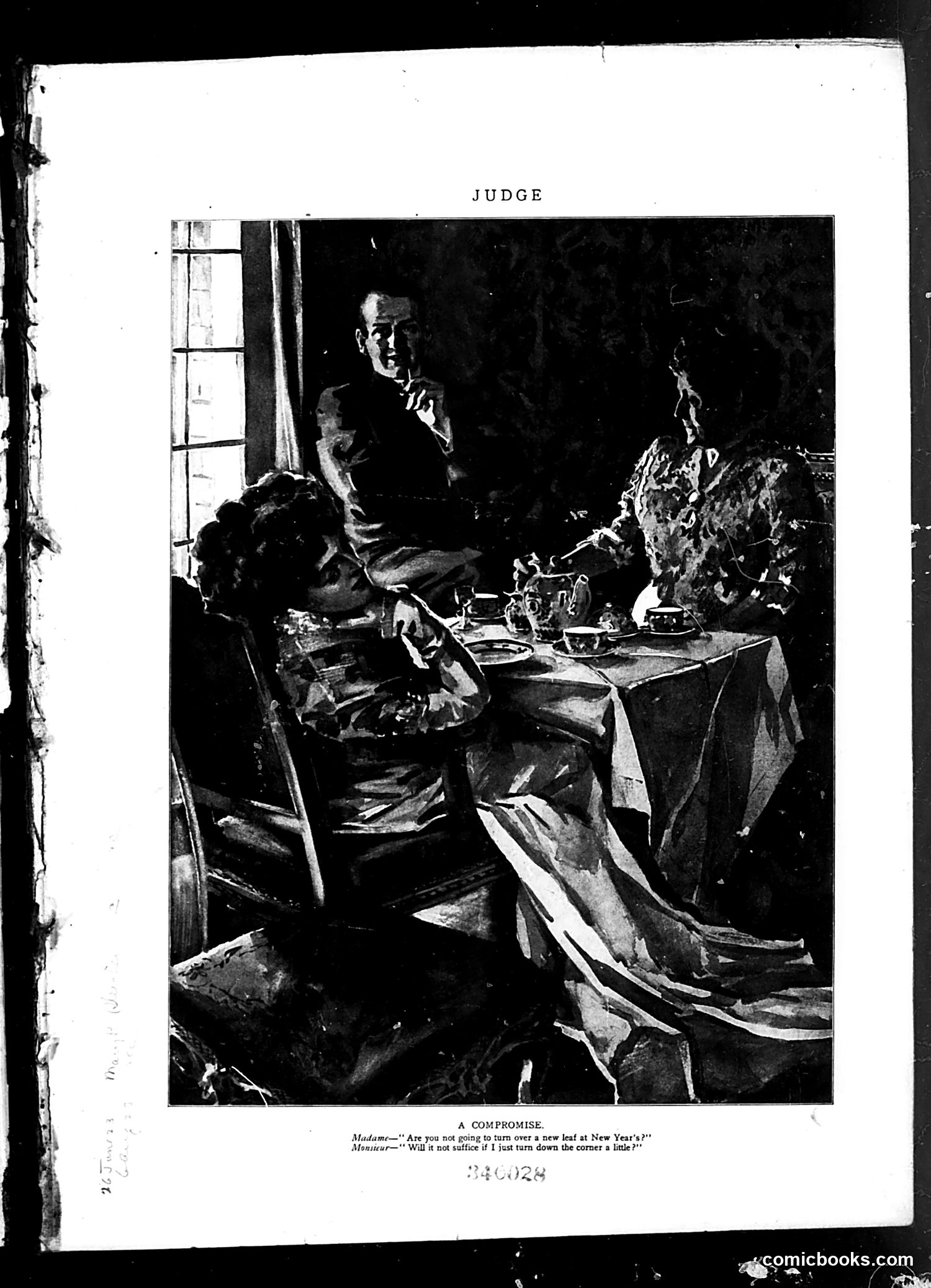
This political cartoon depicts three figures in what appears to be a New Year's negotiation scene. The dialogue reveals the satire's point: **Madame:** "Are you not going to turn over a new leaf at New Year's?" **Monsieur:** "Will it not suffice if I just turn down the corner's a bit?" The cartoon satirizes the reluctance to make genuine reform or change. Rather than fully committing to improvement (turning over a "new leaf"), one figure proposes only minimal, superficial adjustment ("turning down the corner"). This likely references political or social resistance to substantive reform around the New Year period. The elegant domestic setting and formal dress suggest this critiques bourgeois or political hypocrisy—the tendency to make token gestures rather than meaningful commitments to change.
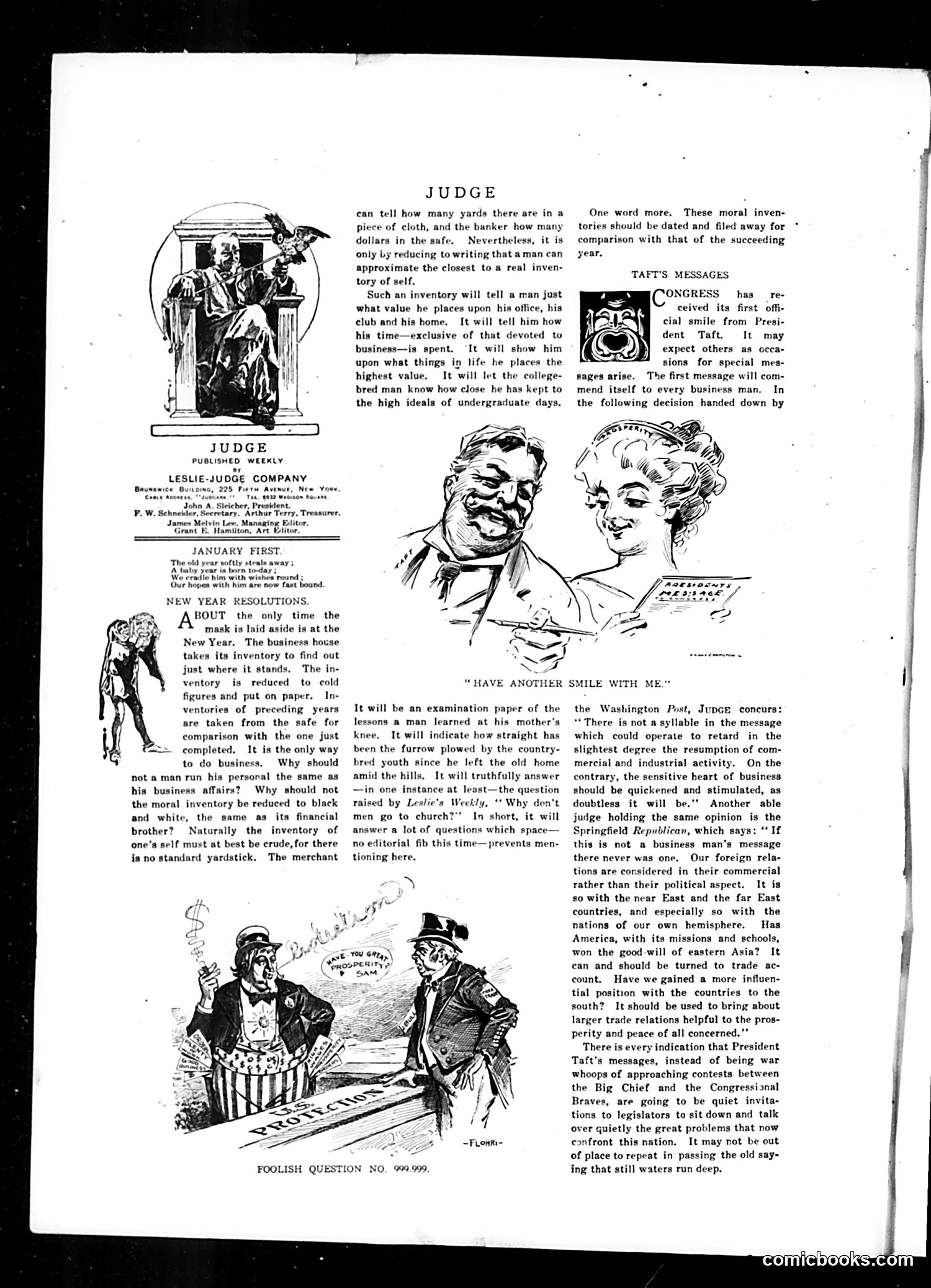
This page contains editorial content and satirical cartoons from Judge magazine. The main section, "Taft's Messages," discusses President Taft's official communications to Congress regarding business matters. The cartoon "Foolish Question No. 99,999" depicts two figures examining what appears to be a protective trade barrier or tariff (labeled "PROTECTION"), with one figure appearing surprised or questioning. This likely satirizes debates over protectionist trade policies during the Taft administration. The upper cartoon, "Have Another Smile With Me," shows two figures exchanging pleasantries, possibly satirizing political or commercial cheerfulness masking underlying tensions. The page reflects early 20th-century concerns with presidential policy, trade regulation, and business practices—topics Judge regularly mocked through visual satire and editorial commentary.
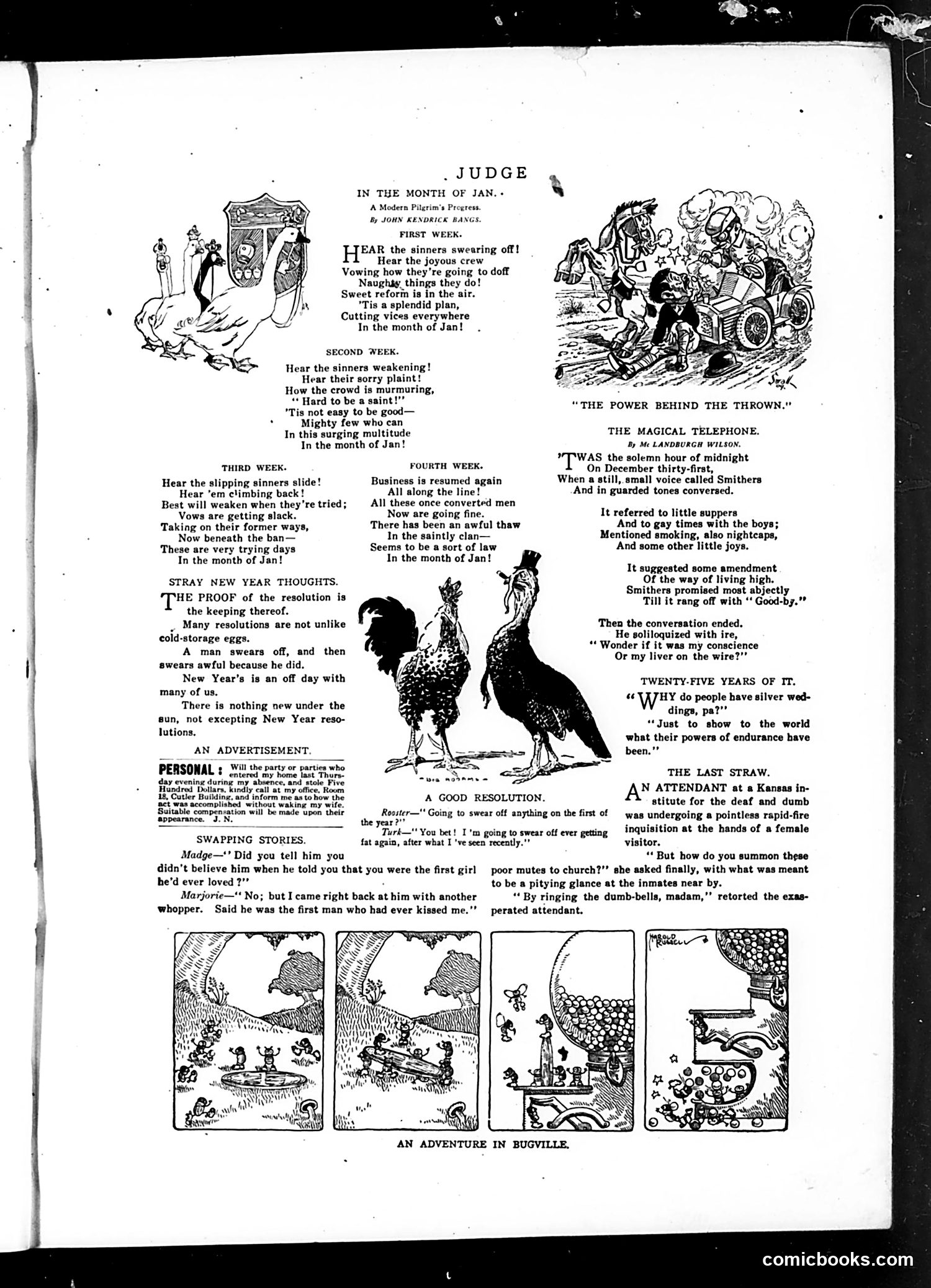
This page from **Judge** magazine (dated in the month of January, based on "In the month of Jan!" refrains) contains primarily **humorous verse and short stories** rather than political cartoons. The content includes: - **"Judge in the Month of Jan"** — satirical poems mocking New Year's resolutions, which the writer suggests are hollow and repetitive ("There is nothing new under the sun") - **"The Magical Telephone"** — a comedic story about a mysterious midnight phone call - **"A Good Resolution"** — a brief humorous anecdote about swearing off fat - **"An Adventure in Bugville"** — an illustrated serial story (shown in four comic panels at bottom) This appears to be **general-audience entertainment content** rather than pointed political satire. The jokes target timeless human foibles—broken resolutions, domestic confusion—rather than contemporary political figures or events.
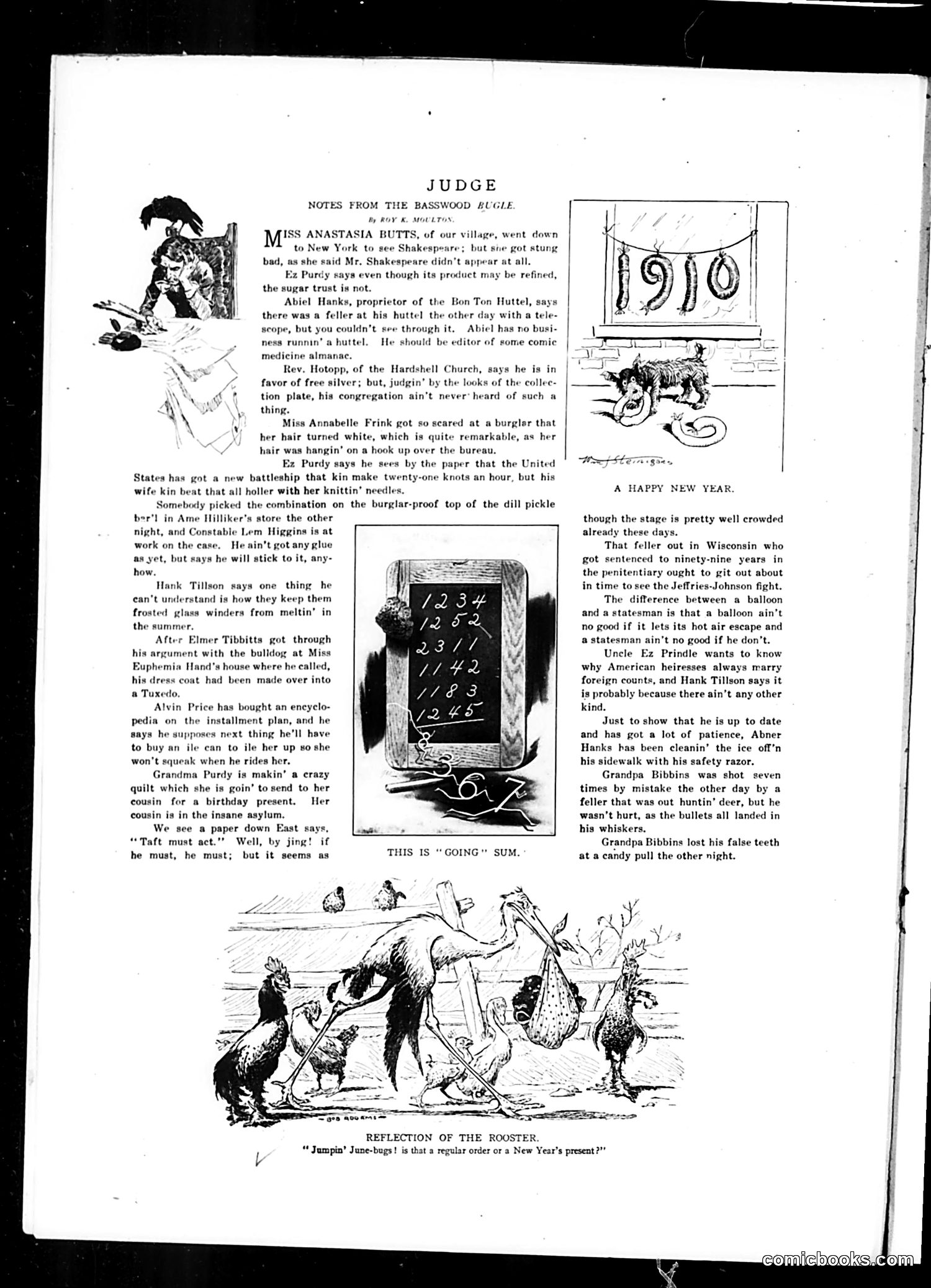
This page from **Judge** magazine presents rural humor through the "Basswood Bugle" column by Roy K. Moulton, featuring small-town gossip and observations from an unnamed village. The content satirizes small-town life and contemporary issues through folksy anecdotes: Miss Anastasia Butts's failed Shakespeare trip, burglars terrorizing locals, and technological confusion (Alvin Price buying an encyclopedia on installment). A reference to President Taft ("Taft must act") pokes fun at political expectations. The cartoons illustrate the column's humor: "A Happy New Year" shows dogs and a pig outside a storefront marked "1910," while "This Is 'Going' Sum" depicts a slate of debts. "Reflection of the Rooster" shows farm animals, with the caption implying surprise at an unusual request. Overall, the page ridicules rural simplicity, provincial attitudes, and Gilded Age social anxieties (heiresses marrying foreign counts) through gentle, humor-focused satire rather than sharp political commentary.
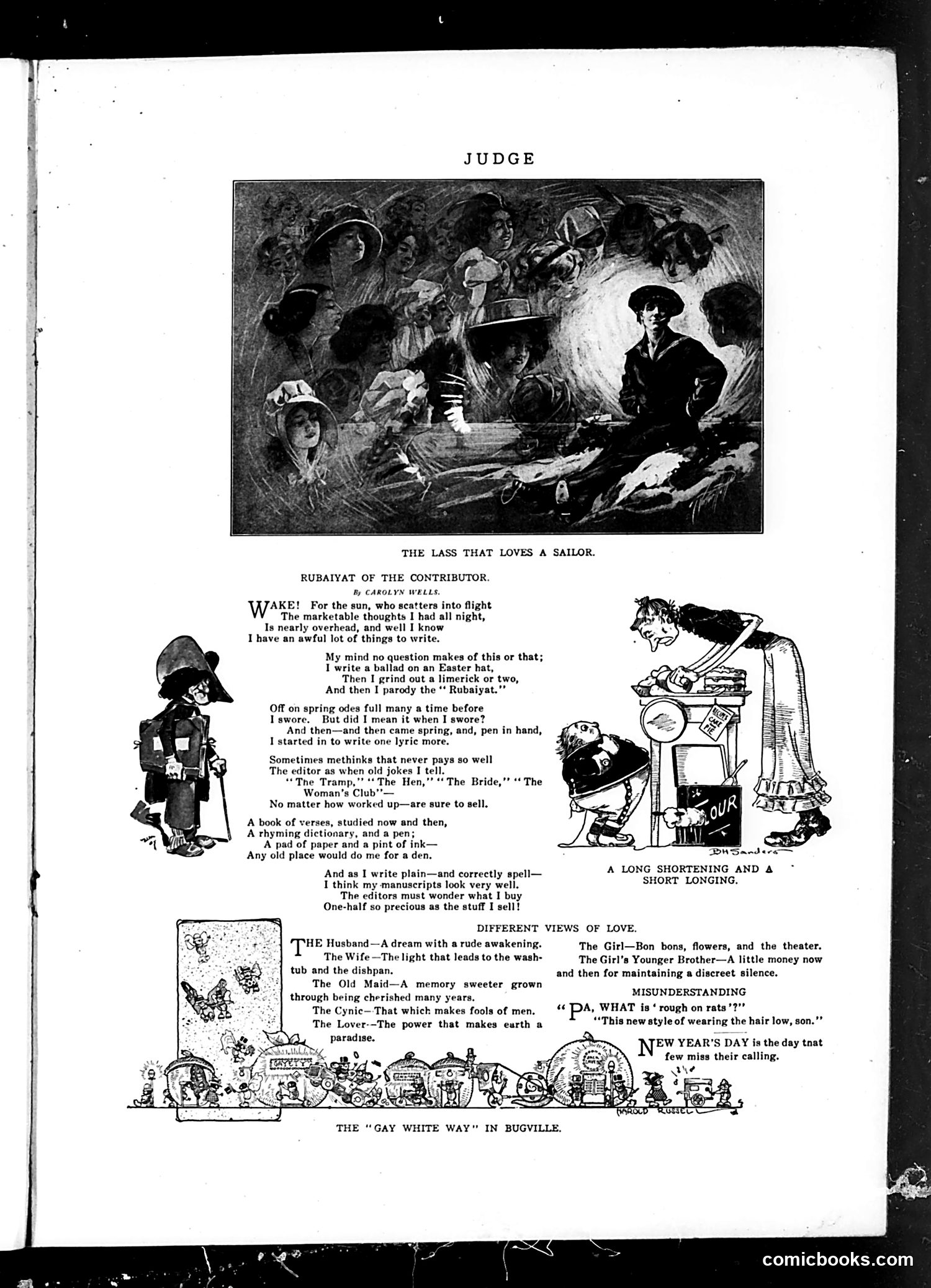
This page from Judge presents humorous content about writing and love, circa early 1900s. **"Rubaiyat of the Contributor"** by Carolyn Wells is a self-aware parody of Omar Khayyam's famous poem, but about a magazine contributor's creative struggles. The author jokes about recycling content—grinding out Easter hat ballads, limericks, and parodies—and notes that editors prefer rehashed material ("The Tramp," "The Hen," "The Bride," "Woman's Club") over original work. It's satirizing both hack writers and editors' predictable taste. **"Different Views of Love"** offers cynical takes on romance from various perspectives: husbands face "rude awakenings," wives see only dishpans, old maids romanticize memory, cynics see foolishness, while girls want material goods. The "Girl's Younger Brother" requires bribes for "discreet silence"—suggesting impropriety. The small illustrations and scattered humor reflect Judge's typical miscellaneous satirical format, poking fun at contemporary writing culture and courtship customs.
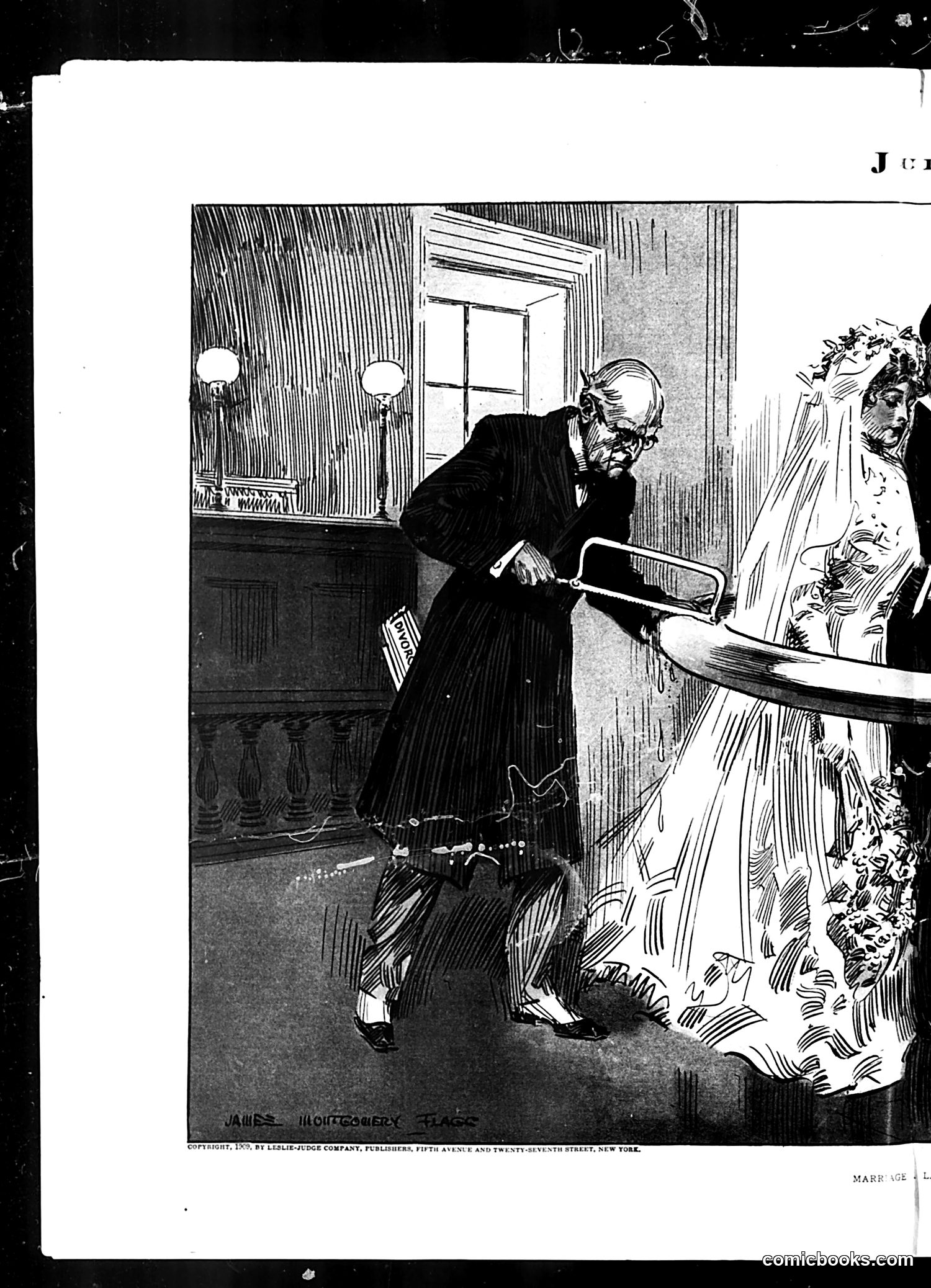
This is a black and white satirical cartoon from **Judge** magazine showing an elegantly dressed woman in an elaborate wedding gown and veil being examined or measured by an older man in formal attire holding what appears to be a measuring or evaluation tool. The cartoon appears to satirize the **commodification of marriage**, likely critiquing the practice of evaluating potential brides based on material or physical standards rather than genuine affection. The woman's ornate dress emphasizes her status as a "product" being assessed. The exact historical context and identities of specific figures remain unclear from the visible text, which is largely illegible in the OCR. The signature appears to be by James Montgomery Flagg, a prominent Judge cartoonist of the early 1900s.
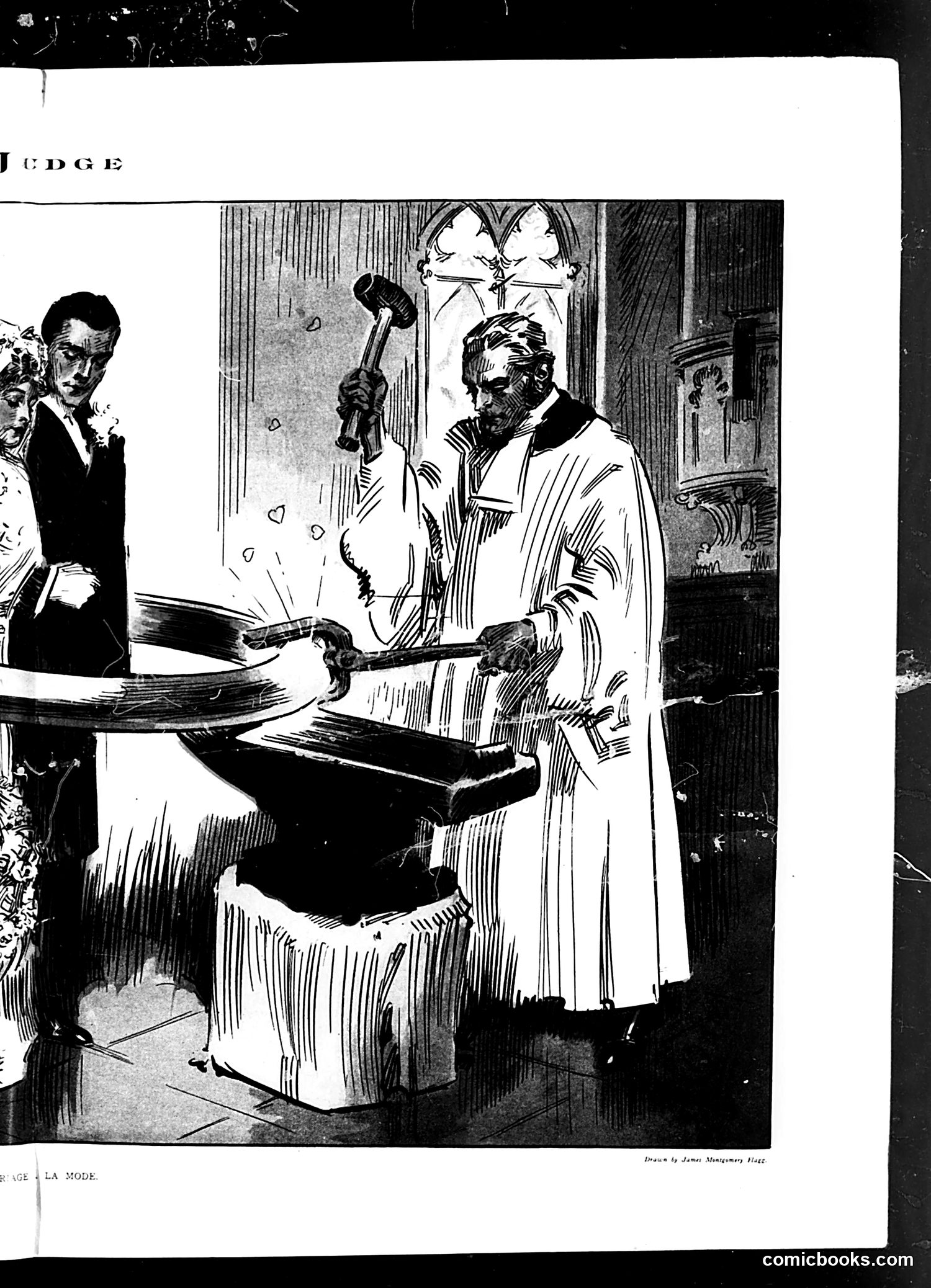
The page header reads "JUDGE" and shows what appears to be a satirical illustration. The main image depicts a man in robes (likely a judge or clergyman) working at an anvil with a hammer, while a well-dressed man in dark clothing watches from the left side. The OCR text is too fragmented to provide clear context. The illustration's specific satirical point—whether it concerns judicial reform, religious authority, labor practices, or another social/political issue of the era—cannot be determined with confidence from the image alone. The craftwork/anvil imagery suggests commentary on work or creation, but without clearer text or additional context, the precise meaning remains unclear.
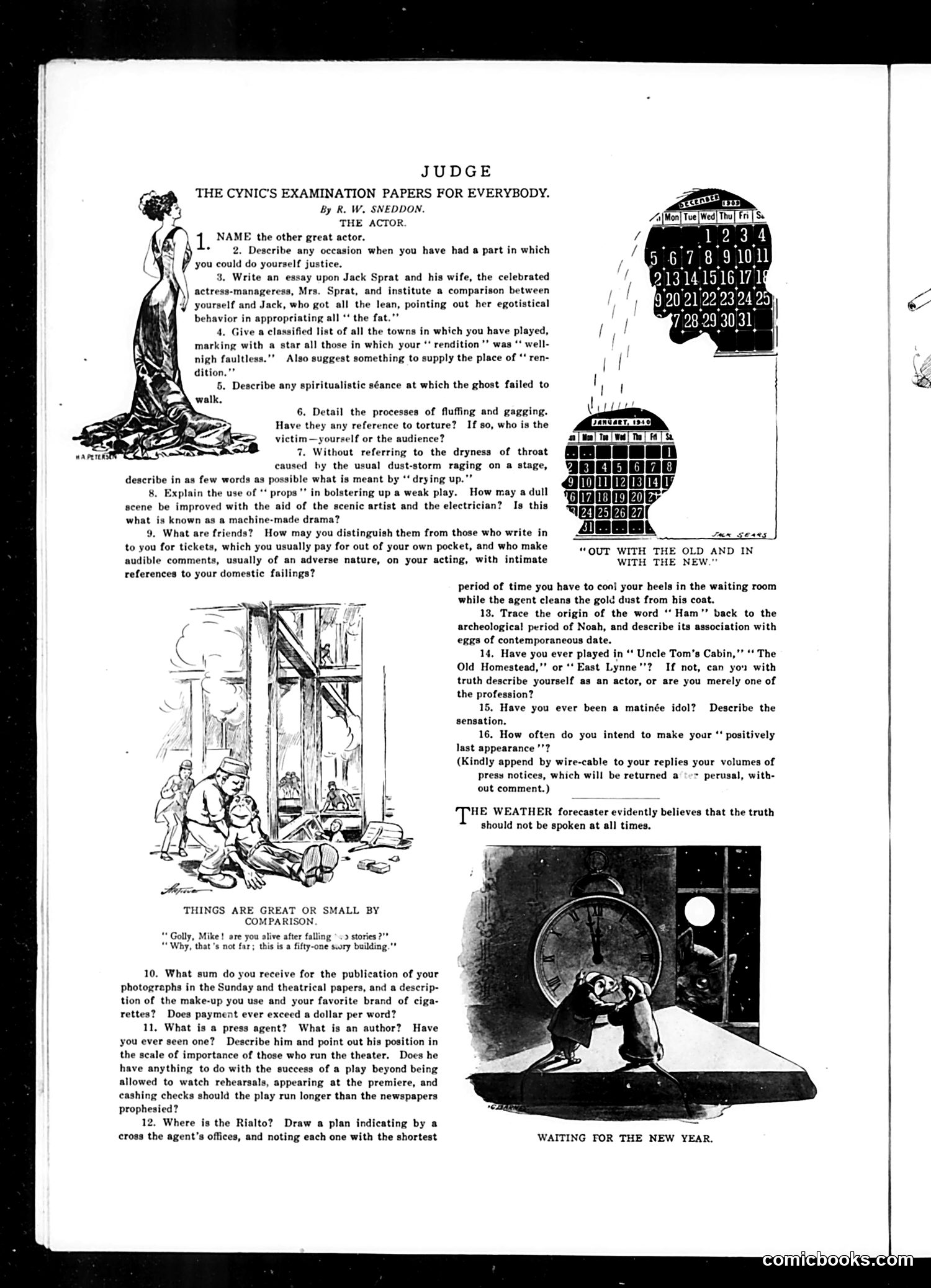
This is a satirical examination for actors, mocking theatrical pretension and self-deception. "The Cynic's Examination Papers" humorously exposes common acting industry absurdities: **The satire targets:** - Actors' inflated self-importance (Question 1 sarcastically asks them to name "the other great actor") - Fake credentials and exaggerated claims of success - The relationship between actors and their parasitic entourages (press agents, ticket-seekers) - Theatre industry phoniness ("machine-made drama," "drying up," using props to cover weak performances) **Key jokes:** - "Ham" acting traced back to Noah (Question 13)—implying bad acting is ancient - The "matinée idol" question mocking celebrity worship - The final cartoon shows actors as merely tall buildings compared to humans—emphasizing their inflated egos versus actual significance The accompanying illustration of people dwarfed by a building reinforces the point: things seem great only by comparison. Judge magazine regularly attacked theatrical pretension and humbug with this type of biting humor.
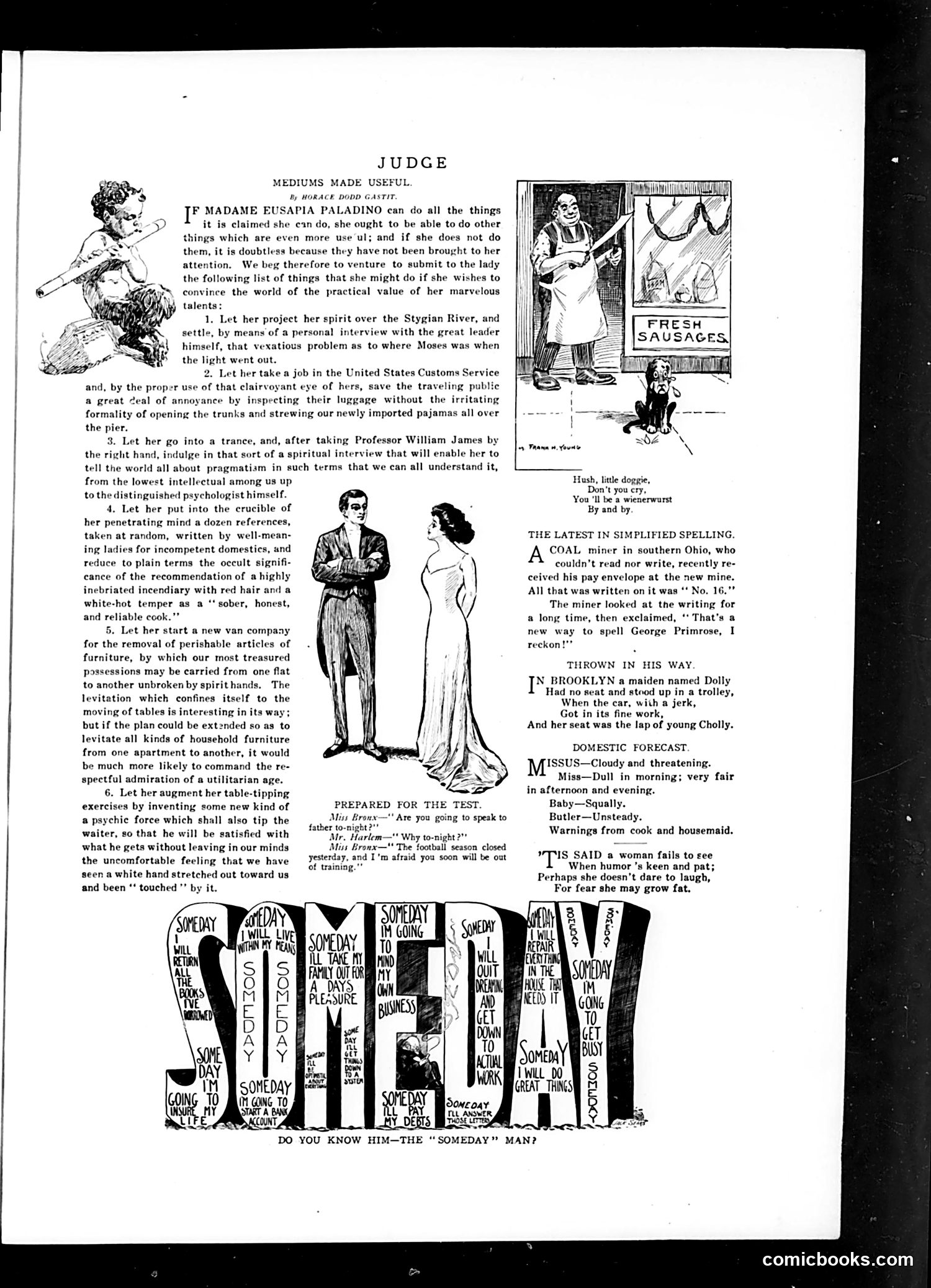
This Judge magazine page satirizes spiritualism and the famous medium **Eusapia Paladino**, a real Italian spiritualist claiming supernatural powers in the early 1900s. The main article humorously suggests practical uses for her alleged abilities—inspecting luggage at customs, explaining philosophy, decoding vague servant references, and moving furniture without damage. The satire mocks both Paladino's claims and society's credulity. References to "Professor William James" invoke the Harvard psychologist who investigated spiritualism, lending false legitimacy. The lower cartoons are unrelated jokes: one about "Someday" promises (aspirational daydreaming), one about a coal miner misreading his pay envelope number as a name, one about a trolley accident creating an unwanted lap-seat, and brief domestic/weather humor. The "wienerwurst" joke plays on simplistic humor about hot dogs and anthropomorphization common to early 20th-century American comics.
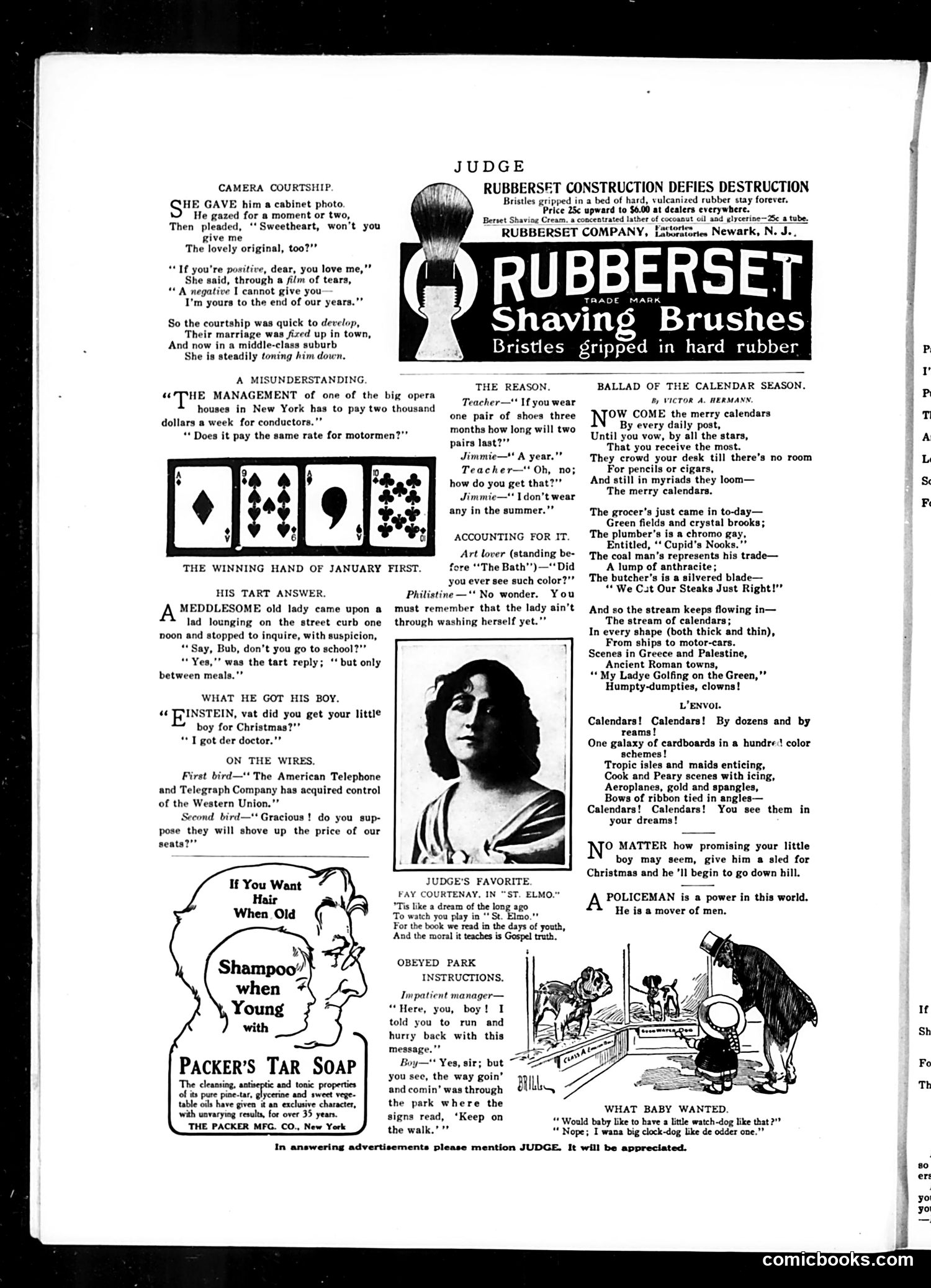
This page from the satirical magazine **Judge** contains several brief humorous pieces and advertisements typical of early 20th-century American humor. **Main Cartoons/Stories:** - **"Camera Courtship"**: A poem mocking how romantic courtship quickly leads to marriage, after which the wife "steadily tones him down"—satirizing the deflation of married life. - **"A Misunderstanding"**: A joke about opera house conductors being paid $2,000/week, questioning why motormen aren't paid the same rate—likely commenting on wage disparity or absurd salary structures. - **"What He Got His Boy"**: A father says he got his son "der doctor" for Christmas—a play on words suggesting the child was sick/needed medical attention rather than receiving a gift. - **"The Reason"**: A schoolteacher's logic puzzle where a student claims two pairs of shoes last a year because he doesn't wear shoes in summer—gentle satire of childhood reasoning. The page is largely **advertisements** (Rubberset brushes, Packer's Tar Soap) mixed with light domestic humor aimed at middle-class readers.
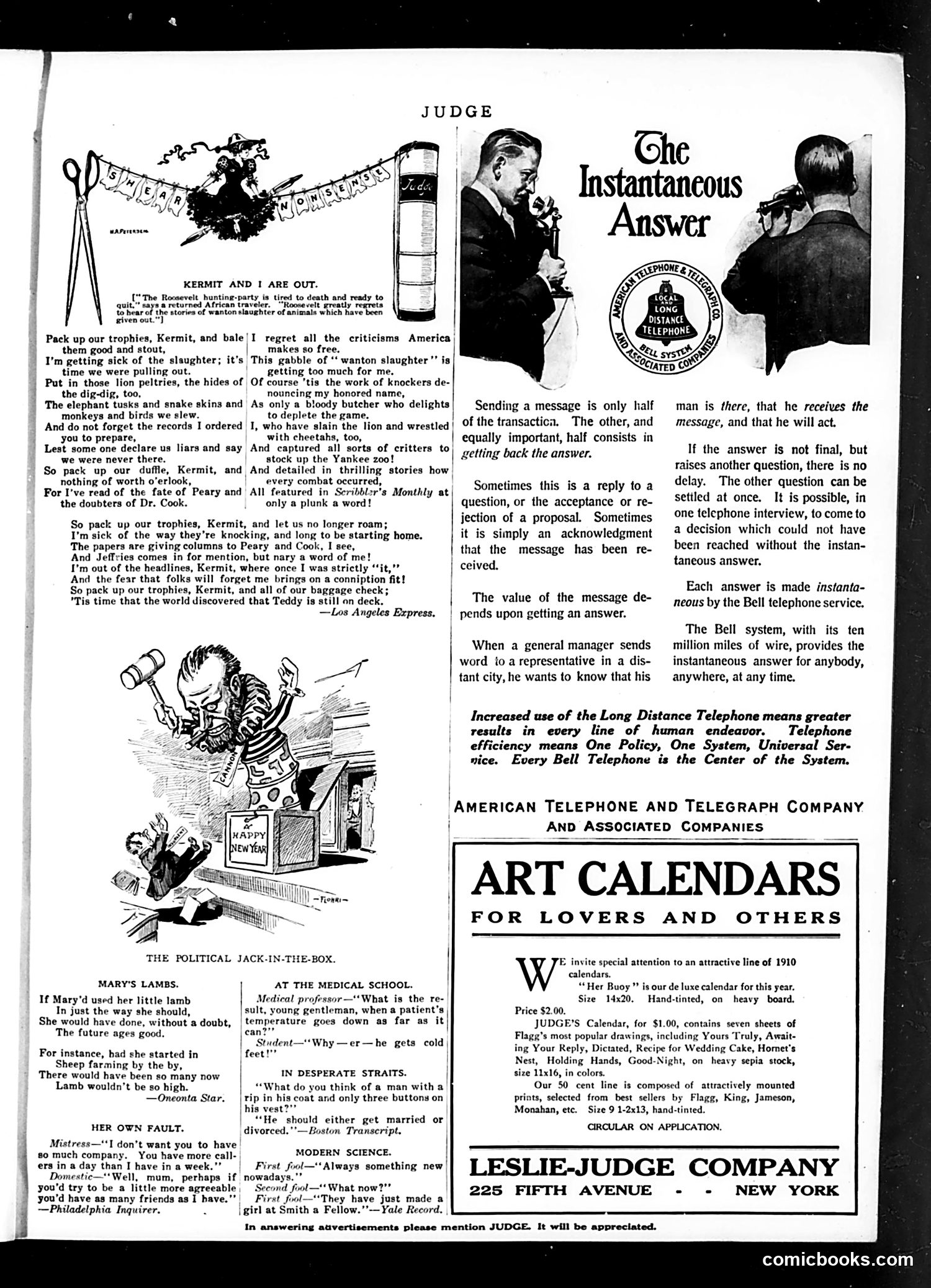
This satirical poem mocks former President Theodore Roosevelt's 1909-1910 African hunting expedition. Roosevelt, depicted as obsessed with his public image, complains that critics call his trophy hunting "wanton slaughter" and deplete game stocks. The satire's bite: Roosevelt claims to regret the criticism, yet his real complaint is vanity—he's upset that newspapers give more coverage to rival explorers Peary and Cook, and that he's "out of the headlines." His solution? Return home to remind America "that Teddy is still on deck." The cartoon targets Roosevelt's outsized ego and self-promotion. Despite framing the hunting trip as scientific exploration, Roosevelt is revealed as primarily concerned with fame and media attention. The phrase "the world discovered that Teddy is still on deck" perfectly captures the satire: Roosevelt's expedition abroad was ultimately about keeping himself in the American spotlight. This reflects real contemporary criticism of Roosevelt's celebrity and his tendency to dominate national discourse.
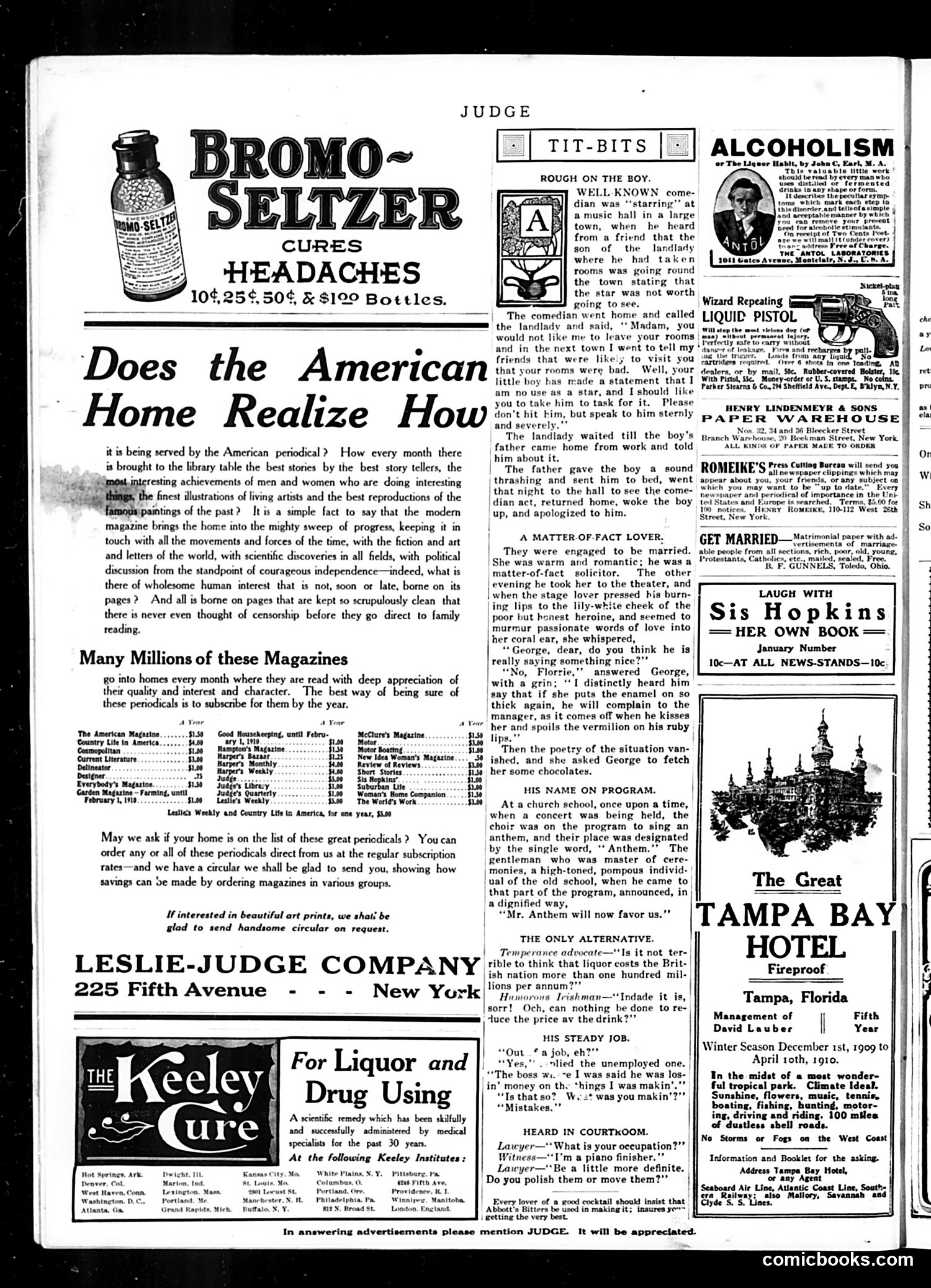
This is primarily an **advertising and miscellaneous content page** rather than a satirical cartoon page. The main elements are: **Advertisements:** - Bromo-Seltzer (headache remedy) - Keeley Institutes (alcohol and drug addiction treatment) - Tampa Bay Hotel in Florida - Leslie-Judge Company magazine subscriptions **Editorial Content:** Several brief humorous anecdotes in the "Tit-Bits" section, including: - "Rough on the Boy": A comedian pressures a landlady to discipline her son for criticizing his performance - "Matter-of-Fact Lover": A romantic woman frustrated by her solicitor fiancé's emotional coldness The page reflects **early 1900s social concerns**: alcohol dependency (Keeley Institutes were genuine treatment centers), patent medicine remedies, and gender dynamics regarding emotional expression in courtship. The humor is gentle, domestic, and moralistic rather than political satire—typical of Judge's family-magazine content of this era.
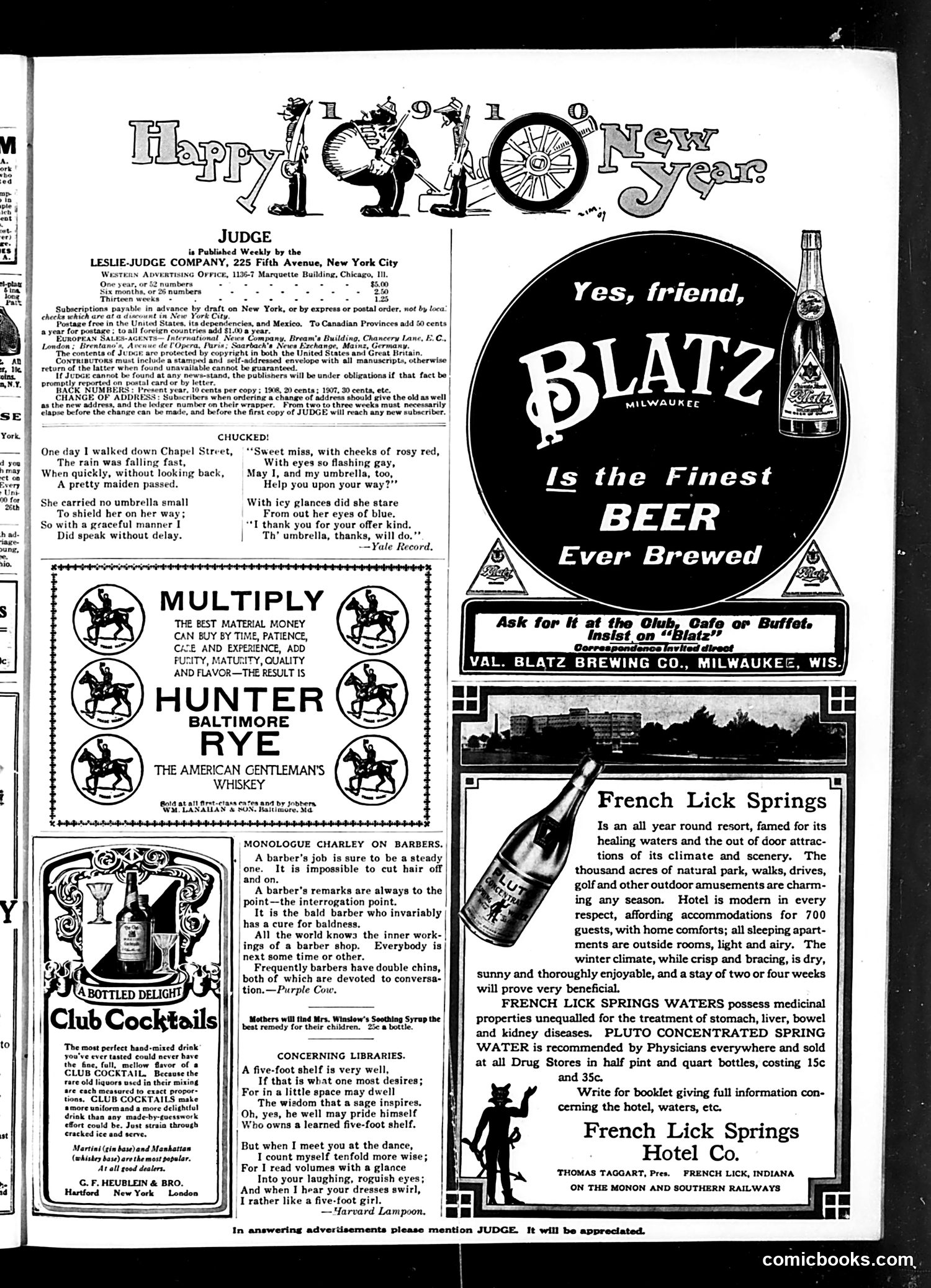
This is primarily an **advertising and editorial page** from Judge magazine's New Year's edition (evident from the decorative "Happy New Year" header with the number 1910). The main content includes: 1. **"Chucked!" poem**: A humorous short verse about a man offering his umbrella to a woman on a rainy street, who rebuffs him—a light romantic joke typical of the era. 2. **Advertisements**: The page is dominated by ads for products including Hunter Baltimore Rye whiskey, Blatz beer, Club Cocktails, and French Lick Springs resort. These reflect early 20th-century consumer culture. 3. **Minor humor pieces**: Brief monologues and quips about barbers and libraries provide filler content. **Historical context**: The ads reveal what affluent readers valued—premium alcohol, luxury resorts with "healing waters," and gentlemanly refinement. The magazine itself, published in New York, targeted educated, upper-class readers with disposable income. There is no significant political satire on this particular page.
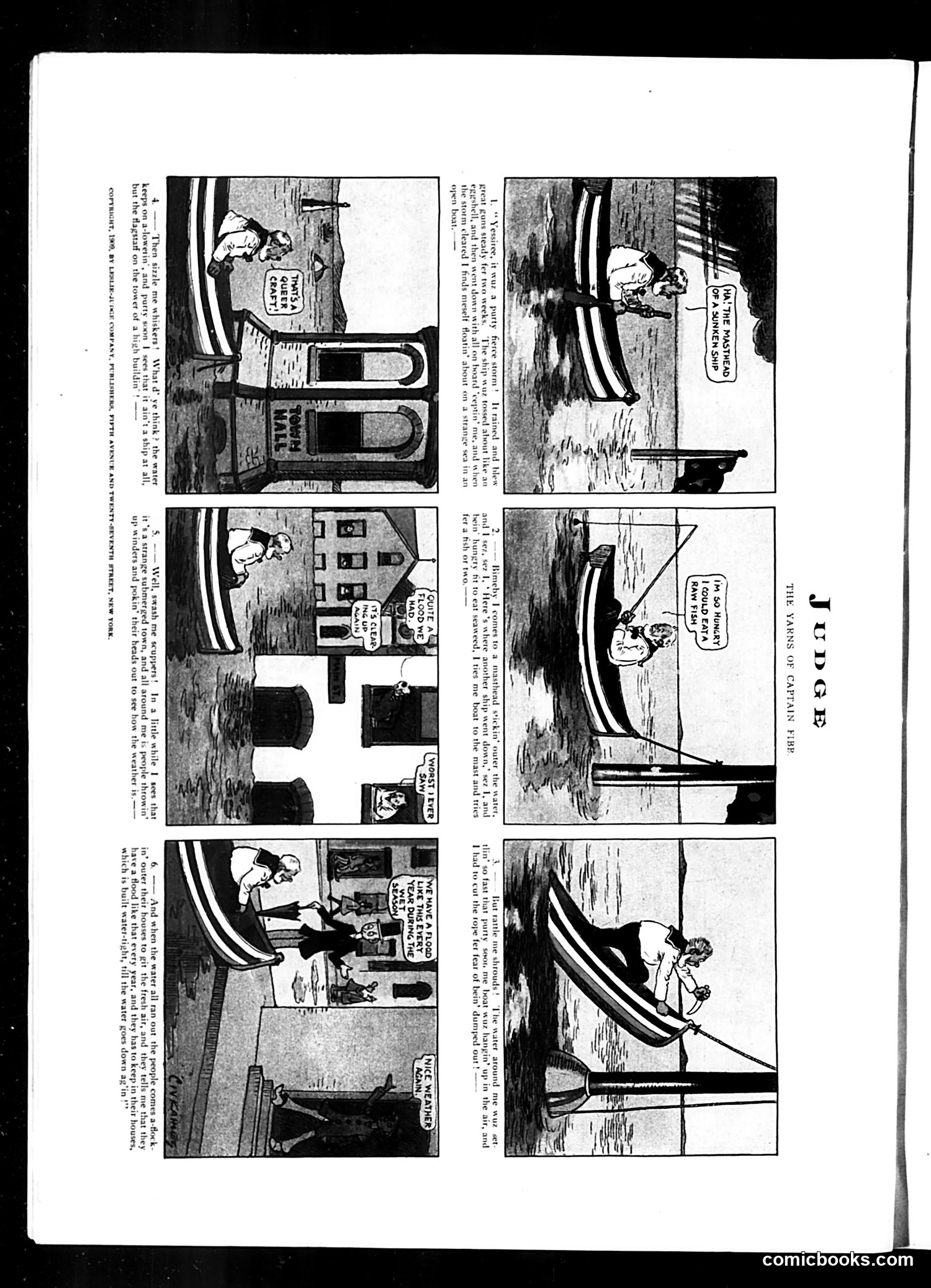
This is a comic strip series titled "The Yarns of Captain Fib," satirizing a character known for exaggeration and tall tales. The strip appears to mock someone who fabricates outlandish stories—a "fibber" or chronic liar. In the visible panels, Captain Fib boasts about eating a massive ship's masthead while starving, exemplifying the absurdly implausible claims the character is known for. The satire targets habitual liars and their increasingly ridiculous fabrications. The title character's name ("Fib" = small lie) underscores the comic's theme: exposing transparent dishonesty through exaggeration. This reflects Judge magazine's tradition of satirical humor targeting recognizable character types and social behaviors, making the implausibility itself the joke.