
Judge, 1910-01-01 · page 10 of 16
Judge — January 1, 1910 — page 10: what you’re looking at
What you’re looking at
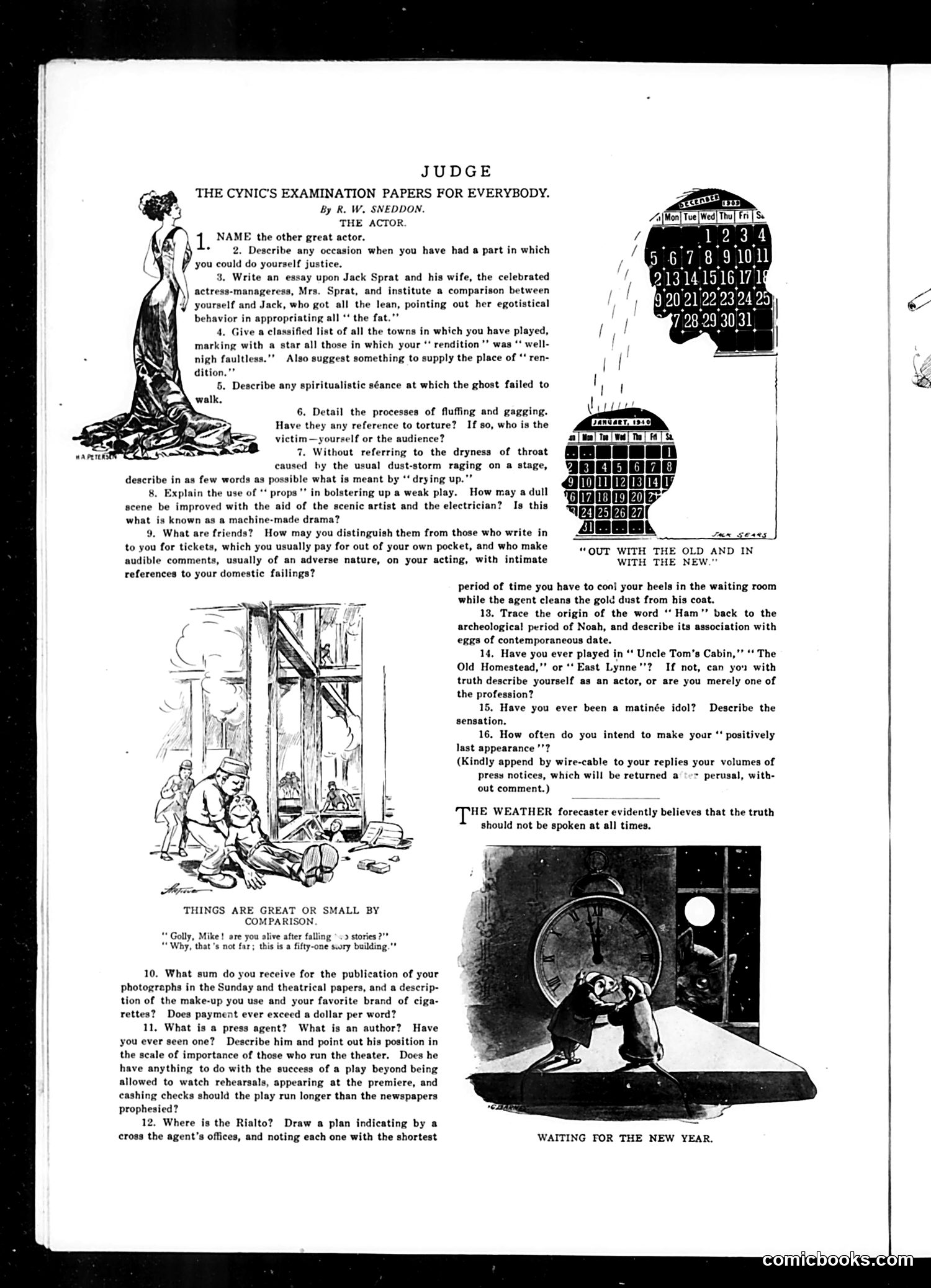
This is a satirical examination for actors, mocking theatrical pretension and self-deception. "The Cynic's Examination Papers" humorously exposes common acting industry absurdities: **The satire targets:** - Actors' inflated self-importance (Question 1 sarcastically asks them to name "the other great actor") - Fake credentials and exaggerated claims of success - The relationship between actors and their parasitic entourages (press agents, ticket-seekers) - Theatre industry phoniness ("machine-made drama," "drying up," using props to cover weak performances) **Key jokes:** - "Ham" acting traced back to Noah (Question 13)—implying bad acting is ancient - The "matinée idol" question mocking celebrity worship - The final cartoon shows actors as merely tall buildings compared to humans—emphasizing their inflated egos versus actual significance The accompanying illustration of people dwarfed by a building reinforces the point: things seem great only by comparison. Judge magazine regularly attacked theatrical pretension and humbug with this type of biting humor.
📄 Transcribed text from this page (OCR, searchable)
Machine-transcribed from the original scan — historical spelling and the odd misread are preserved.
JUDGE THE CYNIC’S EXAMINATION PAPERS FOR EVERYBODY. By R. W. SNEDDON. THE ACTOR NAME the other great actor. * 2. Deseribe any occasion when you have had a part in which you could do yourself justice. 3. Write an essay upon Jack Sprat and his wife, the celebrated actress-manageress, Mrs. Sprat, and institute a comparison between Y yourself and Jack, who got all the lean, pointing out her egotistical behavior in appropriating all “‘ the fat.’” ive a classified list of all the towns in which you have played, marking with a star all those in which your ‘* rendition '’ was ‘* well- nigh faultless."" Also suggest something to supply the place of “‘ ren- dition.” 5. Describe any spiritualistic séance at which the ghost failed to 6, Detail the processes of fluffing and gagging. » they any reference to torture? If 80, who is the victim—yourself or the audience? eT 7. Without referring to the dryness of throat caused by the usual dust-storm raging on a stage, describe in as few words as possible what is meant by “drying up."” 8. Explain the use of * props "’ in bolstering up a weak play. How may a dull scene be improved with the aid of the scenic artist and the electrician? Is this what is known as a machine-made drama? 9. What are friends? How may you distinguish them from those who write in soar to you for tickets, which you usually pay for out of your own pocket, and whomake “our WITH THE OLD AND IN audible comments, usually of an adverse nature, on your acting, with intimate WITH THE NEW." references to your domestic failings? <5 J period of time you have to cool your heels in the waiting room while the agent cleans the gold dust from his coat. 13, Trace the origin of the word “Ham” back to the archeological period of Noah, and describe its association with eggs of contemporaneous date. 14. Have you ever played in “* Uncle Tom's Cabin,”” “ The Old Homestead,” or ‘East Lynne'’? If not, can you with truth describe yourself as an actor, or are you merely one of the profession? 15, Have you ever been a matinée idol? Describe the sensation. 16. How often do you intend to make your “ positively last appearance ""? (Kindly append by wire-cable to your replies your volumes of press notices, which will be returned a'‘-> perusal, with- out comment.) Ts WEATHER forecaster evidently believes that the truth should not be spoken at all times. THINGS ARE GREAT OR SMALL BY COMPARISON “Golly, Mike! are you alive after falling *.> stories ?"* "* Why, that 's not far; this is a fifty-one swory building."* 10. What sum do you receive for the publication of your photographs in the Sunday and theatrical papers, and a descrip- tion of the make-up you use and your favorite brand of ciga- rettes? Does payment ever exceed a dollar per word? 11, What is a press agent? What is an author? Have you ever seen one? Describe him and point out his position in the scale of importance of those who run the theater. Does he have anything to do with the success of a play beyond being allowed to watch rehearsals, appearing at the premiere, and cashing checks should the play run longer than the newspapers prophesied? 12, Where is the Rialto? Draw a plan indicating by a cross the agent's offices, and noting each one with the shortest