
A complete issue · 17 pages · 1909
Judge — December 25, 1909
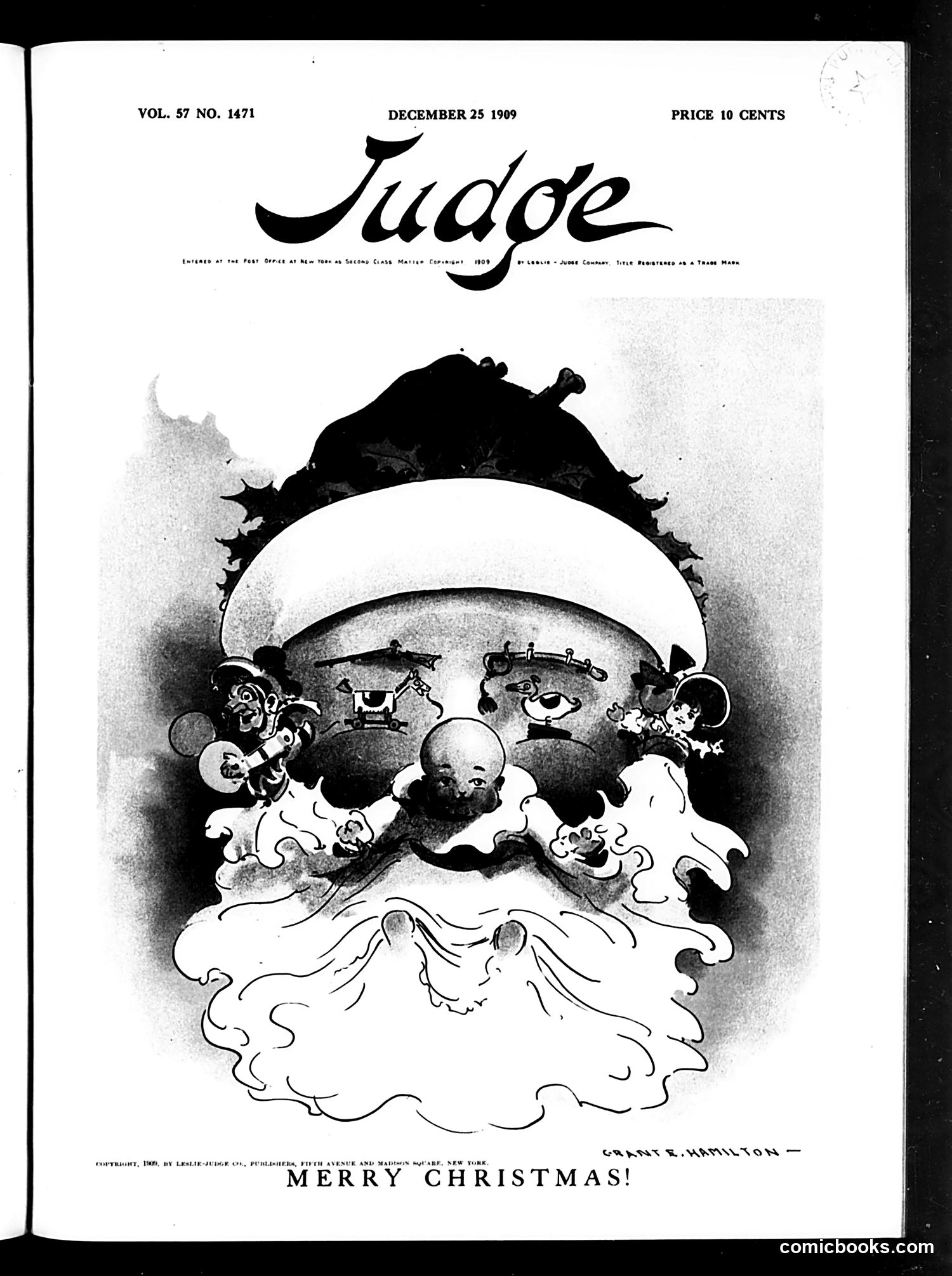
This is a Christmas-themed cover illustration by Grant E. Hamilton featuring Santa Claus surrounded by toys and cherubs. The central figure is an exaggerated Santa with a prominent beard, wearing a traditional cap and white fur trim. Around him are various toys and small cherub-like figures, creating a festive composition. The illustration appears to be purely seasonal rather than political satire. It's a straightforward "Merry Christmas!" greeting typical of holiday magazine covers from this era. There's no apparent political commentary or social satire visible—Judge simply published a cheerful Christmas cover for their December 25 issue, priced at 10 cents. The artistic style and subject matter are consistent with early 20th-century holiday entertainment publications.
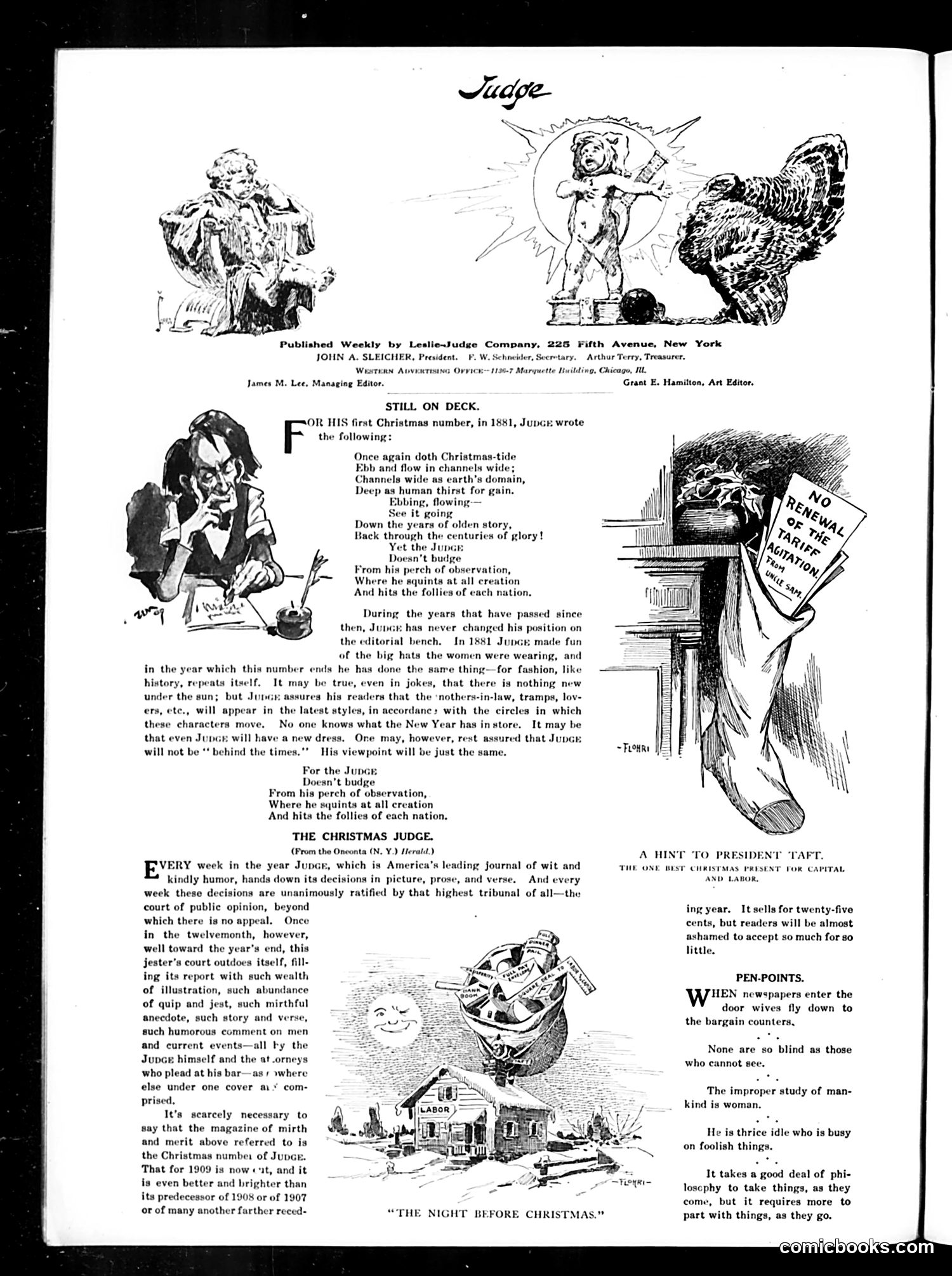
This appears to be a Christmas-themed editorial page from Judge magazine's 1881 holiday issue. The main text "Still on Deck" presents Judge as an observer commenting on human nature and current events from an elevated vantage point—a recurring conceit for the publication. The editorial argues that despite fashion and style changes, human behavior remains constant across centuries. It references Judge's role as America's premier satirical publication, offering "wit and kindly humor" through illustrations and commentary on politics, society, and current events. The accompanying cartoons include "The Night Before Christmas" illustration and sections titled "A Hint to President Taft" and "Pen-Points" containing brief satirical observations. The overall tone celebrates Judge's established position as a trusted arbiter of public opinion and social commentary.
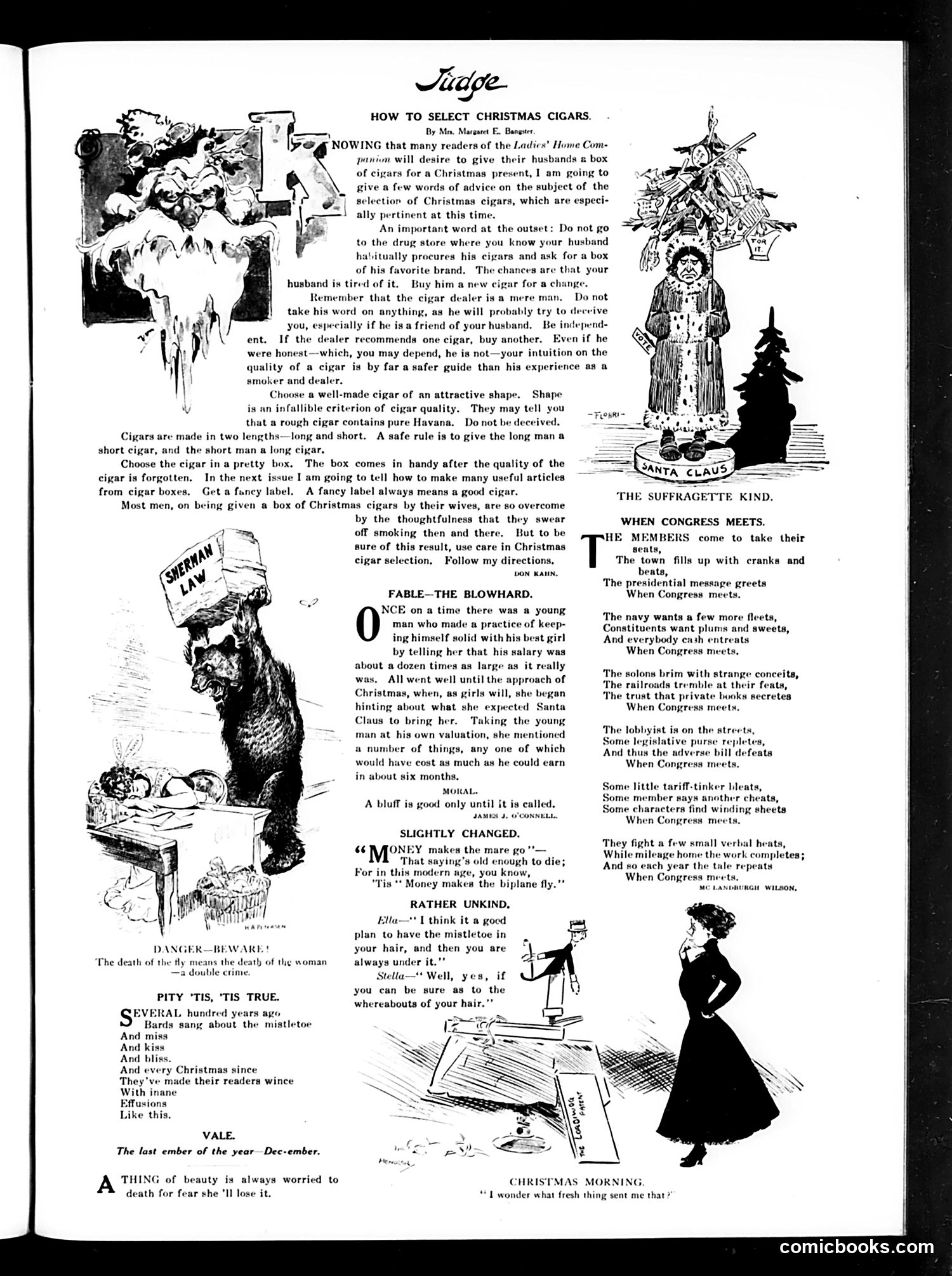
This Judge magazine page combines practical advice with satirical commentary on early 20th-century American life. **Main Content:** The top article, "How to Select Christmas Cigars" by Margaret E. Sangster, offers genuine gift-buying guidance—avoid asking husbands' preferred brands, as dealers may deceive you; choose well-made cigars of attractive shape. **Satirical Sections:** Multiple short pieces mock contemporary issues: "Fable—The Blowhard" ridicules a young man inflating his salary to impress his girlfriend. "When Congress Meets" uses repetitive verse to satirize legislative inefficiency and naval politics. "Rather Unkind" jokes about mistletoe as a marital control device. The scattered illustrations reinforce these themes—a deceived woman, a man under mistletoe, holiday-related scenarios. The overall tone treats domestic and political absurdities with light humor typical of Judge's satirical approach.
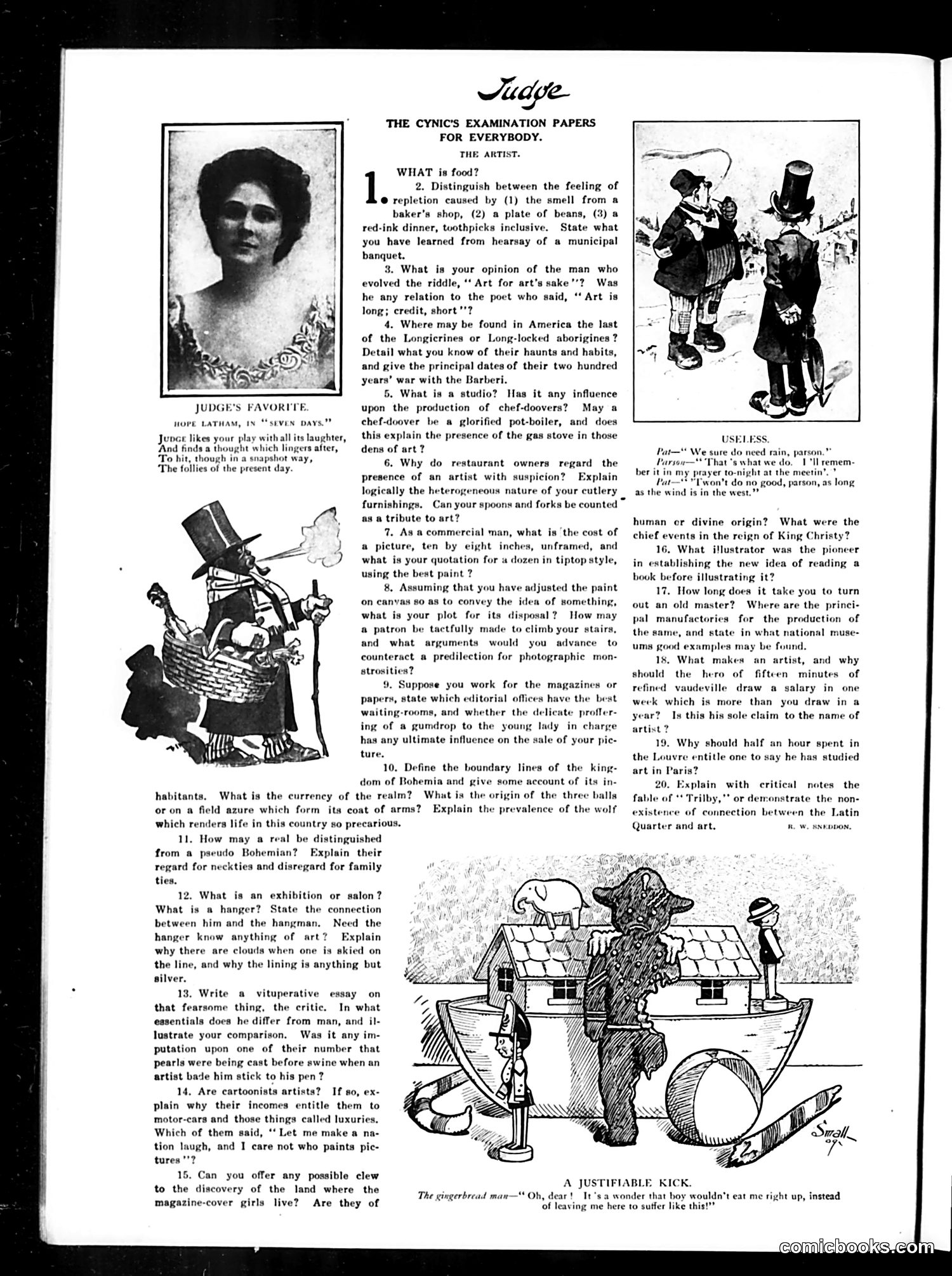
This page presents "The Cynic's Examination Papers for Everybody"—a series of satirical questions targeting various professions and social pretenses. The three cartoons mock: 1. **"Judge's Favorite"** (top left): References Hope Latham in "Seven Days," likely a theatrical production, satirizing artistic pretension. 2. **"Useless"** (top right): Shows two well-dressed men debating whether rain is needed, with one claiming uselessness as long as "the wind is in the west"—mocking wealthy idlers disconnected from practical concerns. 3. **"A Justifiable Kick"** (bottom): Depicts a gingerbread man complaining to a baker that he wasn't eaten "right up," instead being left to suffer—a darkly humorous critique of consumer complaint culture. The accompanying questions sarcastically probe pretension across art, commerce, and society, characteristic of Judge's satirical mission exposing social hypocrisy.
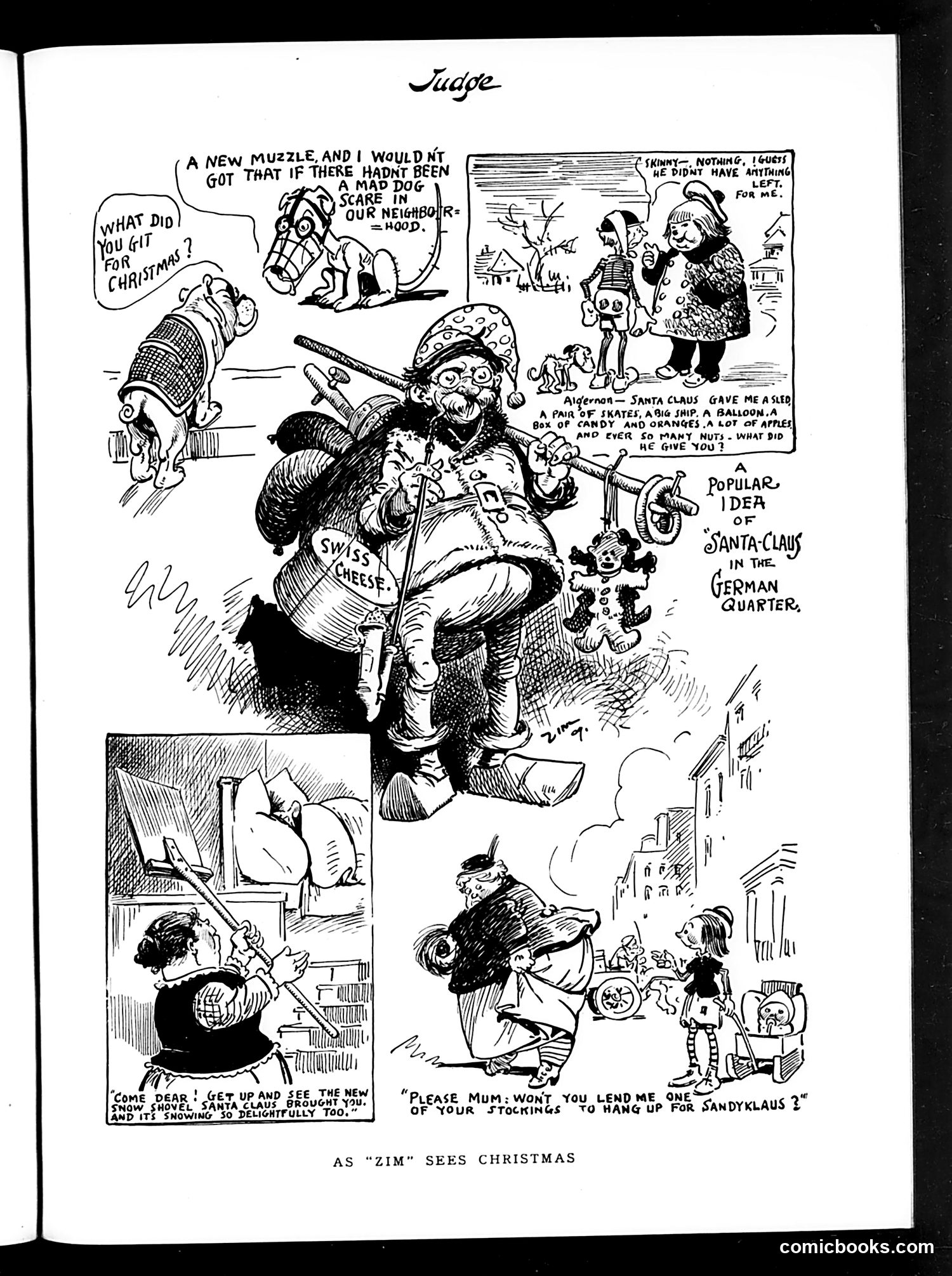
This satirical page depicts Christmas customs in the German quarter of an American city, likely from the early 20th century. The central figure is "Zim" (presumably a German immigrant or German-American character), shown as a portly man in Alpine clothing receiving gifts typical of German Christmas traditions: a sled, skates, toy soldiers, candy, and oranges. The satire compares German and American Christmas practices. The smaller panels show contrasting scenes—one depicting traditional German gift-giving, another showing American children's expectations ("Please Mum, won't you lend me one of your stockings to hang up for Sandyklaus?"). The humor derives from cultural differences in holiday customs and the phonetic rendering of "Santa Claus" as "Sandyklaus" in a German accent.
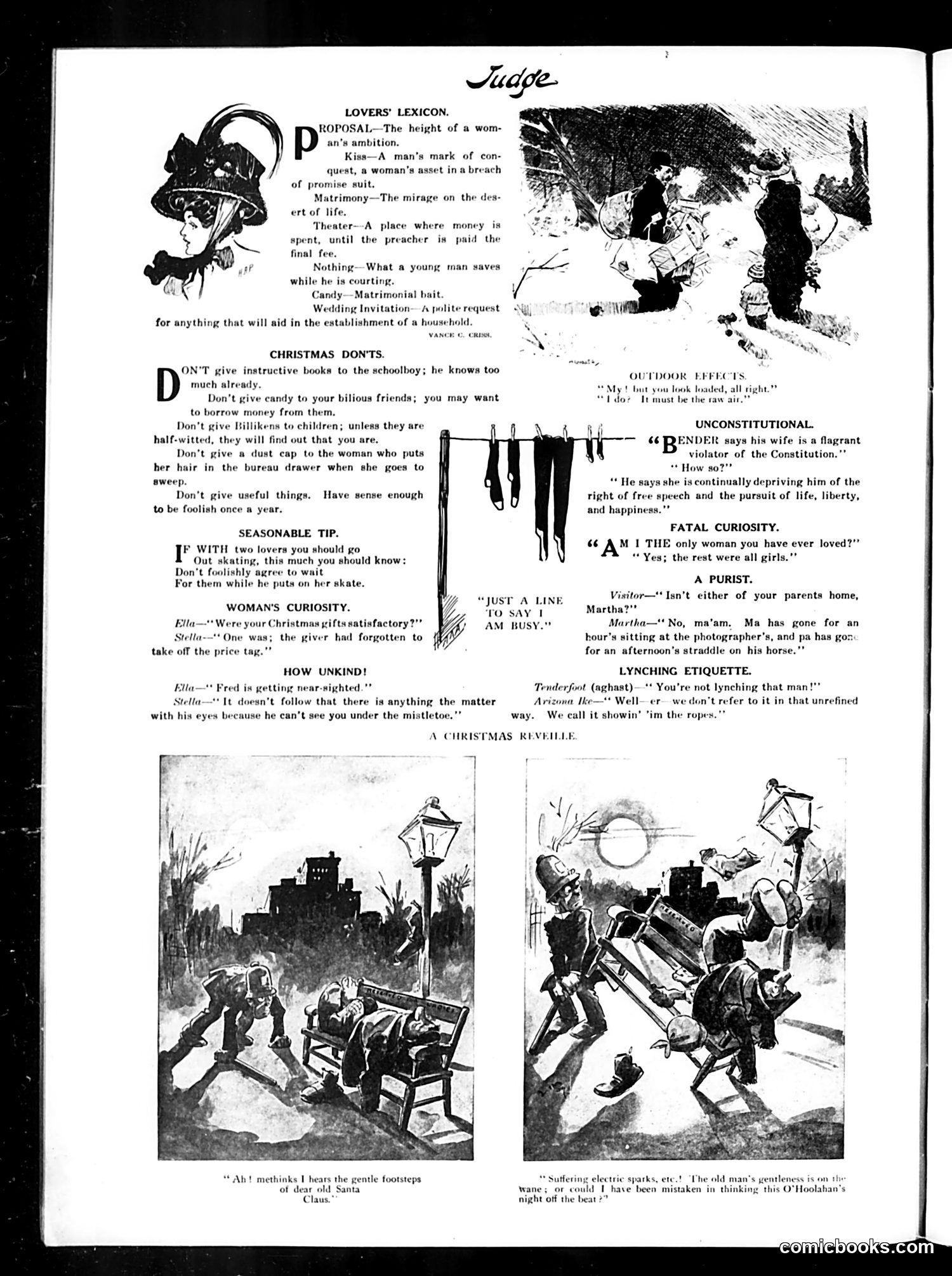
This page from *Judge* (a major American satirical weekly) collects short humor pieces mocking courtship, marriage, and social conventions of the early 1900s. The **"Lovers' Lexicon"** cynically redefines romantic terms: "Proposal" is women's ambition; "Kiss" is male conquest; "Matrimony" is life's disappointment. This reflects period skepticism about marriage as an institution. **"Christmas Don'ts"** offers mock advice about gift-giving—satirizing both materialism and social hypocrisy (don't give useful gifts; do give foolish ones). The short jokes ridicule gender dynamics: wives denying husbands "free speech," women obsessing over Christmas gifts' price tags, suitors gaming the mistletoe convention. **"A Christmas Reveille"** (bottom illustrations) appears to show Santa's arrival, though the captions are partially illegible. Overall, the page satirizes early-20th-century courtship rituals, consumerism, marital discord, and gender relations through brief, cynical quips—typical of *Judge*'s sophisticated urban audience.
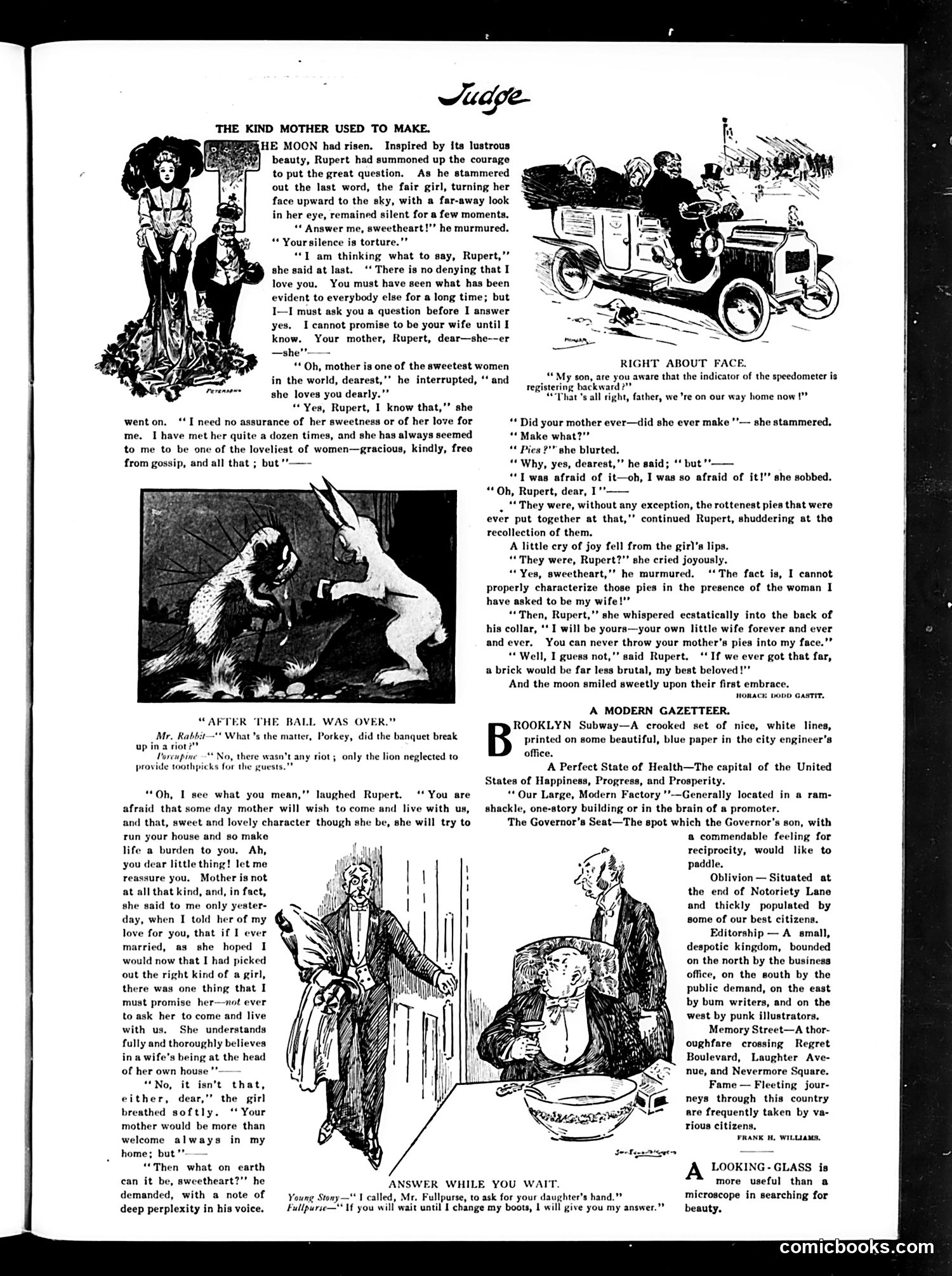
This page contains a romantic short story illustrated with sketches, not political satire. The main narrative, "The Kind Mother Used to Make," depicts a marriage proposal scene with a humorous twist. **The Plot:** Rupert proposes to his girlfriend, who hesitates—not from lack of love, but from concern about his mother. She fears becoming a daughter-in-law to an overbearing mother-in-law. However, Rupert reassures her his mother respects boundaries. The real issue emerges: the girlfriend dreads his mother's notoriously terrible cooking, particularly her pies. Learning that even Rupert acknowledges the pies are inedible—so bad they're beyond criticism—the girlfriend joyfully accepts marriage, knowing her own cooking cannot be unfavorably compared. **The Humor:** The story subverts romantic expectations by making the obstacle not maternal interference but literally terrible cooking. The punchline plays on domestic anxiety: a new wife's fear of household judgment from her mother-in-law, resolved by discovering the mother's cooking is universally acknowledged as awful. The page includes unrelated advertisements and comic vignettes ("After the Ball Was Over," "Right About Face") typical of Judge magazine's format.
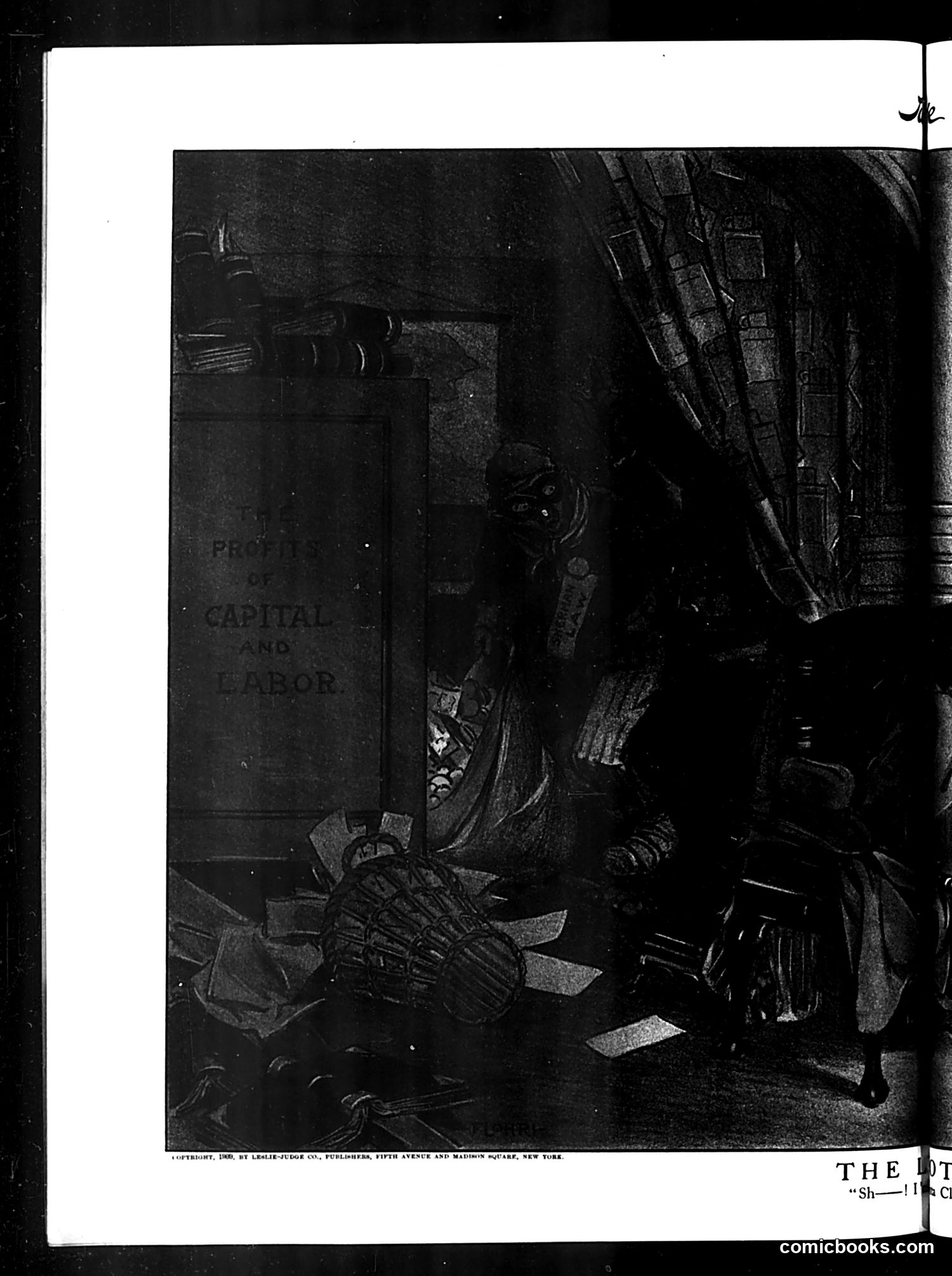
This appears to be a dark, dramatic illustration from Judge magazine showing what looks like a theatrical or allegorical scene. A prominent figure holds a book titled "PROFITS OF CAPITAL AND LABOR" — a reference to economic debate, likely from the early 20th century when labor-capital tensions dominated American politics. The shadowy, Gothic aesthetic suggests this is satirizing contemporary anxieties about wealth distribution and class struggle. The imagery evokes both dramatic theater and political commentary on industrial economics. However, the image quality and partial visibility make it difficult to identify specific figures or pinpoint the exact satirical target with certainty. The copyright credit mentions Leslie Judge as performer at Fifth Avenue and Madison Square venues in New York, suggesting this may reference a specific theatrical or social event from that era. Without clearer details, I cannot definitively explain the precise political message intended.
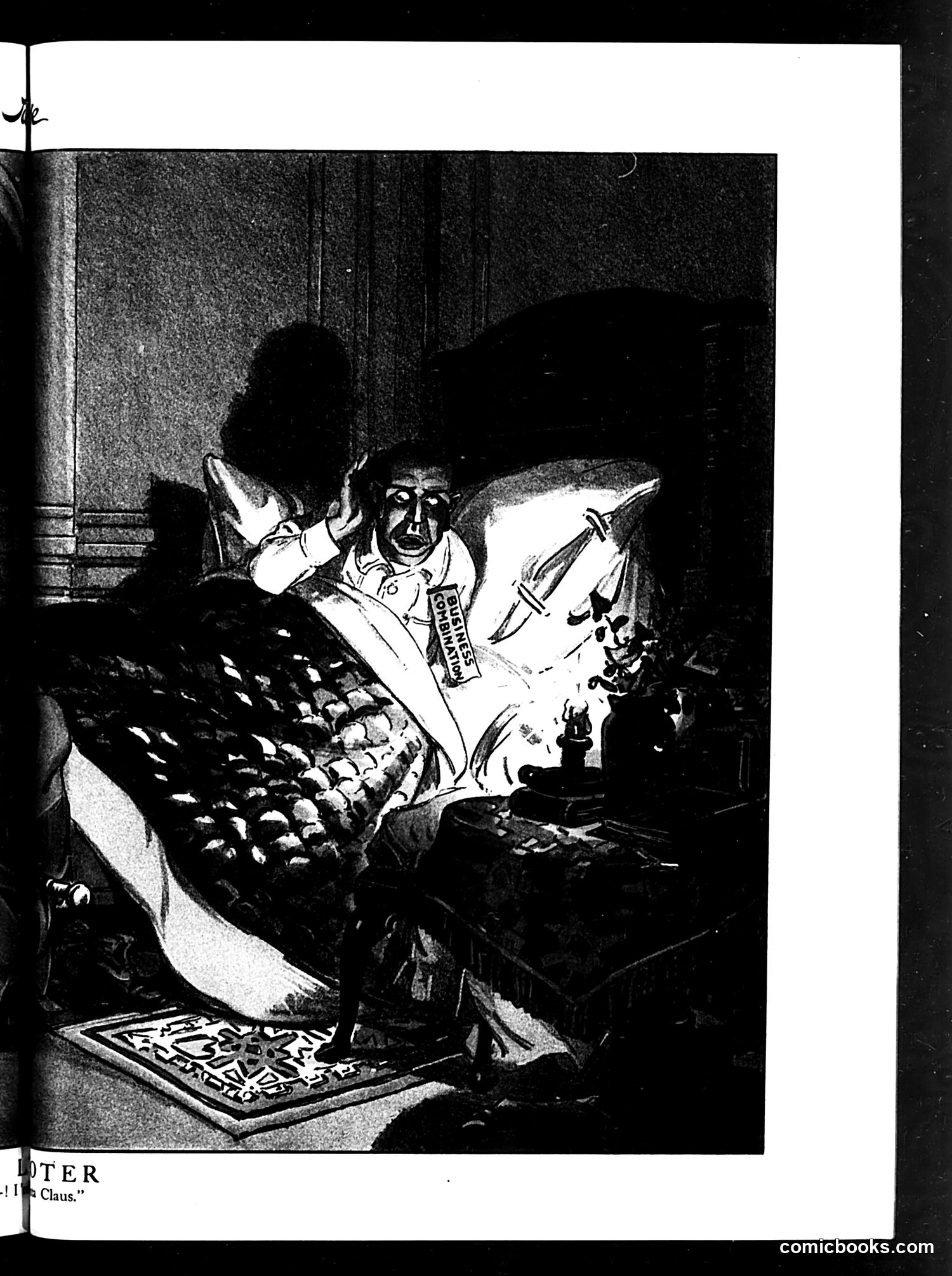
This political cartoon depicts a caricatured figure—appears to be a medical or scientific authority figure based on the visible label on his clothing—examining or conducting some kind of procedure with syringes or medical instruments. The exaggerated facial features and theatrical pose suggest satirical intent, likely mocking either a specific public figure or a broader medical/scientific practice of the era. The elaborate clothing and the presence of what appears to be decorative items suggest this may be satirizing medical charlatanism, quack medicine, or dubious scientific claims popular in early American society. The cartoon's style and Judge magazine's satirical mission indicate this critiqued fraudulent practices or pompous medical practitioners. However, without clearer text or additional context, the specific target and precise historical reference remain unclear.
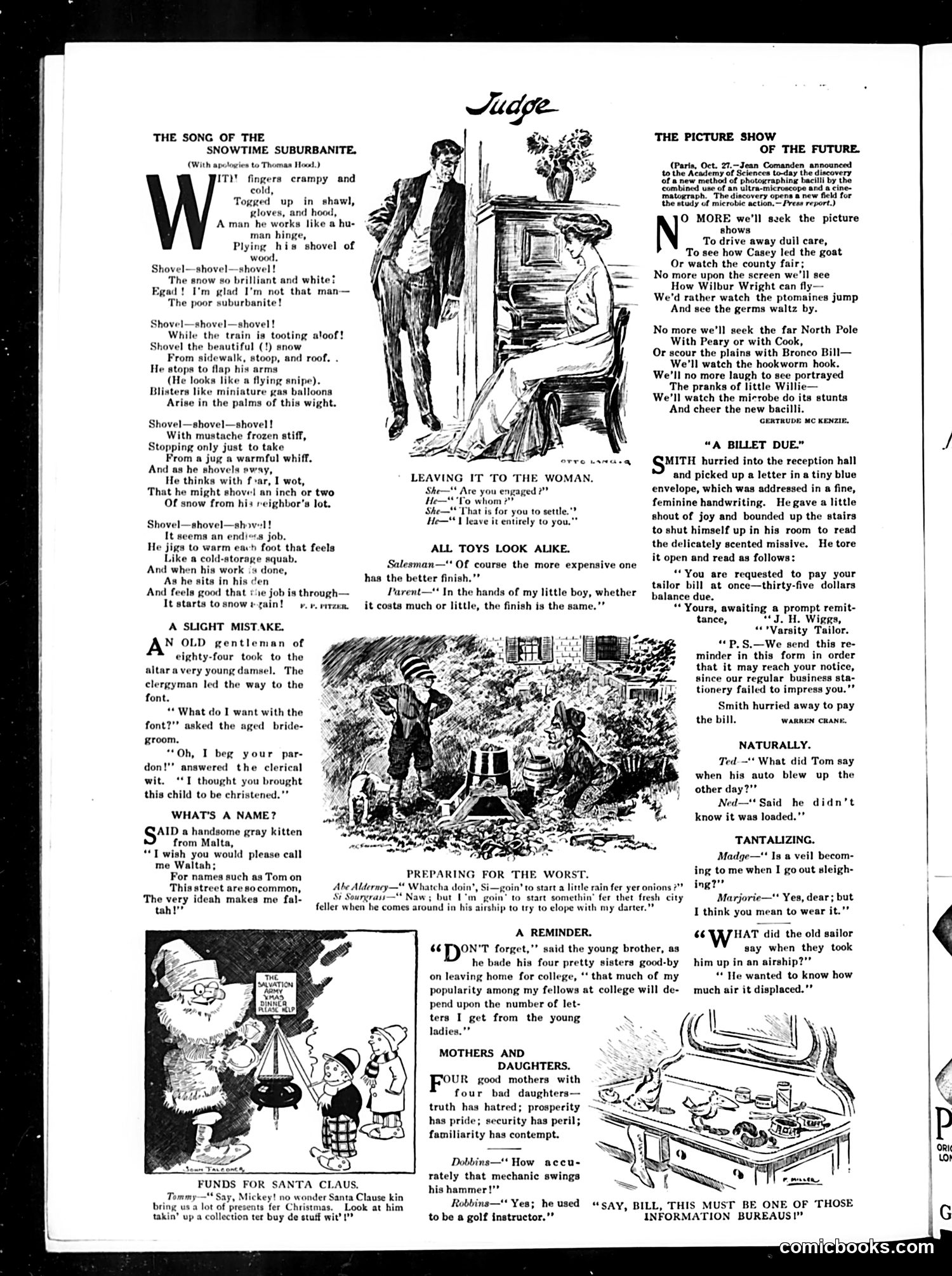
This page from Judge magazine contains humor pieces typical of early 20th-century American satire: **"The Song of the Snowtime Suburbanite"** mocks the frustrated suburban commuter—likely a middle-class man forced to shovel snow before catching his train to the city. The repetitive "Shovel—shovel—shovel!" emphasizes the tedious, endless cycle of winter labor, particularly the ironic final line: just when he finishes, it snows again. **"The Picture Show of the Future"** satirizes the emerging cinema industry by joking that audiences will soon abandon entertainment films to watch microscopic documentaries about germs and bacilli—referencing a recent scientific discovery announced to the Academy of Sciences. It's a gentle mockery of both modern scientific enthusiasm and cinema's potential future. The smaller humor pieces mock naming conventions, age-gap marriages, and courtship customs of the era. The overall tone reflects Judge's characteristic gentle, middle-class social satire rather than biting political commentary.
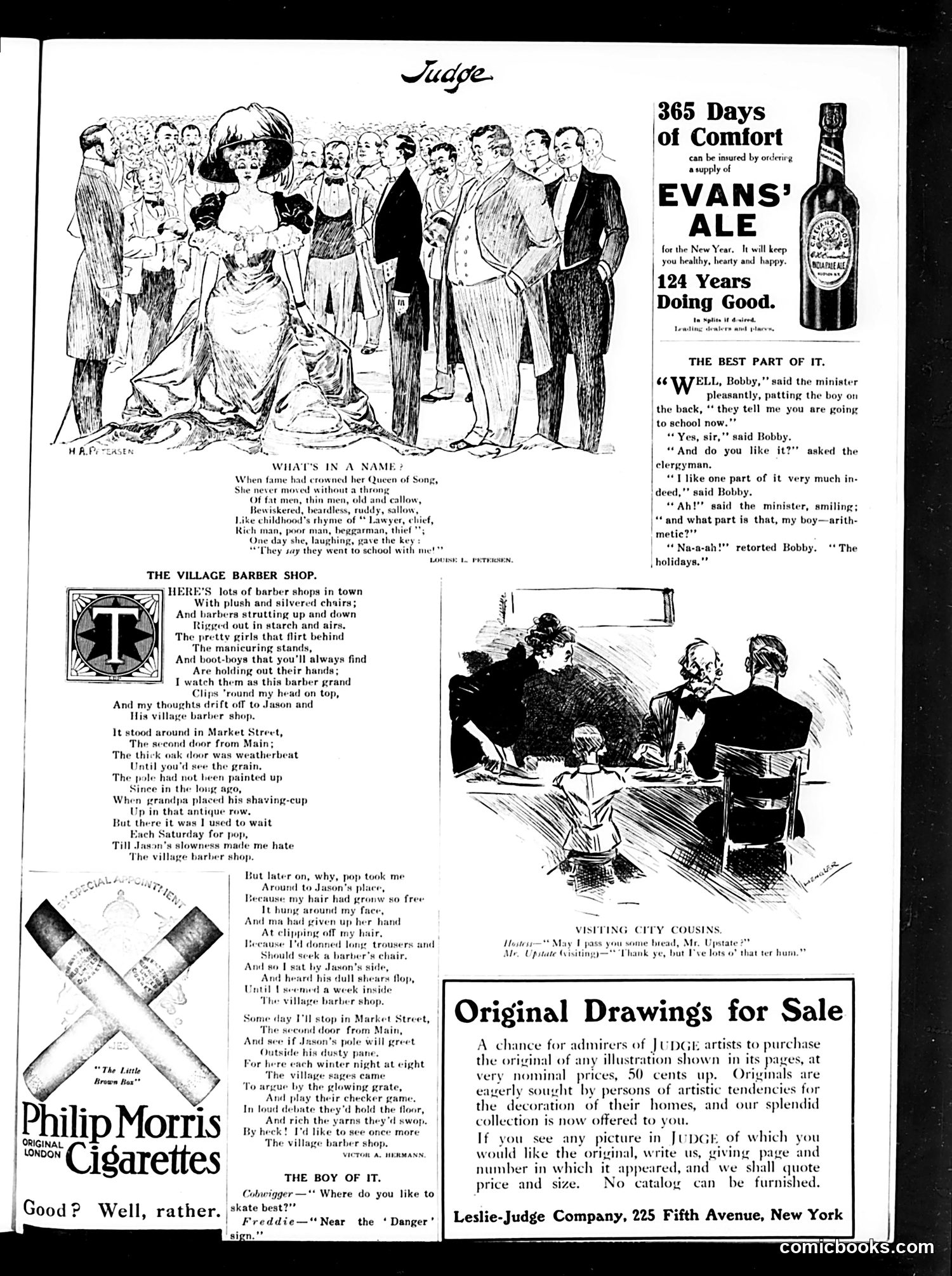
This page contains primarily **advertisements and light humor** rather than political satire. The main content includes: **"What's in a Name?"** — A poem about a famous woman surrounded by various male types (fat, thin, old, bearded, etc.), suggesting the shallow attention fame attracts. **"The Village Barber Shop"** — A nostalgic poem contrasting a boy's impatience waiting for haircuts with adult appreciation for the barber's leisurely pace and conviviality. **"The Boy of It"** — A brief joke about a child preferring to skate near a "Danger" sign, capturing childish attraction to risk. **Advertisements** dominate the page: Evans' Ale (claiming 124 years of quality), Philip Morris Cigarettes, and a pitch to sell original Judge artwork to readers. The humor is gentle and domestic rather than satirical—focused on nostalgia, childhood observations, and consumer goods. No political figures or events are referenced.
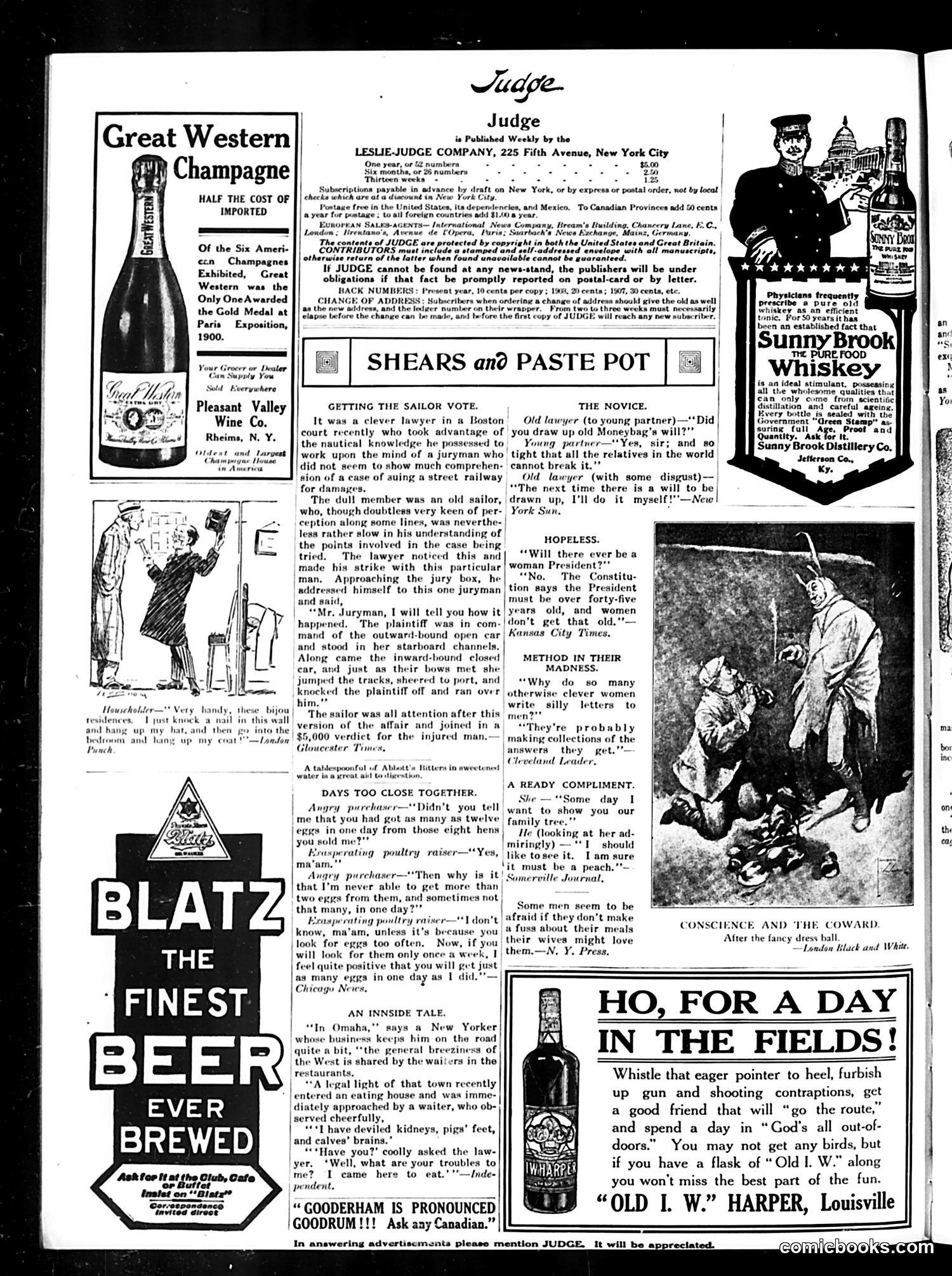
This is primarily an **advertising and humor magazine page** from Judge (circa early 1900s). The main content consists of: **Advertisements**: Prominently featured are ads for Great Western Champagne (emphasizing its 1900 Paris Exposition gold medal), Blatz Beer ("the finest beer ever brewed"), and Sunny Brook Whiskey. **Humor Sections**: Multiple short satirical pieces: - "Getting the Sailor Vote" satirizes a lawyer's manipulation of an unsophisticated juror using nautical jargon - "Days Too Close Together" jokes about a poultry farmer's excuse for low egg production - "An Inside Tale" pokes fun at a waiter advertising unappealing offal dishes - Various one-liners about women, domestic life, and social awkwardness **Political/Social Context**: The humor reflects class-based stereotypes (confused sailors, incompetent farmers, garrulous waiters) typical of early 1900s American satire. The page emphasizes advertising alcohol and tobacco—completely unrestricted marketing of what would later become heavily regulated substances. The content reflects leisure-class attitudes and contains the casual prejudices common to Edwardian American periodicals.
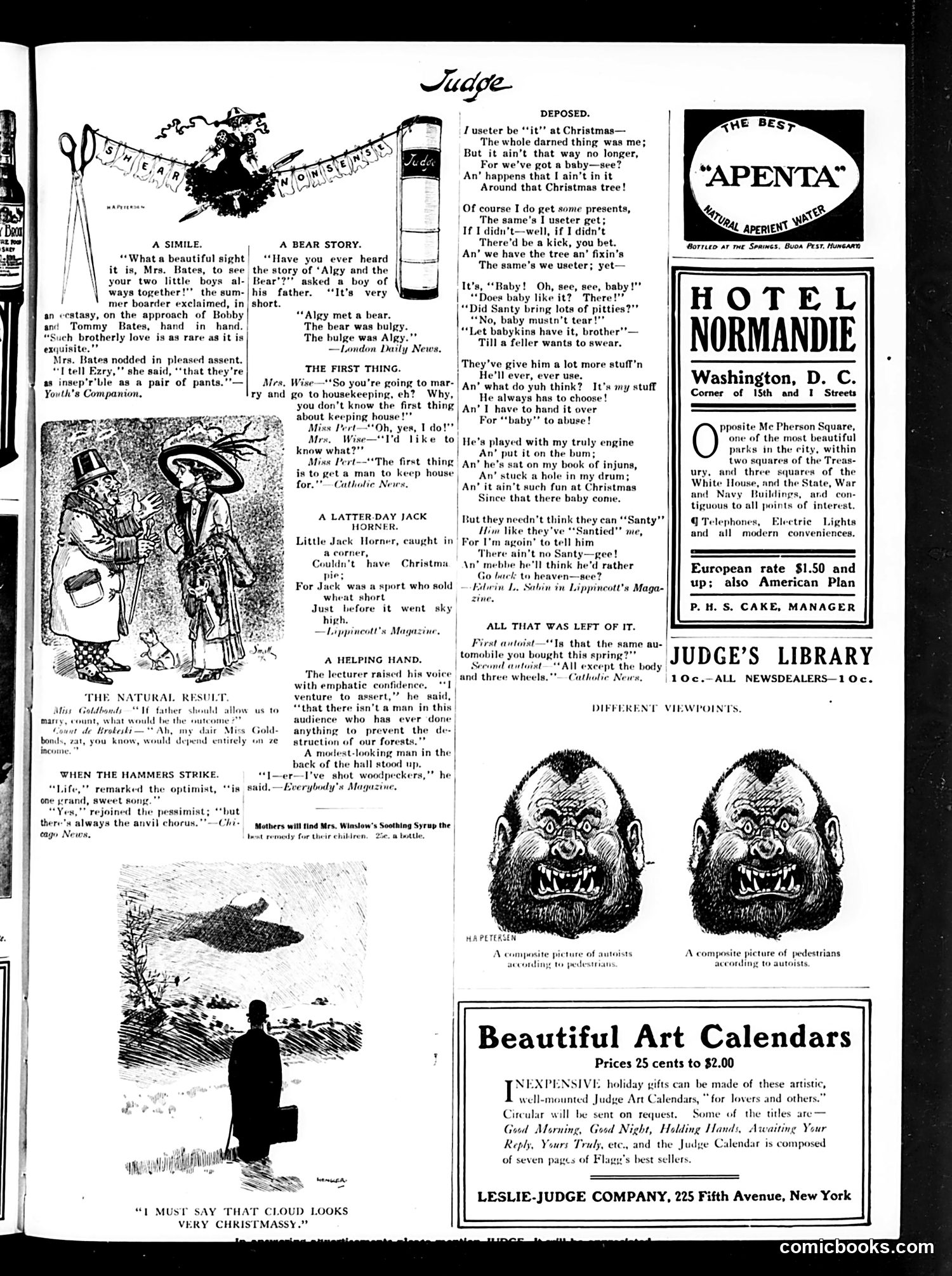
This page contains several brief humorous sketches typical of early-20th-century satirical magazines, plus advertisements. **"Deposed"** depicts a child's loss of Christmas primacy after a baby sibling arrives. The older child complains that he once *was* Christmas ("it" at Christmas), but now parents distribute gifts equally and constantly tell him to share and be gentle with the baby. The satire targets parental behavior and sibling jealousy. **Other sketches** include lighthearted domestic humor: "A Simile" about brotherly love, "A Bear Story" (a traditional joke setup), "The First Thing" (a woman marrying for housekeeping advice), and "A Latter Day Jack Horner" (a man who sold wheat before it rose in value, now poor). These are apolitical, character-driven jokes. **"A Helping Hand"** shows a lecturer claiming no one present has prevented forest destruction; a man admits to shooting woodpeckers—a darkly ironic "contribution." The page is primarily **humorous fiction and advertising** (calendars, Hotel Normandie) rather than political satire or caricature.
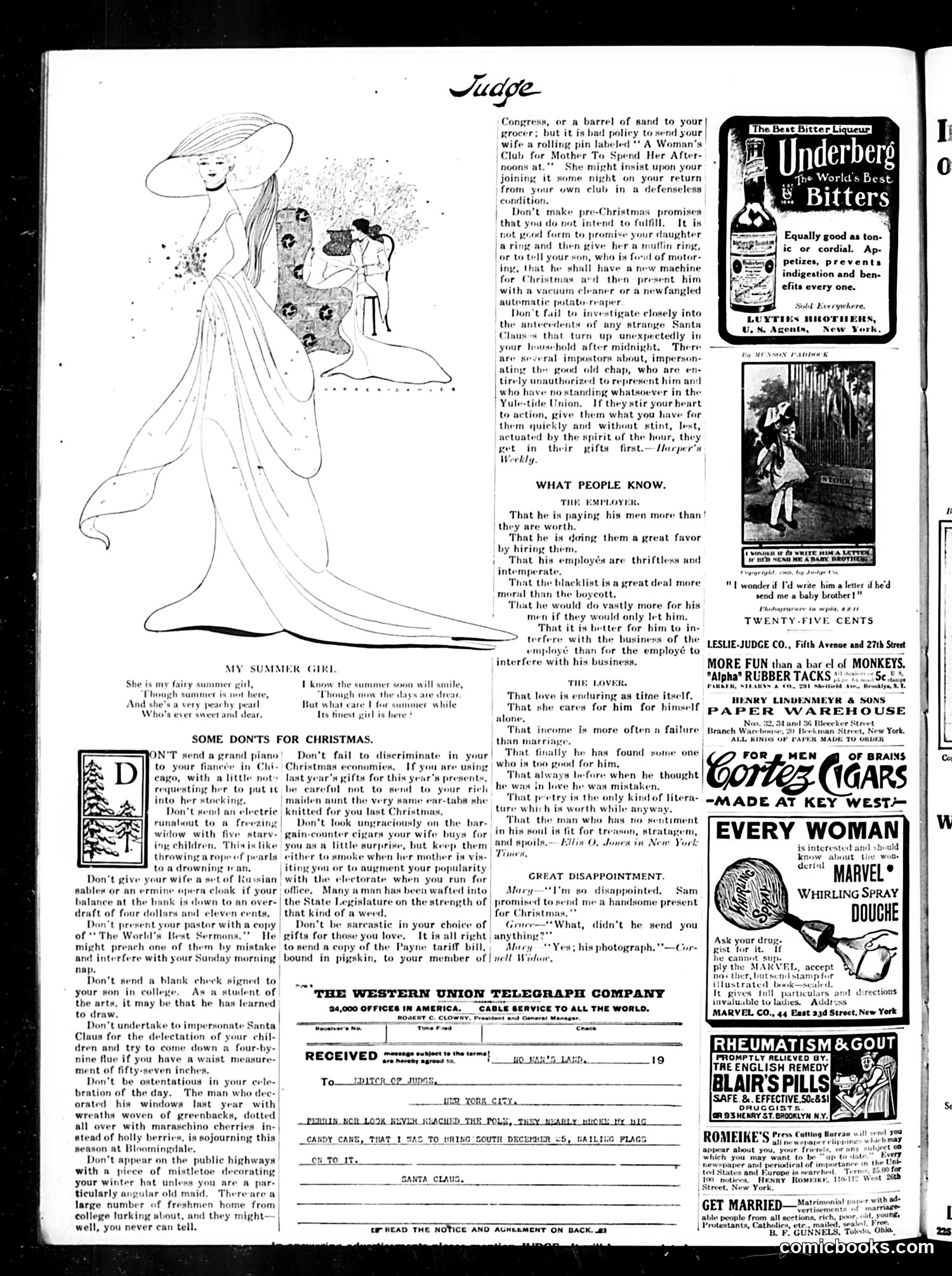
This page contains satirical advice columns rather than political cartoons. The main content includes: **"My Summer Girl"** - A romantic illustration paired with sentimental verse about a young woman, likely poking fun at summer courtship traditions. **"Some Don'ts for Christmas"** - Humorous gift-giving advice targeting various social classes. The satire mocks both wealthy people (warning against extravagant gifts) and poor people (criticizing ostentatious displays). It also ridicules employers' paternalism toward employees and includes stereotypical observations about romantic relationships. **"What People Know"** - Sardonic observations about employer-employee dynamics, suggesting bosses exploit workers while believing themselves benevolent. **"Great Disappointment"** - A brief joke where a woman receives only a photograph instead of an expected valuable gift. The page primarily contains advertisements (Underberg Bitters, Marvel products, etc.) and a Western Union telegram form. The satire reflects early-20th-century class consciousness and social conventions around courtship and commerce.
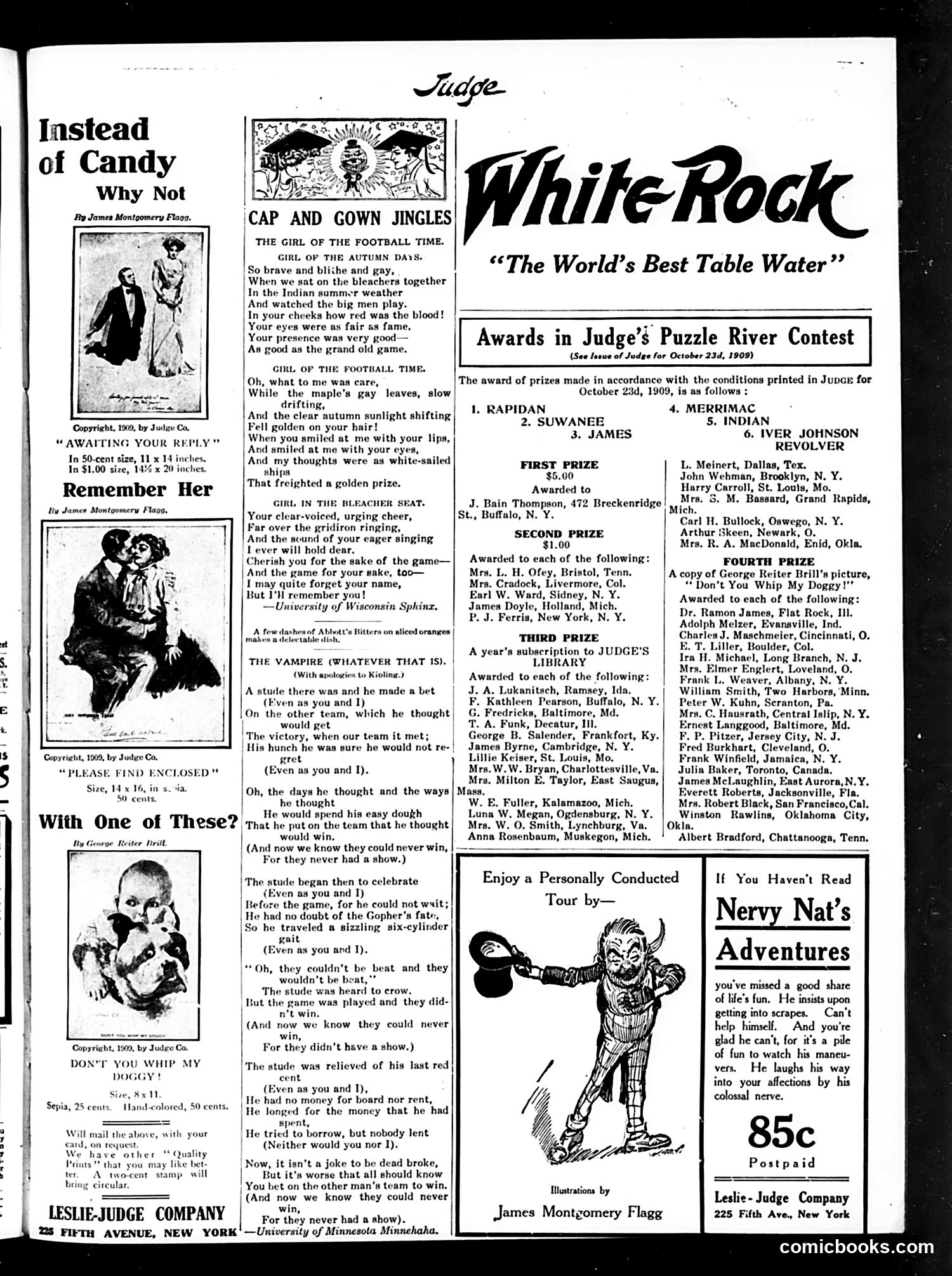
**The Main Content:** This is primarily a **1909 Judge magazine page featuring advertising and college-themed poetry**, not political satire. The dominant pieces are promotional materials and poetry about college football. **The Cartoons/Poetry:** James Montgomery Flagg's illustrations accompany romantic/nostalgic verses about "the girl of the football time"—idealizing female spectators at college football games in autumn. The tone is wistful nostalgia for courtship moments. A longer poem titled "The Vampire" satirizes a specific, small-scale incident: a college student ("stude") who confidently bet money on what he believed was a winning football team, but lost everything when his team actually lost. The poem mocks his overconfidence and subsequent financial ruin through repetitive, mock-dramatic language. **The Context We'd Miss:** College football betting appears to have been common enough for Judge to satirize it. The phrase "Whatever That Is" applied to "vampire" suggests contemporary debates about that literary trope's meaning. The bulk of the page advertises White Rock water and a puzzle contest—typical period magazine filler.
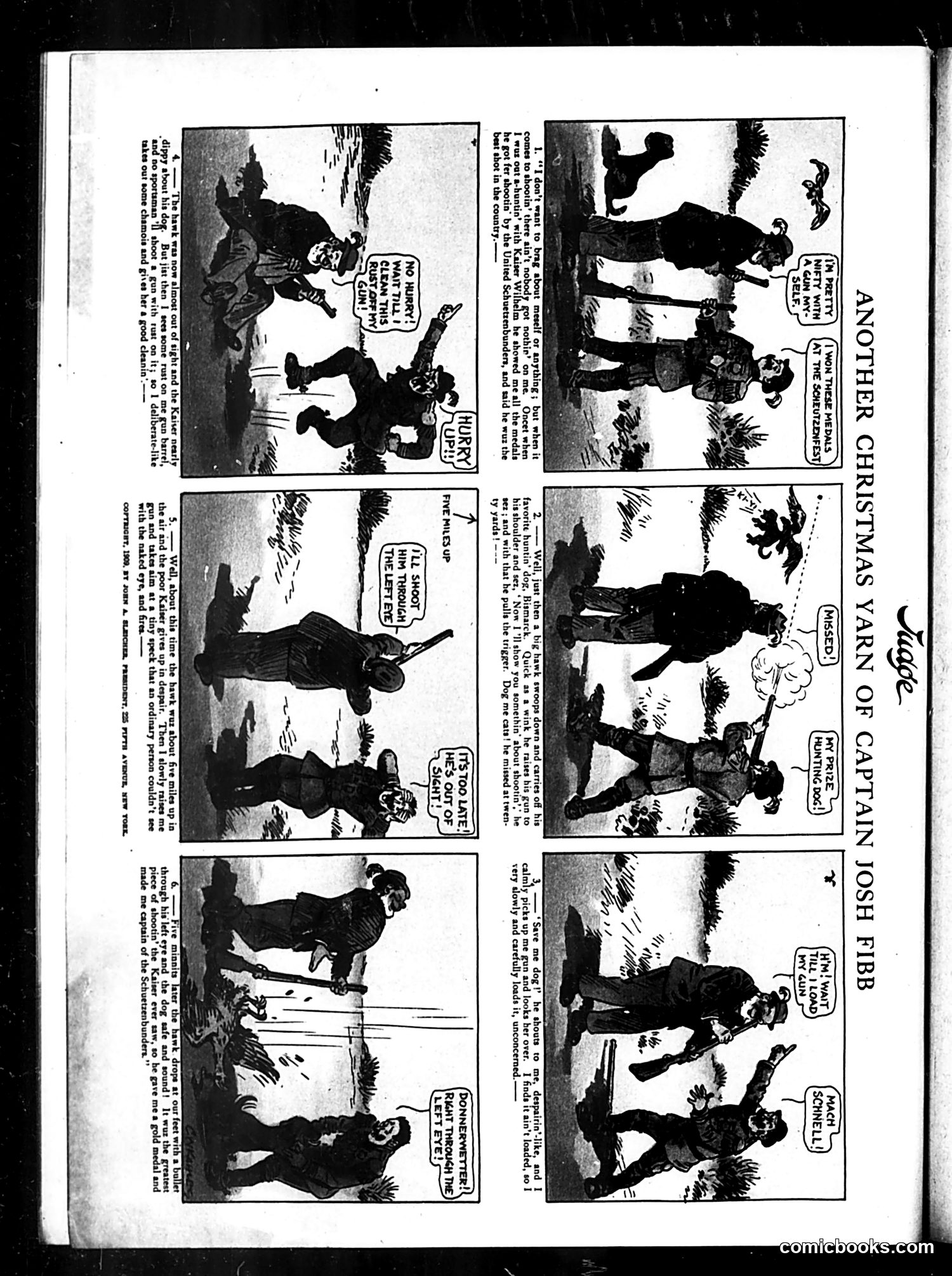
This is a tall-tale comic strip featuring Josh Fibb, a boastful character recounting an exaggerated wartime adventure. The narrative involves shooting down a hawk from an impossibly great distance—five miles up—through meticulous gun-cleaning and marksmanship so extraordinary that ordinary people couldn't perceive the target. The satire targets military braggadocio and immigrant working-class claims to heroism. References to "the Kaiser" and the Schuetzenbund (a German-American rifle club) suggest this targets German-American soldiers or veterans inflating their wartime exploits. The humor derives from the absurd implausibility of the feat and the character's pompous self-aggrandizement—typical of Judge magazine's mockery of ethnic stereotypes and wartime pretension (likely WWI-era, given the 1919 copyright visible).
I can see this is a blank or nearly blank page from what appears to be a Judge magazine issue, with only a watermark visible ("comicbooks.com" at the bottom). There is no discernible cartoon, illustration, text content, or satirical material visible on this page itself—it appears to be either a blank endsheet, back matter, or an advertisement page that didn't reproduce clearly in this scan. Without visible content to analyze, I cannot identify any figures, political references, or satirical commentary. To provide meaningful historical context about this Judge publication, a clearer page image with actual cartoon or text content would be necessary.