
Judge, 1909-12-25 · page 2 of 17
Judge — December 25, 1909 — page 2: what you’re looking at
What you’re looking at
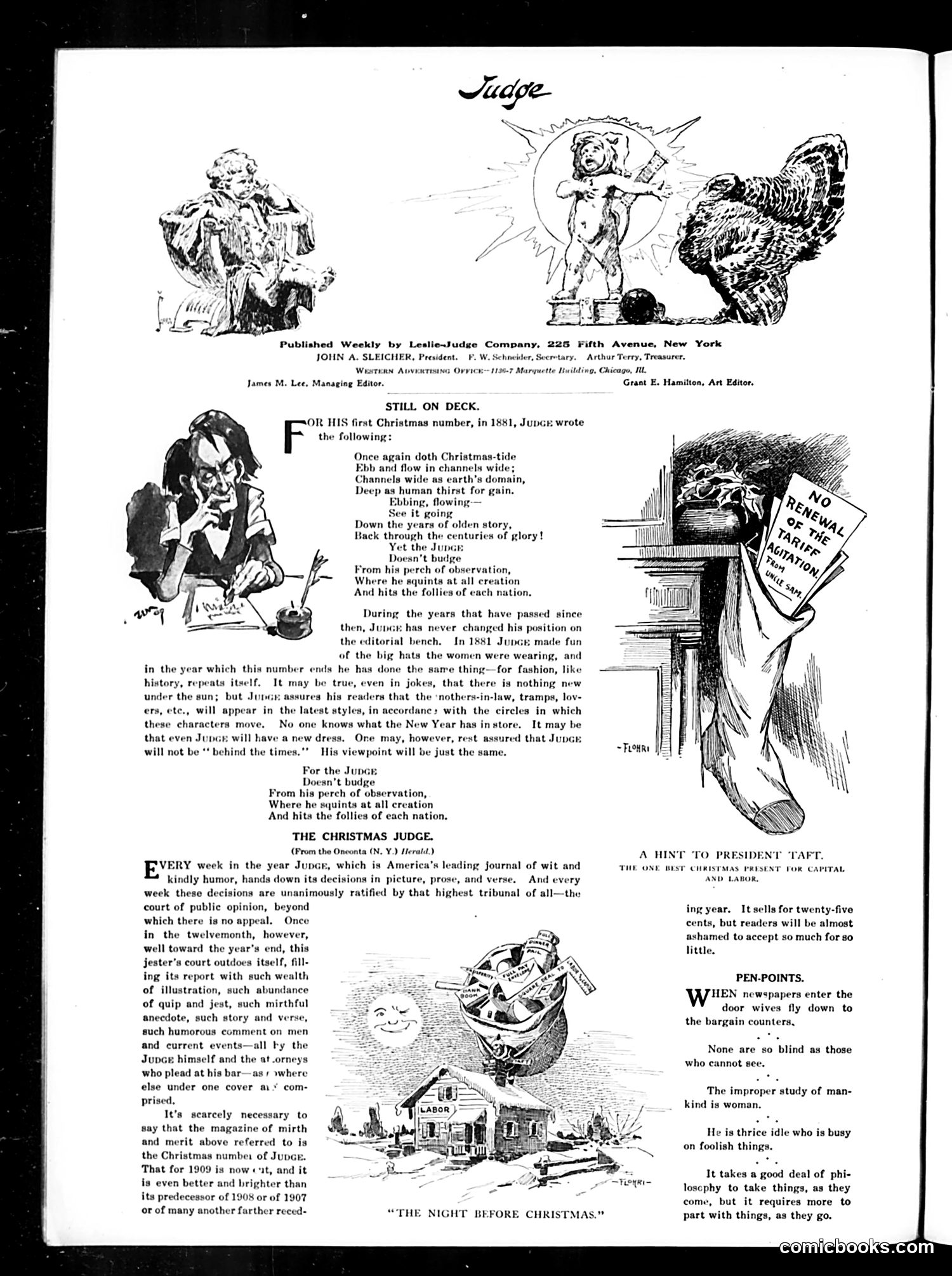
This appears to be a Christmas-themed editorial page from Judge magazine's 1881 holiday issue. The main text "Still on Deck" presents Judge as an observer commenting on human nature and current events from an elevated vantage point—a recurring conceit for the publication. The editorial argues that despite fashion and style changes, human behavior remains constant across centuries. It references Judge's role as America's premier satirical publication, offering "wit and kindly humor" through illustrations and commentary on politics, society, and current events. The accompanying cartoons include "The Night Before Christmas" illustration and sections titled "A Hint to President Taft" and "Pen-Points" containing brief satirical observations. The overall tone celebrates Judge's established position as a trusted arbiter of public opinion and social commentary.
📄 Transcribed text from this page (OCR, searchable)
Machine-transcribed from the original scan — historical spelling and the odd misread are preserved.
Published Weekly by LeslieJudge Company, 225 Fifth Avenue, Arthur Terry, Treasurer. JOHN A. SLEICHER, President. F. W. Schneider, Seerotary. Westen 7 eS Marqurtte Luiliting, Chicago, Mt. Grant E. Hamilton, Art Editor. James M. Lee, Managing Editor. STILL ON DECK. OR HIS first Christmas number, in 1881, Jupce wrote F the following: Once again doth Christmas bb and flow in channels wid annels wide as earth's domain, 3 human thirst for gain. bbing, flowing-— See it going Down the years of olden story, Back through thi uries of glory! Doesn't budge perch of observa he squints at all n And hits the follies of each nation, During the years that have passed since then, Junce has never changed his position on the editorial bench, In 1881 Jupce made fun of the big hats the women were wearing, and in the r which this number ends he has done the same thing—for fashion, li history, repeats itself. It may be true, even in jokes, that th 3 nothing new under the sun; but Juncr assures his readers that the ‘nothers-in-law, tramps, lov- e pte., will appear in the latest styl in accordane+ with the circles in which these characters me No one knows what the New Year has instore. It may be that even Jupcr will have a new d. One may, however, rest assured that Jupce will not be ** behind the times."" His viewpoint will be just the same. For the Jupcr Doesn't bud, From his perch of observation, Where he squints at all creation And hits the follies of each nation. THE CHRISTMAS JUDGE. (Prom the Oneonta (N. Y.) Herald.) VERY week in the year Junge, which is America’s leading journal of wit and kindly humor, hands down its decisions in picture, prose, and verse. And every week these decisions are unanimously ratified by that highest tribunal of all—the court of public opinion, beyond which there is no appeal. Once in the twelvemonth, however, well toward the year’s end, this jester's court outdoes itself, fill- ing its report with such wealth of illustration, such abundance of quip and jest, such mirthful anecdote, such story and verse, such humorous comment on men and current events—all ty the Junce himself and the at orneys who plead at his bar—as + »where else under one cover a * com- prised, It's scarcely necessary to say that the magazine of mirth and merit above referred to is the Christmas numbe1 of Ju > } a. That for 1909 is now «at, and it - is even better and brighter than its predecessor of 1908 or of 1907 or of many another farther reced- ~ Fours |) A HINT THE ONE BEST CHRIsTstas “THE NIGHT BEFORE CHRISTMAS.” New TO PRESIDENT “TAFT. HSENT FOR CAPITAL AND LABOR, ing year. It sells for twenty-five cents, but readers will be almost ashamed to accept so much for so little. PEN-POINTS. WEEN newspapers enter the door wives fly down to the bargain counters, None are so blind as those who cannot see, The improper study of man- kind is woman, He is thrice idle who is busy on foolish things. It takes a good deal of phi- loscphy to take things, as they come, but it requires more to part with things, as they go.