
A complete issue · 16 pages · 1909
Judge — August 14, 1909
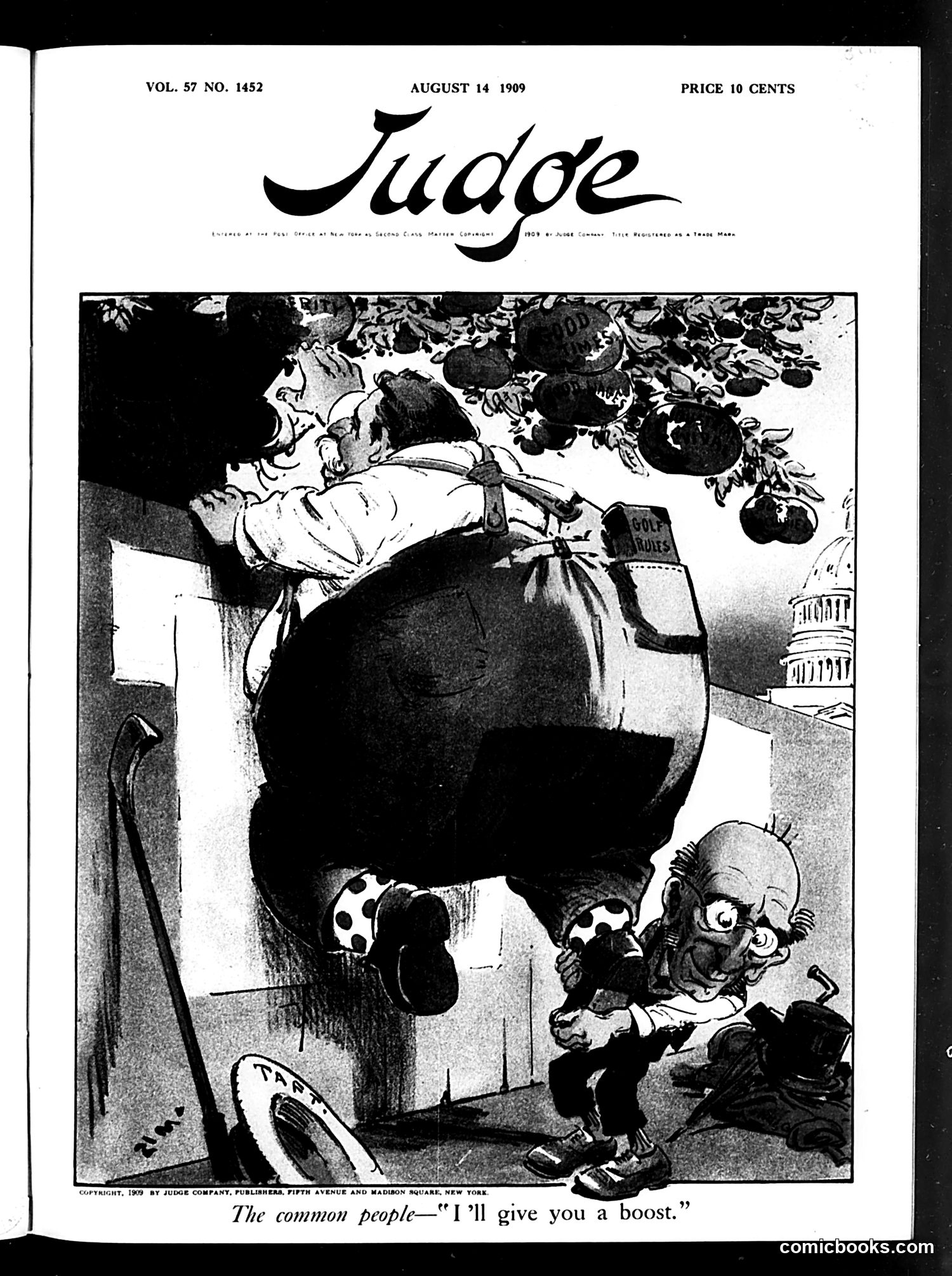
This political cartoon satirizes the common people's struggle under what appears to be corrupt or oppressive leadership. A large, rotund figure (likely representing a politician or robber baron) sits contentedly above, while a small, caricatured man below offers to "give you a boost"—a sarcastic reference to the false promises of help offered to ordinary citizens. The tomato vines overhead suggest agricultural hardship or food scarcity affecting working people. The exaggerated facial features and body proportions are typical of early-1900s caricature style. The cartoon critiques the gap between the powerful and powerless, mocking the hollow reassurances given to struggling ordinary Americans during this era of monopolies and labor unrest.
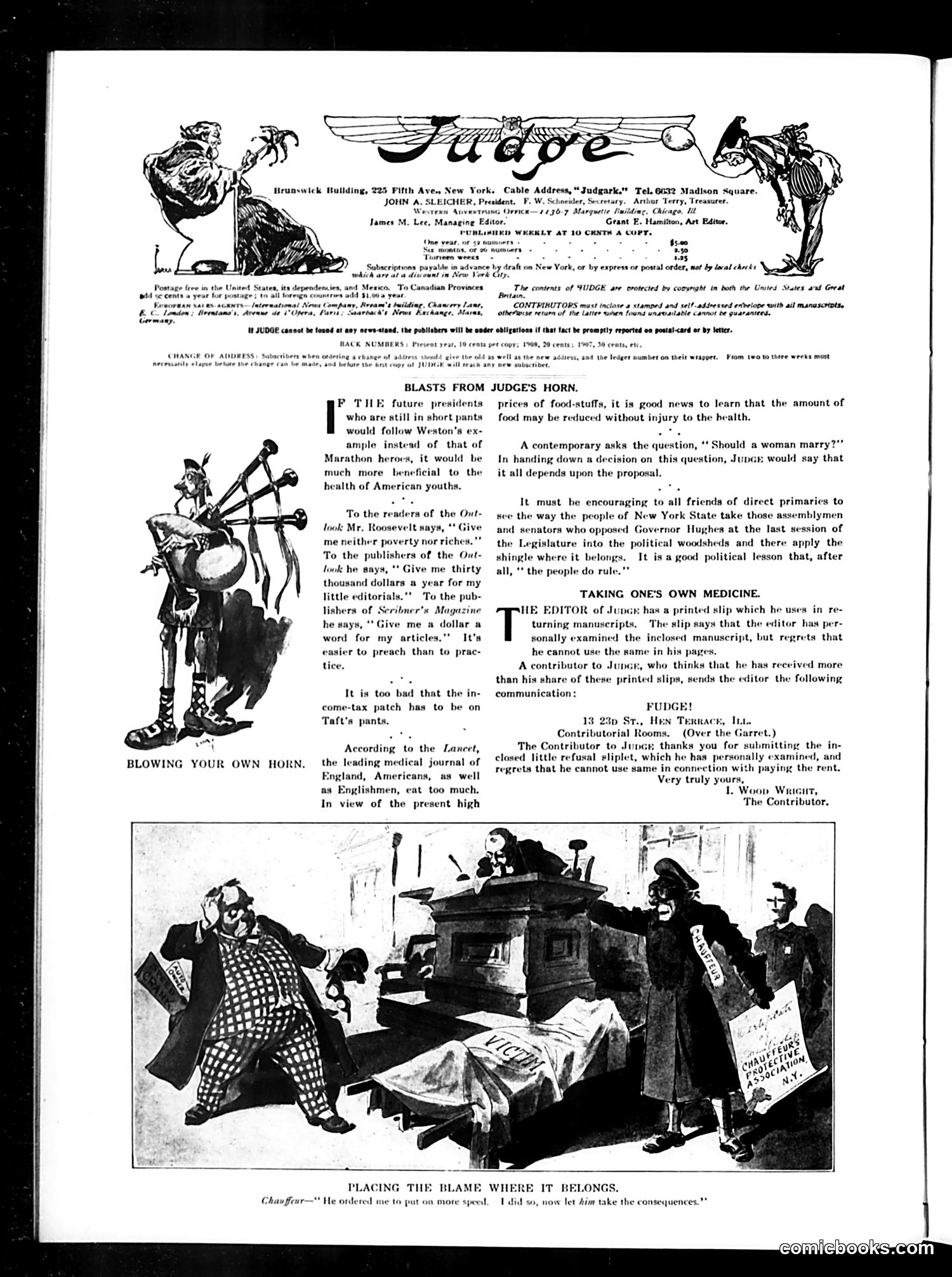
The page contains three distinct sections: 1. **"Blasts from Judge's Horn"** - Editorial commentary criticizing high food prices and advocating for reduced consumption without health damage. It also comments on direct primary elections and political education. 2. **"Taking One's Own Medicine"** - A humorous note about an editor's policy of personally examining manuscripts before rejecting them, with a contributor's complaint about receiving printed rejection slips instead. 3. **"Placing the Blame Where It Belongs"** - A political cartoon (bottom) showing what appears to be a confrontation between figures, with one saying "He ordered me to put on more speed. I did so, now let him take the consequences." The exact historical reference is unclear from the image alone. The overall page reflects typical Judge magazine satirical commentary on contemporary political and social issues.
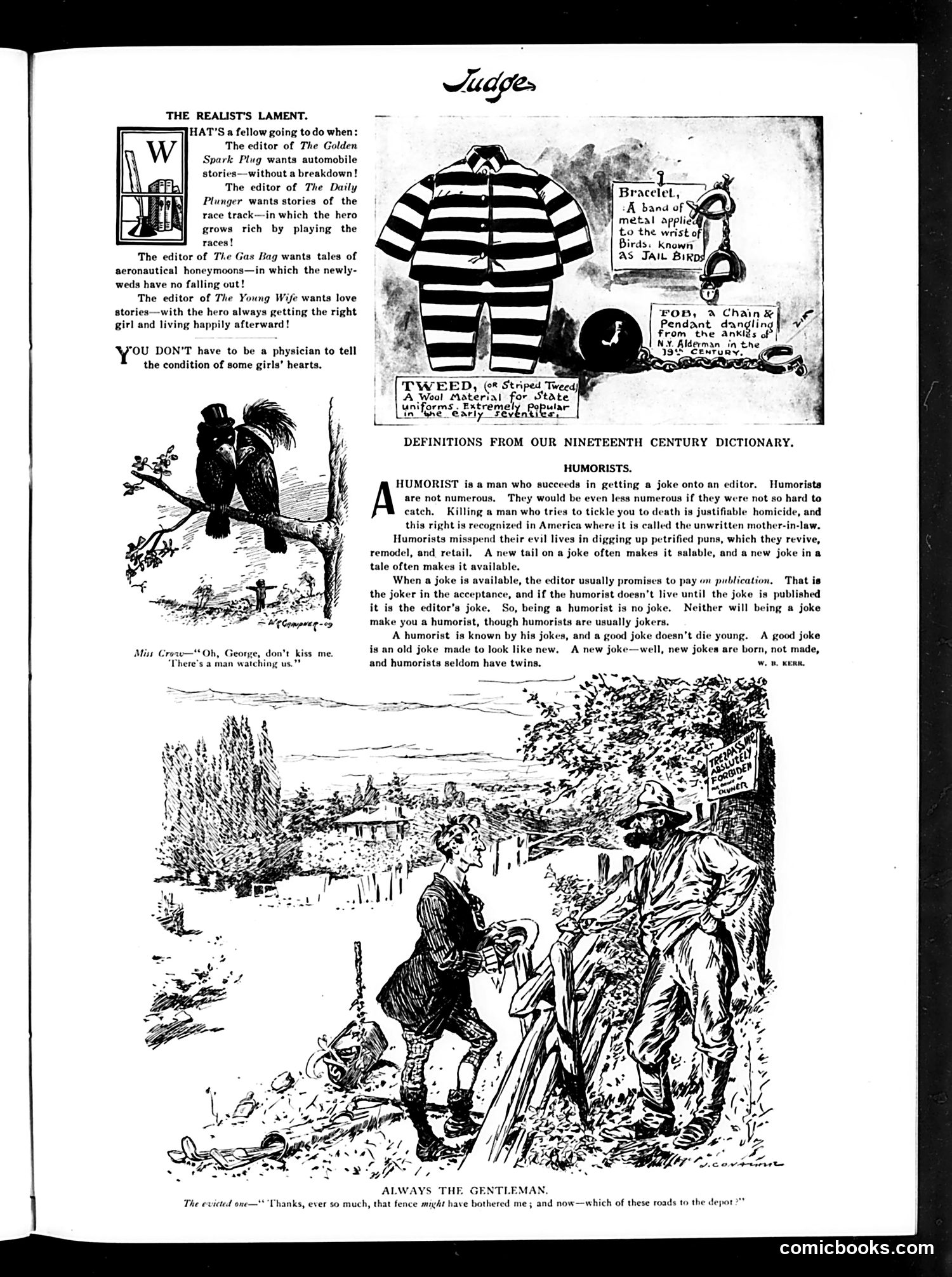
**"The Realist's Lament"** (top left) satirizes magazine editors' differing story preferences—automobile tales, aviation stories, romance narratives—suggesting editors chase sensational content over substance. **"Jail Bird" and "Tweed" illustrations** (top right) appear to be decorative period costume references, though their specific satirical targets are unclear from the image alone. **"Definitions from Our Nineteenth Century Dictionary: Humorists"** (center) is the page's main content—a lengthy satirical definition mocking humorists and joke-writers. The text claims humorists succeed by submitting jokes to editors, then promises payment upon publication. It cynically concludes: "being a humorist is no joke" since neither the joke nor humorist may actually be published. **Bottom illustration** shows a gentleman helping a woman over a fence—captioned "Always the Gentleman," likely satirizing outdated chivalric behavior.
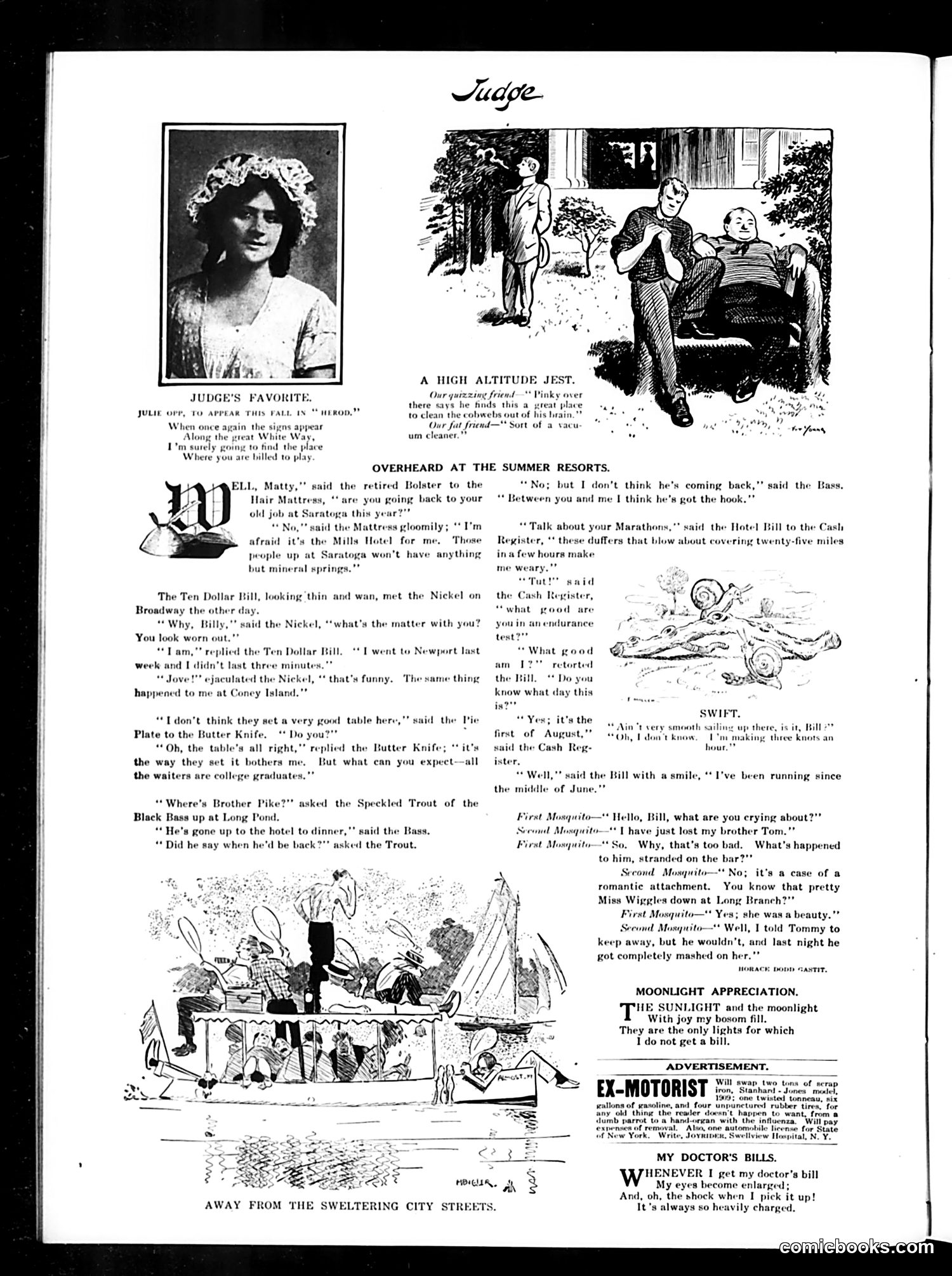
This page from the satirical magazine *Judge* contains humor pieces and advertisements rather than political cartoons. The content includes: **"Judge's Favorite"**: A poem about someone returning to the White Way (Broadway theater district). **"Overheard at Summer Resorts"**: Humorous dialogue between vacationing characters—a retired bolster, a Ten Dollar Bill, a Nickel, a Pie Plate, a Butter Knife, and a Speckled Trout—discussing their summer experiences and financial concerns. The anthropomorphized objects joke about hotel life and tourist activities. **Other sketches**: "A High Altitude Jest," "Swift," and "Moonlight Appreciation" offer various period humor. **Illustrations**: Satirical drawings depict summer resort scenes and a beach-themed gathering. The page primarily targets upper-class leisure activities and summer vacation culture rather than explicit political satire.
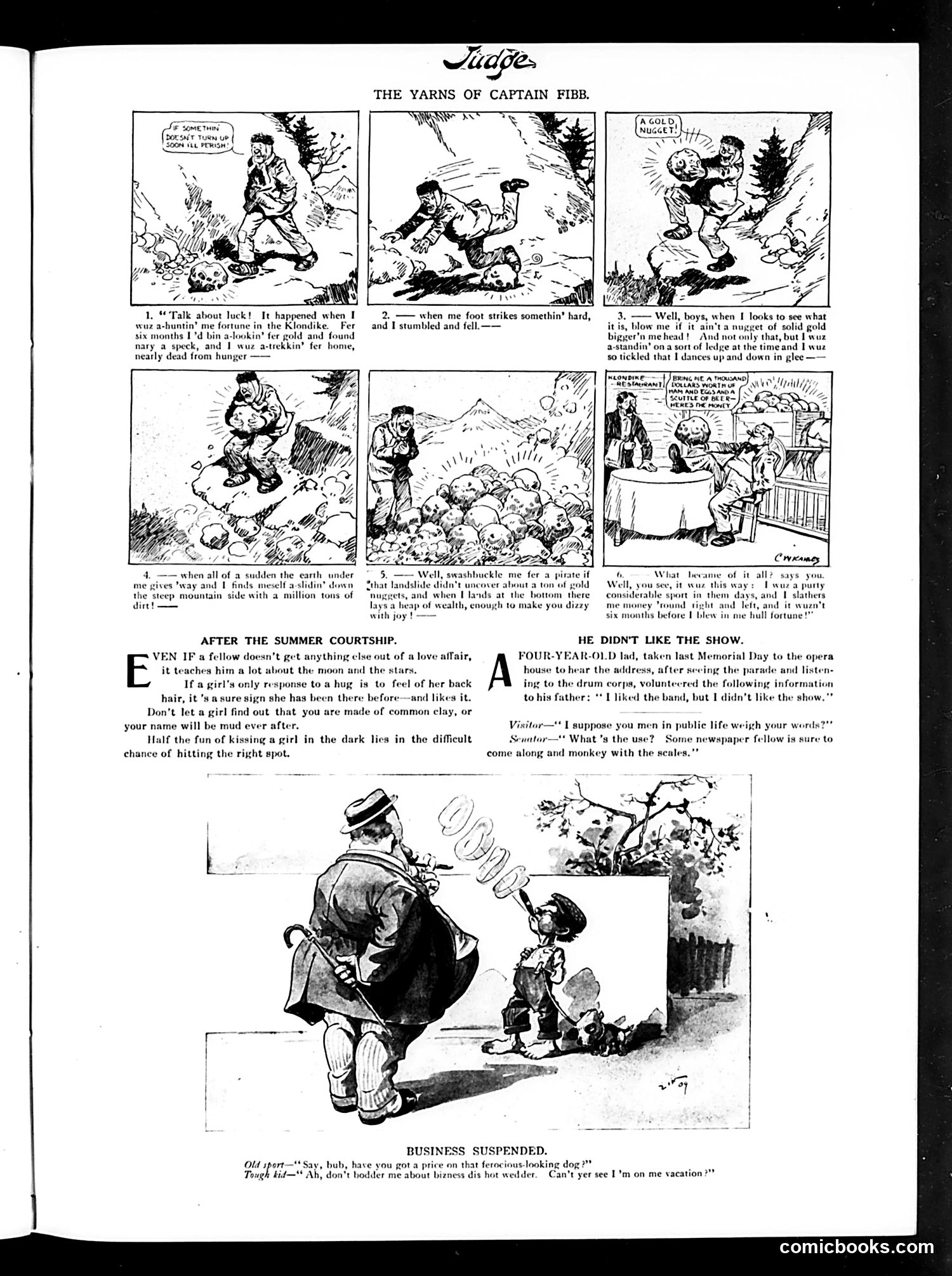
This page presents a comic strip about "Captain Fibb," a tall-tale character who recounts increasingly outlandish adventures to skeptical boys. The narrative arc shows Fibb describing lucky escapes (striking gold, surviving mountain collapses, finding treasure), each story more exaggerated than the last. The satire targets chronic liars and exaggerators—men who entertain through fabrication rather than truth. The boys' reactions shift from interest to visible skepticism, suggesting Judge's commentary on gullibility and the unreliability of such storytellers. The lower section, "Business Suspended," presents a separate joke about a hot-welder taking Memorial Day off, punning on workplace obligations versus leisure time. The humor relies on recognizing universal character types rather than specific political figures.
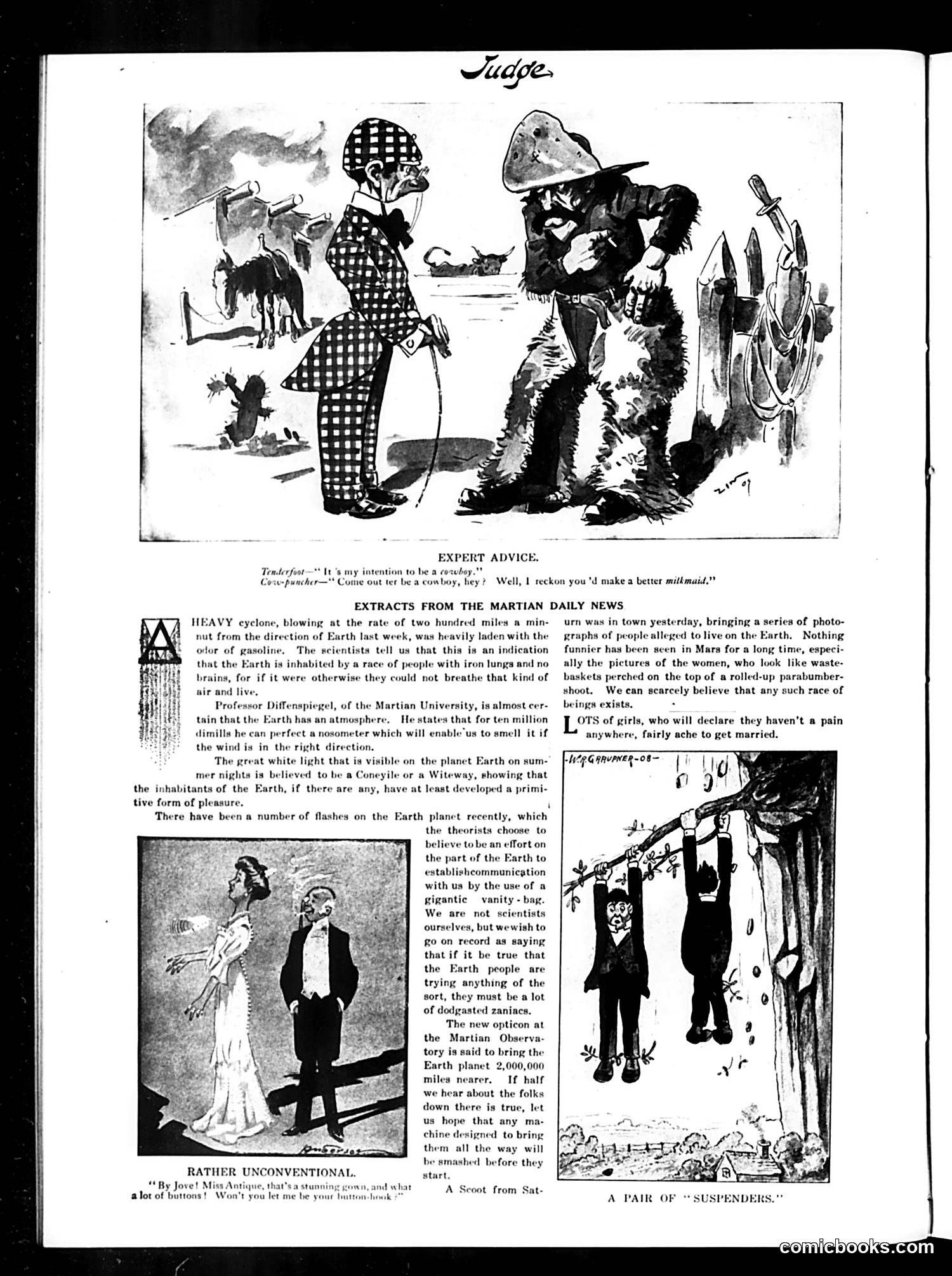
This page satirizes early 20th-century fascination with Mars and extraterrestrial life. The main feature, "Extracts from the Martian Daily News," inverts perspective: Martian scientists observe Earth with the same bemused condescension Europeans applied to "primitive" cultures. The joke targets several contemporary concerns: Earth's industrial pollution (detected as gasoline odor), human irrationality, and vanity. Martians mock earthlings' attempts at communication via mysterious "flashes" (likely referencing actual astronomical observations), dismissing us as "dodgasted zaniacs." The framing cartoon ("Expert Advice") and accompanying illustrations appear to be unrelated Judge humor about conventional social situations—courtship and fashion—providing typical satirical commentary on manners and propriety. The satire ultimately mocks human self-importance: if intelligent Martians existed, they'd find us absurd and dangerous rather than interesting. This reflects contemporary anxiety about industrial modernity and humanity's place in a potentially populated cosmos.
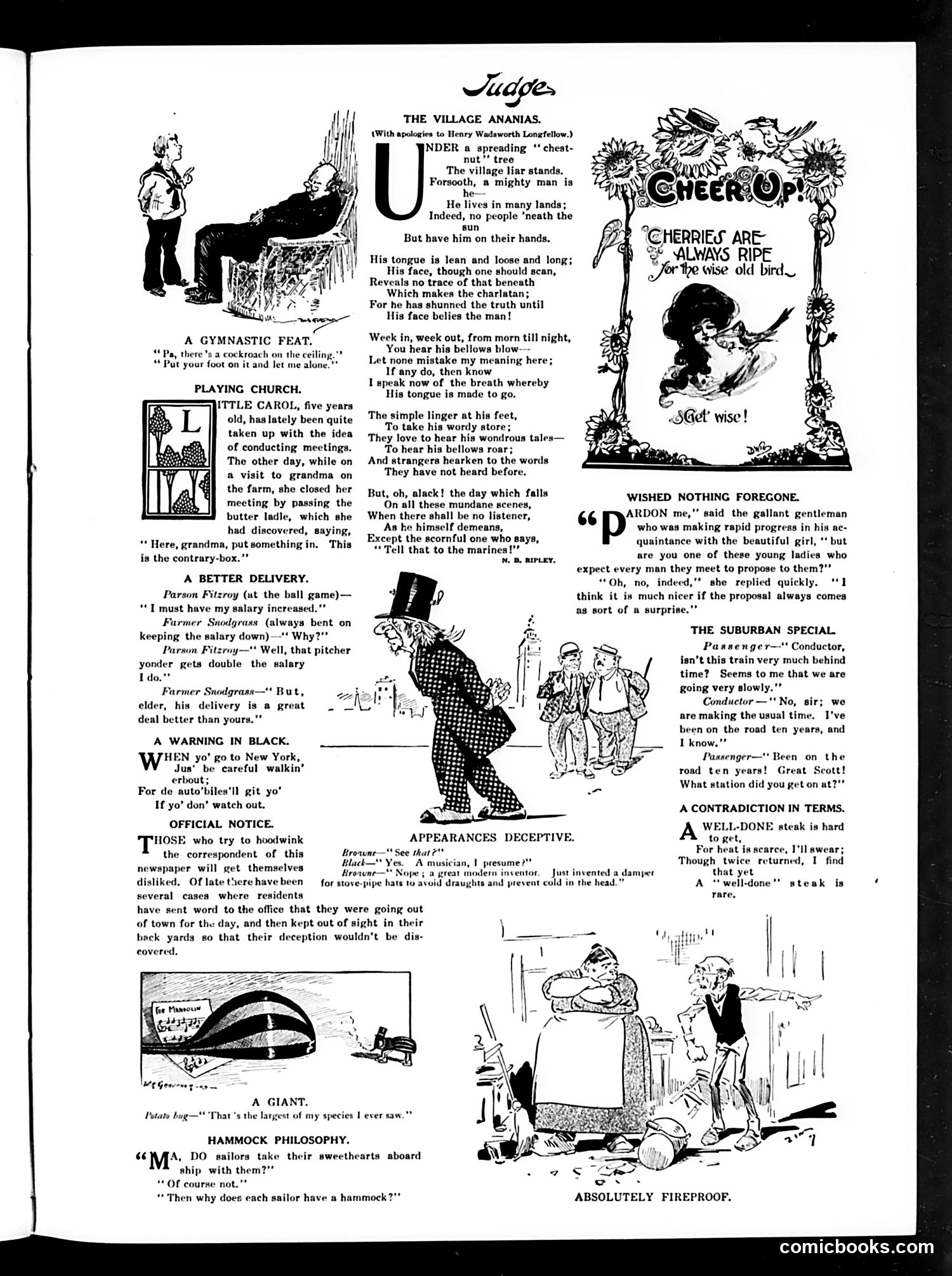
This page contains multiple short humorous pieces typical of early-20th-century American satirical magazines: **"The Village Ananias"** is the main feature—a poem mocking habitual liars in small towns. The title references Ananias from the Bible (a liar struck dead by God), applying this to the "village liar" whose loose tongue spreads tall tales that people eagerly believe, until eventually no one listens. Other pieces include domestic humor: a child conducting a mock church service, a pastor arguing his "delivery" (sermon) deserves higher pay than a baseball pitcher's (playing on the double meaning), and a couple discussing marriage proposals. **"A Warning in Black"** uses dialect humor, warning about automobiles—emerging technology that posed genuine dangers to pedestrians in the early automobile era. Additional brief jokes cover everyday situations: office workers avoiding work, train schedules, overcooked steak, and sailors' hammocks (with a mild innuendo about sweethearts). The cartoons and verses represent genteel, family-friendly satire targeting small-town life, modern conveniences, and social pretension rather than partisan politics.
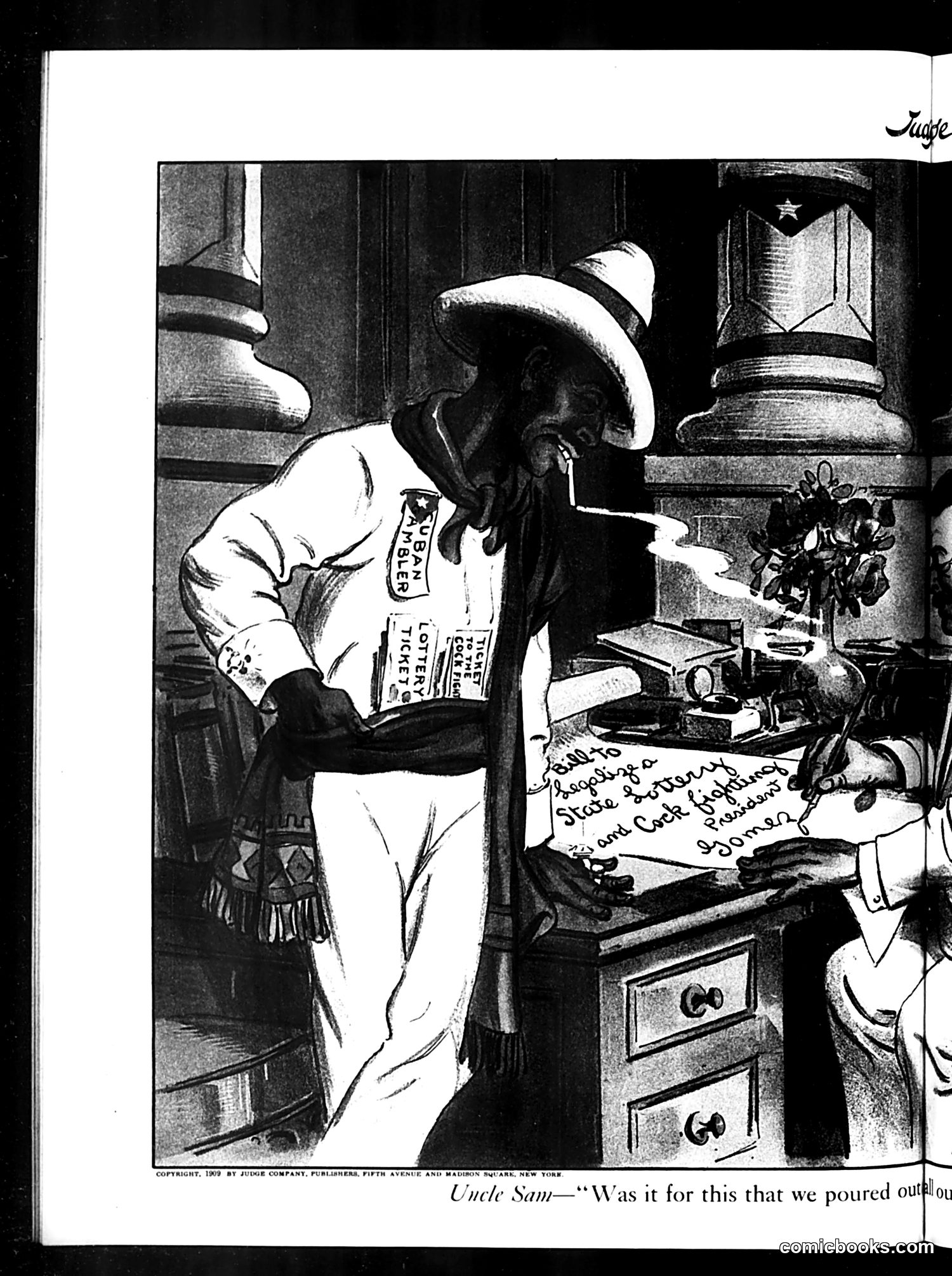
This cartoon depicts a figure in a white naval or military uniform with insignia labeled "COLLECTOR" examining documents at a desk. The caption reads "Uncle Sam—'Was it for this that we poured out'" (incomplete). The satire appears to criticize government spending or resource allocation during wartime. The "Collector" figure—likely representing a corrupt government official or bureaucrat—is shown reviewing what appear to be financial records or invoices, suggesting misuse of public funds. The incomplete caption suggests disillusionment about how national resources were spent. This likely references waste, corruption, or profiteering during a military conflict, though the specific war or date isn't clearly indicated in the visible text. The figure's caricature style was typical of Judge's satirical approach to political criticism.
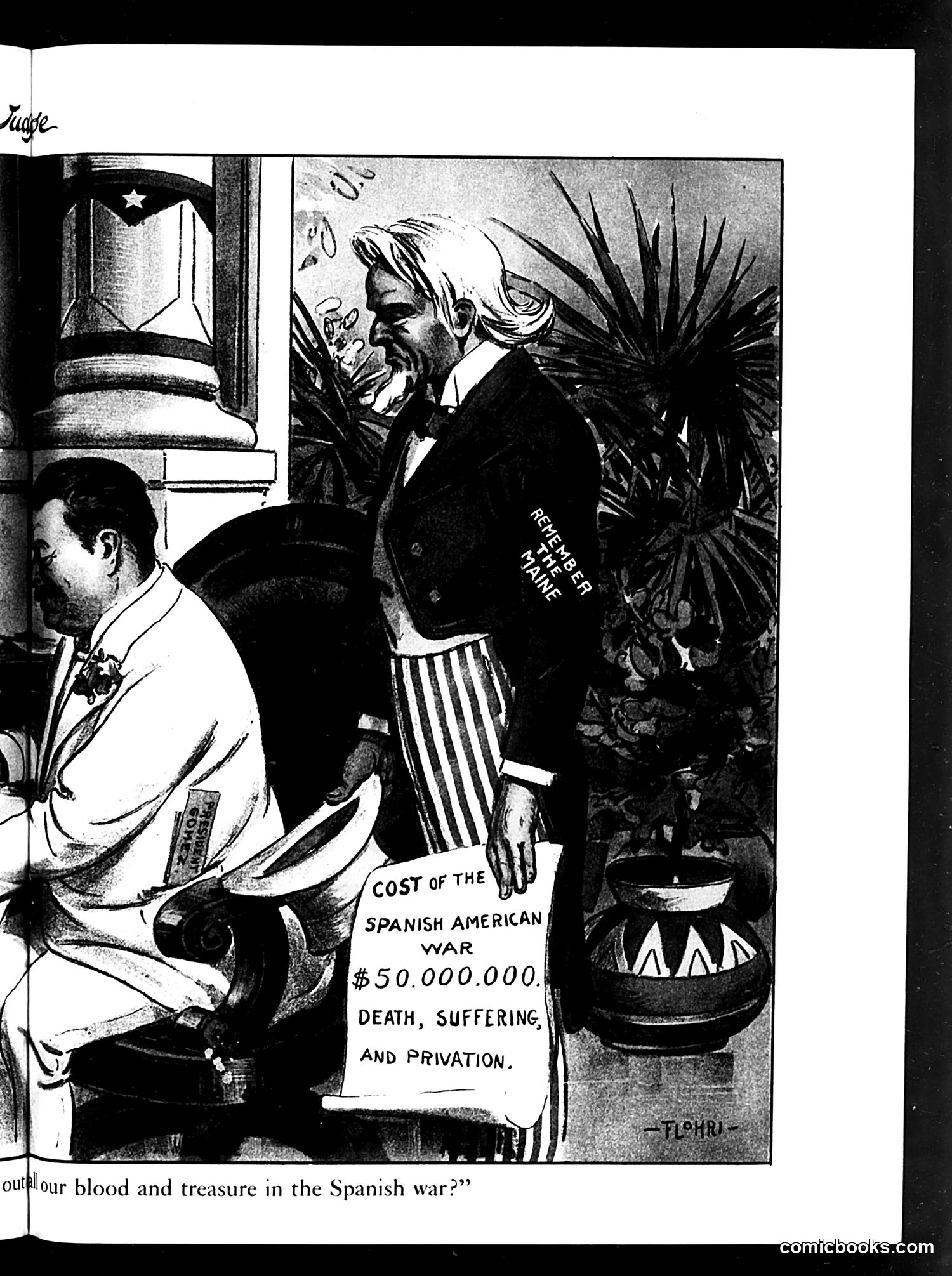
This **Judge** magazine cartoon satirizes American spending on the Spanish-American War (1898). The central figure, labeled "REFUSED DAME" (likely representing Lady Liberty or America), confronts a well-dressed gentleman who appears to represent war profiteers or political leaders. The placard explicitly states the war's "COST OF THE SPANISH AMERICAN WAR: $50,000,000. DEATH, SUFFERING, AND PRIVATION." The satire critiques how wealthy interests benefited financially from the conflict while ordinary Americans suffered casualties and hardship. The "Dame" refuses to accept this outcome, suggesting public rejection of the human and financial costs. The cartoon reflects contemporary anti-war sentiment questioning whether the war's expense and casualties were justified.
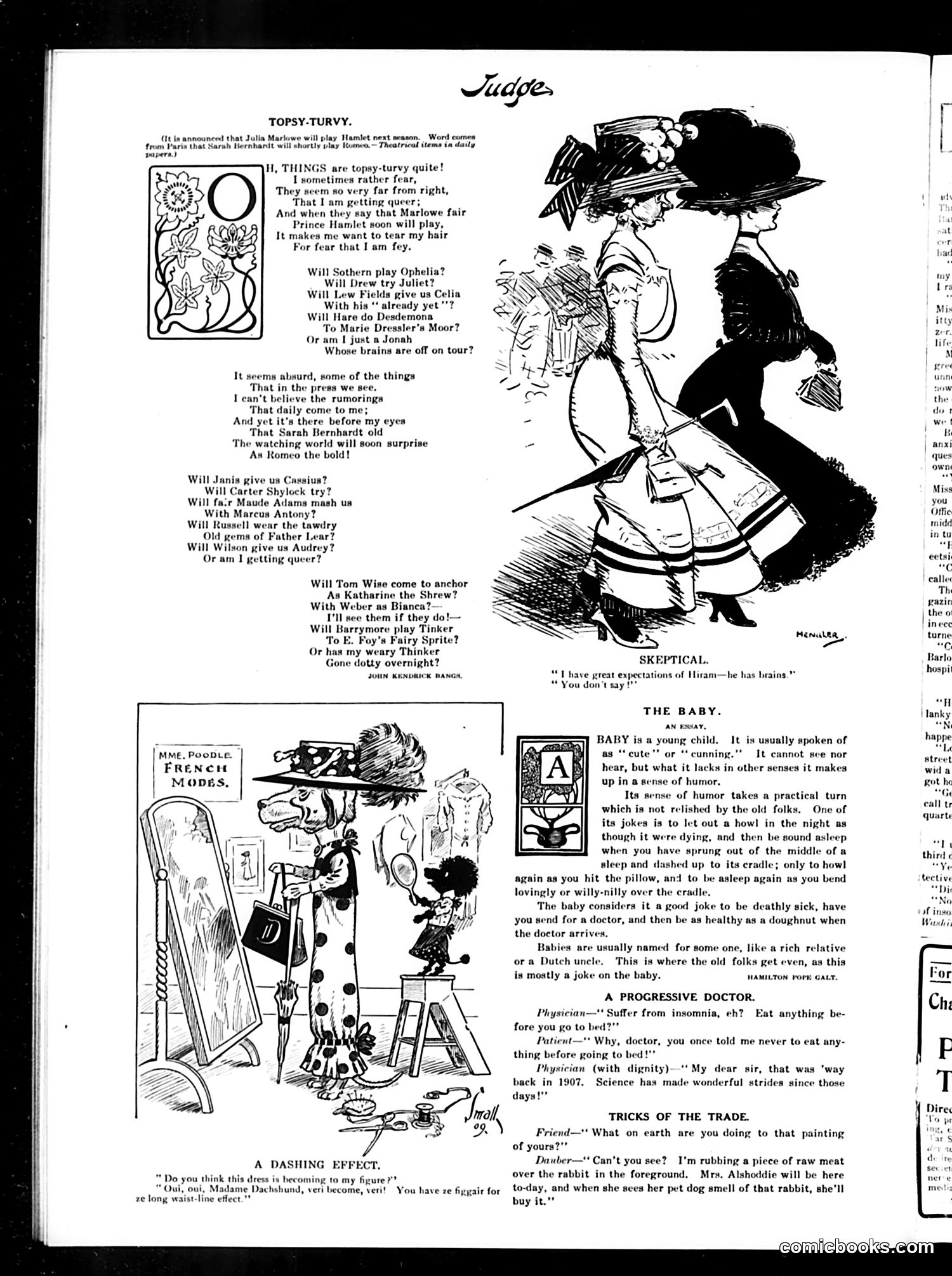
This page satirizes theatrical casting announcements from the early 1900s. The main poem "Topsy-Turvy" by John Kendrick Bangs mocks reports that famous actresses Julia Marlowe and Sarah Bernhardt will play male Shakespearean roles (Hamlet and Romeo). The poet expresses bewildered outrage at gender-crossing theatrical casting, listing absurd hypothetical alternatives: male actors playing female roles like Ophelia and Juliet. The satire reflects contemporary anxiety about theatrical conventions and gender propriety. It's unclear which other actresses mentioned (Maude Adams, Marie Dressler, etc.) had announced similar roles. The page also contains unrelated humor pieces: "A Dashing Effect" (a fashion joke), "The Baby" (infant humor), and "A Progressive Doctor" (medical satire about changing medical advice). The illustrations are cartoons depicting these scenarios without clear political content—mostly social satire about theater, fashion, and domestic life.
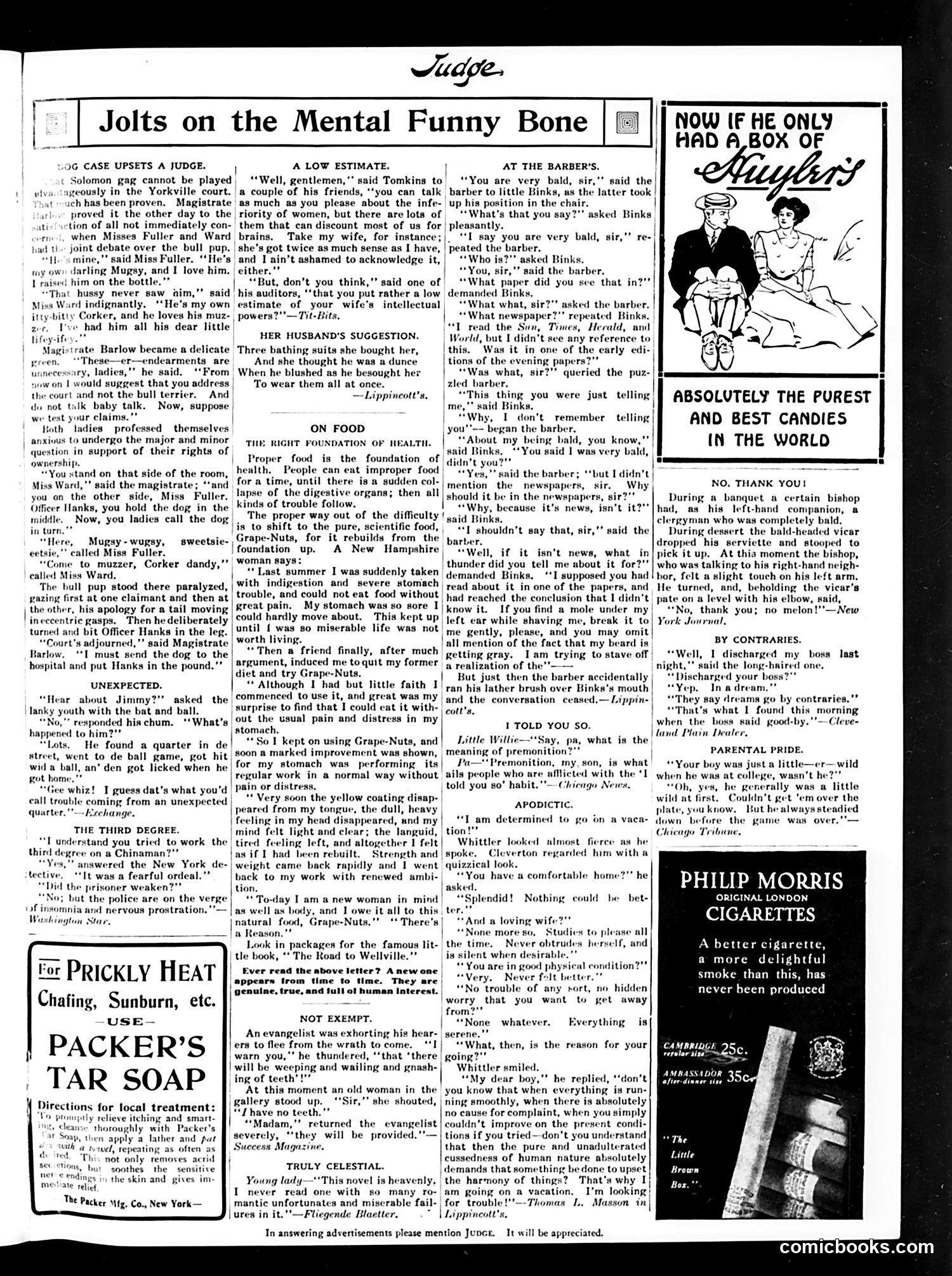
This page contains several satirical pieces typical of early 20th-century American humor: **The main cartoon** depicts a magistrate settling a dispute between two women (Misses Fuller and Ward) who each claim ownership of a bull terrier dog. The satire mocks both the women's use of baby talk ("muzzer," "darling Mugsy") and the absurdity of the legal system being called to adjudicate pet ownership. The dog itself settles matters by biting Officer Hanks, forcing the magistrate to adjourn—a commentary on how courts waste time on trivial matters. **"A Low Estimate"** satirizes marriage dynamics: a husband claims his wife has "twice as much sense" as he does, which another man interprets as the husband underestimating himself—a joke about male ego versus female competence. **Other sections** include humor about food (promoting Grape-Nuts cereal) and typical period jokes. The page reflects Judge's editorial stance: poking fun at gender relations, legal inefficiency, and consumer culture while advertising products to readers.
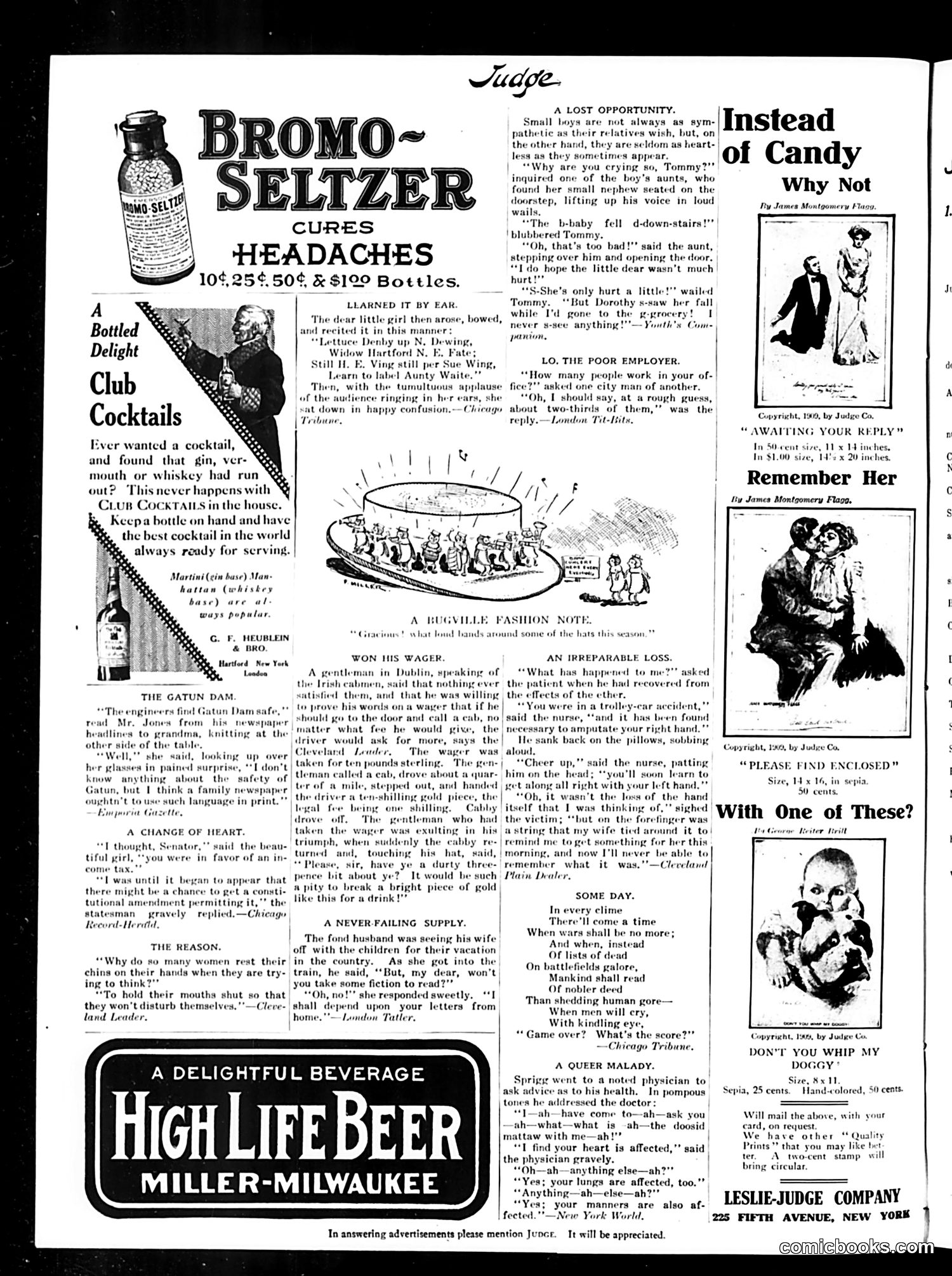
This is primarily an **advertising page** from Judge magazine, featuring multiple product advertisements alongside short humorous anecdotes and satirical cartoons typical of the era. **Key Content:** **Advertisements dominate:** Bromo-Seltzer (headache cure), Club Cocktails, High Life Beer, and Judge Company prints are prominently featured. **Satirical humor includes:** - "A Lost Opportunity": A boy cries over his baby sister's fall; his aunt dismisses it, showing indifference to children's genuine concerns—satire on adult callousness. - "Lo, the Poor Employer": A joke about workplace productivity, suggesting only two-thirds of employees actually work. - Various brief anecdotes mocking Irish accents, romantic sentimentality, and marital dynamics. **James Montgomery Flagg illustrations** accompany romantic/sentimental pieces ("Remember Her," "Awaiting Your Reply"). The page reflects early 20th-century concerns: patent medicines, cocktail culture, workplace efficiency, and gender/class stereotypes. The humor is genteel, targeting middle-class anxieties and social pretensions rather than substantive political satire.
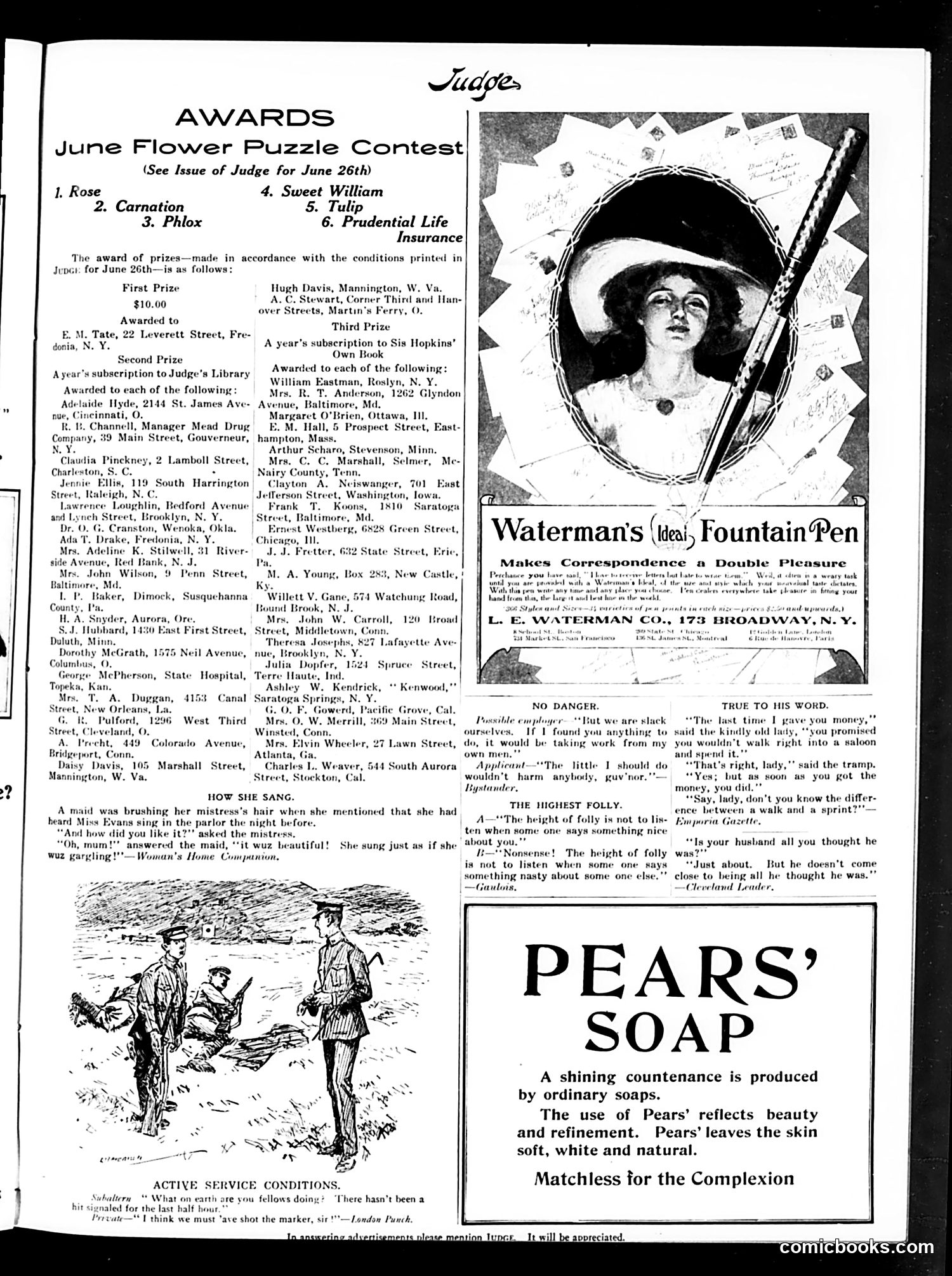
This page is primarily a **results announcement and advertisements** rather than political satire. It announces winners of Judge's June Flower Puzzle Contest, with prizes including cash and magazine subscriptions. The small cartoons present are **domestic humor** rather than political commentary: - **"How She Sang"** depicts a mistress asking her maid about singing the previous night—a lighthearted joke about the maid's vocal abilities. - **"Active Service Conditions"** (bottom) appears to be a WWI-era military joke between a subaltern and private about mistakenly shooting a marker instead of the enemy—period wartime humor. The remainder consists of **brief humorous anecdotes** and **product advertisements** (Waterman's fountain pens, Pears' soap). The page reflects early 20th-century magazine conventions mixing contests, light humor, and advertising rather than the sharp political satire Judge was known for.
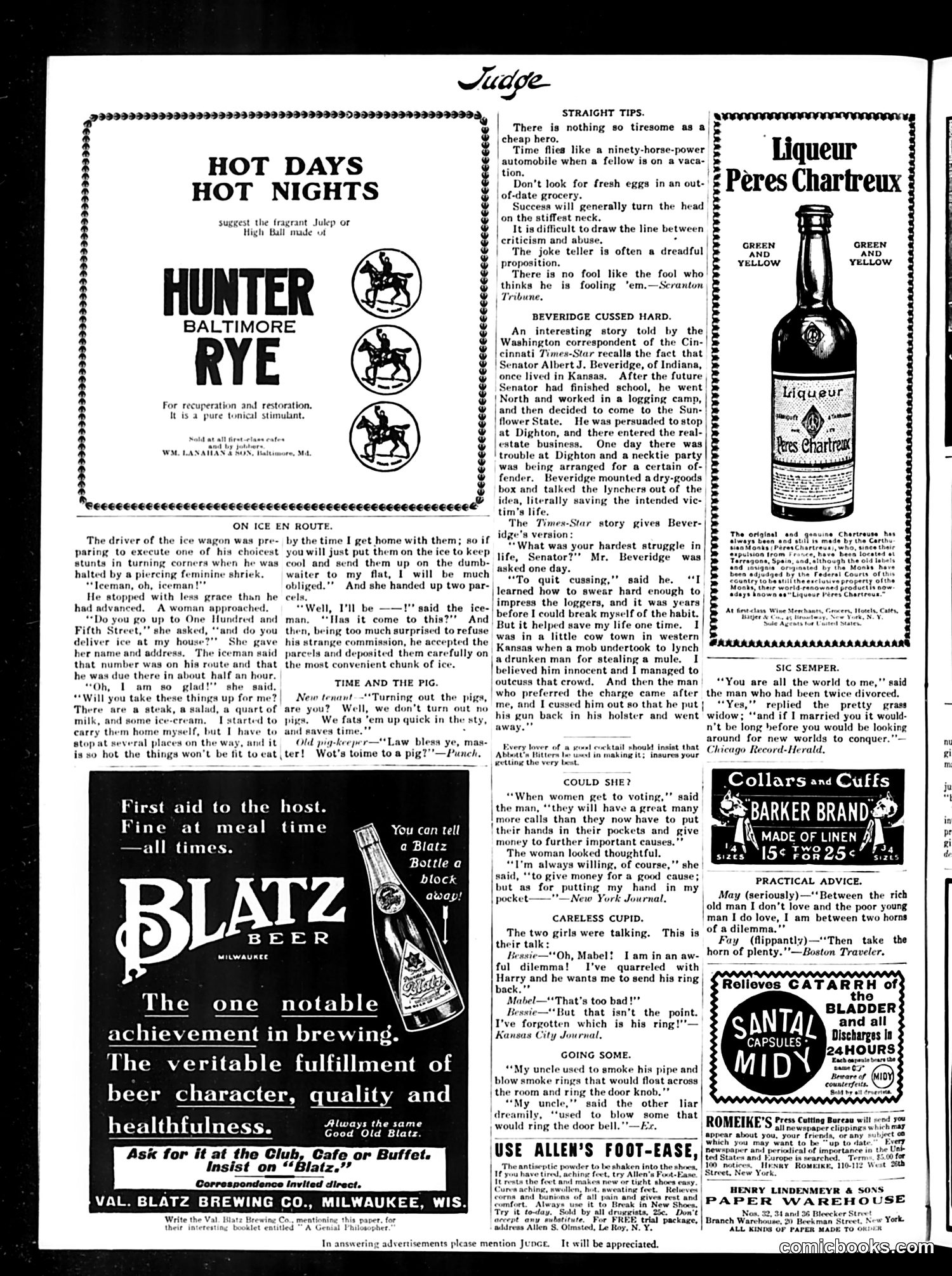
This page is primarily **advertising with some light humor pieces**, typical of Judge's format. The main cartoon is "ON ICE EN ROUTE," a brief humorous anecdote about a woman asking an iceman to deliver groceries on ice while he waits, then carry them upstairs for her. The joke plays on class assumptions: the working-class iceman is incredulous at being treated like a servant, responding sarcastically ("Has it come to this?"). It satirizes the entitled attitude of middle-class housewives toward working people. A secondary piece, "TIME AND THE PIG," presents a brief exchange between a new tenant and old pig-keeper about efficiency, which appears to be a simple wordplay joke about priorities. The page is dominated by **period advertisements**: Hunter Baltimore Rye whiskey, Blatz Beer (Milwaukee), Liqueur Pères Chartreux, and various patent medicines and collar brands. The "STRAIGHT TIPS" column offers sardonic social observations typical of Judge's satirical voice, mocking pretentiousness and human folly. The page reflects early 20th-century concerns: class dynamics, labor relations, and consumer culture.
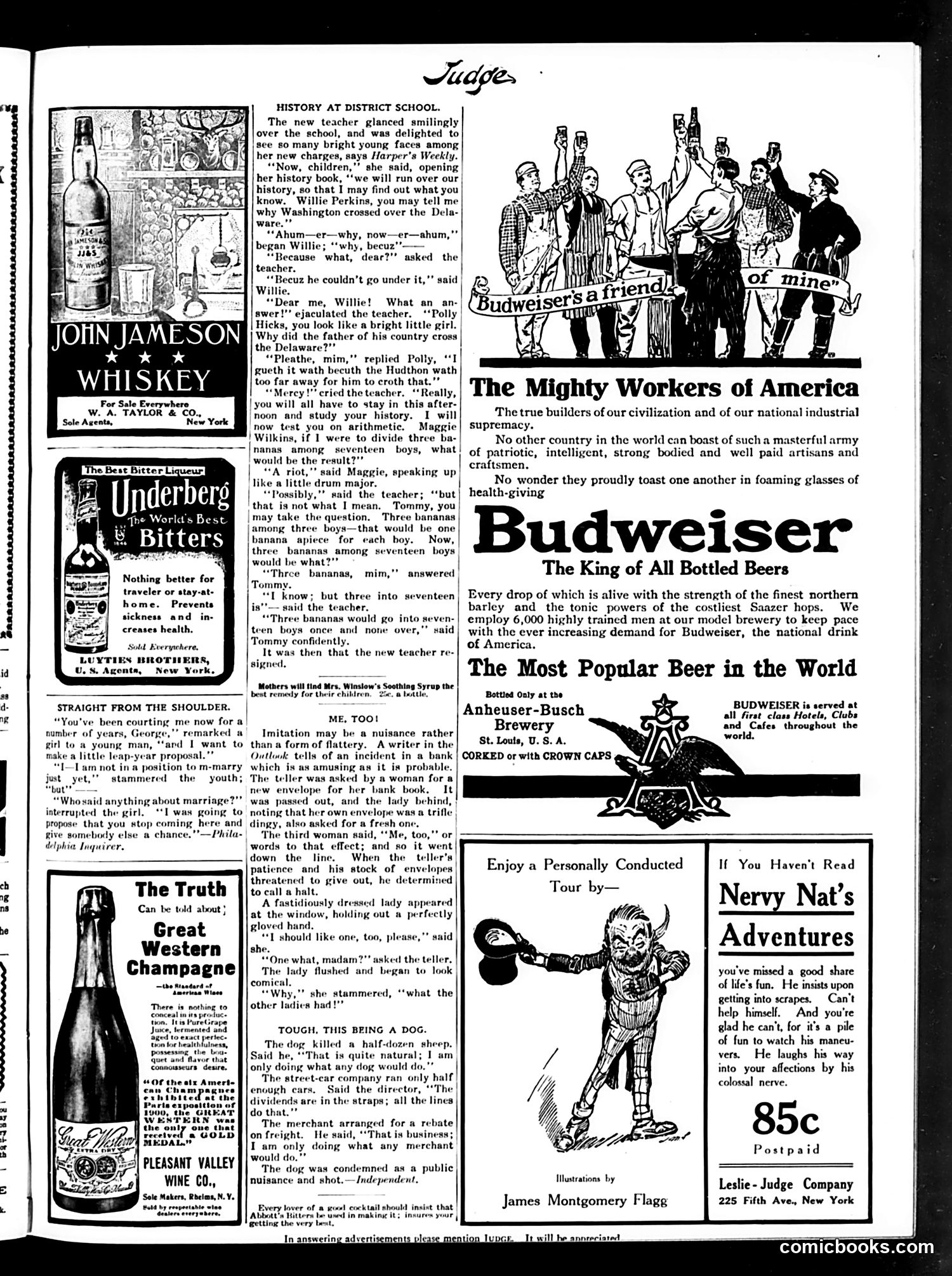
This page is primarily **advertising**, with small humorous anecdotes scattered between commercial announcements for alcoholic beverages (whiskey, champagne, bitters, and beer). The notable content includes: **"History at District School"** — A children's joke where students give absurdly literal answers to history questions. When asked why Washington crossed the Delaware, one child answers "becuz he couldn't go under it" (misunderstanding "crossed"). The humor relies on innocent misinterpretation of language. **"Straight from the Shoulder"** — A brief romantic comedy where a woman proposes a "leap-year proposal" (referencing the custom where women could propose in leap years), but the man deflects by claiming he can't afford marriage. The dominant feature is a large **Budweiser advertisement** celebrating "The Mighty Workers of America" — positioning the beer as the patriotic drink of industrial laborers and craftsmen. This reflects early 1900s marketing that associated beer consumption with American strength and national pride. The page serves primarily as a vehicle for product advertising rather than political satire.
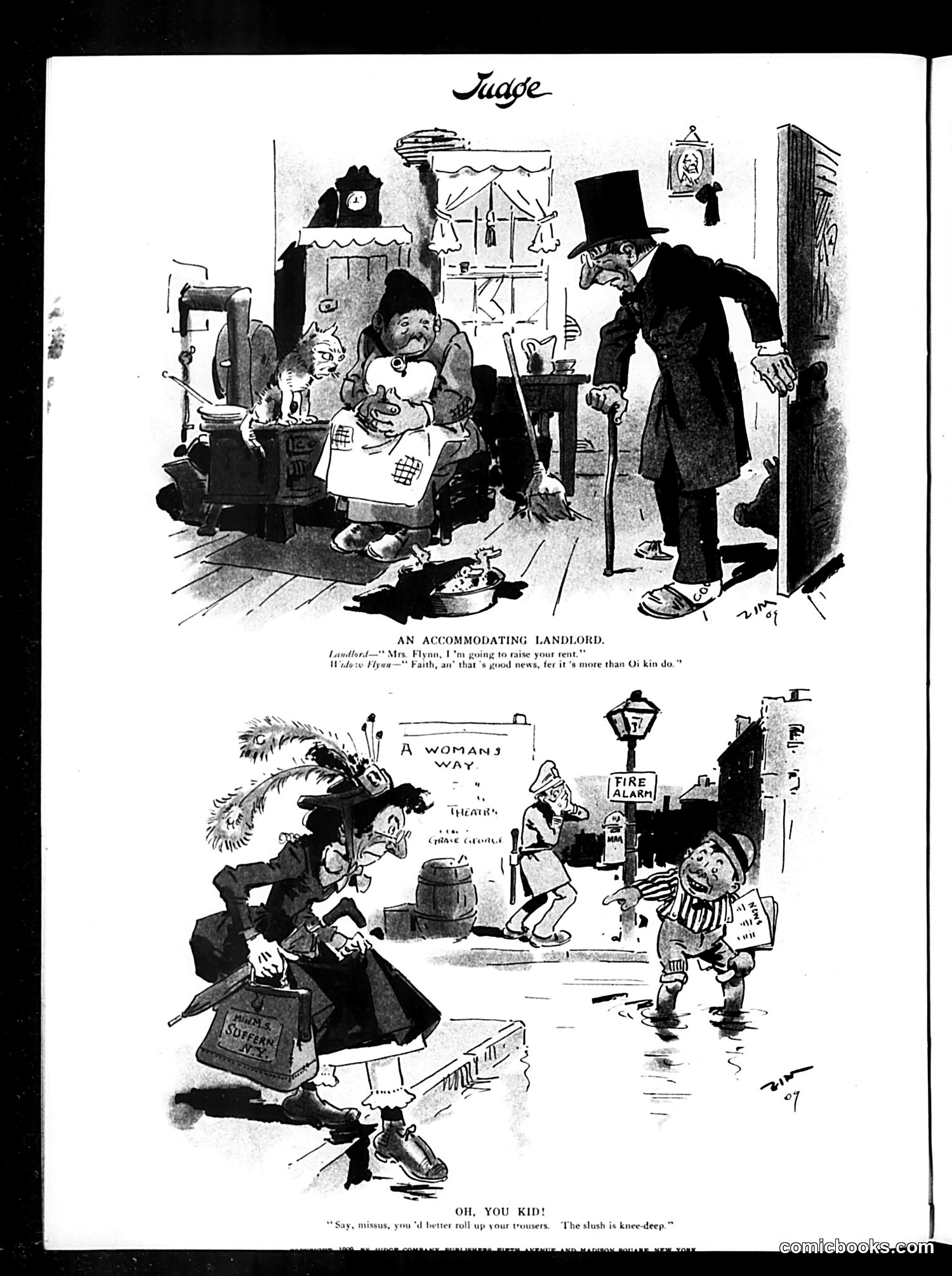
**Top cartoon ("An Accommodating Landlord"):** A well-dressed landlord with a top hat tells a poor tenant woman (Mrs. Flynn) he's raising her rent. She responds that this is "more than O'h kin do"—suggesting Irish working-class struggle. The satire targets landlords exploiting vulnerable tenants with rent increases they cannot afford. **Bottom cartoon ("Oh, You Kid!"):** A woman in fancy dress with a large feathered hat encounters a man in shabby clothes warning her about deep slush on the street, telling her to roll up her trousers. The title "A Woman's Way" and his dismissive "Oh, you kid!" suggest satire of class pretension—a working-class man mocking an overdressed woman ignoring practical reality for vanity. Both cartoons mock class attitudes and economic disparities of the era.