
A complete issue · 16 pages · 1909
Judge — August 7, 1909
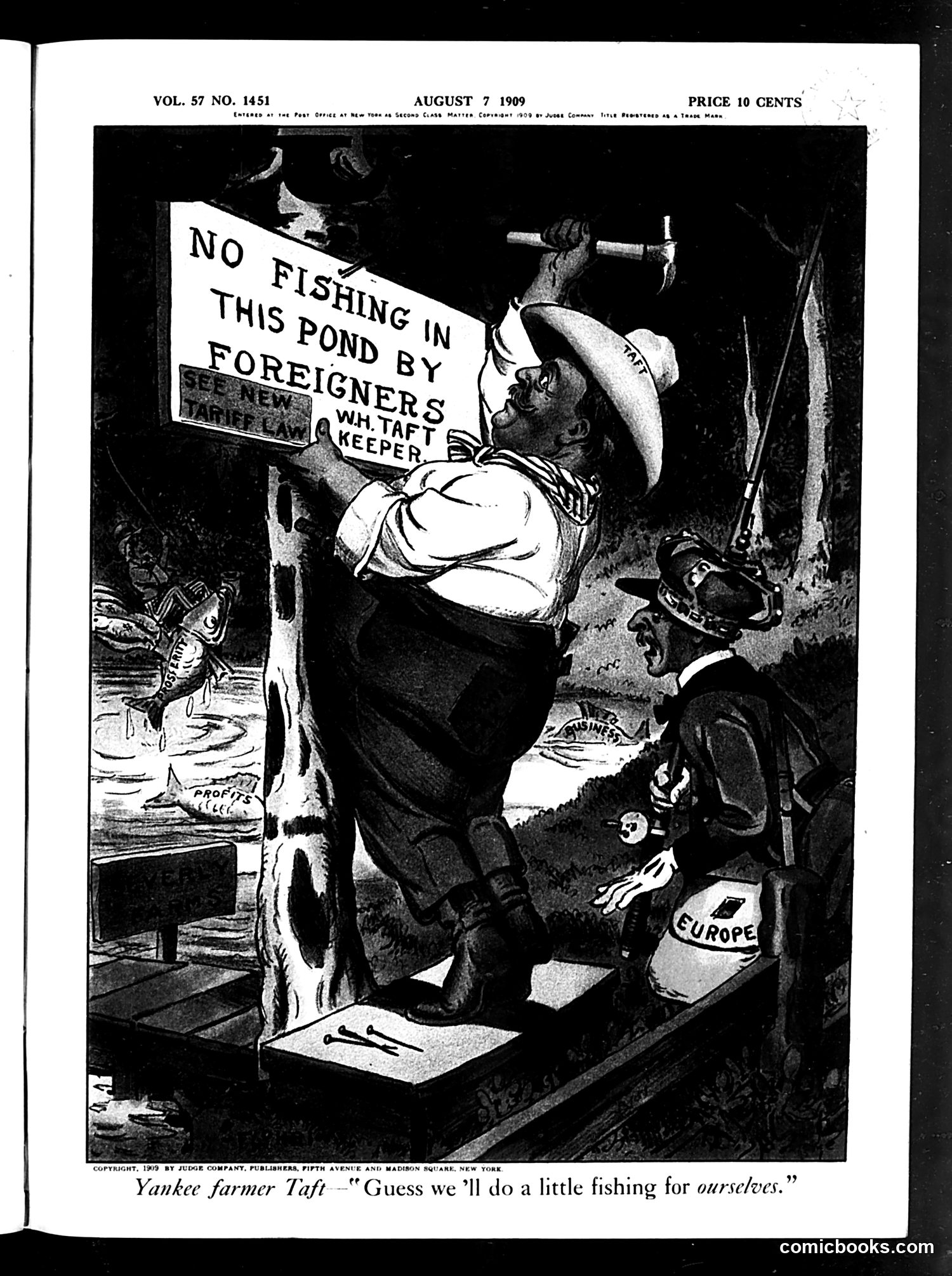
This satirical cartoon depicts President William Howard Taft as a "Yankee farmer" posting a sign reading "NO FISHING IN THIS POND BY FOREIGNERS" with "WH. TAFT KEEPER" marked below. A figure labeled "EUROPE" appears to the right, apparently excluded from the pond. The cartoon satirizes Taft's protectionist economic policies and nationalist stance toward foreign commerce. The "pond" represents American economic resources or markets. By portraying Taft as a farmer-keeper restricting foreign access, Judge mocks what it presents as his isolationist or exclusionary trade policies—contrasting sharply with the cosmopolitan attitudes the magazine apparently favored. The caption's folksy tone ("do a little fishing for ourselves") emphasizes the provincial nature of such protectionism.
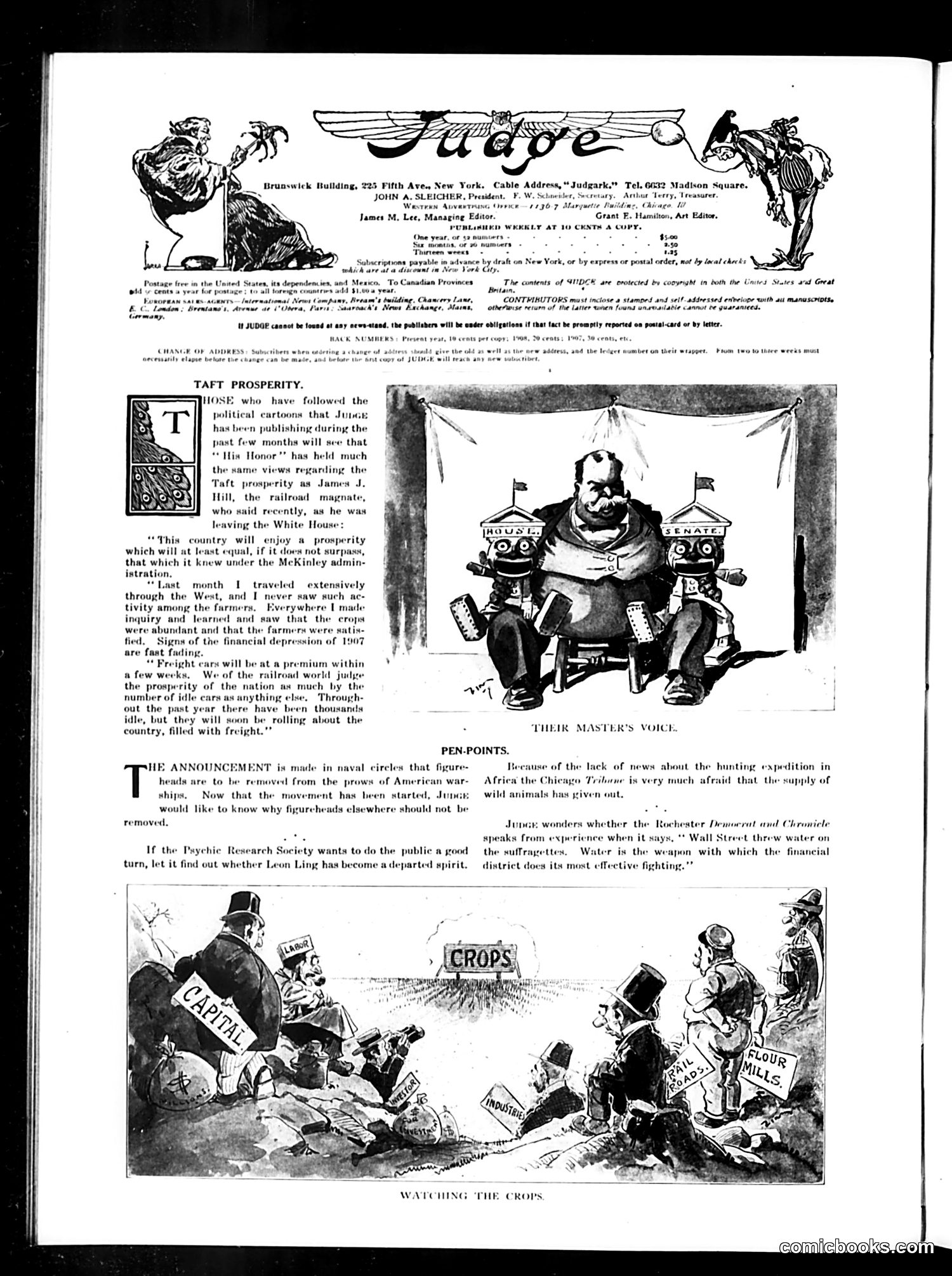
This page contains political commentary on the **Taft administration's economic policies**. The main article "Taft Prosperity" quotes railroad magnate James J. Hill praising prosperity under President Taft, while sarcastically contrasting it with the McKinley era. The central cartoon "Their Master's Voice" depicts a figure (likely Taft) as a puppet controlled by two opposing forces labeled "House" and "Senate"—suggesting he was politically dominated by Congress rather than exercising independent executive power. The lower cartoon "Watching the Crops" uses agricultural imagery to satirize economic concerns, showing various economic interests (capital, crops, flour mills) being monitored or manipulated. The "Pen-Points" section offers brief satirical commentary on contemporary news events, including references to African hunting expeditions and financial district water issues in Rochester.
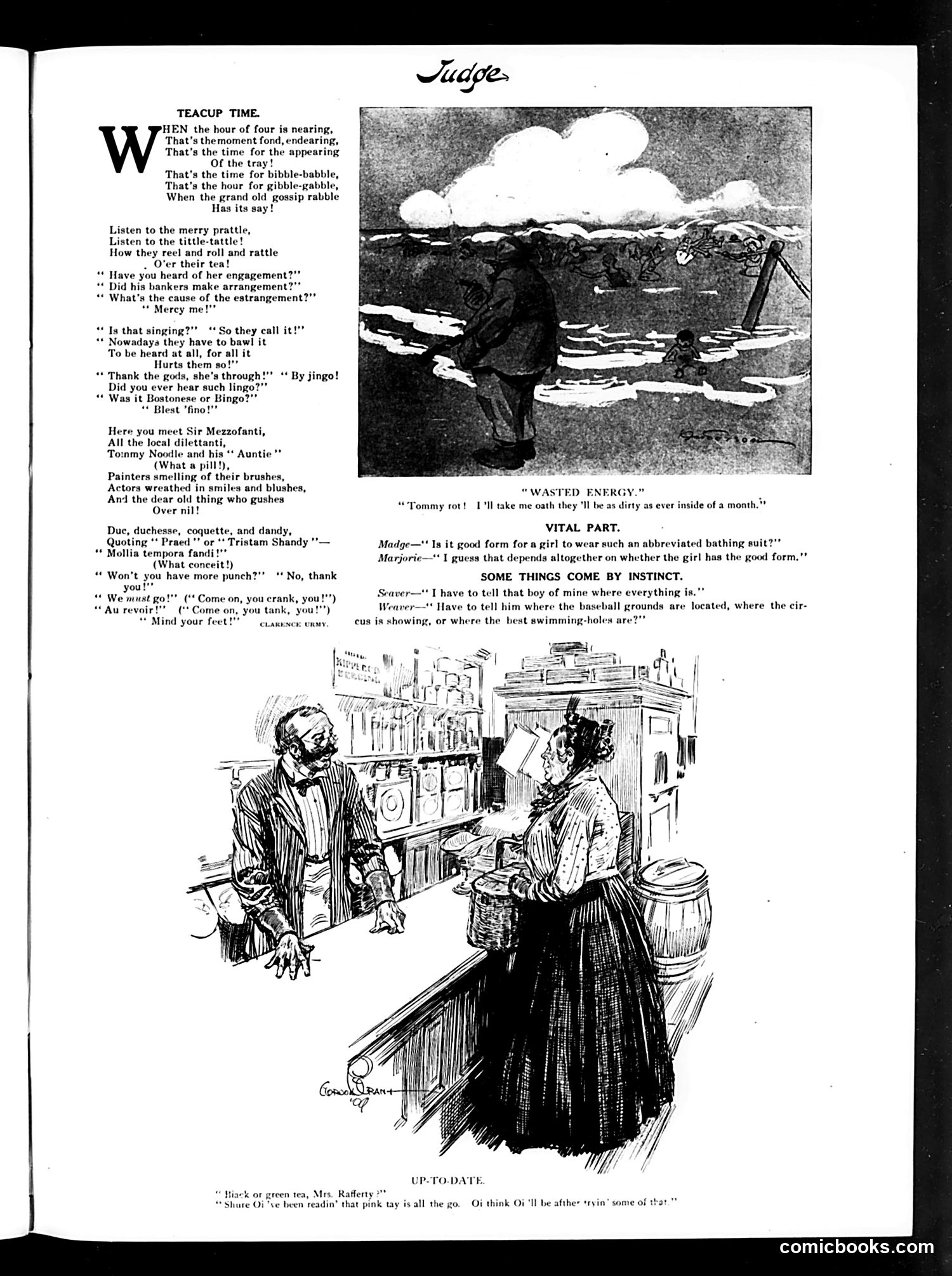
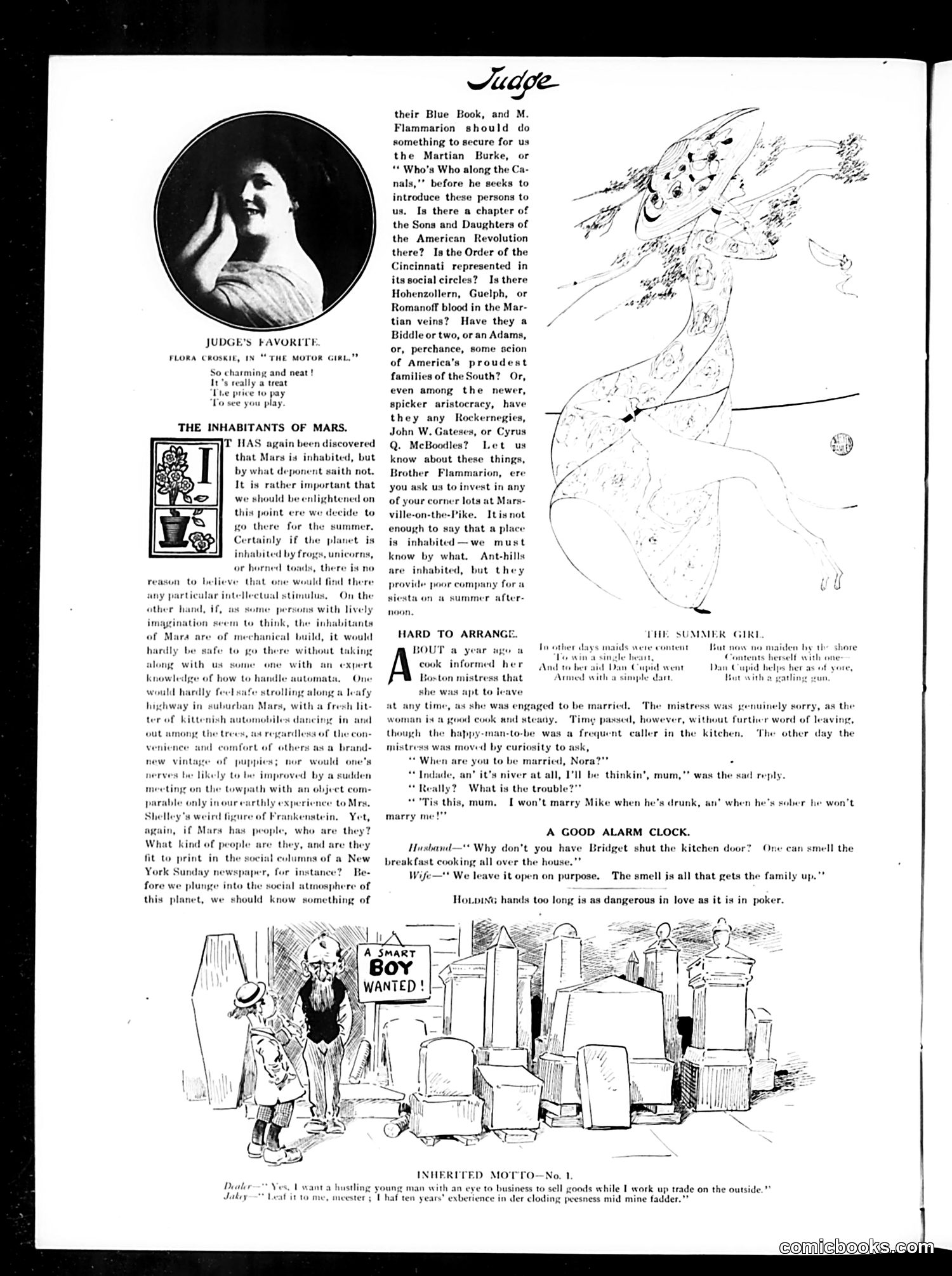
This page contains several distinct satirical pieces: **"Judge's Favorite: Flora"** - A portrait praising an attractive woman as "The Motor Girl," celebrating early automotive culture. **"The Inhabitants of Mars"** - A speculative essay mocking contemporary theories about Martian life, with illustrations of imaginative creatures. The satire targets pseudoscientific claims popular in the era. **"Hard to Arrange"** and **"The Summer Girl"** - Brief domestic humor pieces about courtship and marriage, typical of Judge's social commentary. **"A Good Alarm Clock"** - A one-liner joke about marital life. **"A Smart Boy Wanted"** - A cartoon depicting an employment notice, satirizing labor-seeking youth and working-class aspirations through visual humor. The page represents Judge's typical mix of social satire, domestic comedy, and visual gags targeting turn-of-century American culture and relationships.
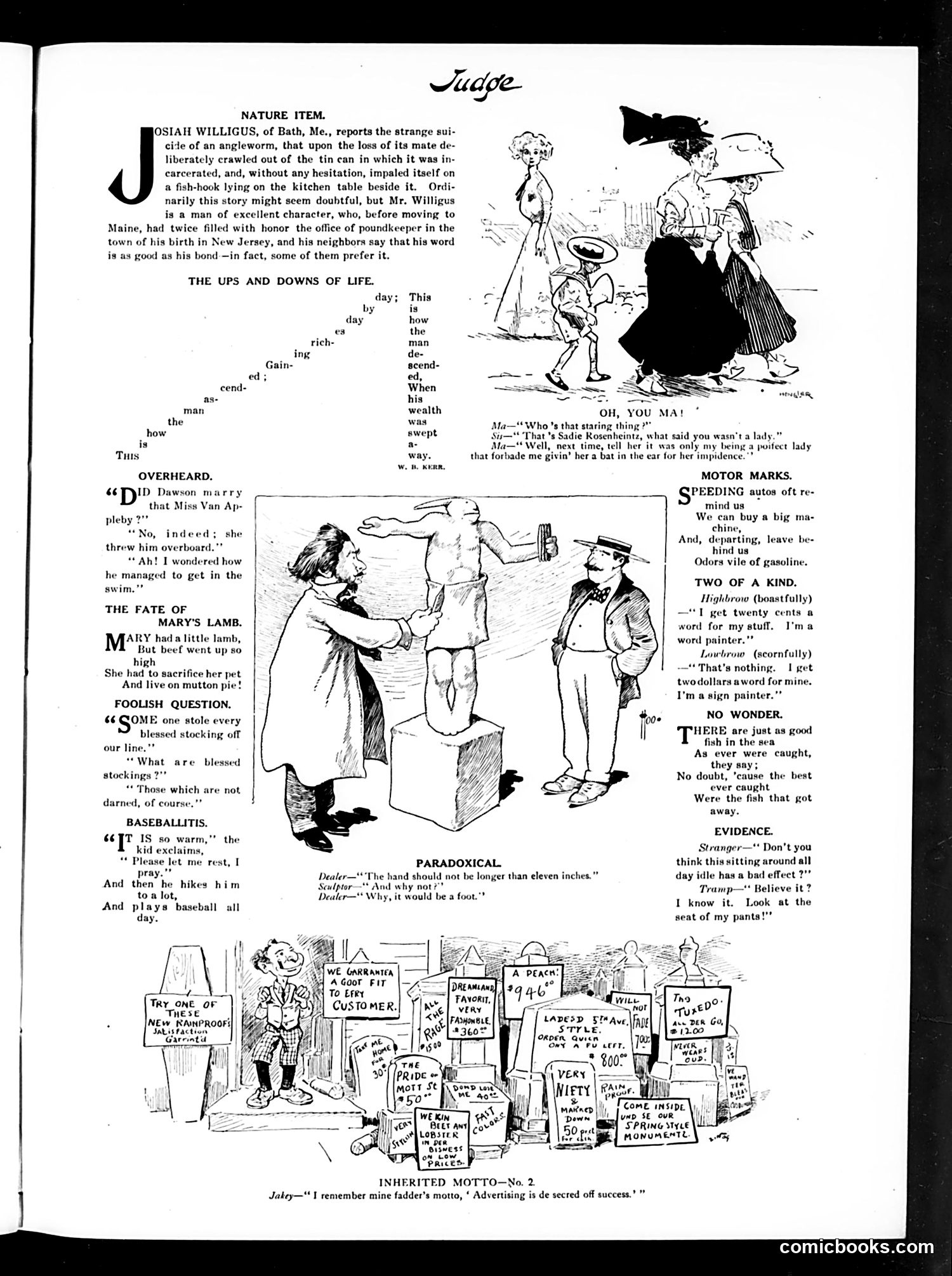
This page contains multiple unrelated humor items typical of Judge magazine's format. The main content includes: **"Nature Item"**: A anecdote about an angleworm's suicide, establishing Josiah Willgus (a real poundkeeper) as a character of note. **"Oh, You Ma!"**: A cartoon showing children with an adult, with dialogue about a "Sadie Rosenheim" — likely ethnic humor common to the era. **"Overheard"**: A brief joke about Miss Van Appleby swimming. **"Motor Marks" and other sections**: Brief one-liner jokes about automobiles and signs. **Bottom cartoon**: Shows a storefront cluttered with advertising signs—satirizing excessive, overlapping commercial signage and poor aesthetic judgment in window displays. The page reflects early 20th-century Judge humor: ethnic stereotypes, automobile-era jokes, and visual satire of commercial culture's tackiness.
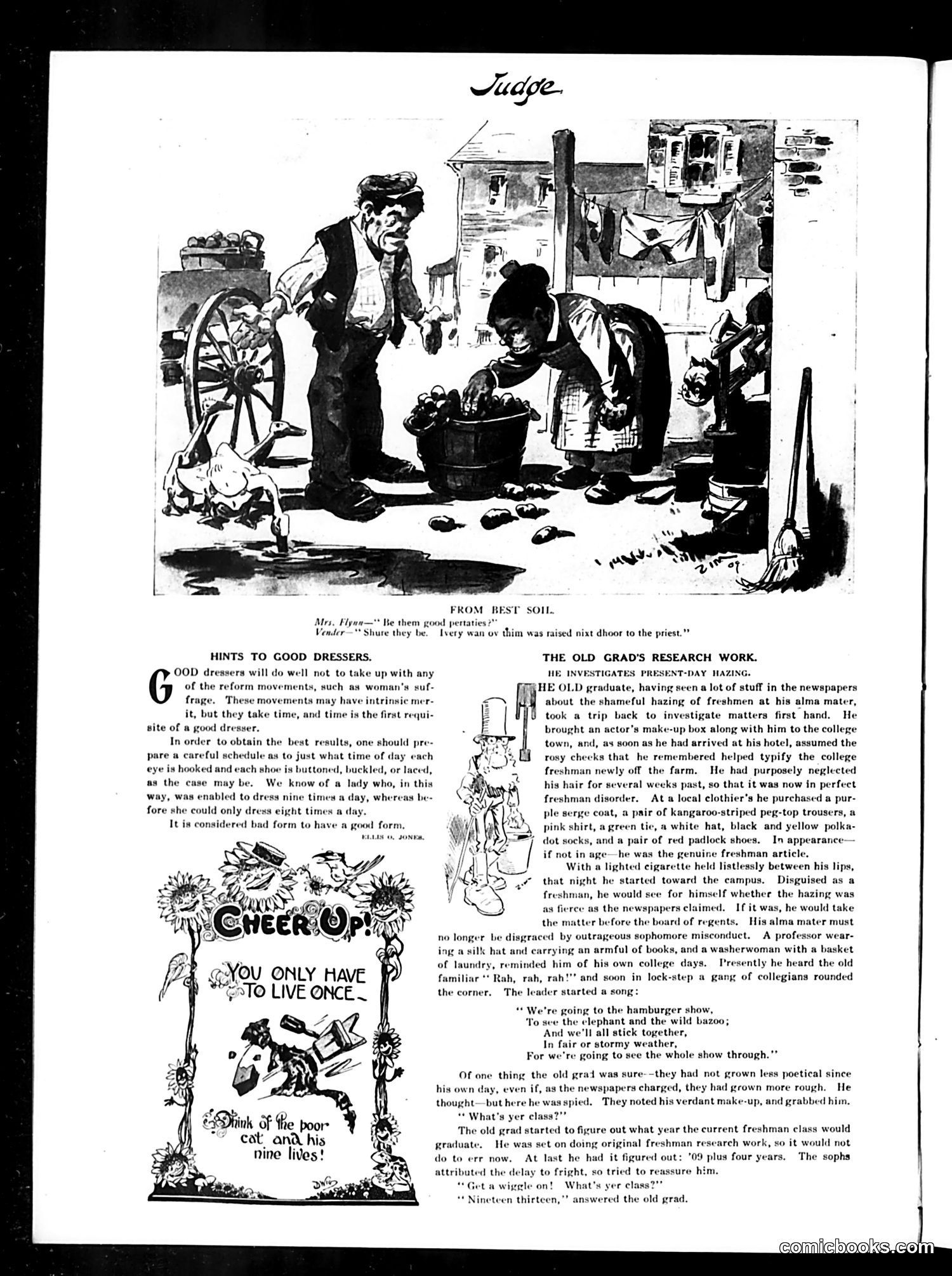
This *Judge* magazine page contains two satirical pieces about late 19th/early 20th-century American life: **Top cartoon ("From Best Soil")**: A vendor selling produce claims his potatoes were "raised next door to the priest," implying proximity to the clergy makes them virtuous. The joke mocks Irish immigrant stereotypes and the tendency to invoke religious authority for mundane commerce. **Main story ("The Old Grad's Research Work")**: An alumnus returns to his college to investigate reports of freshman hazing. He disguises himself as a naive new student using theatrical makeup and deliberately unfashionable clothing (striped trousers, red padlock shoes, polka-dot socks). The satire targets the prevalence of hazing as an acceptable college tradition while mocking the obvious disguise—the sophmores quickly identify and grab him anyway. The piece's tone suggests hazing was common enough to warrant investigative concern, yet treated as inevitable student behavior. The accompanying "Hints to Good Dressers" and "Cheer Up" sections appear to be filler content typical of era magazines.
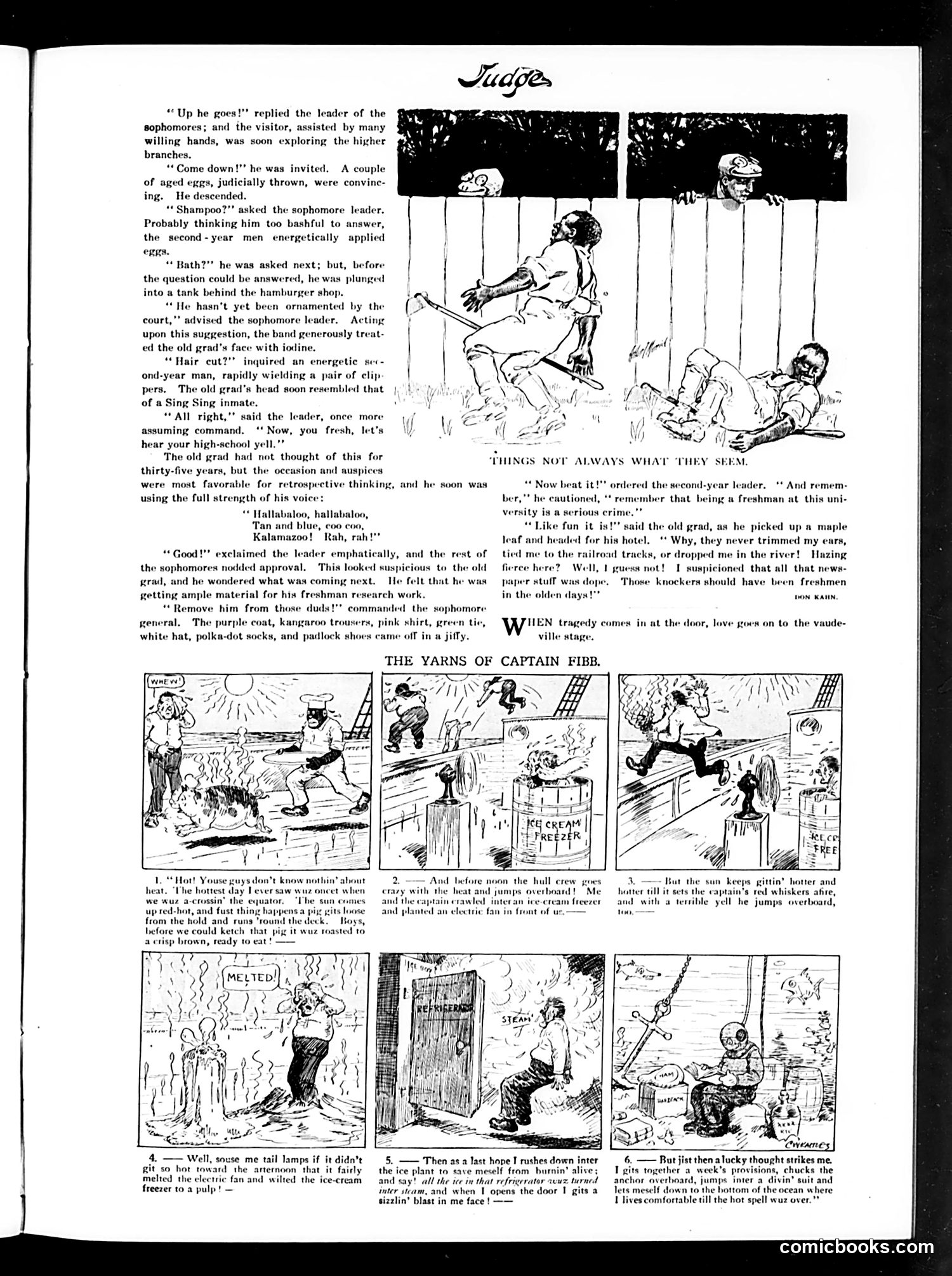
This page contains two distinct pieces of satirical content: **Upper section:** A hazing narrative mocking college fraternity initiation practices. Sophomores subject an visiting alumnus to brutal "pranks"—forcing him up a tree, throwing eggs, applying gas ("shampoo"), dunking him, marking his face with iodine, and cutting his hair. The satire critiques the violence and humiliation normalized in collegiate hazing, with the old graduate ultimately fleeing rather than tolerating the abuse. The joke targets both the cruelty of current students and nostalgia's blindness—he can't understand why modern hazing seems worse than his era. **Lower section ("The Yarns of Captain Fibb"):** A tall-tale comic strip featuring an exaggerated seafaring narrator whose increasingly absurd stories about extreme heat (roasting pigs, melting ice cream freezers, turning refrigerated ice to steam) parody the yarn-spinning tradition. The humor relies on escalating impossibilities and vernacular dialect ("Youse guys," "gits"). Both pieces use exaggeration to satirize American institutions and cultural types—collegiate brutality and boastful maritime folklore.
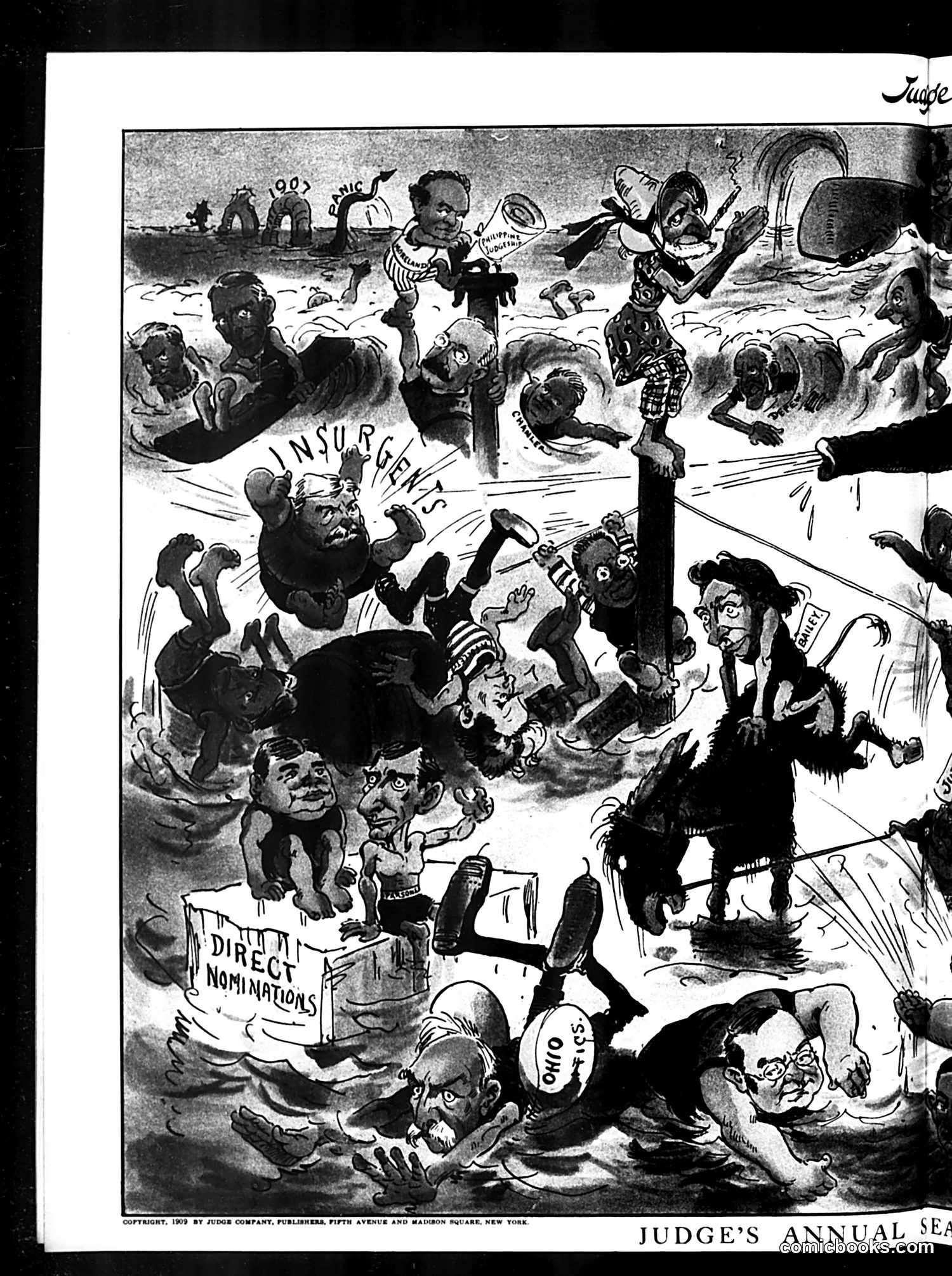
This Judge magazine cartoon satirizes the chaotic state of Democratic Party politics, likely from the 1908 election period. The scene depicts a turbulent "sea" of political turmoil labeled "INSURGENTS" with Democratic figures struggling in the water. A box labeled "DIRECT NOMINATIONS" appears to reference the progressive movement's push for direct primary elections rather than convention selection. The caricatured figures—appearing simian in the period's offensive cartooning style—represent various Democratic factions in disarray. The cartoon mocks internal party conflict, possibly between conservative establishment Democrats and progressive "insurgents" advocating reform. The drowning, chaotic imagery suggests the party was fragmenting over nomination procedures and ideological direction, a common theme in this era's political satire about Democratic Party dysfunction.
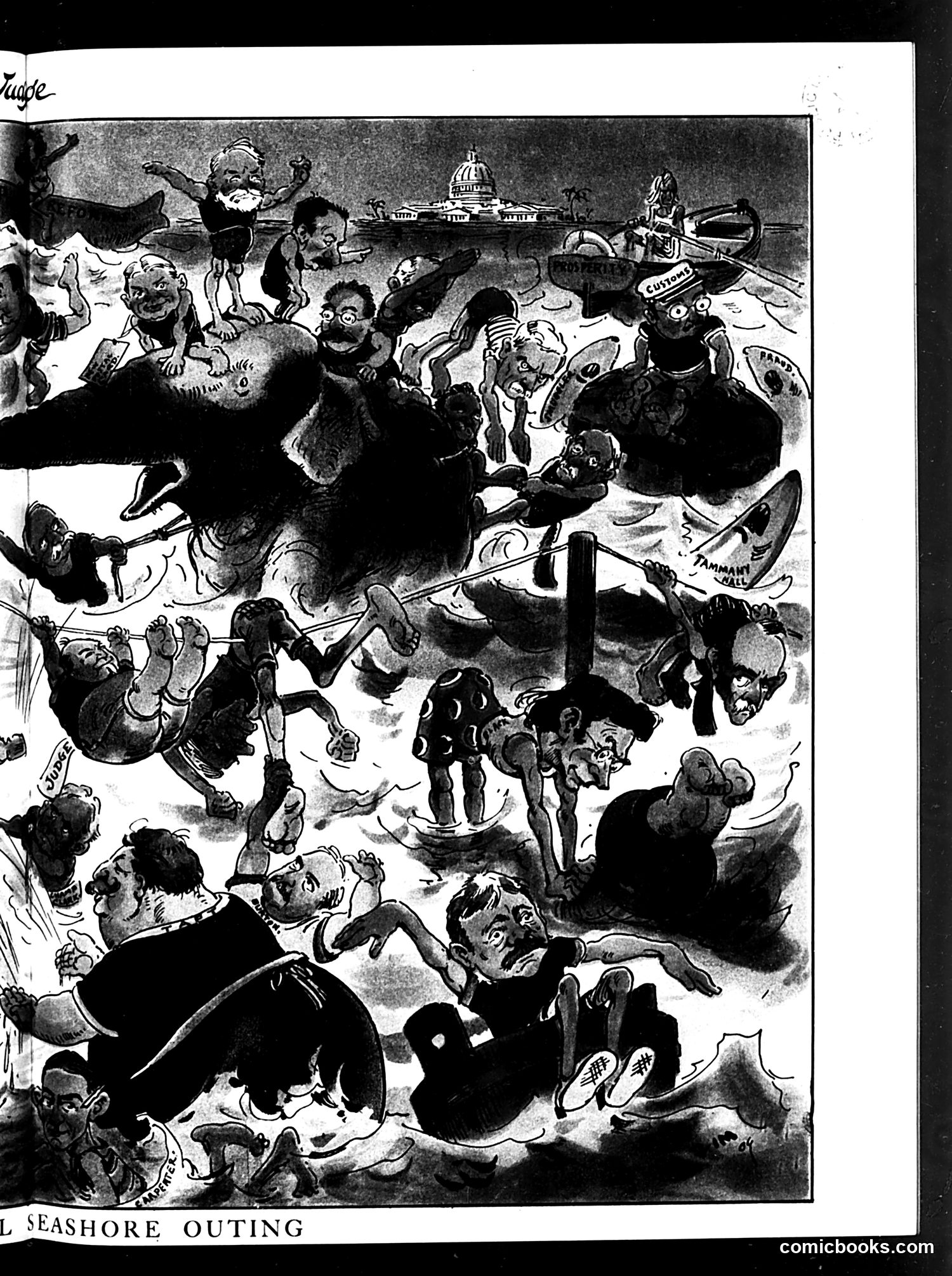
This Judge cartoon satirizes a chaotic seaside scene populated by exaggerated caricatures—many appearing to depict politicians or public figures of the era, though specific identities are unclear from the image alone. The Capitol building visible in the background suggests Washington D.C. connections. The cartoon depicts these figures in an undignified, crowded scramble at the beach, with various characters tumbling, sprawling, and engaged in physical chaos. The satirical point appears to mock politicians or public officials during leisure time, suggesting either incompetence, unseemly behavior, or the absurdity of seeing dignified figures in undignified situations. Without clearer labels or additional context, the specific political references and intended targets remain uncertain.
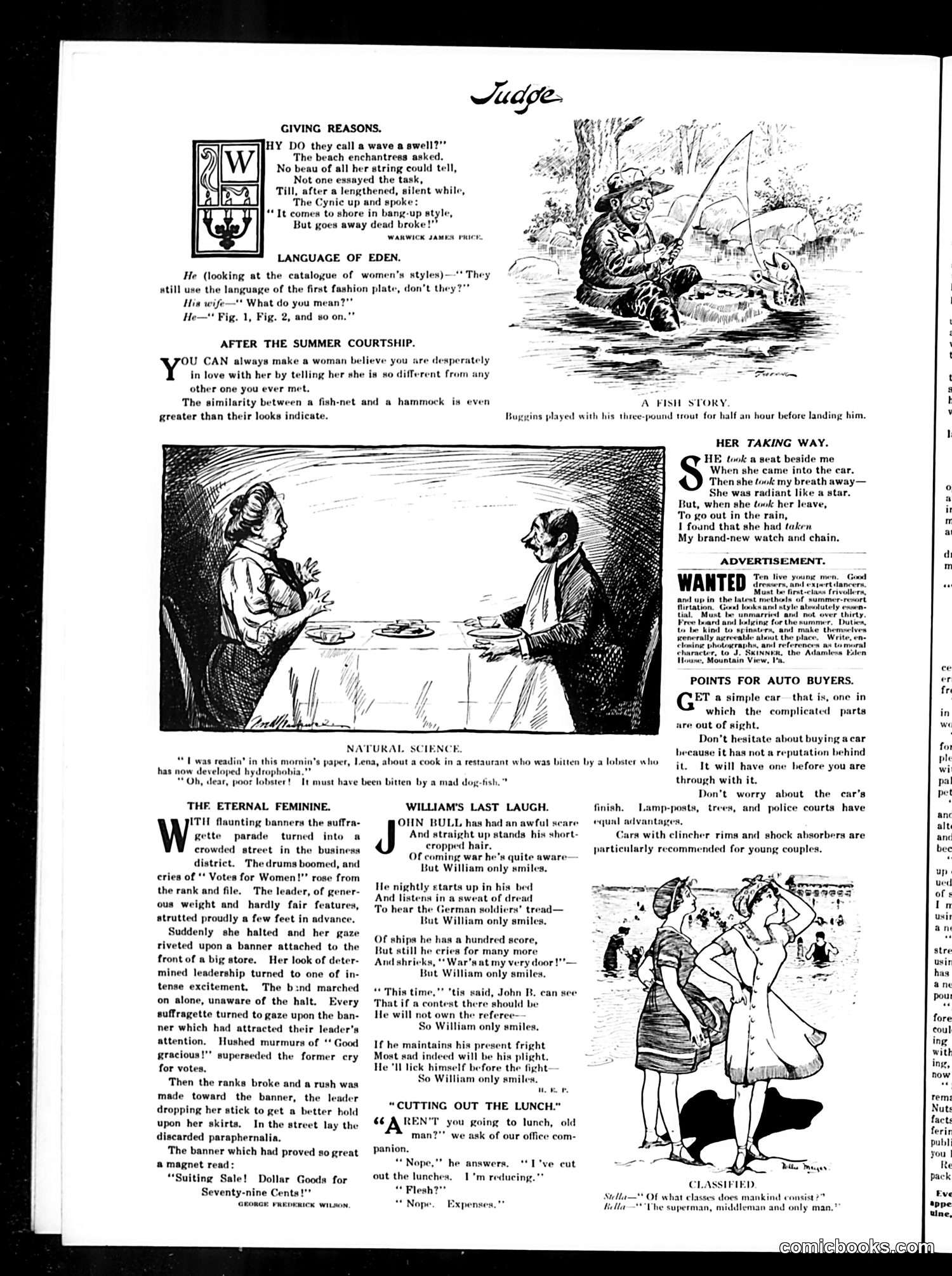
This page contains several short satirical pieces typical of early 20th-century humor magazines: **"The Eternal Feminine"** mocks women's suffrage activists, depicting a suffragette leader distracted mid-protest by a store banner advertising cheap clothing sales—suggesting women are frivolous and easily diverted from serious causes. **"William's Last Laugh"** appears to reference a contemporary political figure (likely related to WWI-era politics), portraying "William" maintaining composure amid war anxieties and military defeats, with the joke being his stoic indifference. **Other brief pieces** include typical turn-of-the-century relationship humor ("Her Taking Way"—a woman steals a man's watch) and mild social commentary on language, fashion, and automobiles. The page is primarily **humorous filler content** rather than hard political satire. The anti-suffrage piece reflects common period attitudes dismissing women's political engagement as inherently superficial—a perspective modern readers should understand as reflecting the prejudices of that era, not factual commentary.
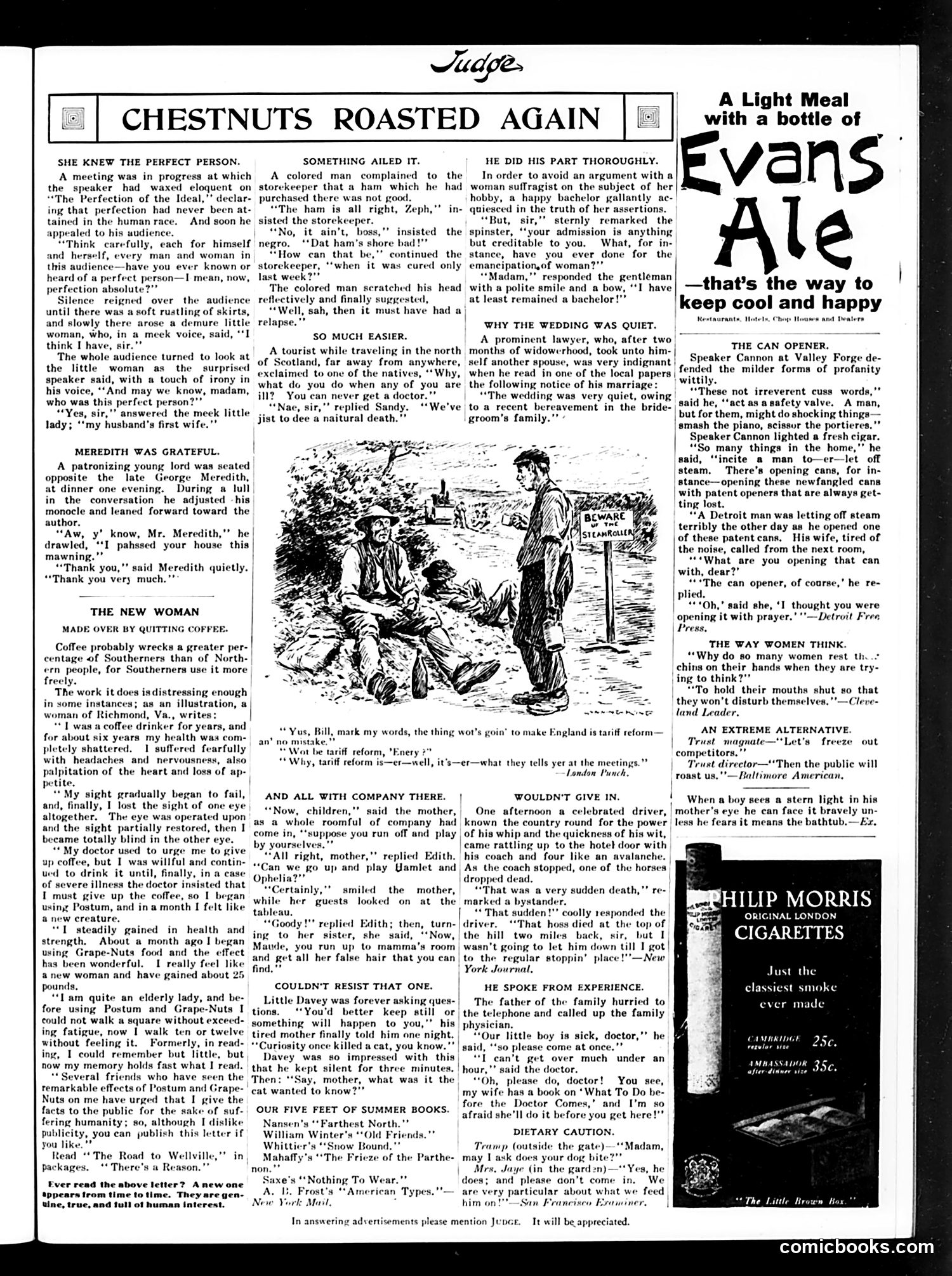
This page from Judge magazine contains multiple short humorous anecdotes typical of early 20th-century American humor. The central cartoon depicts a traveler and what appears to be a Scottish figure near a "Beware" sign—likely illustrating one of the text stories about traveling in Scotland. The humor relies on period stereotypes: a Black man ("Zeph") complaining about a ham, a "New Woman" testimonial about health (likely early 1900s), and a patronizing British aristocrat's condescending encounter with author George Meredith. The main cartoon's joke appears to concern Scottish locations or Scottish people (based on the text reference to "the north of Scotland"), though the specific reference is unclear from the visible portion. The page also includes a Philip Morris cigarette advertisement, indicating this is likely from the 1920s-1930s era. The humor throughout relies on racial caricature, class distinction, and gender stereotypes common to that period's satirical publications.
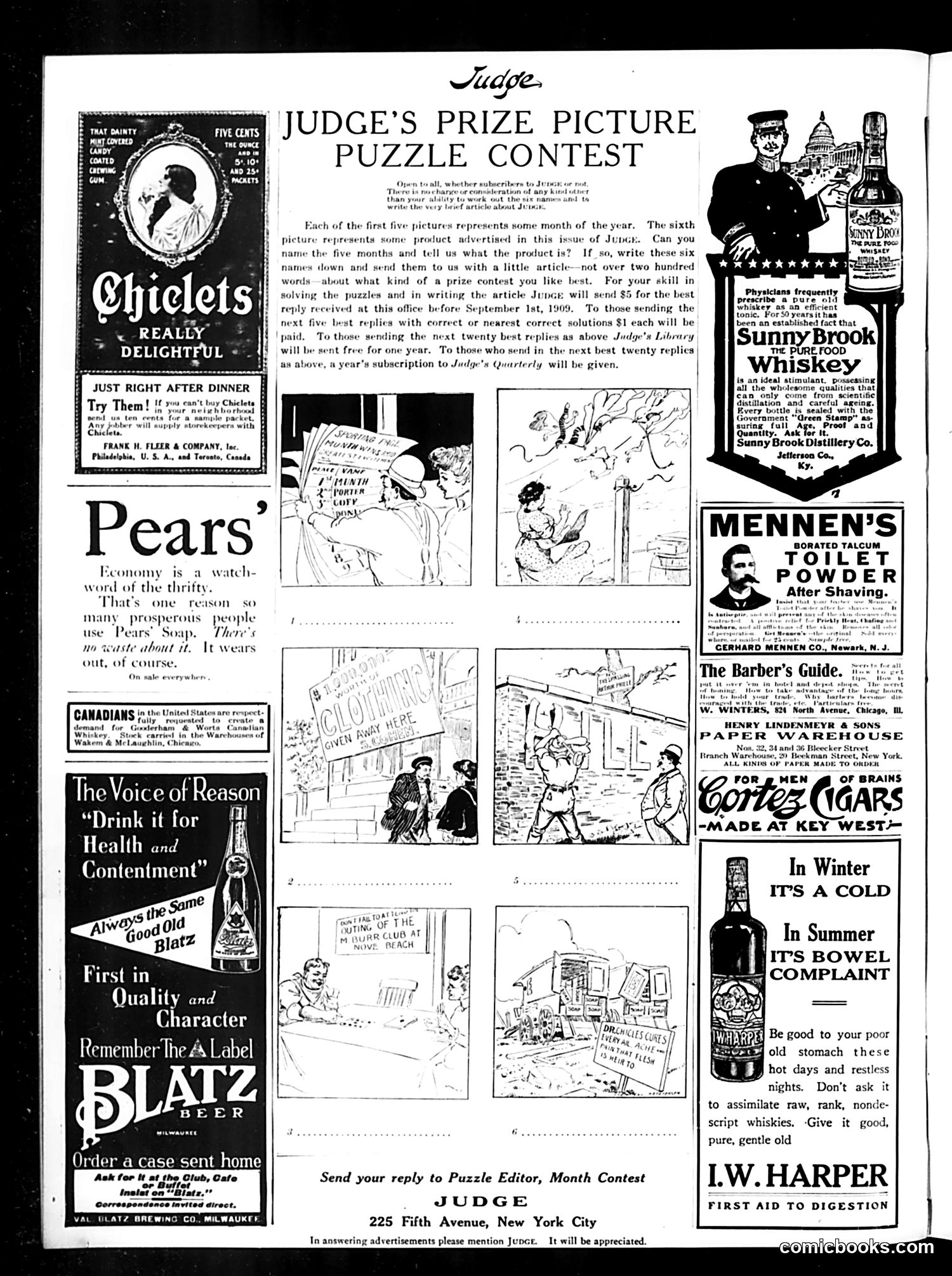
This page features **Judge's Prize Picture Puzzle Contest**—a reader participation competition offering cash prizes and subscriptions. Contestants must identify six products advertised in the issue by matching cartoon illustrations to five months of the year, then submit solutions with a brief written essay about prize contests they enjoy. The six cartoons (numbered 1-6) show humorous domestic scenes with advertised products hidden or referenced within them—a common early-20th-century advertising gimmick combining entertainment with brand promotion. The surrounding advertisements feature period products: Chiclets gum, Pears' soap, Sunny Brook Whiskey, Mennen's talcum powder, and I.W. Harper whiskey. These ads reflect early 1900s consumer goods targeting middle-class households. The contest itself—offering $5 for winners, with graduated prizes for runners-up—represents how magazines monetized reader engagement before mass media existed, using puzzles to build circulation and advertiser revenue simultaneously.
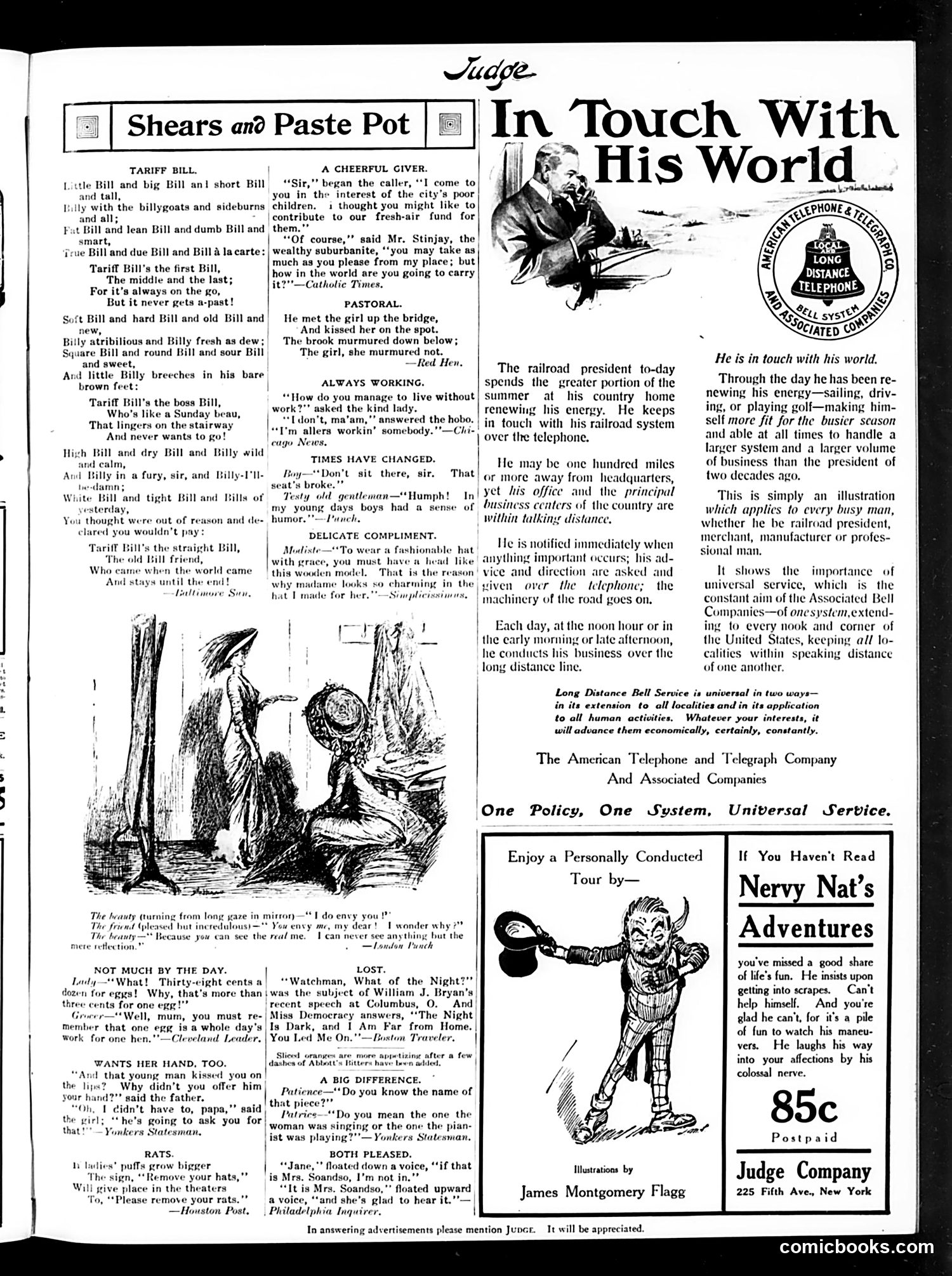
This page contains mostly **humorous short jokes and verses** rather than political cartoons. The content reflects early 20th-century American humor about everyday topics. The **dominant feature** is a full-page **telephone company advertisement** for the American Telephone and Telegraph Company, showcasing the "Long Distance Bell Service." The ad uses the example of a railroad president staying at his country home while remaining connected to his business via telephone—positioned as a modern convenience demonstrating universal service and business necessity. The surrounding jokes are lighthearted domestic and social humor: a "Tariff Bill" verse parodying political legislation through wordplay; jokes about egg prices, young courtship, begging hobos, and marital dynamics. One joke references **William J. Bryan**, the political figure, in a pun about his speech being titled "Watchman, What of the Night?" The page also advertises **"Nervy Nat's Adventures"** comic series for 85 cents postpaid. Overall, this appears to be a typical Judge issue: satirical verse and domestic humor surrounding period advertising.
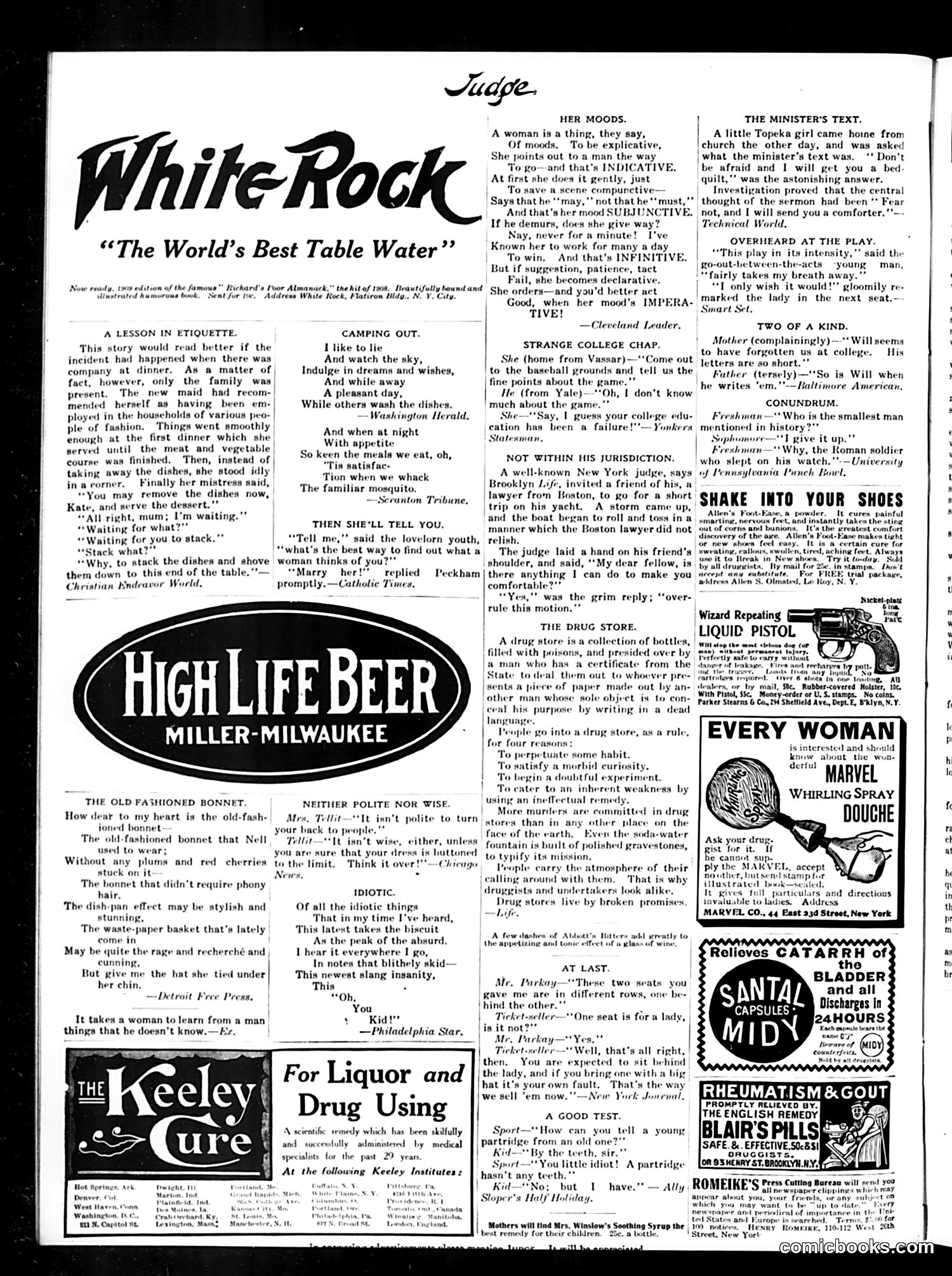
This page from Judge magazine (appears to be early 1900s) is primarily **advertising and humor content**, not political satire. The main elements include: **Advertisements:** White Rock table water, High Life Beer, The Keeley Cure (for alcohol/drug addiction), Allen's Foot-Ease powder, a "Liquid Pistol" revolver, Harlel douche, Santal Midy capsules, and Blair's Pills dominate the layout. **Humor Pieces:** Short jokes and anecdotes about: - A new maid who doesn't understand etiquette (stands idle instead of clearing dishes) - A lovelorn youth seeking romantic advice - A college student from Yale who knows nothing about baseball - A New York judge and Boston lawyer on a yacht during a storm - Various wordplay about women's moods and grammar **Context:** These are gentle, domestic humor pieces typical of Judge's comedic style—poking fun at social conventions, generational differences, and romantic confusion rather than serious political commentary. The advertising reflects period concerns: addiction treatment, foot care, and digestive remedies were prominent commercial interests.
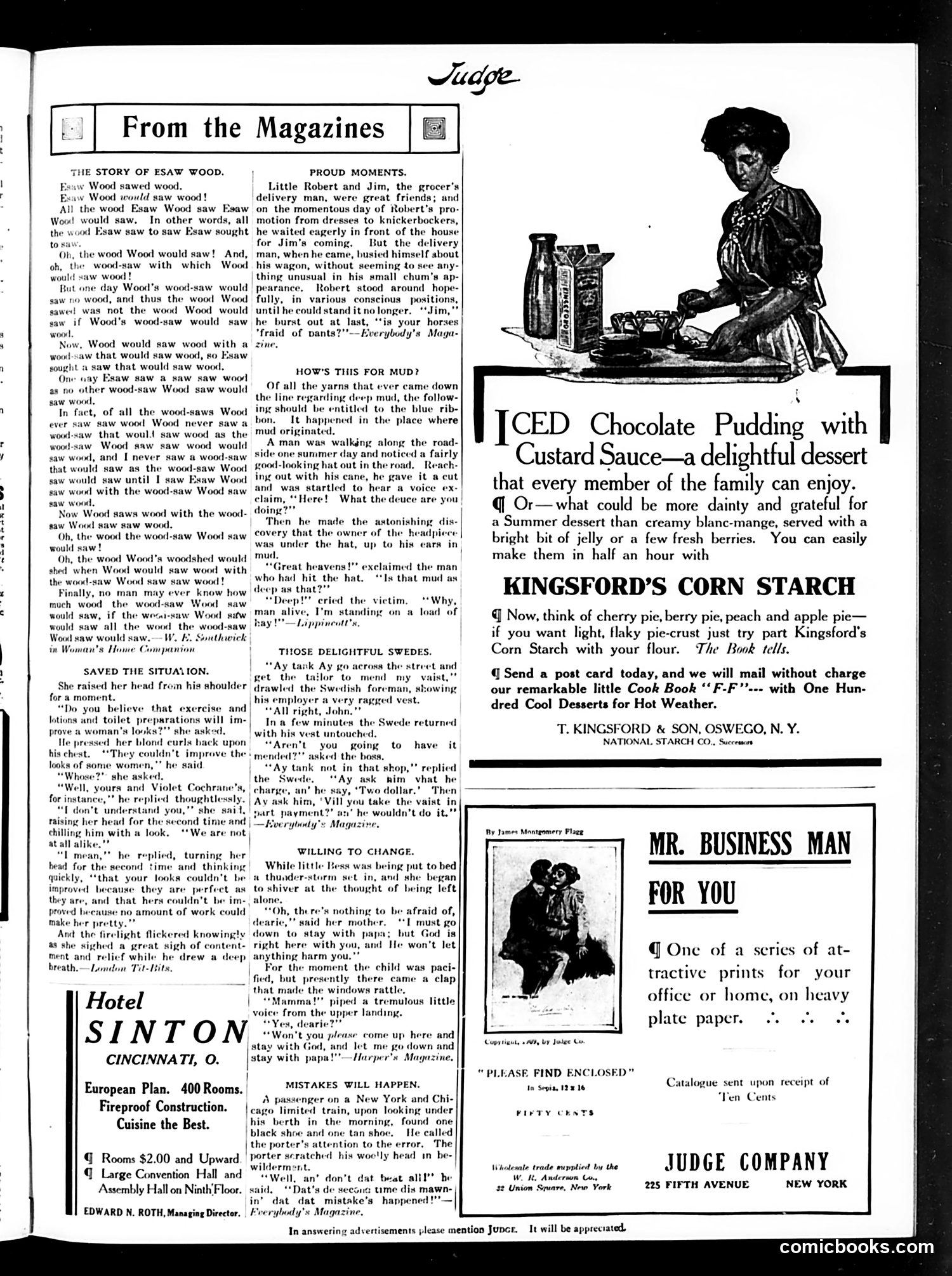
This page collects humorous short stories and anecdotes from various publications, typical of Judge magazine's format. The main pieces include: **"The Story of Esaw Wood"** — A tongue-twister narrative playing on the name "Wood" and the word "wood," deliberately confusing readers with repetitive, nearly nonsensical prose. The joke is the absurdist wordplay itself. **"Proud Moments"** and **"How's This for Mud?"** — Brief anecdotes depicting everyday social situations played for laughs: a child eager to show off new clothing, and an exaggerated tall tale about mud. **"Those Delightful Swedes"** — A joke playing on Swedish-immigrant dialect and cultural stereotypes common in early 20th-century American humor, portraying a Swedish foreman's broken English as humorous. The page is primarily **advertising** (Kingsford's Corn Starch, Hotel Sinton, Judge Company prints), interspersed with these light comedic pieces. It represents typical Judge content: genteel, domesticated humor aimed at middle-class readers, with casual ethnic stereotyping unremarkable for the era.
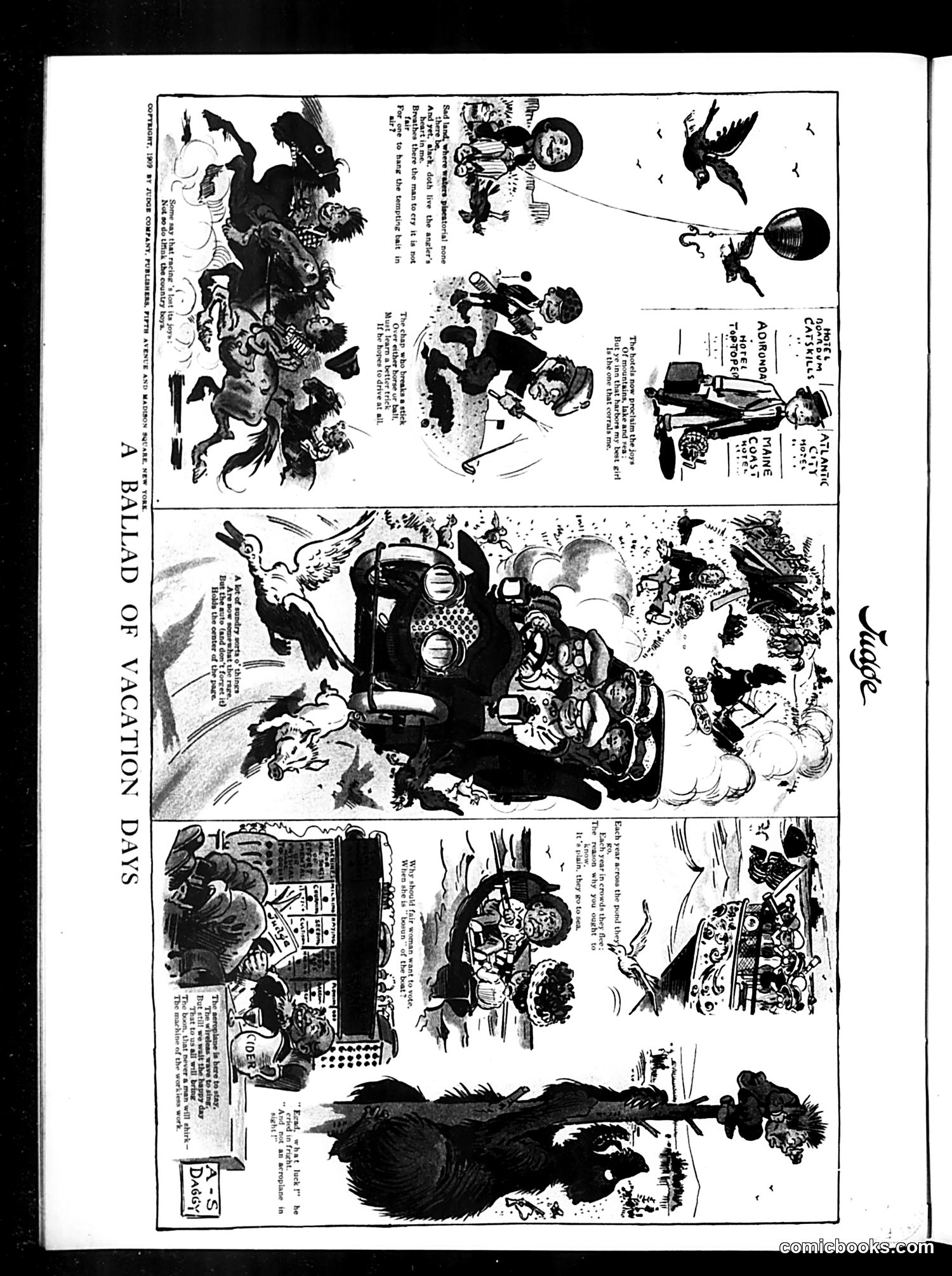
This page appears to be a humorous comic strip satirizing early 20th-century vacation experiences and modern technology. The title "A Ballad of Vacation Days" suggests nostalgic commentary on leisure time. The visible panels depict scenes involving automobiles and early aviation—emerging technologies of the era. References to "The aeroplane is here to stay" and "wireless wave" indicate the strip mocks people's fascination with newfangled inventions during vacations. The exaggerated illustrations and chaotic scenes typical of Judge magazine's style suggest the humor derives from vacationers' encounters with unreliable or dangerous early motor vehicles and aircraft. The satire likely critiques both the reckless adoption of these technologies and people's misguided enthusiasm for them as vacation activities, presenting disaster as the inevitable outcome of such "modern" leisure pursuits.