
A complete issue · 16 pages · 1909
Judge — June 5, 1909
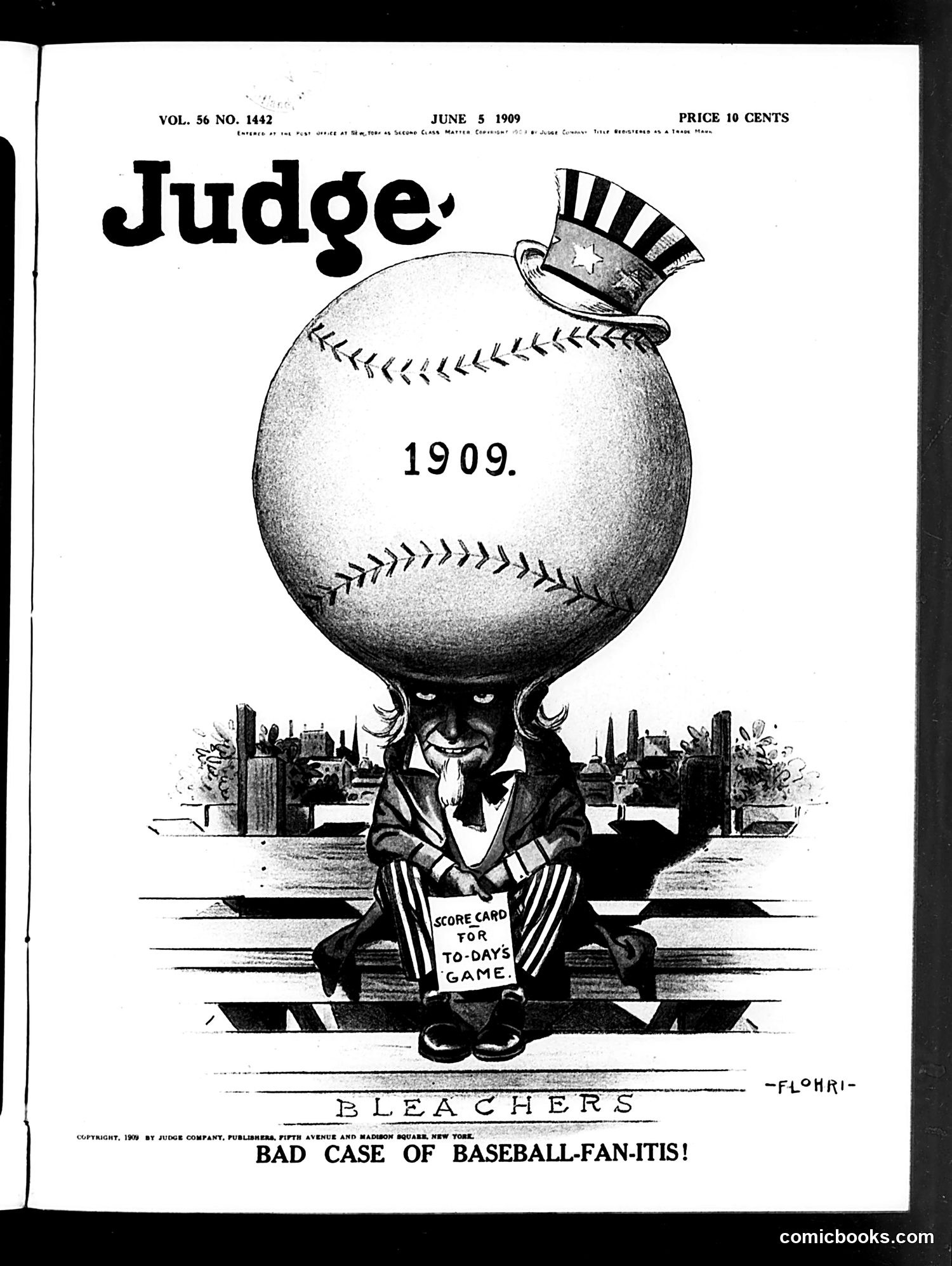
This satirical cover depicts "Baseball-Fan-itis" as a disease afflicting American society. A gnome-like character representing the affliction carries an enormous baseball labeled "1909" on his head while holding a "Score Card for To-Day's Game." Behind him looms a cityscape, suggesting the urban obsession with baseball. The "Bleachers" caption and the character's exaggerated features mock baseball fans' intense, almost frenzied devotion to the sport during the 1909 season. The artist (signed "-Flohr-") satirizes how baseball fever had gripped the nation, reducing fans to comical, disease-stricken creatures. This reflects early 20th-century anxieties about baseball's growing cultural dominance in American life, portrayed here as a kind of collective madness worthy of ridicule.
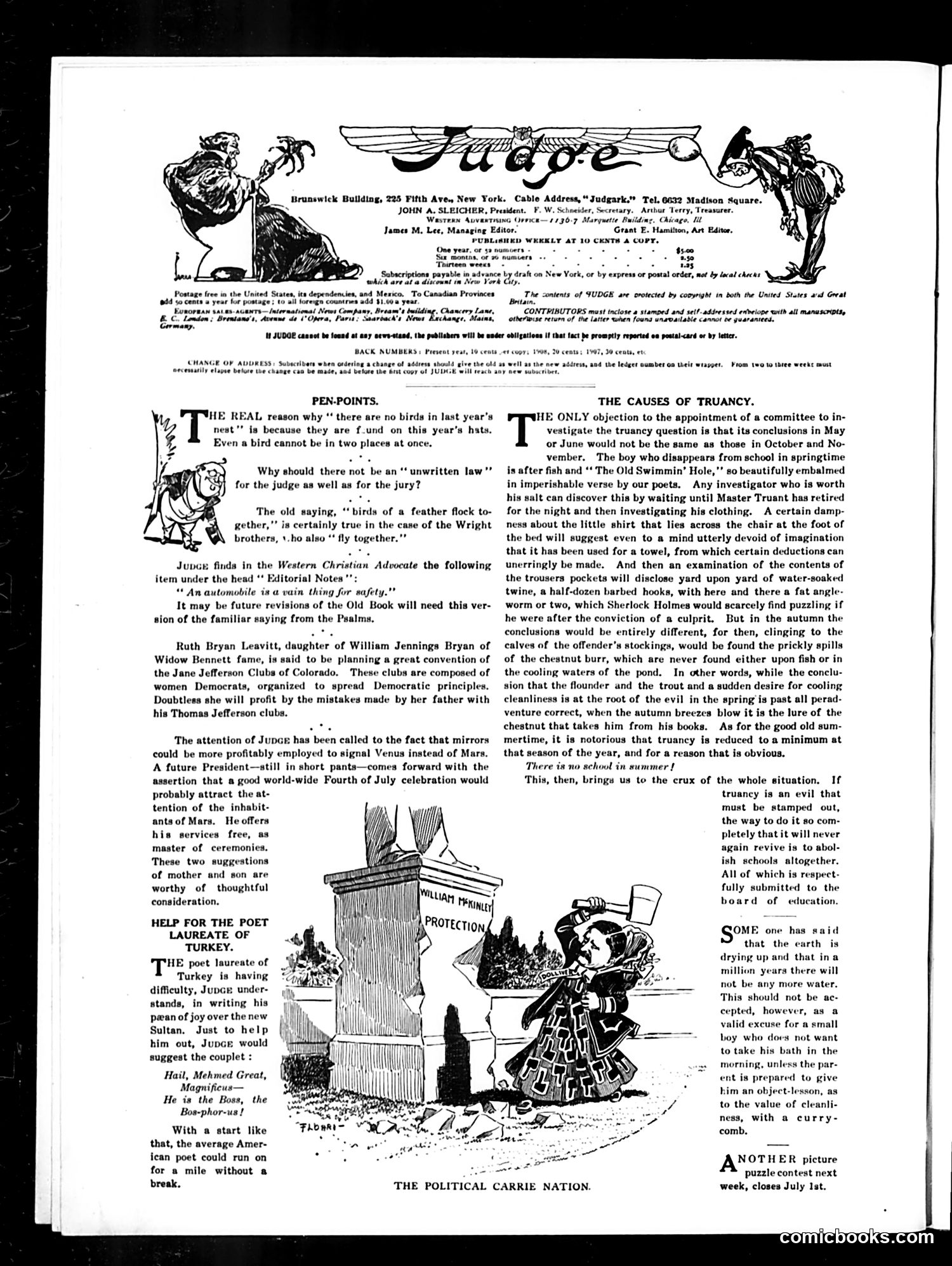
This page contains two main sections: **"Pen-Points"** discusses why birds in last year's hats are "in" this season—a lighthearted fashion commentary noting "even a bird cannot be too fussy about a hat once." **"The Causes of Truancy"** presents the main satirical content. The cartoon "The Political Carrie Nation" depicts a woman (likely referencing Carrie Nation, the famous temperance activist) standing before a "William O'Brien Protection" monument or structure. The accompanying text addresses school truancy, suggesting investigations into missing children reveal they've been playing in water instead of attending class. The satire appears to mock both naive explanations for truancy and possibly references to prohibition-era activism, though the specific political context remains somewhat unclear from this page alone.
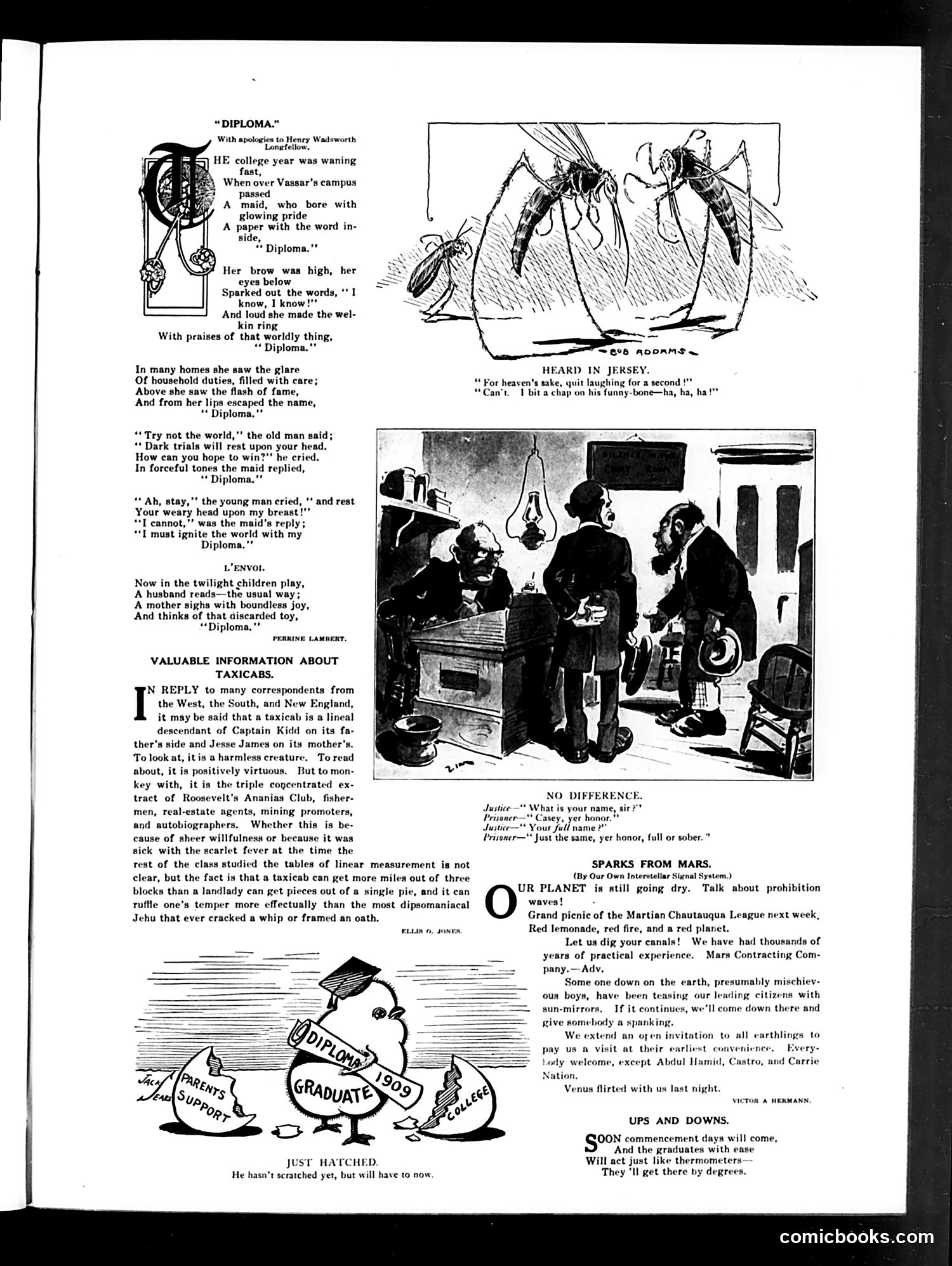
This page combines poetry, humor, and satire typical of early 20th-century Judge magazine. **"Diploma"** (top left) satirizes the worthlessness of college degrees. The poem mocks a maid proudly displaying her diploma despite remaining in domestic service, suggesting education fails to improve one's station. **"Heard in Jersey"** shows two men joking about a third person's "funny bone," a physical comedy reference. **"No Difference"** depicts a jailer and prisoner with identical names, satirizing how institutional positions create no real distinction between authority figures and the incarcerated. **"Valuable Information About Taxicabs"** humorously claims taxicabs descended from Captain Kidd (the pirate), sarcastically praising their ability to exploit passengers. The "Just Hatched" diploma cartoon mocks unprepared graduates entering the world.
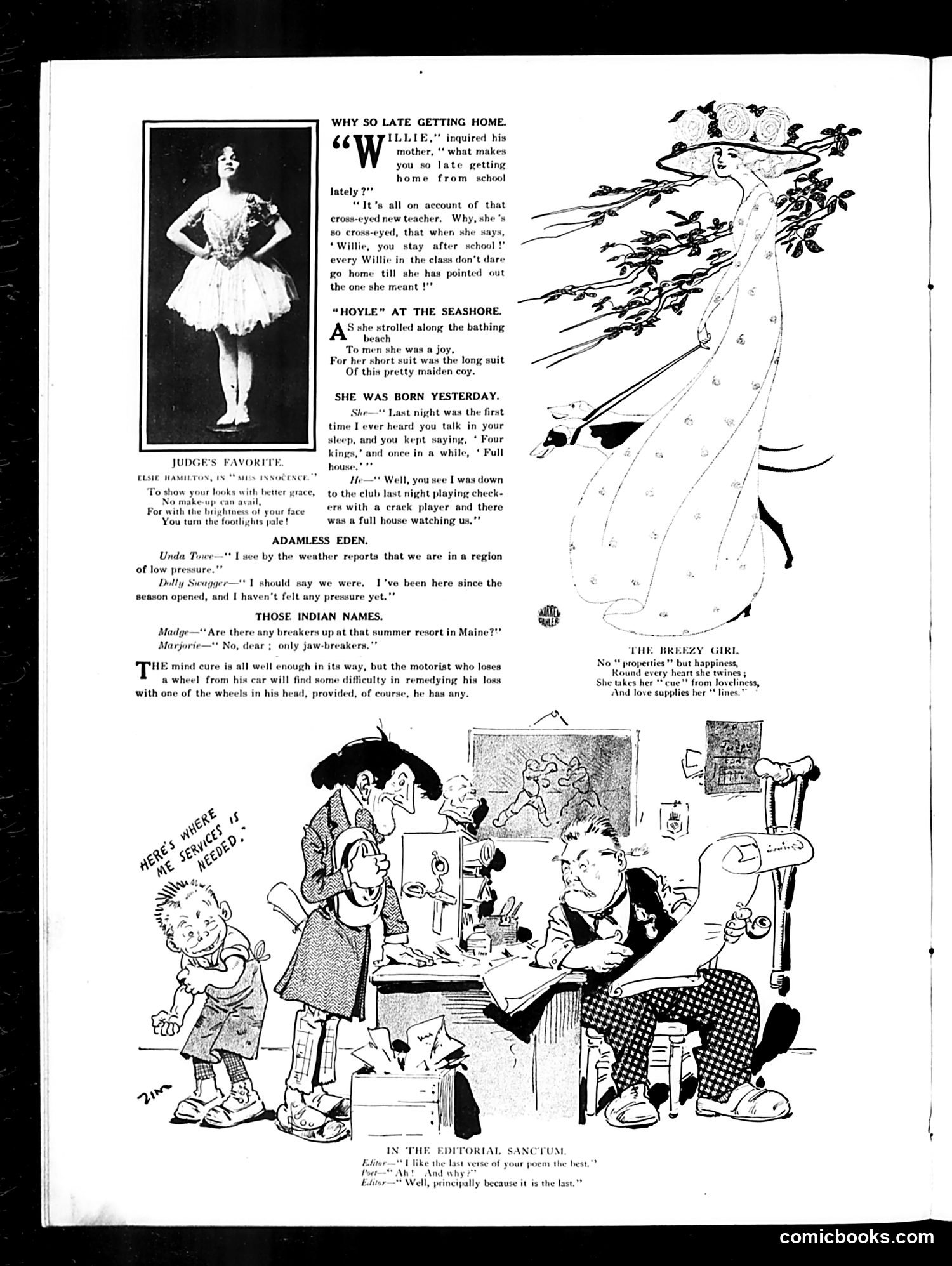
This page contains several satirical pieces typical of early 20th-century Judge magazine: **"Why So Late Getting Home"** mocks a schoolgirl's excuse blaming a "cross-eyed" teacher, playing on the phrase "she has pointed out the one she meant." **"Hoyle at the Seashore"** is a light verse about a maiden observed at a beach. **"She Was Born Yesterday"** presents dialogue about hearing someone talk in their sleep, referencing "Four Kings" and a "Full House"—poker terms used as innuendo. **"Adamless Eden"** and **"Those Indian Names"** are brief topical humor pieces. The bottom cartoon depicts an editorial office scene where an editor debates poetry with a visitor, with an exaggerated family (wife and children) in the background—satirizing domestic interruptions in professional spaces. The humor relies on wordplay, double meanings, and social observation rather than political commentary.
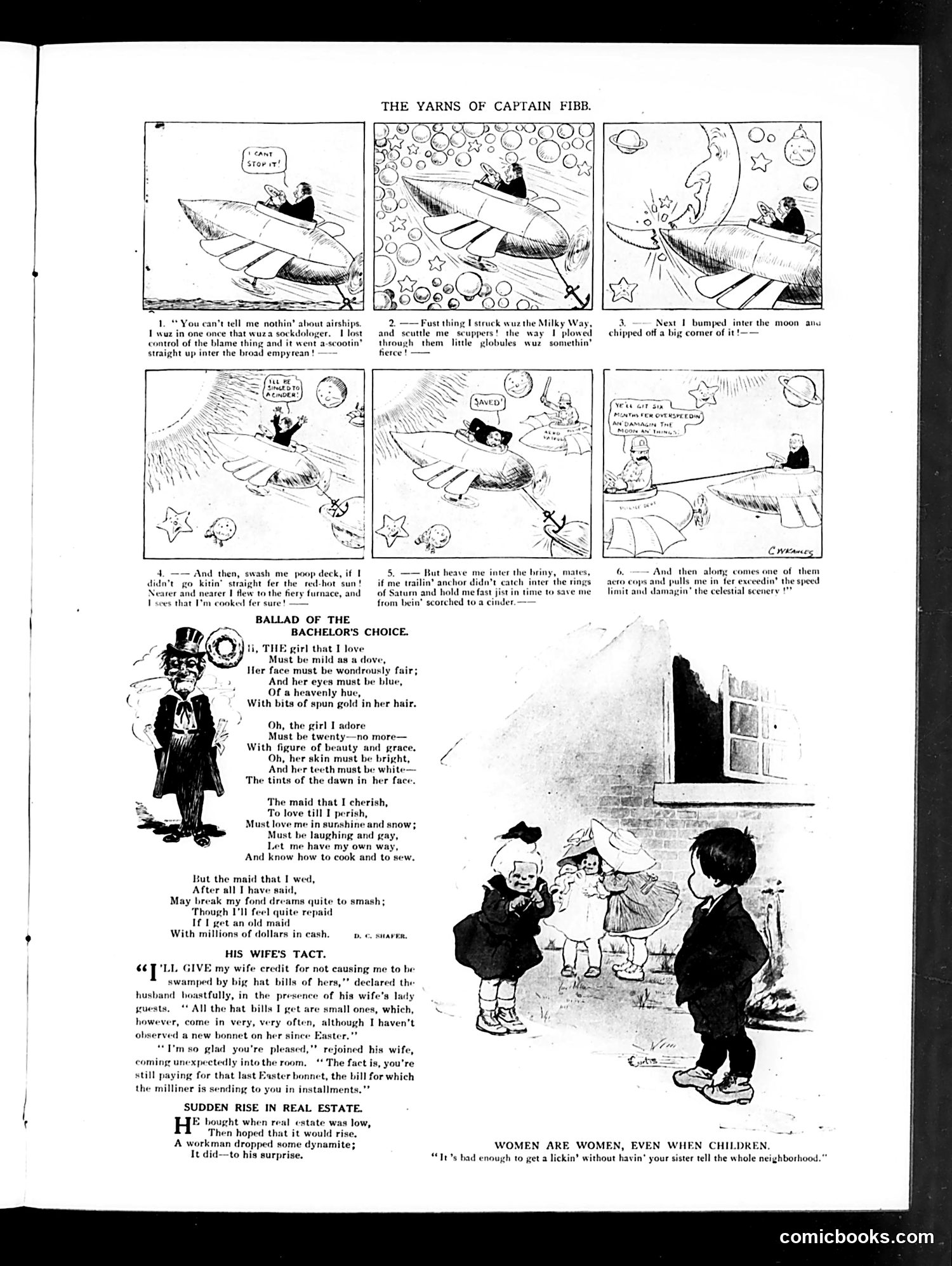
**"The Yarns of Captain Fibb"** is a six-panel comic strip about a character who lies extravagantly—claiming to have traveled through the Milky Way, landed on the moon, and encountered Saturn's rings. The humor relies on tall-tale traditions common to early 20th-century American humor. Below that are three separate pieces: a "Ballad of the Bachelor's Choice" (a poem about romantic preferences), "His Wife's Tact" (a domestic anecdote about bill disputes), and "Sudden Rise in Real Estate" (brief verse about property investment). These represent typical Judge magazine content—light comedy combining visual gags, poetry, and humorous prose. No specific political figures or events appear referenced; the satire targets universal subjects: unreliable narrators, marital dynamics, and financial matters.
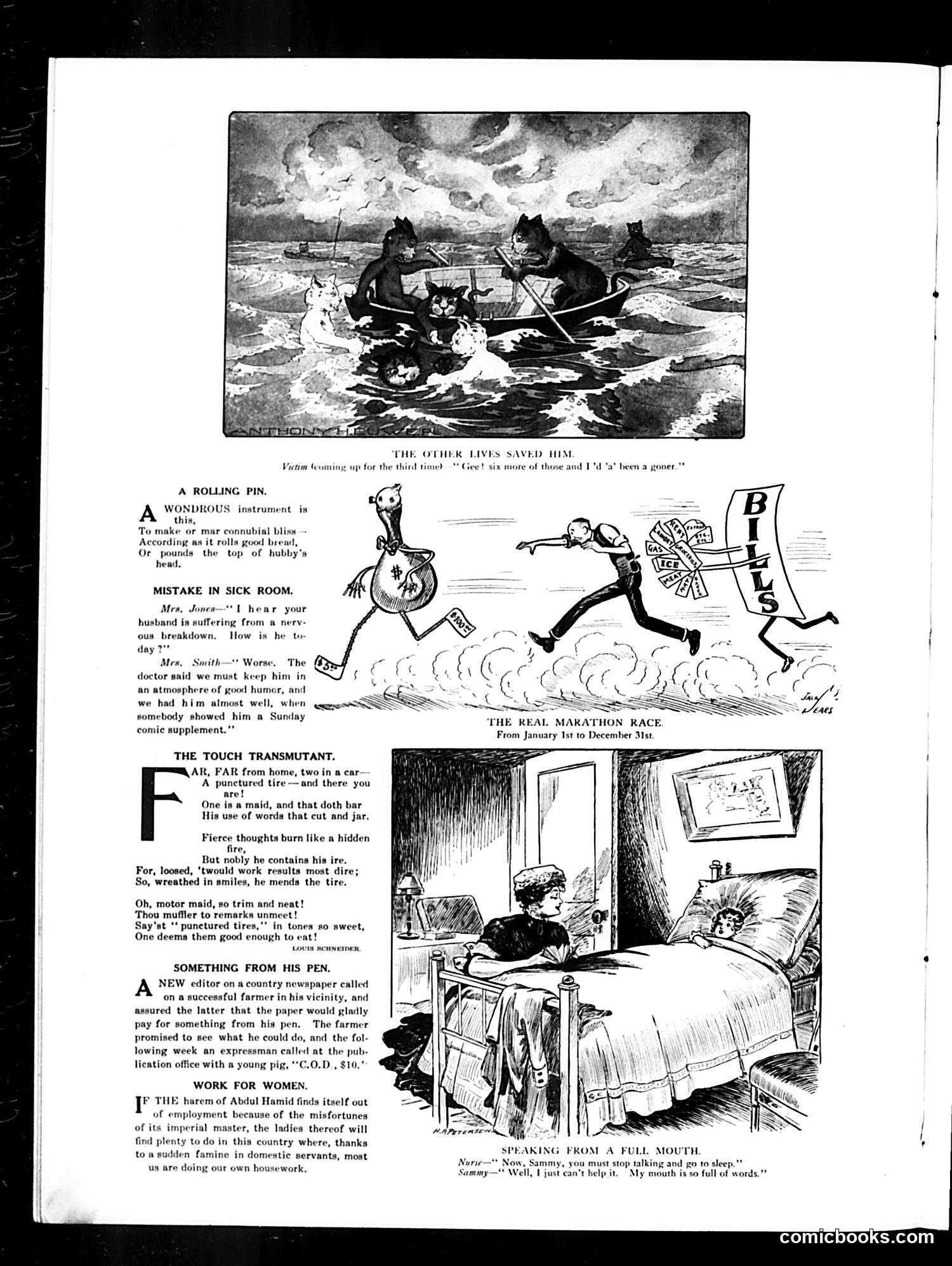
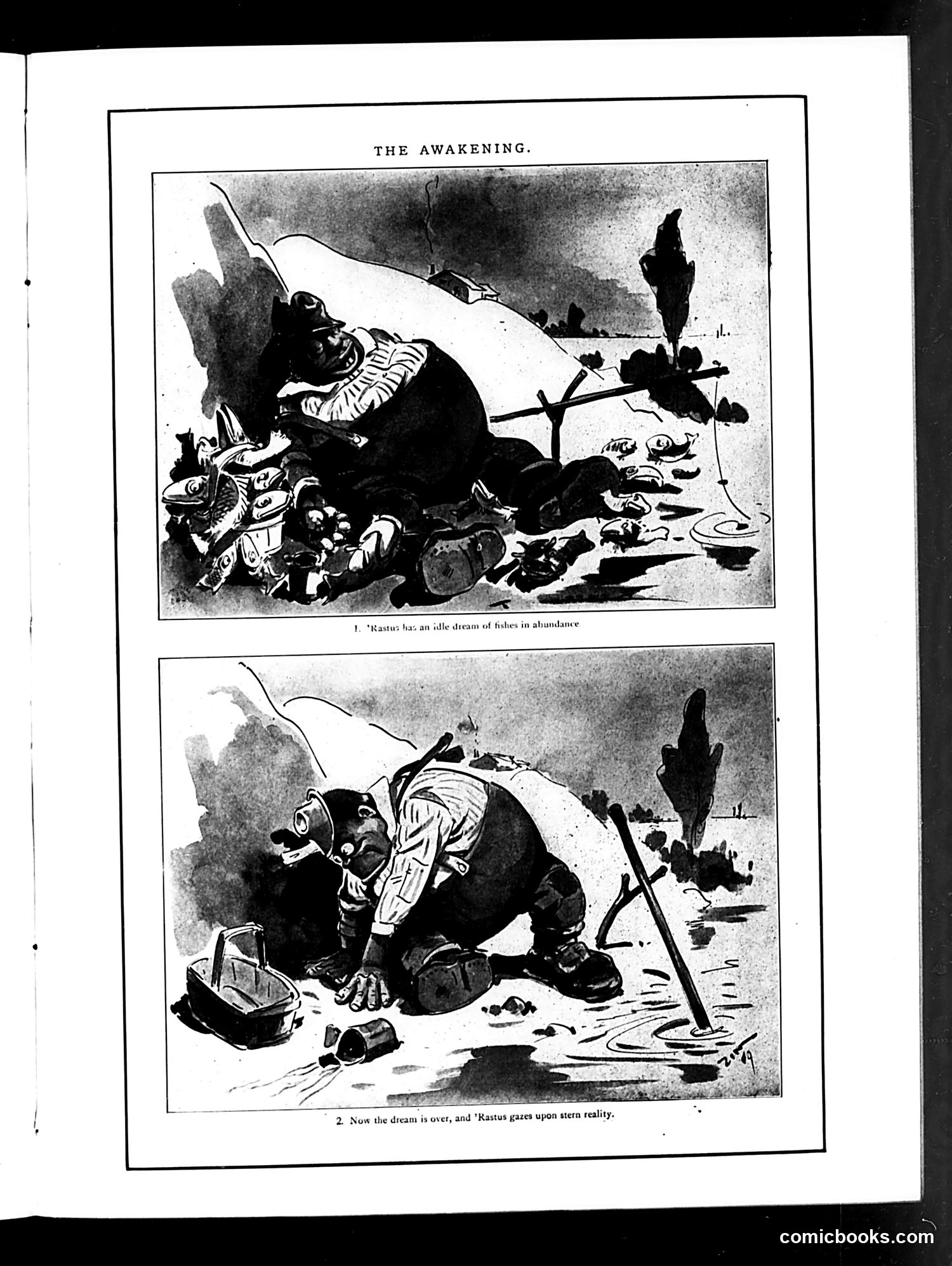
This two-panel cartoon uses racial caricature to depict a character named "Rastus" (a derogatory stereotype common in early 20th-century American media). **Panel 1:** Rastus dreams of "fishes in abundance"—depicting aspirational fantasy with exaggerated imagery surrounding a sleeping figure. **Panel 2:** The "awakening" shows Rastus confronting harsh reality, surrounded by scattered, broken objects and deprivation rather than plenty. The satire appears to mock the gap between poor Black Americans' hopes and their actual living conditions, though the cartoon's crude racial caricature and stereotyping reflect the publication's deeply racist perspective. The "Rastus" character was a common minstrel-era figure used for dehumanizing comic effect in this era's mainstream media.
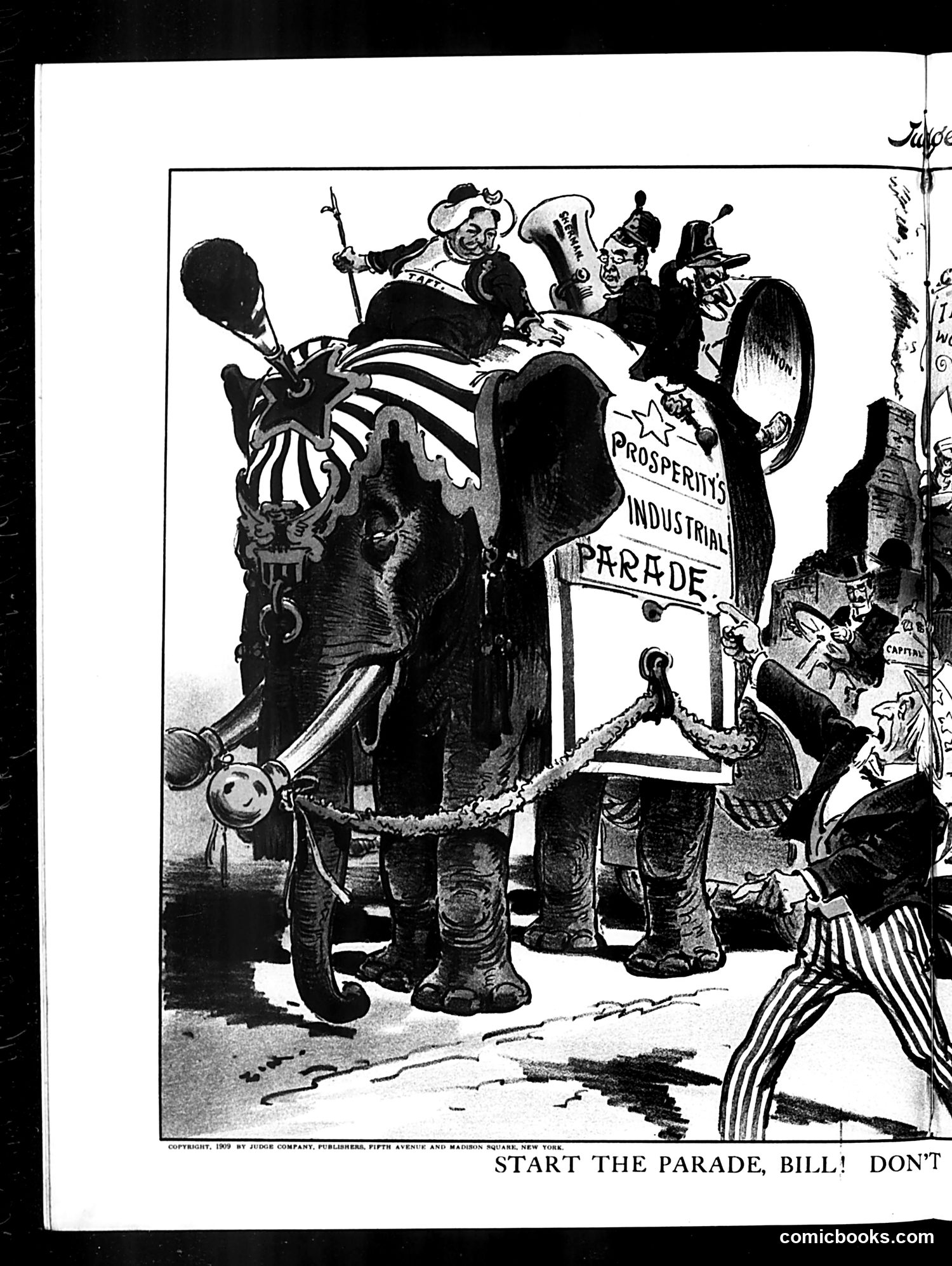
This political cartoon depicts an elephant (the Republican Party symbol) decorated as a parade float labeled "PROSPERITY'S INDUSTRIAL PARADE." Several figures ride atop or lead it, while a man identified as "BILL" (likely referring to a political figure of that era) stands ready to start the procession. The satire critiques Republican claims about prosperity and industrial success. The elaborate pageantry and theatrical nature suggest the "parade" is more spectacle than substance—a performance meant to convince the public of economic well-being rather than genuine prosperity. The command to "START THE PARADE" implies cynicism about political messaging and staged public demonstrations designed to shape public opinion during what was likely an election period. The copyright date (1909) and Judge magazine's satirical tradition support this as commentary on Republican political theater.
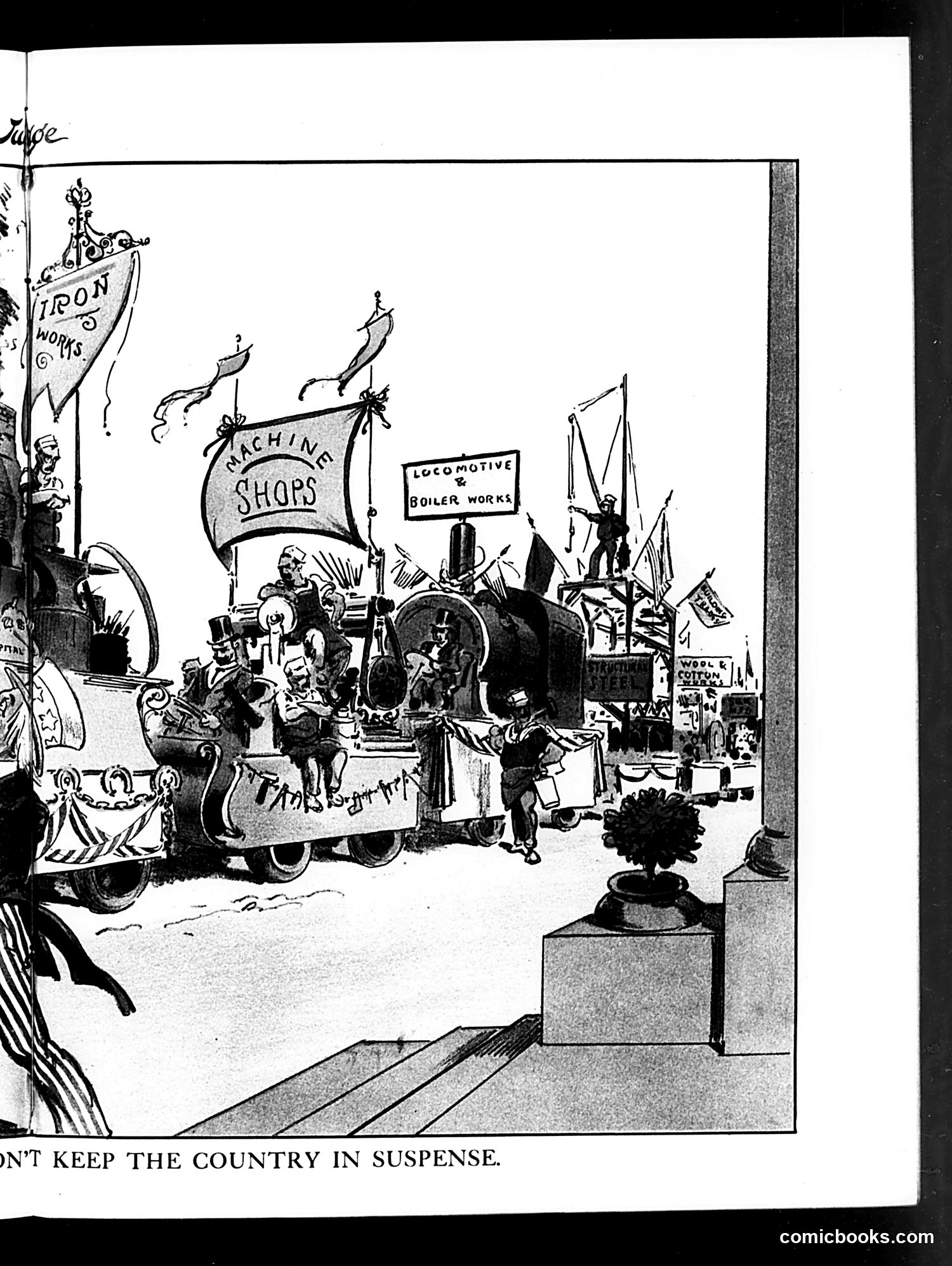
This Judge magazine cartoon satirizes labor unrest and industrial strikes. It depicts an elaborate parade or procession featuring floats labeled "Iron Works," "Machine Shops," and "Locomotive & Boiler Works"—representing major American industries. The caption reads "Don't Keep the Country in Suspense," suggesting the cartoon criticizes prolonged labor disputes that threaten industrial production. The ornate, somewhat mocking style of the parade floats implies the cartoonist views strike negotiations or labor demands as theatrical or excessive rather than legitimate grievances. The specific context—which labor disputes or strikes this references—remains unclear without additional dating information. However, the work reflects Judge's general editorial stance criticizing labor activism as economically disruptive rather than socially justified.
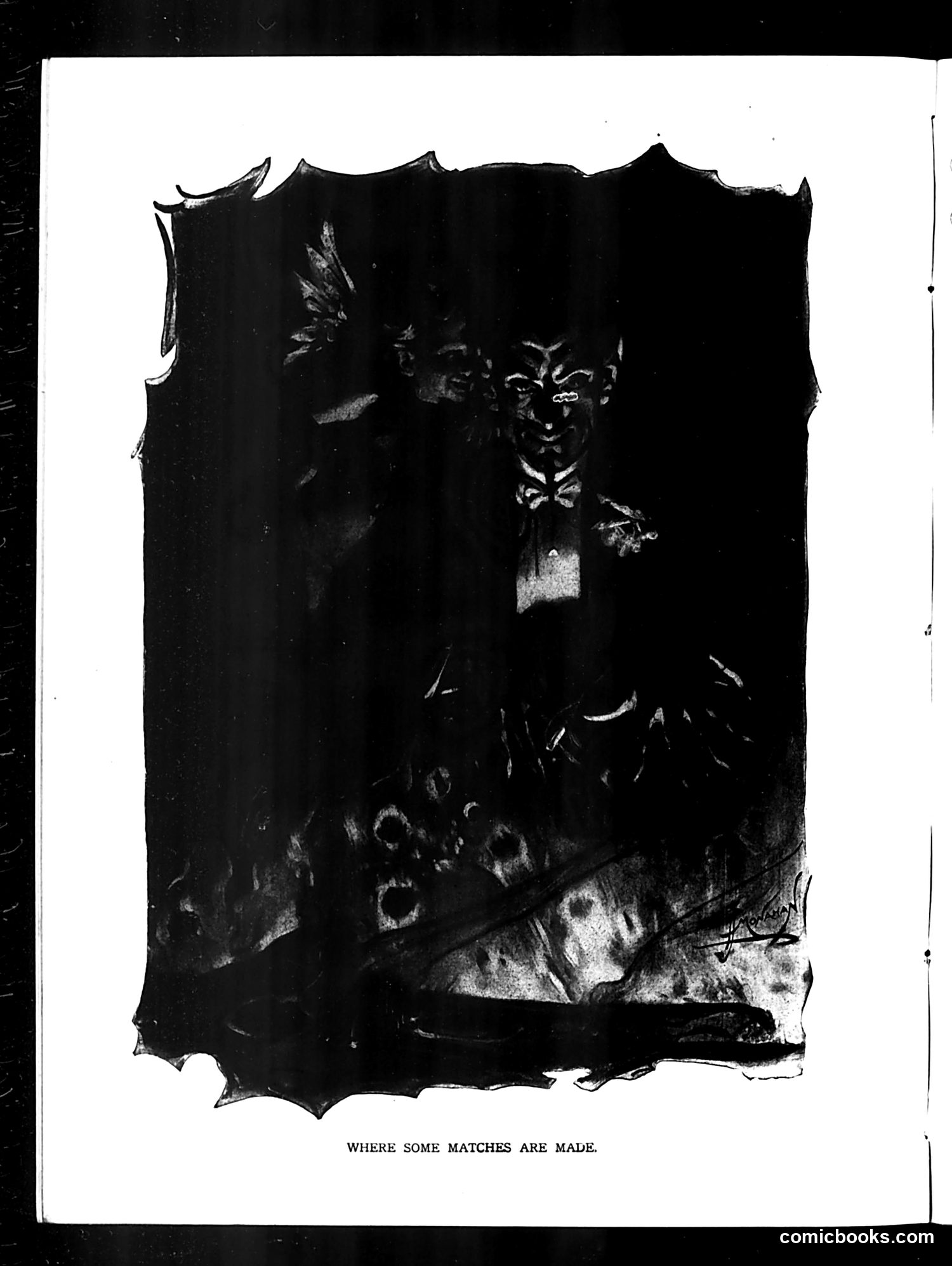
This appears to be a satirical illustration depicting matchmaking or romantic arrangements in a darkly comedic style. The image shows figures in formal attire arranged in shadow, with ornate decorative framing typical of Judge magazine's visual style. The caption "Where Some Matches Are Made" likely contains double meaning—referencing both romantic matchmaking and the literal manufacture of matches. The dark, shadowy rendering and somewhat grotesque treatment of the figures suggests social satire, possibly critiquing: - The artificiality or cynicism of arranged marriages/social matchmaking among the wealthy or elite - The unsavory conditions or exploitation in match factory labor (a contemporary industrial concern) Without additional context about the publication date or accompanying article text, the specific social target remains unclear, though the overall tone is distinctly mocking of some aspect of contemporary society.
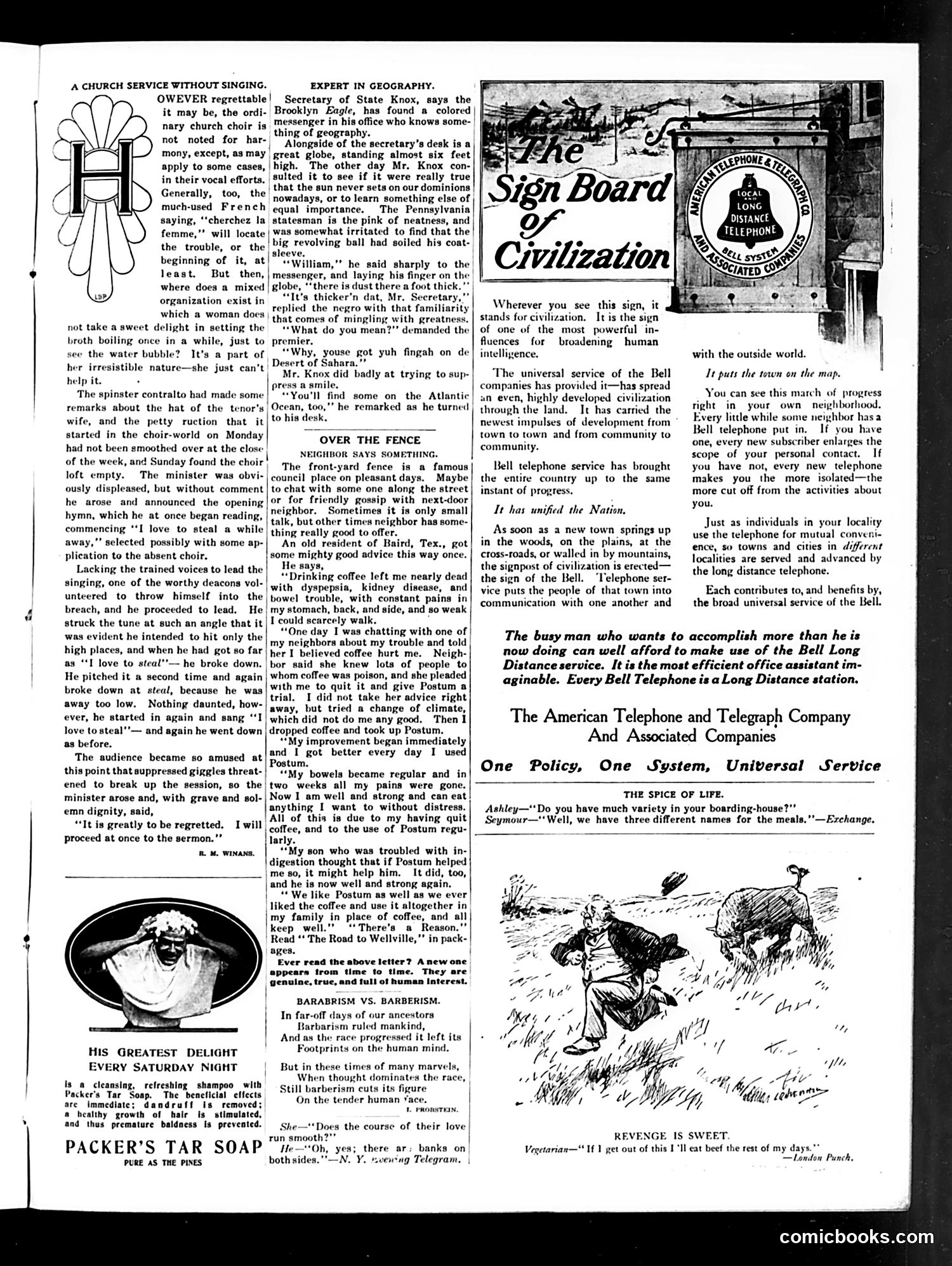
This is a humor piece about a church choir's absence disrupting Sunday services. A spinster contralto and the tenor's wife quarreled over the wife's hat, causing the entire choir to boycott. The minister announces the opening hymn, but when a well-meaning deacon volunteers to lead the singing, he repeatedly fails to maintain the tune—hitting only high notes, then dropping too low. The audience suppresses laughter until the minister, with "grave and solemn dignity," abandons the attempt, saying "It is greatly to be regretted. I will proceed at once to the sermon." The satire targets small-minded church drama: petty female rivalry disrupts communal worship, forcing the congregation to endure an incompetent substitute. The humor lies in the deacon's repeated failures and the absurdity of abandoning singing entirely rather than resolving the underlying conflict.
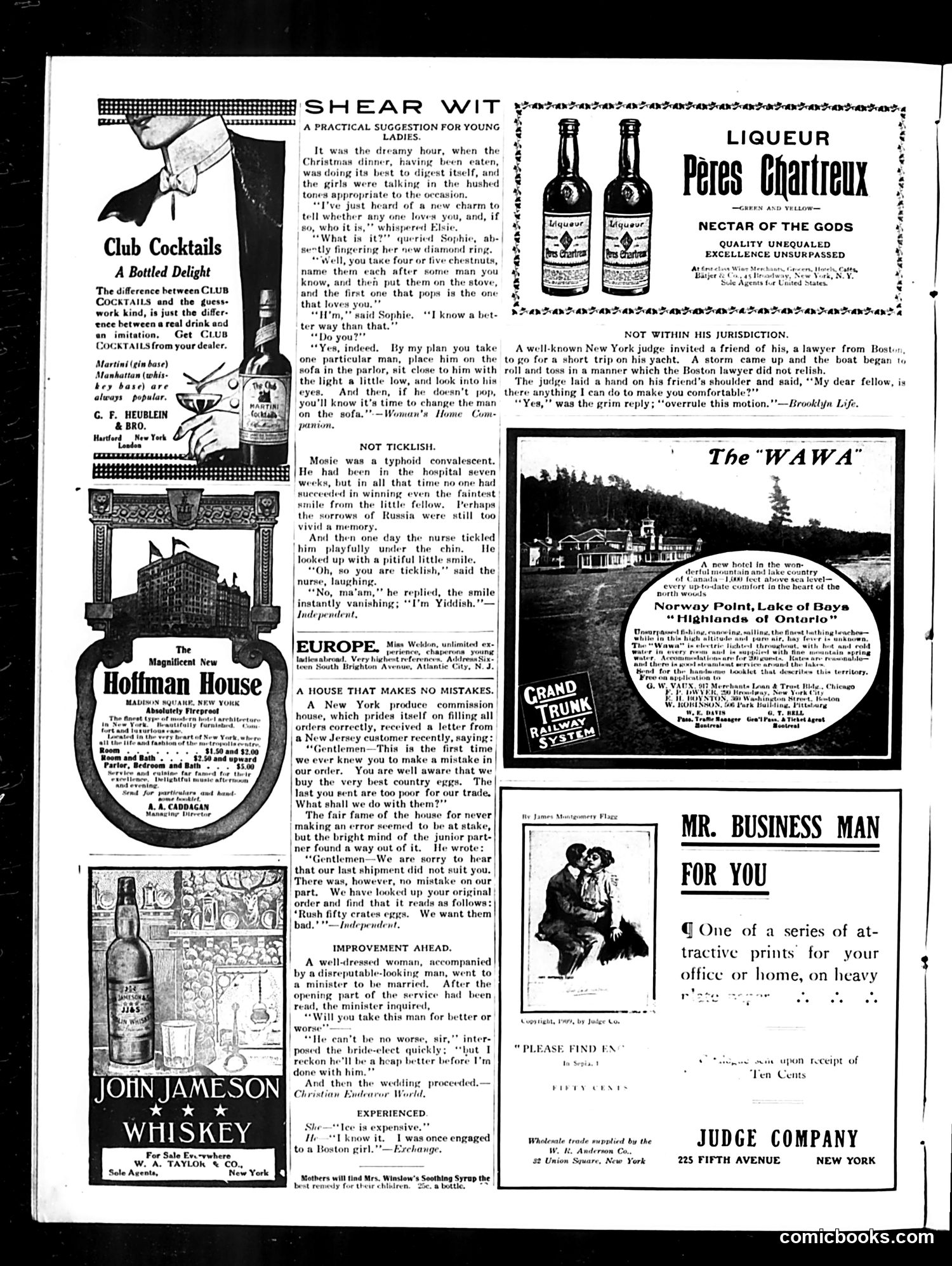
This page from Judge magazine contains mostly **advertisements and humorous anecdotes** rather than political cartoons. The title piece, "Shear Wit: A Practical Suggestion for Young Ladies," presents a satirical dialogue between young women discussing fortune-telling charms—one using chestnuts to divine romantic interests, another suggesting a more direct method of observing a man's behavior on a sofa. The humor targets Victorian courtship rituals and female romanticism. Other brief humorous stories mock everyday situations: a typhoid patient's apparent numbness explained by being Yiddish; a produce company's cleverly defensive response to egg complaints; and a bride's sardonic willingness to accept an improving husband. The remaining content is **commercial advertising**: liqueur, whiskey, hotels, and other products typical of early 20th-century publications. There are no identifiable political figures or references. The satire is gentle, focused on social customs and human nature rather than politics or current events.
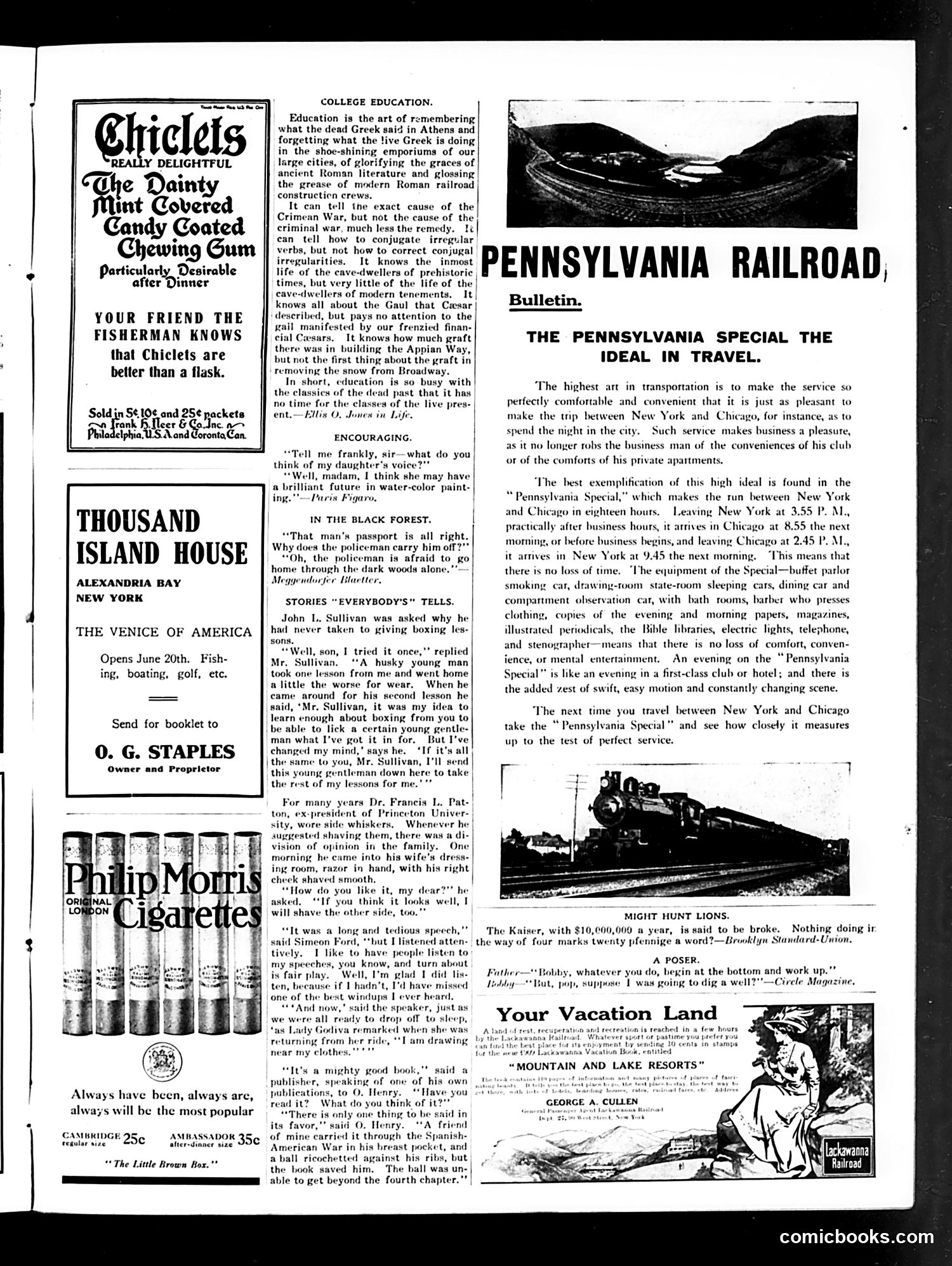
This page is primarily **advertising and promotional content**, not political satire. The dominant feature is a Pennsylvania Railroad advertisement for "The Pennsylvania Special," a luxury train service between New York and Chicago. The top-left contains unrelated ads (Chiclets gum, Thousand Island House resort) and a Philip Morris cigarettes advertisement. The main editorial content is a satirical essay on "College Education" that mocks traditional higher education for teaching ancient history while ignoring modern urban problems—students learn about Roman literature but nothing of tenement life, or about contemporary graft in city infrastructure like snow removal from Broadway. Below this are brief anecdotal stories, including one about boxer John L. Sullivan refusing to teach boxing lessons after one student left worse for wear. The page reflects early 20th-century concerns about the disconnect between classical education and practical modern life, but lacks specific political figures or dated references that would require historical explanation for modern readers.
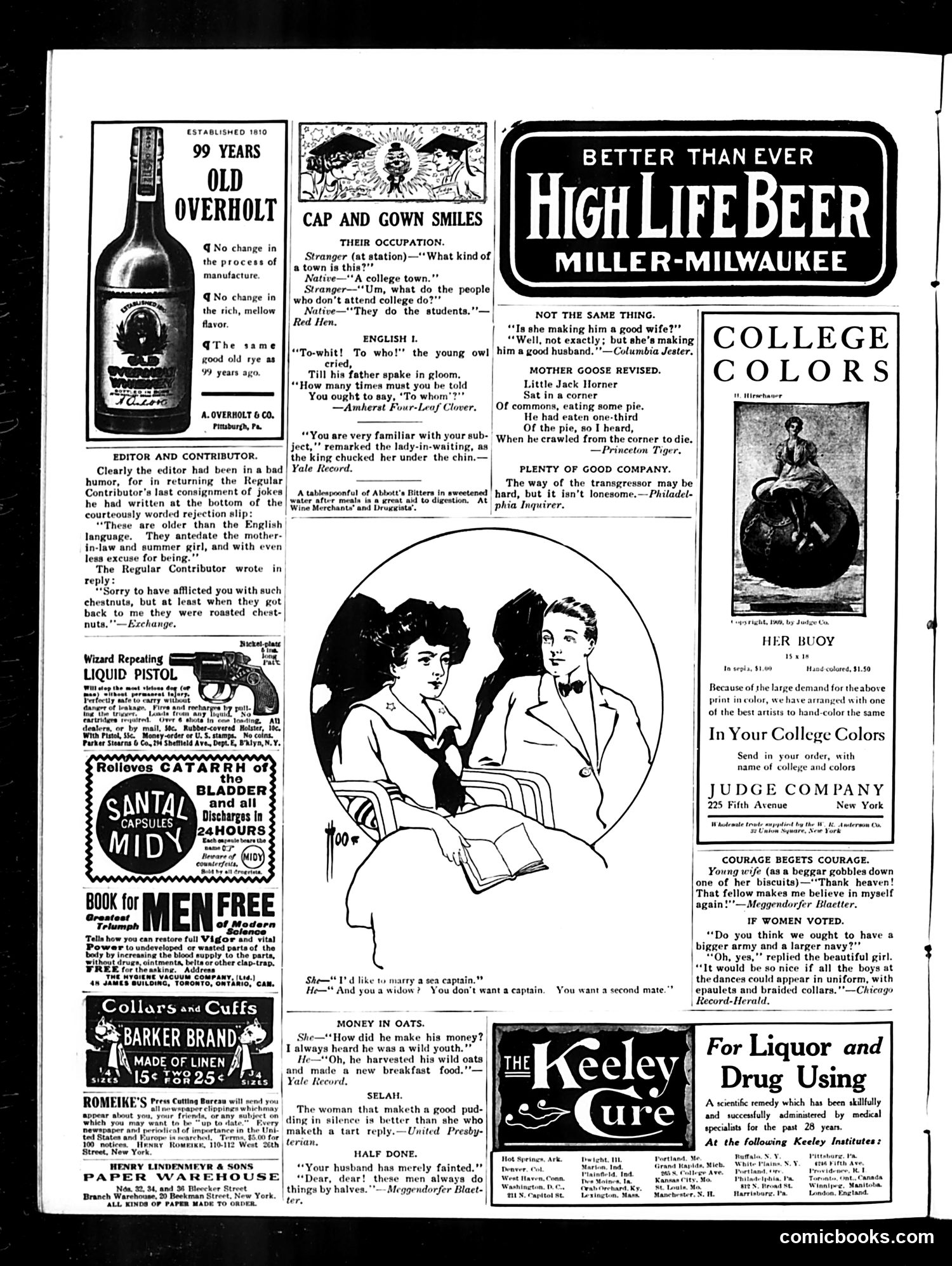
This page from **Judge** magazine is primarily **advertisements and filler content** rather than political satire. The main cartoon depicts a couple on a train, with the man proposing marriage; the woman responds she'd prefer a "second mate" rather than a "captain"—a playful joke about marital hierarchy. The page includes period advertisements (Overholt whiskey, "Liquid Pistol" toys, mail-order vigor books) typical of early 1900s magazines, plus various short jokes reprinted from other publications. A recurring theme involves mild humor about college life and gender relations. The "English I" section gently mocks grammar instruction through dialect humor. References like "Mother Goose Revised" offer lighthearted parodies. Nothing here addresses serious politics; instead, the content reflects contemporary middle-class anxieties about courtship, masculinity (vigor pills), and education—standard fare for a humor magazine of this era.
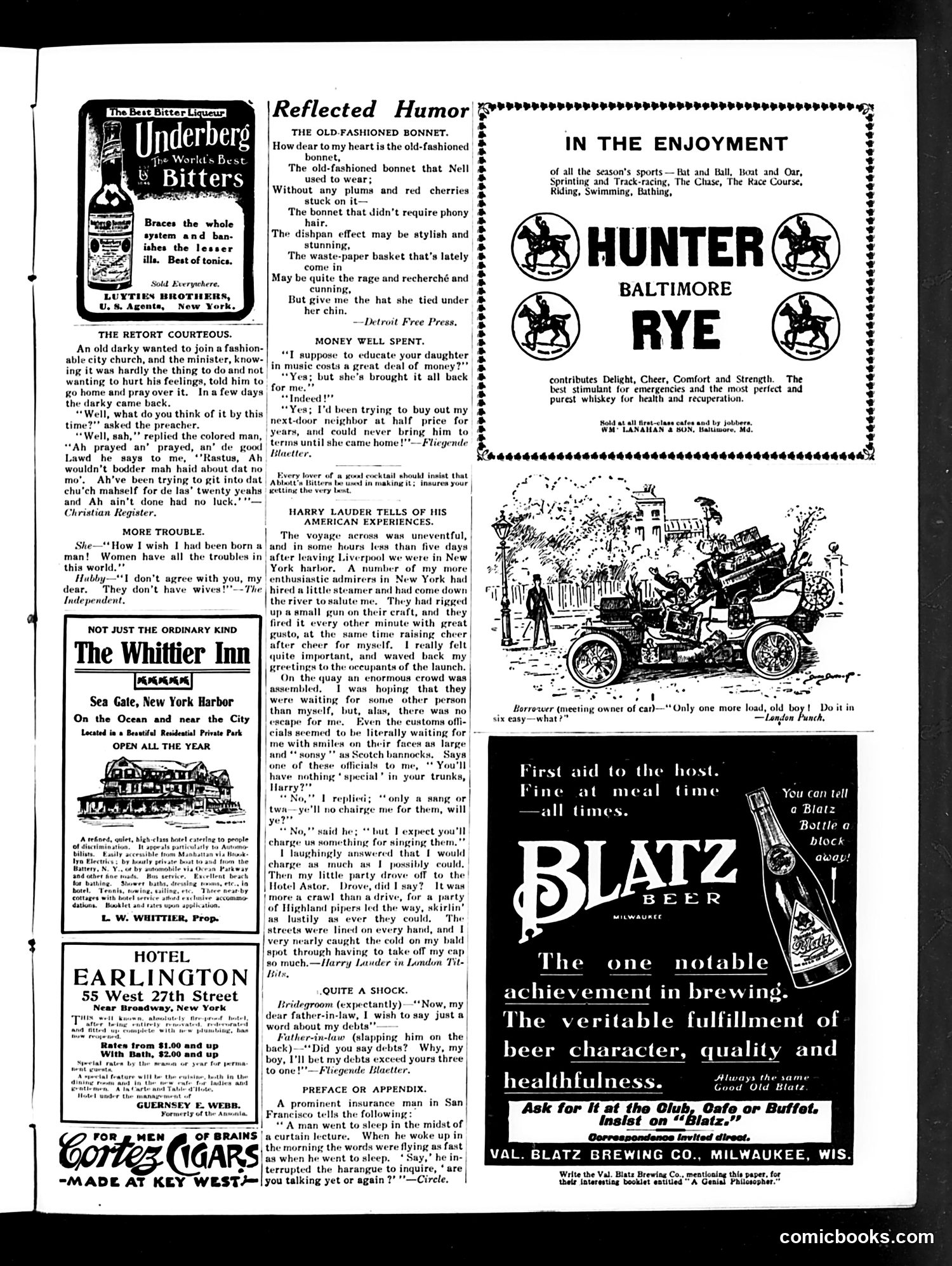
This page from Judge magazine consists primarily of **advertisements and humorous anecdotes** rather than political cartoons. The humor pieces employ **period racial stereotypes**: "The Retort Courteous" features an African American character seeking church membership—the joke relies on outdated dialect and minstrel-show conventions common to early 20th-century comedy. Other items mock **gender dynamics and marriage** ("More Trouble," "Money Well Spent")—typical domestic humor of the era poking fun at wives' expenses and husbands' financial struggles. **Harry Lauder's account** references the Scottish entertainer's American touring experiences, describing enthusiastic crowds and Highland bagpipers—reflecting contemporary celebrity culture. The advertisements for **bitters, hotels, beer, and cigars** dominate the layout, which was standard for Judge's revenue model. Overall, this represents typical early-1900s satirical magazine content: light domestic comedy, period stereotypes, and commercial promotion rather than sharp political commentary.
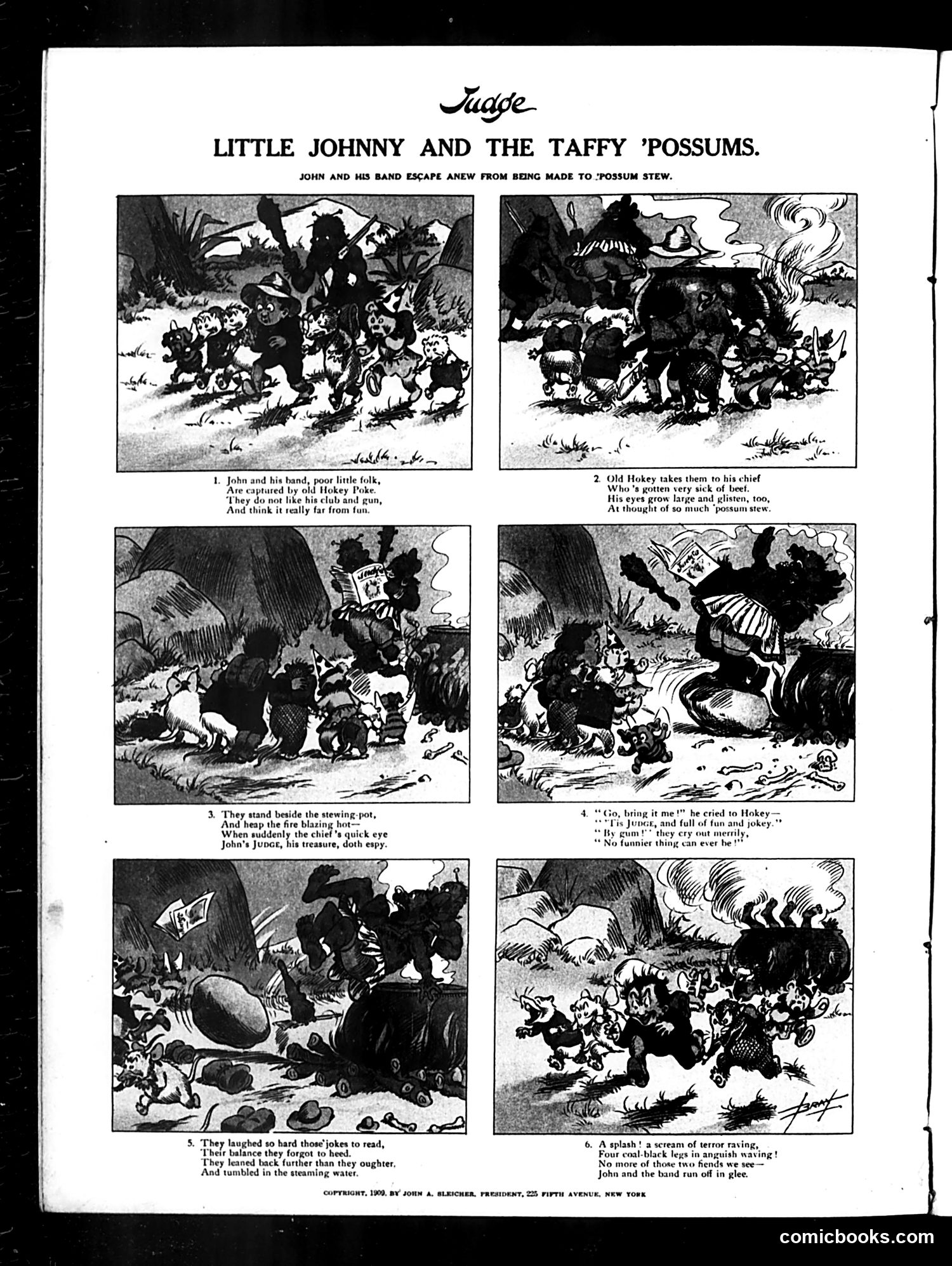
This is a children's adventure comic strip featuring "Little Johnny" and his band escaping from "Old Hokey Poke" and a Native American chief who plan to make them into possum stew. The narrative follows a rescue sequence: the children are captured, brought before a sick chief, Johnny produces a "Junce" (unclear what this is—possibly a magical object or treasure), which causes the pursuers to laugh so hard they lose their balance and tumble into the stewing pot they'd prepared. The humor relies on slapstick reversal—the hunters becoming the hunted. The indigenous characters ("Hokey Poke" and the chief) are portrayed as villains in a stereotypical adventure narrative typical of early 1900s children's entertainment. The comic reflects period attitudes toward Native Americans as exotic antagonists rather than as nuanced characters.