
A complete issue · 16 pages · 1908
Judge — November 21, 1908
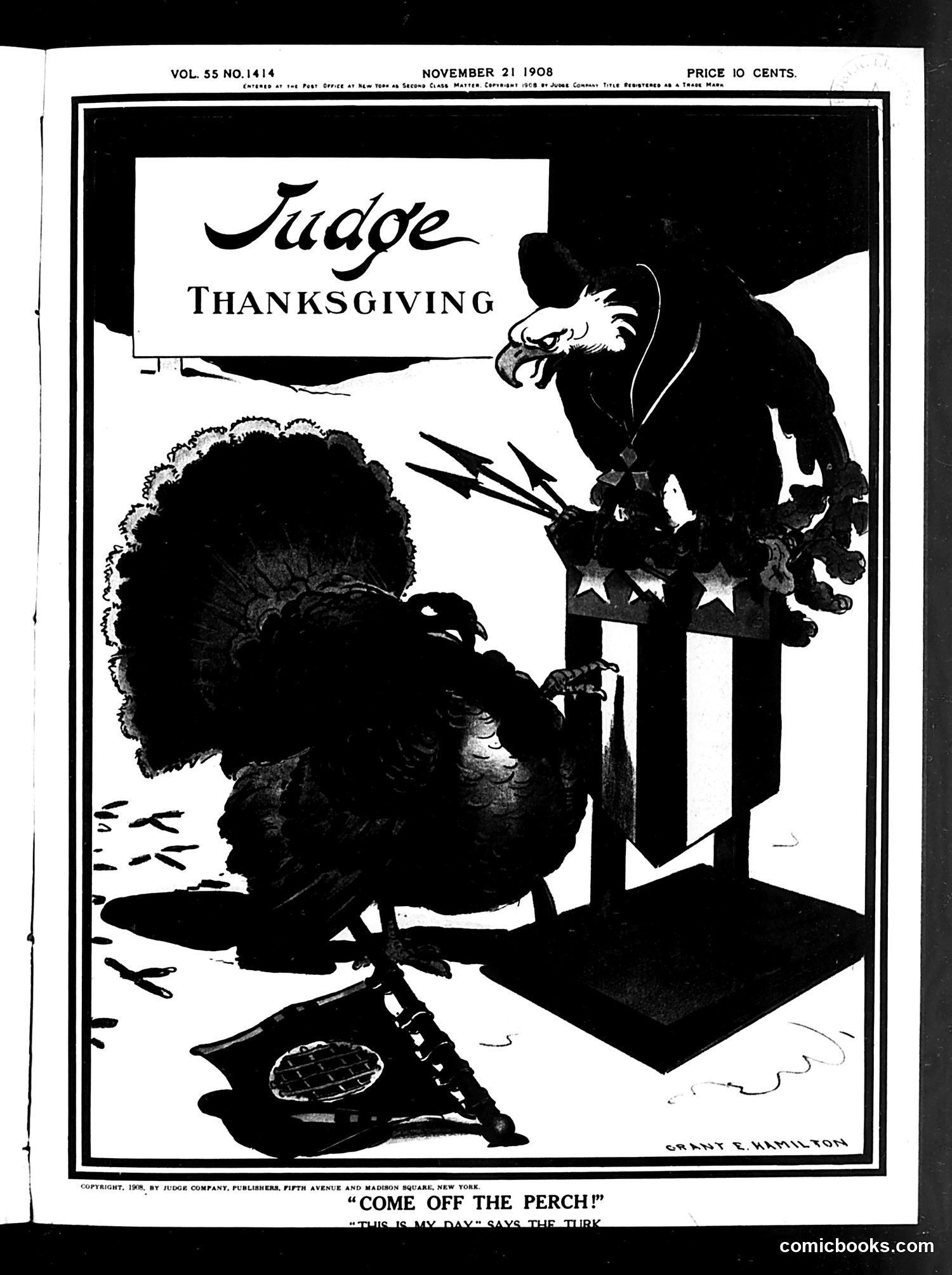
This Thanksgiving-themed cover cartoon depicts a turkey on a patriotic pedestal being threatened by a menacing figure perched on top. The caption reads "COME OFF THE PERCH!" with the subtitle "THIS IS MY DAY," SAYS THE TURK." The cartoon appears to be political satire, likely referencing the 1908 presidential election. The turkey—representing either a candidate or political position of prominence—is being challenged to "come down" from its elevated status. The aggressive figure threatening the turkey seems to represent a challenger or opposing political force. The patriotic shield and American iconography suggest this concerns domestic politics. The specific election or political struggle referenced remains unclear without additional historical context, but the message is one of political challenge and competitive displacement.
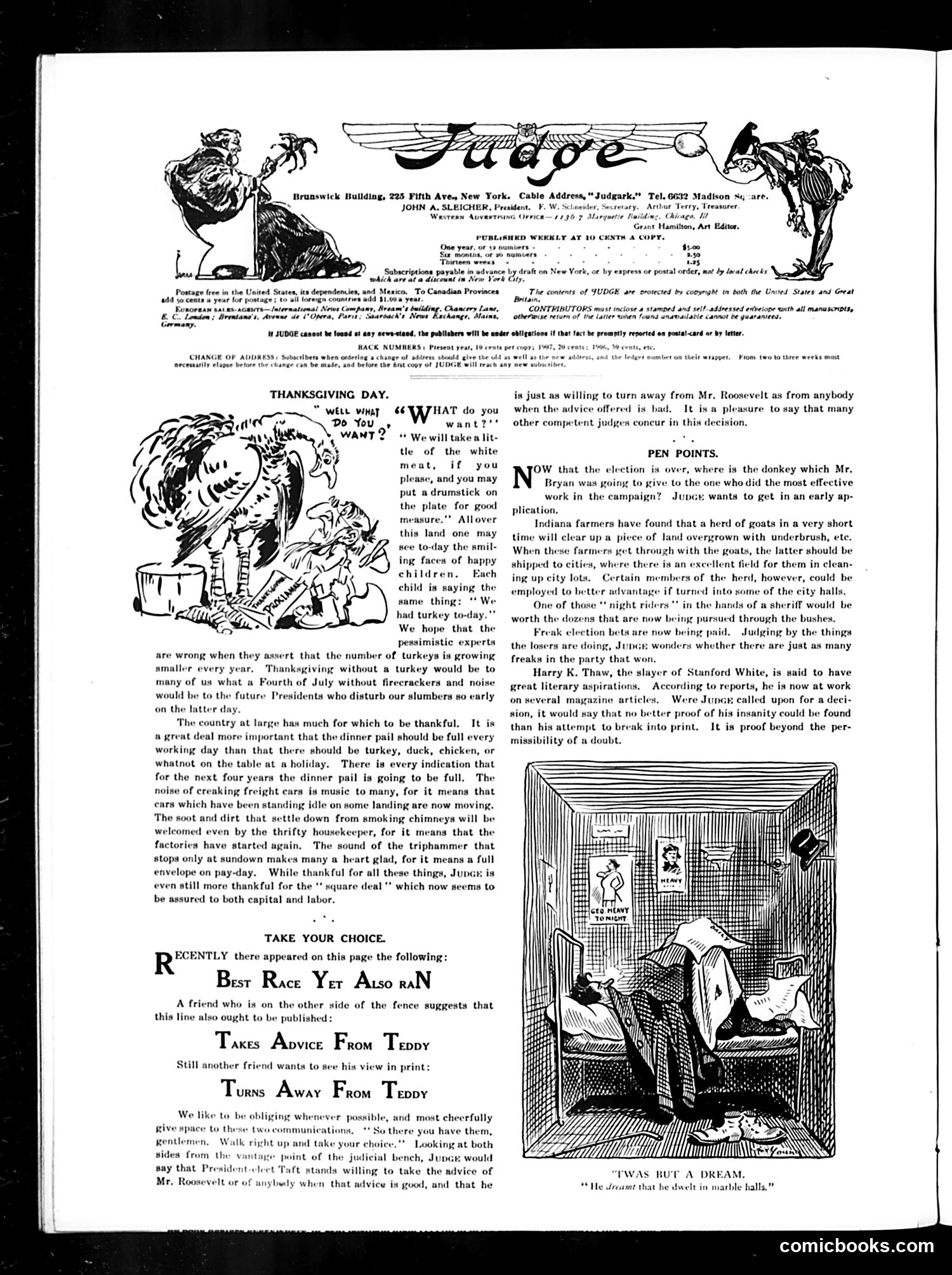
This page satirizes early 1900s politics, particularly **President Theodore Roosevelt's** influence on the 1908 election. The text discusses whether successor **William Howard Taft** should accept Roosevelt's advice, presenting competing headlines: "Best Race Yet Also Ran," "Takes Advice From Teddy," and "Turns Away From Teddy." The cartoon titled "I Was But a Dream" (bottom right) appears to depict someone in an ornate room, likely referencing political aspirations or illusions of power. The "Thanksgiving Day" section mocks optimistic predictions about turkey availability and economic prosperity, suggesting satirical doubt about such forecasts. The piece generally critiques the tension between Roosevelt's continued influence and Taft's independence as incoming president, a major political drama of that election cycle.
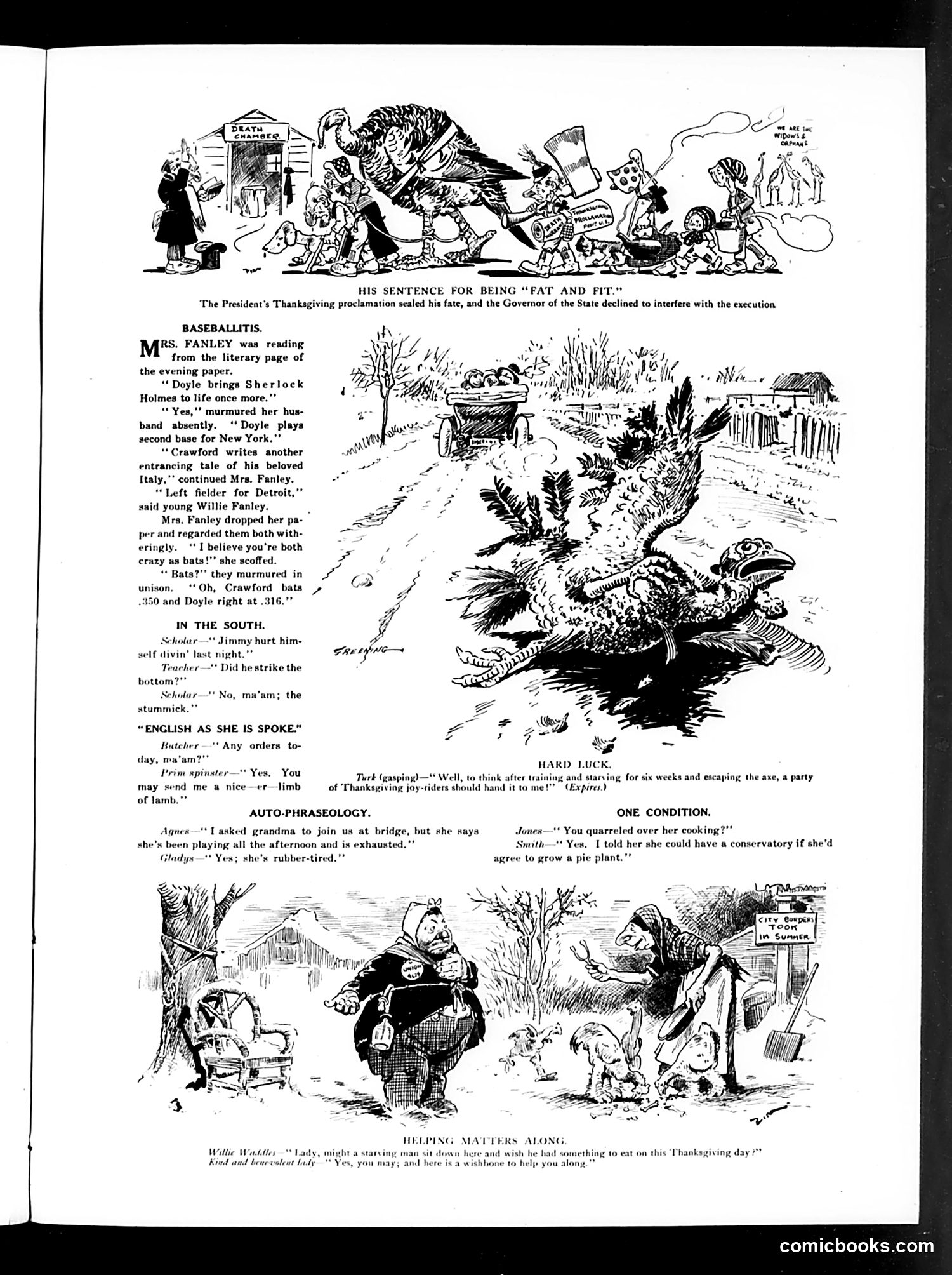
**Top Cartoon**: References a presidential pardon for someone convicted of being "fat and fit." The President's Thanksgiving proclamation sealed the fate; a State Governor refused to interfere with execution. This appears to be satire about arbitrary executive clemency and the absurdity of executing someone for physical characteristics—likely mocking contemporary political figures' use of pardons. **Remaining Content**: Consists of short humorous anecdotes and jokes organized by section ("Baseballitis," "In the South," "English As She Is Spoke," etc.). These are typical Judge magazine filler—puns, dialect humor, and domestic comedy common to the era. The bottom cartoon shows a man offering Thanksgiving charity to those in need, reflecting period attitudes toward poverty and charity. The page demonstrates Judge's mix of political satire and light entertainment humor.
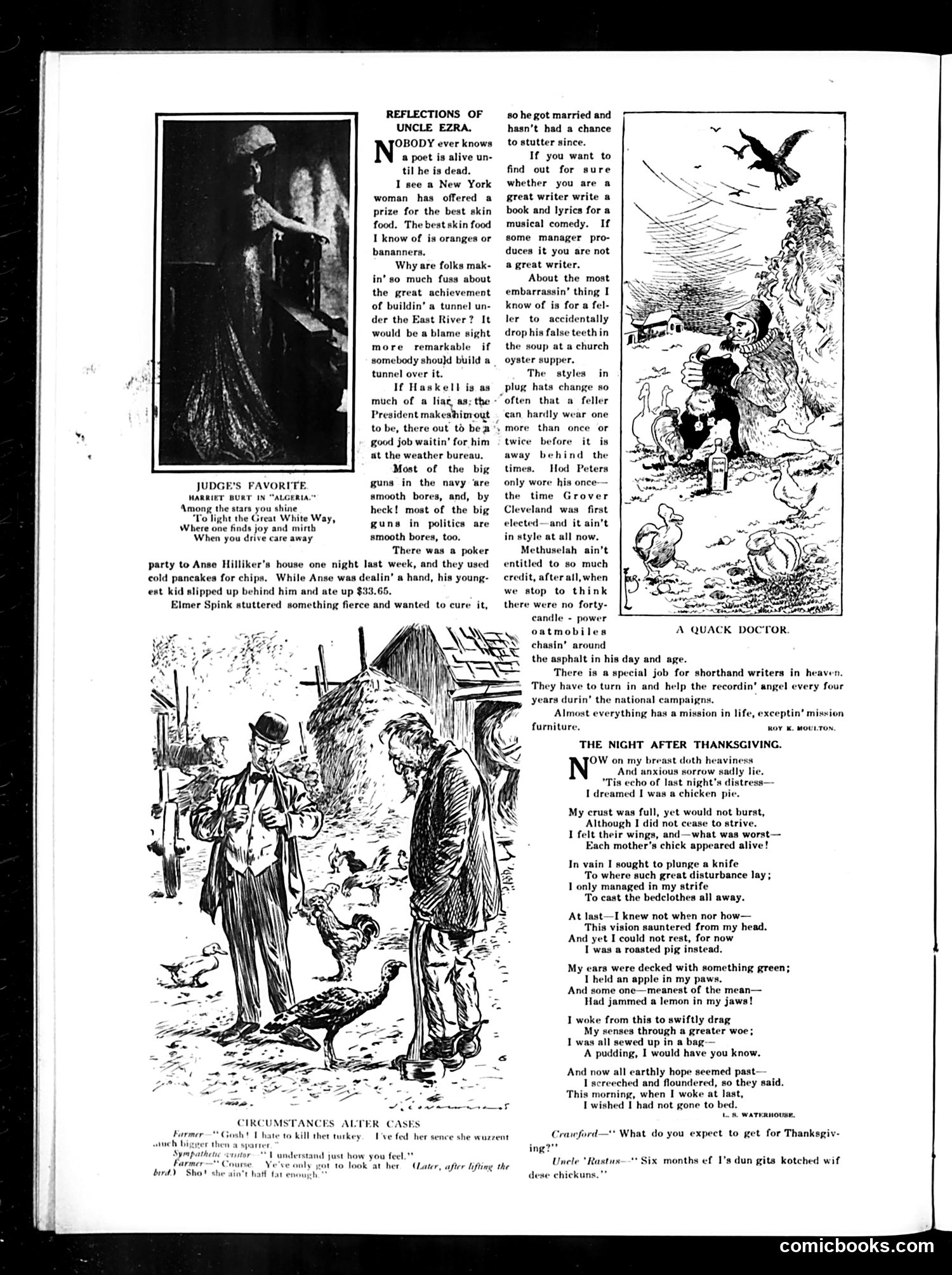
This page contains three distinct pieces: **"Reflections of Uncle Ezra"** - A humorous column mocking pretension, including jokes about New York society, the Panama Canal, naval guns, and Haskell (likely a public figure) being called a liar. **"A Quack Doctor"** - An illustration satirizing fraudulent medical practitioners, a common target of Progressive-era satire. **"The Night After Thanksgiving"** - A comic poem about digestive distress after overindulging, a relatable satirical take on holiday excess. **"Circumstances Alter Cases"** - A dialogue cartoon showing two men with poultry, with dialogue suggesting the farmer and butcher have different perspectives on the value of turkeys—likely social commentary on class differences or hypocrisy. The page reflects turn-of-the-century concerns: medical fraud, social pretension, and class commentary.
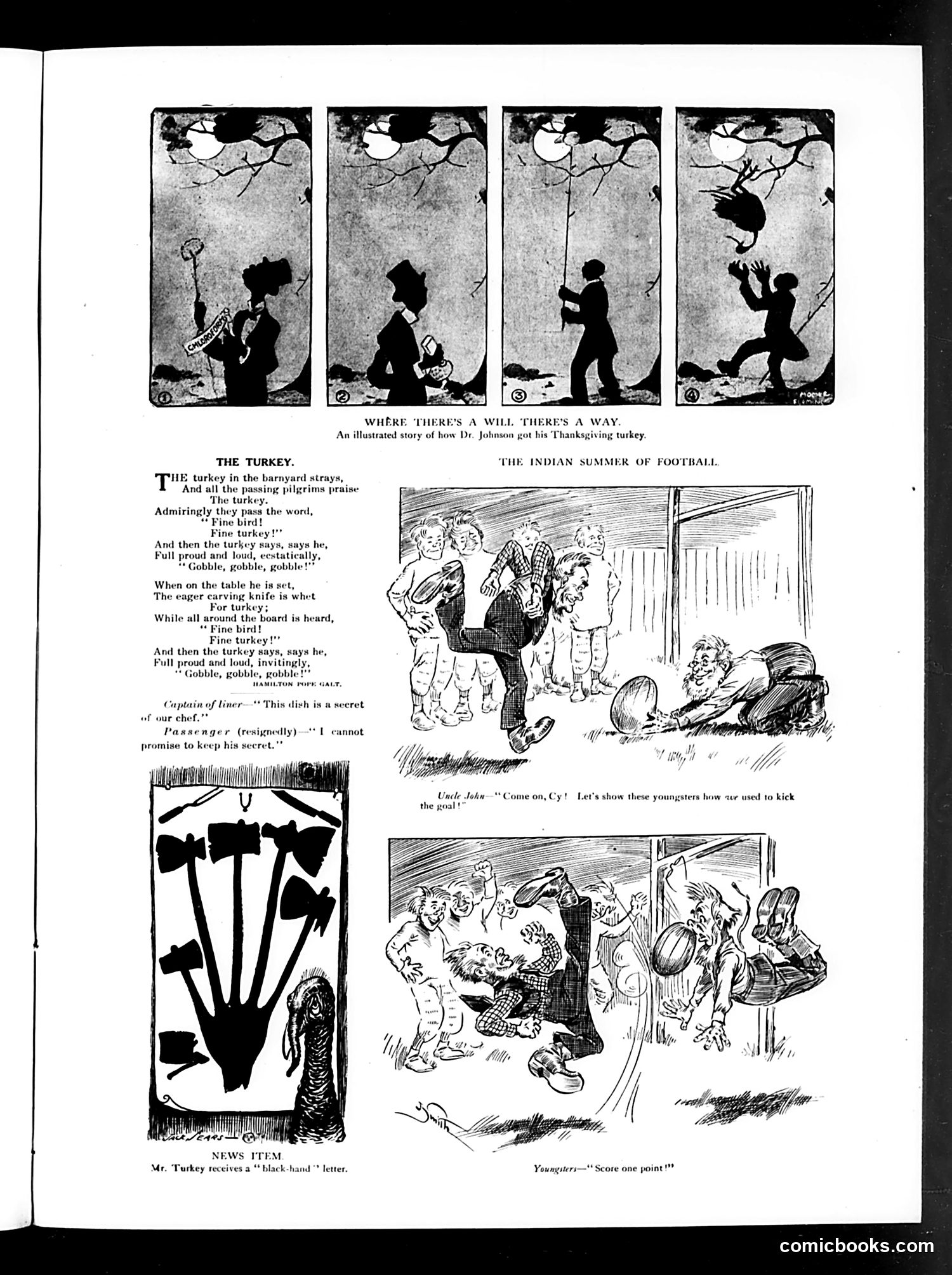
**"Where There's a Will There's a Way"** (top strip): A silhouette sequence showing someone acquiring a turkey for Thanksgiving, culminating in catching it mid-air. This appears to be a humorous how-to narrative about obtaining holiday dinner. **"The Turkey"** (poem): A comedic verse celebrating the turkey's role in Thanksgiving, with the bird's repeated call "Gobble, gobble, gobble!" **"The Indian Summer of Football"** (main cartoon): Children play football with an elderly man (Uncle John) attempting to teach them the sport. The humor derives from generational contrast—old versus young engaging in athletic play during autumn. **"News Item"**: A visual pun showing a turkey receiving a "black-hand letter" (threatening extortion note), anthropomorphizing the bird. The page combines holiday-themed humor with slapstick comedy typical of early 20th-century satirical magazine content.
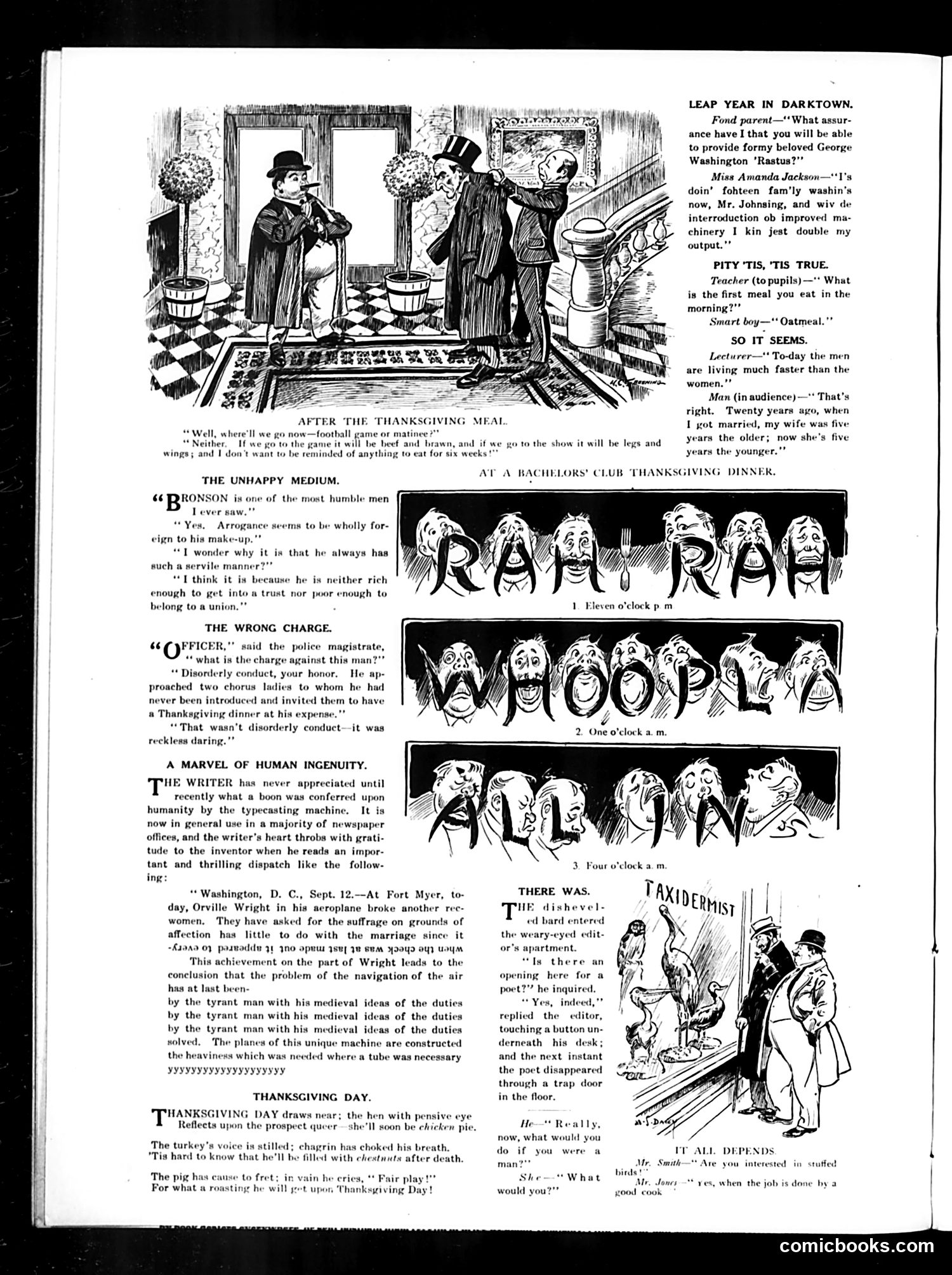
This page contains several satirical pieces typical of early 20th-century American humor: **"Leap Year in Darktown"** uses racist caricature and dialect to mock African American aspirations. A prospective father-in-law questions whether a young man can support his daughter; she brags about her laundry business and "improved machinery"—satirizing both economic ambition and the idea of women as breadwinners during leap year (when tradition reversed courtship roles). **Other sketches** mock social pretension, bachelor recklessness, and gender dynamics. "The Wrong Charge" jokes about a man inviting chorus girls to dinner without introduction as "reckless daring" rather than misconduct. **"Marvel of Human Ingenuity"** satirizes newspaper typecasting machines by reproducing a repetitive, garbled dispatch about Orville Wright's aviation experiments—suggesting the technology produces mindless repetition. The page reflects period anxieties about modernization, changing gender roles, and social mobility, delivered through offensive racial stereotyping standard to 1900s American satire.
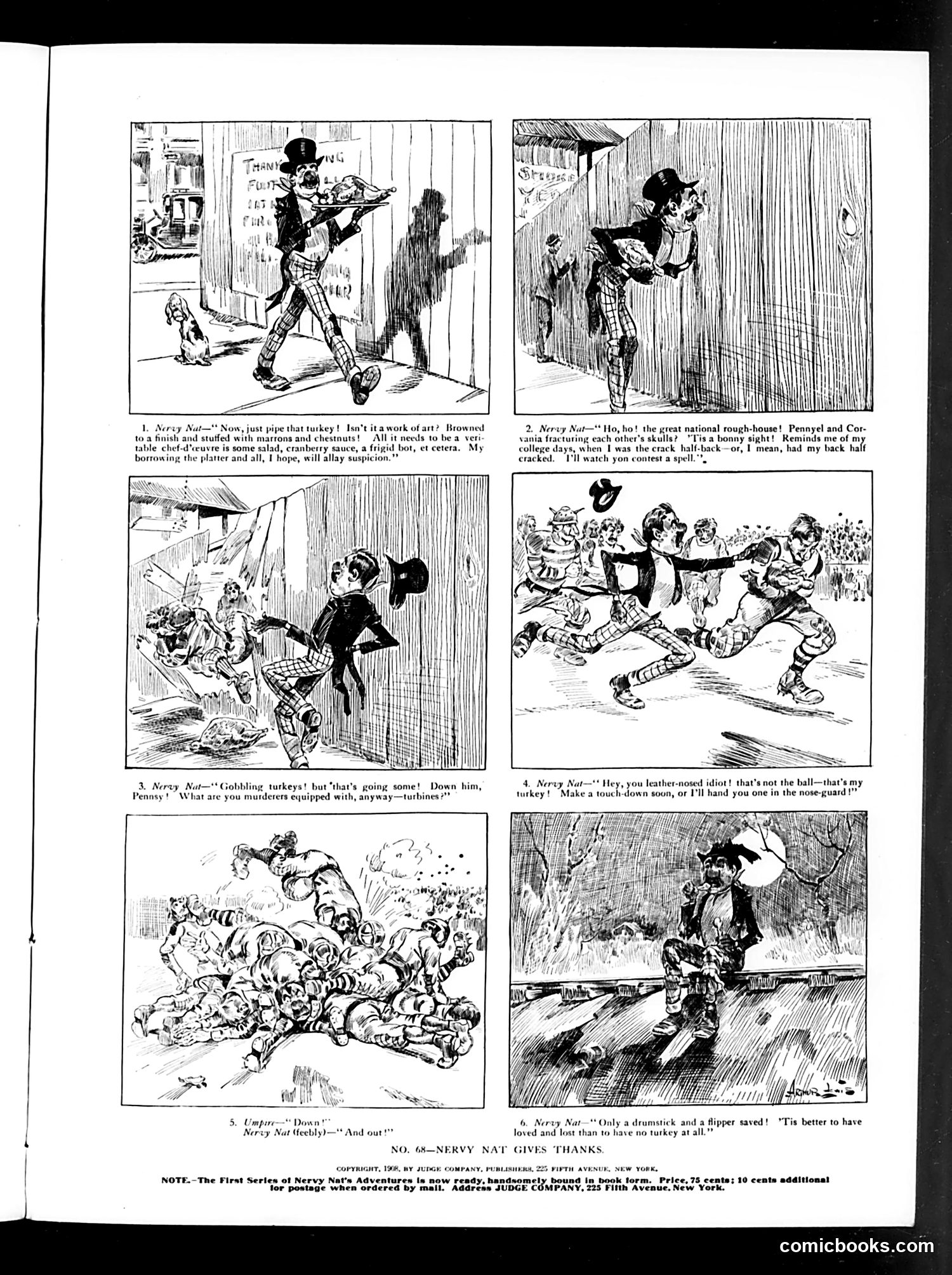
This is a comic strip following a character named "Nervy Nat" through Thanksgiving Day mishaps. The humor centers on Nat's attempts to steal or borrow a turkey while observing a football game between Pennsylvania and Cornell universities. The strip satirizes holiday chaos: Nat sneaks a turkey from a dinner table, watches the brutal college football match (which he compares to his own rougher college days), and the game devolves into pure violence with players literally fighting over what they believe is the ball—but is actually Nat's stolen turkey. The joke culminates in physical comedy: the "football" gets destroyed in the scrimmage, and Nat survives with only a drumstick and a flipper, leading to the final pun that it's "better to have loved and lost than to have no turkey at all." The comic reflects early 1900s American culture: holiday traditions, college football's brutal reputation, and slapstick humor.
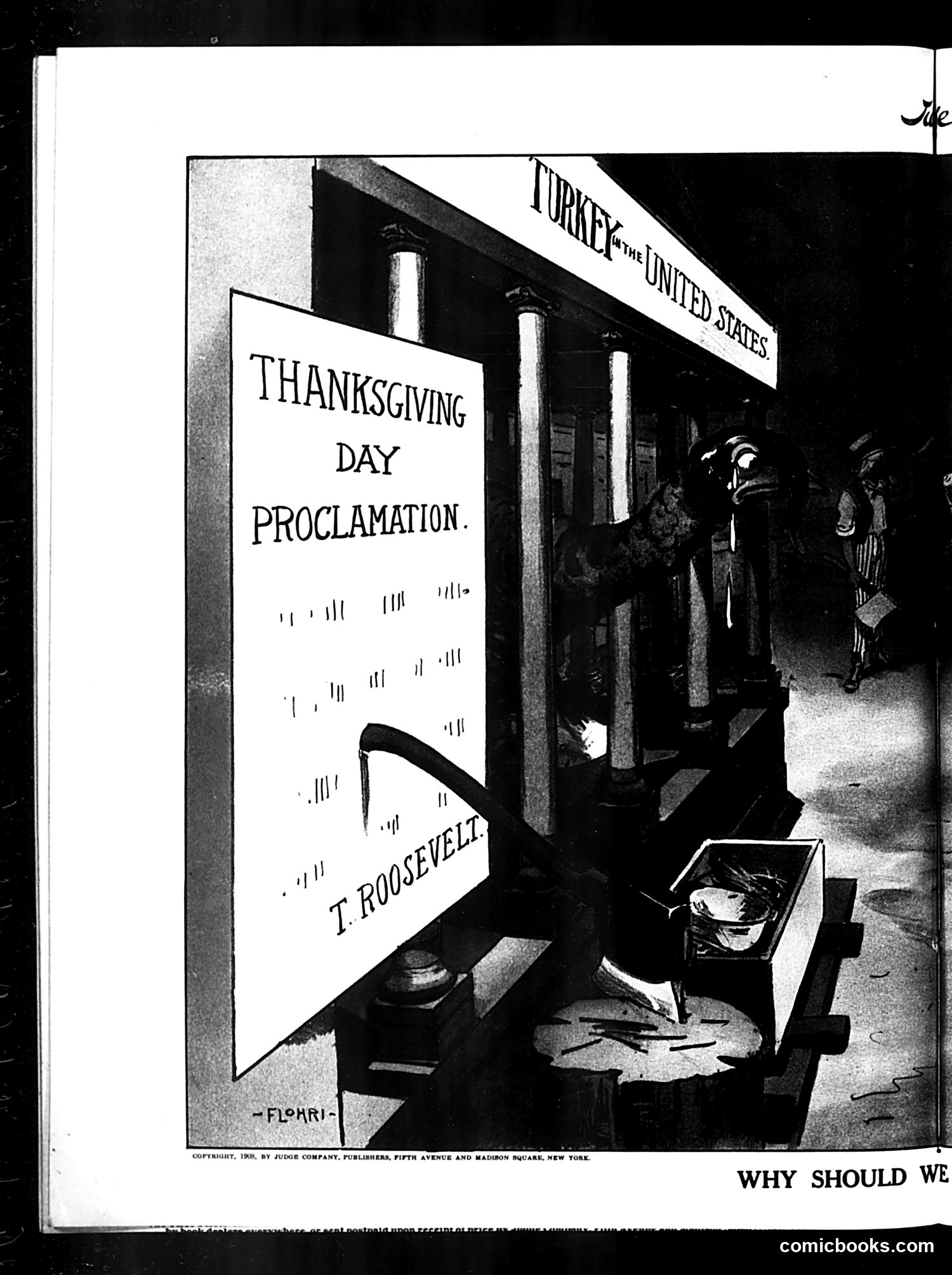
This appears to be a Judge magazine cartoon satirizing Theodore Roosevelt's Thanksgiving Day Proclamation. The image shows a formal proclamation document signed by "T. Roosevelt" displayed prominently, with what appears to be a turkey in a box below it—likely representing the holiday's traditional bird. The cartoon's point is unclear from the visible portion, but the juxtaposition of the grand, formal proclamation with the humble turkey suggests mockery of Roosevelt's grandiose style or the disconnect between official proclamations and ordinary celebration. The partial text "WHY SHOULD WE" at bottom indicates the cartoon makes a critical argument, though the complete message is cut off. The signature appears to be "Fiohr" or similar. The cartoon likely criticizes either Roosevelt's policies or his tendency toward dramatic pronouncements.
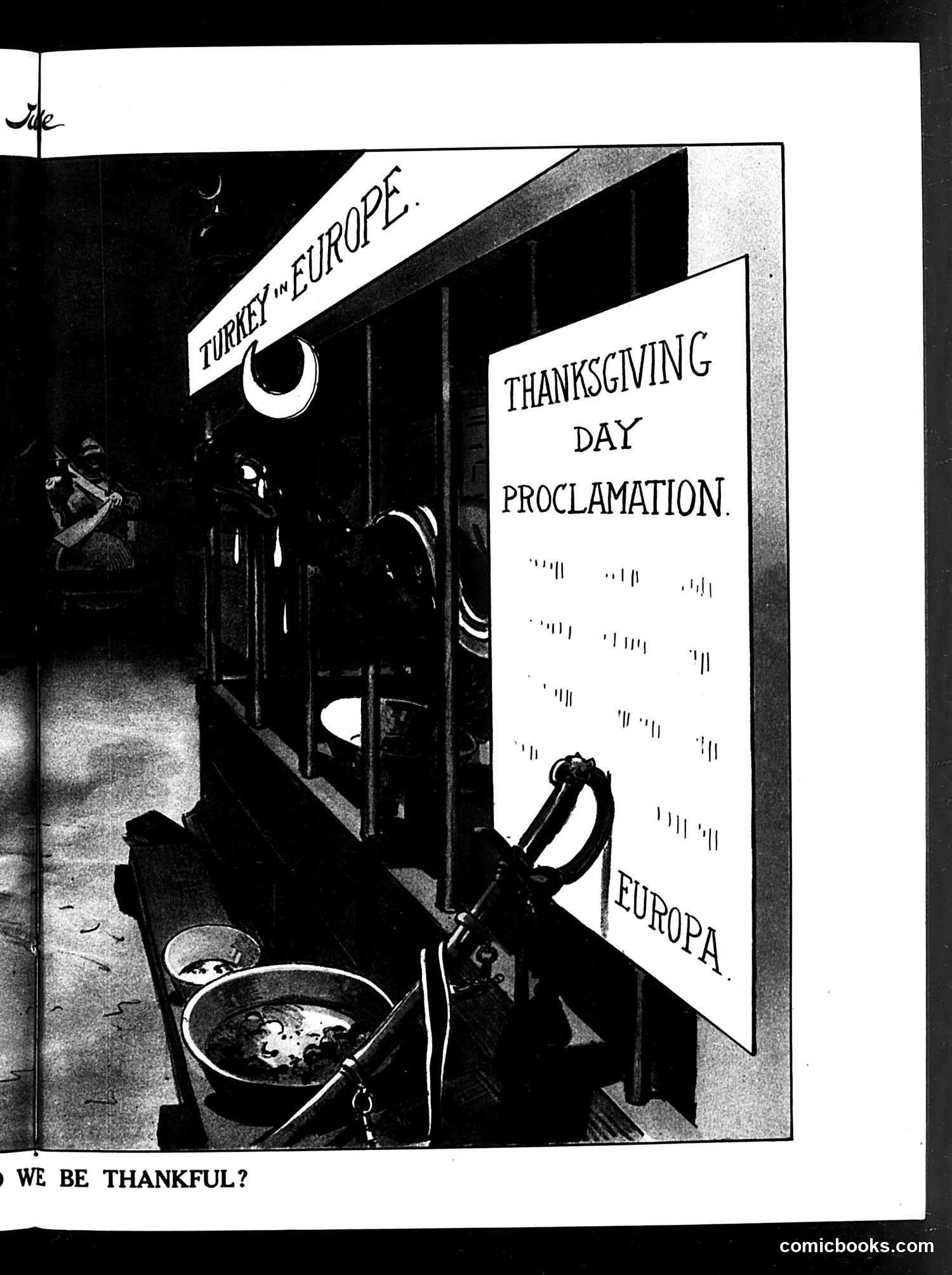
This cartoon satirizes post-World War I Europe's hardships. A skeletal, emaciated figure labeled "Europa" (personifying Europe) sits before a "Thanksgiving Day Proclamation," with an empty bowl and meager provisions. The banner reads "Turkey in Europe," likely referencing either Ottoman Turkey or ironic scarcity. The caption "We Be Thankful?" questions whether Europeans can genuinely give thanks given widespread poverty and hunger following the war. The contrast between the celebratory American holiday tradition and Europe's deprivation creates bitter satire. Judge magazine appears criticizing American complacency about European suffering or, alternatively, mocking European nations' inability to recover economically post-WWI despite peace treaties.
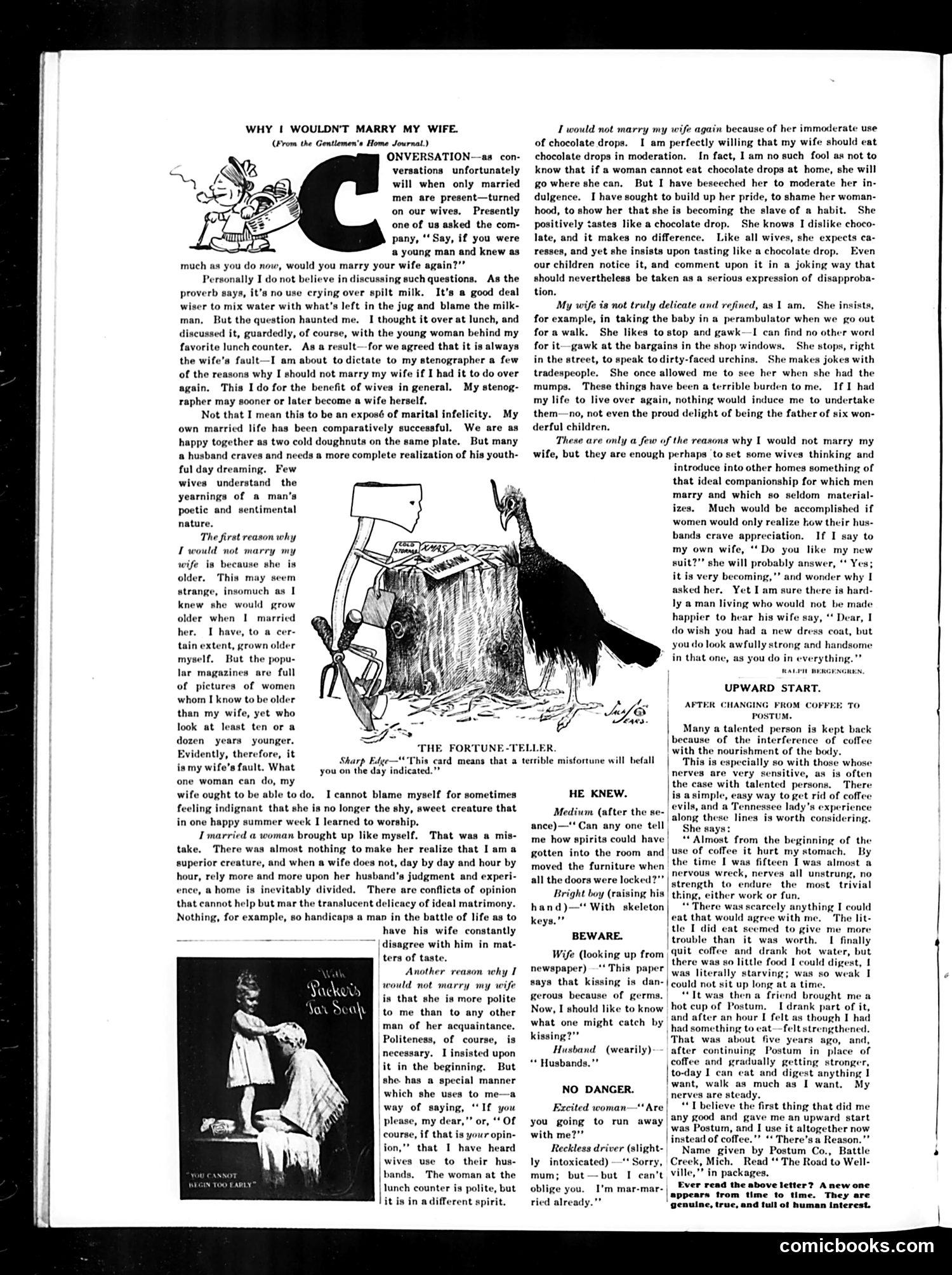
This page presents a humorously misogynistic article titled "Why I Wouldn't Marry My Wife," presented as purportedly from a gentlemen's magazine. The piece satirizes married men's complaints about their wives through exaggerated grievances: she's aging (unlike models in magazines), she's too polite to him, she eats too many chocolate drops, and she interrupts his activities to ask about his day. The satire works by revealing the absurdity of male entitlement—the narrator expects his wife to remain perpetually young, constantly defer to his judgment, and manage her own autonomy entirely around his preferences. By listing these petulant complaints seriously, Judge mocks the self-centered expectations husbands held while positioning themselves as society's superior creatures. The accompanying illustrations and other brief comedic pieces ("The Fortune-Teller," "He Knew," "Beware," "No Danger") follow similar patterns, satirizing contemporary social attitudes through exaggeration.
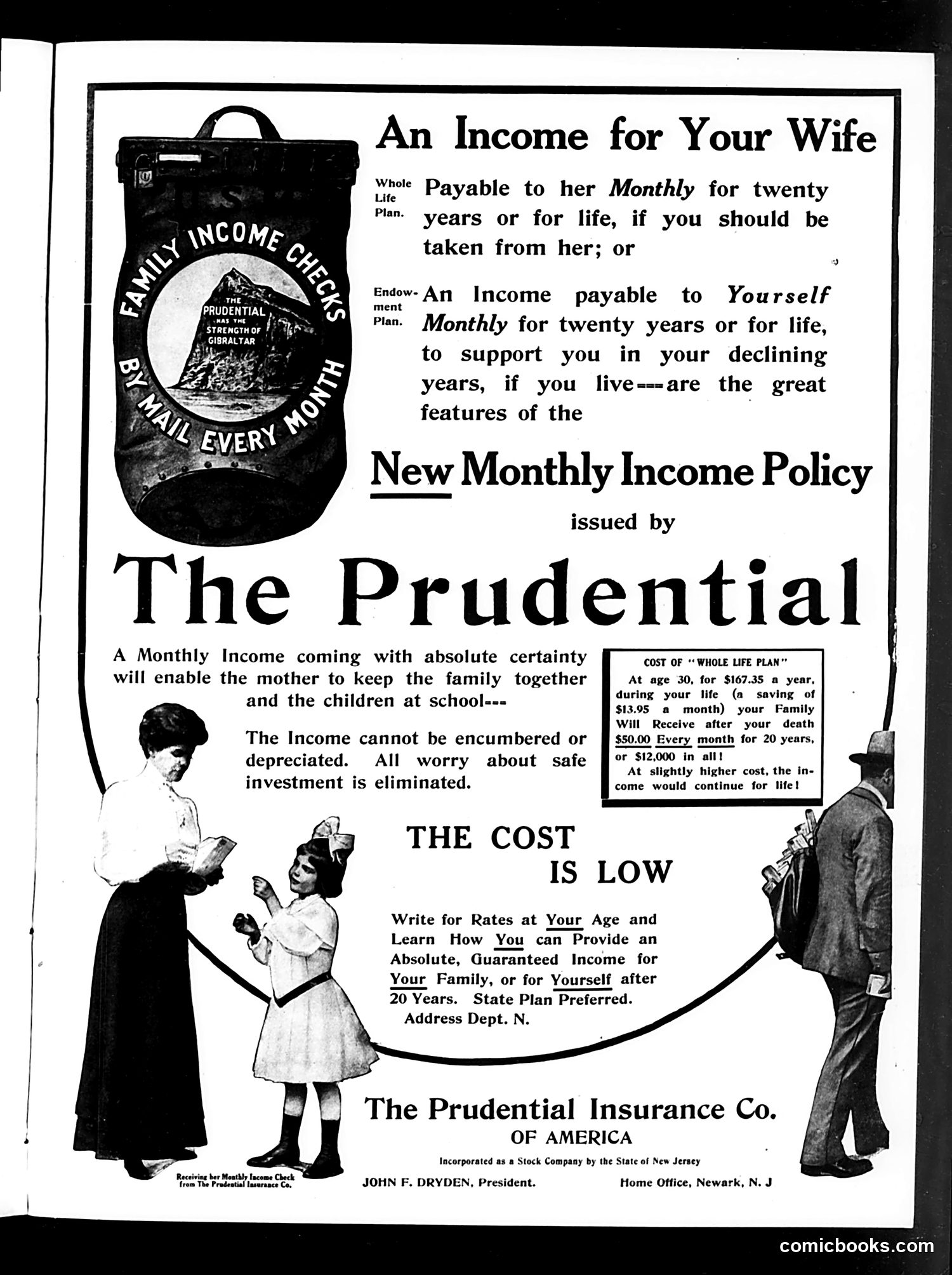
This is primarily a **Prudential Insurance advertisement**, not a satirical cartoon. The page promotes the company's "New Monthly Income Policy" to Judge magazine readers. The imagery depicts a idealized family scenario: a mother with children receiving monthly income payments, and a man (presumably the breadwinner/policyholder) on the right. The visual message is reassuring—financial security for dependents. The satirical element, if present, is subtle: the ad promises to solve a genuine social anxiety of the era—what happens to a wife and children if the breadwinner dies? By framing insurance as a solution that keeps "the family together and the children at school," Prudential appeals to middle-class anxieties about economic vulnerability. The cost details ($167.35 annually at age 30, yielding $50 monthly for 20 years) suggest this targets modest-income workers seeking affordable protection. There's no obvious political satire here—it's a straightforward pitch using emotional appeals common to early 20th-century insurance marketing.
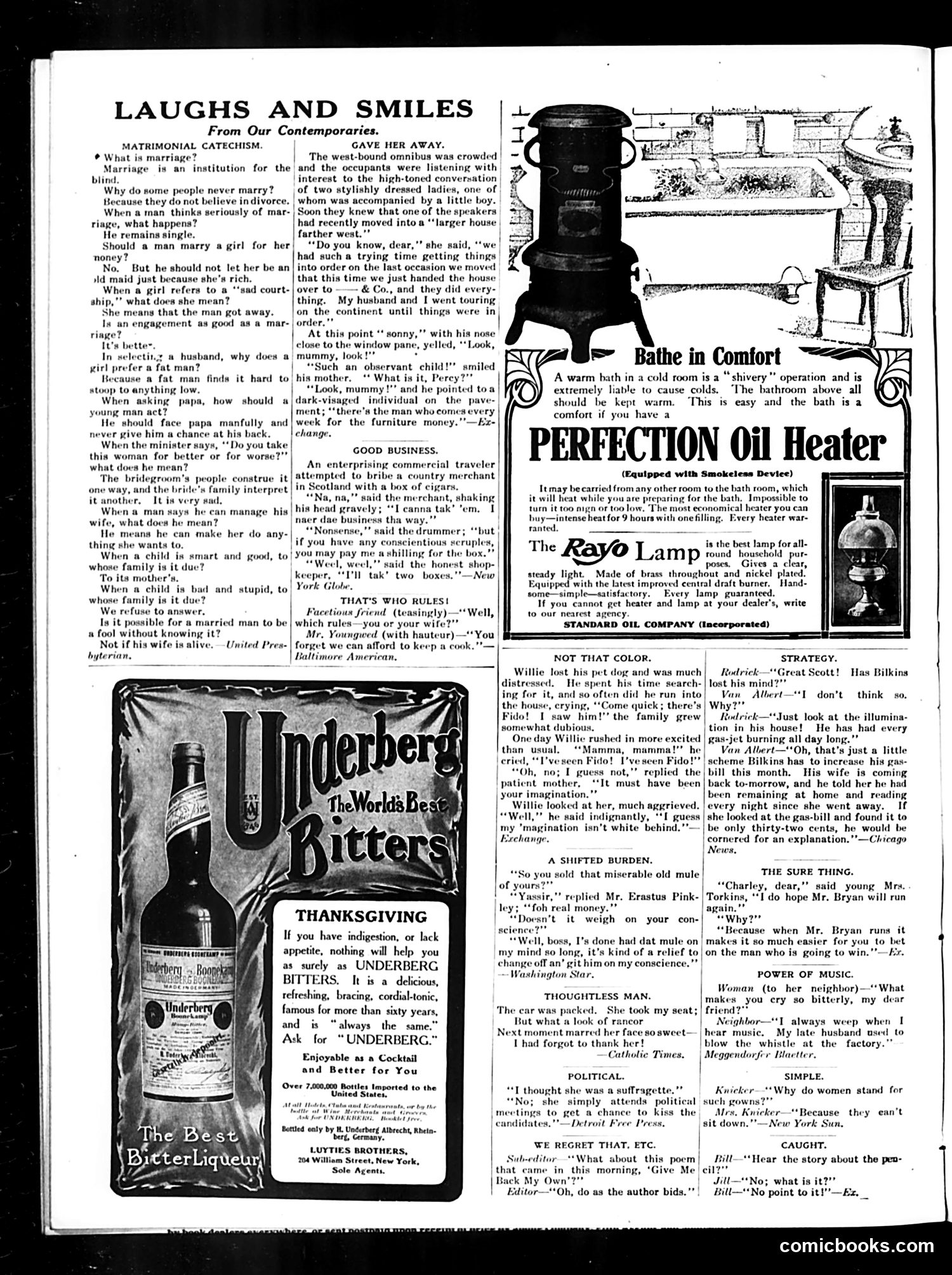
This page from *Judge* magazine contains primarily **humorous short jokes** rather than political cartoons. The "Laughs and Smiles" section consists of brief, domestic comedy pieces typical of early 20th-century American humor. The jokes target conventional marriage and gender roles: husbands avoiding wives' authority, wives controlling finances, and the absurdity of matrimonial expectations. One piece, "Gave Her Away," uses a child's innocent observation to expose class pretension—a wealthy woman brags about hiring movers while touring Europe, revealing her family's concern with appearances. The page includes **period advertisements** (Underberg Bitters, Perfection Oil Heater, Rayo Lamp) alongside lighter anecdotes about business dealings and social observation. **No significant political content or identifiable caricatures appear.** The humor reflects conservative domestic attitudes common to the era, emphasizing wives' control over household finances and husbands' domestic powerlessness—stock themes in early 20th-century American comedy.
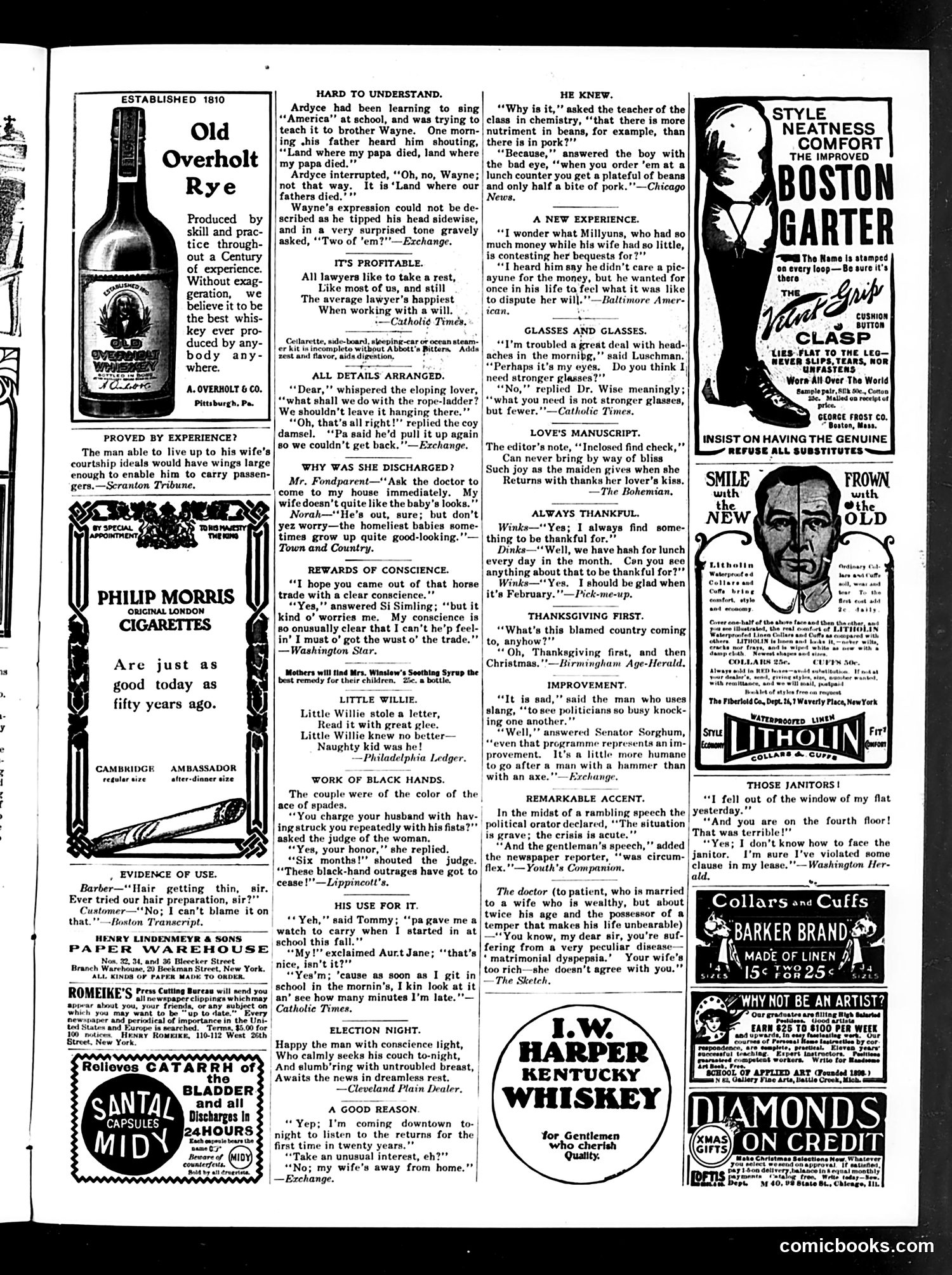
This page is primarily **advertising with brief satirical humor pieces**, typical of Judge magazine's format. The main advertisements feature liquor (Old Overholt Rye, I.W. Harper Kentucky Whiskey) and Philip Morris cigarettes—products marketed as time-tested quality. The scattered short jokes mock everyday situations: - A child mishearing the patriotic song "America" as "land where my papa died" (twice), missing the lesson about "our fathers"—satirizing children's literal interpretations - An elopement where the girl's father planned to retrieve the rope ladder, preventing escape—dark humor about parental control - A servant's tactless comment that even homely babies grow up decent - "Black hands" crime references reflecting period anxieties about organized crime The "Election Night" verse celebrates the man sleeping soundly rather than anxiously awaiting election results—likely commentary on political indifference or confidence. Overall, the page reflects early-20th-century middle-class concerns: child-rearing, domestic relations, crime, and politics—delivered through gentle, family-magazine humor alongside period product promotions.
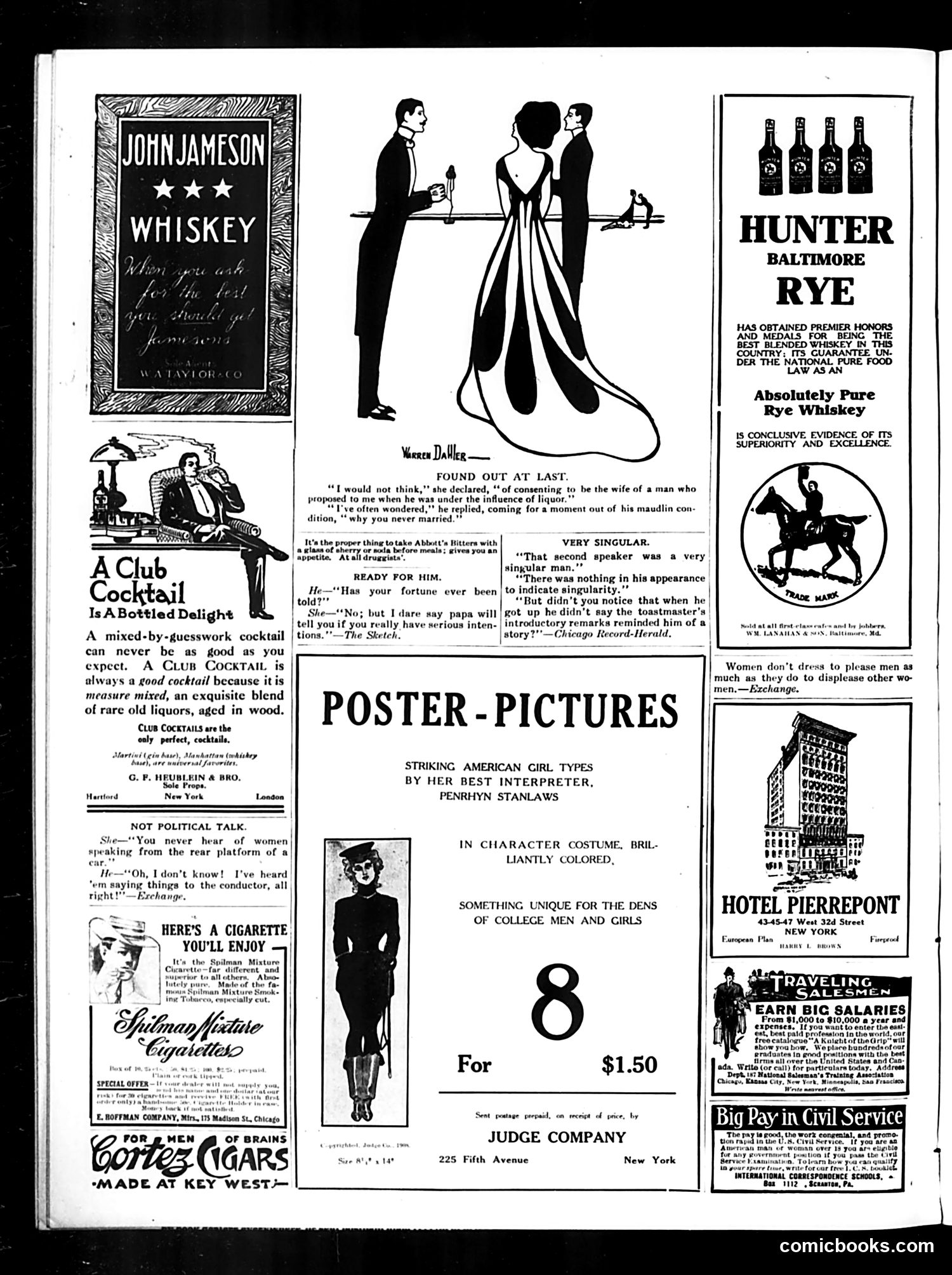
This page is primarily **advertising with humorous filler content**, typical of early 20th-century magazines. The main cartoons are short joke pieces about courtship and marriage: - **"Found Out at Last"**: A woman rejects a drunk suitor, then the man sardonically observes she "never married"—implying her standards are impossibly rigid. - **"Very Singular"**: A play on the word "singular" (odd/peculiar). A man at a social gathering fails to react to standard toastmaster jokes, which guests find strange. - **"Not Political Talk"** and **"Ready for Him"**: Brief romantic/marital humor about fortune-telling and proposals. The satire targets **courtship conventions and gender relations** of the era—women's marriage standards, male drunkenness, and the awkwardness of social rituals. The page also advertises whiskey, cigarettes, hotels, and other products, reflecting pre-Prohibition America and the magazine's commercial function.
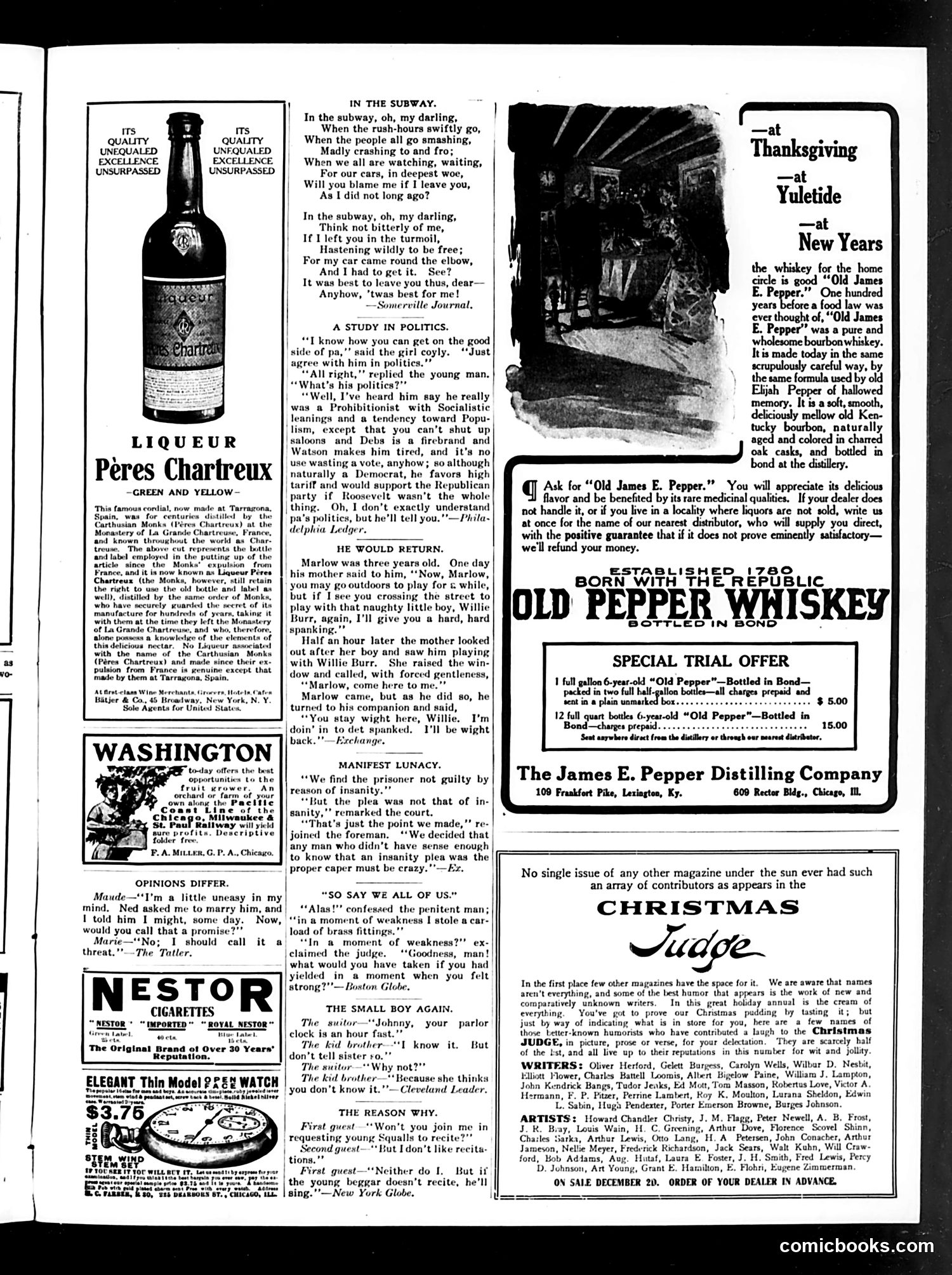
This page from *Judge* magazine is primarily **advertising and light humor**, not political satire. The content includes: **Advertisements:** - Liqueur and whiskey ads (Péres Chartreux, Old Pepper Whiskey, Nestor Cigarettes, watches) - These occupy significant space, reflecting the magazine's revenue model **Humor pieces:** - "In the Subway": A sentimental poem about abandoning a lover to catch the subway car—mocking both romance and urban rushing - "A Study in Politics": Satirizes a voter's incoherent political positions (simultaneously Prohibitionist, Socialist, Democratic, protectionist)—common *Judge* fare mocking political inconsistency - "Opinions Differ": A brief joke about engagement promises - "The Small Boy Again": A recurring comedic character type **"Christmas Judge" promotional text** advertises the magazine's upcoming holiday issue. The page lacks identifiable caricatures of specific political figures. The "politics" humor reflects early 1900s concerns about voter confusion and party contradictions, not particular elections or scandals.
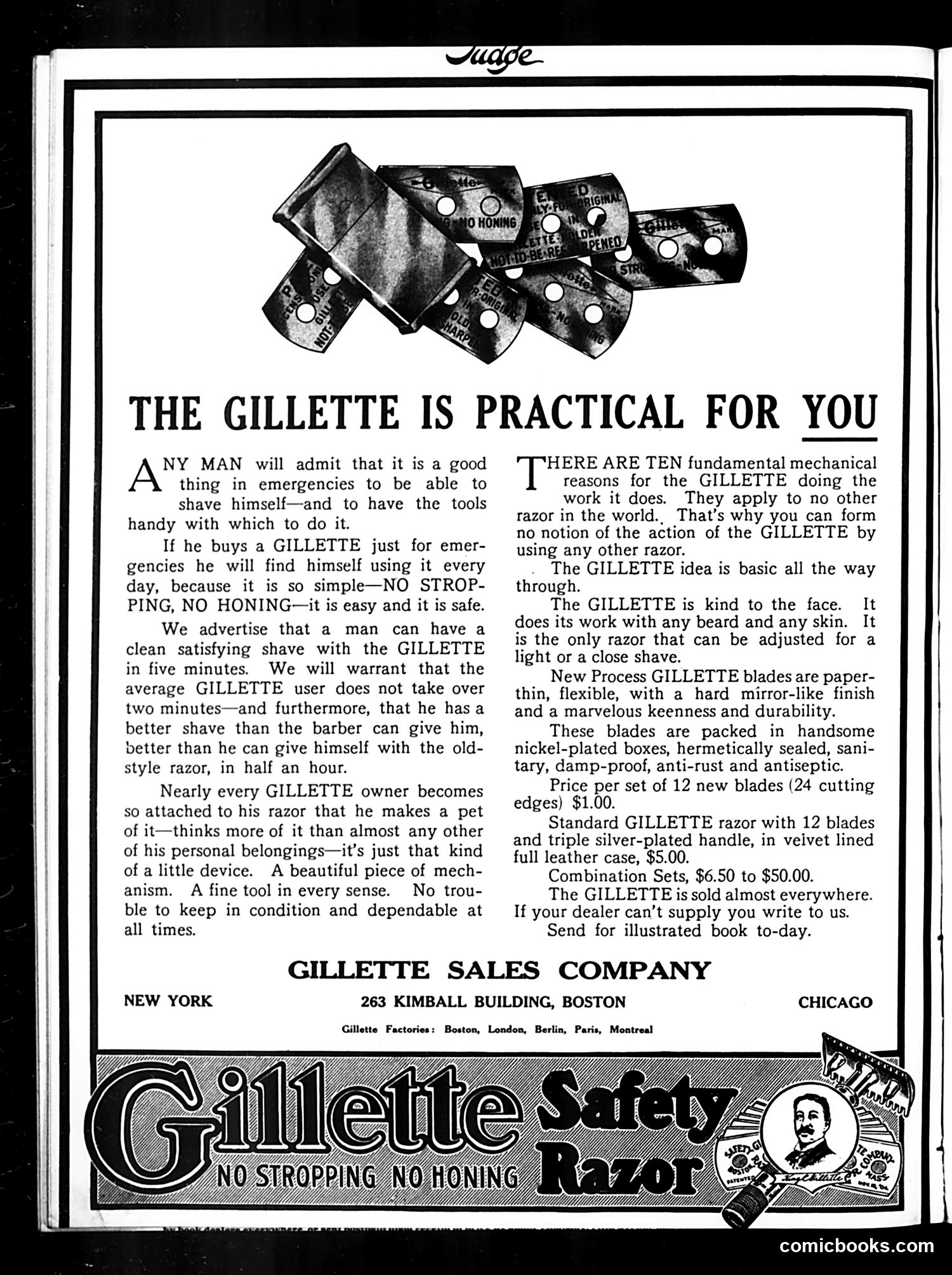
This page is **not a cartoon or satire**—it's a straight advertisement for Gillette Safety Razors, placed in *Judge* magazine. The ad promotes the Gillette's practicality for everyday men, emphasizing its simplicity (no stropping or honing required), speed (five minutes or less), and superiority over traditional straight razors and barber services. It highlights product features like adjustable blade depth and durable construction, then lists prices: $1 for blade sets, $5 for the standard razor with case. The image shows multiple Gillette razor packages arranged above the text. The bottom features the product logo and branding. This represents early 20th-century consumer marketing targeting middle-class male self-sufficiency—positioning the Gillette as an affordable, convenient alternative to barber visits. The emphasis on personal ownership and attachment ("makes a pet of it") reflects period marketing psychology around masculine convenience products.