
A complete issue · 17 pages · 1907
Judge — December 28, 1907
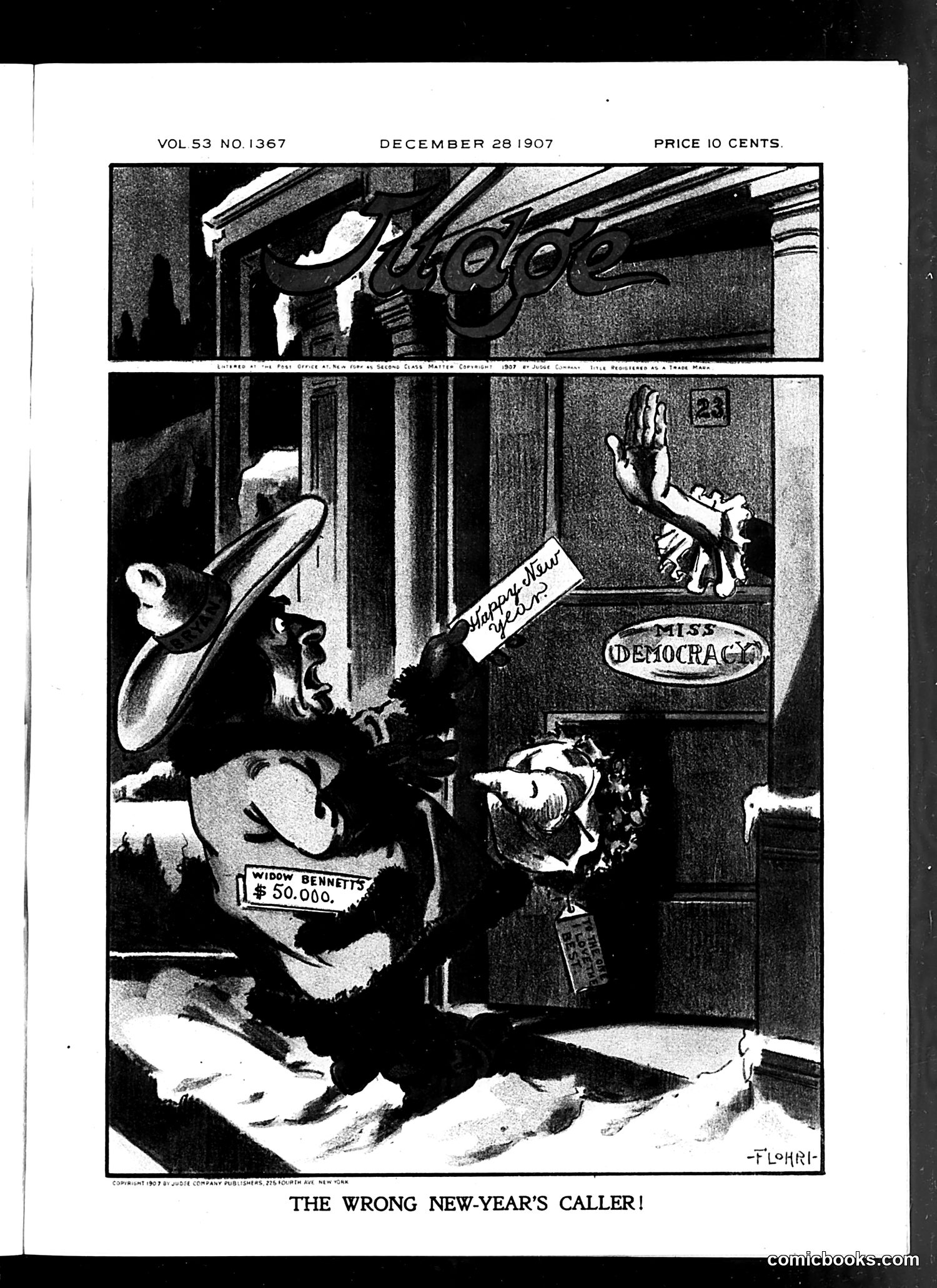
This December 28, 1907 *Judge* cartoon satirizes political corruption during the Progressive Era. The central figure labeled "Widow Bennett's $50,000" represents a bribe or embezzled funds. A monkey-like caricature (likely depicting a corrupt politician or party operative) arrives at a door marked "Miss Democracy," attempting to enter under false pretenses—suggested by the "Approved by Congress" document he holds. The cartoon criticizes how politicians used official approval to legitimize corrupt dealings. The "wrong" caller jokes that corruption disguises itself as legitimate while Democracy's door should remain closed to such visitors. This reflects early 1900s anxieties about governmental malfeasance and the need for reform—central Progressive Era concerns about protecting democratic institutions from backroom dealing.
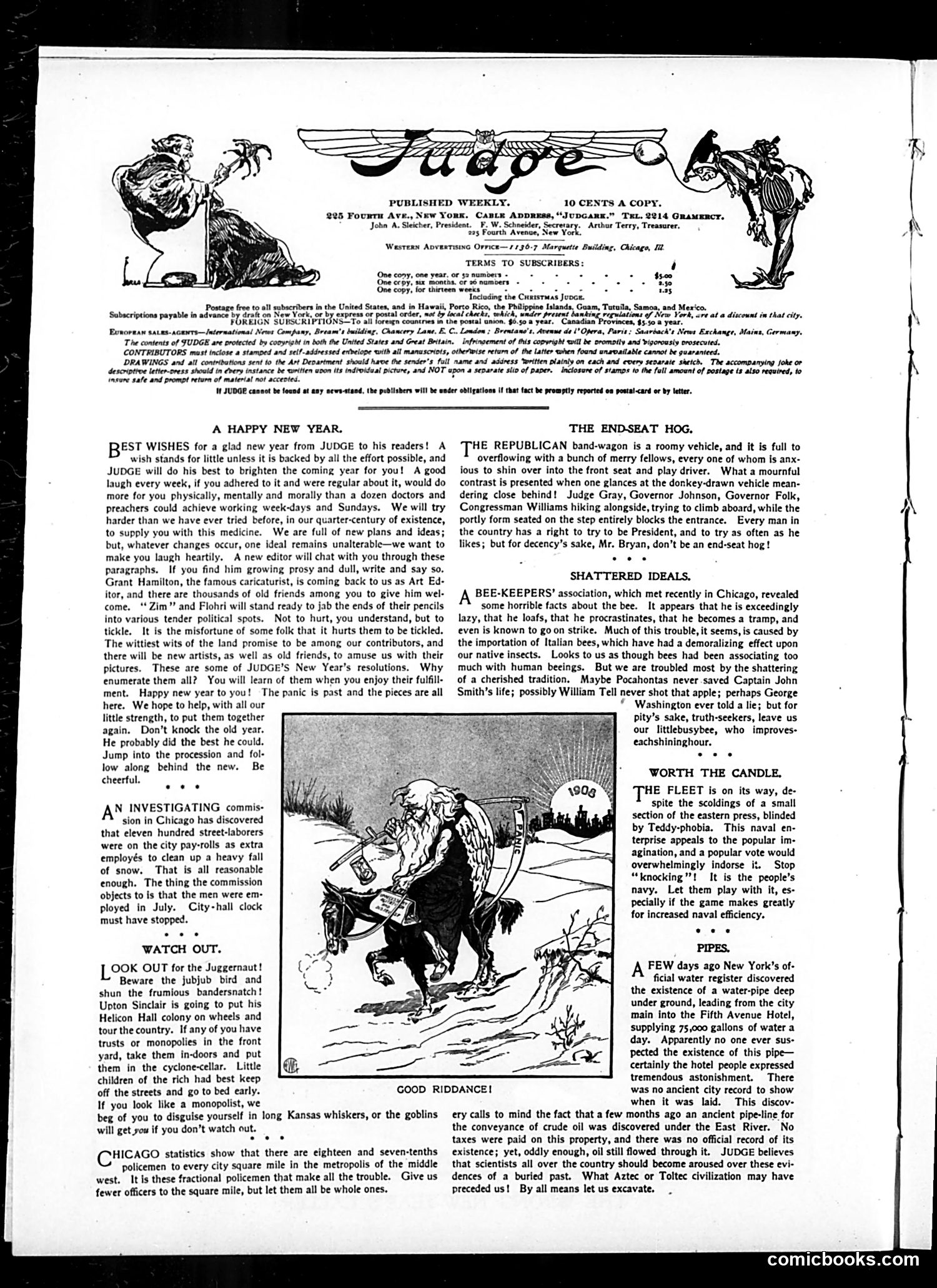
The central cartoon, "Good Riddance!," depicts a donkey (representing the Democratic Party) being kicked out into winter snow by an angel figure. This appears to celebrate Republican electoral victory, likely following the 1900 presidential election when McKinley defeated Bryan. The surrounding editorials include commentary on Chicago politics, naval expansion ("The Fleet"), and underground water pipes discovered beneath New York City's Fifth Avenue Hotel. "The End-Seat Hog" satirizes Republican congressman Williams through a donkey-drawn carriage metaphor. The "Shattered Ideals" section mocks the Bee-Keepers' Association's claims about bee behavior, using it as social commentary on unrealistic idealism. Overall, the page reflects early 1900s Republican triumphalism and satirizes contemporary political figures and policy debates.
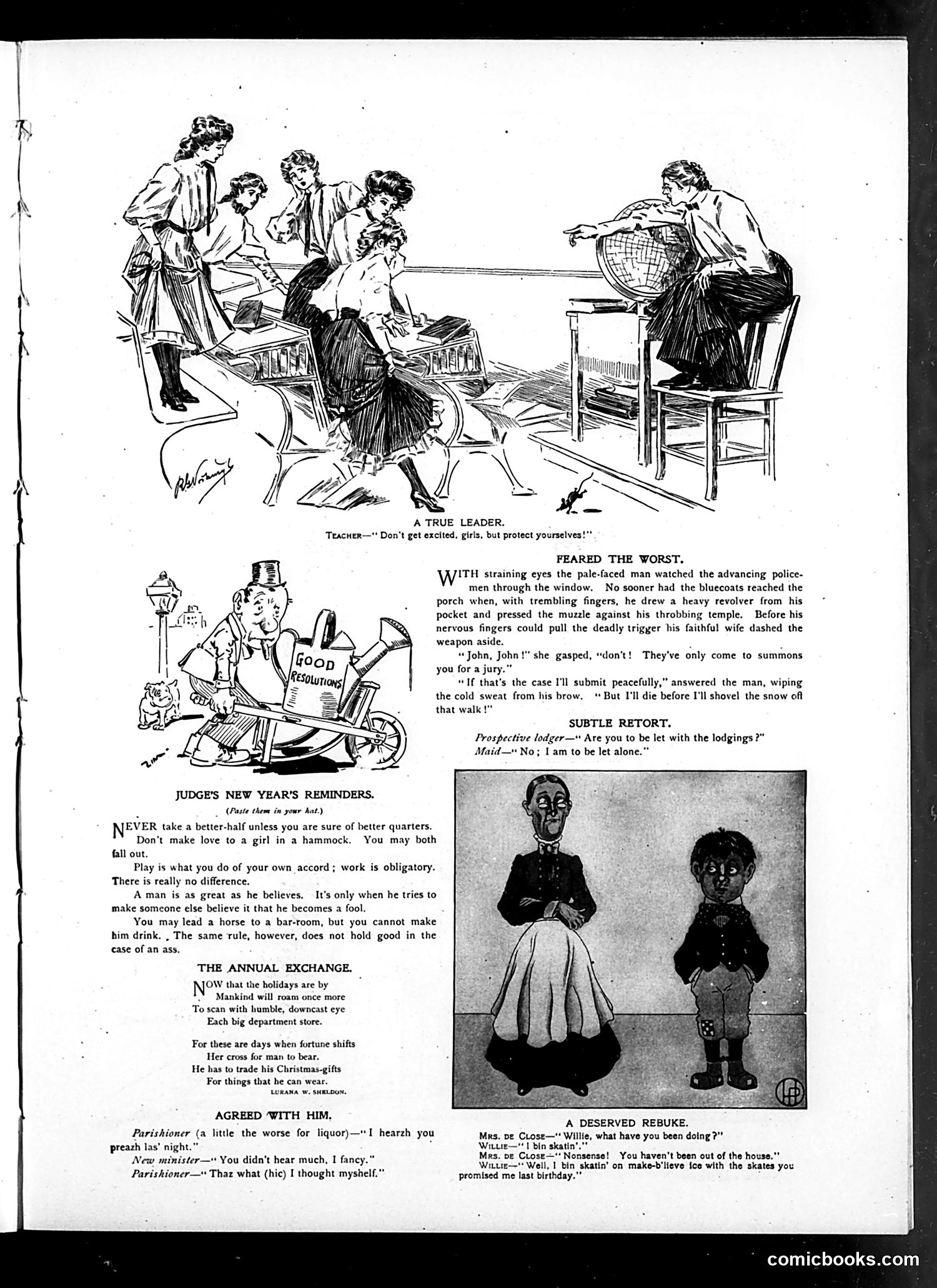
**"A True Leader"** (top illustration): Depicts a teacher instructing girls on self-defense against advancing policemen. The caption—"Don't get excited, girls, but protect yourselves!"—satirizes concerns about police conduct or overreach, likely referencing contemporary tensions between law enforcement and civilians. **"Feared the Worst"** and **"Subtle Retort"**: These paired narrative vignettes appear to mock anxious reactions to criminal activity and show clever verbal comebacks. **"Judge's New Year's Reminders"** and other text sections: Offer satirical advice on social behavior and morality. **"A Deserved Rebuke"** (photograph): Shows a domestic scene with a child, likely commenting on parental discipline or household relationships. The page's overall tone suggests early-20th-century social satire about class, authority, and urban life.
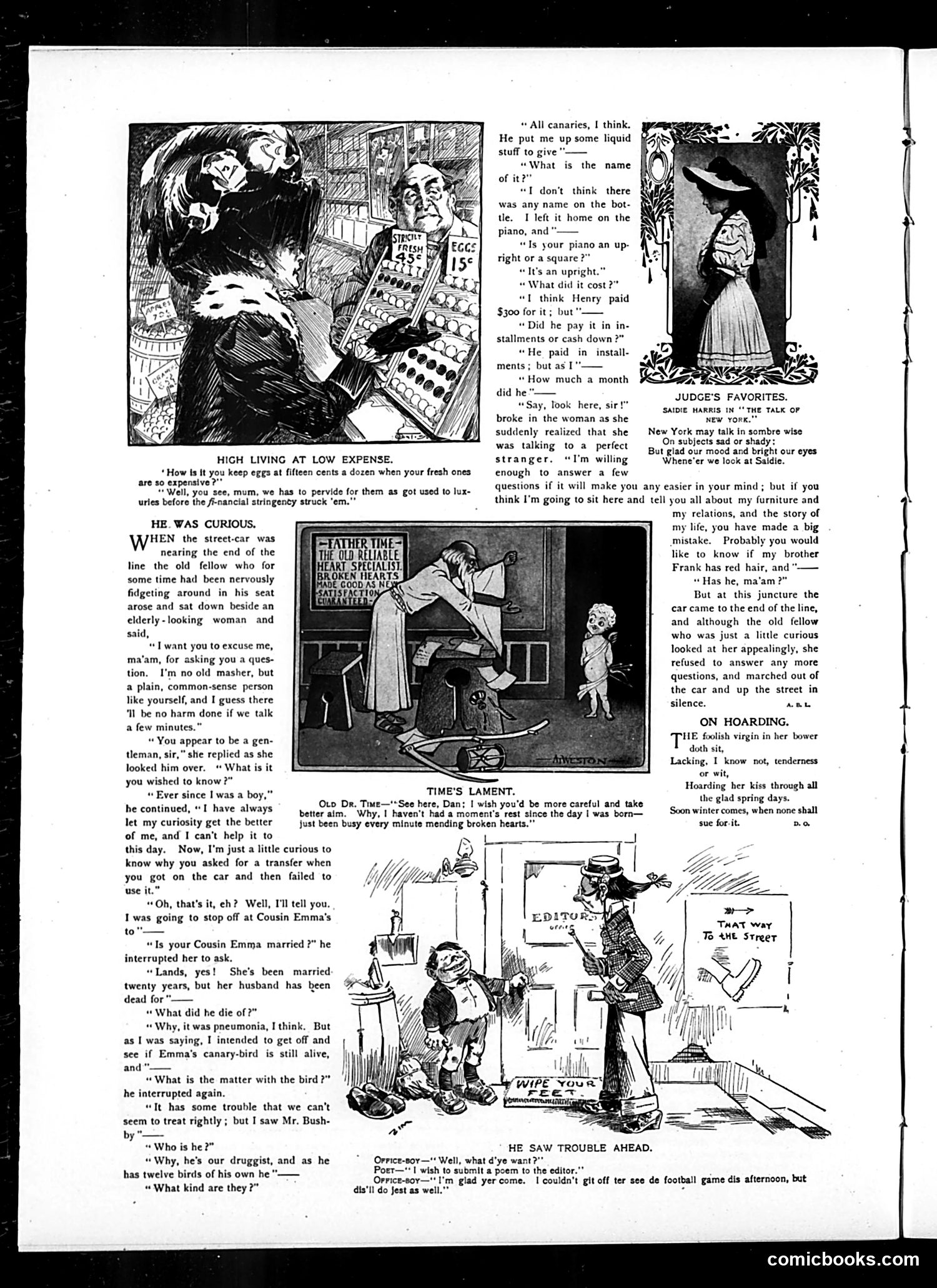
This page contains three satirical comic strips typical of early 20th-century Judge magazine humor: 1. **"High Living at Low Expense"** depicts a woman shopping for affordable groceries, satirizing the challenge of maintaining middle-class respectability on limited budgets. 2. **"He Was Curious"** shows a street-car encounter where an elderly man asks a woman personal questions about her life. The satire appears to target nosiness and masculine presumptuousness—the woman eventually refuses to answer further questions and leaves. 3. **"Time's Lament"** and **"He Saw Trouble Ahead"** feature office scenes with editorial/publishing staff, likely satirizing workplace dynamics and newspaper operations. The overall theme involves social awkwardness, class anxiety, and gender relations—common Judge subjects reflecting urban American life concerns of the era.
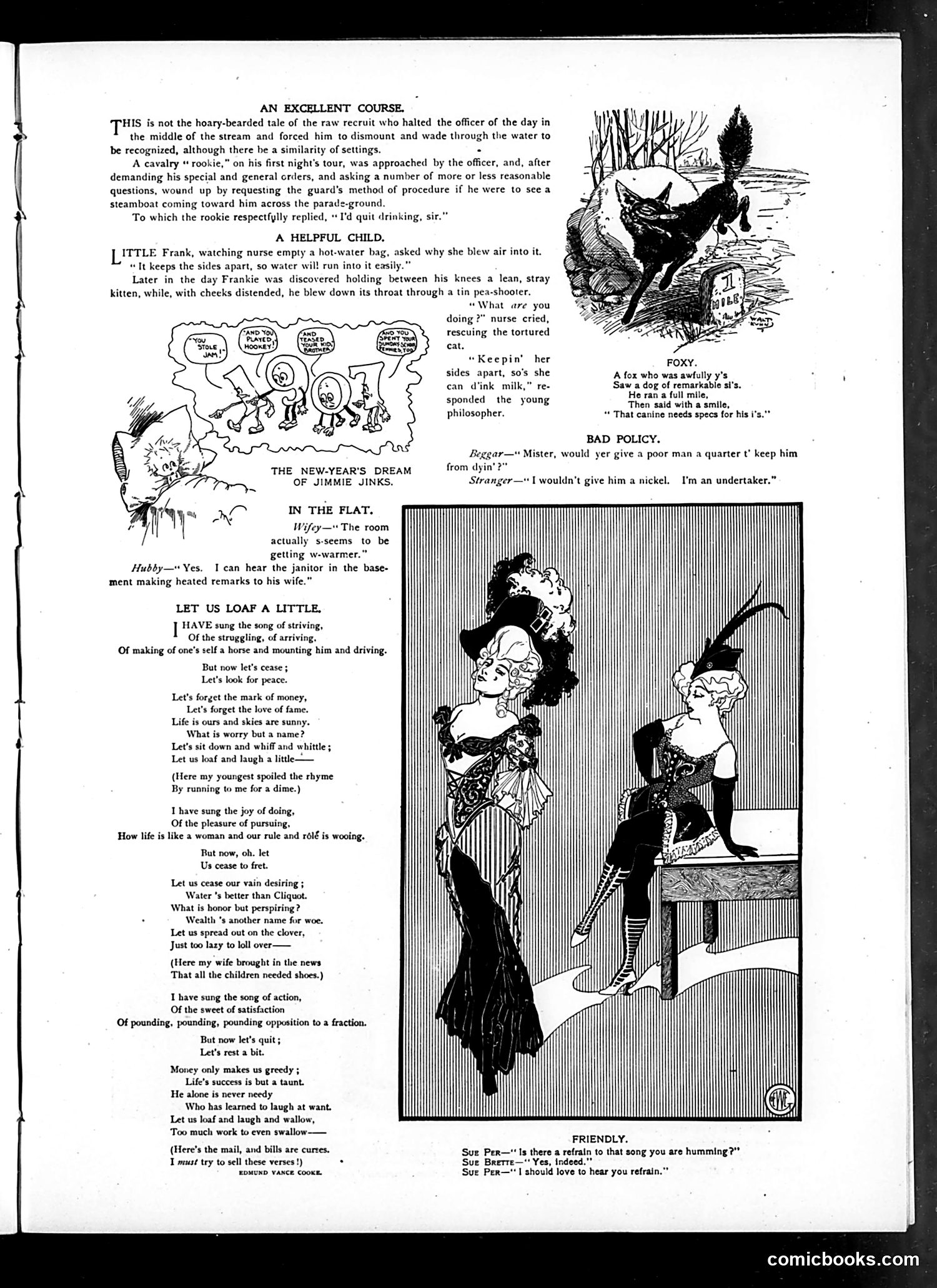
This page contains several brief humorous pieces rather than political cartoons. "An Excellent Course" mocks a raw military recruit's naive questions to an officer. "A Helpful Child" describes young Frank asking innocent questions about a hot-water bottle, then later holding a stray kitten improperly—the humor lies in childhood misunderstandings. "The New Year's Dream of Jimmie Jinks" and "In the Flat" offer domestic humor about New Year's resolutions and apartment life. "Let Us Loaf a Little" is a longer poem advocating rest and leisure over constant striving. "Bad Policy," "Friendly," and other brief exchanges present simple wordplay or situational comedy without specific political references. The illustrations support lighthearted domestic and social humor rather than satirizing particular political figures or events.
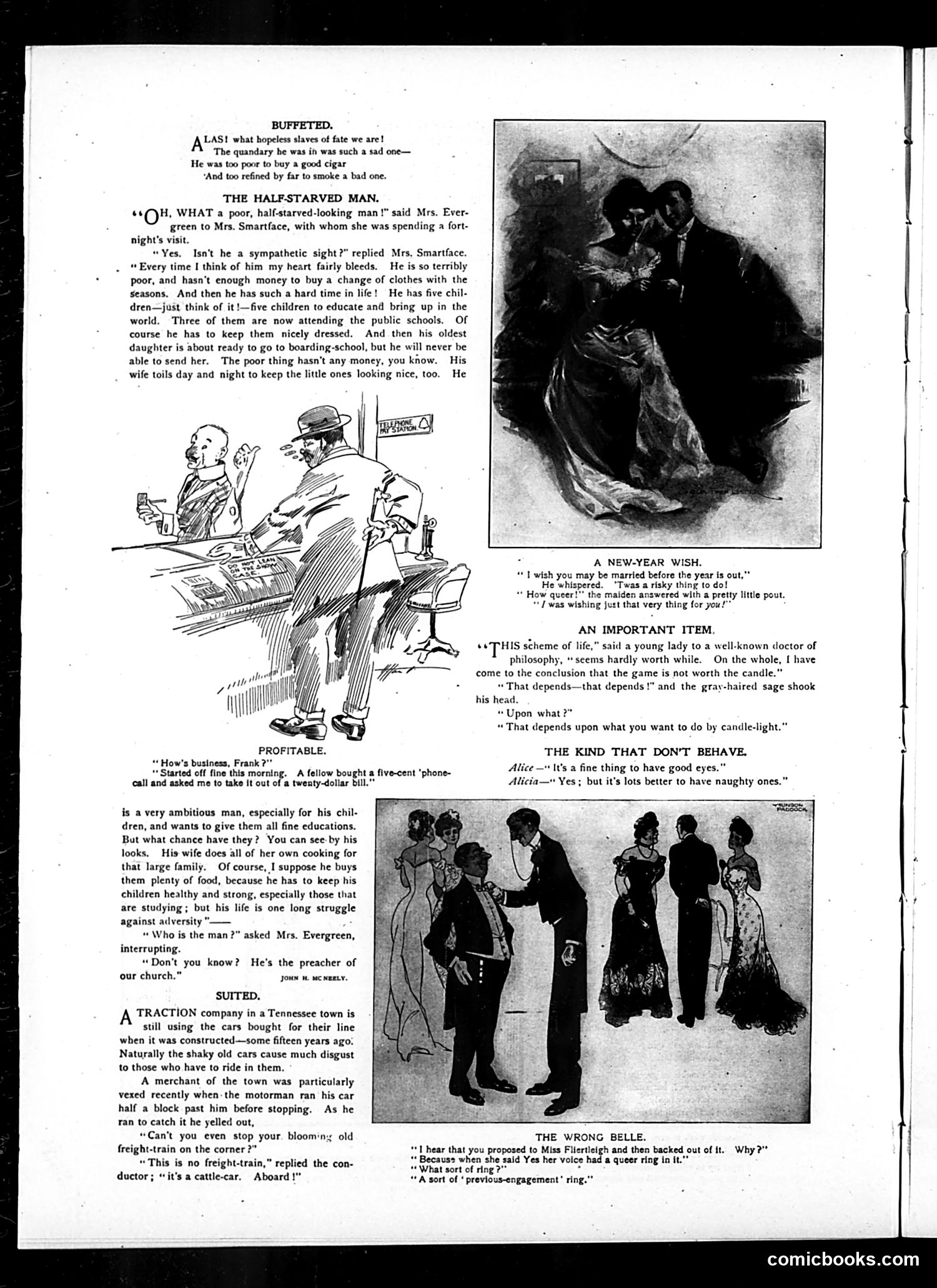
This page contains multiple satirical short jokes and cartoons typical of early-20th-century American humor: **"Buffeted"** mocks class anxiety—a man too poor to afford quality cigars but too refined to smoke cheap ones, trapped by social pretension. **"The Half-Starved Man"** satirizes upper-class women's performative sympathy. Mrs. Smartface waxes eloquent about a poor family's struggles, revealing the man is actually her church's preacher—implying her concern is shallow and disconnected from reality. **"Profitable"** jokes about a customer's poor math or deliberate con: buying a five-cent phone call with a twenty-dollar bill. **"Suited"** pokes fun at an old, unreliable streetcar system in Tennessee that literally overshoots stops. **"The Wrong Belle"** plays on "engagement ring" slang—the woman wears a ring from a *previous* engagement, hinting at relationship instability. The cartoons employ gentle irony targeting social hypocrisy, economic absurdity, and romantic mishaps rather than hard political commentary.
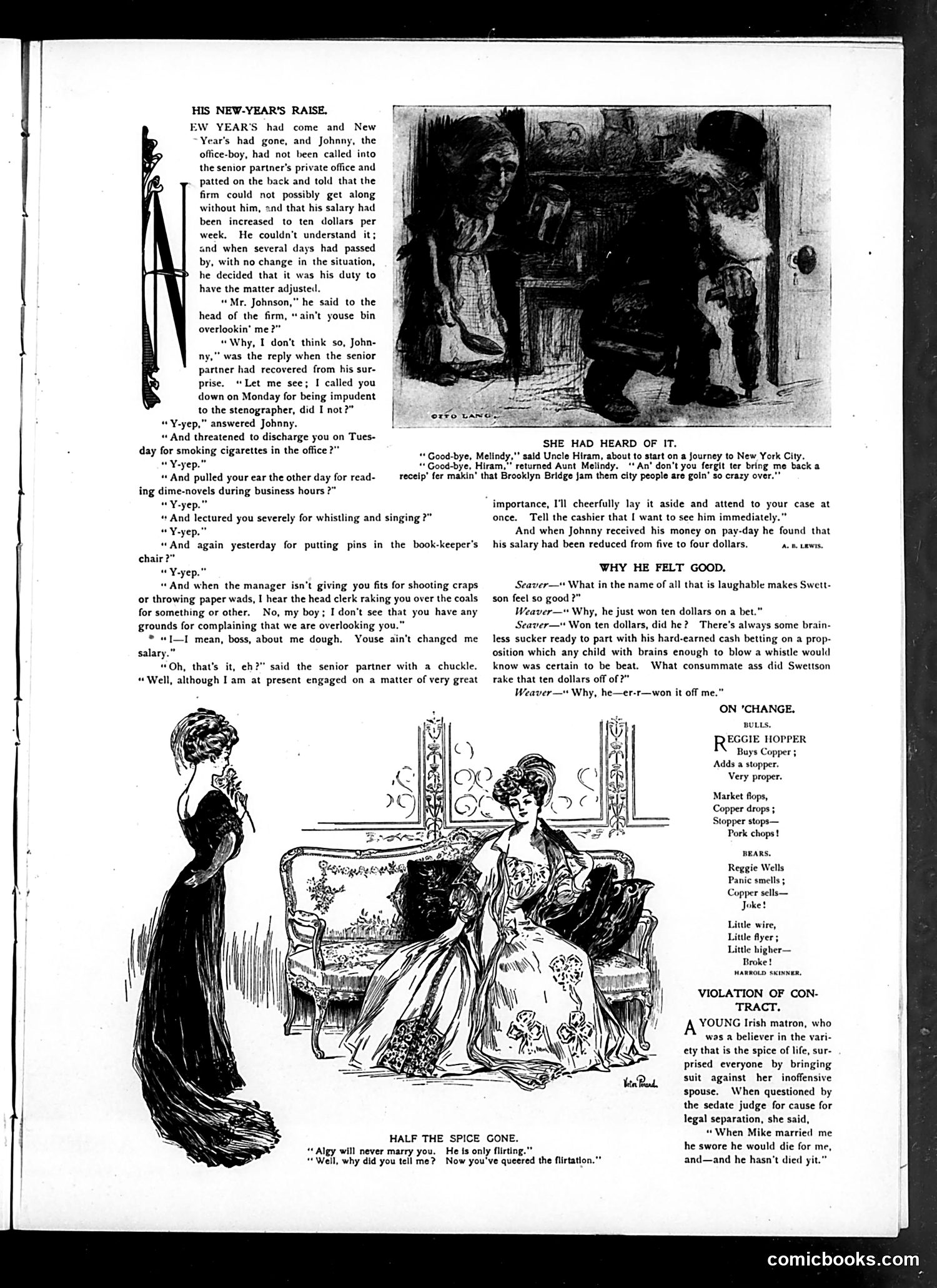
This page contains multiple satirical pieces typical of early 20th-century American humor: **"His New-Year's Raise"**: Johnny, an office boy, seeks a salary increase from his senior partner. The partner catalogs Johnny's numerous workplace infractions (impudence, smoking, reading dime-novels, whistling, mischief), refusing the raise. The joke's irony: Johnny receives his money on payday but finds his salary *reduced* from five to four dollars—punishment disguised as payroll. **Other brief pieces**: "She Had Heard of It" satirizes a rural woman's ignorance (expecting a "Brooklyn Bridge jam" recipe). "Half the Spice Gone" mocks a woman angry at losing a flirtation. "Why He Felt Good" jokes about a foolish bettor. **"On 'Change"** and **"Violation of Contract"**: Stock market humor and a domestic joke about an Irish wife suing for separation because her husband broke his marriage vow to "die for her"—she interprets it literally. The page reflects working-class anxieties about employment, rural-urban divides, and marital discord through period stereotypes and wordplay typical of Judge's satirical approach.
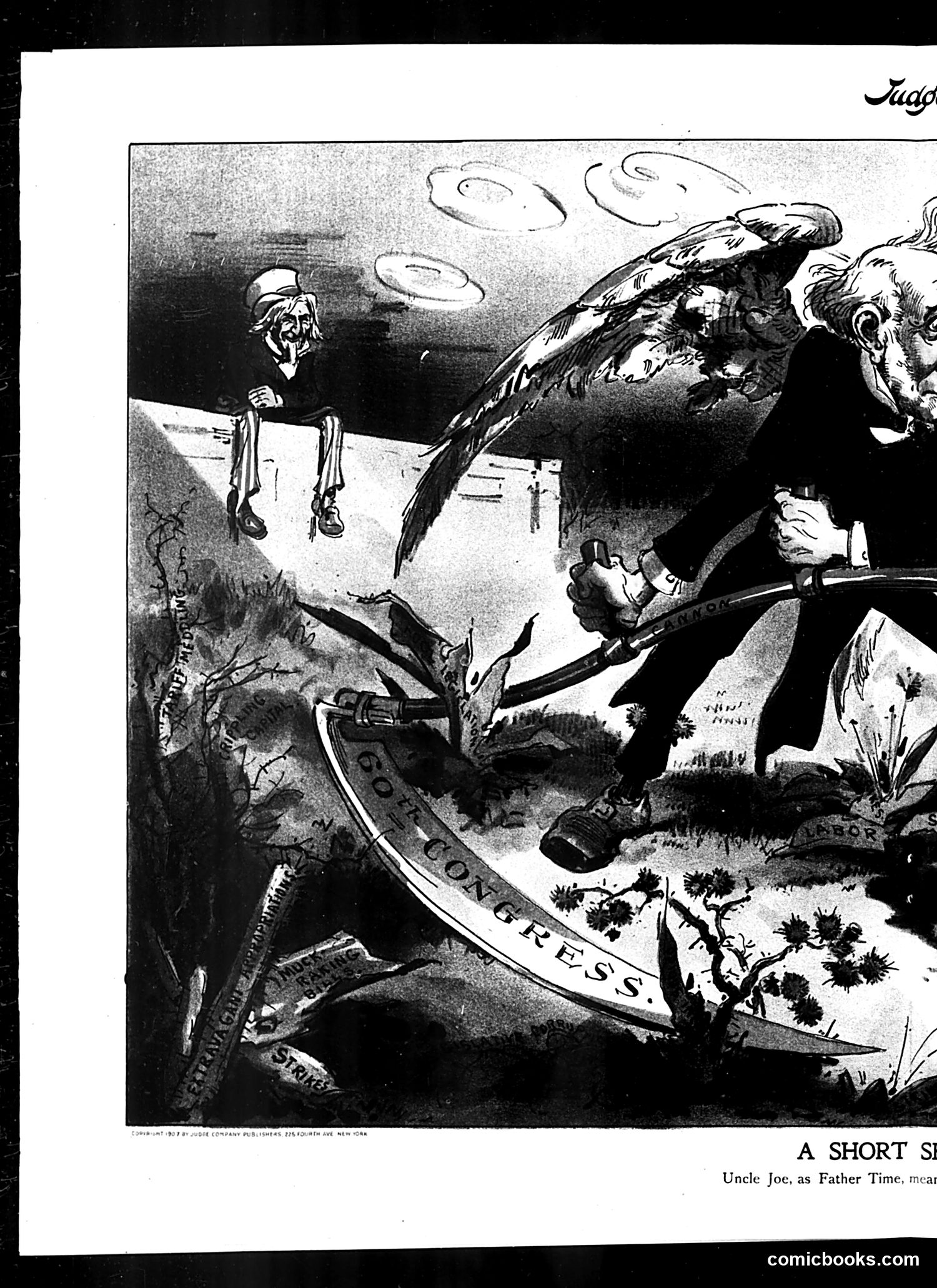
This Judge magazine cartoon presents an allegorical figure labeled "Uncle Joe" portrayed as Father Time, measuring something with a scythe. The incomplete title "A SHORT SI[GHT]" and caption suggest commentary on temporal perspective or miscalculation. "Uncle Joe" likely refers to Joseph Stalin, though the exact historical moment is unclear without the full caption. The cartoon appears to satirize either Stalin's misguided policies, his underestimation of time-related consequences, or perhaps his role in some geopolitical situation where his judgment proved flawed. The mystical/supernatural imagery with floating objects above suggests either folly or otherworldly consequences. Without the complete text and publication date visible, the specific political reference remains uncertain, though the tone is clearly mocking.
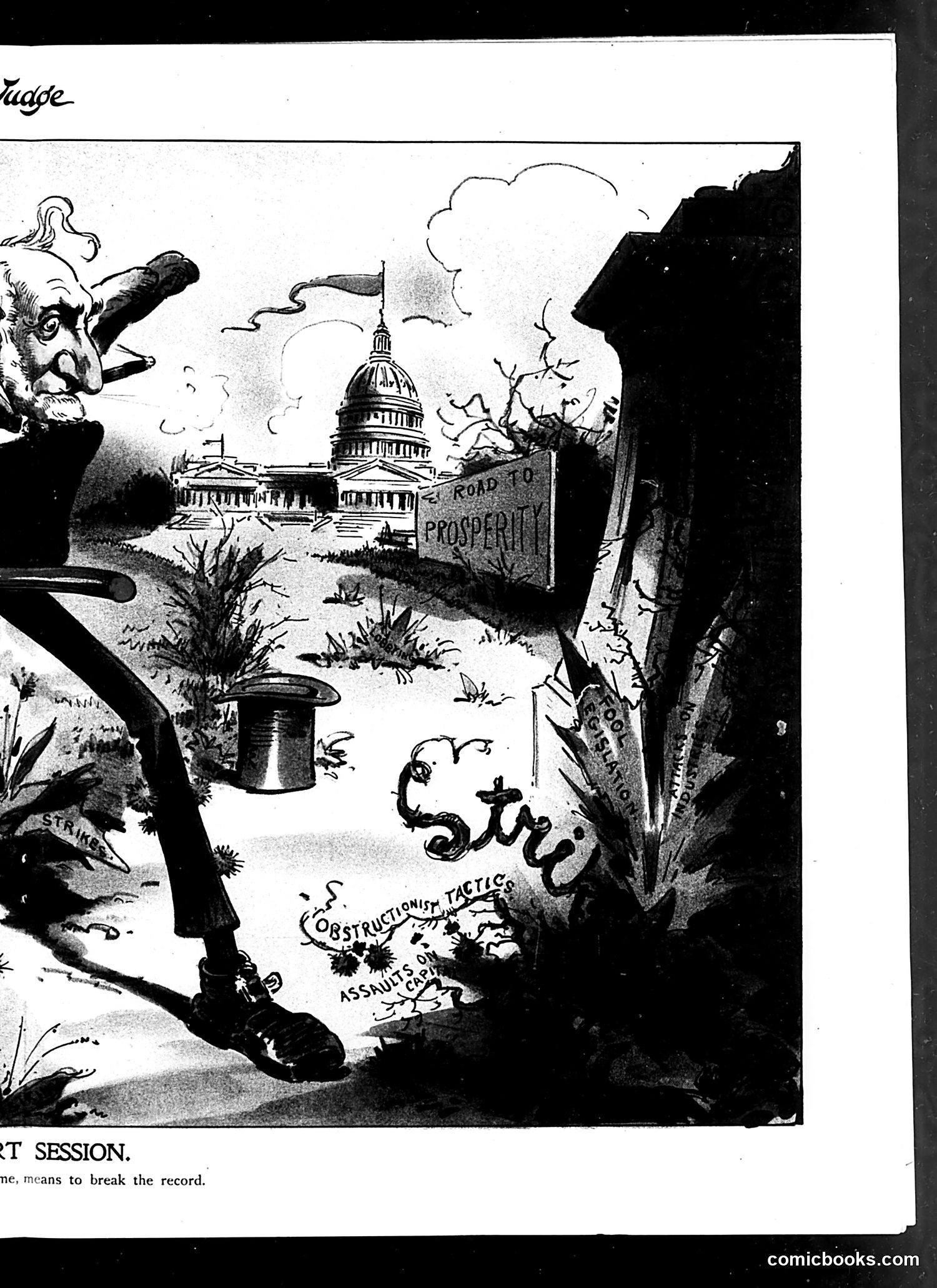
This is a political satire cartoon showing the U.S. Capitol building labeled "ROAD TO PROSPERITY" under siege. The cartoon depicts: - **A large threatening figure** (left) wielding weapons, representing obstructionist political forces - **Destructive elements** labeled "OBSTRUCTIONIST TACTICS" and "ASSAULTS ON" (text partially obscured) attacking the path to prosperity - **Dead/barren vegetation** symbolizing economic damage or stagnation - **A dark ominous force** (right) looming over the scene The satire critiques political obstruction blocking the nation's economic progress. Without the specific date visible, the exact historical context is unclear, but this appears to target Congressional obstruction of legislation intended to promote economic recovery or prosperity—likely from the early-to-mid 20th century based on Judge magazine's era and style.
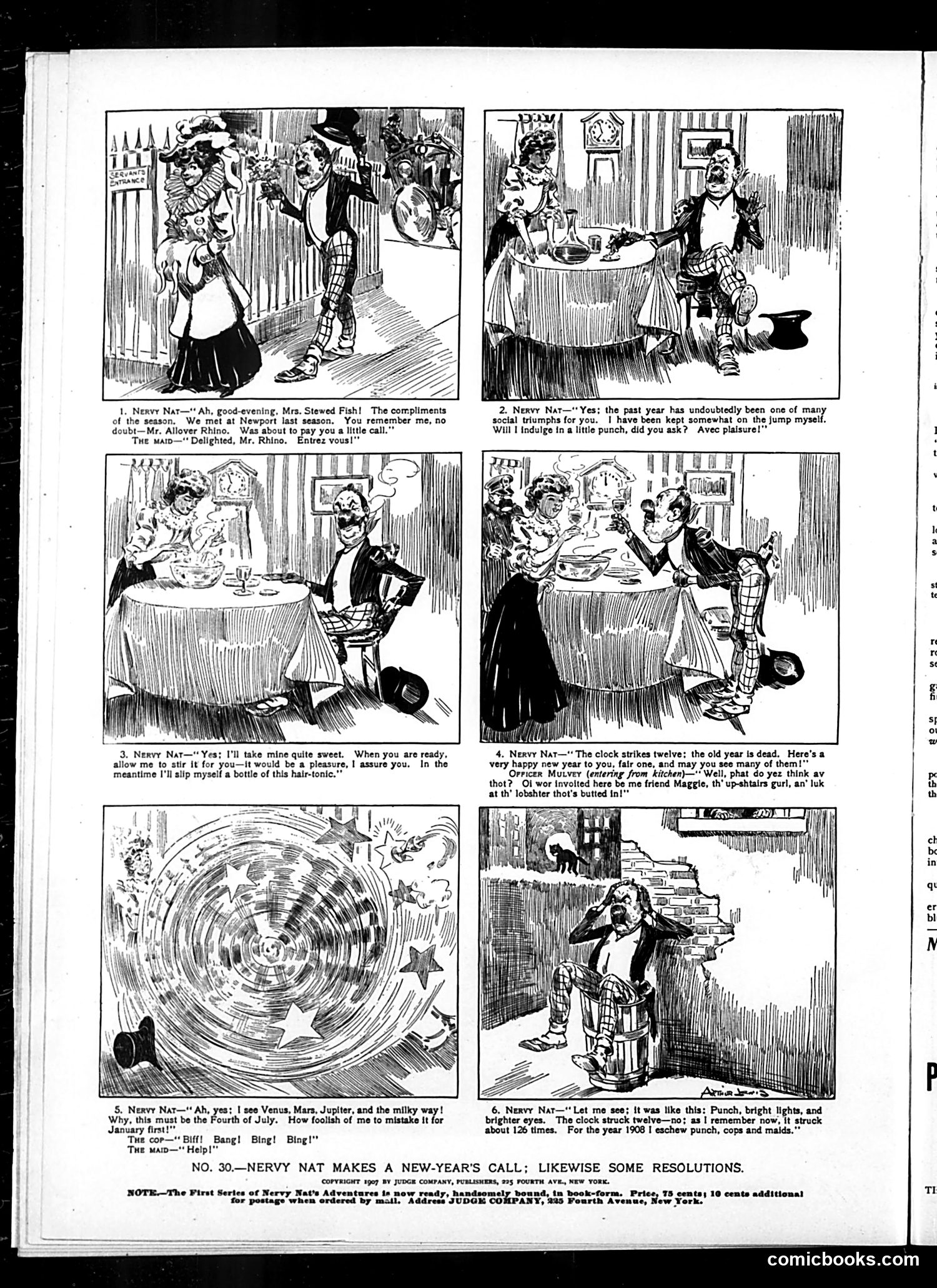
This is a six-panel comic strip from Judge magazine (copyright 1907) featuring "Nervy Nat," a recurring character who appears to be a working-class or lower-class man making an uninvited New Year's social call on wealthy people. The satire centers on **class contrast and social climbing**: Nat crashes a New Year's party at an upscale home, where he's neither wanted nor belongs. The humor derives from his audacious behavior—offering to "stir" drinks, angling for hair tonic, and making inappropriate astronomical observations—while his hosts attempt polite tolerance of his intrusion. The final panels suggest consequences: Nat gets thrown out by police ("Biff! Bang! Bing!"), and he resolves to avoid "punch, cops and maids" in the new year 1908. The strip mocks both Nat's presumption in gate-crashing and, implicitly, the pretentious courtesy of the wealthy trying to maintain composure around an unwanted guest. It's humor derived from social transgression and class-based embarrassment.
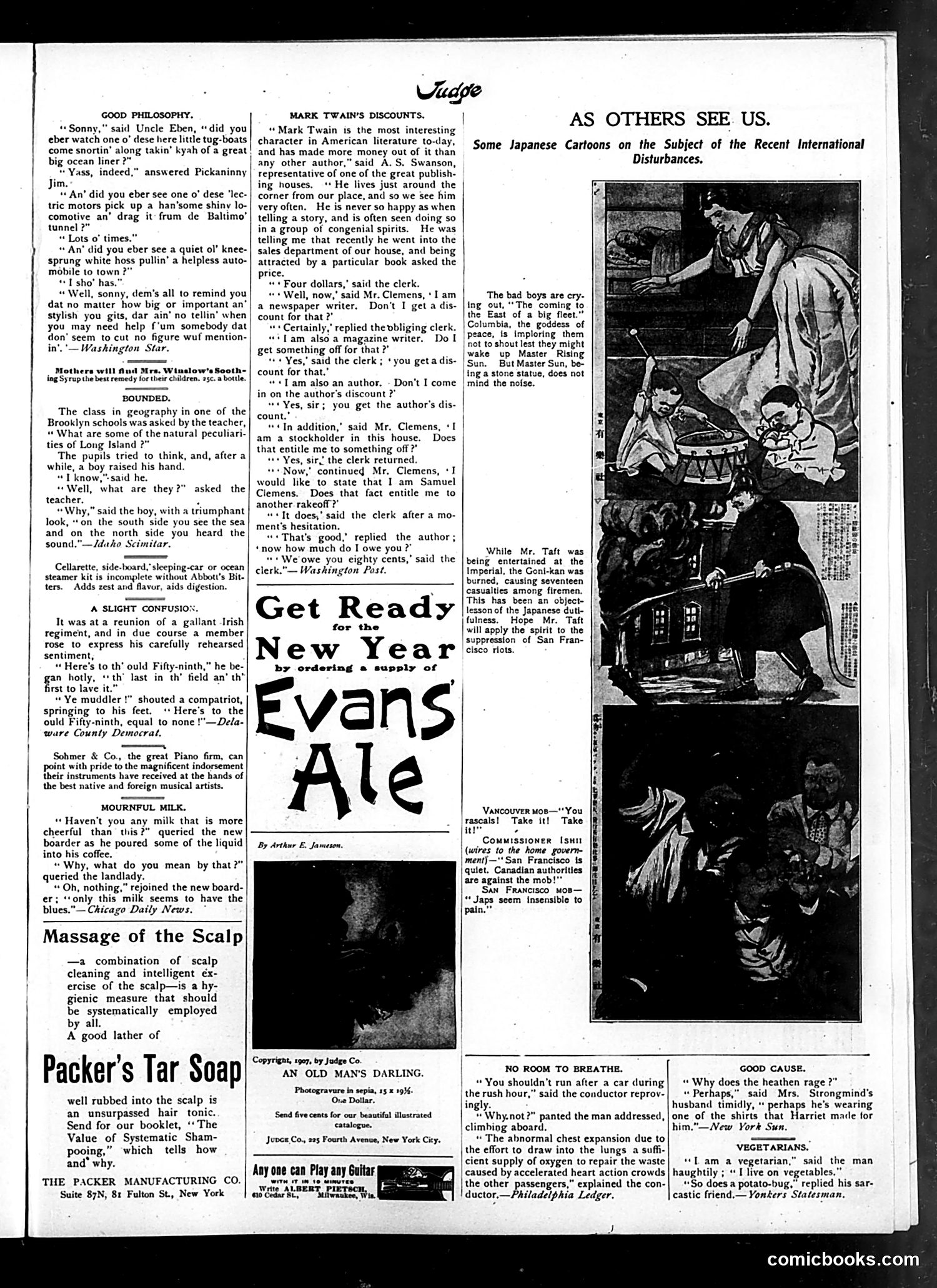
This page features Japanese political cartoons depicting foreign conflicts and crises. The three visible cartoons appear to reference recent international events, though the specific incidents aren't identified in the visible text. The cartoons use caricature to satirize foreign powers and their responses to global disturbances. One cartoon shows figures in what appears to be a conflict situation; another depicts people amid destruction or chaos. The art style is typical of early 20th-century editorial cartooning—exaggerated features and dramatic compositions designed to convey moral judgment about international affairs. The page title indicates these are Japanese artists' commentary on "recent international disturbances," likely referencing conflicts or crises of the era when Judge magazine published this issue. Without more context or clearer image resolution, the specific political situations being satirized remain unclear, but the intent is clearly critical commentary on foreign powers' conduct.
This page is primarily **advertising and light humor** rather than political satire. The content reflects early 20th-century American consumer culture: **Main Features:** - Multiple patent medicine ads (morphine treatment, asthma cure, blood poison remedy)—common in this era despite later regulations - Beverage advertisements (champagne, table water, wine) - Short comic anecdotes about everyday life **The Jokes:** The humor is gentle and domestic: a girl misuses "tantalize" in botany class, an Irish immigrant remains optimistic despite hardship, a woman insults her friend's age, and a peacemaker diplomatically agrees both men are right. **Notable Content:** A lengthy article about Chartreuse liqueur explains a real legal dispute: French monks were expelled by the government in 1901, and competitors sold fake versions. This describes actual trademark litigation—not satire, but business news. **Historical Context:** This reflects an era before FDA regulation (1906), when patent medicines made dubious health claims openly, and immigration humor stereotyped Irish workers.
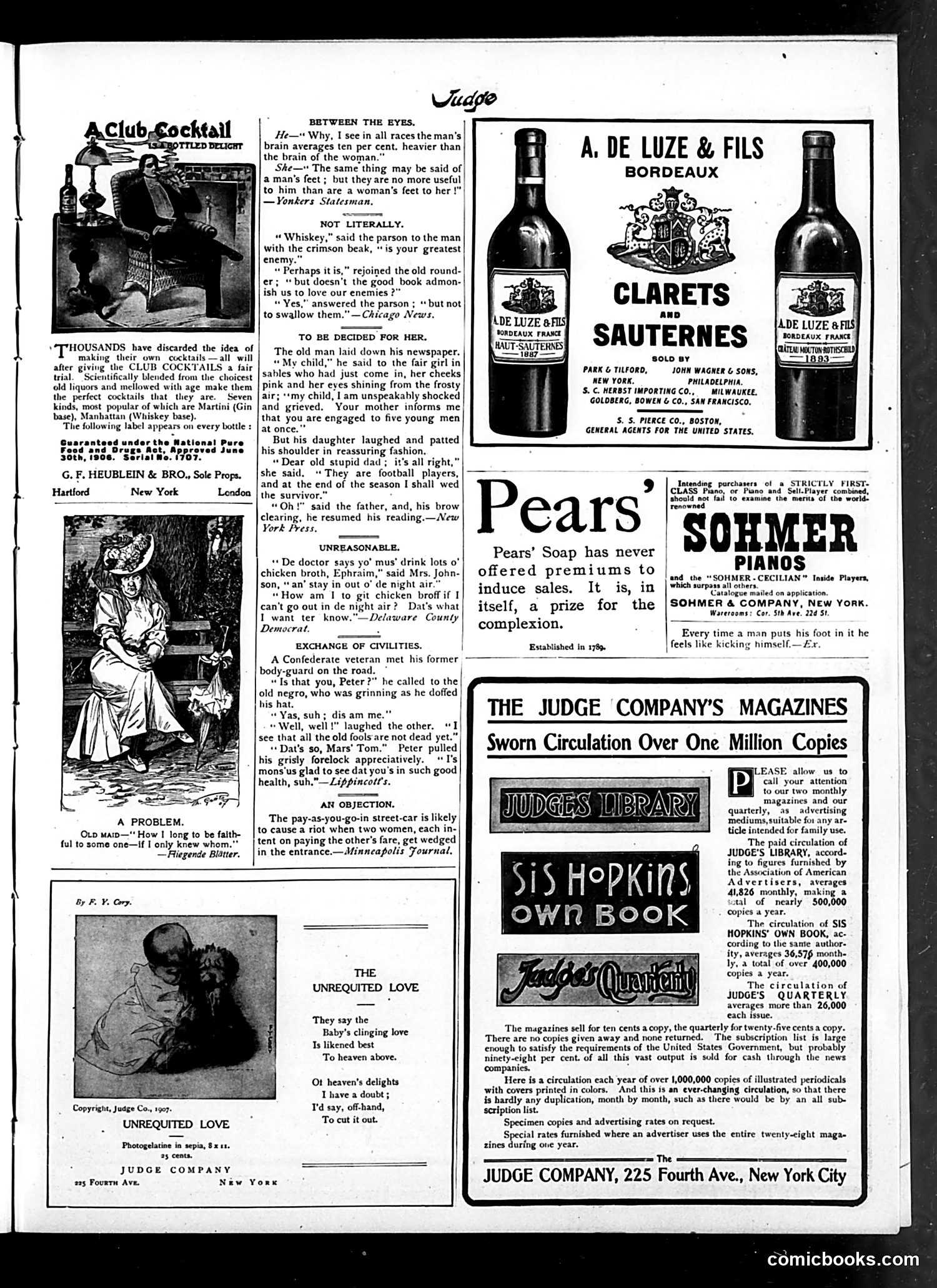
This page is primarily **advertising and light humor** rather than political satire. The content includes: **Humor Sections:** - Short joke columns ("Between the Eyes," "Not Literally," etc.) featuring gentle domestic and social comedy—a woman defending her intelligence against brain-size arguments, a man's relationship with whiskey, a father learning his daughter is engaged to five football players simultaneously. **Key Advertisement:** The page prominently features **A. De Luze & Fils wines** (French Bordeaux clarets and sauternes), with detailed distributor information for American cities. **Other Ads:** - Club Cocktails (pre-made mixed drinks) - Pears' Soap (emphasizing natural quality over marketing gimmicks) - Sohmer Pianos - Judge Company magazines **Notable:** The humor relies on period-specific contexts—references to streetcars, the acceptability of casual drinking, and gender stereotypes about women's intellect—but contains no identifiable political figures or events. The page reflects early 1900s American middle-class values and consumer culture.
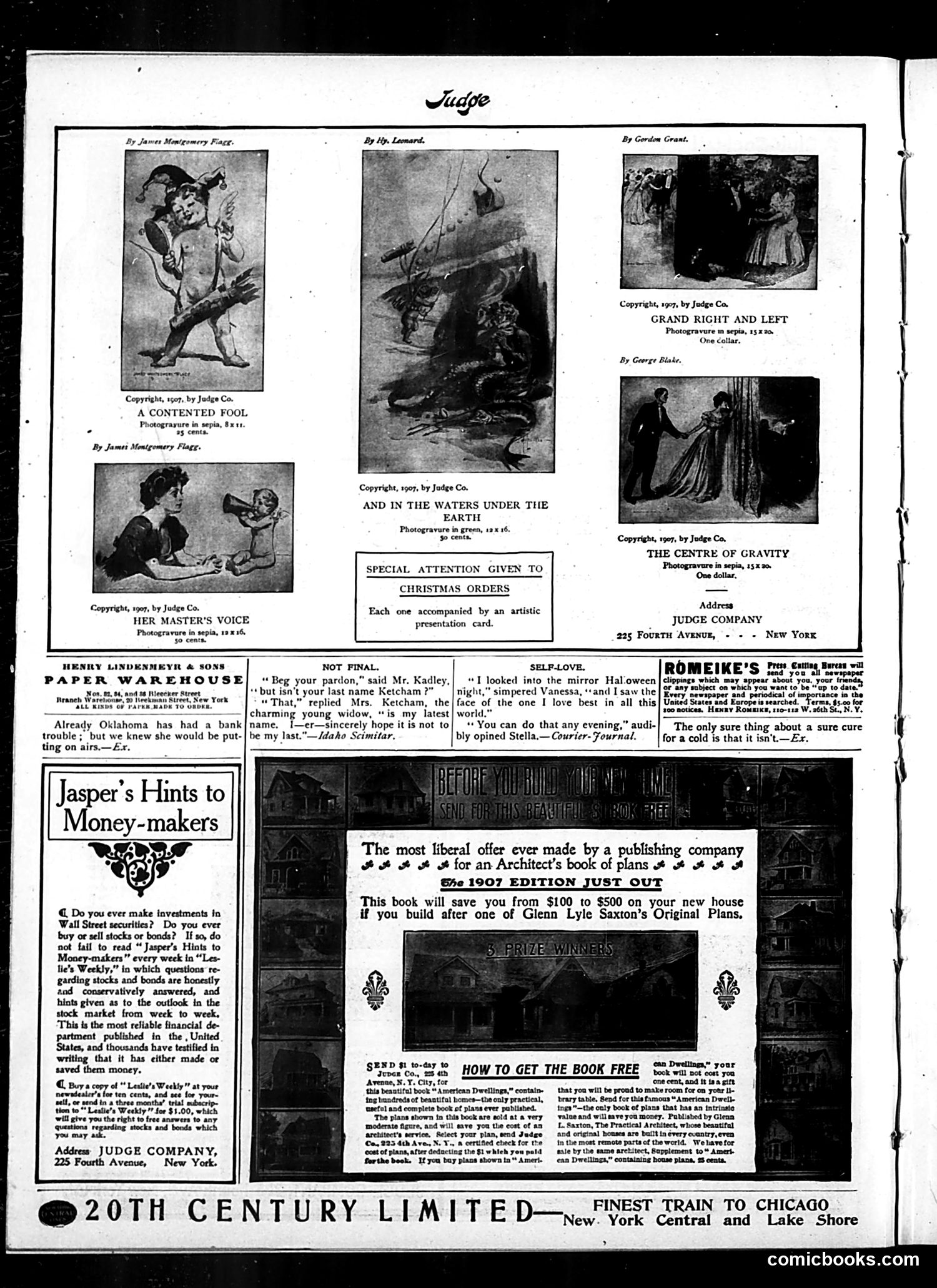
This is primarily an **advertising and promotional page** from Judge magazine (1907), with minimal actual satirical content. The top section displays four small photogravure artworks available for purchase—prints by James Montgomery Flagg and others with titles like "A Contented Fool" and "Her Master's Voice." Below are three brief **humorous anecdotes** typical of Judge's light humor: a widow with a new married name, a woman seeing her lover's face in a mirror on Halloween, and an Oklahoma bank trouble joke. These are mild social satire with no specific political figures. The bulk of the page comprises **advertisements**: Henry Lindenmeyr & Sons (paper warehouse), Jasper's "Hints to Money-makers" (stock market advice column), and notably, **Glenn Lyle Saxton's architectural house plans** (promoting savings of $100-$500 on home construction). A Romeike's clipping service ad and 20th Century Limited railway ad round out the page. This appears to be a revenue-driven page mixing light entertainment with paid advertising rather than substantive political or social satire.
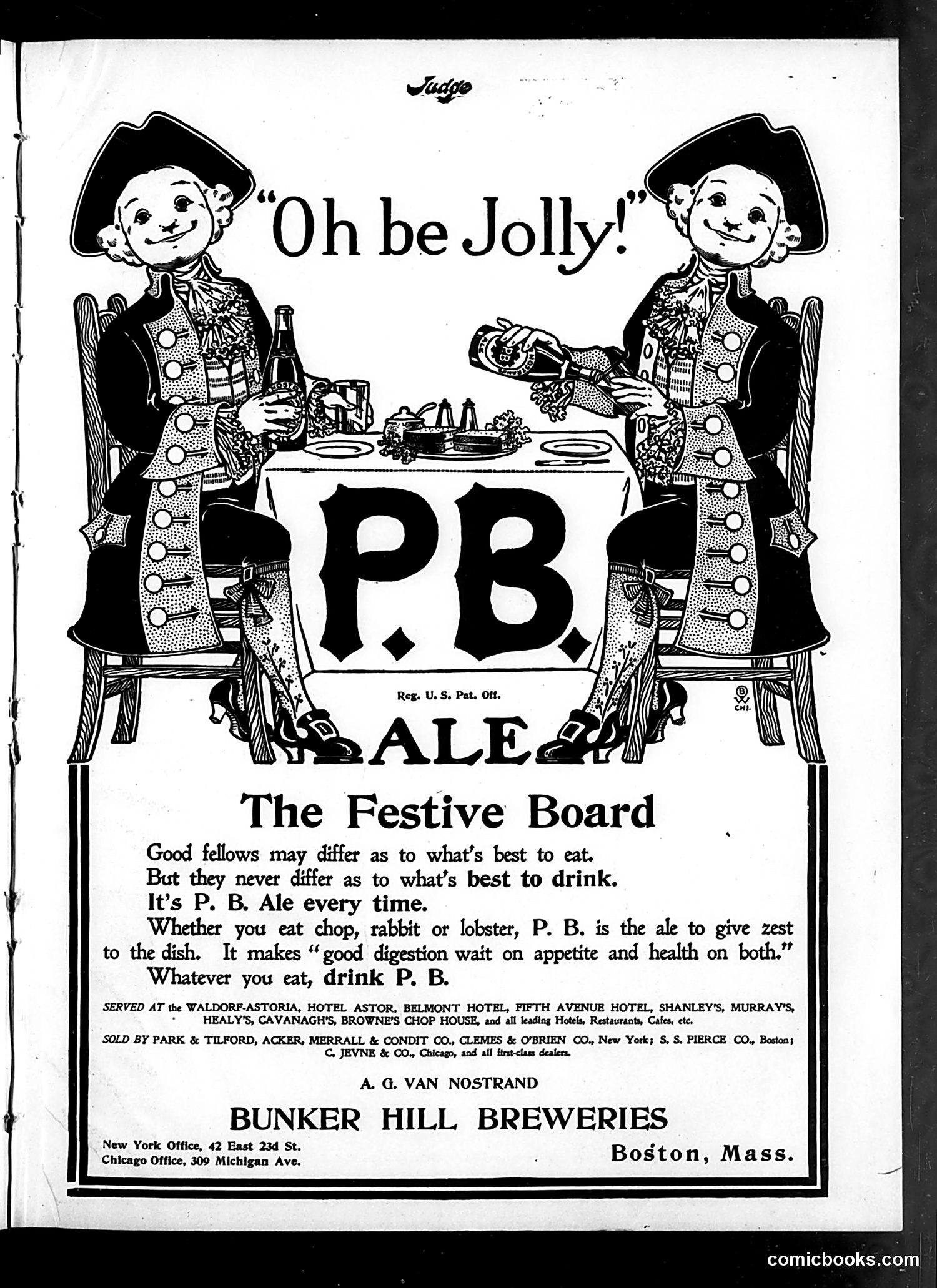
This is primarily a **beer advertisement**, not political satire. It appears in *Judge*, a humor magazine that accepted commercial advertising. The image shows two jovial, well-dressed gentlemen in colonial-era clothing (tricorn hats, ornate coats) dining together, toasting with bottles of P.B. Ale. The colonial styling likely references "The Festive Board" subtitle and suggests tradition and respectability. The pitch is straightforward: P.B. Ale pairs with any meal and promotes digestion and health. The advertisement emphasizes the product's availability at upscale Boston and New York establishments (Waldorf-Astoria, Hotel Astor, etc.) to suggest quality and social status. The "Oh be Jolly!" tagline and cheerful characterization appeal to male camaraderie and good fellowship—common advertising themes of this era. This is **commercial messaging**, not commentary or satire.
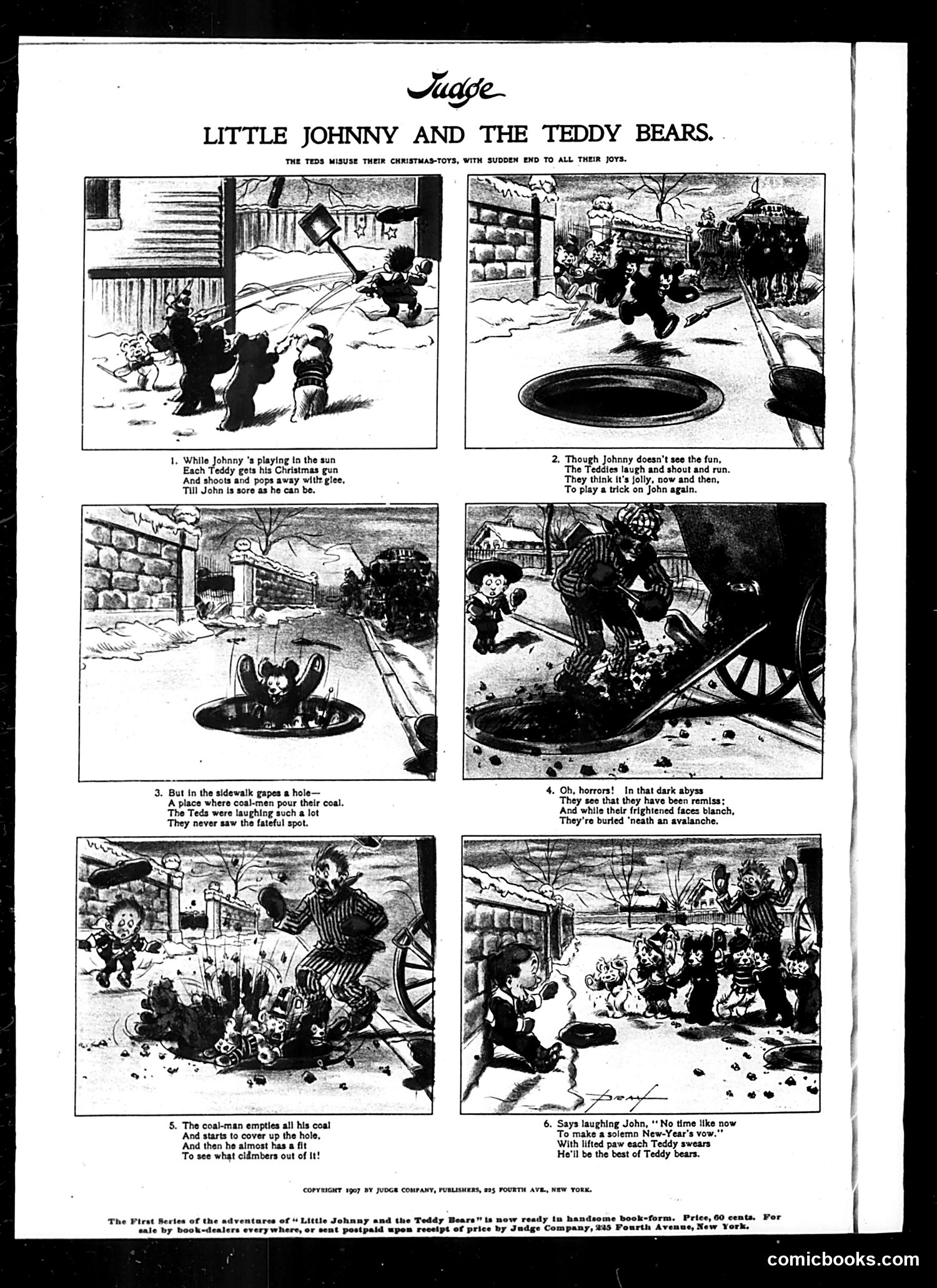
This is a humorous six-panel comic strip from Judge magazine (1907) about misbehaving teddy bears—the popular plush toys named after President Theodore "Teddy" Roosevelt. **The story**: Young Johnny receives teddy bears as Christmas gifts. The bears, given toy guns, shoot at Johnny for fun until they accidentally fall into a coal delivery hole and get buried under an avalanche of coal. When Johnny discovers them covered in coal dust, he makes a New Year's vow that they'll "be the best of Teddy bears" going forward. **The satire**: The joke works on two levels—literally as slapstick children's humor (mischievous toys get comeuppance), but also as gentle mockery of the teddy bear craze itself, which was sweeping America due to Roosevelt's popularity. The bears' brief "wildness" with toy guns, followed by their literal burial and reformation, may also reflect contemporary anxieties about uncontrolled behavior and the need for discipline. The caption promises this is "the first series," indicating the strip's commercial success.
I appreciate your request, but I must be candid: this image is almost entirely black with minimal visible content. The only clearly legible text is "comicbooks.com" in the bottom right corner. I cannot reliably identify any cartoon figures, caricatures, political references, text content, or satirical elements from this page. The image quality and darkness make it impossible to discern what Judge magazine content appears here—whether it's a political cartoon, advertisement, masthead, or illustration. To provide accurate historical analysis as you've requested, I would need a clearer, higher-contrast image where the actual content is visible. I cannot responsibly guess at meanings or identities without being able to see them clearly.