
A complete issue · 16 pages · 1907
Judge — October 19, 1907
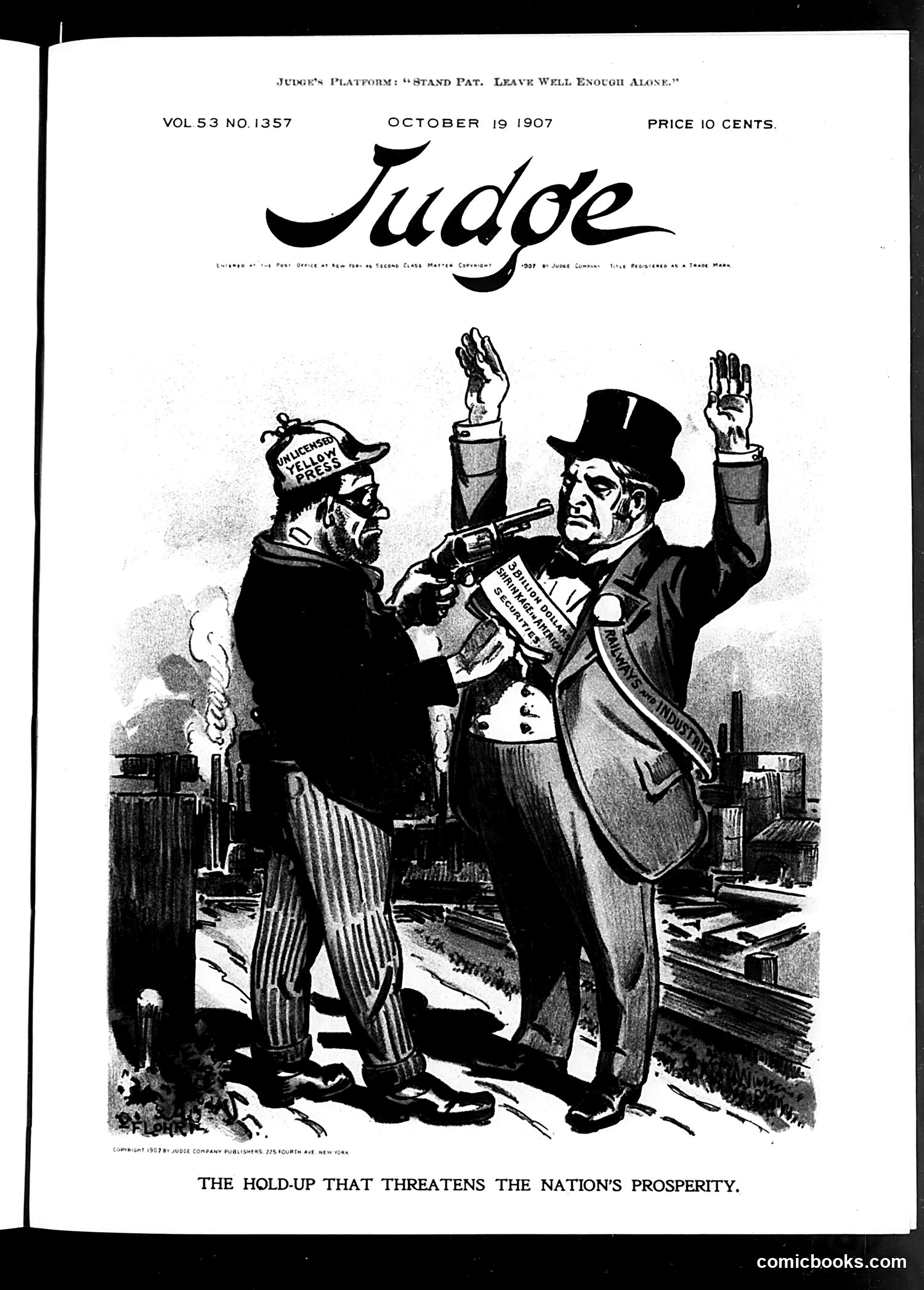
The cartoon depicts a violent confrontation between two figures in an industrial setting. The figure on the left wears a cap labeled "MILLIONAIRE'S PRESS" and holds a revolver; the figure on the right, in formal attire with a top hat, appears to be a wealthy industrialist or monopolist, hands raised in surrender. The caption reads: "THE HOLD-UP THAT THREATENS THE NATION'S PROSPERITY." This satirizes the relationship between wealthy newspaper publishers and industrial magnates during the Progressive Era. The "millionaire's press" is portrayed as literally robbing or coercing the nation's business interests—likely critiquing either sensationalist journalism's attacks on big business, or conversely, suggesting press corruption by moneyed interests. The industrial backdrop emphasizes threats to American economic stability during this period of trust-busting and regulatory reform.
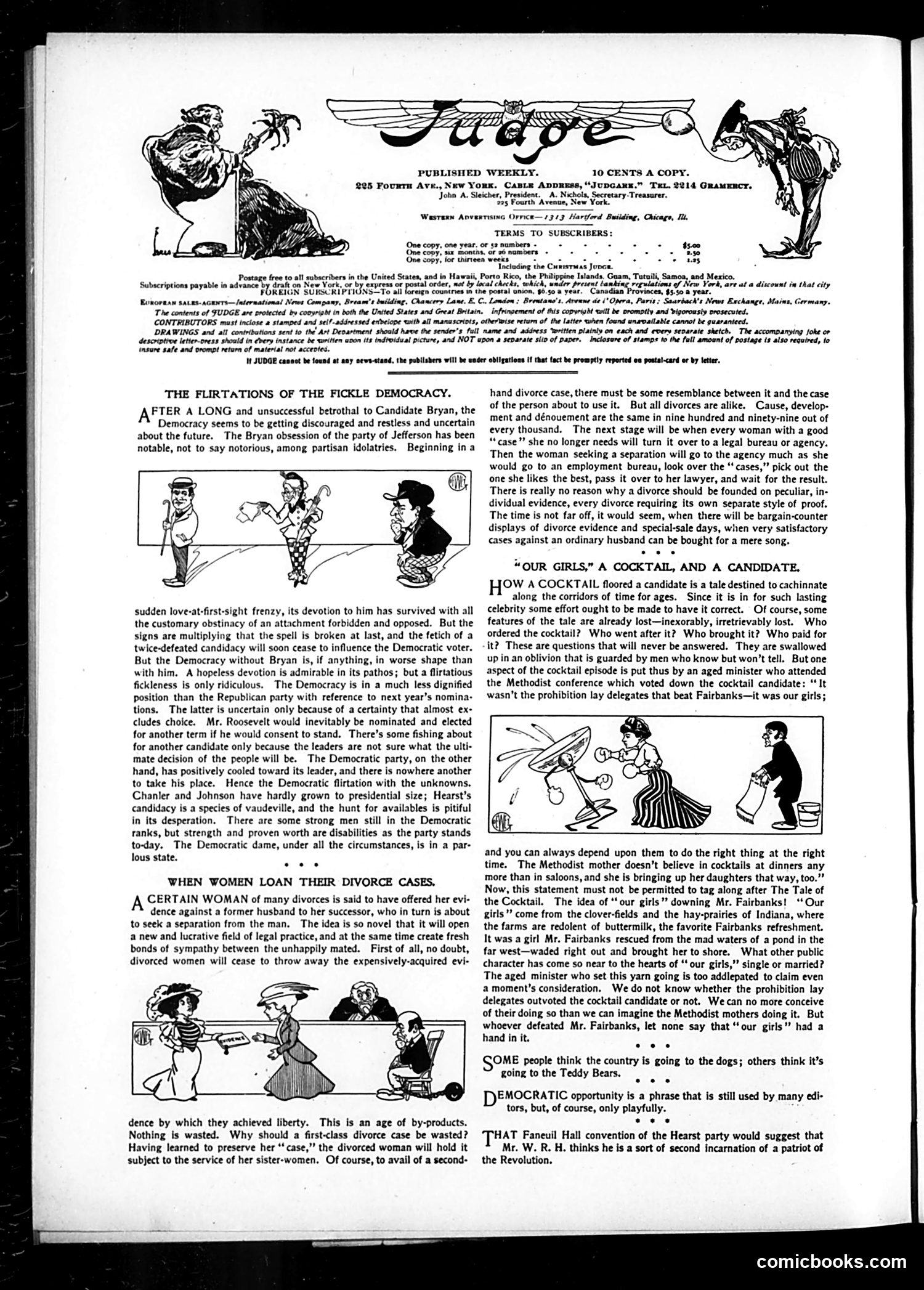
This page satirizes the Democratic Party and women's issues circa the Bryan candidacy era. The main article "The Flirtations of the Fickle Democracy" mocks Democratic inconsistency regarding candidate William Jennings Bryan, comparing the party's wavering support to romantic fickleness. The secondary pieces critique women's divorce accessibility and cocktail culture. "When Women Loan Their Divorce Cases" suggests women casually share separation strategies, while "'Our Girls': A Cocktail, and a Candidate" sarcastically attacks the perceived contradiction between Methodist prohibition and support for cocktails—apparently used to promote the Democratic candidate. The cartoons illustrate these themes with sketches of women discussing divorces and socializing. The satire targets Democratic hypocrisy, women's changing social roles, and perceived moral inconsistency.
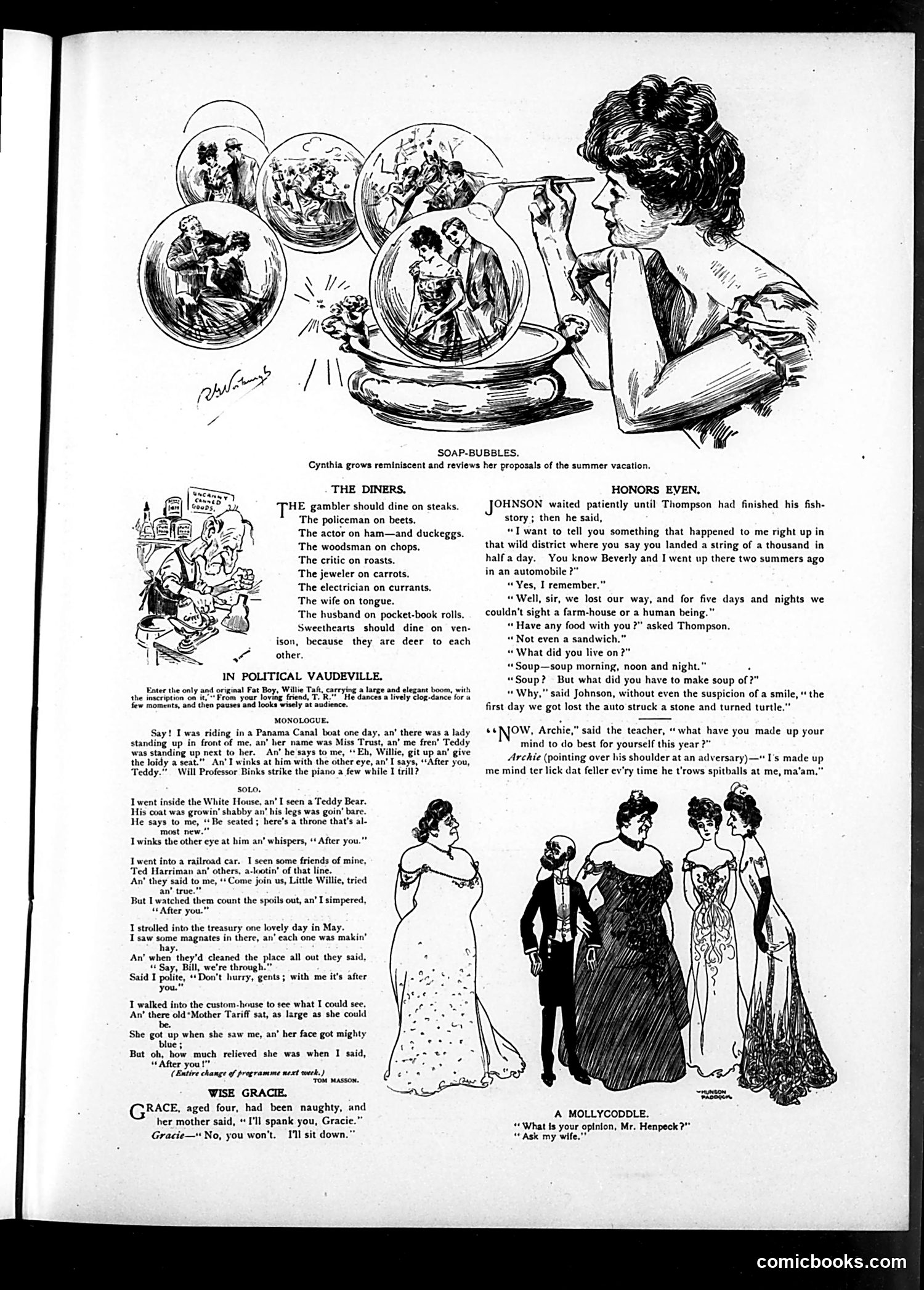
This page contains several humorous sketches and poems rather than political cartoons. The main illustration shows a woman blowing soap bubbles containing scenes of summer vacation activities—a visual metaphor for daydreaming or fantasy. The text sections include: - **"The Diners"** and **"In Political Vaudeville"**: Satirical poems listing what different professions should eat - **"Honors Even"**: A dialogue about an auto accident and lost farm - **"A Mollycuddle"**: A brief joke about deference to wives The cartoon sketches appear to be social satire about contemporary leisure activities and domestic relations, typical of Judge's humor. Without clear identifiable figures or specific dated events referenced, these represent general social commentary on early 20th-century American middle-class life rather than topical political satire.
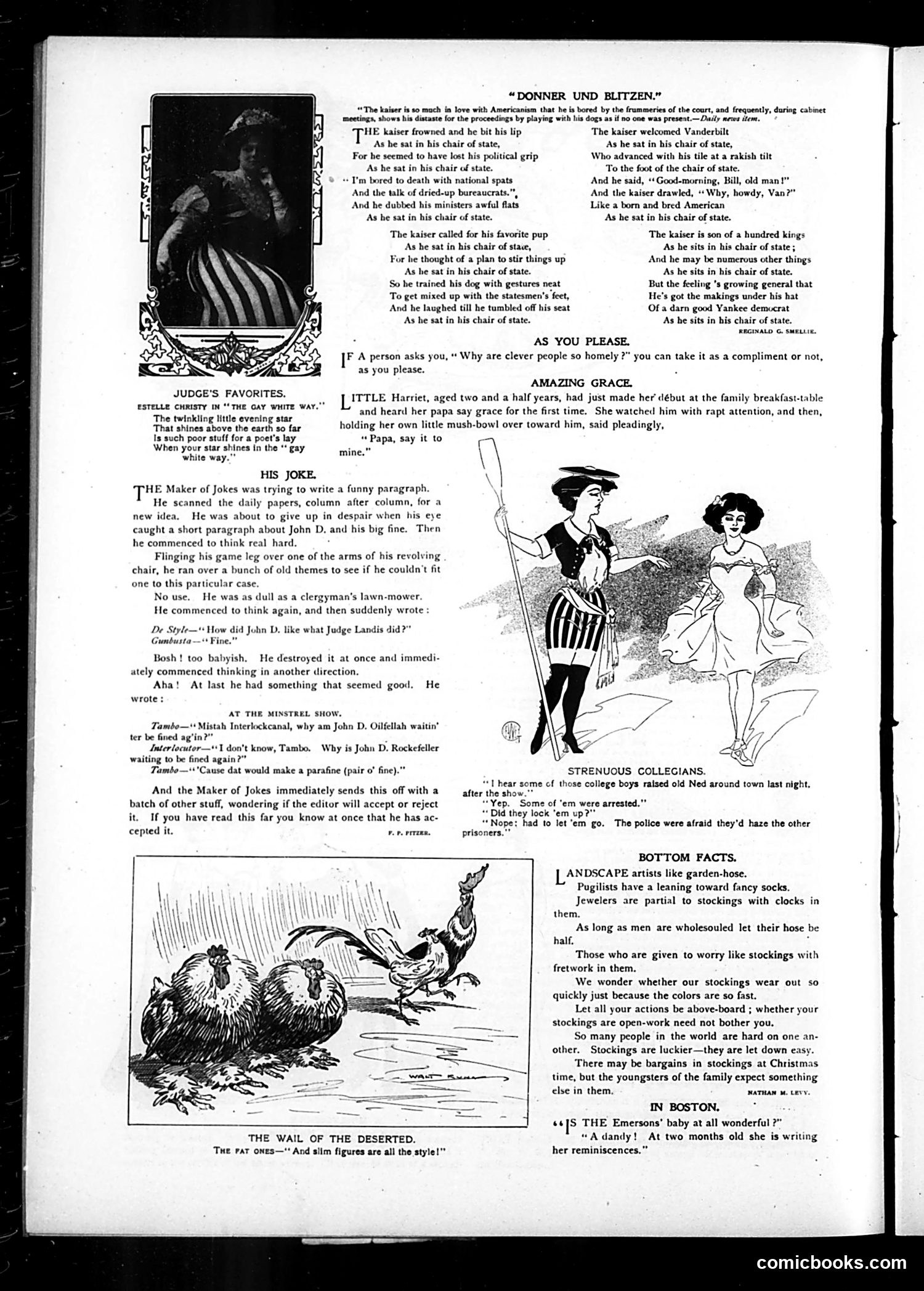
The top sections contain satirical poetry about "Donner und Blitzen" (a German kaiser) and "The Kaiser welcomed Vanderbilt," mocking German-American relations and possibly American industrialists' dealings with Kaiser Wilhelm II. The cartoons focus on domestic American humor: "Amazing Grace" depicts a toddler's first table manners; "Strenuous Collegians" shows college boys causing trouble; and "The Wail of the Deserted" illustrates fat fowl lamenting slim fashion figures—a commentary on contemporary body-image ideals. "His Joke" and "Judge's Favorites" are humor columns typical of Judge magazine's format. The bottom sections ("Bottom Facts," "In Boston") offer miscellaneous satirical observations about fashion, stockings, and social customs. This page represents Judge's characteristic blend of political satire, social commentary, and light domestic humor aimed at educated American readers.
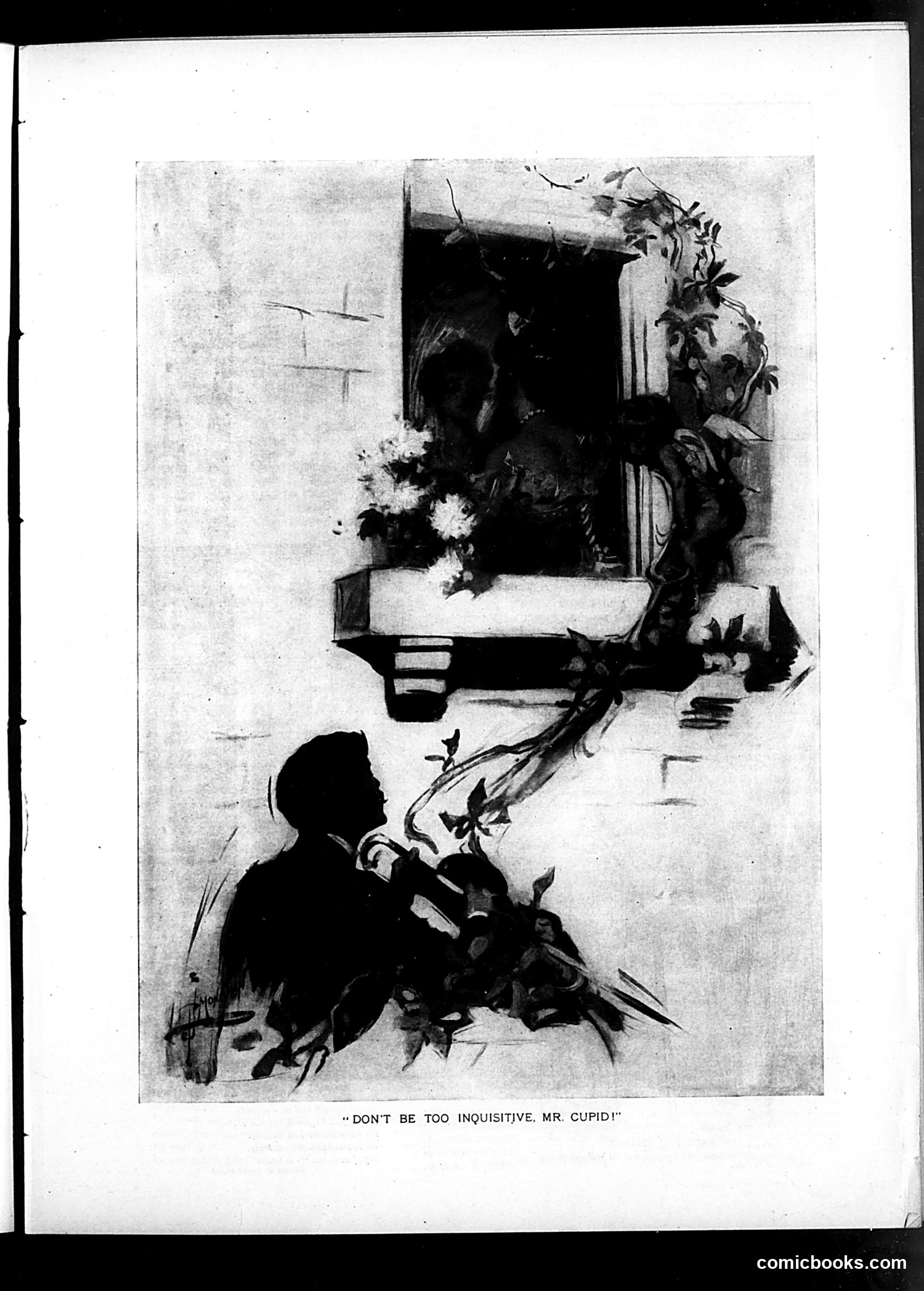
This cartoon depicts Cupid (the winged cherub of love, shown in silhouette at bottom left) being warned away from peering into a window where a couple appears to be courting or compromising. The interior scene shows figures near a window with flowering plants, typical Victorian domestic imagery. The satire plays on the tension between romantic idealism (Cupid's traditional role) and Victorian propriety. The caption suggests that curiosity about private romantic matters—particularly what actually happens behind closed doors between unmarried couples—is inappropriate and should be discouraged. This likely mocks either the hypocrisy of Victorian morality or anxieties about young people's unsupervised courtship practices during this era.
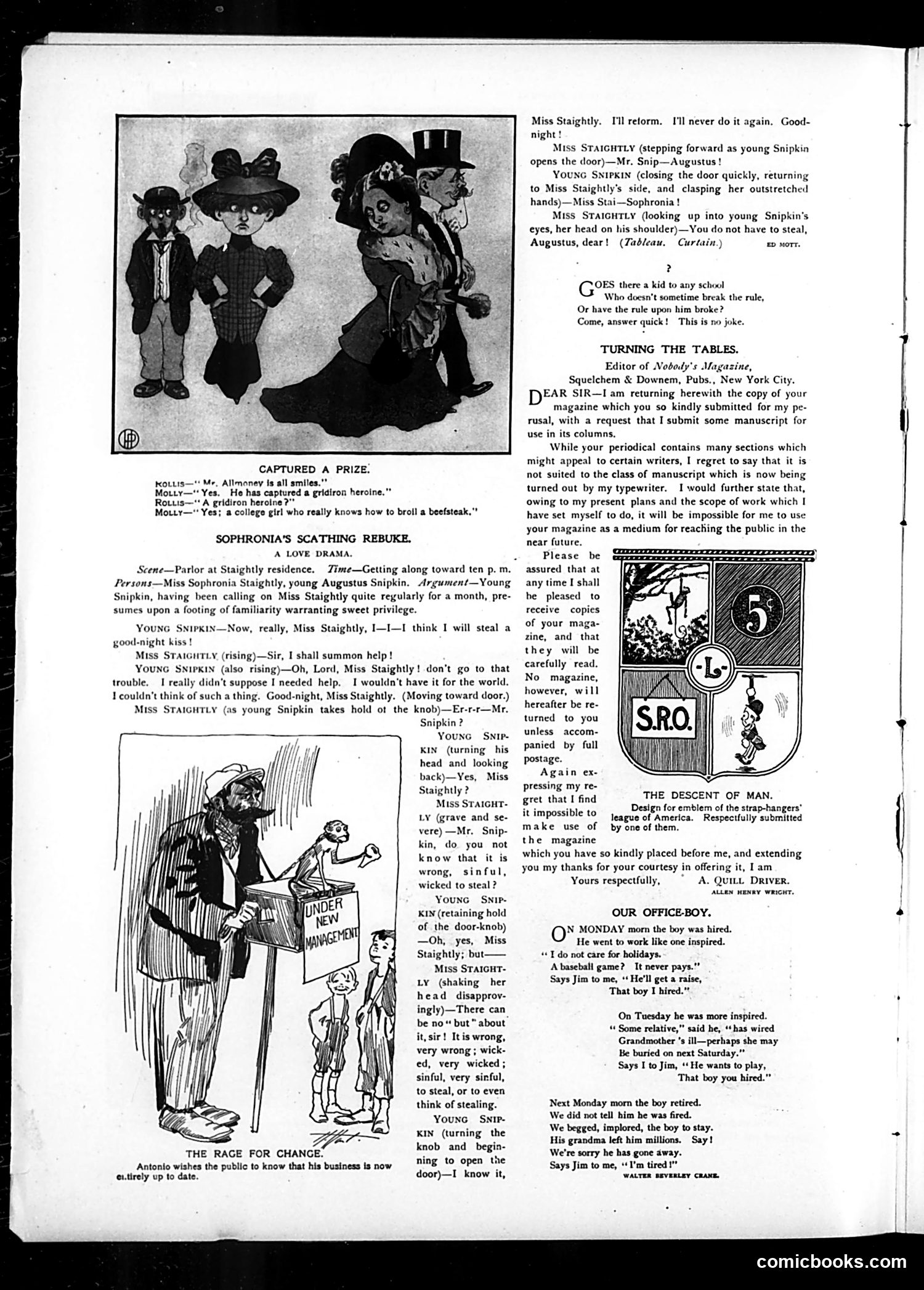
This page contains several satirical sketches mocking contemporary social behaviors and romantic conventions of the era. **"Sophronia's Scathing Rebuke"** depicts a young couple where the woman lectures her suitor about stealing, apparently referencing petty theft or possibly dishonest behavior in courtship—a moral critique wrapped in domestic drama. **"Captured a Prize"** jokes about a "gridiron heroine"—a college girl valued for her ability to cook beefsteak rather than her education, satirizing how women were reduced to domestic skills despite attending university. **"Turning the Tables"** presents an editor rejecting a magazine submission by mimicking the dismissive form-letter tone magazines typically use on writers—turning professional rejection back on the publication itself as satire. **"Our Office-Boy"** humorously contrasts the boy's initial enthusiasm with subsequent excuses (grandmother's illness, family obligations), mocking worker reliability and the gap between promise and performance. These sketches reflect period anxieties about courtship propriety, women's education, publishing gatekeeping, and labor reliability.
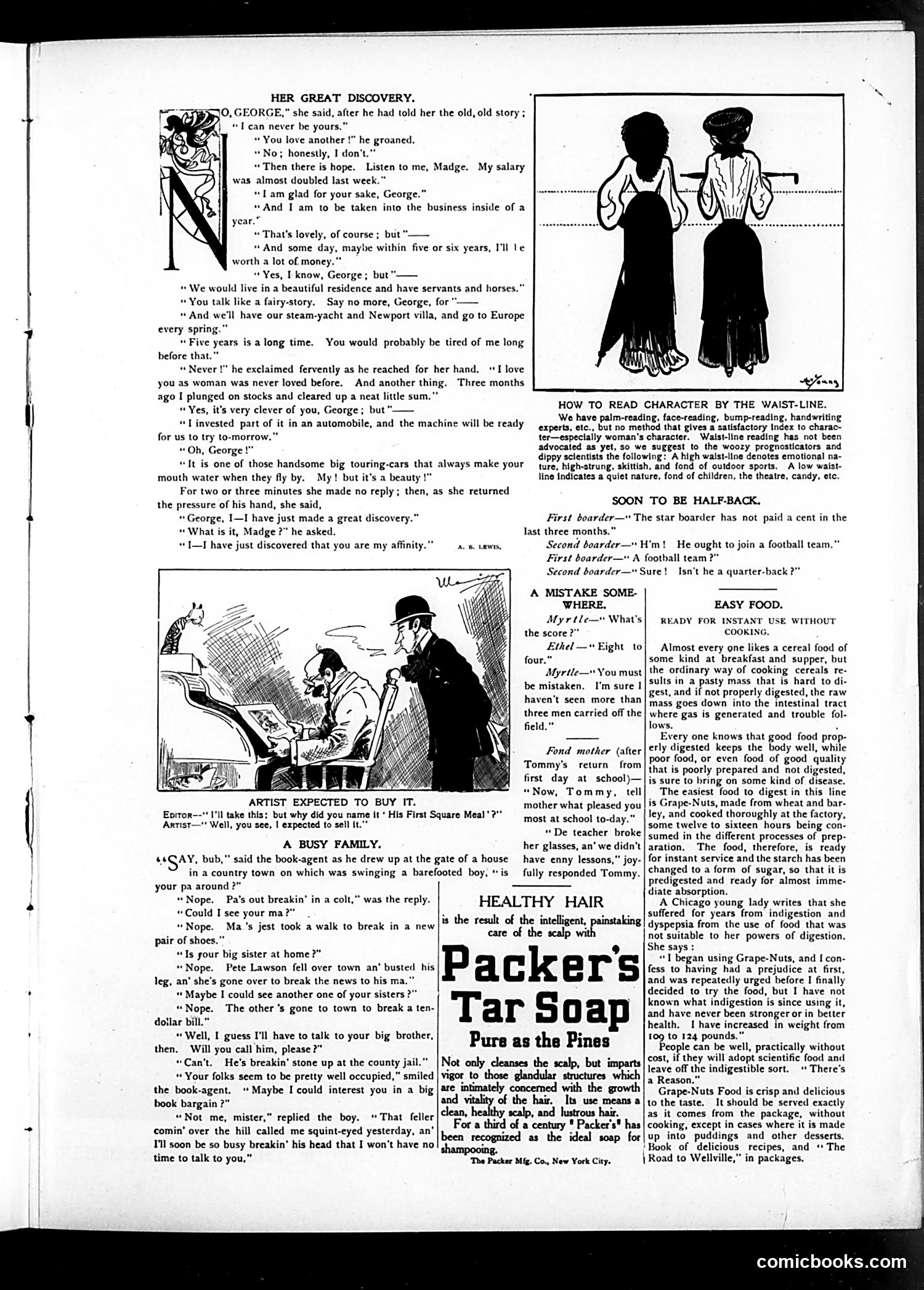
The main cartoon satirizes romantic courtship and materialism. A man proposes by listing escalating financial achievements—doubled salary, business partnership, future wealth, servants, horses, a steam-yacht, Newport villa, European travel, and a luxury automobile. The woman repeatedly interrupts with hesitations until he exhausts his list. Her "great discovery" is not love but that he represents her "affinity"—suggesting she's been won over by his material prospects rather than genuine emotion. The satire mocks both his mercenary seduction and her transparent mercenary acceptance. The accompanying section "How to Read Character by the Waist-Line" is pseudoscientific humor, parodying pop psychology trends (phrenology, palmistry, graphology) by proposing that women's waist placement reveals personality—high waists indicating emotional nature, low waists indicating quiet domesticity. This gently ridicules popular pseudo-science and gender stereotyping. The smaller cartoons—"A Busy Family," "Soon to be Half-Back," "A Mistake Somewhere"—are quick jokes typical of period magazines, unrelated to the main narrative.
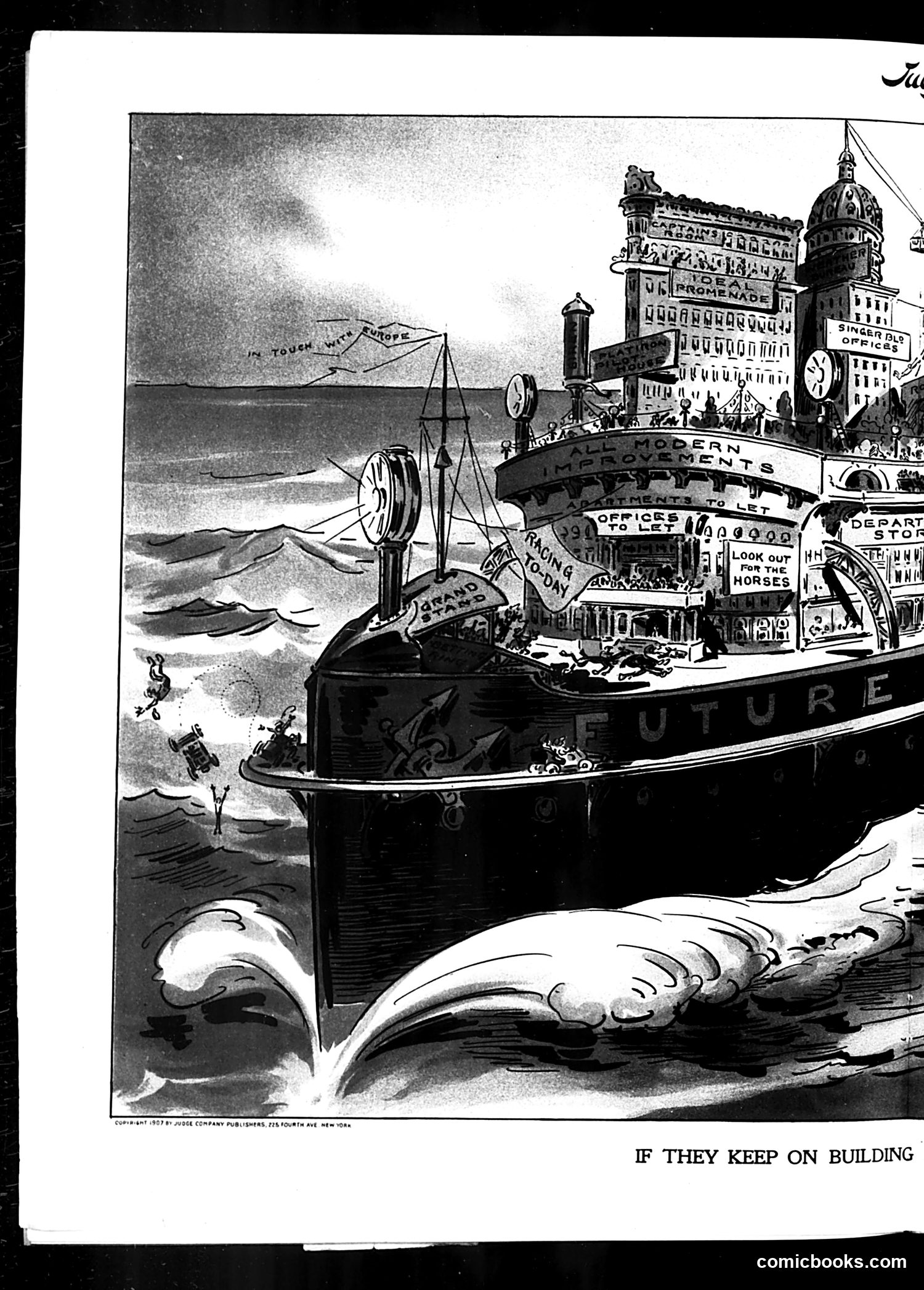
This political cartoon appears to satirize unchecked urban development and construction. The image shows a massive ship labeled "THE FUTURE" laden with tall buildings, skyscrapers, and urban infrastructure being launched into the ocean. On the left, small figures appear to be drowning or struggling in the water—possibly representing those displaced by rapid development or overwhelmed by progress. The caption "IF THEY KEEP ON BUILDING" suggests a warning about excessive construction and expansion. The ship's overloaded cargo of buildings implies the satire concerns whether cities are building too recklessly or unsustainably. The drowning figures suggest human costs or negative consequences of this unchecked growth that decision-makers may be ignoring. Without a visible date, the specific historical context remains unclear, though this appears critical of urban development practices.
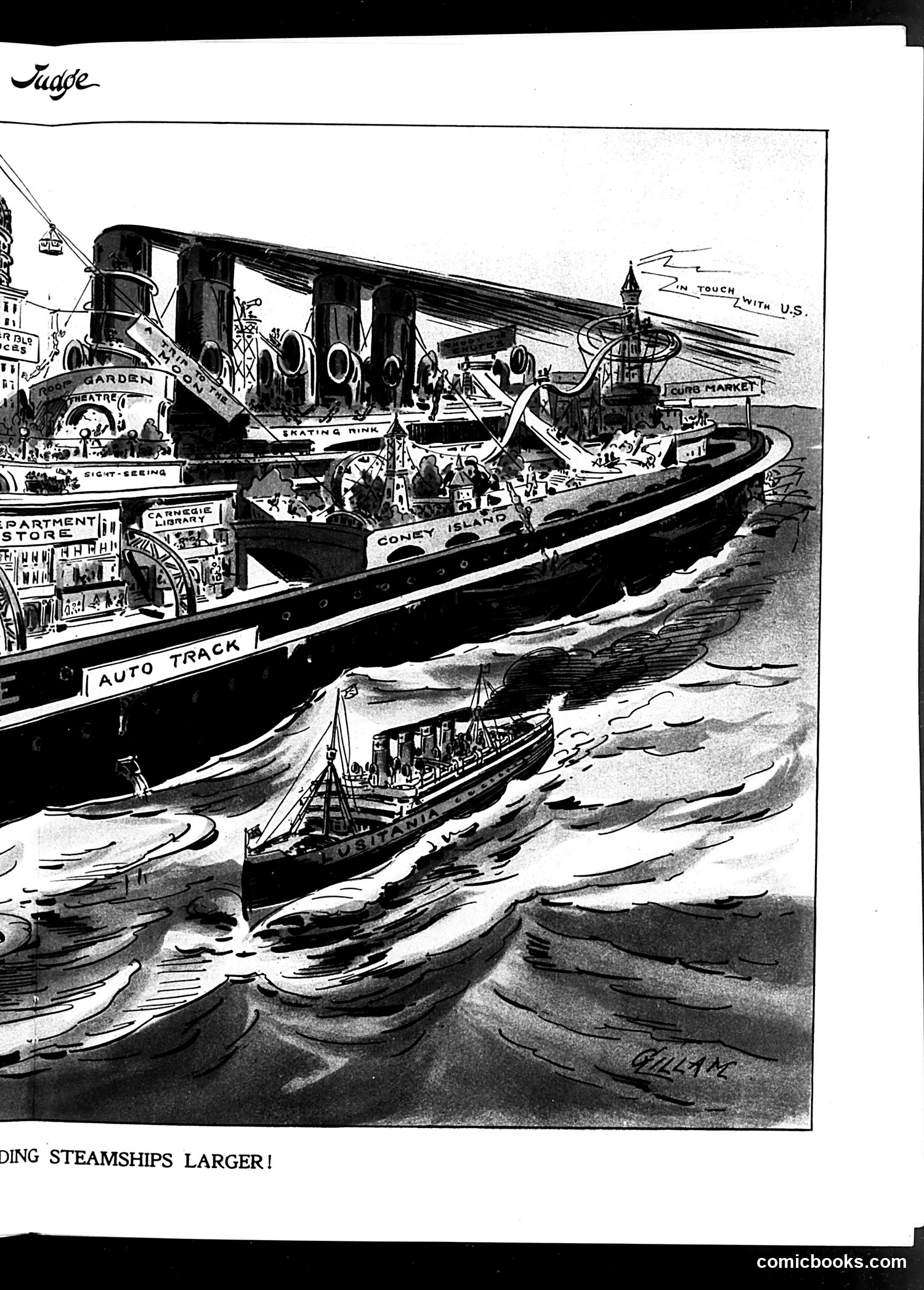
This appears to be a satirical cartoon about American industrial expansion and competition with foreign shipping. A massive American steamship dominates the composition, crowded with labeled attractions (Garden, Theatre, Market, Skating Rink, Auto Track, Department Store, Carnegie Library) — suggesting American vessels are becoming floating cities of commerce and culture. A smaller foreign ship labeled "U.S." (unclear if this is intentional or OCR error) appears dwarfed below, suggesting America is building steamships larger than competitors. The caption "DING STEAMSHIPS LARGER!" emphasizes this competitive boasting. The cartoon likely satirizes American industrial pride and the growing maritime competition of the early 20th century, when steamship construction represented national prestige and economic power. The crowded, commercialized American vessel mocks excessive American consumerism and expansionism.
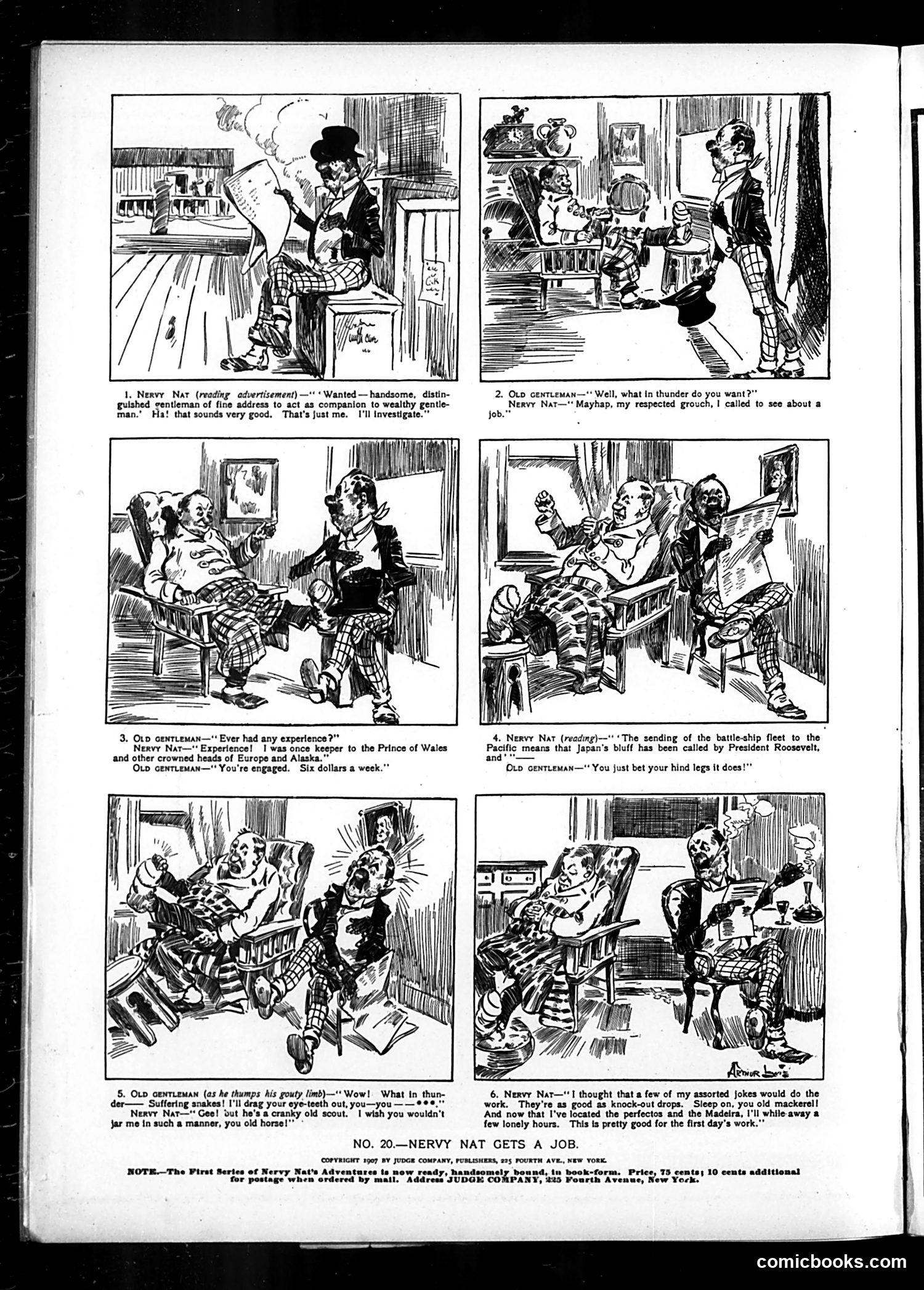
This six-panel comic follows a con-artist character, Nervy Nat, as he fraudulently lands employment with a wealthy old gentleman by fabricating credentials. **The satire:** Nat answers a want ad by claiming (falsely) to have served as companion to European royalty and the Prince of Wales. The gullible employer hires him for six dollars weekly. Once employed, Nat exploits the situation shamelessly—he steals cigars and liquor ("perfectos and Madeira"), tells bad jokes to sedate the irritable, gouty employer, and relaxes while the old man suffers. **Social context:** The cartoon mocks both naive wealth (easily duped gentlemen) and opportunistic working-class hustlers. Panel 4 references President Roosevelt's 1907 Great White Fleet deployment to intimidate Japan—contemporary geopolitical news Nat cynically uses in conversation. The comedy relies on period class dynamics: an underhanded servant exploiting a wealthy but foolish employer, a familiar scenario in early-1900s American humor.
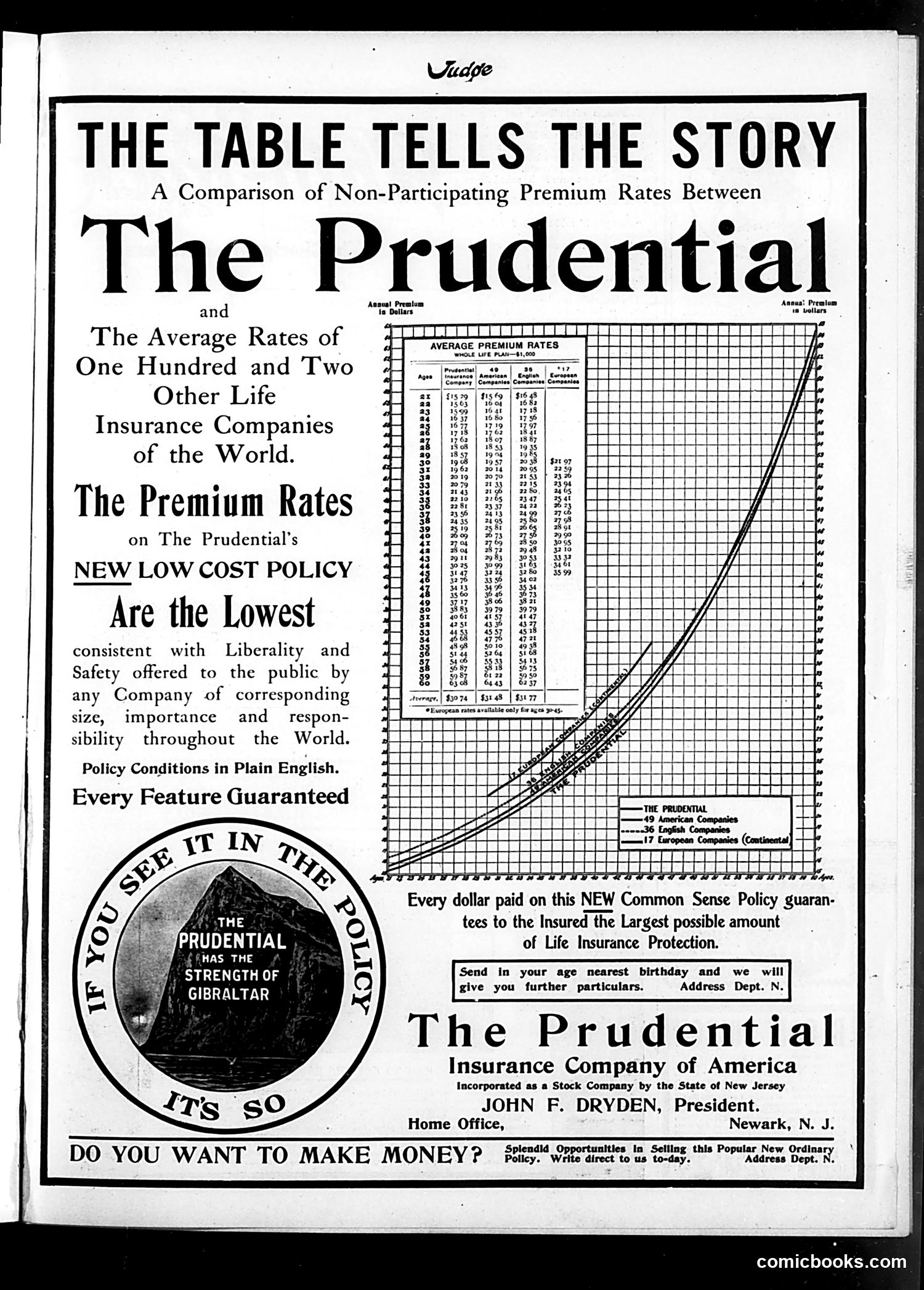
This is **not satire**—it's a straightforward insurance advertisement, not a cartoon. The page compares The Prudential's life insurance premiums against 102 competitors worldwide using a data table and graph. The ad claims Prudential offers the lowest rates while maintaining safety and generous coverage. The "Gibraltar" reference alludes to the Rock of Gibraltar, a symbol of strength and stability—implying Prudential's financial solidity. The tagline "If you see it in the Pouroit, it's so" emphasizes trustworthiness. The graph visually demonstrates Prudential's competitive advantage, showing their premium curve below competitors from American, English, and European companies. The ad targets potential customers and sales agents ("Do you want to make money?"), promising commissions for selling their "New Common Sense Policy." This represents typical early-20th-century insurance marketing: comparing rates graphically, invoking stability symbols, and positioning the company as the consumer's best financial choice.
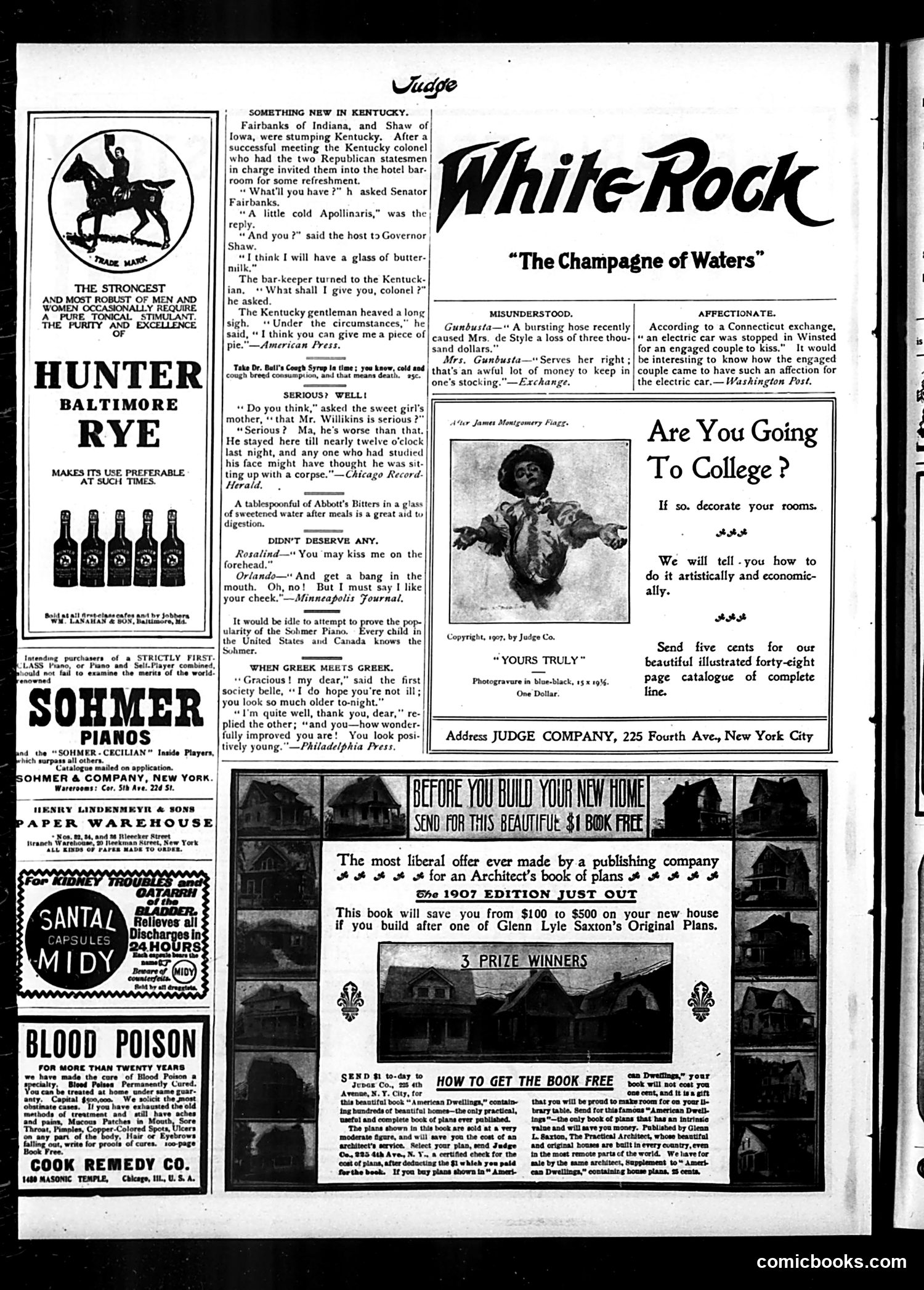
This is primarily an **advertising page** from Judge magazine (circa 1907), with several short humor pieces interspersed. The main cartoons are brief anecdotes: 1. **"Something New in Kentucky"** satirizes regional stereotypes—a Kentucky colonel, when offered refined beverages (Apollinaris water), requests pie instead, suggesting rural unsophistication compared to Eastern Republican politicians. 2. **"When Greek Meets Greek"** depicts two society women exchanging backhanded compliments, each insulting the other while appearing polite—a commentary on feminine social hypocrisy. 3. Other brief jokes mock romance ("Serious? Well!"), misunderstandings, and affectation. The advertisements—for Hunter Baltimore Rye whiskey, Sohmer pianos, blood-poison remedies, and architectural home-design books—reflect early 1900s consumer culture and the magazine's target readership of educated, middle-to-upper-class men. The page's humor relies on class distinctions, gender stereotypes, and social pretension typical of Judge's satirical approach.
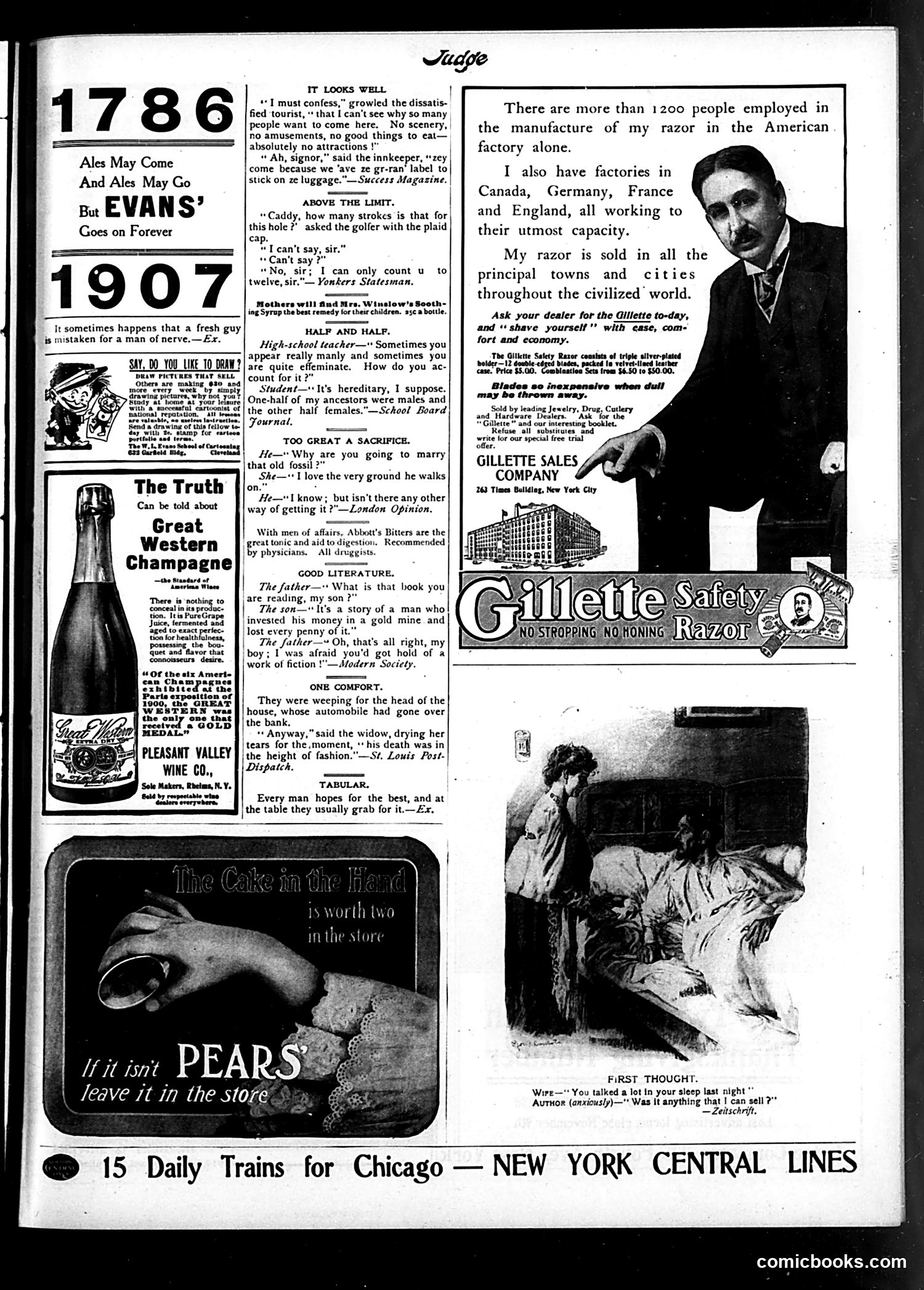
This is primarily an **advertising and humor page** from Judge magazine (dated 1786/1907 based on headers). The page contains mostly brief satirical jokes and several advertisements. **Key Content:** The dominant advertisement features a **Gillette Safety Razor** pitch with a man demonstrating the product. The copy boasts of 1,200+ American factory employees and international factories—emphasizing mass production and global distribution as selling points. **Satirical Humor Sections:** - Brief quips mocking tourists, golf scoring, inheritance, marriage to the wealthy, automobiles, and authors seeking publication - A "High-school teacher" joke about effeminacy being hereditary - Jokes imply class anxiety (gold-mining losses), consumerism (automobile accidents), and domestic friction **Historical Context for Modern Readers:** The Gillette ad reflects early 1900s industrial pride—companies advertised scale and workforce size as quality markers. The humor reflects Edwardian anxieties: status-seeking through consumption, gender performance, and the nouveau riche. The page demonstrates how advertising and entertainment were intertwined in period magazines.
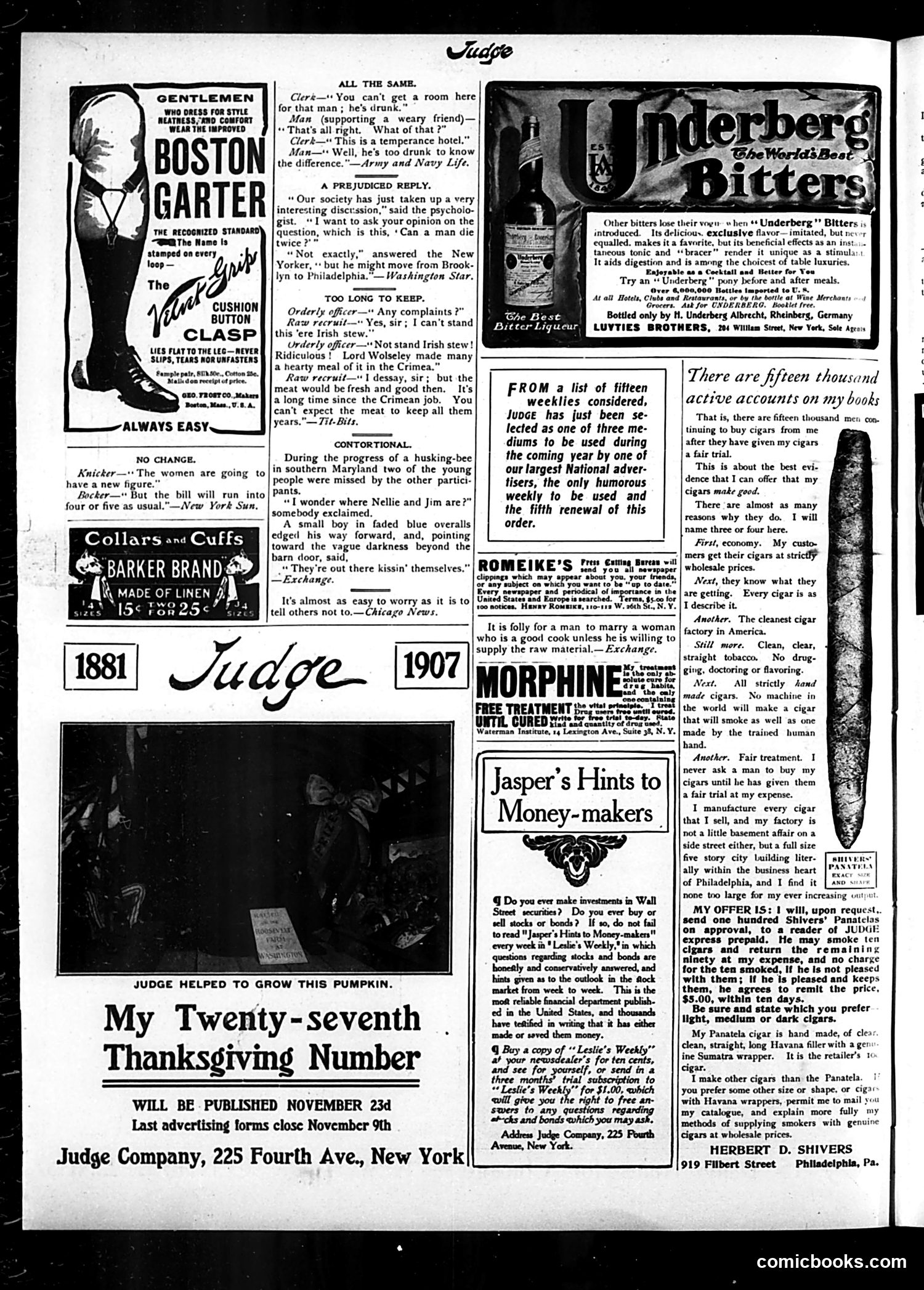
This page is primarily **advertising and promotional content** for Judge magazine itself, with several short humorous anecdotes sprinkled throughout. The main cartoon illustration shows a large pumpkin with the caption "JUDGE HELPED TO GROW THIS PUMPKIN"—a self-promotional visual joke about Judge's influence and reach. The **humor pieces** are brief, typical early-1900s jokes: a drunk man at a temperance hotel, a recruit complaining about old meat in Irish stew (referencing the Crimean War decades earlier), and a young couple "kissin' themselves" at a husking bee. These reflect period attitudes about intoxication, military service, and courtship. The page advertises **Judge's upcoming 27th Thanksgiving issue** and promotes the magazine itself as an advertising medium, claiming selection by major national advertisers. It's essentially a trade publication page celebrating Judge's commercial success and longevity rather than delivering political satire.
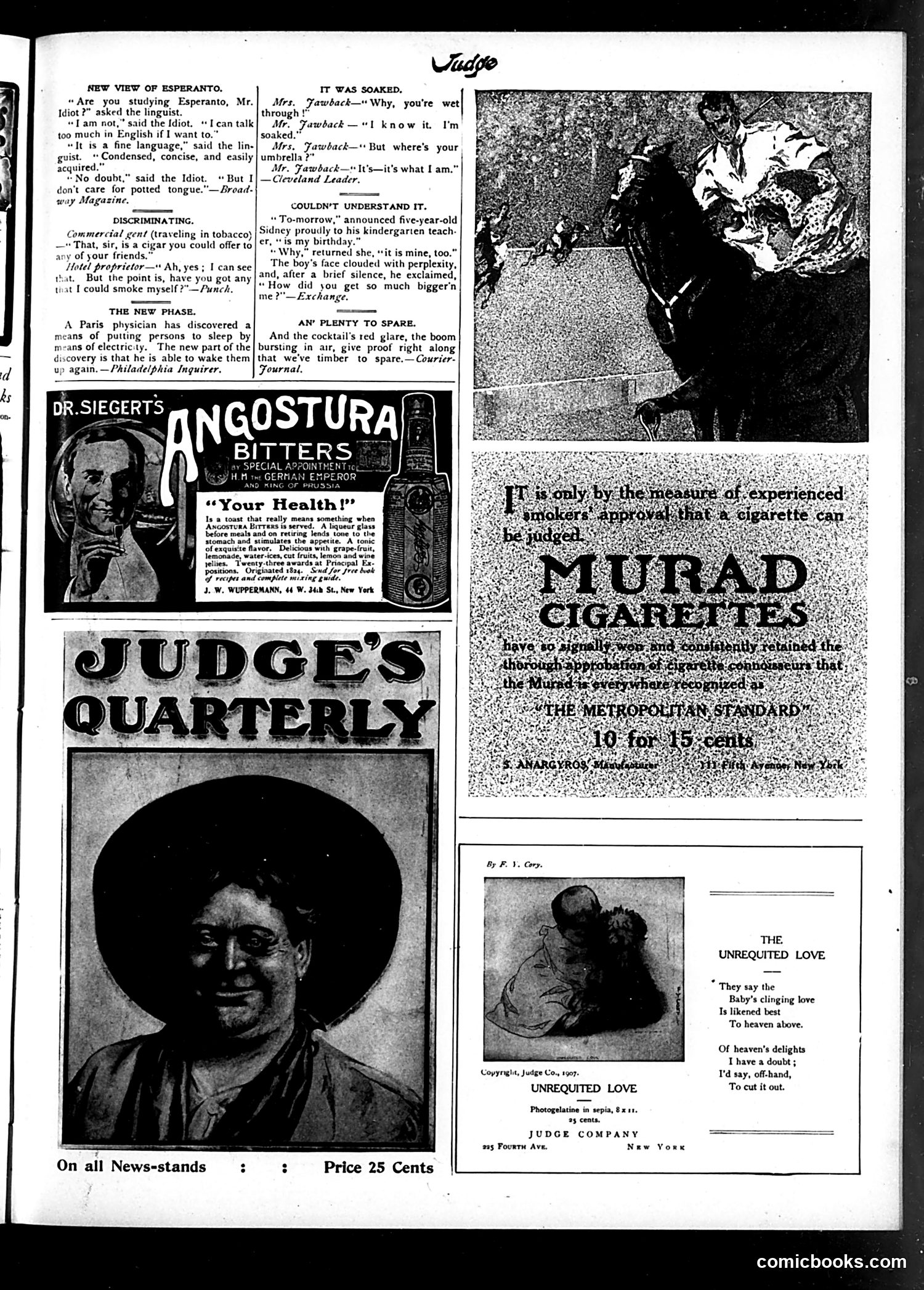
This page contains **short humorous anecdotes and advertisements** rather than political cartoons. The jokes mock contemporary concerns: **"New View of Esperanto"**: Satirizes the international language movement popular in the early 1900s. An idiot character jokes he won't learn Esperanto since he already talks too much in English—mocking both the language's adoption and self-aware verbosity. **Other brief jokes** target: a tobacco salesman's hypocrisy (cigars good enough for others but not himself), a doctor's newfound ability to wake electrified patients, a husband's umbrella literally serving as shelter (soaked through), a five-year-old's confusion about his teacher's age, and military preparedness ("timber to spare"). **The advertisements** include Dr. Siegert's Angostura Bitters (a digestive tonic), Judge's Quarterly magazine, Murad Cigarettes, and a romantic photogravure titled "Unrequited Love." The page reflects **turn-of-century American middle-class preoccupations**: language debates, consumer products, and sentimental humor. The satire is gentle and domestic rather than pointed political commentary.
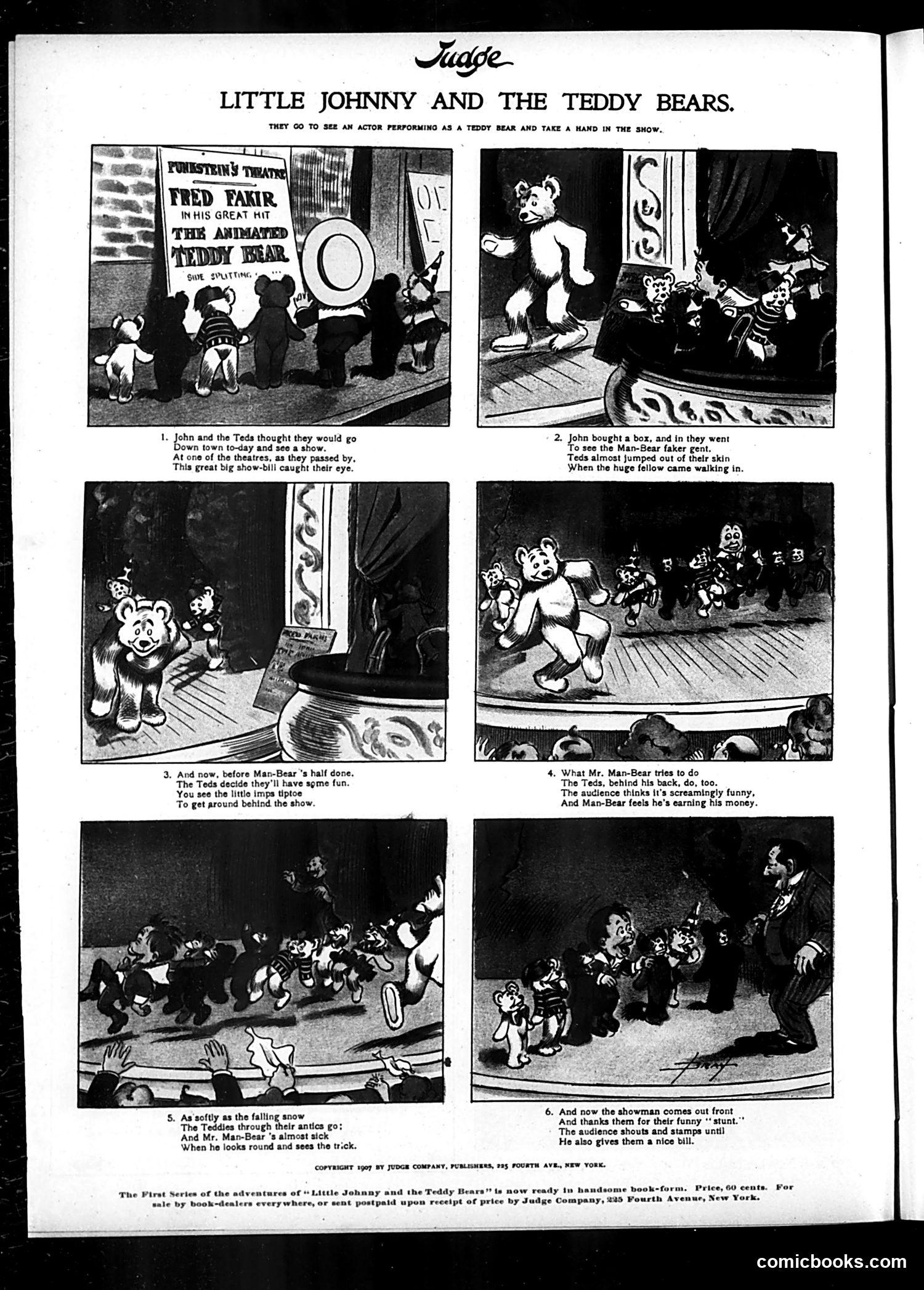
This is a humorous six-panel comic strip, not political satire. It depicts child characters ("Little Johnny" and "the Teds"—anthropomorphic teddy bears) attending a theatrical performance where an actor performs as a large teddy bear ("Man-Bear"). The joke centers on the bears sneaking backstage and mimicking the performer's actions while he performs, causing the audience to laugh. The performer initially doesn't realize what's happening until he turns around mid-act and sees them copying him. The story concludes with the showman good-naturedly thanking them, and the audience rewarding the bears. The strip reflects early 20th-century entertainment culture and the popularity of teddy bears (then a relatively recent toy craze inspired by President Theodore Roosevelt). It's a lighthearted children's story about mischief and performance, with an advertisement at the bottom promoting the comic as an available book collection.