
Judge, 1907-10-19 · page 2 of 16
Judge — October 19, 1907 — page 2: what you’re looking at
What you’re looking at
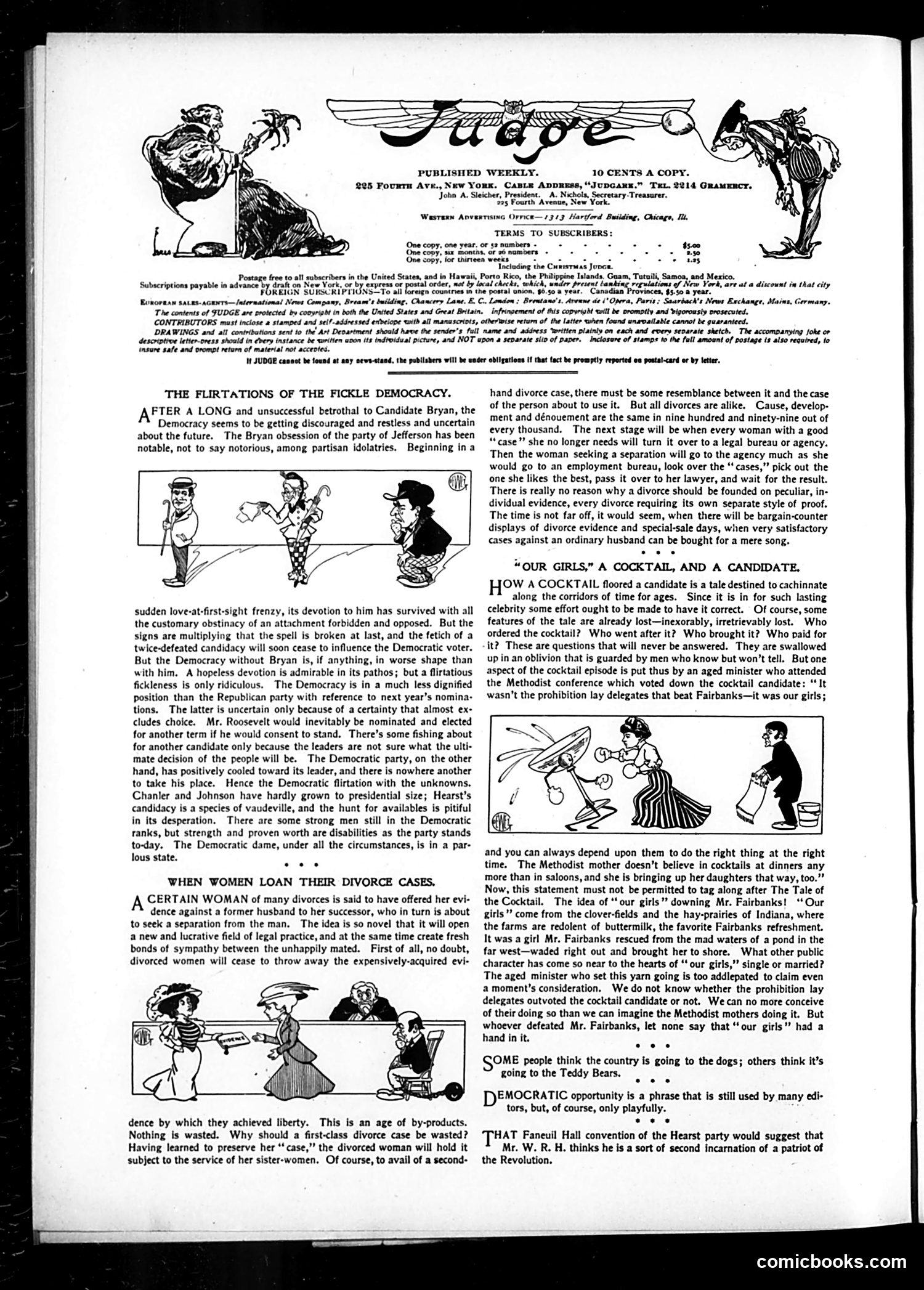
This page satirizes the Democratic Party and women's issues circa the Bryan candidacy era. The main article "The Flirtations of the Fickle Democracy" mocks Democratic inconsistency regarding candidate William Jennings Bryan, comparing the party's wavering support to romantic fickleness. The secondary pieces critique women's divorce accessibility and cocktail culture. "When Women Loan Their Divorce Cases" suggests women casually share separation strategies, while "'Our Girls': A Cocktail, and a Candidate" sarcastically attacks the perceived contradiction between Methodist prohibition and support for cocktails—apparently used to promote the Democratic candidate. The cartoons illustrate these themes with sketches of women discussing divorces and socializing. The satire targets Democratic hypocrisy, women's changing social roles, and perceived moral inconsistency.
📄 Transcribed text from this page (OCR, searchable)
Machine-transcribed from the original scan — historical spelling and the odd misread are preserved.
PUBLISHED WEEKLY. —— —— as 10 CENTS A COPY. 2@5 Fourrm Ave., New Yorx. Caste Apprrss,“Jupcanx.” Tx. 2214 Gramencr, Ye WS AN One copy, one year. or sz numbers - One copy, six months. or 26 numbers - Ove copy, for Uurteen weeks stage free to all subscribers in the United States, Pc Subscriptic ible in advance by draft on New York, or by express or HPtons Paya im ada FOREIGN SUISCRIPTION John A. Sleicher, President. Wasraxn Apvernisin in Hawaii, Porto Rico, the Philippine Islands. Gaam, Tutuili, Samoa, and M. tal order, not by local checks, which, wader. foreign countries in the postal union, $6.30 a ye A. Nichols, Secretary Treasurer. 295 Fourth Avenue, New York. 1313 Hartford Building, Oricage, Ie TERMS TO SUBSCRIBERS: + ts00 - “B30 Tnclading the Cumesrstas Jonce. fico, tions of New York, are at a discount in that city vinces, $5.50 a year. rexent Lamkin ~ Canadian Evora satns-acers—/nternational News Company, Bream’s building, Chancery Lane. EC. Loudon : Brentane's, Avenne de (' Opera, Paris; Saarbach's News Exchange, Mains, Germany. The contents of FUDGE are protected by cooyright in both the United States and Great Britain. infringement of this copyrisM will be cromotty and vigorously srosecuted. CONTRIBUTORS must inciose a stamped and sei?-addressed efbeiope with all manascriots, otherwise return of the latter when found unavailable cannot be guaranteed. DRAWINGS and all contributions sent to the' Art Devartment should have the sender's full name and address ‘written plainly on each and every seoarate sketch. The accompanying joke or descriptive letter-oress should in ebery instance be woritten aon its indrwidual picture, and NOT spon a separate siio of paper. inclosare of stamps to the full amount of postage (8 also required, (0 insure safe and crompt return of material not acceotes. H JUDGE cannot be found at any eewe-stend, the publishers will be ender obligations if that tact be promptly reported on postal-card or by letter. ‘THE FLIRTATIONS OF THE FICKLE DEMOCRACY. AFTER A LONG and unsuccessful betrothal to Candidate Bryan, the Democracy seems to be getting discouraged and restless and uncertain about the future. The Bryan obsession of the party of Jefferson has been notable, not to say notorious, among partisan idolatries. Beginning in a sudden love-at-first-sight frenzy, its devotion to him has survived with all the customary obstinacy of an attachment forbidden and opposed. But the signs are multiplying that the spell is broken at last, and the fetich of a twice-defeated candidacy will soon cease to influence the Democratic voter. But the Democracy without Bryan is, if anything, in worse shape than with him. A hopeless devotion is admirable in its pathos; but a flirtatious fickleness is only ridiculous. The Democracy is in a much less dignified position than the Republican party with reference to next year’s nomina- tions. The latter is uncertain only because of a certainty that almost ex- cludes choice. Mr. Roosevelt would inevitably be nominated and elected for another term if he would consent to stand. There’s some fishing about for another candidate only because the leaders are not sure what the ulti- mate decision of the people will be. The Democratic party, on the other hand, has positively cooled toward its leader, and there is nowhere another to take his place. Hence the Democratic flirtation with the unknowns. Chanler and Johnson have hardly grown to presidential size; Hearst’s candidacy is a species of vaudeville, and the hunt for availables is pitiful in its desperation. There are some strong men still in the Democratic ranks, but strength and proven worth are disabilities as the party stands to-day. The Democratic dame, under all the circumstances, is in a par- lous state. WHEN WOMEN LOAN THEIR DIVORCE CASES. A CERTAIN WOMAN of many divorces is said to have offered her evi- dence against a former husband to her successor, who in turn is about to seek a separation from the man. The idea is so novel that it will open a new and lucrative field of legal practice, and at the same time create fresh bonds of sympathy between the unhappily mated. First of all, no doubt, divorced women will cease to throw away the expensively-acquired evi- dence by which they achieved liberty. This is an age of by-products. Nothing is wasted. Why should a first-class divorce case be wasted? Having learned to preserve her “case,” the divorced woman will hold it subject to the service of her sister-women. Of course, to avail of a second- hand divorce case, there must be some resemblance between it and the case of the person about to use it. But all divorces are alike. Cause, develop- ment and dénouement are the same in nine hundred and ninety-nine out of every thousand. The next stage will be when every woman with a good “*case’’ she no longer needs will turn it over to a legal bureau or agency. Then the woman seeking a separation will go to the agency much as she would go to an employment bureau, look over the “cases,” pick out the one she likes the best, pass it over to her lawyer, and wait for the result. There is really no reason why a divorce should be founded on peculiar, in- dividual evidence, every divorce requiring its own separate style of proof. The time is not far off, it would seem, when there will be bargain-counter displays of divorce evidence and special-sale days, when very satisfactory cases against an ordinary husband can be bought for a mere song. “OUR GIRLS,” A COCKTAIL, AND A CANDIDATE. How A COCKTAIL floored a candidate is a tale destined to cachinnate along the corridors of time for ages. Since it is in for such lasting celebrity some effort ought to be made to have it correct. Of course, some features of the tale are already lost—inexorably, irretrievably lost. Who ordered the cocktail? Who went after it? Who brought it? Who paid for it? These are questions that will never be answered. They are swallowed up in an oblivion that is guarded by men who know but won’t tell. But one aspect of the cocktail episode is put thus by an aged minister who attended the Methodist conference which voted down the cocktail candidate: “It wasn’t the prohibition lay delegates that beat Fairbanks—it was our girls; and you can always depend upon them to do the right thing at the right time. The Methodist mother doesn’t believe in cocktails at dinners any more than in saloons, and she is bringing up her daughters that way, too.”” Now, this statement must not be permitted to tag along after The Tale of the Cocktail. The idea of ‘our girls’ downing Mr. Fairbanks! ‘Our girls’ come from the clover-fields and the hay-prairies of Indiana, where the farms are redolent of buttermilk, the favorite Fairbanks refreshment. It was a girl Mr. Fairbanks rescued from the mad waters of a pond in the far west—waded right out and brought her to shore. What other public character has come so near to the hearts of “‘ our girls,” single or married? The aged minister who set this yarn going is too addlepated to claim even a moment’s consideration. We do not know whether the prohibition lay delegates outvoted the cocktail candidate or not. We can no more conceive of their doing so than we can imagine the Methodist mothers doing it. But whoever defeated Mr. Fairbanks, let none say that “our girls” had a hand in it. ‘OME people think the country is going to the dogs; others think it’s going to the Teddy Bears. ee DEMocrRaTIC opportunity is a phrase that is still used by many edi- tors, but, of course, only playfully. eee THAT Faneuil Hall convention of the Hearst party would suggest that Mr. W. R. H. thinks he is a sort of second incarnation of a patriot of the Revolution. comicbooks.com