
A complete issue · 16 pages · 1907
Judge — September 28, 1907
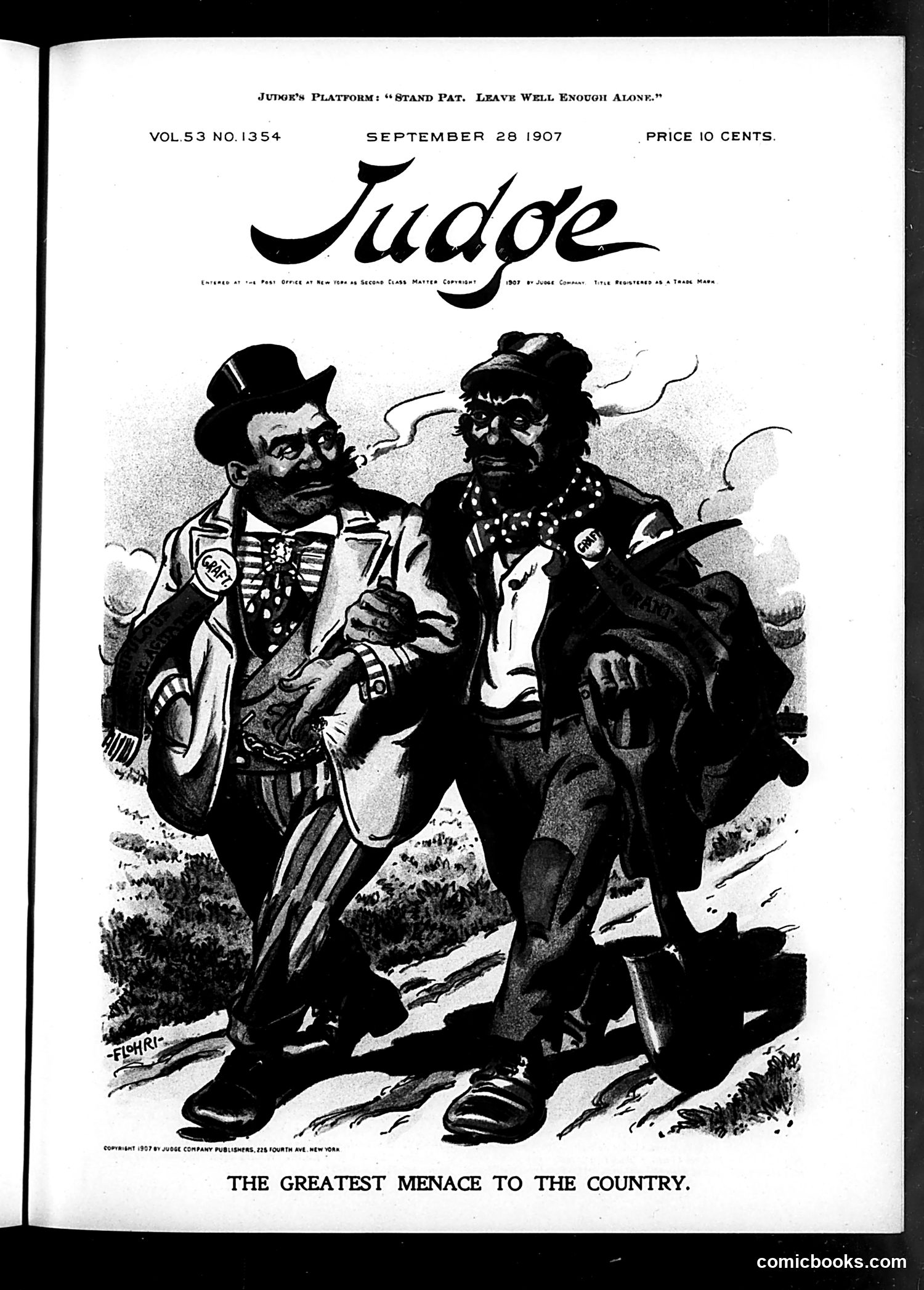
This political cartoon depicts two caricatured figures labeled "The Greatest Menace to the Country." Based on the 1907 date and exaggerated facial features characteristic of period political satire, these appear to represent political or social figures viewed as threats by the magazine's editors. The figures wear elaborate, decorated clothing suggesting wealth or pretension. The artist's style employs caricature conventions common to early 20th-century American political commentary, including exaggerated features to convey disdain or mockery. Without clearer identifying labels or context in the visible text, I cannot definitively identify which specific individuals or groups are being satirized. The "menace" reference suggests commentary on contemporary political concerns, but the specific target remains unclear from this image alone.
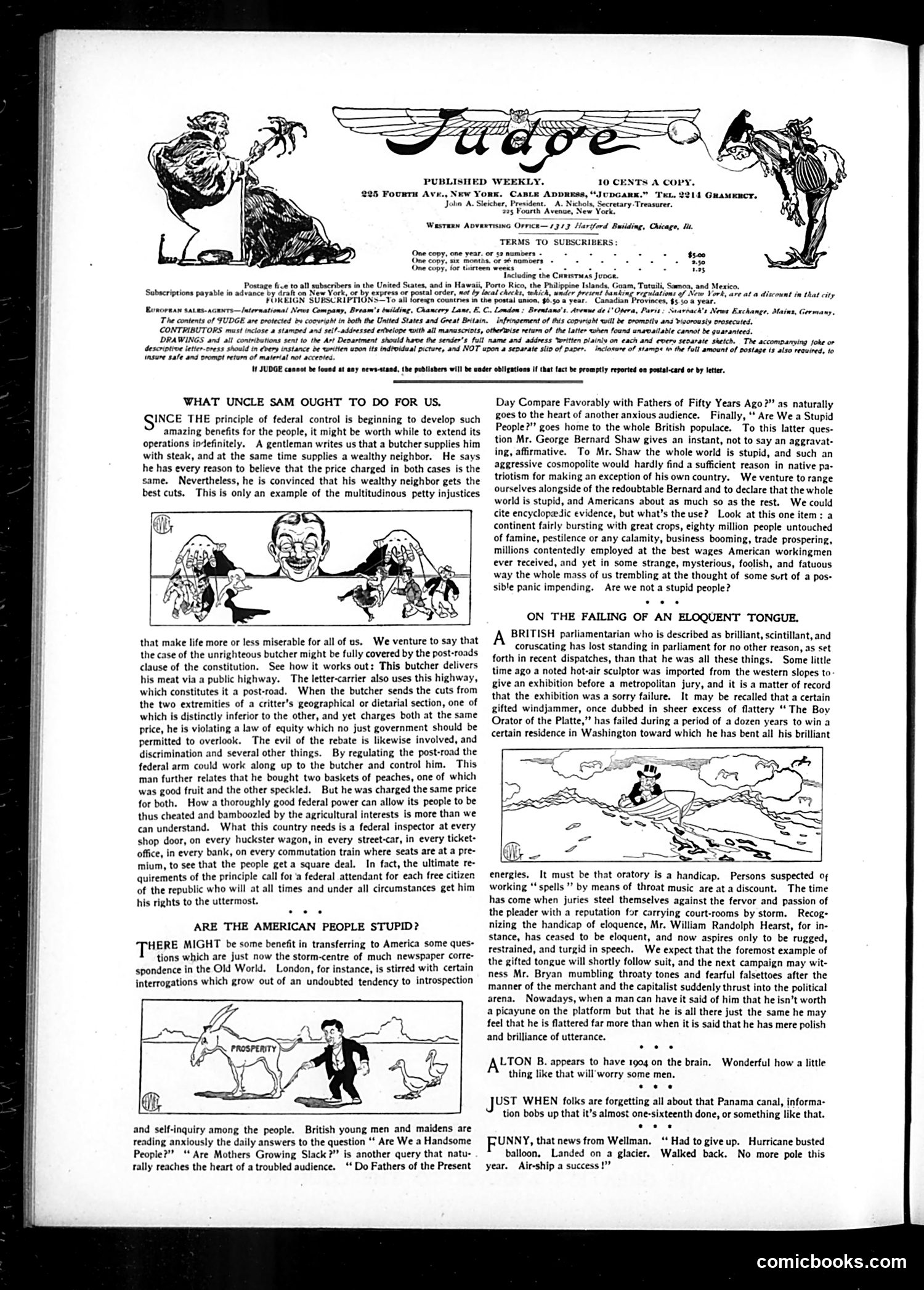
This page contains three distinct satirical pieces critiquing American politics and society circa early 1900s. **"What Uncle Sam Ought to Do for Us"** attacks wealthy industrialists' refusal to support public welfare despite massive profits. The cartoon depicts fat plutocrats hoarding wealth while millions suffer poverty. **"On the Failing of an Eloquent Tongue"** mocks a British parliamentarian (likely William Randolph Hearst, based on context clues about oratory and politics) whose eloquence masks corrupt intent. The satire suggests his brilliant speeches manipulate rather than inform. **"Are the American People Stupid?"** questions whether citizens accept journalistic misinformation and partisan propaganda without critical examination. The overall theme: Judge criticizes both wealthy elites exploiting workers and political figures using rhetorical skill to deceive the public.
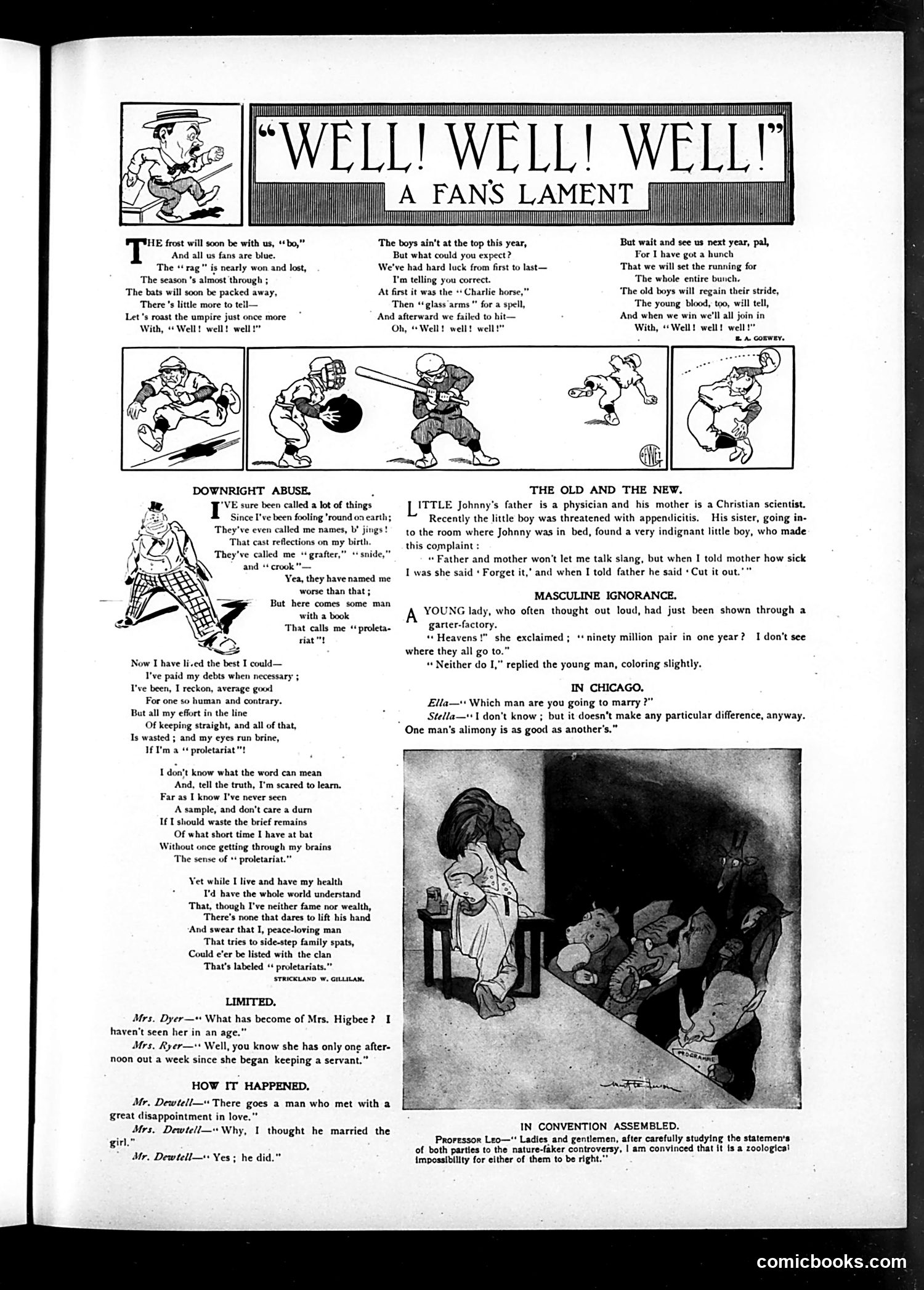
This page contains baseball humor and social commentary typical of early 20th-century American satire. **"Well! Well! Well!" (top):** A "fans lament" poem mocking disappointed baseball enthusiasts after a poor season. The accompanying cartoons show slapstick baseball scenes, likely referencing a specific team's failures, though the exact team isn't identifiable from the image alone. **Other sections** include miscellaneous jokes about: - Domestic abuse ("Downright Abuse") - Class commentary ("The Old and the New") - Gender and courtship humor ("Masculine Ignorance," "In Chicago") - A photograph captioned "In Convention Assembled" showing what appears to be a political or social gathering The overall tone reflects Judge's typical blend of sports criticism, family life satire, and period-specific social observations aimed at educated urban readers.
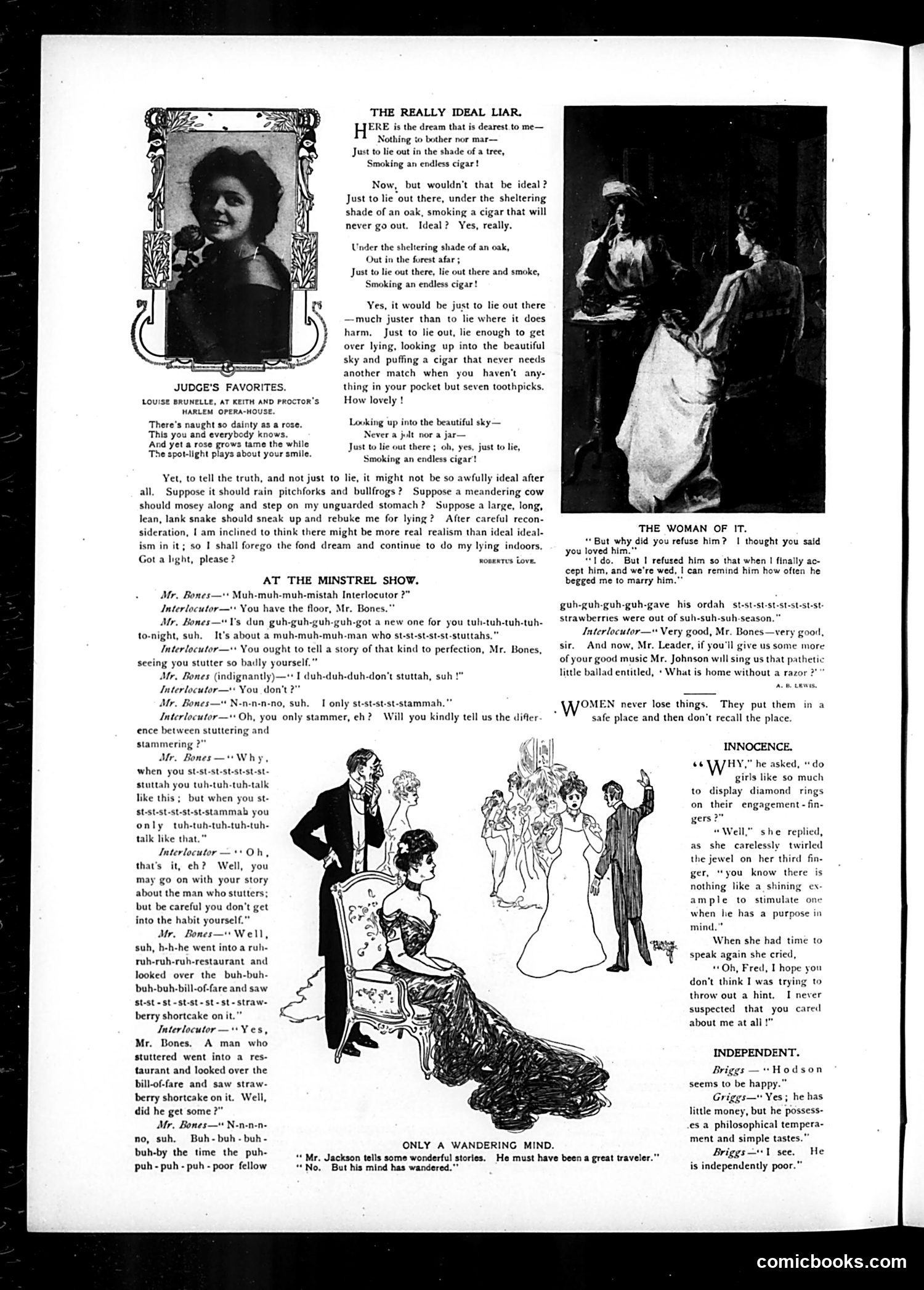
This page contains several satirical pieces typical of Judge magazine's humor: **"The Really Ideal Liar"** mocks romantic idealization by describing a man lounging under a tree smoking an endless cigar—presented as the ultimate fantasy of leisure and irresponsibility. **"At the Minstrel Show"** satirizes a dialogue between Mr. Jones and an Interlocutor, poking fun at stuttering and verbal mishaps. Jones repeatedly mangles his words in increasingly absurd ways, creating slapstick humor from speech impediments. The accompanying illustrations show social scenes—a woman at what appears to be a formal gathering, and figures in period dress at a social event. **"Innocence," "Independent,"** and other brief comic pieces employ wordplay and social observation typical of Judge's style, targeting marriage dynamics, materialism, and pretension among the middle and upper classes. The overall tone reflects early-20th-century American satirical humor.
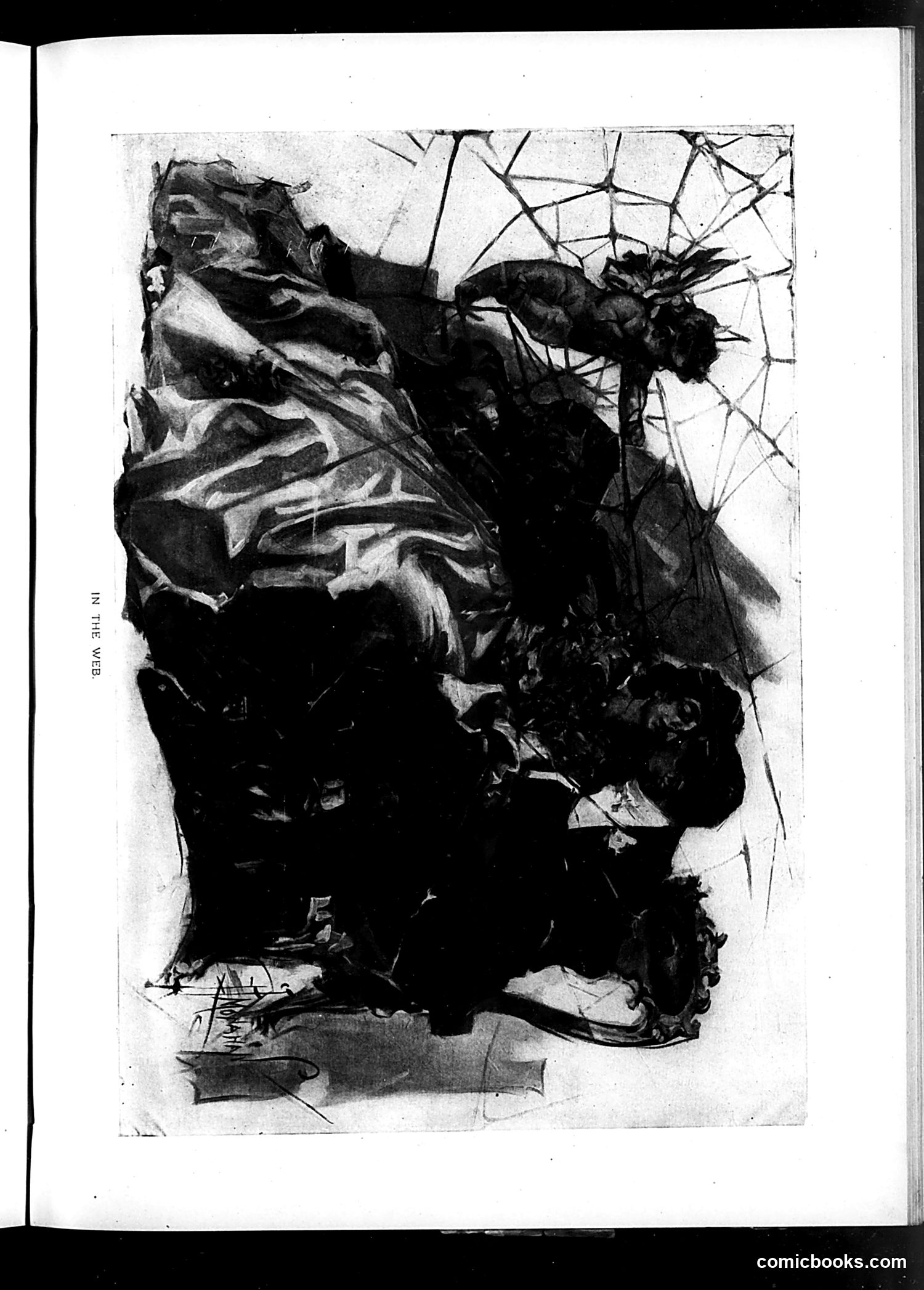
This appears to be a political cartoon from *Judge* magazine showing figures caught in a spider's web. The image quality and OCR limitations make specific identification difficult, but the title "In the Web" suggests entrapment or being caught in a complex, inescapable situation—a common satirical metaphor. The cartoon likely critiques political corruption, conspiracy, or institutional problems of its era. The web imagery represents how subjects are trapped by forces beyond their control, suggesting they're victims of larger schemes or systems. Without clearer details or dates visible, I cannot identify the specific political figures or events referenced, though the composition indicates this addresses serious political malfeasance or scandal affecting multiple parties.
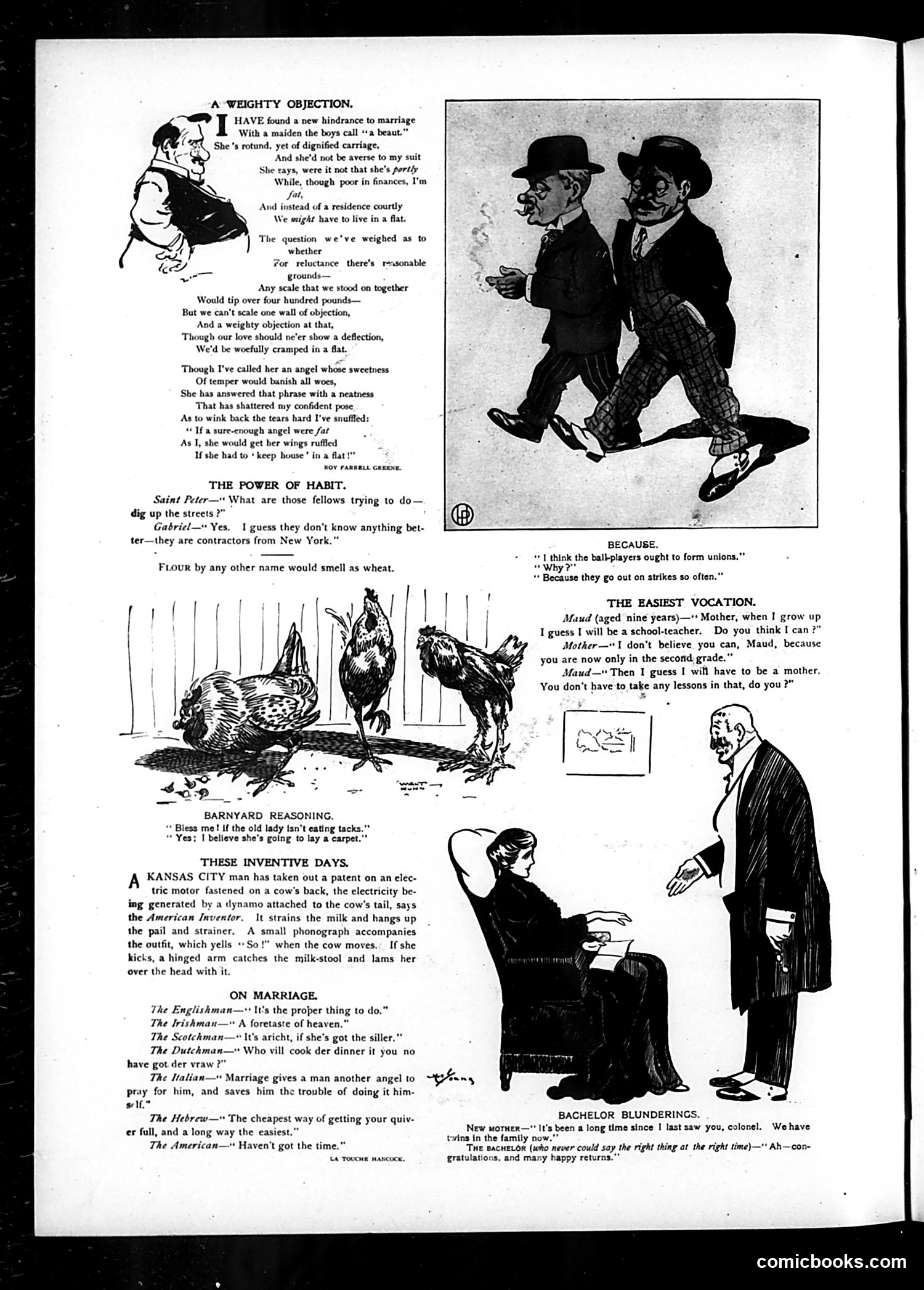
This page contains several unrelated satirical pieces typical of early 20th-century humor magazines: **"A Weighty Objection"** mocks a couple's marriage dilemma: both are obese, and they fear living in a cramped apartment would be uncomfortable. The satire targets Victorian courtship anxieties and class concerns about housing, using their combined weight as the punchline. **"Power of Habit"** jokes that New York construction contractors compulsively dig up streets out of ingrained routine rather than necessity. **"Easiest Vocation"** presents a child's logic: if teaching requires education but motherhood doesn't, she'll become a mother—satirizing assumptions about women's roles requiring no training. **"Barnyard Reasoning"** uses animal stupidity for humor: a cow eating tacks must be preparing to "lay a carpet." **"These Inventive Days"** mocks over-engineered absurdity: an elaborate cow-milking machine with a phonograph and retaliatory arm. **"On Marriage"** compiles ethnic stereotypes about marriage from different nationalities—standard period ethnic humor. **"Bachelor Blunderings"** shows a man congratulating someone on their wedding with "many happy returns"—an awkward gaffe about the phrase's typical funeral use.
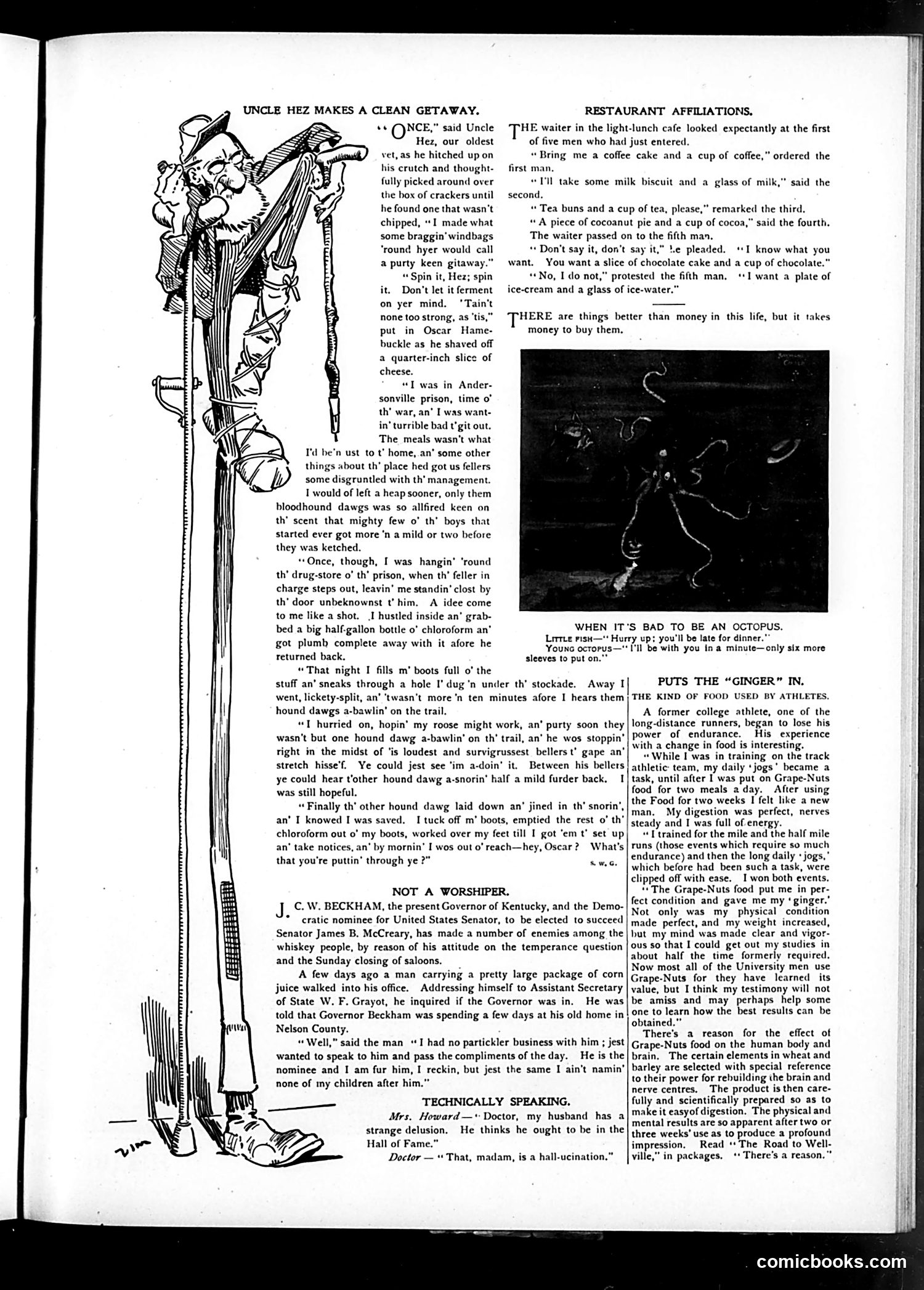
This page contains three comic pieces satirizing American life: **"Uncle Hez Makes a Clean Getaway"**: A tall-tale yarn where an elderly Civil War veteran, Uncle Hez, describes escaping Andersonville Prison by stealing chloroform from the prison pharmacy and using it to sedate tracking bloodhounds. The humor lies in the tall-tale format and vernacular dialect typical of frontier storytelling. **"Restaurant Affiliations"**: A brief joke where five diners each order something, but the fifth man subverts expectations by ordering ice cream and water instead of the predictable chocolate cake and chocolate beverage, mocking the monotonous pattern. **"When It's Bad to Be an Octopus"**: A visual gag showing an octopus struggling to put on multiple sleeves, playing on the creature's eight arms. The page also contains political commentary about Kentucky Governor C.W. Beckham's temperance stance ("Not a Worshiper"), where a whiskey supplier tries to gain his favor. The content reflects period concerns: Civil War nostalgia, temperance debates, and simple comedic wordplay.
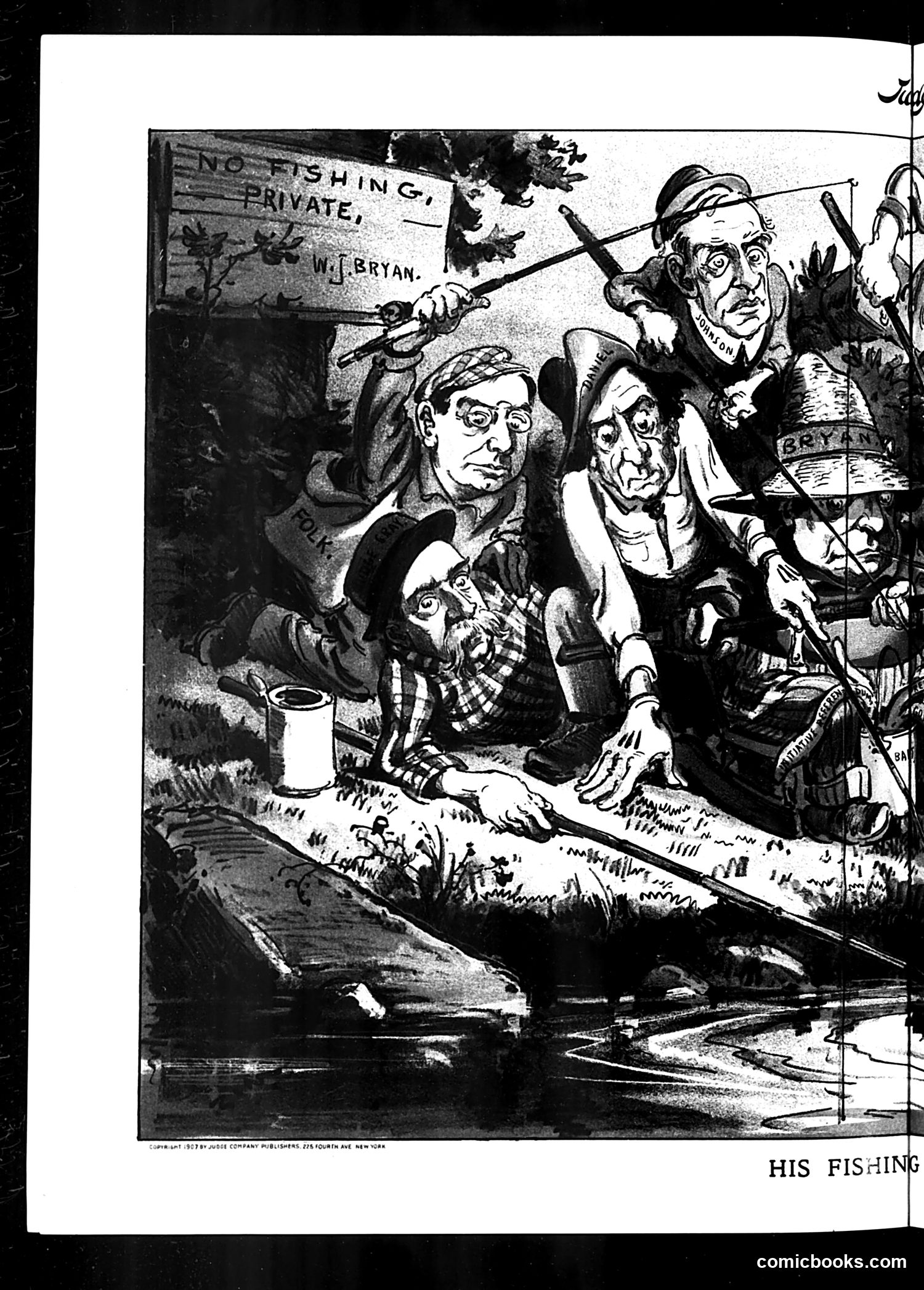
This political cartoon depicts several caricatured figures fishing together by a riverbank. A sign reading "NO FISHING! PRIVATE. W. J. BRYAN" is visible in the background, suggesting the satire concerns William Jennings Bryan, the prominent American politician and three-time presidential candidate. The cartoon appears to satirize Bryan and associates engaged in some form of questionable activity labeled metaphorically as "fishing"—likely a reference to political maneuvering, fundraising, or similar self-interested behavior. The "private" sign being ignored reinforces the suggestion of impropriety or trespassing on restricted grounds. Without the publication date visible, the specific political context remains unclear, though this likely critiques Bryan's political activities during one of his campaigns or periods of influence.
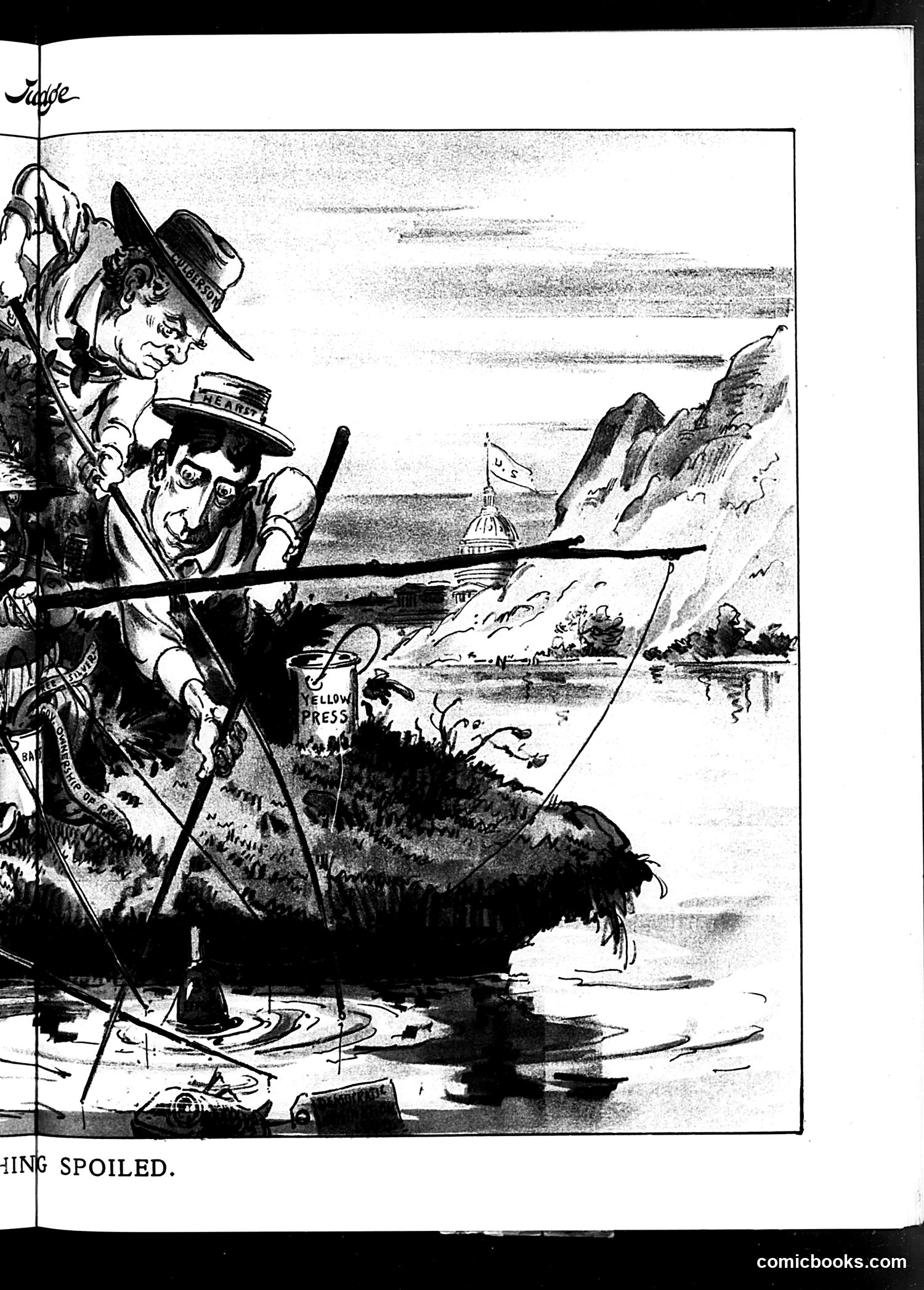
This appears to be a Gilded Age political cartoon depicting the corruption of American government. Two caricatured figures (likely representing political machines or corrupt politicians) sit fishing in waters near the Capitol building, with a container labeled "YELLOW PRESS" visible. The "yellow journalism" reference suggests media complicity in political corruption. The figures are portrayed as opportunistic and predatory, "fishing" in government waters—a metaphor for exploiting public resources for private gain. The caption "Nothing Spoiled" likely carries ironic intent, suggesting that despite widespread corruption and malfeasance, the system remains fundamentally compromised and "spoiled." The cartoon critiques the intertwined corruption between media, politics, and big business characteristic of the Gilded Age period.
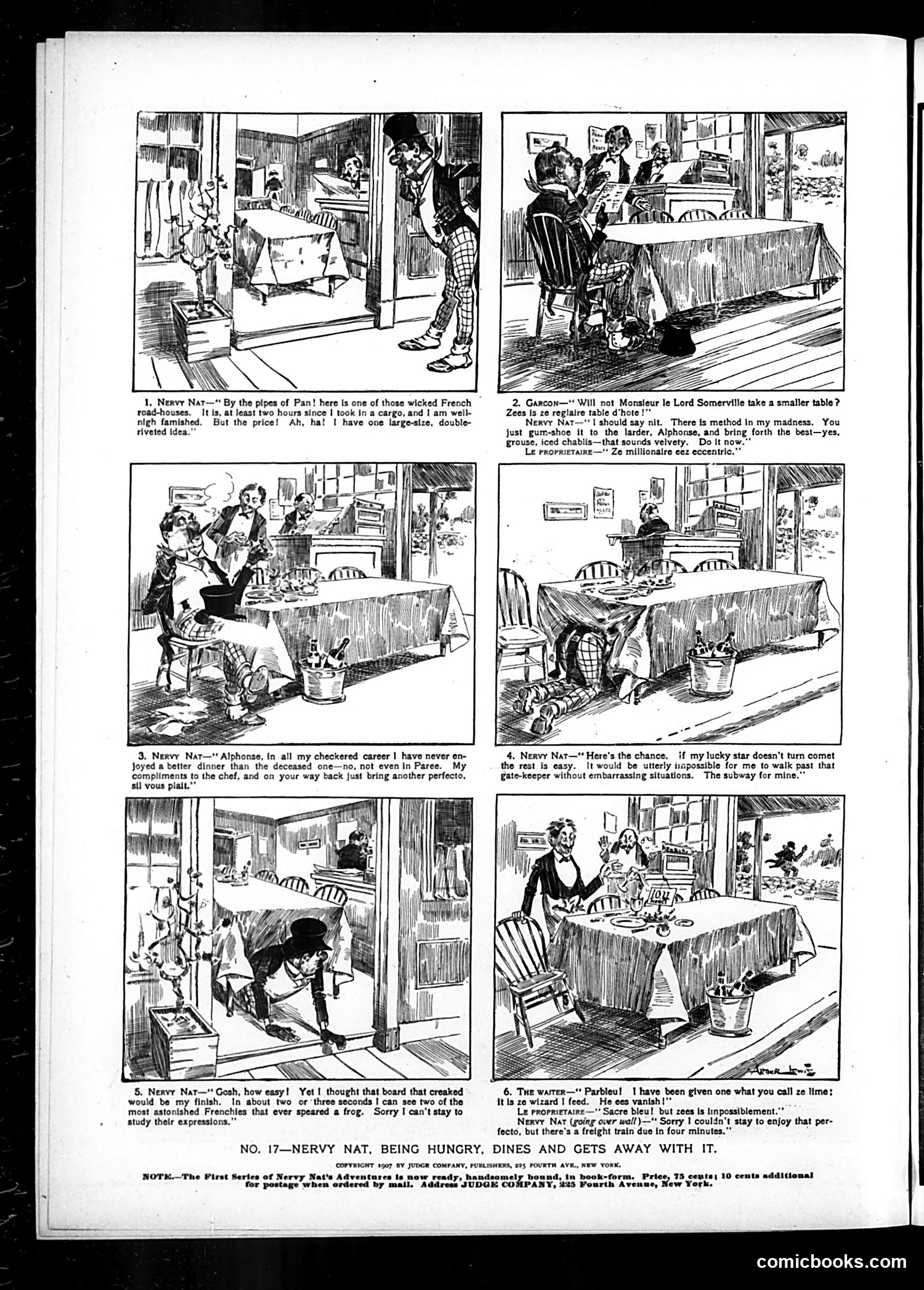
This 1907 Judge comic strip satirizes American confidence and resourcefulness through the character "Nervy Nat," a hungry traveler at a French roadhouse who cannot afford the menu prices. The satire works on two levels: it mocks both French pretension (depicted through exaggerated accents and snobbish waiters concerned about proper table etiquette) and celebrates American ingenuity. Nat solves his dilemma by sneaking into the kitchen, stealing a meal, and escaping over the wall onto a freight train—outwitting the "eccentric" Europeans through sheer audacity. The humor reflects early-20th-century American attitudes: superiority over "wicked French" establishments and celebration of quick-witted rule-breaking as a national trait. The Francophone dialogue (rendered phonetically for comic effect) reinforces the "foreign oddness" of European customs to American readers.
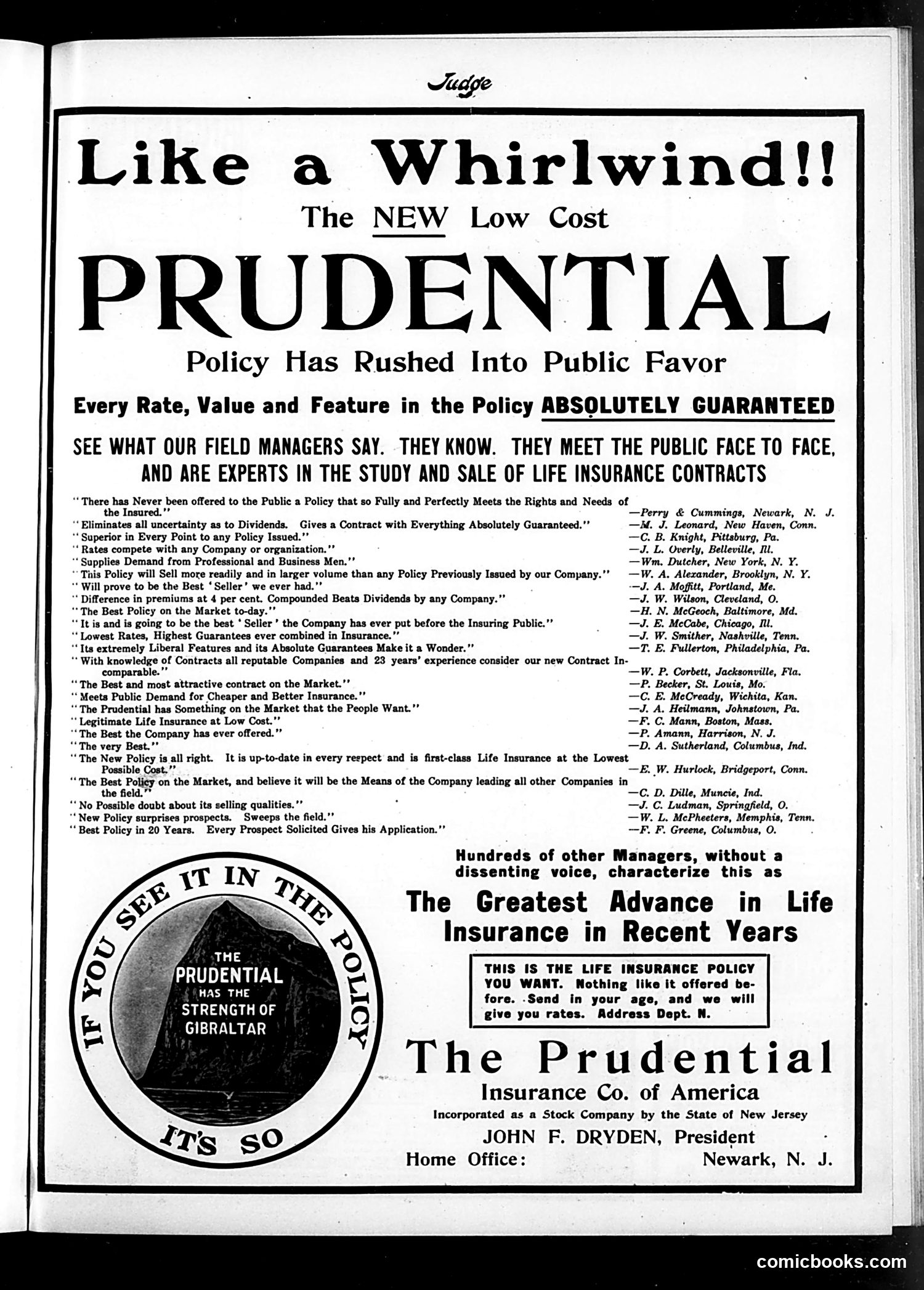
This is **not a cartoon or satire**, but rather a full-page advertisement for Prudential Insurance's new life insurance policy, appearing in *Judge* magazine. The ad uses testimonial marketing, featuring dozens of quotes from Prudential field managers praising the new "low cost" policy as superior, easier to sell, and better than competitors' offerings. The repeated superlatives ("best," "greatest," "wonder") and emphatic guarantees emphasize the product's alleged market dominance. The circular seal reading "If you see it in the Poultry, It's So" appears to be a tongue-in-cheek reference to established advertising slogans of the era—likely a parody of similar trust-building claims used by insurance companies. For modern readers: this represents early 20th-century insurance marketing relying on professional endorsements and repetitive positive claims rather than substantive product details. The sheer volume of manager testimonials was meant to create an impression of overwhelming approval and success.
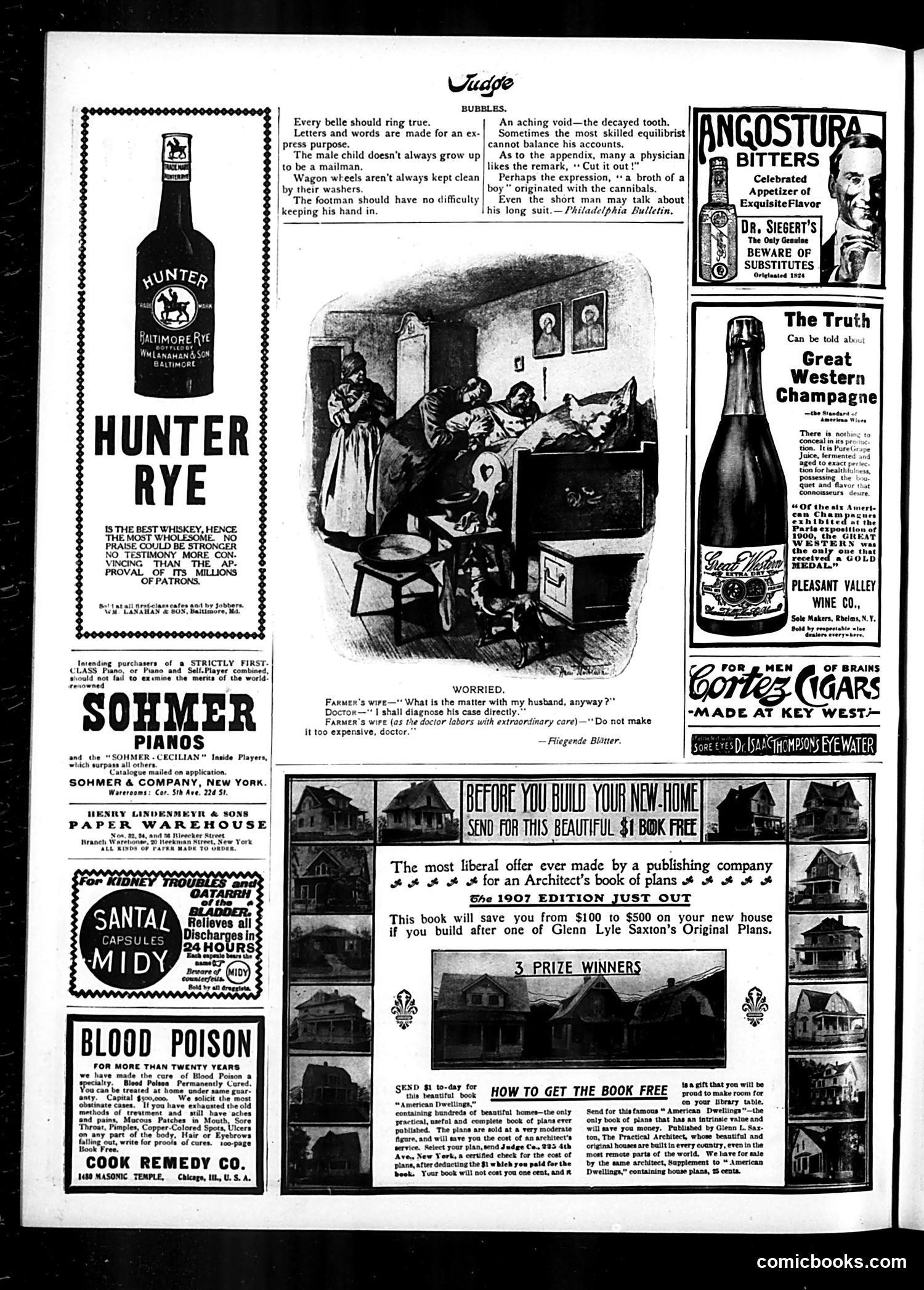
This page is primarily **advertising** with a small satirical cartoon titled "Worried." The central cartoon depicts a farmer's wife consulting a doctor about her husband's illness. The joke hinges on class anxiety: the wife interrupts the doctor's examination to ask if treatment will be "too expensive," revealing her financial worry. The caption attributes this to *Fliegende Blätter* (a German humor magazine), suggesting the joke plays on rural/working-class concerns about medical costs—a timeless concern but particularly acute in early 1900s America before health insurance existed. The surrounding content is entirely commercial advertisements for whiskey (Hunter Rye), wine, champagne, pianos (Sohmer), patent medicines (for "blood poison"), building plans, and bitters—typical Judge magazine filler. These ads reveal period consumer culture and medical quackery accepted in the era. The page lacks clear political satire; its humor is social/domestic rather than explicitly political.
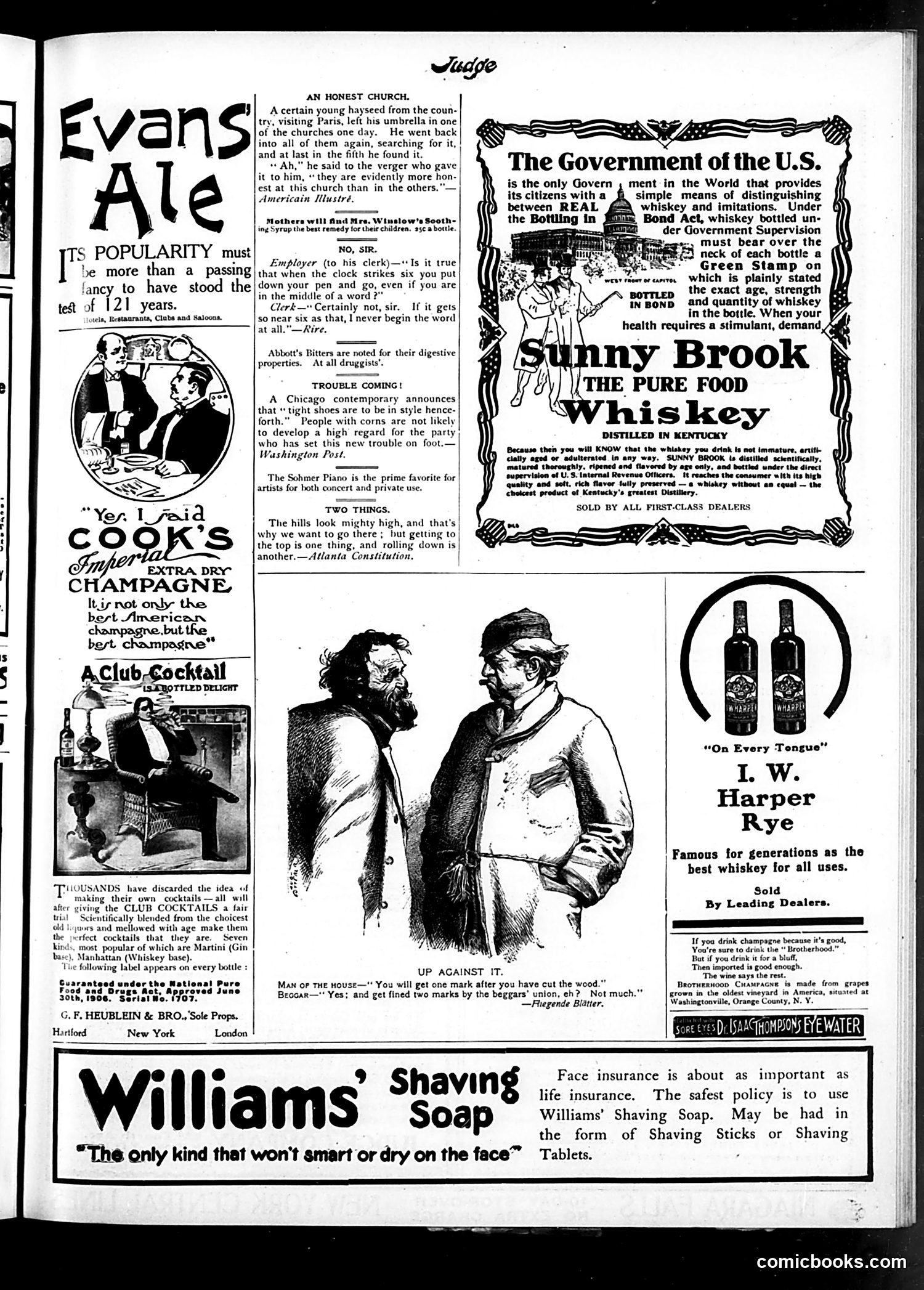
This page consists primarily of **advertising** for various alcoholic beverages and products (Evans Ale, Cook's Champagne, Sunny Brook Whiskey, I.W. Harper Rye) interspersed with brief humorous anecdotes typical of Judge magazine's satirical style. The main jokes include: 1. **"An Honest Church"** — A rural visitor assumes a Parisian church is more honest than others because he found his umbrella there, missing the irony that all churches are equally honest (or the anecdote plays on provincial naiveté). 2. **"Trouble Coming"** — Social satire mocking a Chicago fashion trend announcing tight shoes will be fashionable, suggesting this will cause suffering for those with corns. 3. **"Up Against It"** — A woodcutter refuses payment because he fears being fined by beggars' unions, satirizing labor disputes or street-level extortion. The page reflects early 1900s concerns: agricultural/urban divides, fashion absurdities, and labor relations. The heavy advertising reflects Judge's business model during the Prohibition era's approach.
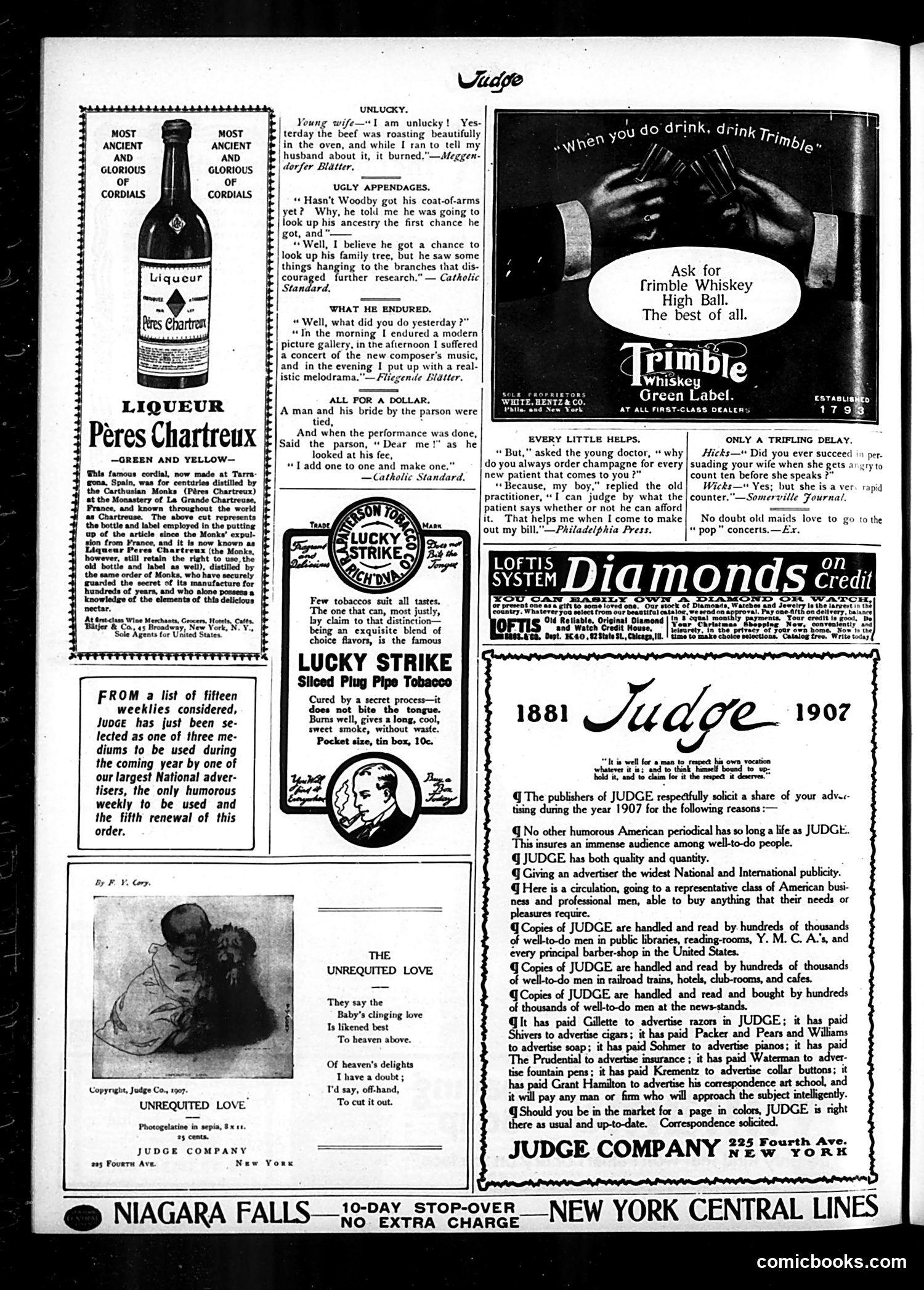
This is primarily an **advertising page** from Judge magazine (1907), featuring multiple product ads and short humorous anecdotes rather than political cartoons. The page contains: **Advertisements**: Peres Chartreux liqueur, Lucky Strike tobacco, Trimble Whiskey, Loftis Diamond credit system, and railroad promotions dominate the layout. **Brief Jokes**: Scattered throughout are short, mild humor pieces about everyday situations—a wife burning roast, a man researching embarrassing family ancestry, someone enduring modern art galleries and contemporary music. These reflect early 1900s upper-class anxieties about modernity. **"Unrequited Love" Photo Essay**: A sentimental piece about a baby's love, with accompanying photograph. **Publisher's Pitch**: The right column aggressively promotes Judge's advertising value to potential clients, claiming it reaches "well-to-do people" through libraries, barbershops, and trains. The satire is gentle and domestic rather than political—typical of Judge's mainstream humor appealing to prosperous readers.
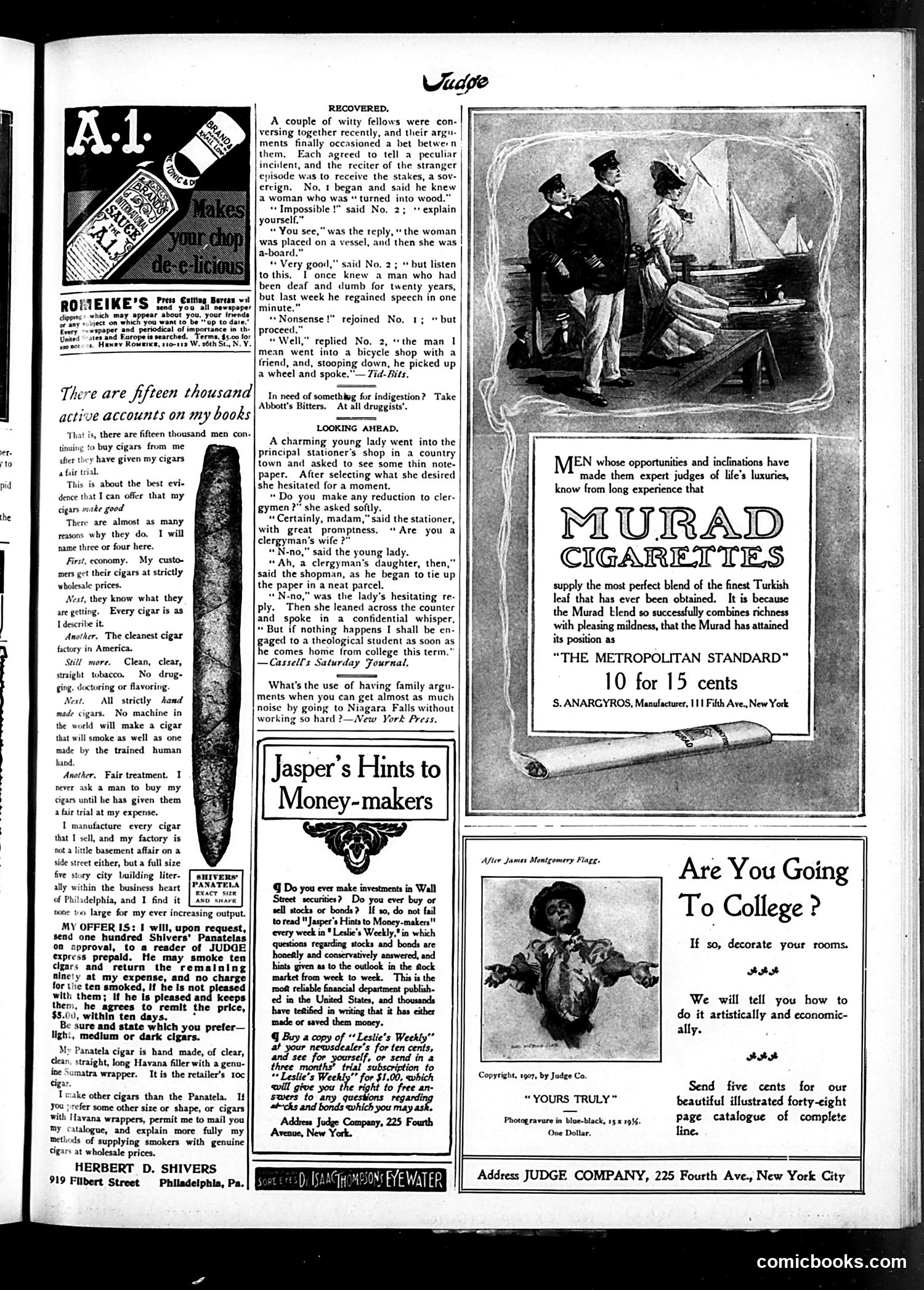
This is primarily an **advertising page** from an early 20th-century Judge magazine, dominated by cigar and consumer product ads rather than political satire. The small comic content consists of two **brief joke pieces**: 1. **"A wooden woman"** — A pun-based joke where one man claims to know a woman "turned into wood" after being placed "a-board" (aboard a ship). His friend counters with a man who "picked up a wheel and spoke" in a bicycle shop. These are wordplay jokes exploiting double meanings rather than social commentary. 2. **"Looking Ahead"** — A young woman inquires about clergy discounts at a stationer's shop. When asked if she's a clergyman's wife or daughter, she reveals she expects to become one when her boyfriend "comes home from college this term." This gently mocks courtship expectations and presumed futures. The page otherwise features extensive cigar manufacturer advertisements (Shivers Panatellas, Murad Cigarettes) and business offers typical of the era's Judge magazine format—mixing light humor with commercial content aimed at male readers.
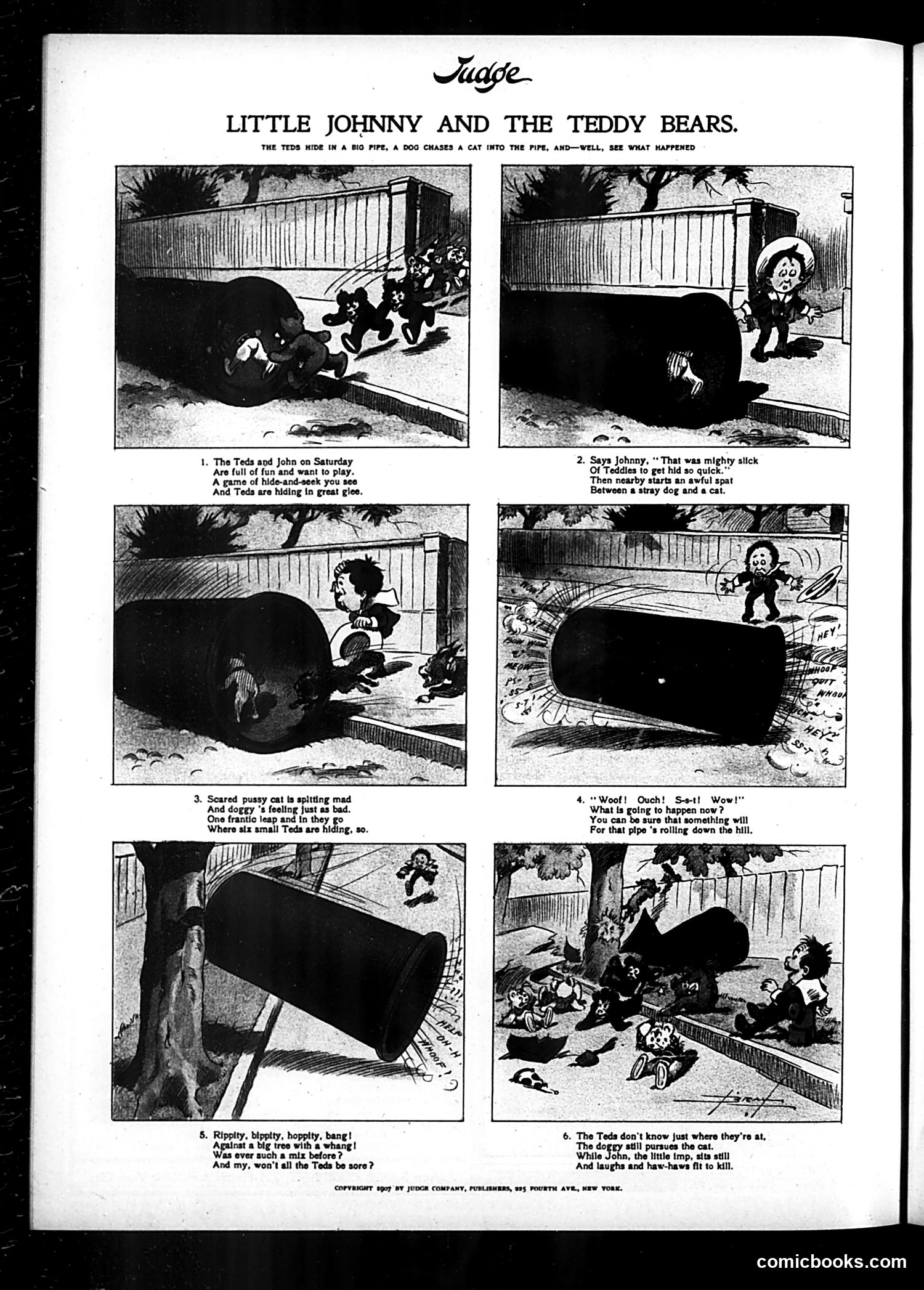
This is a children's comic strip, not political satire. It depicts a slapstick comedy sequence where young Johnny and his toy "teddy bears" play hide-and-seek, hiding in a large pipe. When a dog chases a cat into the same pipe, chaos ensues—the pipe rolls downhill with the toys and animals tumbling inside. The humor derives from physical comedy: the dog and cat fighting, the pipe careening down a hill, and the teddy bears getting jostled around while remaining oblivious to the mayhem. The "teddy bears" reference dates this to the Theodore Roosevelt era (early 1900s), when teddy bears became a popular toy named after the president. The strip's appeal is simply innocent, turn-of-the-century children's entertainment—no deeper political meaning is present.