
A complete issue · 16 pages · 1907
Judge — August 24, 1907
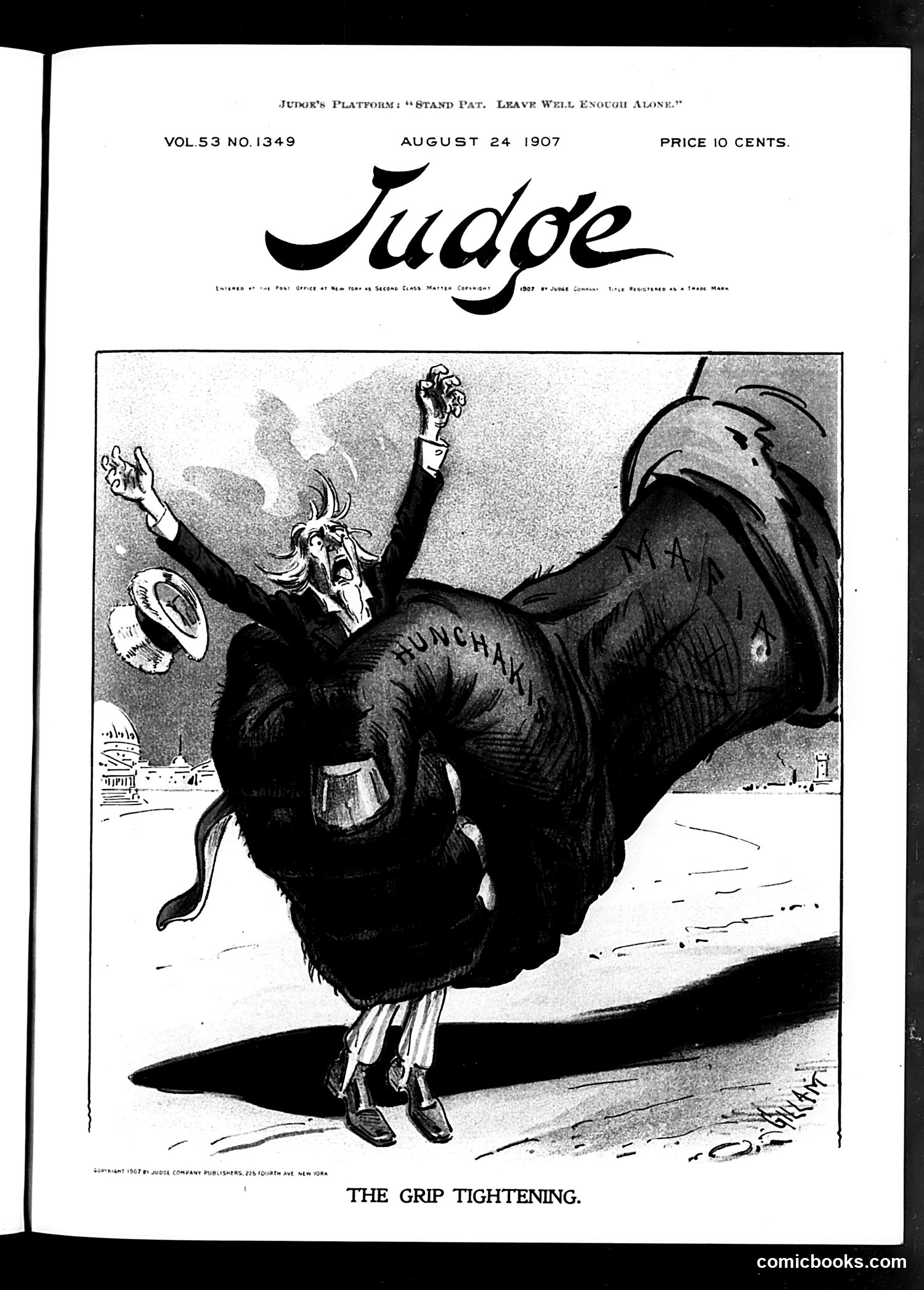
This political cartoon depicts a large, menacing figure labeled "HUNCHBACK" with a man riding on its back, arms raised in apparent distress or celebration. The figure is trampling what appears to be a Capitol building in the background. The title "The Grip Tightening" suggests increasing control or pressure. Without additional context, the specific identities and political situation are unclear. The "hunchback" likely represents a negative force or entity, while the rider may symbolize either a political figure or the American public. The Capitol's presence suggests federal government concerns. The cartoon appears to critique growing power or control during Theodore Roosevelt's administration (1907), though the exact target remains ambiguous without supporting text.
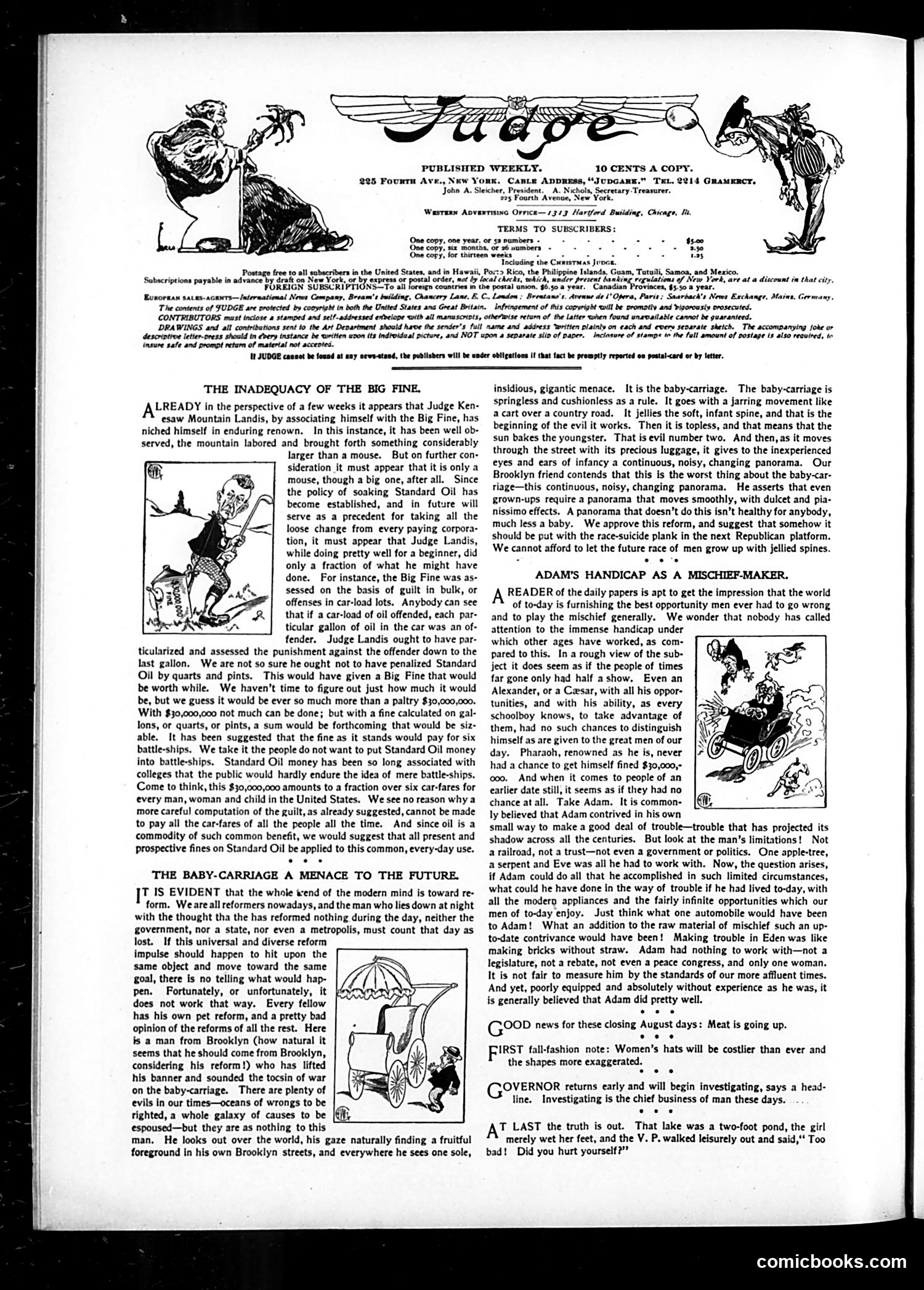
This page contains three separate satirical pieces targeting early 20th-century figures and social issues: **"The Inadequacy of the Fine"** critiques Judge Landis (baseball's commissioner) for insufficient punishment of offenders, suggesting fines pale against Standard Oil's wealth and corruption. **"The Baby-Carriage a Menace to the Future"** satirizes reformist impulses by mocking those who blame baby carriages for urban problems, arguing such thinking ignores actual systemic issues. **"Adam's Handicap as a Mischief-Maker"** appears to discuss how an underprivileged Brooklyn man lacks resources to reform society despite good intentions—contrasting his powerlessness against wealthy figures' capacity for influence. The cartoons use exaggerated illustrations and ironic commentary to expose the contradictions in Progressive Era reform movements and enforcement against the powerful.
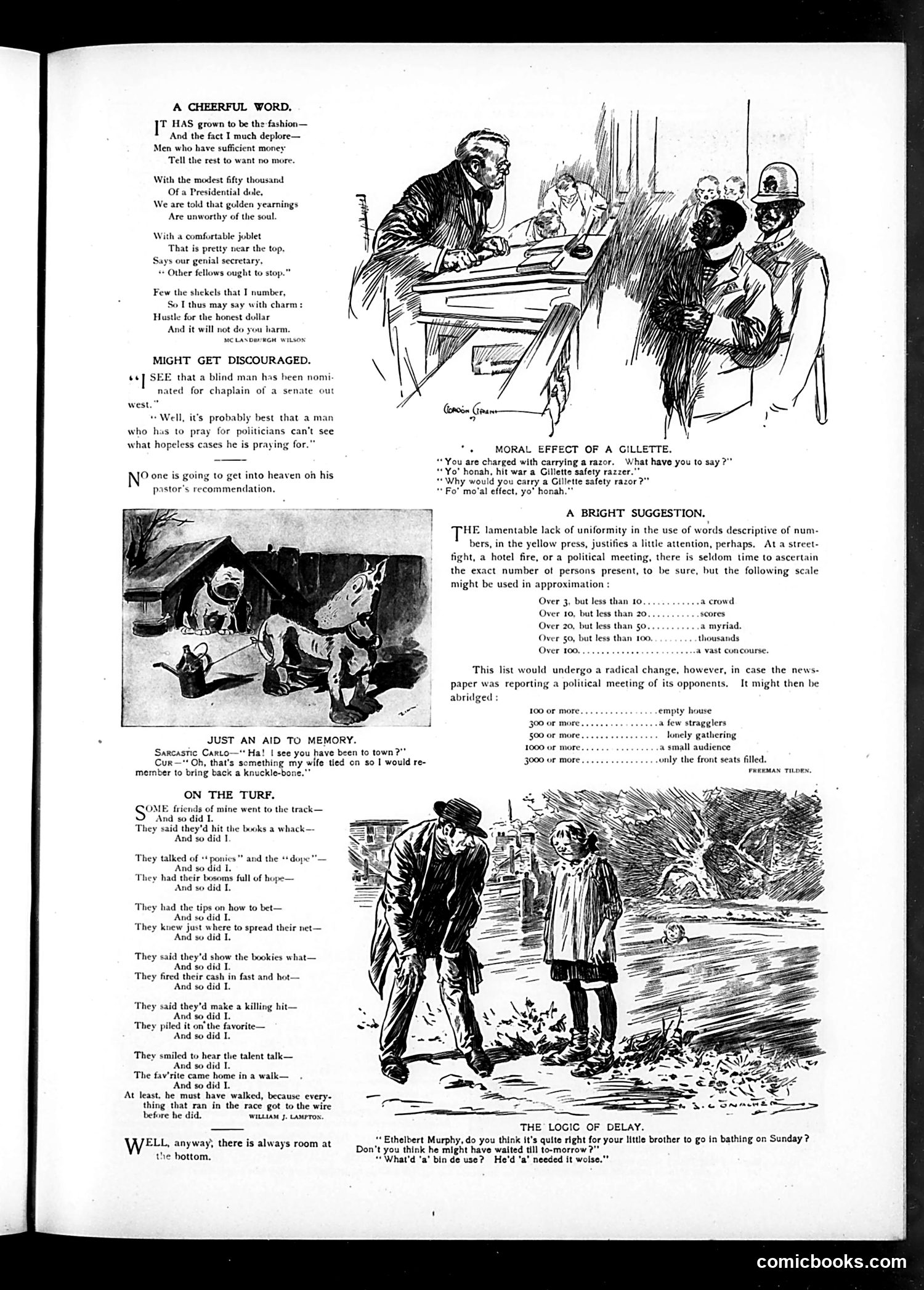
This page contains several satirical pieces critiquing American politics and social customs circa early 20th century. **"A Cheerful Word"** mocks wealthy men who've grown tired of charitable donations, suggesting they now prefer modest "fifty thousand dollar" gifts instead—satirizing how the rich rationalize reducing philanthropy. **"Moral Effect of a Gillette"** appears to joke about safety razors and masculinity, with a chaplain character asking why one would carry such a razor. **"A Bright Suggestion"** proposes standardized terminology for describing newspaper crowd sizes at political meetings, mocking imprecise journalistic reporting. **"On the Turf"** satirizes horse racing culture and gambling, depicting people making unsuccessful bets repeatedly ("and so did I"). The illustrations throughout use exaggerated caricature to critique political hypocrisy, journalistic inaccuracy, and working-class gambling habits.
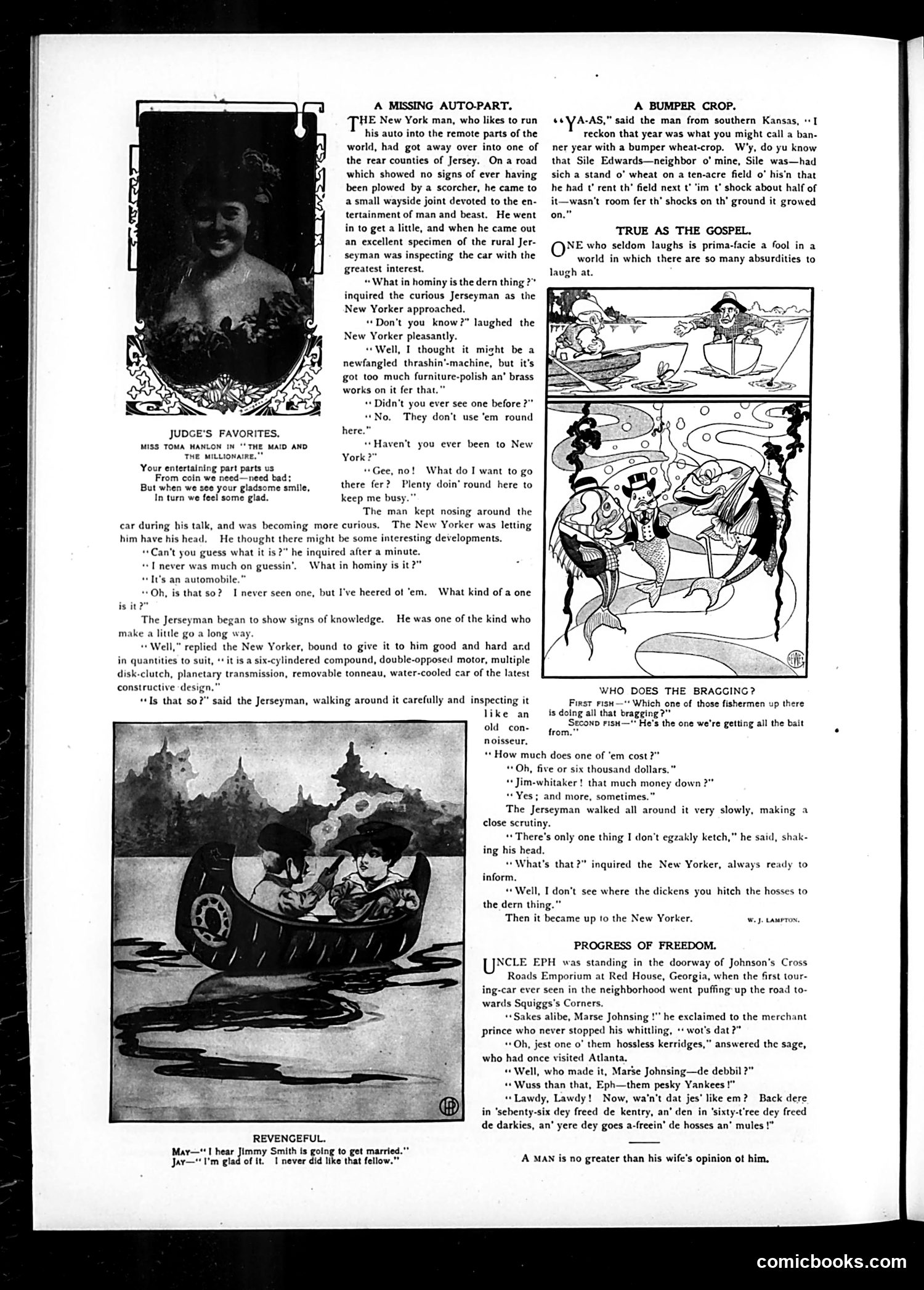
This page contains several humorous stories and cartoons reflecting early 20th-century American life: **"A Missing Auto-Part"** satirizes the newfangled automobile. A New Yorker encounters a Jersey farmer who's unfamiliar with cars, mistaking parts for farm equipment. The joke relies on urban-rural cultural divide regarding new technology. **"A Bumper Crop"** jokes about wheat farming economics, with a Kansas farmer discussing crop yields. **"True as the Gospel"** cartoon depicts people fishing and boating, illustrating the absurdity of human nature. **"Who Does the Bragging?"** shows fishermen exaggerating their catches—a timeless joke about fishing tall tales. **"Progress of Freedom"** references a touring car's arrival in rural Georgia, with dialect-heavy dialogue capturing period attitudes toward modernization and regional differences. These pieces reflect Judge's satirical focus on American social contrasts and technological change.
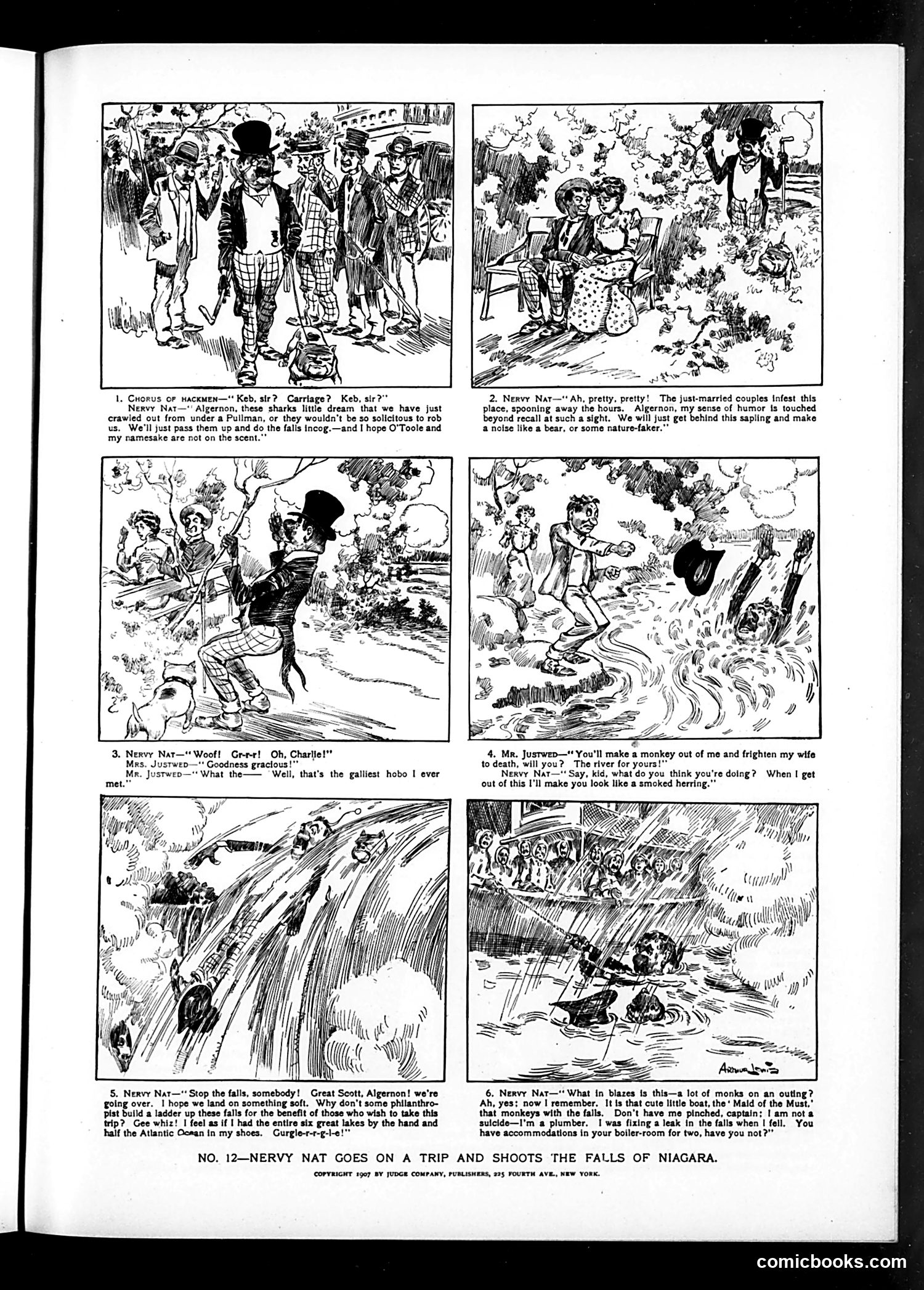
This is a comic strip titled "Nervy Nat Goes on a Trip and Shoots the Falls of Niagara" (copyright 1907, Judge Company). It depicts a character named Nat on a honeymoon trip to Niagara Falls with his new wife. The strip's humor derives from slapstick physical comedy: Nat repeatedly falls into water, gets soaked, and narrowly escapes going over the falls themselves. The joke plays on the era's common perception of Niagara Falls as both a romantic honeymoon destination and a genuinely dangerous location. The strip satirizes the contrast between newlyweds' romantic expectations and comedic misadventure. "Nervy Nat" appears to be an established character from Judge magazine, used here for situational humor rather than political satire. The content reflects early 20th-century American comic sensibilities emphasizing visual gags and physical mishaps.
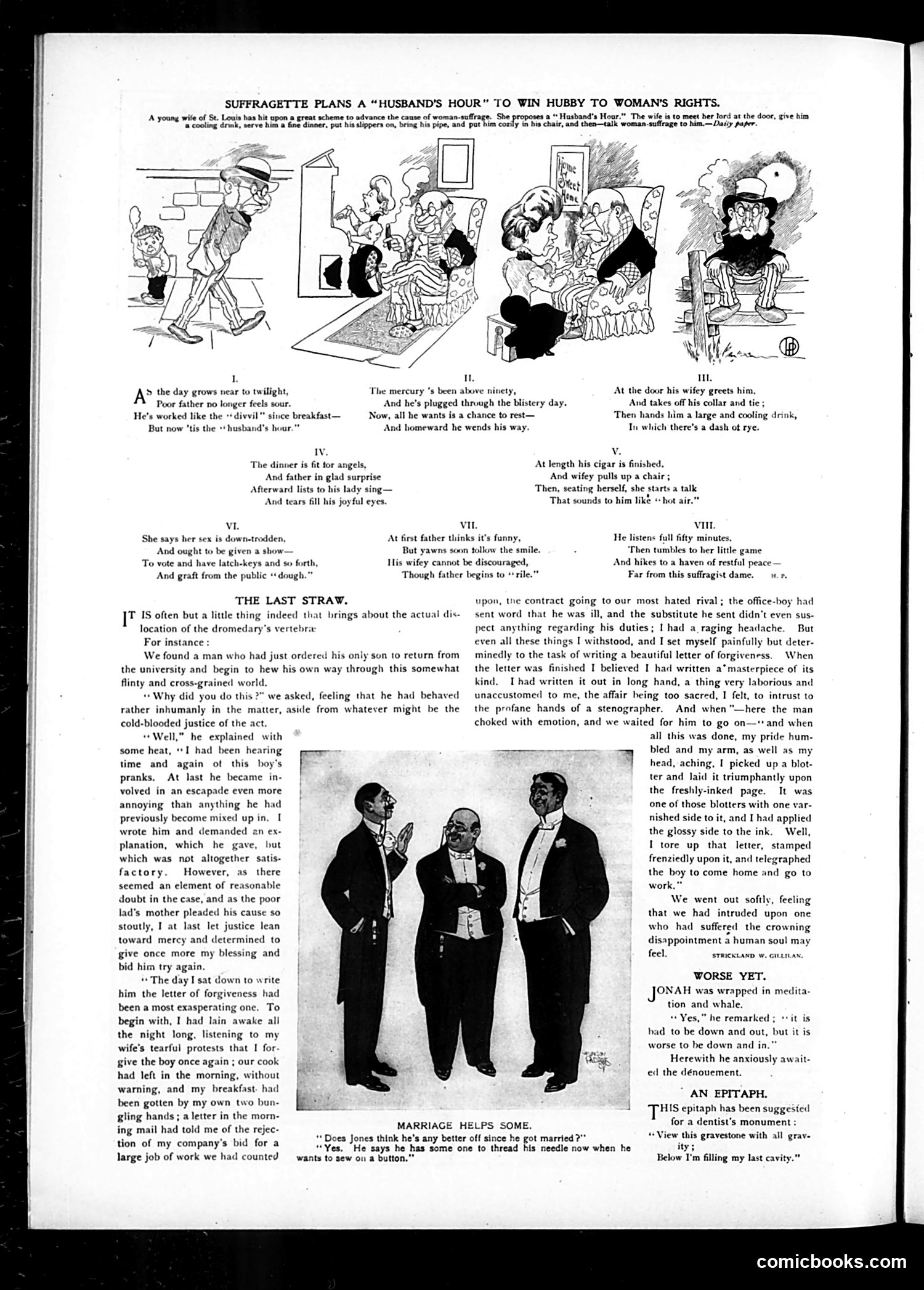
This Judge magazine page mocks suffragettes' strategy to win male support for women's voting rights. The comic strip depicts a wife's plan: she pampers her husband with dinner, slippers, and a pipe, then launches into suffrage arguments while he's relaxed and trapped. The satire ridicules both the tactic and its presumed failure. Panels show the husband initially pleased, then bored, yawning, and finally escaping to "a haven of restful peace" away from the "suffragist dame." The joke: women believe domestic comfort can manipulate men into political concessions, but husbands simply endure the talk and escape—the strategy backfires. The accompanying story "The Last Straw" uses unrelated domestic chaos to illustrate men's fragility and limited patience, reinforcing the cartoon's message that women's rights advocacy annoys rather than persuades men.
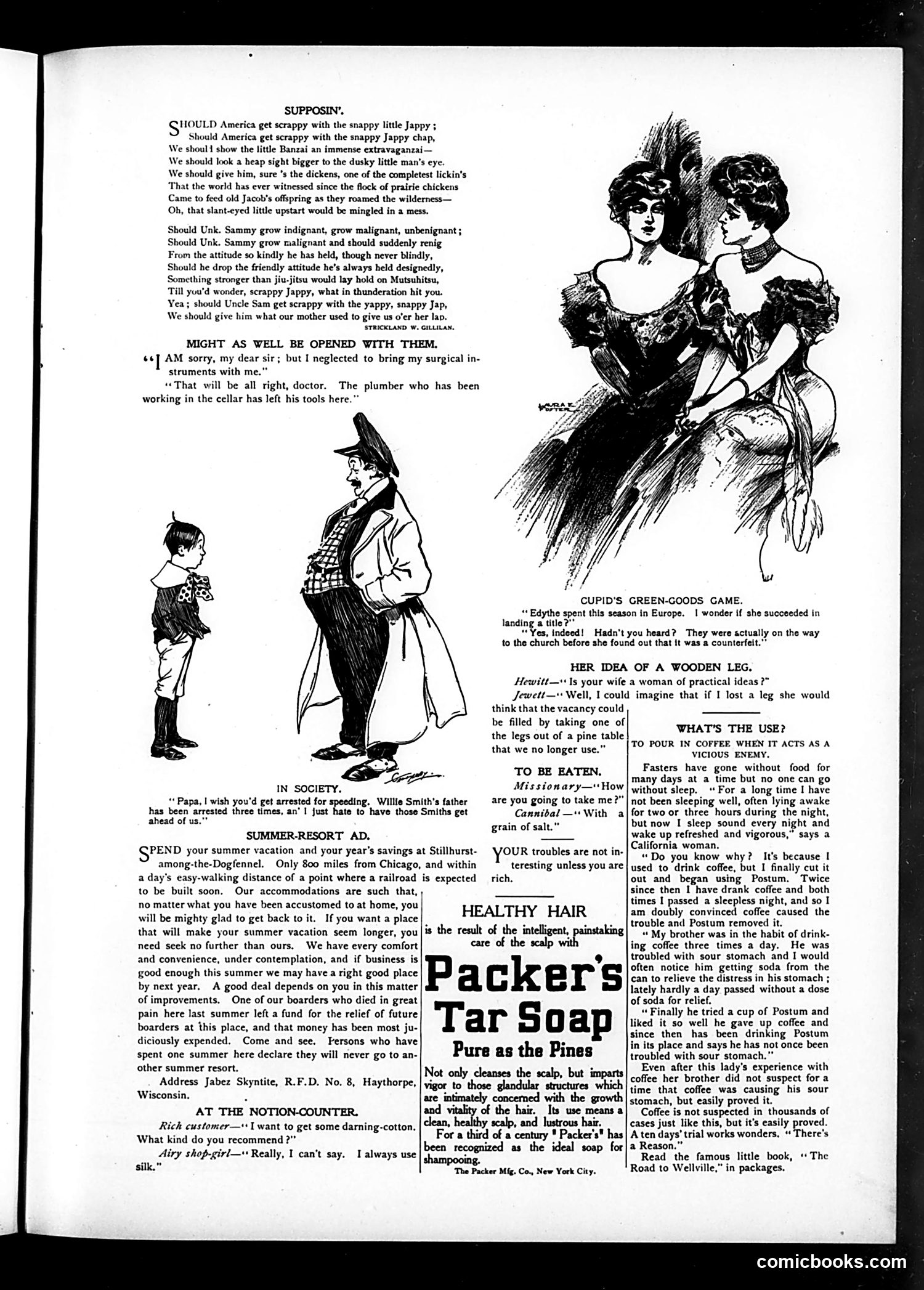
This page from *Judge* magazine contains satirical content reflecting early 20th-century attitudes: **"SUPPOSIN'" poem**: Inflammatory verse about potential U.S.-Japan conflict, using dehumanizing language ("Jappy," "dusky little man"). Reflects pre-WWI tensions and racist attitudes toward Japanese people common in American media of this era. **Cartoon humor sections**: Several brief jokes, including one about a counterfeit title (mocking women seeking aristocratic marriages abroad) and domestic humor about plumbing tools and coffee addiction. **Advertisements**: A "Packer's Tar Soap" ad and a satirical resort advertisement mocking vacation expectations. The page's overall tone—particularly the poem's militaristic braggadocio and ethnic caricature—reveals how mainstream American humor magazines openly promoted xenophobic and racist stereotypes during this period. The content would be considered deeply offensive today.
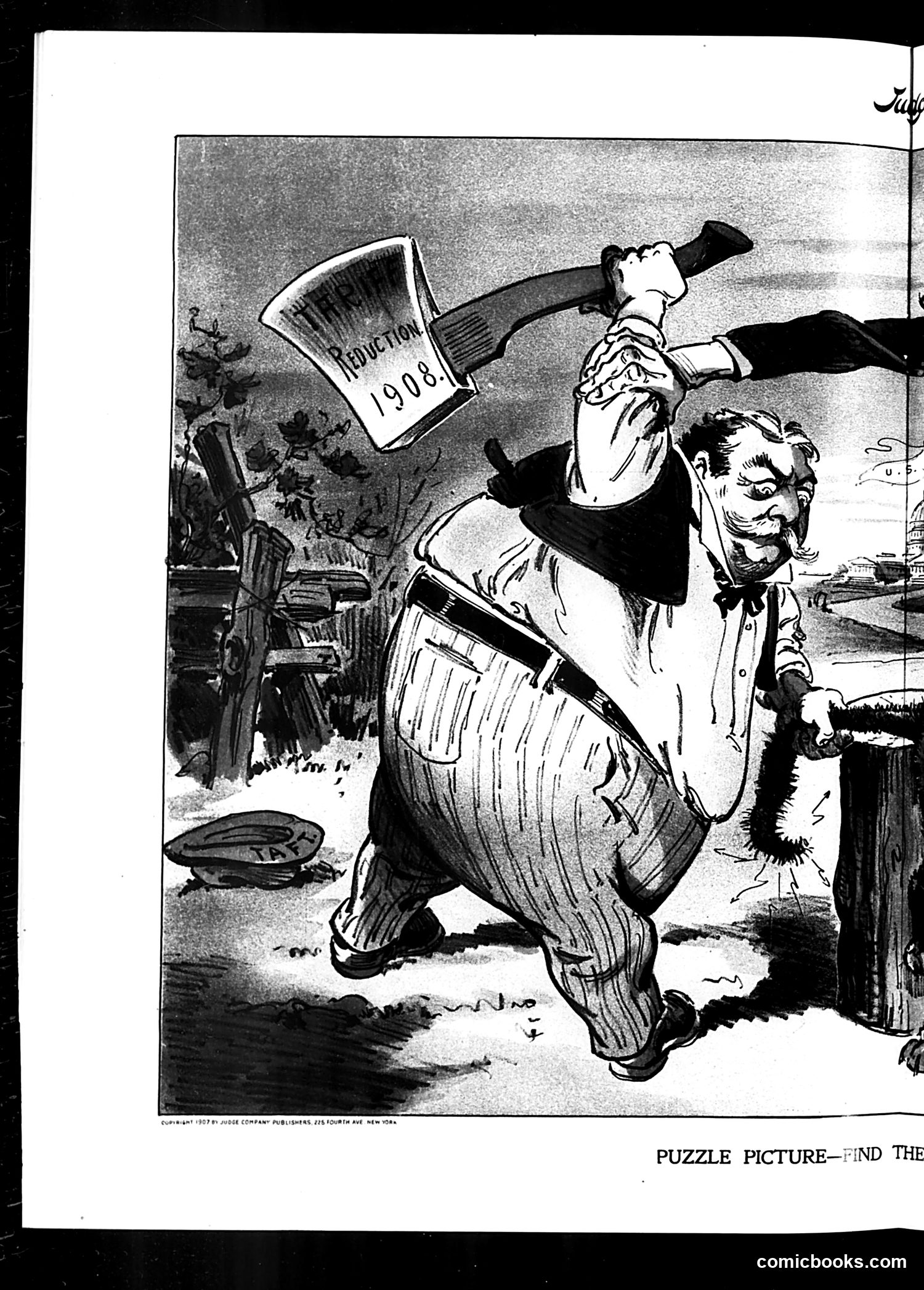
This appears to be a political cartoon from Judge magazine, though the OCR text is incomplete, cutting off mid-caption at "PUZZLE PICTURE—FIND THE..." The cartoon depicts a corpulent, caricatured figure (drawn in an exaggerated style typical of early 20th-century satire) wielding an axe labeled "REDUCTION 1908." A smaller, sinister-looking figure stands nearby. The setting appears rural or industrial. The "1908" reference and "reduction" axe suggest this concerns 1908 political events—likely Theodore Roosevelt's presidency or election dynamics. However, without the complete caption text, I cannot definitively identify the specific figures or the cartoon's exact satirical point. The "puzzle picture" format suggests readers were meant to identify hidden elements or meanings. The cartooning style and crude caricature techniques reflect attitudes common to that era's political satire.
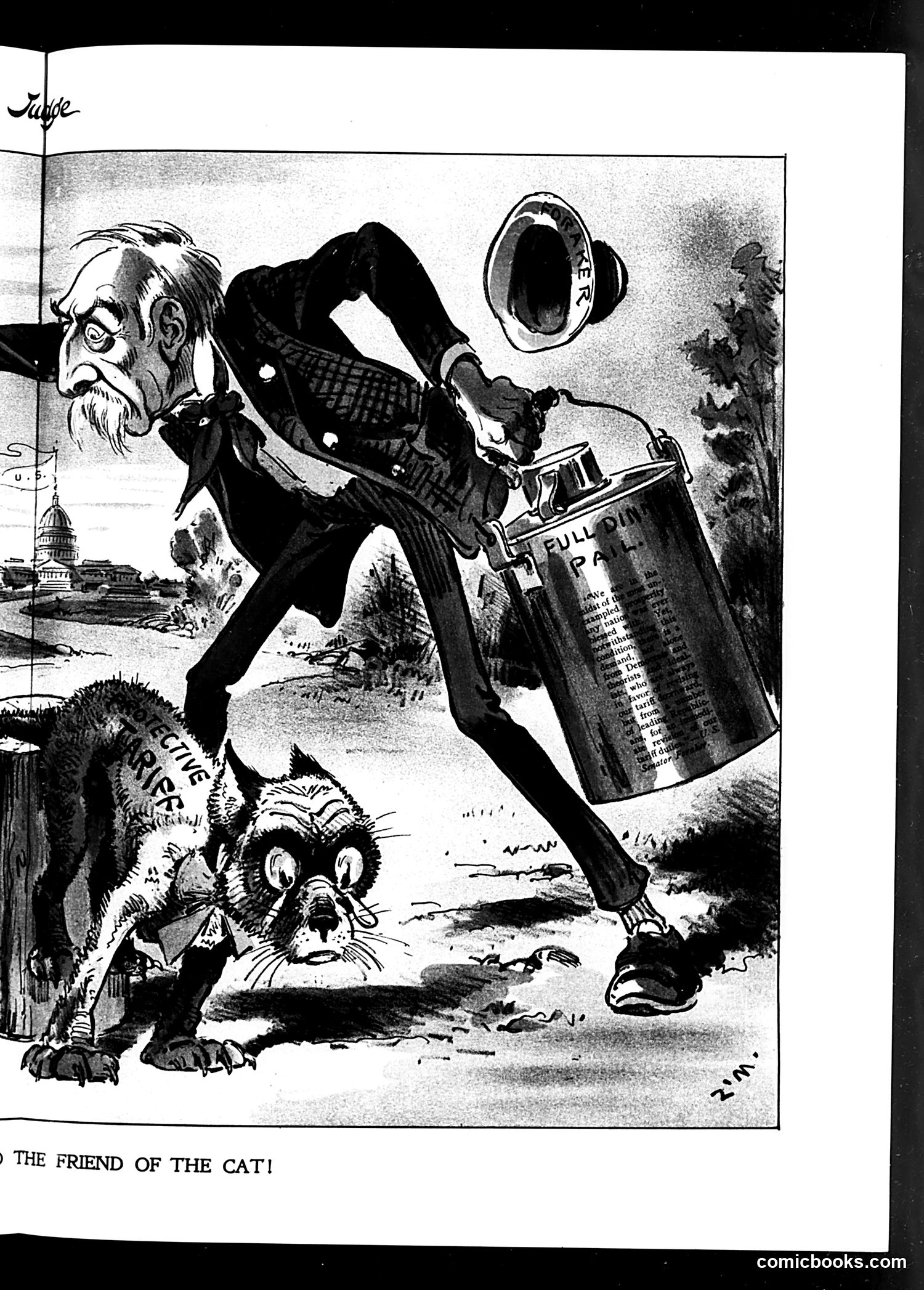
This political cartoon depicts a bearded man in formal attire wielding a large can labeled "FULL PA[IL]" (likely "Full Pail"), appearing to pour or spray its contents. A distressed cat cowers below him. The Capitol building is visible in the background, suggesting a Washington political figure. The satire likely criticizes a politician for actions harmful to common people (represented by the vulnerable cat). The "full pail" container suggests excessive dumping of something undesirable—possibly referring to corrupt legislation, unfair policies, or political malfeasance. Without the magazine's date and additional context, the specific politician and issue remain unclear, but the cartoon employs typical Progressive-era Judge magazine satire: using animal suffering to critique political abuse of power.
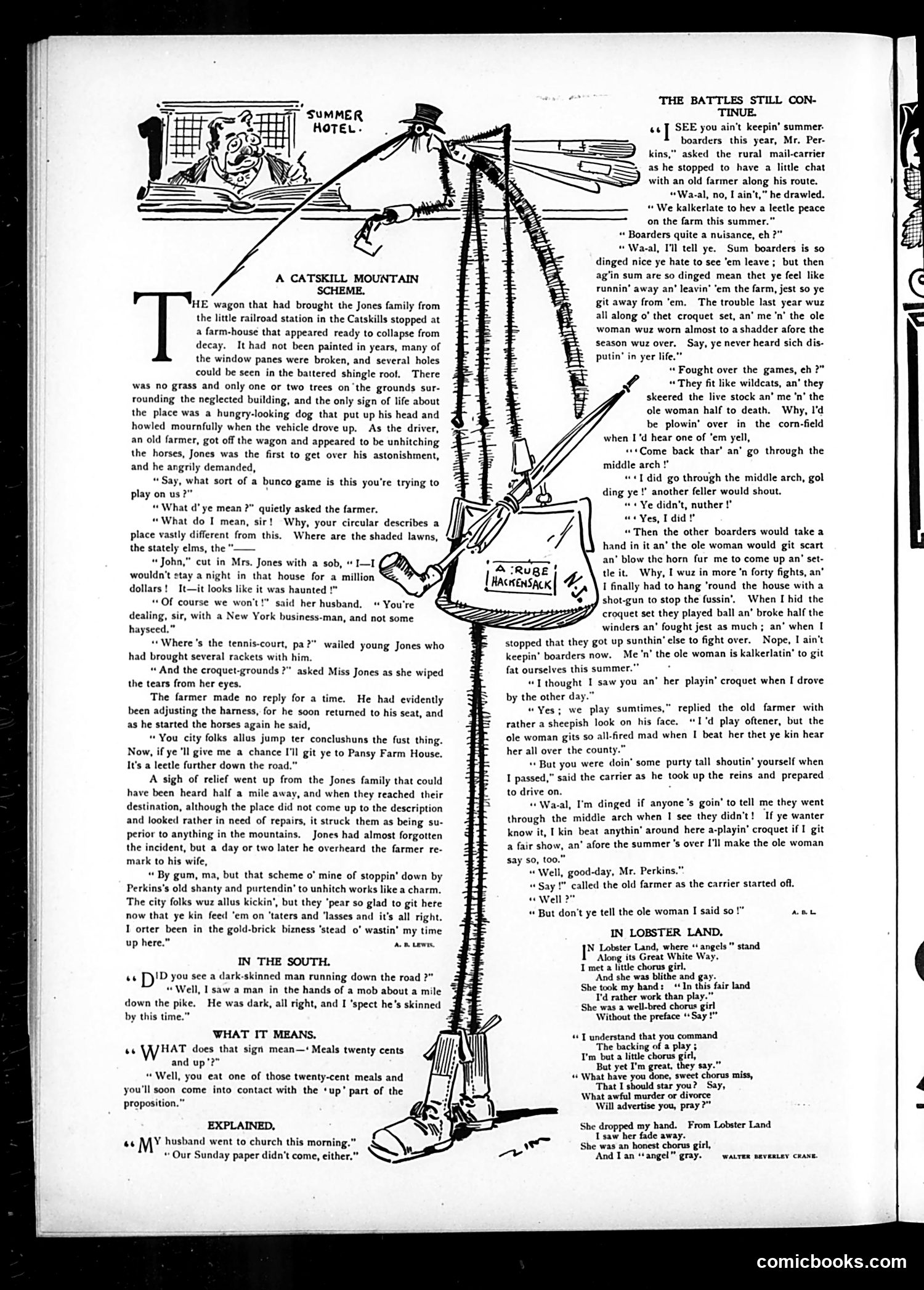
This Judge magazine page contains several satirical pieces about rural hospitality and social deception. **"A Catskill Mountain Scheme"** (main cartoon): A New York City family arrives at what they believe is a nice summer hotel, only to find a dilapidated farmhouse. The farmer reveals he intentionally brought them to the wrong location first as a "bunco" (confidence) scheme—a trick to make the actual farm seem better by comparison. The satire mocks both the dishonest rural con artist and the gullible city folk who fall for it, while also critiquing false advertising in the tourism industry. The smaller pieces mock rural dialect and ignorance ("Waz-al"), overpriced meals, and a dark joke about Southern racial violence ("skinned by this time"). The overall theme: city dwellers seeking country retreats encounter rural trickery and lowered expectations—a common Judge topic about the clash between urban sophistication and rural cunning.
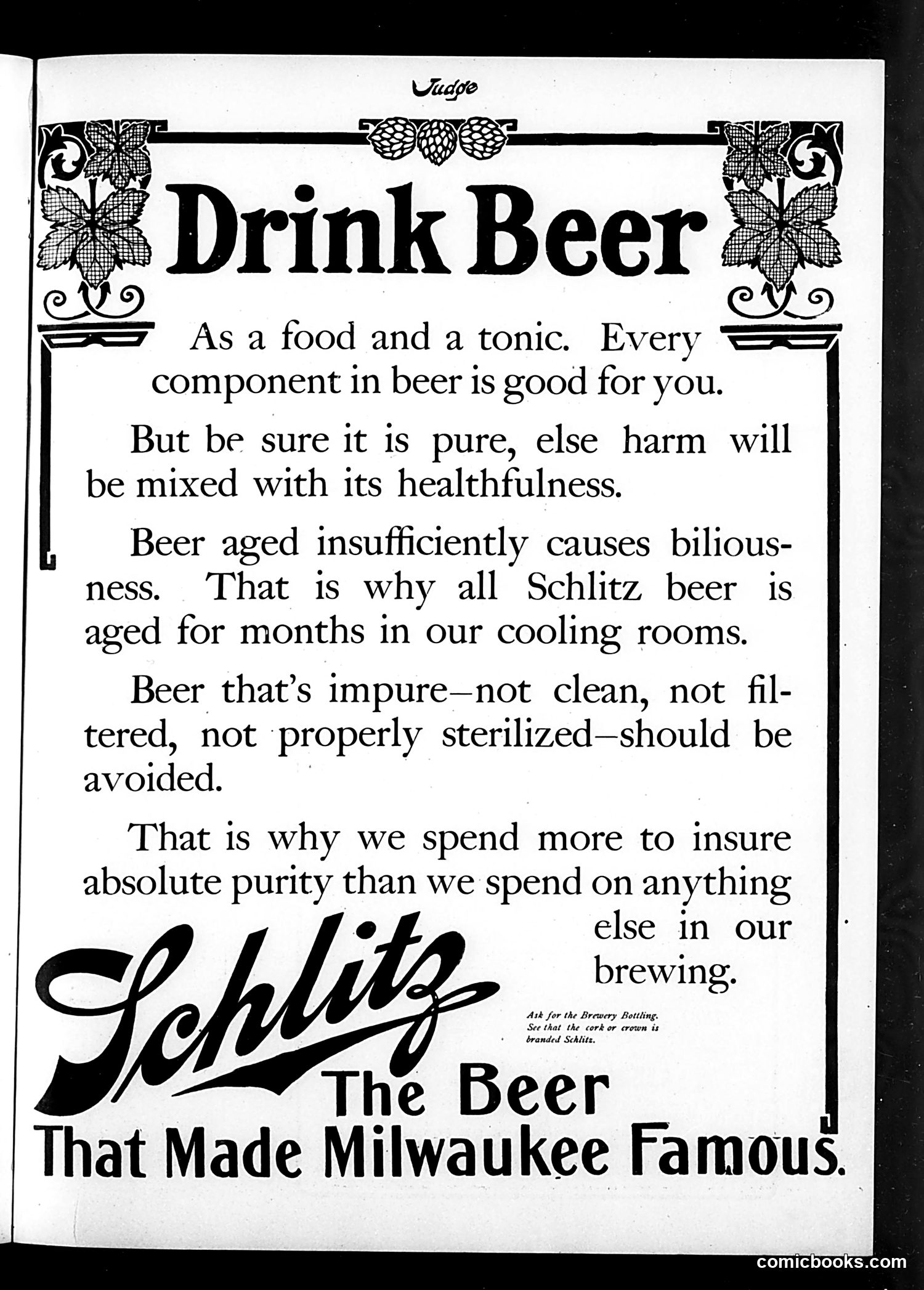
This is primarily **advertising content, not satire**. It's a Schlitz beer advertisement from Judge magazine promoting the brand's purity and quality. The ad makes health claims typical of early 20th-century beer marketing—positioning beer as both a "food and tonic" with medicinal benefits. It emphasizes Schlitz's superior manufacturing practices: extended aging, cleaning, filtering, and sterilization to ensure "absolute purity." The messaging reflects contemporary concerns about contaminated food and beverages (pre-FDA regulation era) and positions Schlitz as the safer, more scientifically-produced choice. The tagline "The Beer That Made Milwaukee Famous" was Schlitz's actual slogan during this period. The decorative art-nouveau border with hops imagery is typical Judge magazine styling. This is straightforward product promotion rather than satirical commentary.
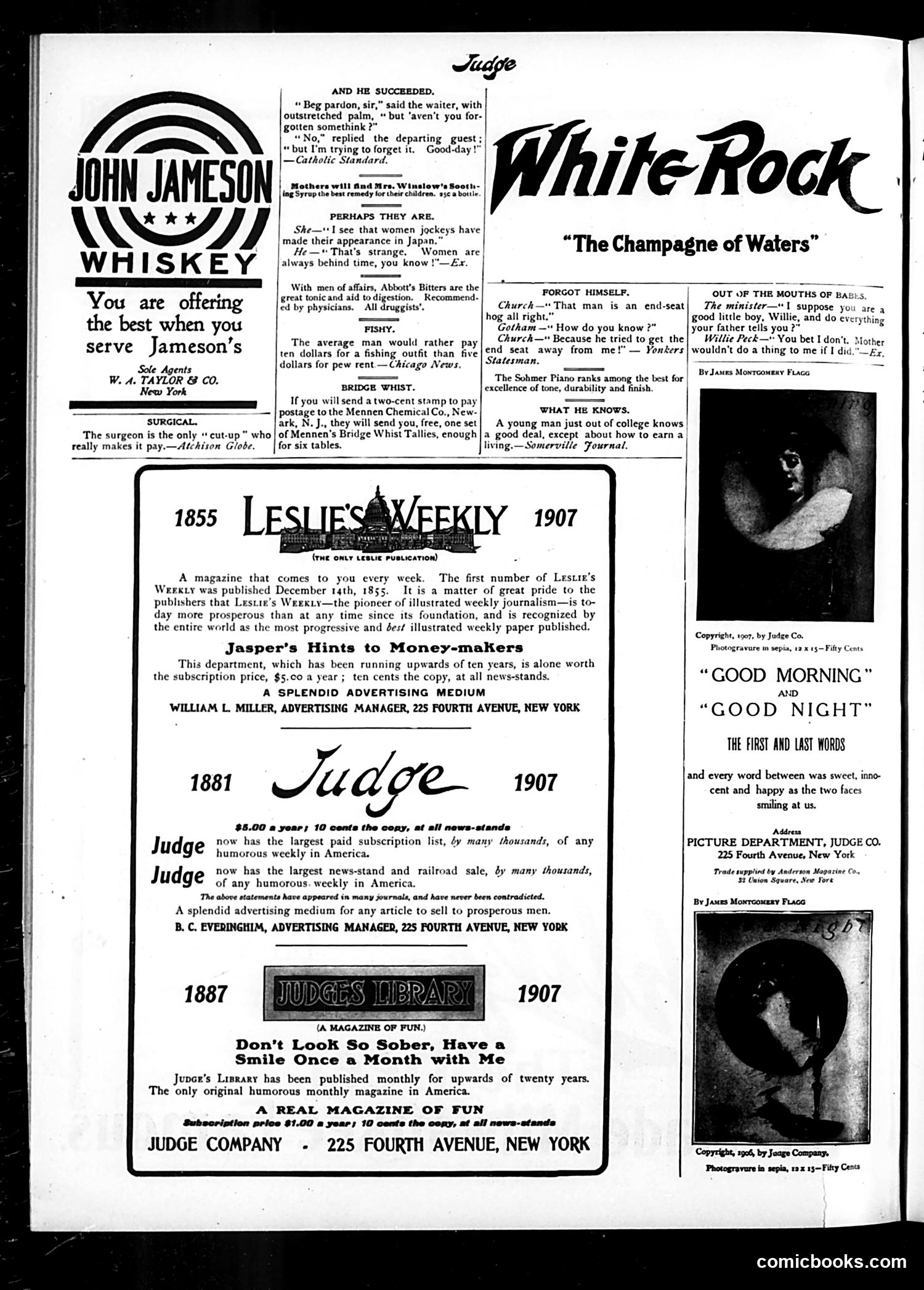
This page is primarily **advertising and promotional material** for Judge magazine and related publications, with brief humorous snippets interspersed. The small cartoons/jokes reference contemporary social issues: women appearing as jockeys in Japan (mocking assumptions about gender roles), a waiter expecting a tip (social commentary on service industry customs), and a college graduate's ignorance about earning a living (satirizing elite education's impracticality). The page showcases Judge's sister publications—Leslie's Weekly (founded 1855), Judge's Library, and Judge itself—all emphasizing their large circulation and advertising reach to wealthy readers. The tagline "The Champagne of Waters" for White Rock mineral water exemplifies the era's marketing to prosperous audiences. Most content consists of testimonials about circulation numbers and advertising value, reflecting Judge's business model: reaching "prosperous men" through humorous content that attracted affluent subscribers desirable to advertisers.
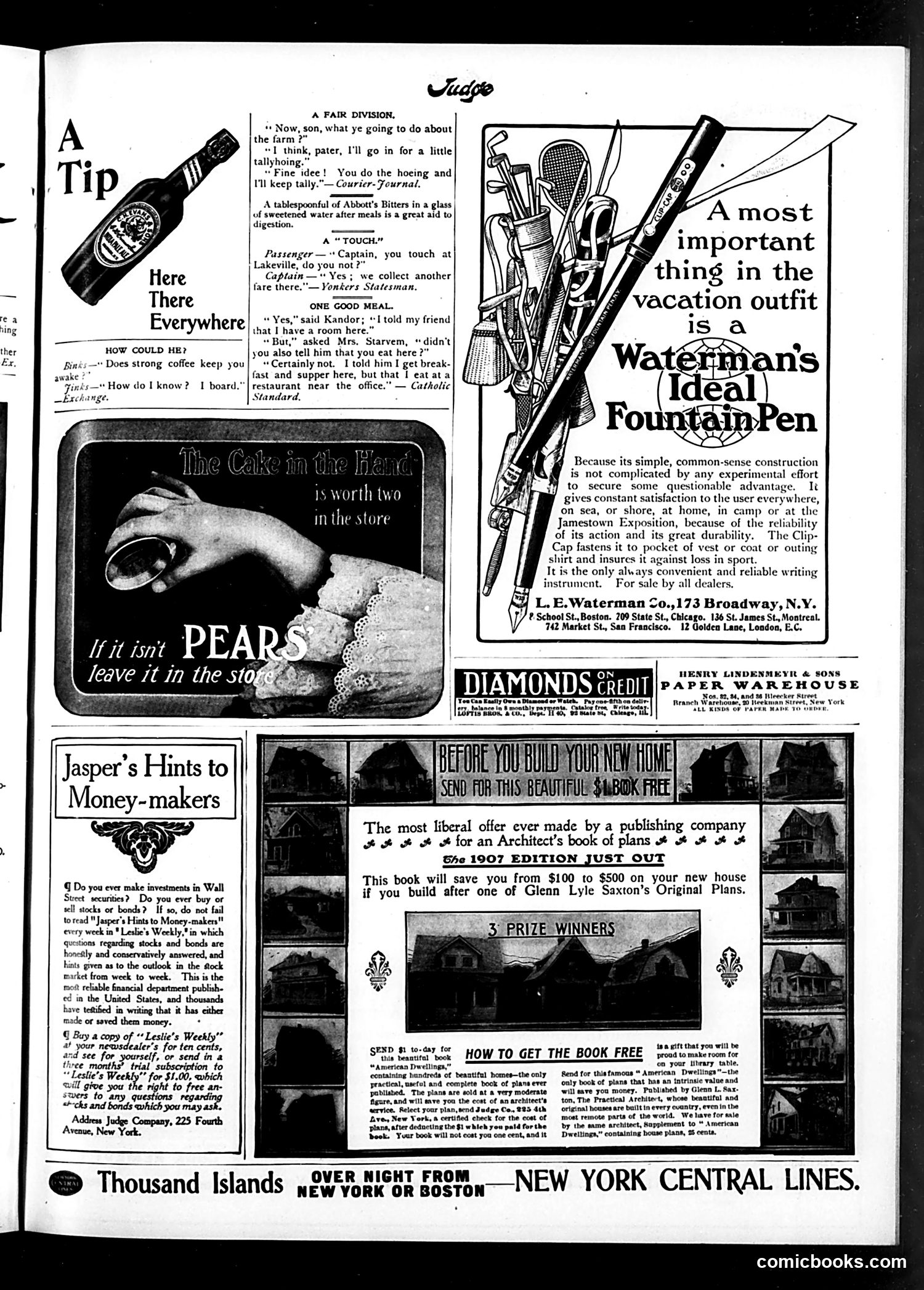
This page is primarily **advertising**, not political satire. It contains multiple product advertisements from the early 1900s (around 1907 based on visible dates). The small humorous items ("A Fare Division," "A Touch," etc.) are brief jokes—typical filler content in magazines of this era—rather than cartoons with political meaning. They poke gentle fun at everyday situations: a father and son discussing farm work, a ship captain collecting fares, and people discussing meals and lodging. The main advertisements promote: - **Abbott's Bitters** (digestive aid) - **Waterman's Ideal Fountain Pen** (vacation essential) - **Diamonds on credit** (jewelry) - **Glenn Lyle Saxton's house-plan books** (architecture) - **Leslie's Weekly** (investment advice column) - **New York Central Lines** (railroad travel) The "Jasper's Hints to Money-makers" section advertises investment advice in Leslie's Weekly. There is no discernible political satire or social commentary on this particular page.
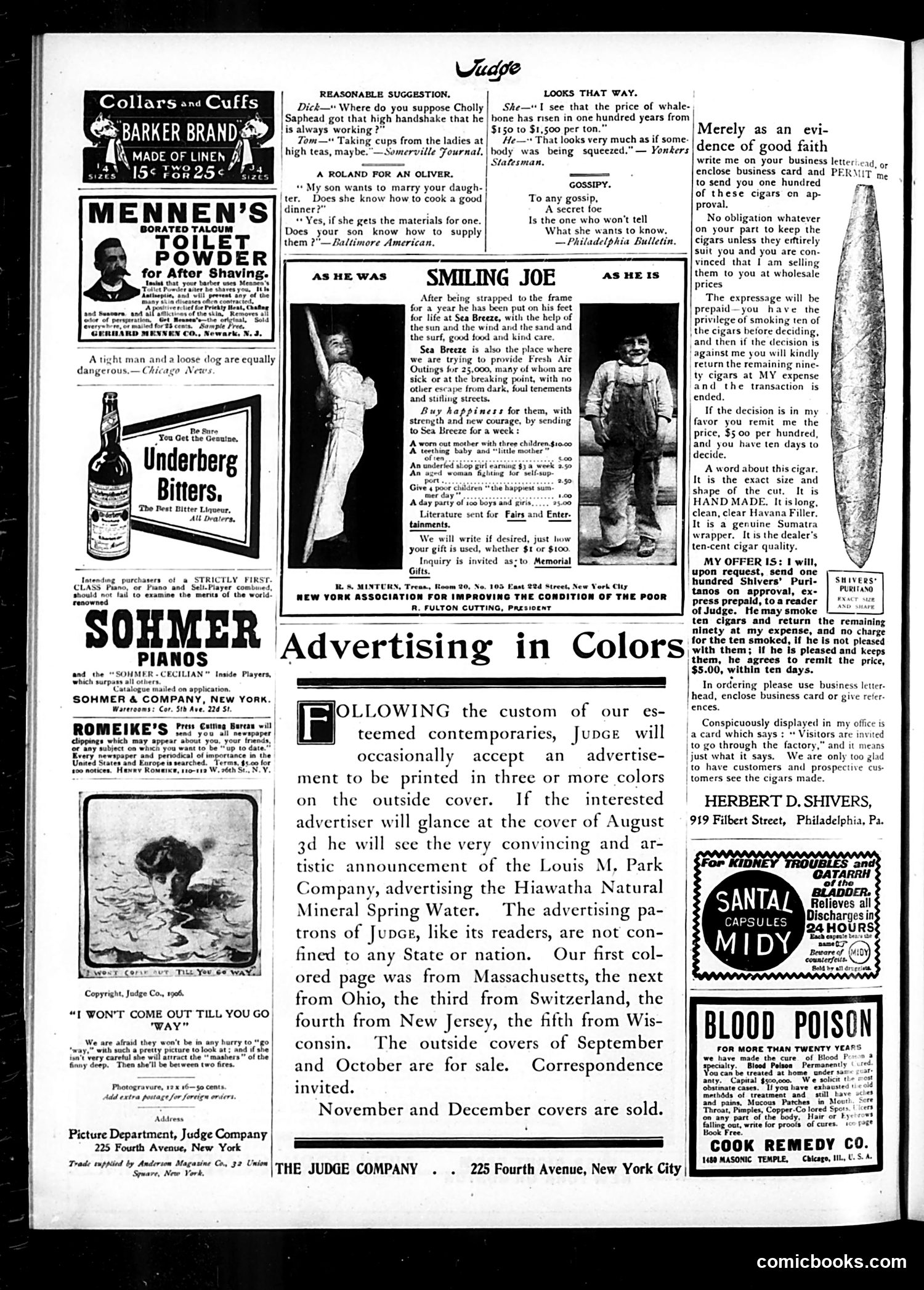
This page is primarily **advertising and announcements** rather than political satire. The content includes: **Small Comic Vignettes:** Brief jokes about social etiquette—a man's "high handshake" from attending ladies' teas, a marriage proposal conditional on cooking ability, and gossip about whalebone corset prices rising (implying women are being "squeezed"). **Social Service Content:** "Smiling Joe" describes the Fresh Air Fund, a charitable organization providing seaside respite for poor New Yorkers, particularly mothers and children from tenements. This reflects Progressive Era philanthropy. **Main Feature:** An announcement that *Judge* will now accept color advertisements on outside covers, highlighting the magazine's national reach and modern capabilities. **Period Context:** The advertisements (Mennen's talc, Underberg bitters, Sohmer pianos) and the casual sexism in the jokes typify early 1900s commercial culture. The charitable appeal and technological innovation demonstrate the era's mix of industrial advancement with emerging social consciousness.
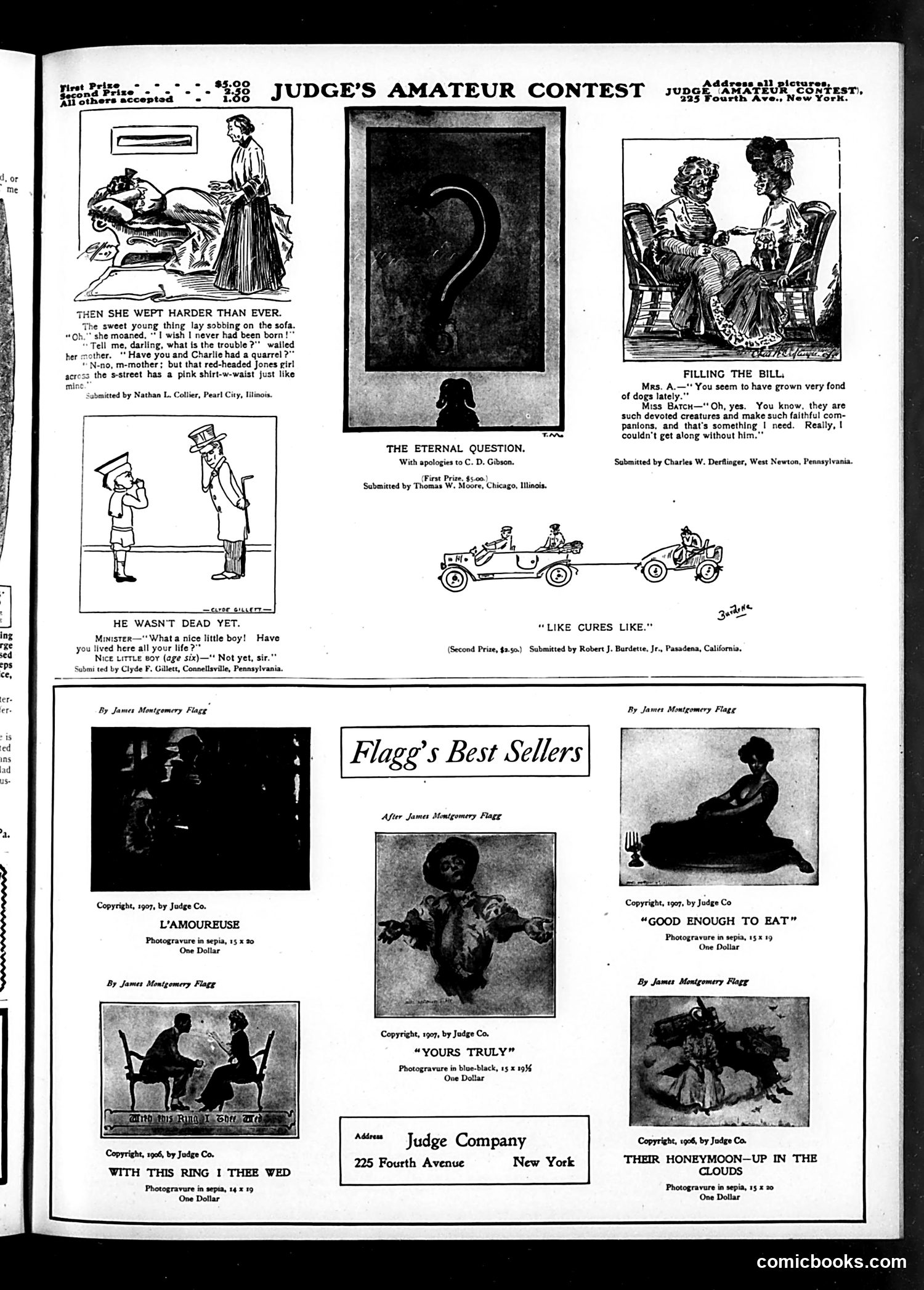
This page showcases humorous amateur submissions to Judge's comedy contest, circa 1907. The cartoons mock everyday social situations: **"Then She Wept Harder Than Ever"**: A young woman is devastated not by romantic rejection but because a rival girl owns an identical pink shirt-waist—satirizing female vanity and fashion obsession. **"He Wasn't Dead Yet"**: A child's naive response to "Have you lived here all your life?" ("Not yet, sir") humorously suggests he expects to die soon, poking fun at children's literal interpretations. **"The Eternal Question"**: A silhouette cartoon addressing an unspecified eternal question (Gibson's reference unclear without context). **"Filling the Bill"** and **"Like Cures Like"**: Mock romantic/social situations with predictable punchlines. The page also advertises James Montgomery Flagg art prints available through Judge Company—typical of early 1900s magazine merchandising. These amateur submissions represent the magazine's appeal to ordinary readers' humor and observations about courtship, fashion, and domestic life.
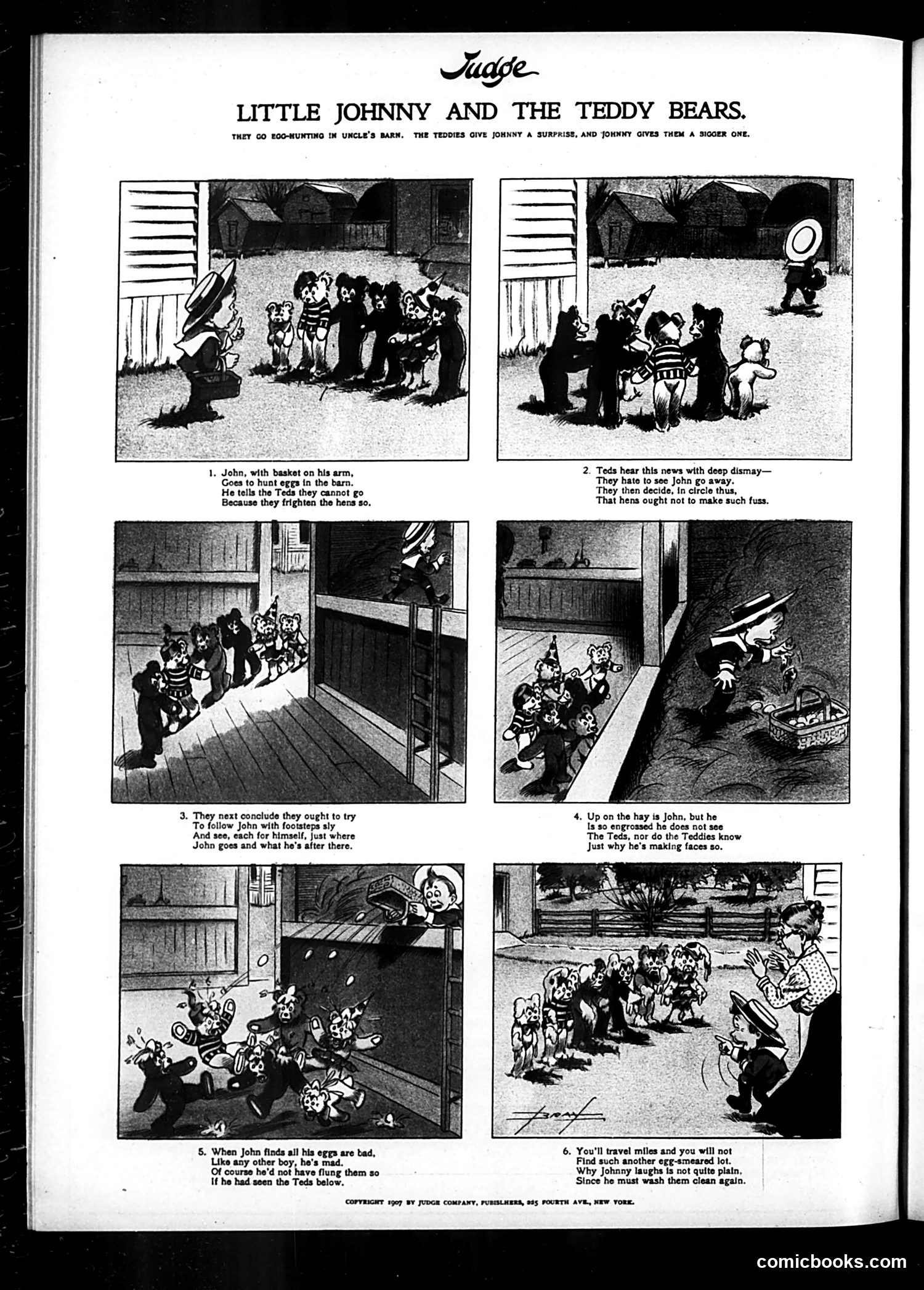
This is a children's comic strip—not political satire—featuring "teddy bears," stuffed toys named after President Theodore Roosevelt (a popular fad in the early 1900s). The plot: Young Johnny goes egg-hunting in a barn while his teddy bears, upset at being left behind, secretly follow him. Johnny, unaware of their presence, becomes frustrated when he finds rotten eggs and angrily throws them. The bears, positioned below him, get pelted with the mess. The joke concludes with ironic observations: Johnny doesn't realize why the bears are there, and he's now covered in egg despite needing to wash clean anyway. The humor is gentle, slapstick comedy aimed at children—the teddy bears' misguided attempt to follow Johnny backfires comically. No deeper political meaning is evident; it's simply playful entertainment capitalizing on the teddy bear craze of that era.