
Judge, 1907-08-24 · page 4 of 16
Judge — August 24, 1907 — page 4: what you’re looking at
What you’re looking at
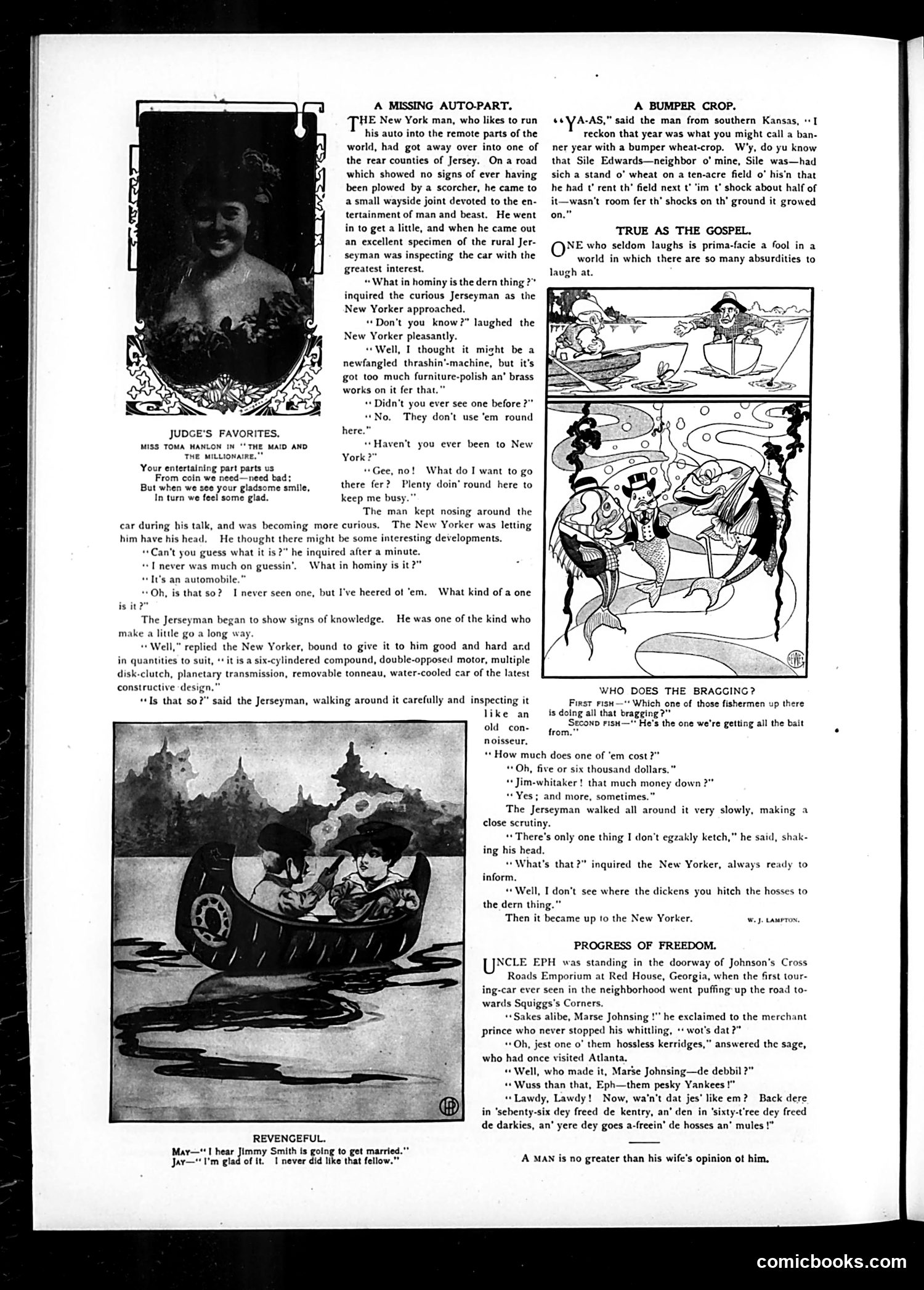
This page contains several humorous stories and cartoons reflecting early 20th-century American life: **"A Missing Auto-Part"** satirizes the newfangled automobile. A New Yorker encounters a Jersey farmer who's unfamiliar with cars, mistaking parts for farm equipment. The joke relies on urban-rural cultural divide regarding new technology. **"A Bumper Crop"** jokes about wheat farming economics, with a Kansas farmer discussing crop yields. **"True as the Gospel"** cartoon depicts people fishing and boating, illustrating the absurdity of human nature. **"Who Does the Bragging?"** shows fishermen exaggerating their catches—a timeless joke about fishing tall tales. **"Progress of Freedom"** references a touring car's arrival in rural Georgia, with dialect-heavy dialogue capturing period attitudes toward modernization and regional differences. These pieces reflect Judge's satirical focus on American social contrasts and technological change.
📄 Transcribed text from this page (OCR, searchable)
Machine-transcribed from the original scan — historical spelling and the odd misread are preserved.
A MISSING AUTO-PART. THE New York man, who likes to run his auto into the remote parts of the world, had got away over into one of the rear counties of Jersey. On a road A BUMPER CROP. 40VA-AS," said the man from southern Kansas, «1 reckon that year was what you might call a ban- ner year with a bumper wheat-crop. W'y, do yu know that Sile Edwards—neighbor o' mine, Sile was—had sich a stand o° wheat on a ten-acre field o° his'n that he had t’ rent th’ field next t' ‘im t’ shock about half of it—wasn't room fer th’ shocks on th’ ground it growed which showed no signs of ever having been plowed by a scorcher, he came to a small wayside joint devoted to the en- tertainment of man and beast. He went on. in to get a little, and when he came out an excellent specimen of the rural Jer- seyman was inspecting the car with the greatest interest. « What in hominy is the dern thing ?” inquired the curious Jerseyman as the New Yorker approached. “Don't you know?" laughed the New Yorker pleasantly. “Well, I thought it might be a newfangled thrashin'-machine, but it’s got too much furniture-polish an’ brass works on it fer that." ++ Didn't you ever see one before ?” ‘0. They don’t use ‘em round TRUE AS THE GOSPEL. NE who seldom laughs is prima-facie a fool in a world in which there are so many absurdities to here.” “Haven't you ever been to New York ? “Gee, no! What do I want to go there fer? Plenty doin’ round here to keep me busy.” The man kept nosing around the car during his talk, and was becoming more curious. The New Yorker was letting him have his head. He thought there might be some interesting developments. “Can't you guess what it is?” he inquired after a minute. What in hominy is it?” JUDGE'S FAVORITES. MISS TOMA HANLON IN ‘THE MAID AND THE MILLIONAIRE,"* Your entertaining part parts us From coin we need—need bad; But when we see your gladsome smile, In turn we feel some glad. * [never was much on guessin’, It’s an automobile.” Oh, is that so? I never seen one, but I've heered of ‘em, What kind of a one is it? The Jerseyman began to show signs of knowledge. make a little go a long way. He was one of the kind who “Well,” replied the New Yorker, bound to give it to him good and hard and dered compound, double-opposed motor, multiple disk-clutch, planetary transmission, removable tonneau, water-cooled car of the latest in quantities to suit, + it is a six-cy WHO DOES THE BRAGGING? First ris —‘ Which one of those fishermen up there is doing all that bragging?” rom eoN FiSH—"" He's the one we're getting all the bait from."* constructive design, «Is that so?” said the Jerseyman, walking around it carefully and inspecting it like an old con- noisseur, ** How much does one of ‘em cost?” ** Oh, five or six thousand dollars.” jim-whitaker! that much money down ?” ++ Yes; and more, sometimes.” The Jerseyman walked all around it very slowly, making a close scrutiny. «There's only one thing I don’t egzakly ketch,” he said, shak- ing his head. “What's that?” inquired the New Yorker, always ready to inform. “Well, I don’t see where the dickens you hitch the hosses to the dern thing.” Then it became up to the New Yorker. Wj. Lauro PROGRESS OF FREEDOM. [UNCLE EPH was standing in the doorway of Johnson's Cross Roads Emporium at Red House, Georgia, when the first tour- ing-car ever seen in the neighborhood went puffing up the road to- wards Squiggs’s Corners. ++ Sakes alibe, Marse Johnsing prince who never stopped his whittling, ++ wot's dat ?” “Oh, jest one o' them hossless kerridges,” answered the sage, who had once visited Atlanta. “Well, who made it, Marse Johnsing—de debbil ?” ++ Wuss than that, Eph—them pesky Yankees !” “Lawdy, Lawdy! Now, wa'n't dat jes’ like em? Back dere in ‘sebenty-six dey freed de kentry, an’ den in ‘sixty-t’ree dey freed de darkies, an’ yere dey goes a-freein’ de hosses an’ mules !” he exclaimed to the merchant REVENGEFUL. limmy Smith is going to get married.” fats I'm glad of it.I never did like that fellow.” A MAN is no greater than his wife's opinion ot him, comicbooks.com