
Judge, 1907-08-24 · page 2 of 16
Judge — August 24, 1907 — page 2: what you’re looking at
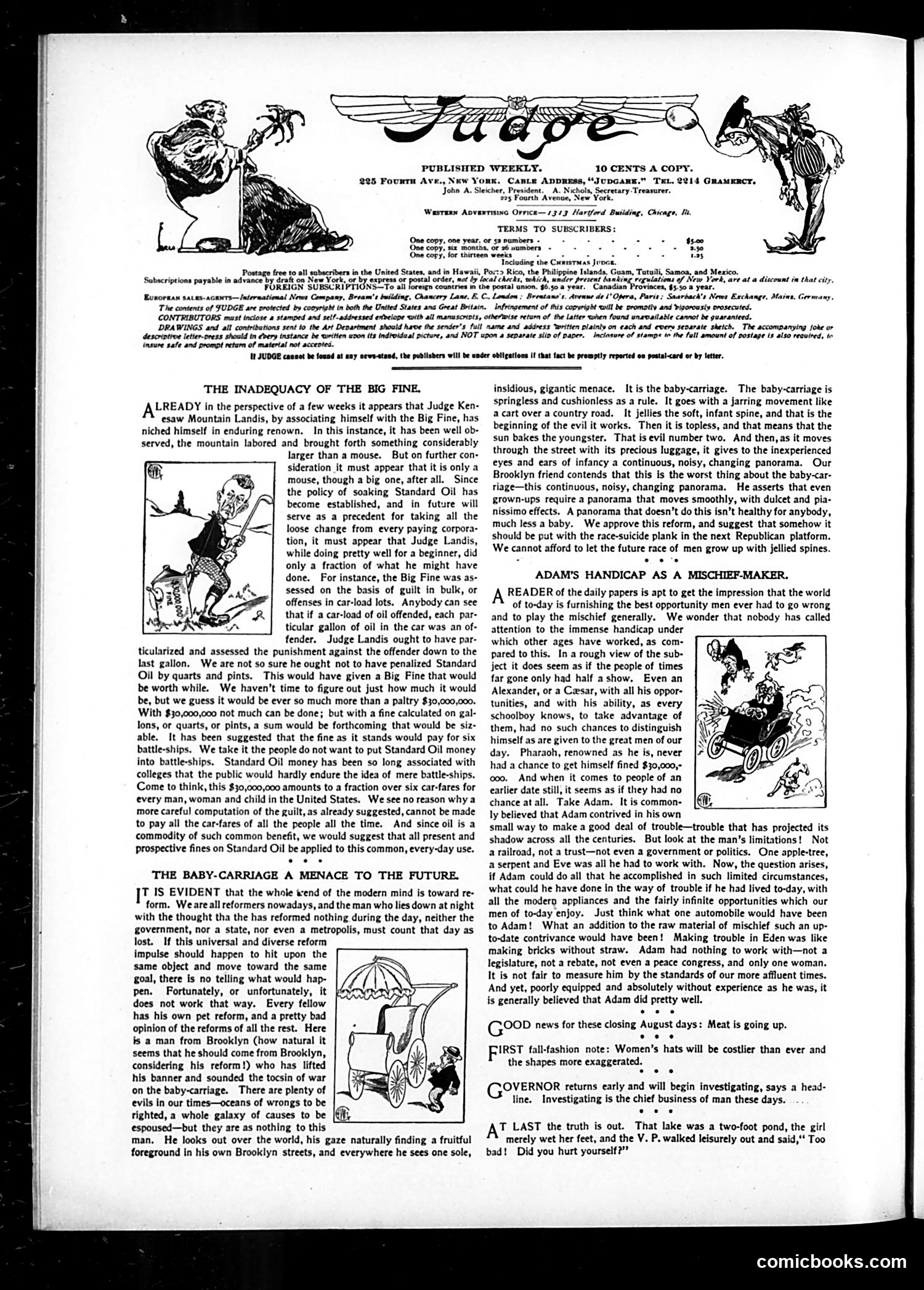
What you’re looking at
This page contains three separate satirical pieces targeting early 20th-century figures and social issues: **"The Inadequacy of the Fine"** critiques Judge Landis (baseball's commissioner) for insufficient punishment of offenders, suggesting fines pale against Standard Oil's wealth and corruption. **"The Baby-Carriage a Menace to the Future"** satirizes reformist impulses by mocking those who blame baby carriages for urban problems, arguing such thinking ignores actual systemic issues. **"Adam's Handicap as a Mischief-Maker"** appears to discuss how an underprivileged Brooklyn man lacks resources to reform society despite good intentions—contrasting his powerlessness against wealthy figures' capacity for influence. The cartoons use exaggerated illustrations and ironic commentary to expose the contradictions in Progressive Era reform movements and enforcement against the powerful.
📄 Transcribed text from this page (OCR, searchable)
Machine-transcribed from the original scan — historical spelling and the odd misread are preserved.
PUBLISHED WEEKLY. 10 CENTS A COPY. 225 Fourrn Ave., New Yore. Cancz Appness,“Jupcamm.” Txt. 2014 Grawencr, John A. Sleicher, President. Warn Apvernisine Ornice—1313 Ha! AD 225 Fourth Avene, hols, Secretary ‘Treasurer. jew York. ford Building, Chicago, It. TERMS TO SUBSCRIBERS: One copy, one year, or szpumvers- + + One copy, six months, or 26 wumbers One copy, for Pe Subscriptions payable in advance by draft on New York, of al order, free to all subscribers in the United States, and in Hawaii, Post> Rico, by local checks, by express or i FOREIGN SUBSCRIPTIONS—To all foreign countries im the postal union. $6.50 a year. C thirteen weeks Toclading the Cumsraas Juve: Philippine Itands. Goam, Tatu, Samoa, and Mexico. . fr present banking regulations of New Vork, are at a discount in that city. Canadian Proviaces, $570 8 year ym Eoxornan sates-acmers—/nternational News Company, Bream's building, Caancery Lane. &. C., London : Brontane's, Avenue del" Opera, Paris: Saarbach's News Exchange, Mains, Germany. The contents of FUDGE are protected by cooyright in both the United States ana Great Britain. infringement of this copyright ‘will be promptly and vigorousiy prosecuted. CONTRIBUTORS mast inciose 4 stamped and self-addressed ertoelope with all manascrcts, othePtvise return of the Latter when found unavailable cannot be guaranteed. DRAWINGS and all contributions sent to the Art Department should have the sender's fall name and address written plainly on each and every separate sketch. The accompanying foke or descriptive letter-Deess should tn évery instance be ‘aritten apon tts indtwidaal picture, and NOT upon a separate slip of paper. inciosure of stamps tn the full amount of postage is also reouired, 1 insare safe and prompt return of matertal not accepted. UW JUDOE cansot be found at any newe-stand, the publishers will be under obligations if that fact be promptly reported on postal-card or by letter. THE INADEQUACY OF THE BIG FINE, ALREADY in the perspective of a few weeks it appears that Judge Ken- esaw Mountain Landis, by associating himself with the Big Fine, has niched himself in enduring renown. In this instance, it has been well ob- served, the mountain labored and brought forth something considerably larger than a mouse. But on further con- sideration it must appear that it is only a mouse, though a big one, after all. Since the policy of soaking Standard Oil has become established, and in future will serve as a precedent for taking all the loose change from every paying corpora- tion, it must appear that Judge Landis, while doing pretty well for a beginner, did only a fraction of what he might have done. For instance, the Big Fine was as- sessed on the basis of guilt in bulk, or offenses in car-load lots. Anybody can see that if a car-load of oil offended, each par- ticular gallon of oil in the car was an of- fender. Judge Landis ought to have par- ticularized and assessed the punishment against the offender down to the last gallon. We are not so sure he ought not to have penalized Standard Oil by quarts and pints. This would have given a Big Fine that would be worth while. We haven't time to figure out just how much it would be, but we guess it would be ever so much more than a paltry $30,000,000. With $30,000,000 not much can be done; but with a fine calculated on gal- lons, or quarts, or pints, a sum would be forthcoming that would be siz- able. It has been suggested that the fine as it stands would pay for six battle-ships. We take it the people do not want to put Standard Oil money into battle-ships. Standard Oil money has been so long associated with colleges that the public would hardly endure the idea of mere battle-ships. Come to think, this $30,000,000 amounts to a fraction over six car-fares for every man, woman and child in the United States. We see no reason why a more careful computation of the guilt, as already suggested, cannot be made to pay all the car-fares of all the people all the time. And since oil is a commodity of such common benefit, we would suggest that all present and Prospective fines on Standard Oil be applied to this common, every-day use. THE BABY-CARRIAGE A MENACE TO THE FUTURE. It IS EVIDENT that the whole send of the modern mind is toward re- form. Weare all reformers nowadays, and the man who lies down at night with the thought tha the has reformed nothing during the day, neither the government, nor a state, nor even a metropolis, must count that day as lost. If this universal and diverse reform impulse should happen to hit upon the same object and move toward the same goal, there is no telling what would hap- pen. Fortunately, or unfortunately, it does not work that way. Every fellow has his own pet reform, and a pretty bad opinion of the reforms of all the rest. Here fs a man from Brooklyn (how natural it seems that he should come from Brooklyn, considering his reform!) who has lifted his banner and sounded the tocsin of war on the baby-carriage. There are plenty of evils in our times—oceans of wrongs to be righted, a whole galaxy of causes to be espoused—but they are as nothing to this man. He looks out over the world, his gaze naturally finding a fruitful foreground in his own Brooklyn streets, and everywhere he sees one sole, insidious, gigantic menace. It is the baby-carriage. The baby-carriage is springless and cushionless as a rule. It goes with a jarring movement like a cart over a country road. It jellies the soft, infant spine, and that is the beginning of the evil it works. Then it is topless, and that means that the sun bakes the youngster. That is evil number two. And then, as it moves through the street with its precious luggage, it gives to the inexperienced eyes and ears of infancy a continuous, noisy, changing panorama. Our Brooklyn friend contends that this is the worst thing about the baby-car- riage—this continuous, noisy, changing panorama. He asserts that even grown-ups require a panorama that moves smoothly, with dulcet and pia- nissimo effects. A panorama that doesn’t do this isn’t healthy for anybody, much less a baby. We approve this reform, and suggest that somehow it should be put with the race-suicide plank in the next Republican platform. We cannot afford to let the future race of men grow up with jellied spines. ADAM'S HANDICAP AS A MISCHIEF-MAKER. A READER of the daily papers is apt to get the impression that the world of to-day is furnishing the best opportunity men ever had to go wrong and to play the mischief generally. We wonder that nobody has called attention to the immense handicap under which other ages have worked, as com- pared to this, In a rough view of the sub- ject it does seem as if the people of times far gone only had half ashow. Even an Alexander, or a Czesar, with all his oppor tunities, and with his ability, as every schoolboy knows, to take advantage of them, had no such chances to distinguish himself as are given to the great men of our day. Pharaoh, renowned as he is, never had a chance to get himself fined $30,000,- coo. And when it comes to people of an earlier date still, it seems as if they had no chance at all. Take Adam. It is common- ly believed that Adam contrived in his own small way to make a good deal of trouble—trouble that has projected its shadow across all the centuries. But look at the man’s limitations! Not a railroad, not a trust—not even a government or politics. One apple-tree, a serpent and Eve was all he had to work with. Now, the question arises, if Adam could do all that he accomplished in such limited circumstances, what could he have done in the way of trouble if he had lived to-day, with all the modera appliances and the fairly infinite opportunities which our men of to-day enjoy. Just think what one automobile would have been to Adam! What an addition to the raw material of mischief such an up- to-date contrivance would have been! Making trouble in Eden was like making bricks without straw. Adam had nothing to work with—not a legislature, not a rebate, not even a peace congress, and only one woman. It is not fair to measure him by the standards of our more affluent times. And yet, poorly equipped and absolutely without experience as he was, it is generally believed that Adam did pretty well. 00D news for these closing August days: Meat is going up. FIRST fall-fashion note: Women’s hats will be costlier than ever and the shapes more exaggerated. GOVERNOR returns early and will begin investigating, says a head- line. Investigating is the chief business of man these days. eee T LAST the truth is out. That lake was a two-foot pond, the girl merely wet her feet, and the V. P. walked leisurely out and said,“ Too bad! Did you hurt yourself?” comicbooks.com