
Judge, 1907-08-24 · page 10 of 16
Judge — August 24, 1907 — page 10: what you’re looking at
What you’re looking at
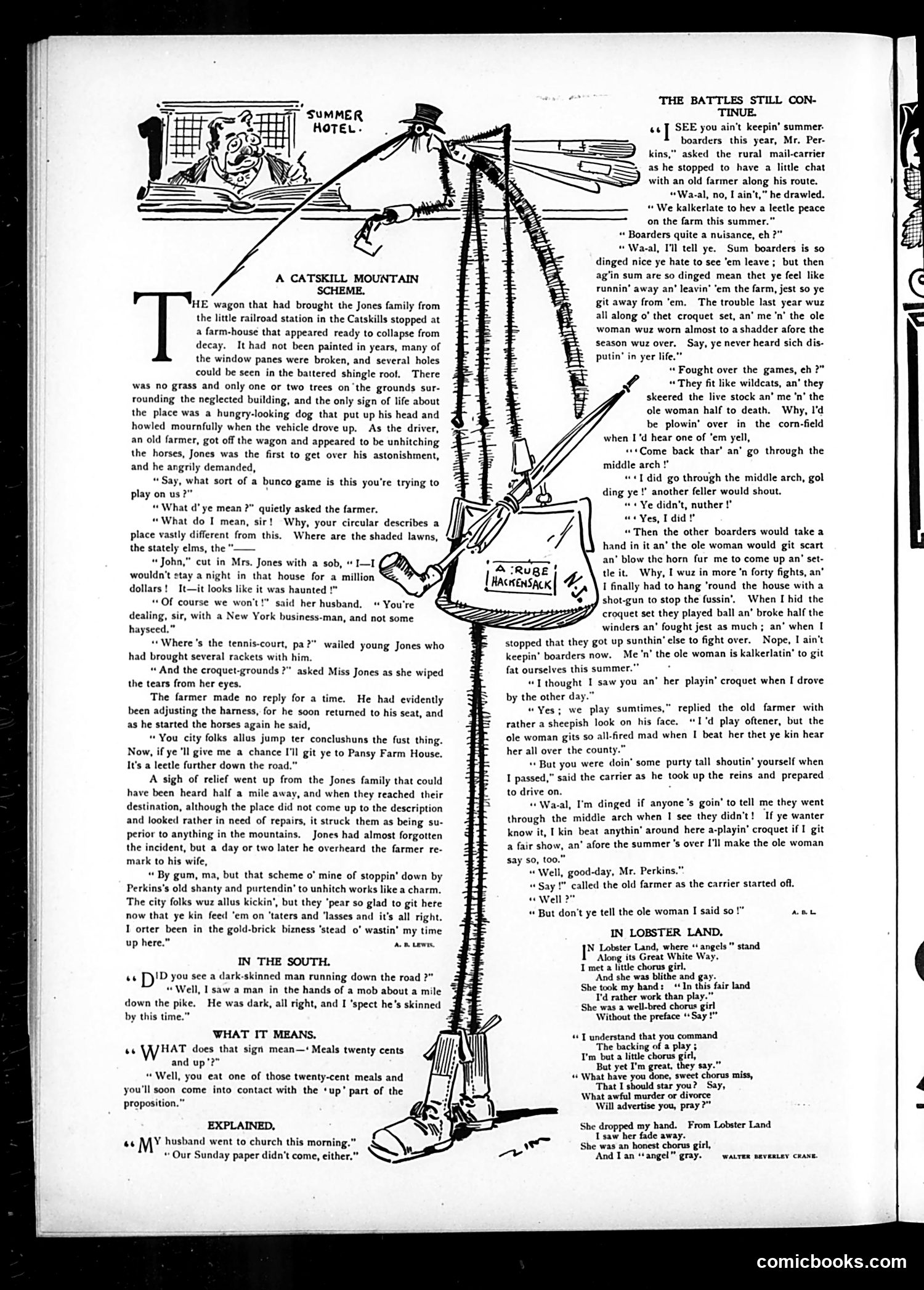
This Judge magazine page contains several satirical pieces about rural hospitality and social deception. **"A Catskill Mountain Scheme"** (main cartoon): A New York City family arrives at what they believe is a nice summer hotel, only to find a dilapidated farmhouse. The farmer reveals he intentionally brought them to the wrong location first as a "bunco" (confidence) scheme—a trick to make the actual farm seem better by comparison. The satire mocks both the dishonest rural con artist and the gullible city folk who fall for it, while also critiquing false advertising in the tourism industry. The smaller pieces mock rural dialect and ignorance ("Waz-al"), overpriced meals, and a dark joke about Southern racial violence ("skinned by this time"). The overall theme: city dwellers seeking country retreats encounter rural trickery and lowered expectations—a common Judge topic about the clash between urban sophistication and rural cunning.
📄 Transcribed text from this page (OCR, searchable)
Machine-transcribed from the original scan — historical spelling and the odd misread are preserved.
SUMMER HOTEL. A CATSKILL MOUNTAIN SCHEME. HE wagon that had brought the Jones family from the little railroad station in the Catskills stopped at a farm-house that appeared ready to collapse from decay, It had not been painted in years, many of the window panes were broken, and several holes could be seen in the battered shingle root. There was no grass and only one or two trees on‘the grounds sur- rounding the neglected building, and the only sign of life about the place was a hungry-looking dog that put up his head and howled mournfully when the vehicle drove up. As the driver, an old farmer, got off the wagon and appeared to be unhitching the horses, Jones was the first to get over his astonishment, and he angrily demanded, “Say, what sort of a bunco game is this you're trying to play on us?” “What d’ ye mean ?” quietly asked the farmer. “What do I mean, sir! Why, your circular describes a place vastly different from this. Where are the shaded lawns, the stately elms, the "—— “John,” cut in Mrs. Jones with a sob, « I—I wouldn't stay a night in that house for a million dollars! It—it looks like it was haunted !" Of course we won't!" said her husband. « You're dealing, sir, with a New York business-man, and not some hayseed.” «Where's the tennis-court, pa?” wailed young Jones who had brought several rackets with him. “ And the croquet-grounds 2” asked Miss Jones as she wiped the tears from her eyes. The farmer made no reply for a time. He had evidently been adjusting the harness, for he soon returned to his seat, and as he started the horses again he said, "You city folks allus jump ter conclushuns the fust thing. Now, if ye ‘ll give me a chance I'll git ye to Pansy Farm House. It's a leetle further down the road.” A sigh of relief went up from the Jones family that could have been heard half a mile away, and when they reached their destination, although the place did not come up to the description and looked rather in need of repairs, it struck them as being su- perior to anything in the mountains. Jones had almost forgotten the incident, but a day or two later he overheard the farmer re- mark to his wife, “ By gum, ma, but that scheme o' mine of stoppin’ down by Perkins’s old shanty and purtendin’ to unhitch works like a charm. The city folks wuz allus kickin’, but they ‘pear so glad to git here now that ye kin feed ‘em on ‘taters and ‘lasses and it's all right. I orter been in the gold-brick bizness ‘stead o wastin’ my time up here.” en IN THE SOUTH. 64 PID you see a dark-skinned man running down the road ?" “Well, I saw a man in the hands of a mob about a mile down the pike. He was dark, all right, and I ‘spect he’s skinned by this time.” WHAT IT MEANS. vy wat does that sign mean—* Meals twenty cents and up'?" “Well, you eat one of those twenty-cent meals and you'll soon come into contact with the ‘up’ part of the proposition.” EXPLAINED, 66 MY husband went to church this morning.” * Our Sunday paper didn’t come, either.” vO TY oT a eee on a cr bee RANI EU PRA CH BULHH Ree oe — THE BATTLES STILL CON- ‘TINUE. 66] SEE you ain't keepin’ summer. boarders this year, Mr. Per- kins,” asked the rural m; as he stopped to have a with an old farmer along his route. “Waz-al, no, I ain't,” he drawled. “ We kalkerlate to hev a leetle peace on the farm this summer.” « Boarders quite a nuisance, eh?” « Waz-al, I'll tell ye. Sum boarders is so dinged nice ye hate to see ‘em leave ;_ but then ag’in sum are so dinged mean thet ye feel like runnin’ away an’ leavin’ ‘em the farm, jest so ye git away from ‘em. The trouble last year wuz all along o' thet croquet set, an’ me 'n’ the ole woman wuz worn almost to a shadder afore the season wuz over. Say, ye never heard sich dis- putin’ in yer life.” “Fought over the games, eh ?” “ They fit like wildcats, an’ they skeered the live stock an’ me 'n’ the ole woman half to death. Why, I'd be plowin’ over in the corn-field when I'd hear one of ‘em yell, «Come back thar’ an’ go through the middle arch !" «+L did go through the middle arch, gol ding ye !’ another feller would shout. Ye didn’t, nuther !" “Yes, Idid !" “Then the other boarders would take a hand in it an’ the ole woman would git scart an’ blow the horn fur me to come up an’ set- tle it. Why, I wuz in more ‘n forty fights, an I finally had to hang ‘round the house with a shot-gun to stop the fussin’. When I hid the croquet set they played ball an’ broke half the winders an’ fought jest as much ; an’ when I stopped that they got up sunthin’ else to fight over. Nope, I ain't keepin’ boarders now. Me'n’ the ole woman is kalkerlatin’ to git fat ourselves this summer.” “T thought I saw you an’ her playin’ croquet when I drove by the other day.” ; “Yes; we play sumtimes,” replied the old farmer with rather a sheepish look on his face. “I'd play oftener, but the ole woman gits so all-fired mad when I beat her thet ye kin hear her all over the county. ++ But you were doin’ some purty tall shoutin’ yourself when I passed,” said the carrier as he took up the reins and prepared iRUBE} ENSACK | &, 4 to drive on. ««Wa-al, I'm dinged if anyone's goin’ to tell me they went through the middie arch when I see they didn't! If ye wanter know it, [kin beat anythin’ around here a-playin’ croquet if I git a fair show, an’ afore the summer’’s over I'll make the ole woman say So, too.” te “Well, good-day, Mr. Perkins. “Say !" called the old farmer as the carrier started off. ++ Well 2” : = « But don’t ye tell the ole woman I said so ! a IN LOBSTER LAND. N Lobster Land, where “angels” stand Along its Great White Way. I met a little chorus girl, ‘And she was blithe and gay. _ She took my hand: | +¢In this fair land I'd rather work than play.” She was a well-bred chorus girl Without the preface ‘Sa; eu «« [understand that you command The backing of a play ; I'm but a little chorus girl, But yet I'm great, they say.” « What have you done, sweet chorus miss, ‘That I should star you? Say, What awful murder or divorce Will advertise you, pray ?” She dropped my hand. From Lobster Land I saw her fade away. She was an honest chorus girl, ‘And Ian “angel” gray. WALTER BEVERLEY CRANE. comicbooks.com