
A complete issue · 16 pages · 1907
Judge — August 10, 1907
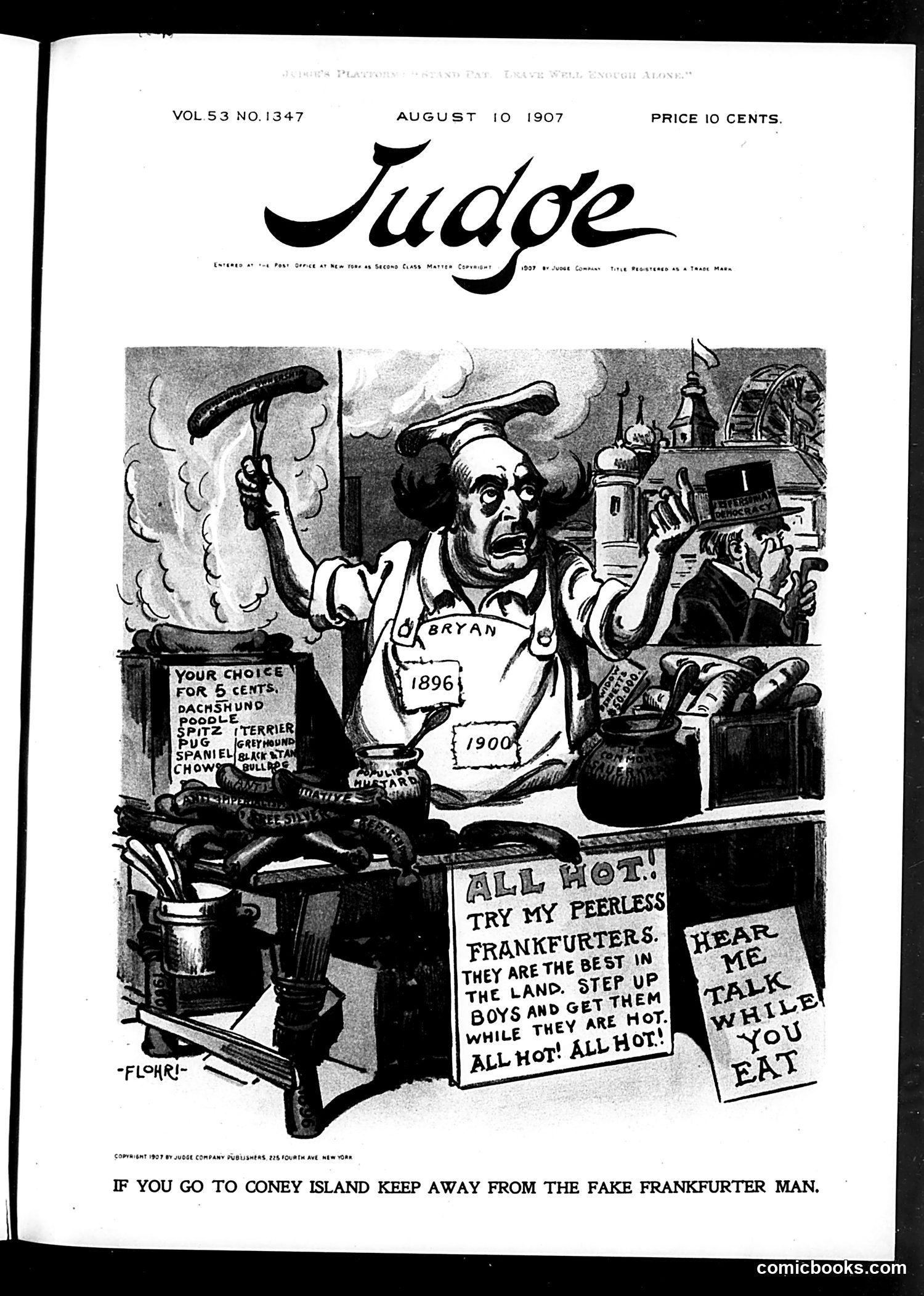
This cartoon satirizes William Jennings Bryan, the three-time presidential candidate labeled with his electoral years (1896, 1900). Bryan is depicted as a street vendor hawking "frankfurters" at Coney Island, a popular New York amusement park. The satire appears to mock Bryan's repeated failed presidential campaigns by reducing him to a pitchman selling cheap hot dogs. The sign promises "peerless frankfurters" — likely a jab at Bryan's self-promotion and grandiose rhetoric about being the people's champion. The caption warns visitors to "keep away from the fake frankfurter man," suggesting Bryan is a fraudulent hustler peddling inferior goods disguised with inflated claims. The cartoon uses the carnival setting and food-vendor imagery to ridicule Bryan's political credibility and appeal.
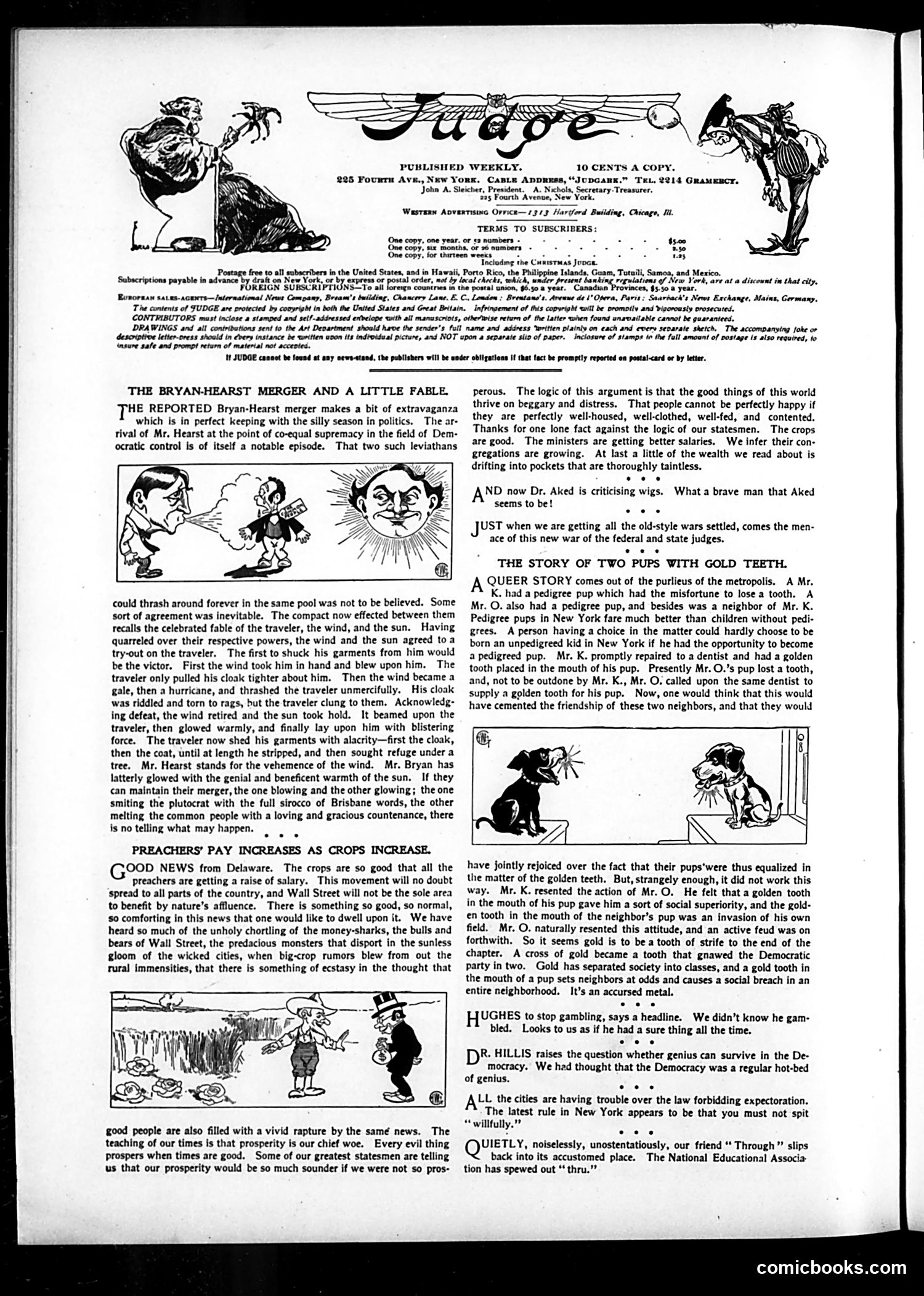
This page contains several satirical pieces typical of Judge magazine's political commentary: **"The Bryan-Hearst Merger"** mocks a potential political alliance, depicting two figures (likely William Jennings Bryan and William Randolph Hearst, both prominent Democrats/Populists) as incompatible partners who cannot maintain unity—a critique of their conflicting interests and egos. **"The Story of Two Pups with Gold Teeth"** is an allegorical fable satirizing class divisions and Democratic Party infighting. Two dogs (representing Democratic factions) squabble over a golden tooth, symbolizing wealth or political power, ultimately damaging their community through their conflict. The remaining items offer brief political observations on judges, crop prices, and social issues, using typical early-20th-century Judge satire: visual caricature combined with pointed social commentary about American politics and society.
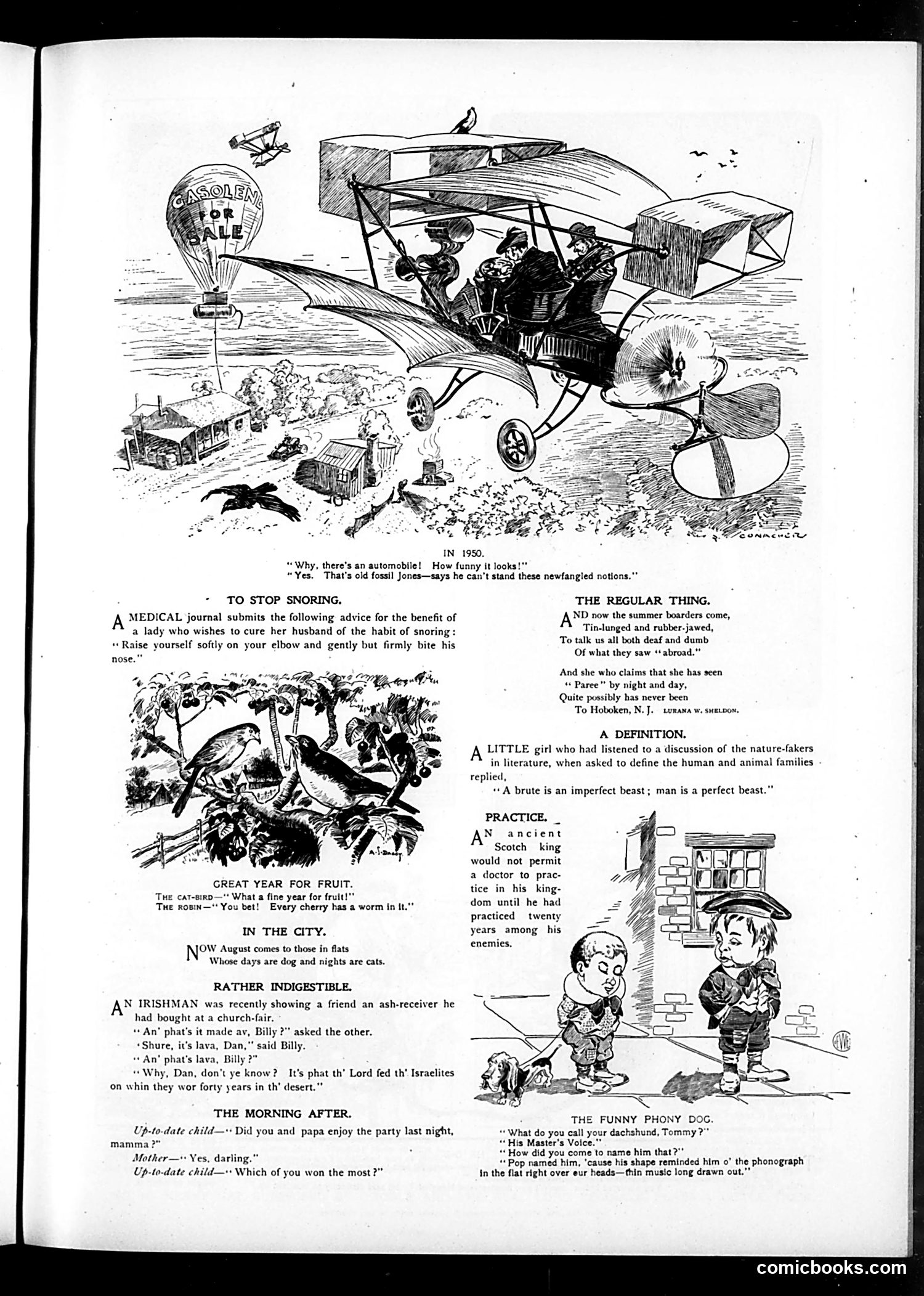
The top cartoon depicts a futuristic flying machine from 1950, mocking early aviation fantasies. The dialogue ("old fossil Jones") suggests satire of technological skeptics who doubted new inventions would work. The remaining content consists of short humorous items typical of Judge's format: - "To Stop Snoring" offers absurd medical advice - "The Regular Thing" jokes about travelers' exaggerated stories - "A Definition" presents a child's witty comparison of humans and beasts - "Practice" recounts a Scottish king requiring medical experience through combat - "In the City" and "Rather Indigestible" are brief jokes - "The Morning After" and "The Funny Phony Dog" are domestic humor sketches The page lacks overt political content, focusing instead on general social satire, wordplay, and whimsy typical of early 20th-century humor magazines.
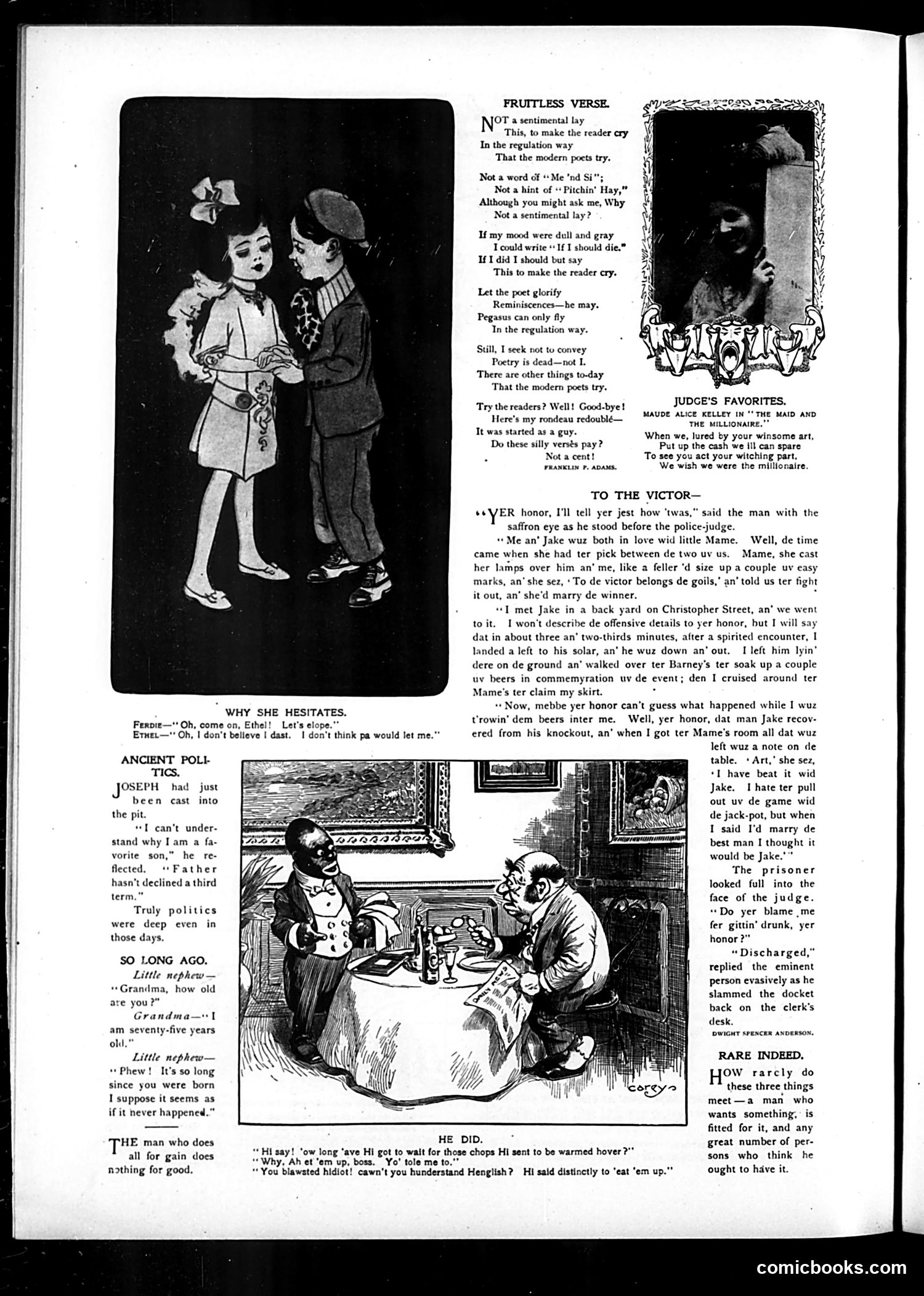
This page contains several separate pieces of humor and satire: **"Fruitless Verse"** mocks modern poetry's self-seriousness, arguing poets needlessly complicate their work with emotional manipulation rather than genuine craft. **"Why She Hesitates"** appears to be a brief dialogue about romantic indecision. **"Ancient Politics"** uses a historical anecdote about Joseph being cast into a pit to comment that political maneuvering has always been corrupt—"truly politics were deep even in those days." **"To the Victor"** recounts a streetfight between two men over a woman named "Mame," told in dialect. The judge sentences the winner to marry her—a satirical commentary on judicial "justice." **"He Did"** is a brief joke about waiting for ships to be warmed. The overall page lacks a coherent theme, featuring typical Judge magazine fare: literary criticism, romantic comedy, and crude humor.
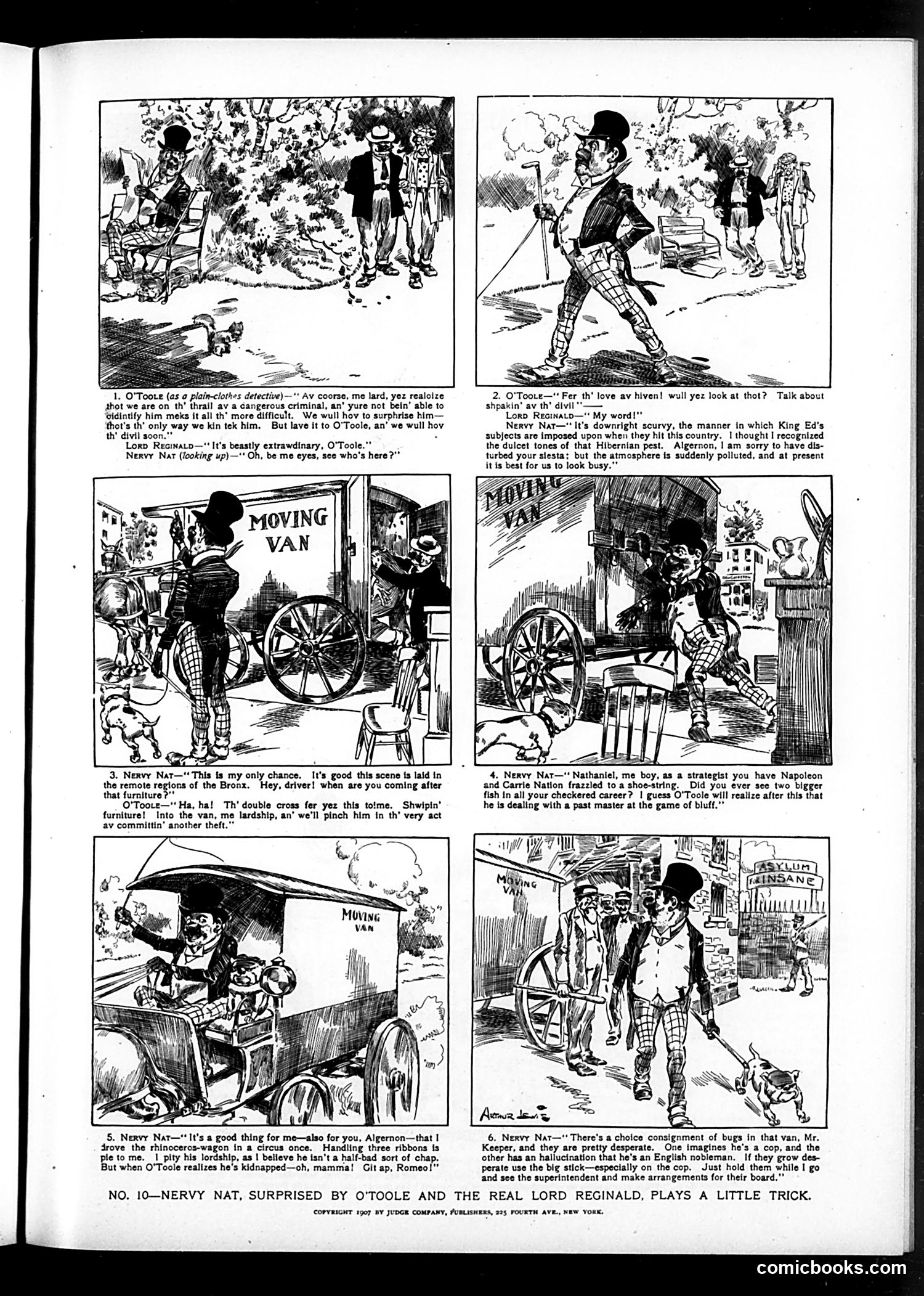
This is a six-panel comic strip titled "Nervy Nat, Surprised by O'Toole and the Real Lord Reginald, Plays a Little Trick" from Judge magazine (copyright 1907). The story follows a character named Nervy Nat who encounters O'Toole (described as "a plain-clothes detective") and claims to be "Lord Reginald." The narrative involves a moving van and appears to satirize common urban crime and fraud. Nat attempts to convince O'Toole that he's a nobleman, while stealing furniture into the van. The humor derives from Nat's scheming and his attempt to manipulate both O'Toole and an alleged English nobleman who may or may not exist, culminating in what the title promises will be "a little trick." The satire targets gullibility, class pretension, and petty urban theft common in early 1900s American cities.
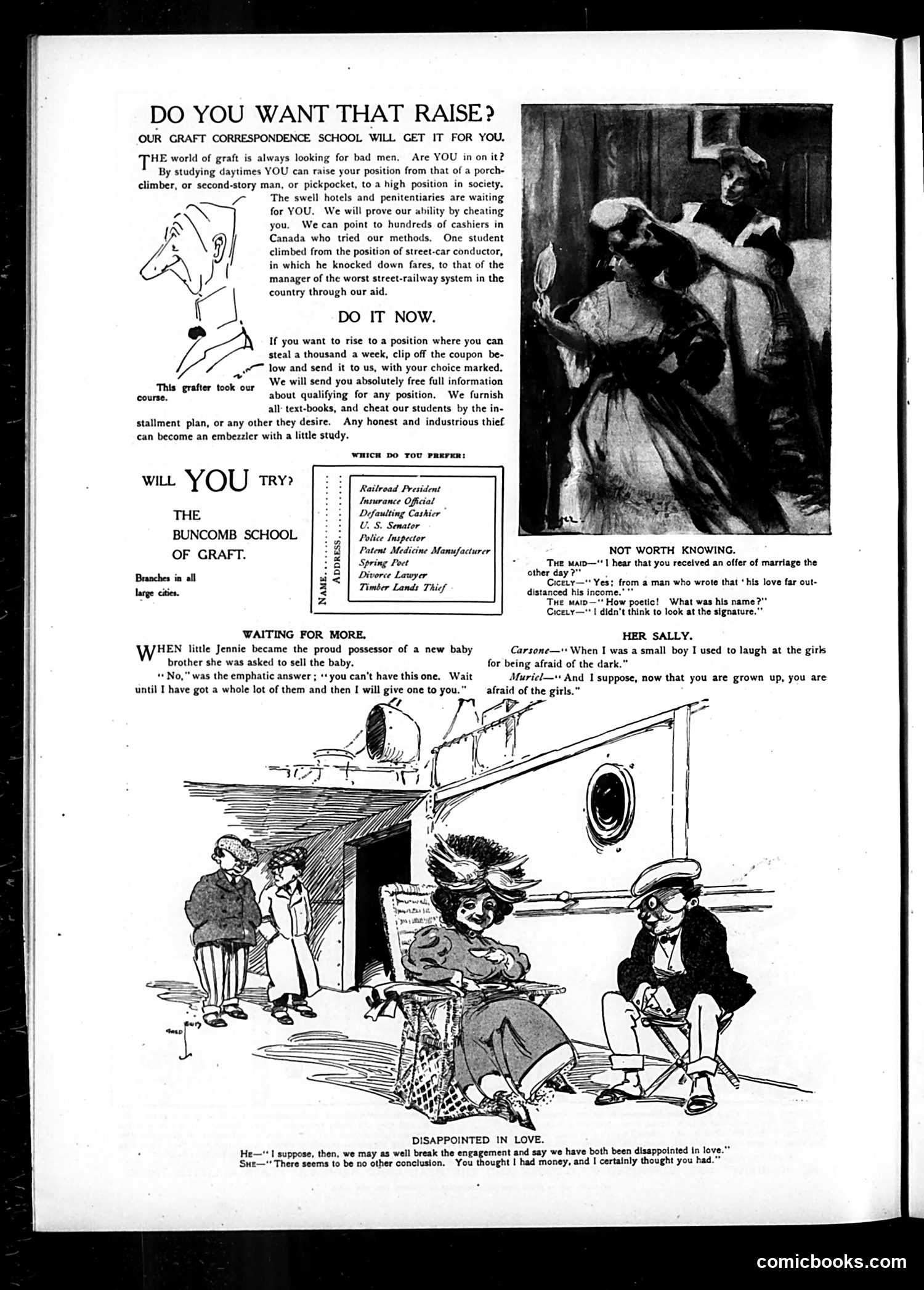
This Judge magazine page contains **scathing social satire** about corruption in early 20th-century America. The top section mocks a fraudulent "correspondence school" teaching graft—satirizing how institutional corruption was so normalized that criminals could openly advertise "training." The list of preferred positions (Railroad President, U.S. Senator, Police Inspector, Patent Medicine Manufacturer) equates respectable professions with criminality, suggesting these industries were widely viewed as corrupt. The accompanying photo labeled "NOT WORTH KNOWING" shows a maid, with text about a man whose "love far outdistanced his income"—mocking fortune-hunting and the mercenary nature of relationships. Below are three brief satirical vignettes about human nature: a baby-hoarding child, a boy-turned-man afraid of girls, and an engagement broken because both parties discovered the other lacked money. **The core message:** Judge is exposing how corruption permeates American institutions and how greed drives human behavior at all social levels.
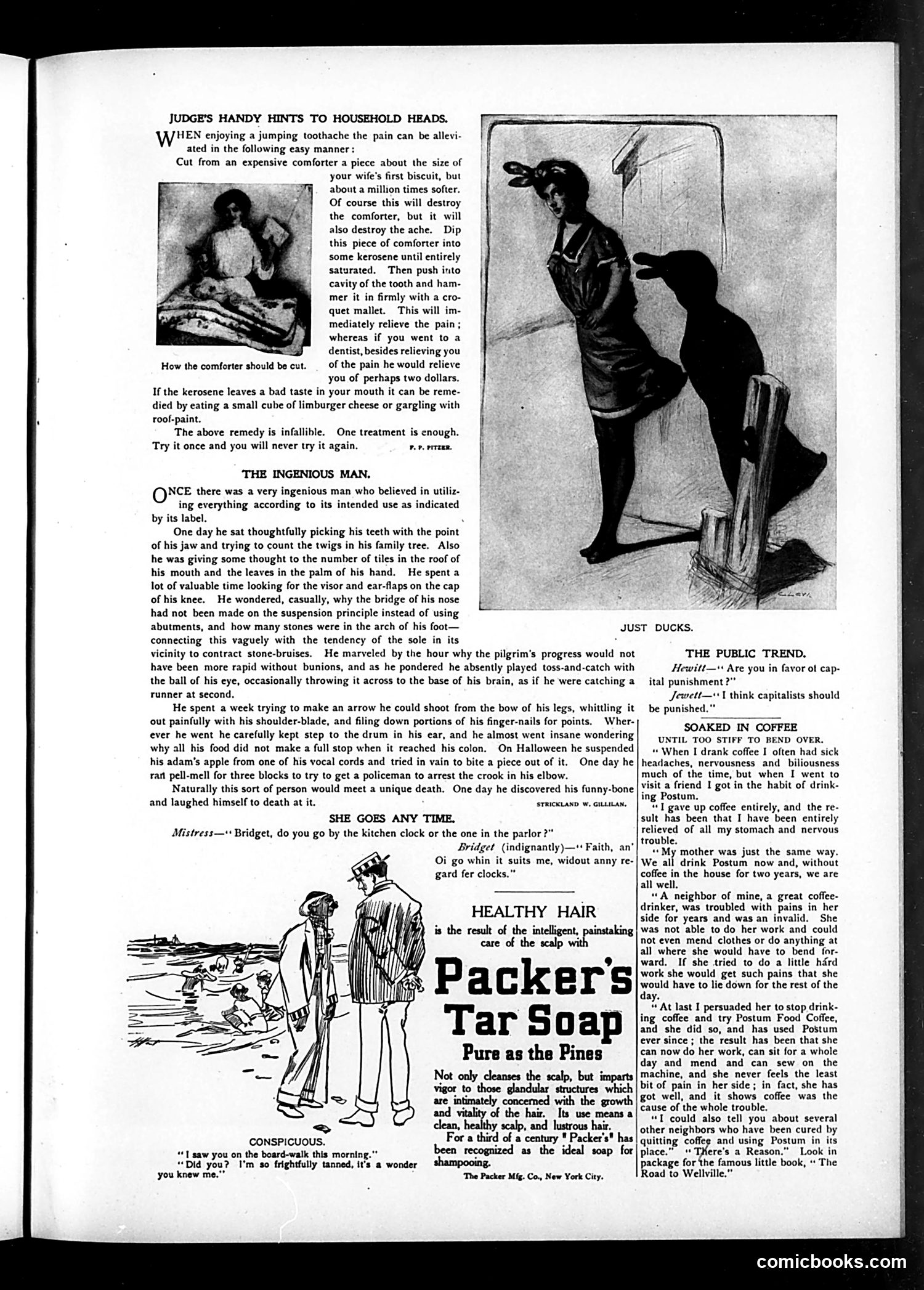
This page contains three distinct satirical pieces: **"Judge's Handy Hints to Household Heads"** mocks DIY home remedies by proposing an absurdly destructive toothache cure (soaking a comforter piece in kerosene and hammering it into the tooth). The joke: it's cheaper than dentists but completely ridiculous—satirizing both penny-pinching and dubious folk remedies. **"The Ingenious Man"** ridicules someone who takes anatomical labels literally, attempting to use body parts according to their names (shooting arrows from his "bow" of legs, playing catch with his "ball" of eye). The satire mocks pedantic over-literalism and misapplied logic. **"She Goes Any Time"** features a brief exchange where an Irish maid (Bridget) asserts independence from clock-watching—likely poking fun at working-class servant attitudes or Irish stereotypes of the era. The page also contains a **Packer's Tar Soap advertisement** and brief joke about capital punishment/capitalists, standard Judge content mixing humor with product promotion.
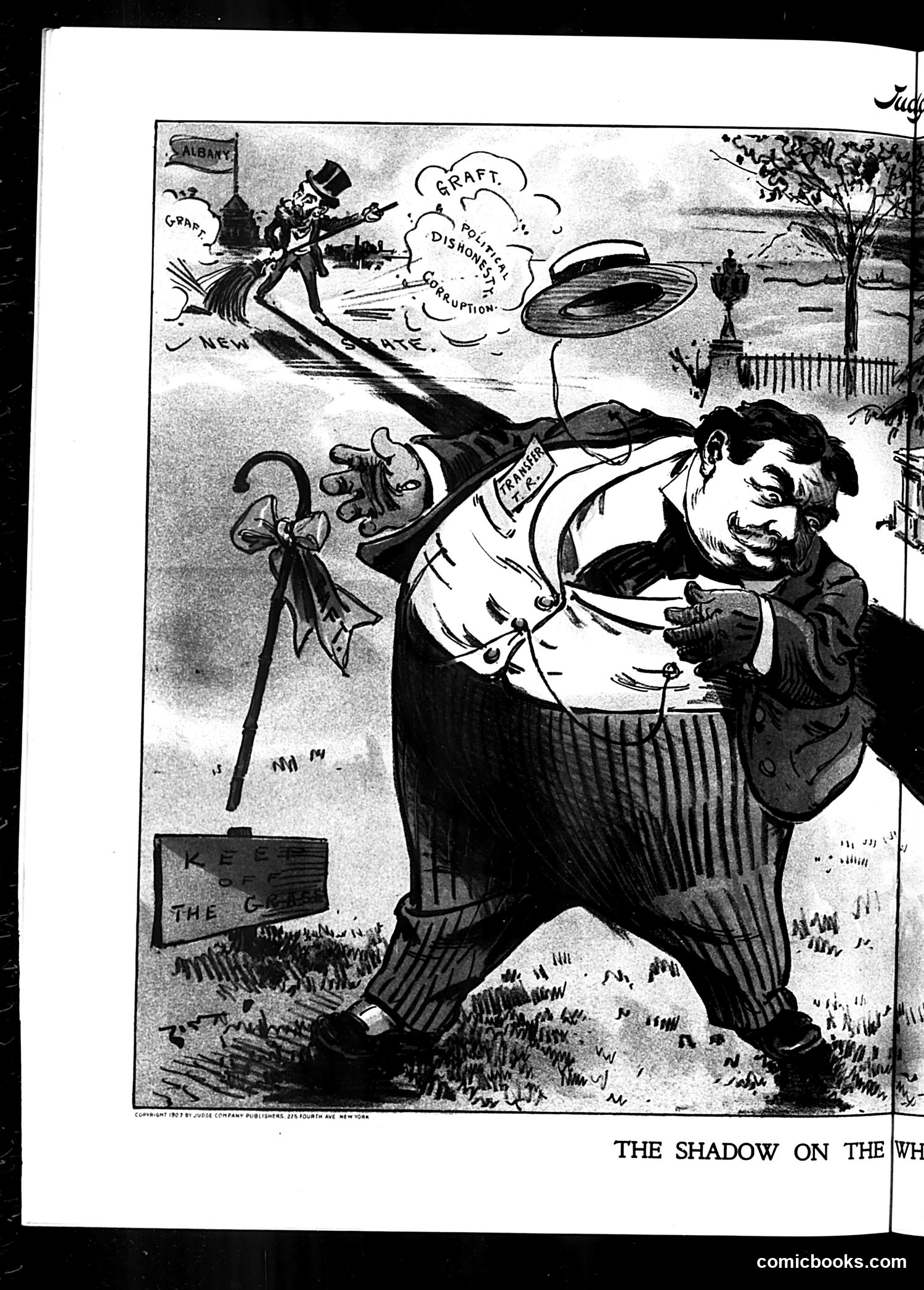
This Judge magazine cartoon satirizes corruption in Albany (New York's capital, labeled at top left). The central figure is a portly politician or bureaucrat representing the state government, depicted as bloated and corrupt. His shadow on the wall shows a skeletal, demonic figure engaging in various crimes: "graft," "political dishonesty," and "corruption" are labeled in speech bubbles. The cartoon's message is straightforward: Albany's government appears respectable on the surface (the well-dressed man), but its true nature—revealed by its "shadow"—is criminal and malevolent. This is classic muckraking satire criticizing political corruption in early 20th-century New York state government. The title "The Shadow on the Wh[ite House]" (partially cut off) suggests broader implications beyond Albany.
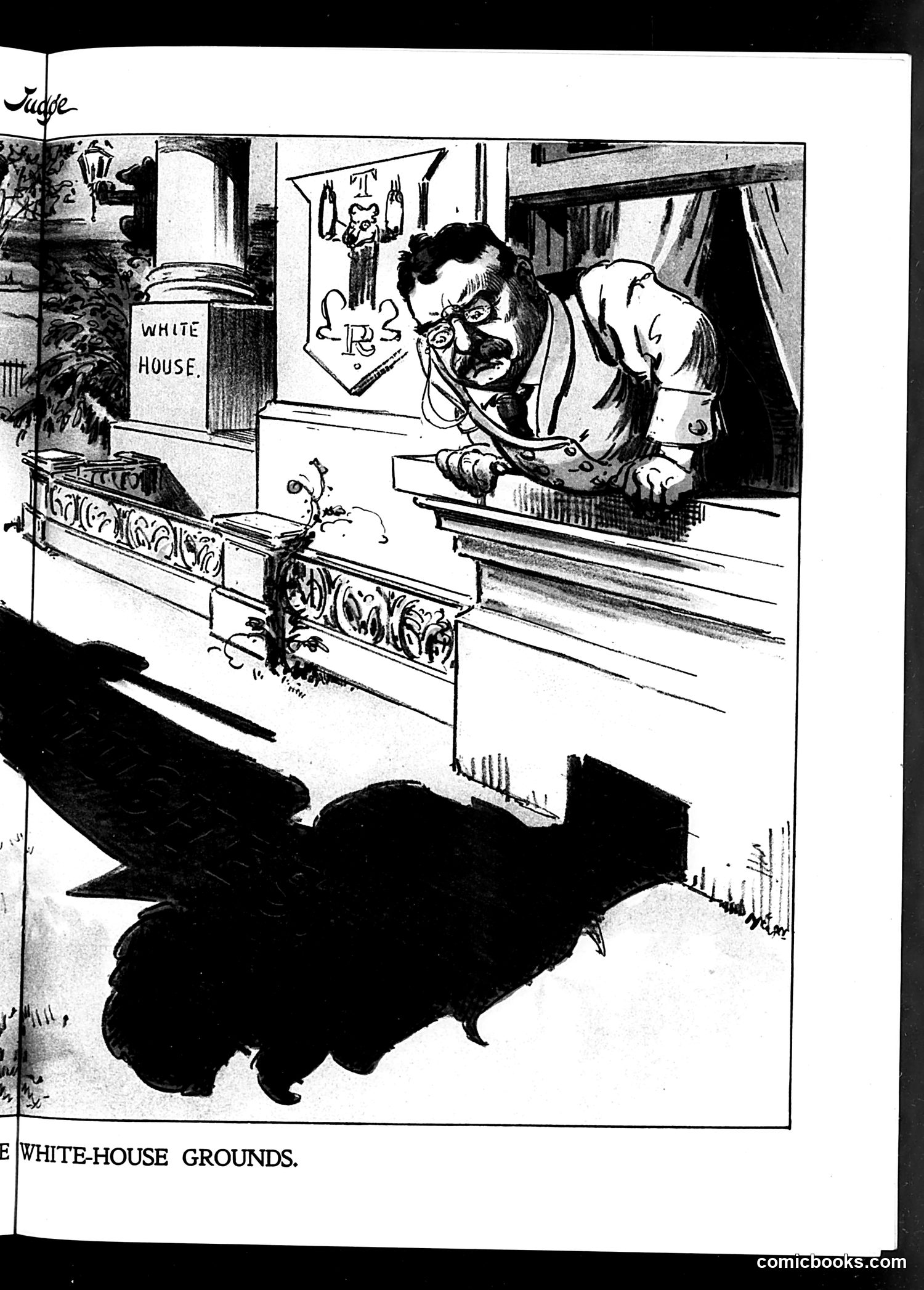
This political cartoon depicts a menacing figure lurking on the White House grounds. The figure appears caricatured with exaggerated, aggressive features and is drawn in stark black silhouette, suggesting a threatening or sinister presence. The cartoon is titled "White-House Grounds," positioning this as commentary on security or unwanted intrusion at the president's residence. Without additional context about the publication date or visible text identifying the figure, I cannot definitively state who is being satirized or what specific political event this references. The style suggests early-to-mid 20th century American political satire, likely commentary on a perceived threat to presidential security or an unwelcome political/social element. The exaggerated caricature and ominous presentation indicate editorial disapproval of whoever or whatever is represented.
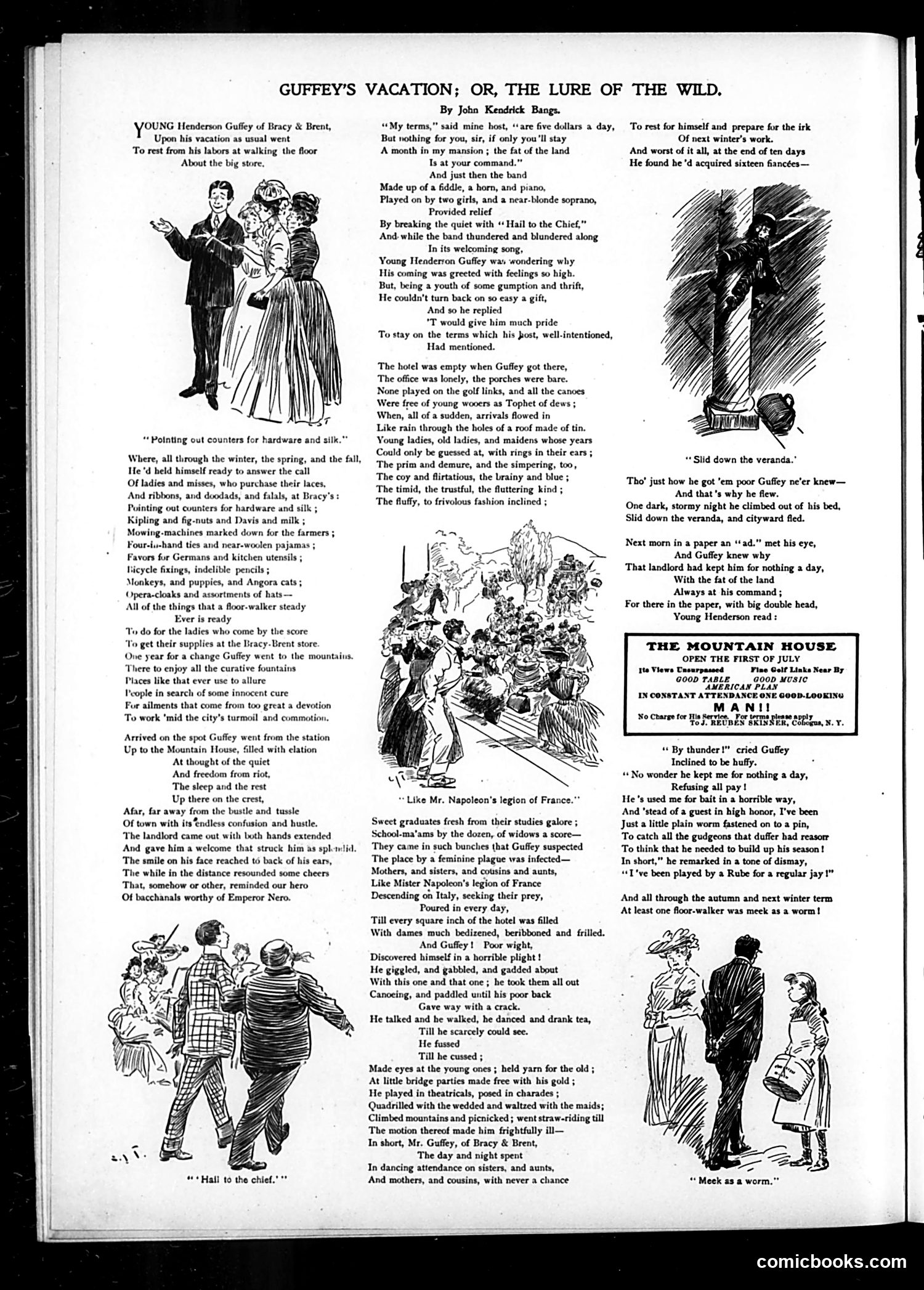
This humorous poem by John Kendrick Bangs satirizes a department store floor-walker named Henderson Guffey who takes a mountain resort vacation seeking peace and quiet. The joke centers on the landlord's seemingly generous offer—free lodging if Guffey stays a month—which becomes clear only at the end. The satire targets how hotels and resorts used attractive women as bait to lure male guests, driving business. When Guffey arrives, the hotel is empty; suddenly "sixteen fiancées" materialize once he's committed. The landlord exploited Guffey's presence to attract female guests, making him the unwitting draw. Guffey flees one night, discovering too late through a newspaper ad why he'd been offered free room and board—he was the real attraction, not the hotel's amenities. The cartoon mocks both commercialized leisure and romantic scheming in the Gilded Age resort economy.
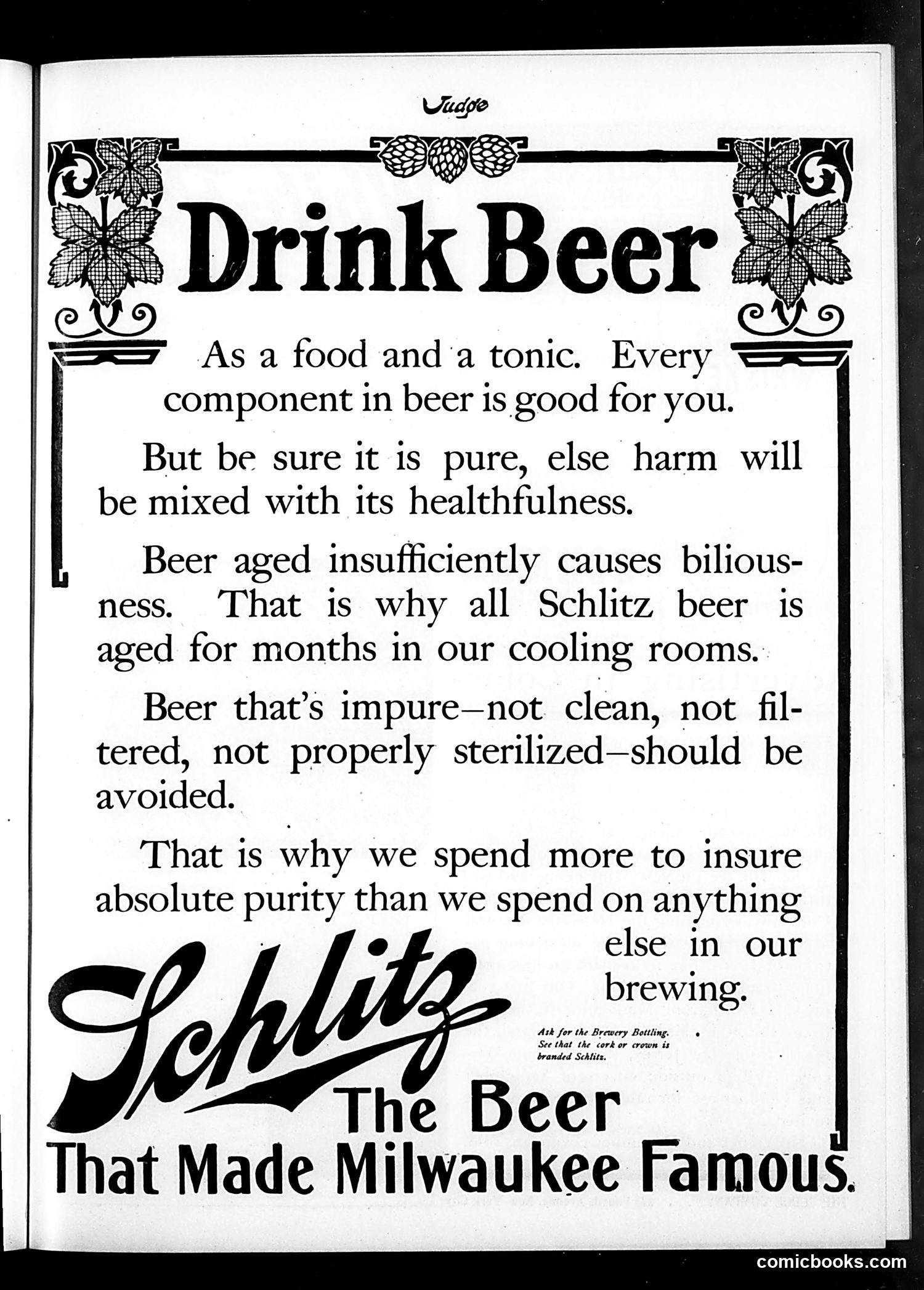
This is a **Schlitz beer advertisement**, not a satirical cartoon. The page promotes Schlitz as a health beverage by emphasizing purity and proper aging. The ad makes health claims typical of early 20th-century beer marketing: beer functions as "food and a tonic" with beneficial components. However, it warns consumers against inferior competitors—beer aged insufficiently causes "biliousness" (digestive upset), and impure beer lacking proper filtration or sterilization should be avoided. The advertisement's central argument is that Schlitz justifies higher costs through superior manufacturing standards: extended aging in cooling rooms and rigorous purity controls. The tagline "The Beer That Made Milwaukee Famous" positions Schlitz as Milwaukee's premier export. This reflects a pre-Prohibition era (likely 1900s-1910s) when brewers marketed beer as medicinal, before alcohol regulation and health science shifted public perception.
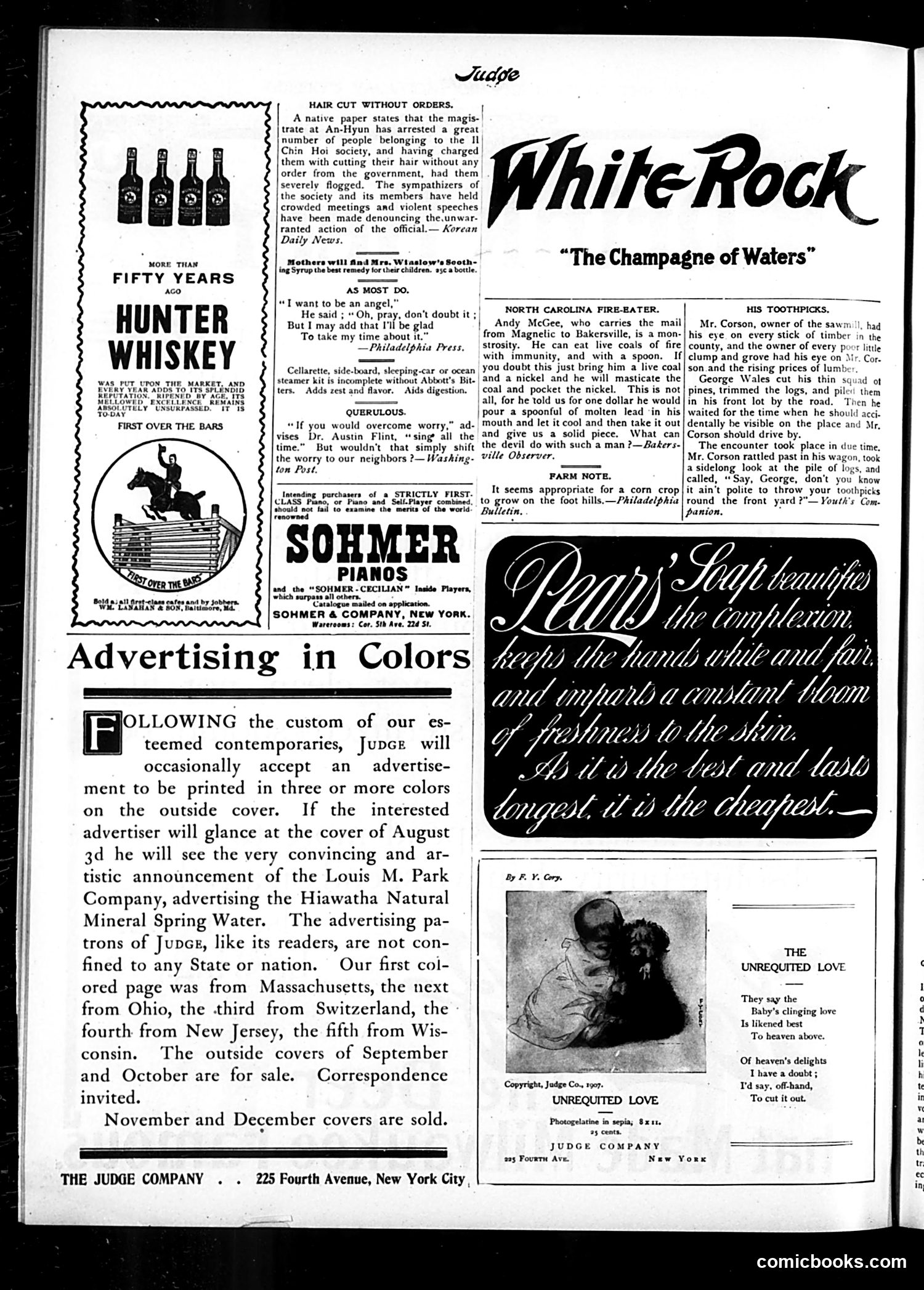
This page primarily features **satirical news items and advertisements** rather than a single cartoon. The notable content includes: **"Hair Cut Without Orders"**: A satirical brief mocking Korean authorities who flogged citizens of the Il Chin Hoi society for cutting hair without government permission—highlighting absurd governmental overreach. **"North Carolina Fire-Eater"**: A humorous anecdote about Andy McGee, a mail carrier who performs the circus-like stunt of eating live coals and molten lead, presented as local color/curiosity. **"His Toothpicks"**: A rural comedy sketch where Mr. Corson, a timber mill owner, sarcastically calls piled logs "toothpicks"—a jab at a neighbor's modest woodlot. The page also announces Judge's new policy of accepting **color advertisements on outside covers**, noting their geographic diversity of advertisers. The tone throughout is characteristic of Judge's style: mocking government foolishness, celebrating American eccentricity, and gentle mockery of rural life and human foibles.
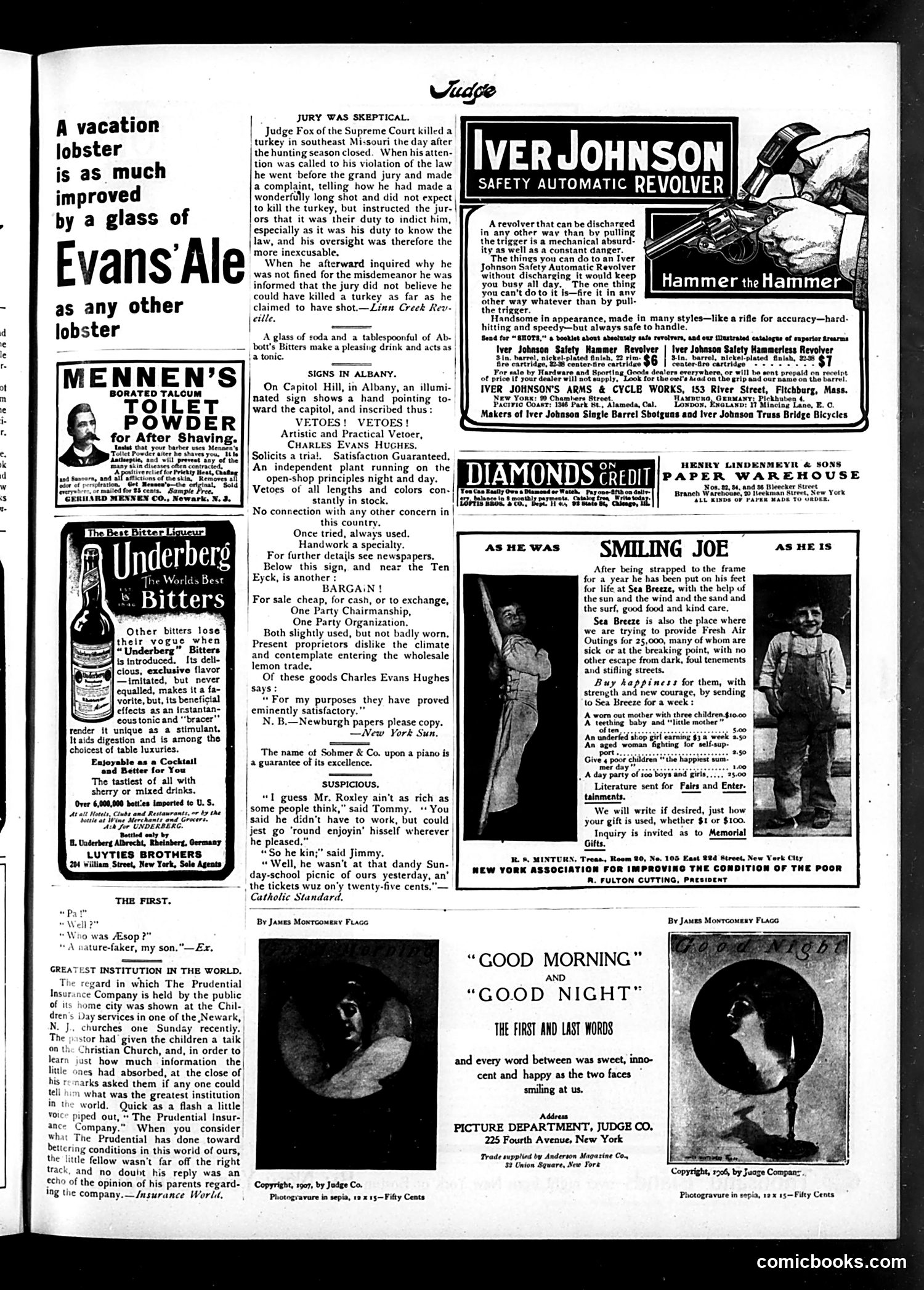
This page combines advertisements with political satire. The main cartoon content appears in the "SIGNS IN ALBANY" section, which mocks **Charles Evans Hughes**, who served as Governor of New York. The satire presents two fictional Albany storefront signs: 1. **"VETOES! VETOES!"** — advertising Hughes as a professional vetoist, implying he excessively vetoed legislation with an "open-shop" operation running day and night. 2. **"BARGAIN!"** — advertising a "Party Chairmanship" and "Party Organization" for sale cheap, suggesting Hughes had damaged or abandoned Republican Party leadership and organization through his actions. The humor targets Hughes' controversial gubernatorial tenure, likely his friction with the Republican Party machine and his use of executive veto power. The joke implies his leadership left the party weakened and available for "wholesale" disposal. The remainder of the page consists of period product advertisements (Evans Ale, Mennen's Talcum, Underberg Bitters, etc.) and anecdotes, typical of Judge's advertising-heavy format.
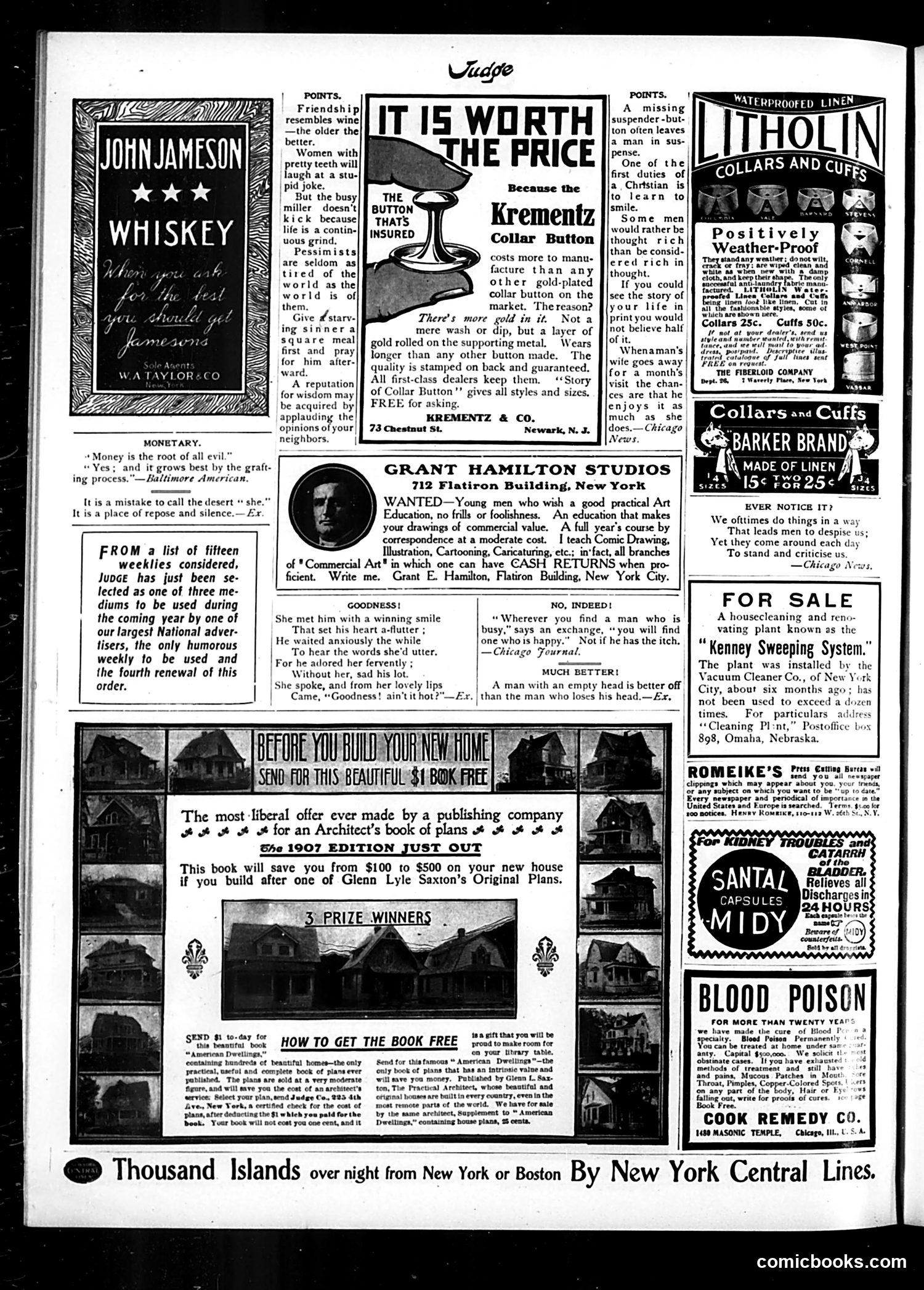
This is primarily an **advertising page** from Judge magazine, not a political cartoon. The page contains multiple paid advertisements and brief satirical "points" (short jokes/observations). The notable content includes: **"It Is Worth the Price"** — an ad for Krementz Collar Buttons, arguing their gold plating justifies higher cost than competitors. **"Points"** — scattered one-liners mocking human nature: friendship improves with age like wine; pessimists tire of the world faster than the world tires of them; women laugh at stupid jokes if they're pretty. **Grant Hamilton Studios** — an ad offering commercial art education with "cash returns," suggesting students could earn money while learning cartooning and illustration. **Grant Hamilton Studios illustration** — shows a woman greeting a man, followed by disappointing dialogue ("Goodness! ain't it hot?"), satirizing romantic disappointment. The page reflects early 1900s concerns: commercialism, dating customs, and the emerging field of commercial art. Most content is mercenary rather than satirical—Judge was selling ad space to various businesses rather than delivering pointed social commentary.
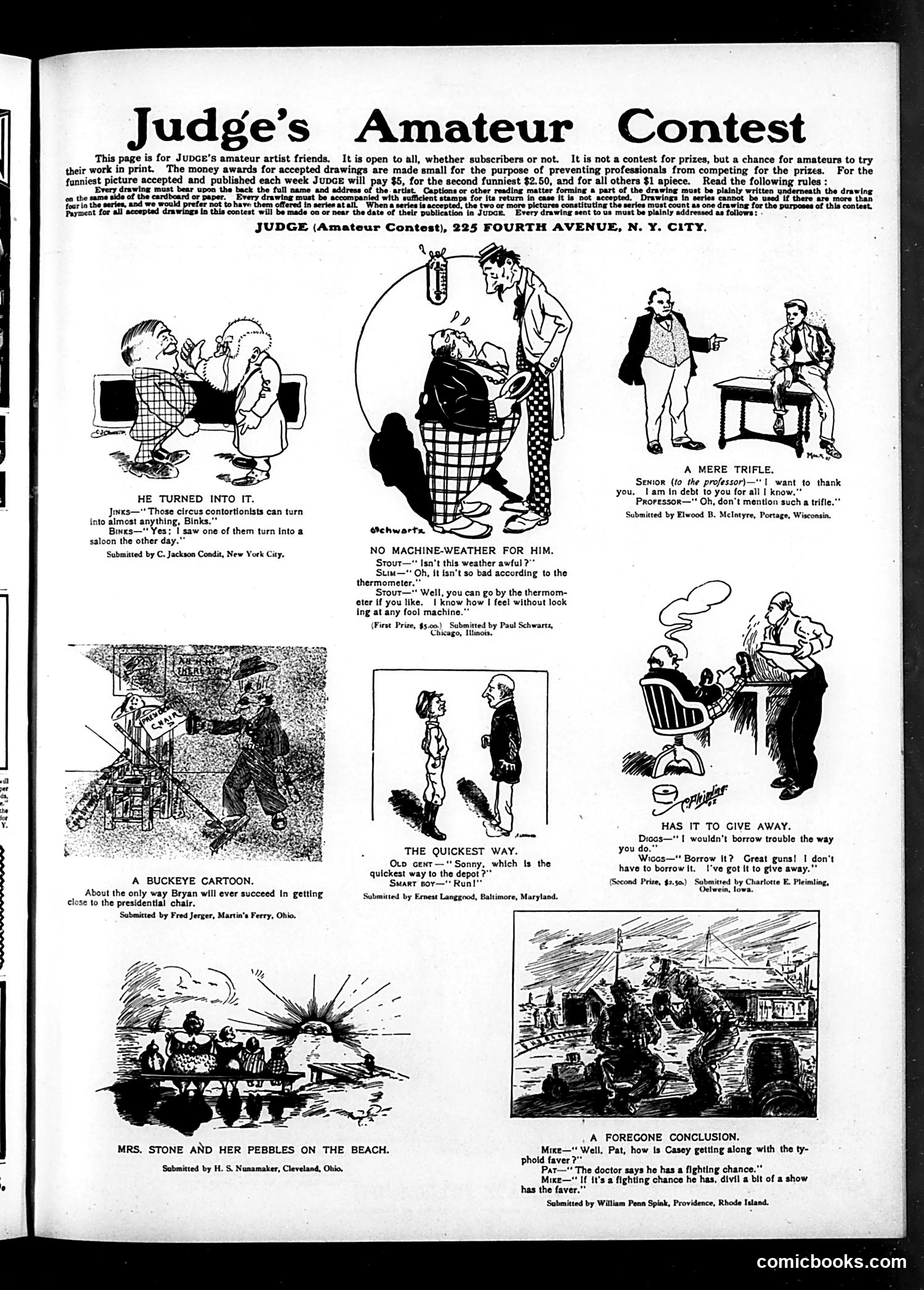
This page showcases amateur cartoonists' submissions to Judge magazine's weekly contest, paying $5 for the funniest cartoon, $2.50 for second place, and $1 for others. The cartoons present simple, domestic humor typical of early 20th-century American comedy: - **"He Turned Into It"**: A joke about someone mistaking a circus performer for a saloon owner - **"No Machine-Weather for Him"**: A stubborn man refuses to trust a thermometer, claiming personal feeling over technology - **"A Buckeye Cartoon"**: References William Jennings Bryan's failed presidential ambitions - **"The Quickest Way"**: A child asks directions to the depot - **"A Mere Trifle"**: A student thanks a professor; the professor dismisses it as nothing - **"Has It to Give Away"**: A joke about someone so troubled they have worries to spare - **"A Foregone Conclusion"**: Dark humor about a sick boxer's slim survival chances The humor relies on wordplay, irony, and everyday situations rather than topical satire.
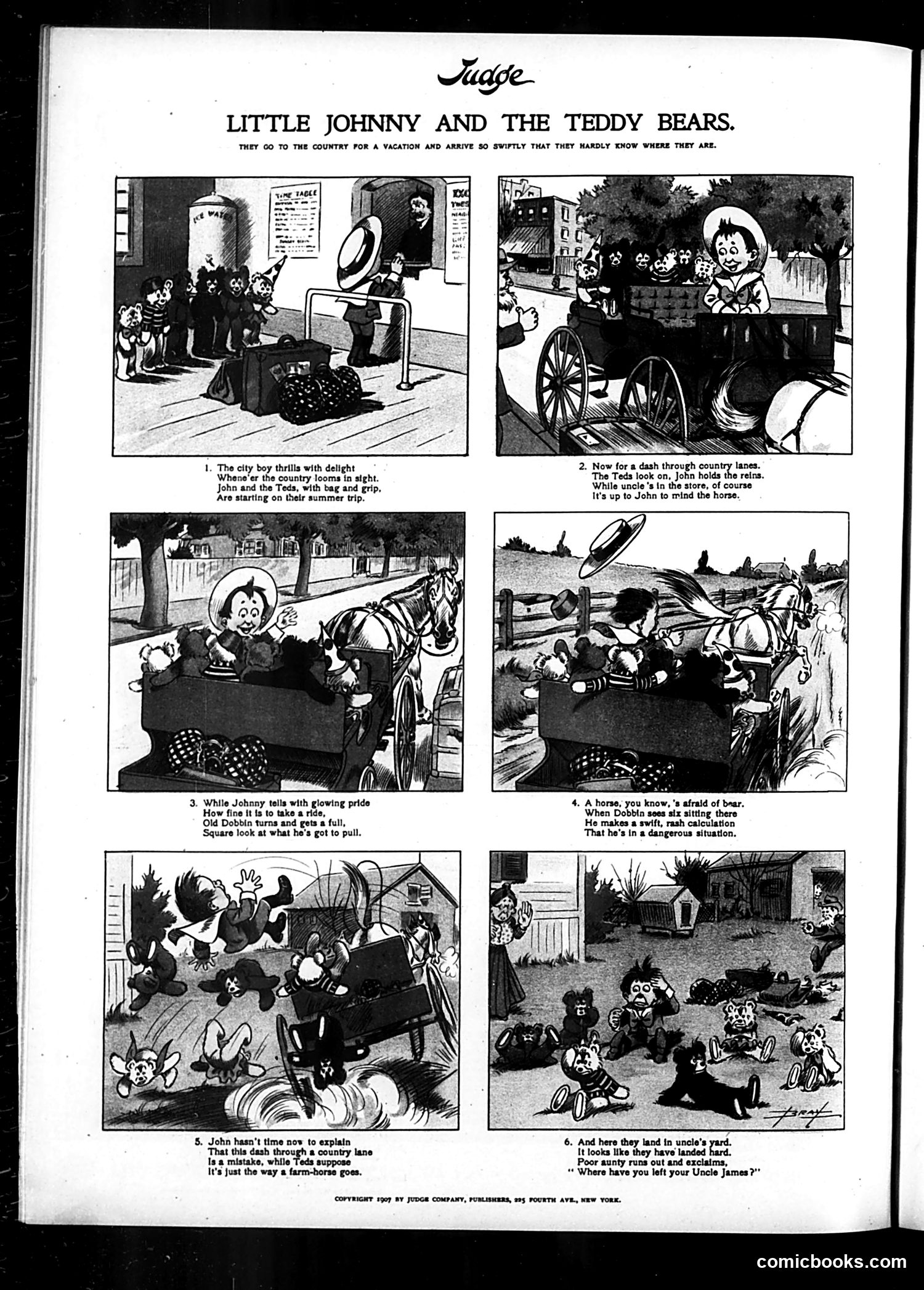
This is a six-panel children's comic strip, not political satire. It depicts "Little Johnny" (a city boy) taking anthropomorphic teddy bears on a country vacation. The humor derives from comic mishaps: Johnny confidently drives a horse-drawn cart through rural roads while the bears ride along. The horse, startled by the chaotic passengers, bolts uncontrollably through the countryside, ultimately depositing everyone in Uncle's yard in disarray. The "Teddy Bears" reference likely alludes to the popular toy craze following President Theodore Roosevelt's 1902 bear-hunting incident (which inspired the "Teddy Bear" name). The strip plays on urban-versus-rural culture clash and the unpredictability of rural travel — relatable themes for Judge's early-20th-century readership. The joke is simply slapstick: city dwellers' overconfidence leading to comedic chaos.