
Judge, 1907-08-10 · page 2 of 16
Judge — August 10, 1907 — page 2: what you’re looking at
What you’re looking at
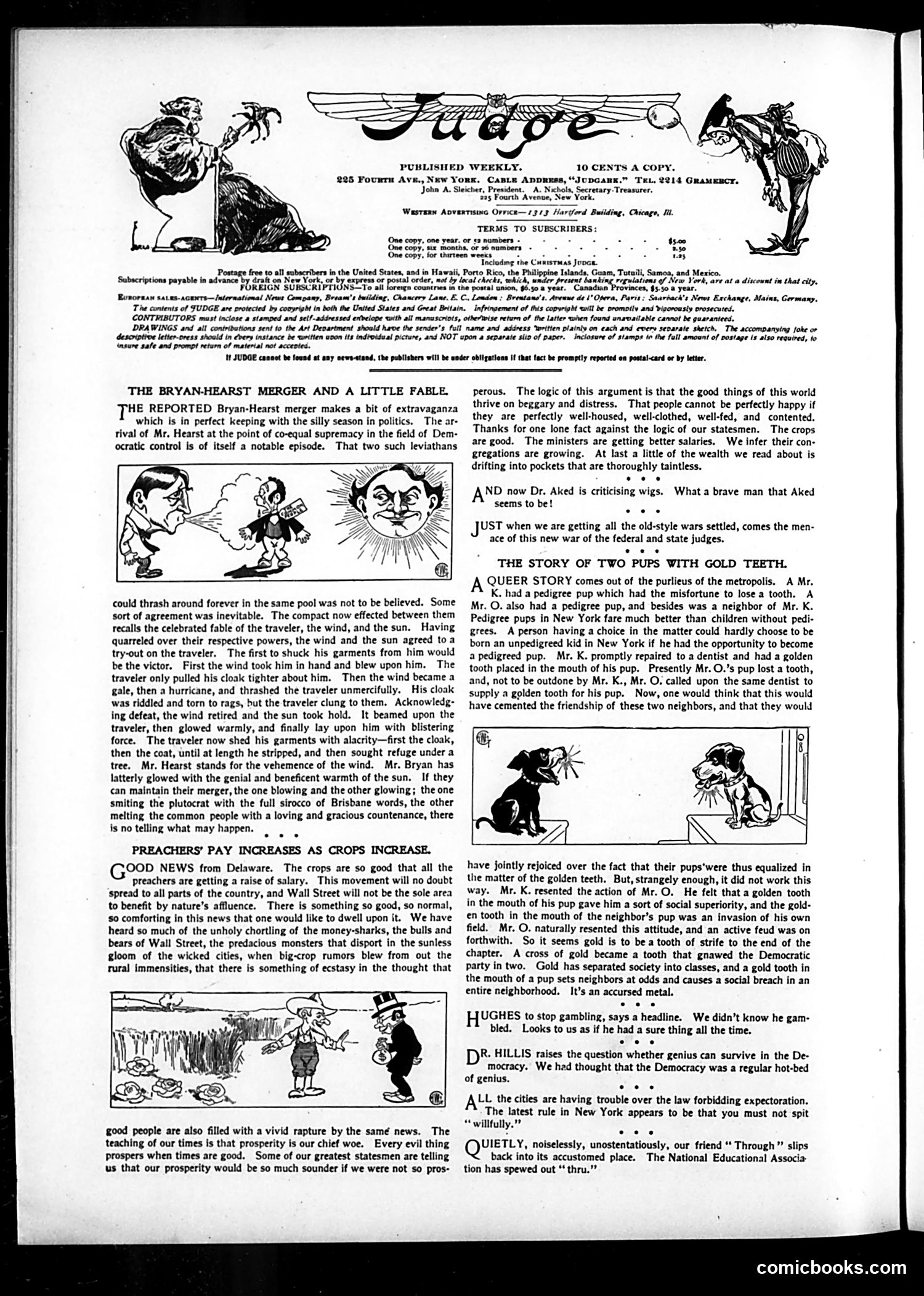
This page contains several satirical pieces typical of Judge magazine's political commentary: **"The Bryan-Hearst Merger"** mocks a potential political alliance, depicting two figures (likely William Jennings Bryan and William Randolph Hearst, both prominent Democrats/Populists) as incompatible partners who cannot maintain unity—a critique of their conflicting interests and egos. **"The Story of Two Pups with Gold Teeth"** is an allegorical fable satirizing class divisions and Democratic Party infighting. Two dogs (representing Democratic factions) squabble over a golden tooth, symbolizing wealth or political power, ultimately damaging their community through their conflict. The remaining items offer brief political observations on judges, crop prices, and social issues, using typical early-20th-century Judge satire: visual caricature combined with pointed social commentary about American politics and society.
📄 Transcribed text from this page (OCR, searchable)
Machine-transcribed from the original scan — historical spelling and the odd misread are preserved.
= i L— Zz PUBLISHED WEEKLY. 225 Founrn Avs., Nuw Yo Joho A. Sie Wasraen Apvexrisixc Or 10 CENTS A COPY, CanLe Appaxss,“Jupcann.” Txt, 2214 Gramxncr. » President. A. Nichols, Seer 225 Fourth Avenue, New York 313 Harford Building, Cricage, I. TERMS TO SUBSCRIBERS: One copy, one year.orsanumbers- = One copy, six months, ‘One copy; for thirteen weeks B fal order, mat by lec P Subset fable in advance by draft on New Vork, or by express or “gasses FOREIGN SUBSCRIPTIONS To al zo numoers - eae ls 135 TIncladmg the Cunistmas Joocs. free to all subscribers in the United States, and in Hawaii, Porto Rico, the Philippine Islands, Guam, Tutuili, Samoa, and Mexico. al checks, which, under present banking regulations of New York, areata discownt in that city, reign countries in the postal umon, $6.50 a year. Canadian Provinces, $5:50 a year. Eunoraan satus-acunrs—International News Company, Bream's building, Chancery Lane. E. C. Londen : Brentane's. Avenue de |" Opera, Paris: Saarback's News Exchange, Mains, Germany, The contents of FUDGE are protected by conyright in both the United States and Great Britain. infringement of this copyright wll be Dromotlv and vigorously srosecuted. CONTRIBUTORS mast inciose a stamped and self-addressed envelope wth all manascriots, otherwise return of the Latter when found enavailaNe cannot be guaranteed. DRAWINGS and all contribations sent to the Art Department shoald have the sender's full name and adéress “written plainly on each and every seoarate sketch. The accompanying Joke or descriptive letter-oress should in every instance be woritten acon tts indtoidual picture, and NOT upon a separate slip of paper. inciosure of stamps to the fall amount of vostage 1s also required, 10 insure safe and prompt return of material not acceotes. WW JUDGE canect be found at any newsstand, the publishers will be ender obligations if that fact be promptly reported on postal-card or by letter. THE BRYAN-HEARST MERGER AND A LITTLE FABLE. THE REPORTED Bryan-Hearst merger makes a bit of extravaganza which is in perfect keeping with the silly season in politics. The ar- rival of Mr. Hearst at the point of co-equal supremacy in the field of Dem- ocratic control is of itself a notable episode. That two such leviathans could thrash around forever in the same pool was not to be believed. Some sort of agreement was inevitable. The compact now effected between them recalls the celebrated fable of the traveler, the wind, and the sun. Having quarreled over their respective powers, the wind and the sun agreed toa try-out on the traveler. The first to shuck his garments from him would be the victor. First the wind took him in hand and blew upon him. The traveler only pulled his cloak tighter about him. Then the wind became a gale, then a hurricane, and thrashed the traveler unmercifully. His cloak was riddled and torn to rags, but the traveler clung to them. Acknowledg- ing defeat, the wind retired and the sun took hold. It beamed upon the traveler, then glowed warmly, and finally lay upon him with blistering force. The traveler now shed his garments with alacrity—first the cloak, then the coat, until at length he stripped, and then sought refuge under a tree. Mr. Hearst stands for the vehemence of the wind. Mr. Bryan has latterly glowed with the genial and beneficent warmth of the sun. If they can maintain their merger, the one blowing and the other glowing; the one smiting the plutocrat with the full sirocco of Brisbane words, the other melting the common people with a loving and gracious countenance, there is no telling what may happen. . PREACHERS’ PAY INCREASES AS CROPS INCREASE. OOD NEWS from Delaware. The crops are so good that all the preachers are getting a raise of salary. This movement will no doubt ‘spread to all parts of the country, and Wall Street will not be the sole area to benefit by nature’s affluence. There is something so good, so normal, ‘so comforting in this news that one would like to dwell upon it. We have heard so much of the unholy chortling of the money-sharks, the bulls and bears of Wall Street, the predacious monsters that disport in the sunless gloom of the wicked cities, when big-crop rumors blew from out the rural immensities, that there is something of ecstasy in the thought that ii mA good people are also filled with a vivid rapture by the samé news. The teaching of our times is that prosperity is our chief woe. Every evil thing prospers when times are good. Some of our greatest statesmen are telling us that our prosperity would be so much sounder if we were not so pros- perous. The logic of this argument is that the good things of this world thrive on beggary and distress. That people cannot be perfectly happy if they are perfectly well-housed, well-clothed, well-fed, and contented. Thanks for one lone fact against the logic of our statesmen. The crops are good. The ministers are getting better salaries. We infer their con- gregations are growing. At last a little of the wealth we read about is drifting into pockets that are thoroughly taintless. eee ND now Dr. Aked is criticising wigs. seems to be! What a brave man that Aked Just when we are getting all the old-style wars settled, comes the men- ace of this new war of the federal and state judges. THE STORY OF TWO PUPS WITH GOLD TEETH. A QUEER STORY comes out of the purlieus of the metropolis. A Mr. K. had a pedigree pup which had the misfortune to lose a tooth. A Mr. O. also had a pedigree pup, and besides was a neighbor of Mr. K. Pedigree pups in New York fare much better than children without pedi- grees. A person having a choice in the matter could hardly choose to be born an unpedigreed kid in New York if he had the opportunity to become a pedigreed pup. Mr. K. promptly repaired to a dentist and had a golden tooth placed in the mouth of his pup. Presently Mr. O.’s pup lost a tooth, and, not to be outdone by Mr. K., Mr. O. called upon the same dentist to supply a golden tooth for his pup. Now, one would think that this would have cemented the friendship of these two neighbors, and that they would have jointly rejoiced over the fact that their pups‘were thus equalized in the matter of the golden teeth. But, strangely enough, it did not work this way. Mr. K. resented the action of Mr.O. He felt that a golden tooth in the mouth of his pup gave him a sort of social superiority, and the gold- €n tooth in the mouth of the neighbor’s pup was an invasion of his own field. Mr. O. naturally resented this attitude, and an active feud was on forthwith. So it seems gold is to bea tooth of strife to the end of the chapter. A cross of gold became a tooth that gnawed the Democratic party in two. Gold has separated society into classes, and a gold tooth in the mouth of a pup sets neighbors at odds and causes a social breach in an entire neighborhood. It’s an accursed metal. HUGHES to stop gambling, says a headline. We didn’t know he gam- bled. Looks to us as if he had a sure thing all the time. eee HILLIS raises the question whether genius can survive in the De- We had thought that the Democracy was a regular hot-bed D® mocracy. of genius. Att the cities are having trouble over the law forbidding expectoration. The latest rule in New York appears to be that you must not spit * willfully.”” (Sex . UIETLY, noiselessly, unostentatiously, our friend “ Through” slips back into its accustomed place. The National Educational Associa tion has spewed out “ thru.”” comicbooks.com