
A complete issue · 16 pages · 1907
Judge — August 3, 1907
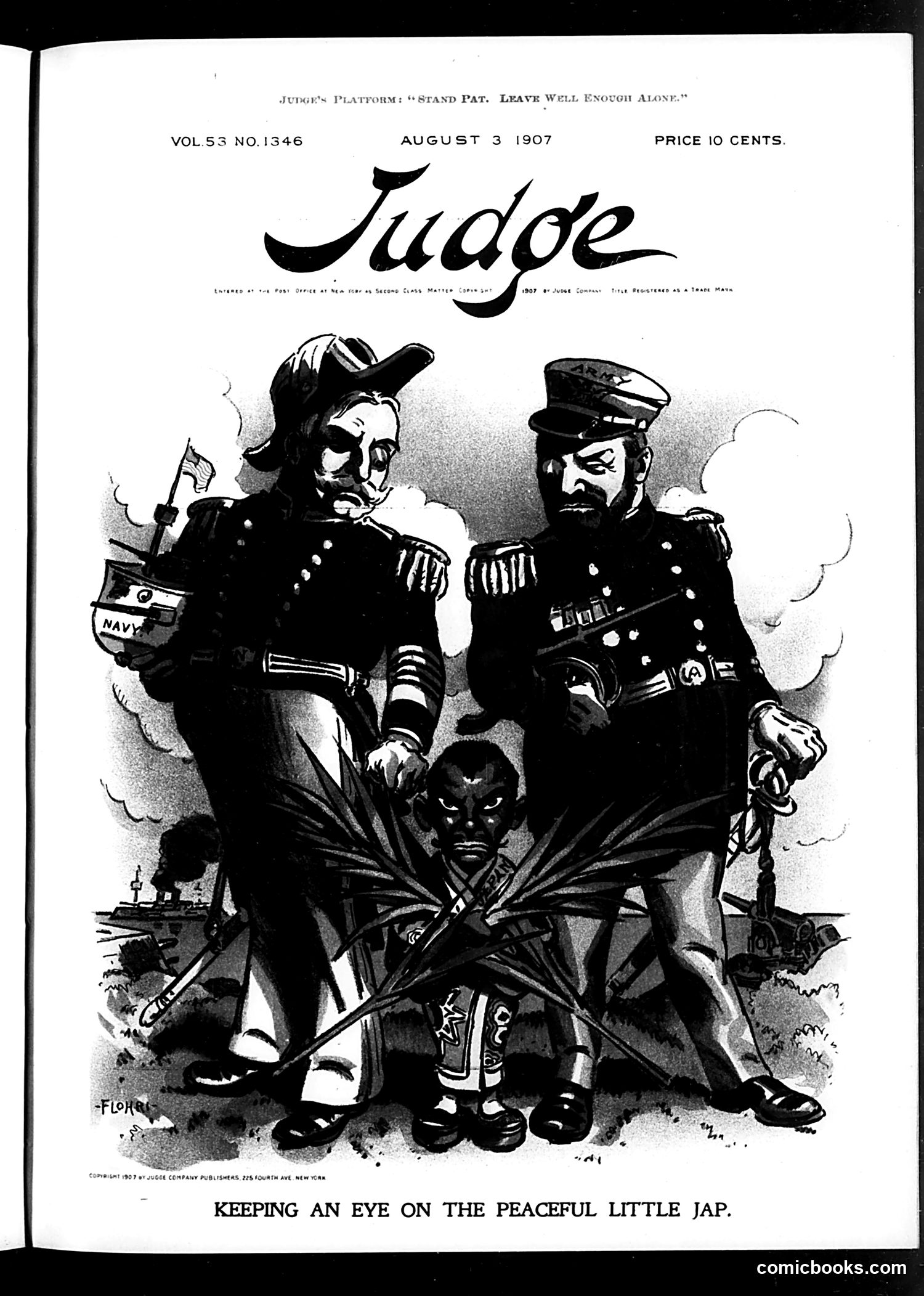
This satirical cartoon depicts two Western military officers (likely American and British, based on naval uniforms) closely watching a small Japanese figure. The "peaceful little Jap" is portrayed ironically—the diminutive caricature contradicts the title's sarcasm, as Japan had recently defeated Russia in the Russo-Japanese War (1904-1905), shocking Western powers with its military prowess. The cartoon reflects early-20th-century anxieties about Japanese expansionism in the Pacific. The Western naval powers are depicted as vigilant guardians, suggesting wariness of Japan's growing strength despite its small size. This represents the era's emerging "Yellow Peril" rhetoric and concerns about shifting global power dynamics in Asia.
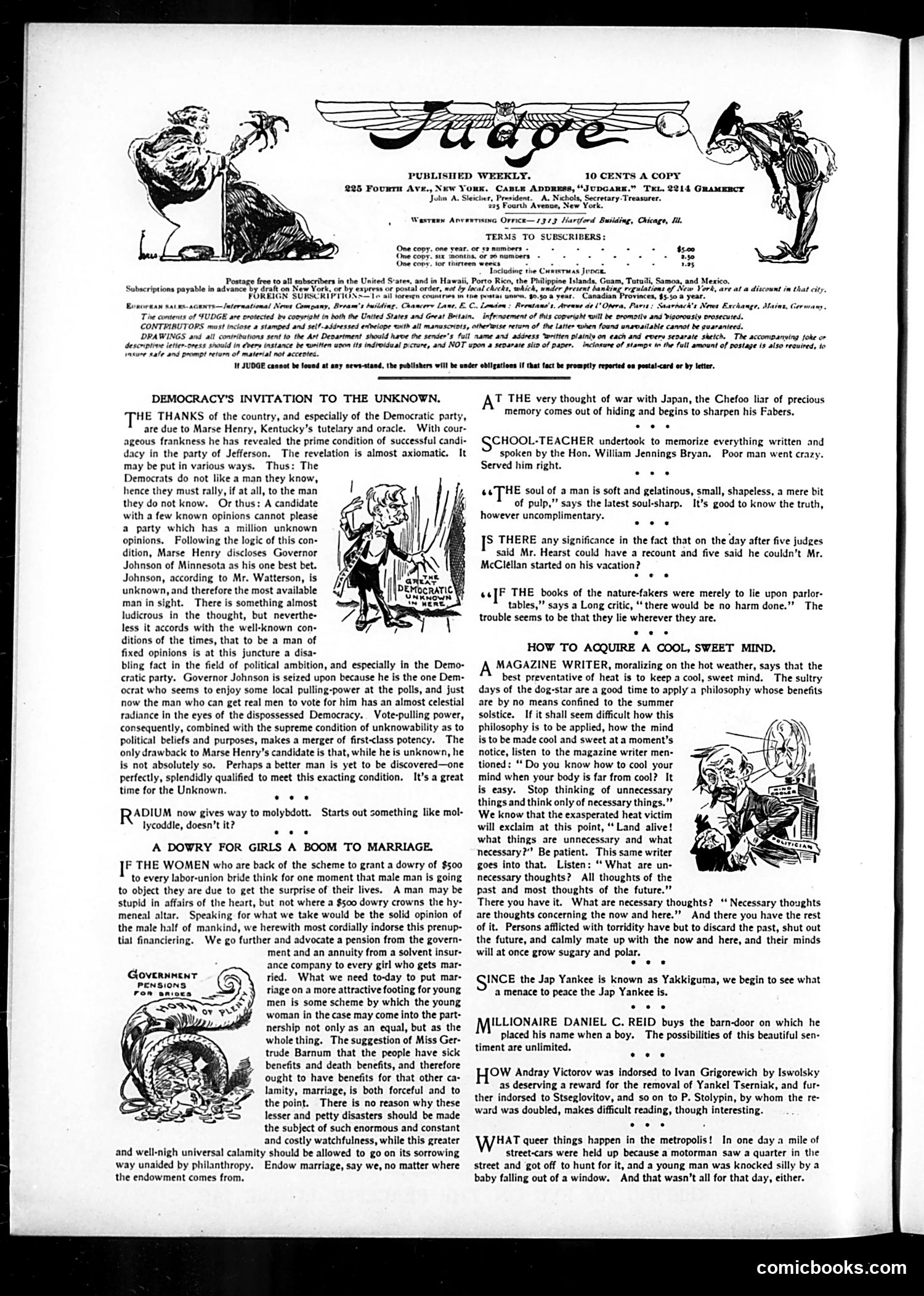
This page contains several satirical pieces attacking Democratic political figures. The main article "Democracy's Invitation to the Unknown" criticizes Governor John Albert Johnson of Minnesota as the Democratic Party's unknown candidate, mocking his lack of national prominence and questioning his viability. A cartoon labeled "Democratic Party" depicts a figure (likely representing the party) grappling with uncertainty about their candidate selection. Other brief satirical pieces mock contemporary political figures and social issues, including references to judges, Japanese relations ("war with Japan"), and personal scandals. The tone throughout is dismissive and mocking toward Democratic leadership and their political choices. The publication date and specific election context remain unclear from this excerpt alone, though this appears to be pre-election partisan satire typical of Judge magazine's editorial approach.
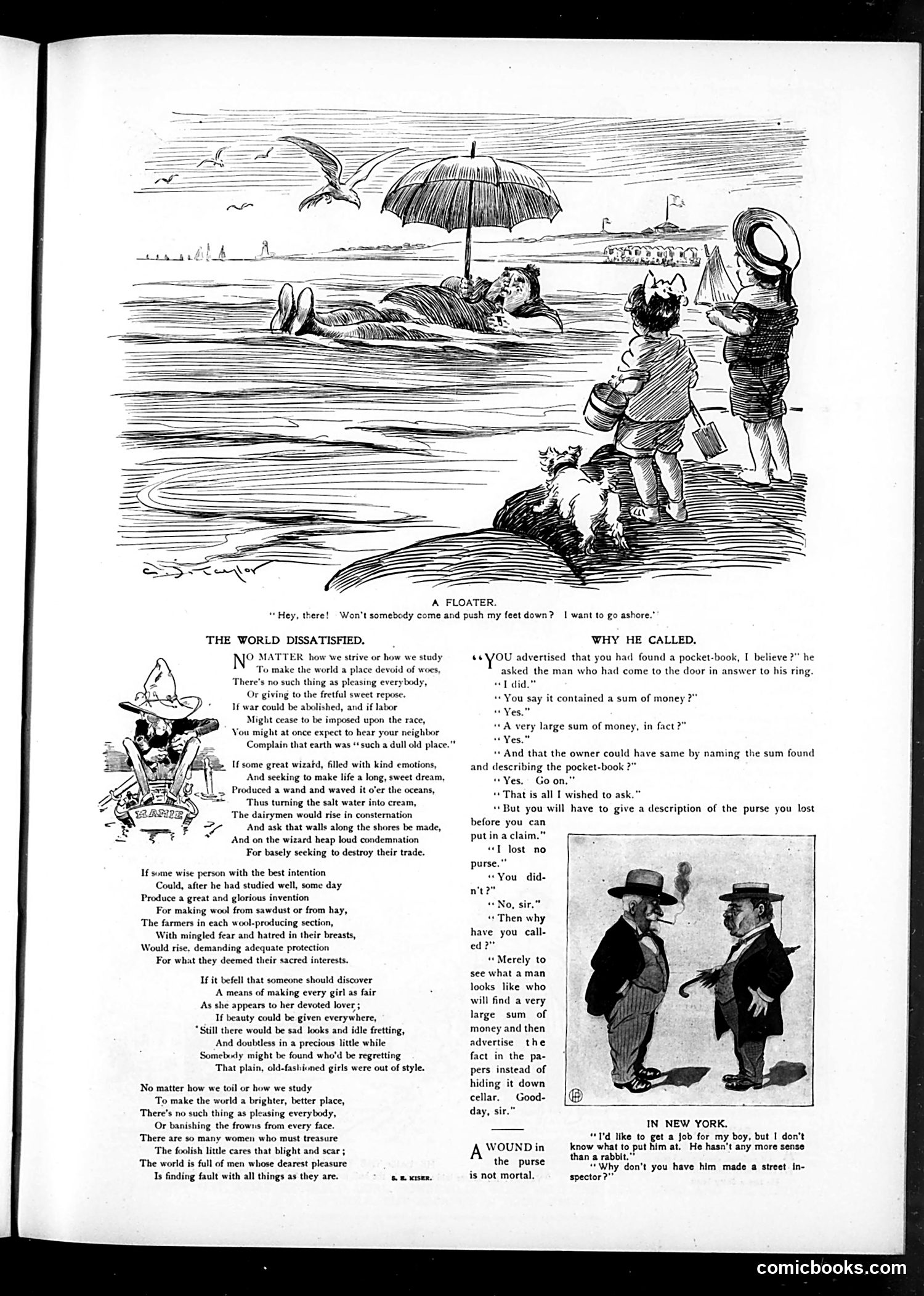
**"A Floater"** (top cartoon) depicts a man floating in water with an umbrella while beachgoers ignore him, with one saying "Won't somebody come and push my feet down? I want to go ashore." The joke appears to play on the word "floater"—likely referencing both the literal situation and a slang term for a dead body or worthless check. **"The World Dissatisfied"** (left poem) is a cynical verse suggesting that no matter how people try to improve the world through innovation or good intentions, dissatisfaction persists. It's social commentary on humanity's perpetual discontent. **"Why He Called"** (right) shows two men in conversation about a lost pocket-book and reward advertisement—satirizing how such announcements might attract opportunists seeking reward money rather than honest finders.
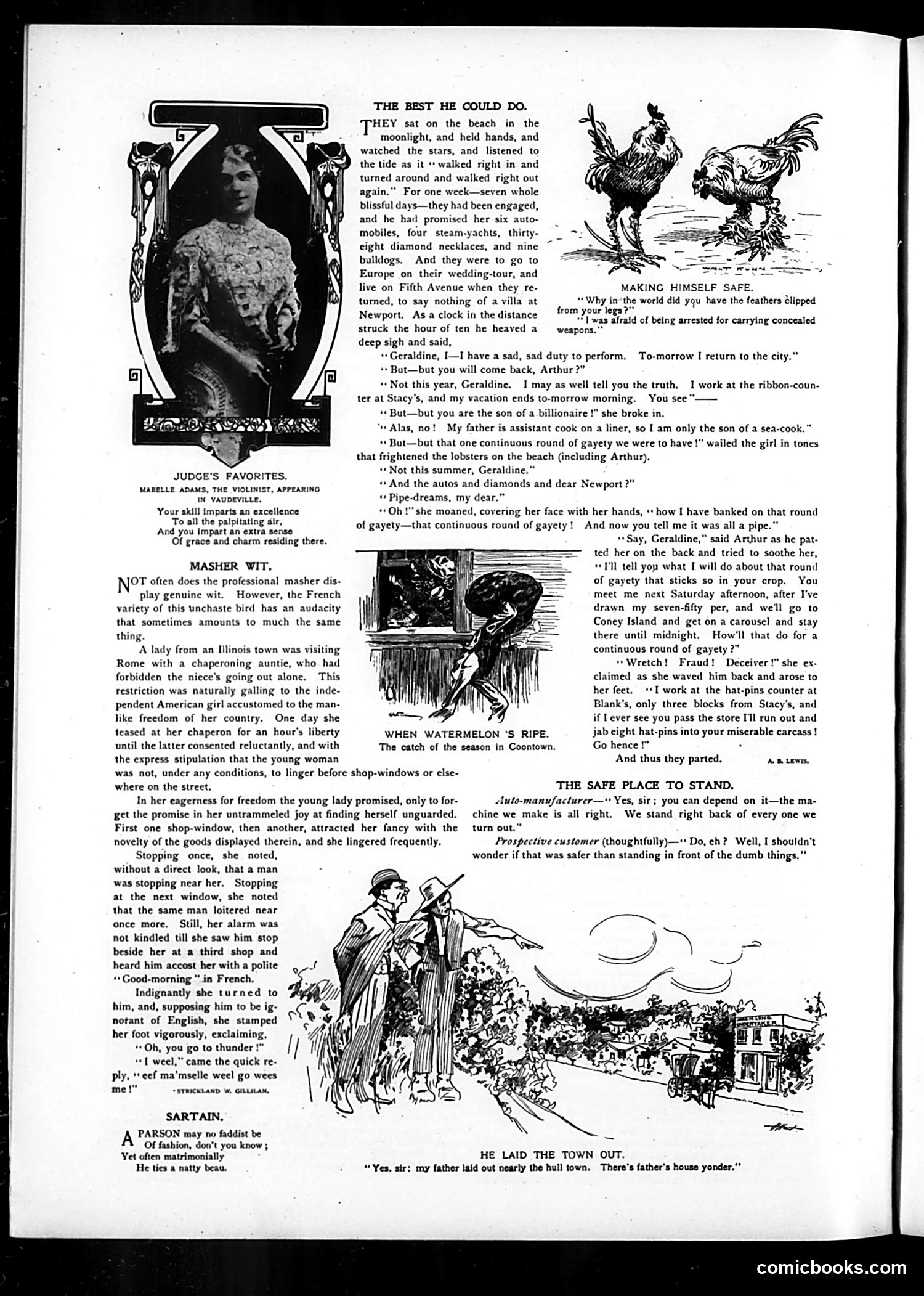
This page contains primarily **fiction and humor sketches** rather than political satire. The main story "The Best He Could Do" depicts a romantic couple on a beach discussing a broken engagement—he's a poor ribbon-counter worker at Stacy's department store, not the wealthy heir she'd expected. The satire targets **class aspirations and materialism**: she fantasized about automobiles and diamonds but must accept his modest reality. Secondary pieces include "Masher Wit" (about street harassment), "Sartorial" (brief verse about fashion), and "The Safe Place to Stand" (department store humor). The illustrations feature everyday scenes—roosters, shoppers, rural figures—with no identifiable political figures or events. This represents Judge's lighter, **social-humor content** rather than its political-cartoon sections.
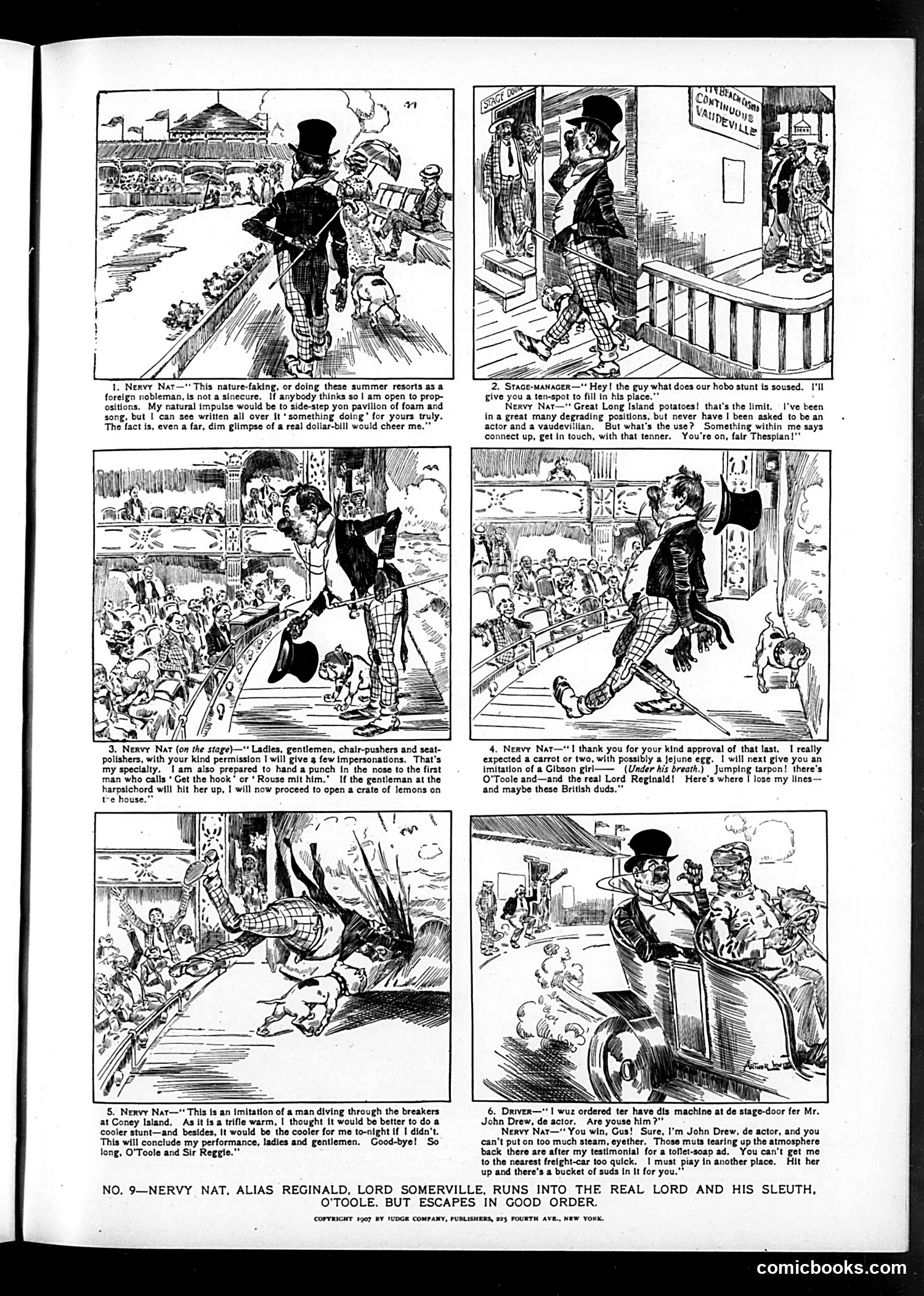
This comic strip features "Nervy Nat," a character who impersonates various theatrical professionals to gain access to summer resorts and entertainment venues. The six-panel narrative shows Nat: 1. Posing as a foreign nobleman at a resort 2. Attempting to substitute for a stage manager 3. Offering vaudeville impersonations to an audience 4. Pretending to be a performer named "John Drew" 5. Imitating a diver at Coney Island 6. Being exposed as a fraud The satire mocks both Nat's brazen deception and the gullibility of institutions that fail to verify credentials. The comic relies on physical comedy and slapstick as Nat's schemes unravel. The title promises he'll encounter "the real Lord Sileuth" and escape in good order—suggesting this is part of an ongoing series about this con-artist character.
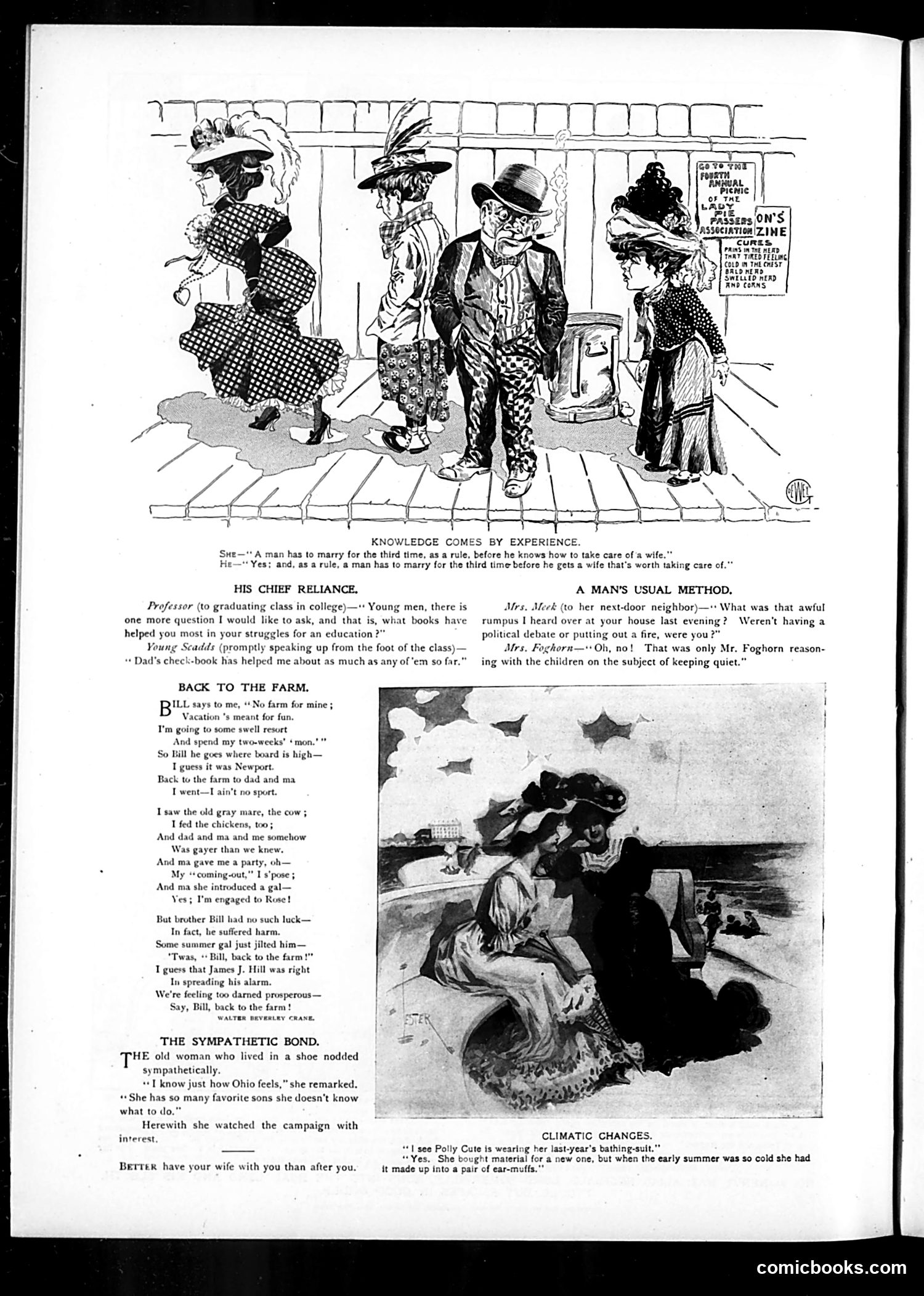
This page contains multiple satirical pieces typical of early 20th-century American humor: **Top cartoon**: Depicts fashionably dressed women gossiping on a street. The caption jokes that men need three marriages to learn how to manage a wife properly—the third wife being "worth taking care of." This reflects contemporary cynicism about marriage and domestic life. **Three dialogue pieces** mock everyday American life: a professor asking what books helped students (answered: "Dad's check-book"), neighbors discussing domestic noise (a husband disciplining children), and rumors about a politician's activity. **"Back to the Farm"**: A poem contrasting two brothers—one returns to simple farm life and finds contentment (and engagement), while the other seeks fashionable resort vacations and suffers. This reflects rural-versus-urban tensions and anxieties about modern prosperity making Americans "too darned prosperous." **"The Sympathetic Bond"**: References Ohio having many notable sons, comparing the state to the nursery rhyme woman with many children. **"Climatic Changes"**: A brief joke about cold weather making bathing suits impractical. The overall tone is gently satirical about modern American manners and social pretension.
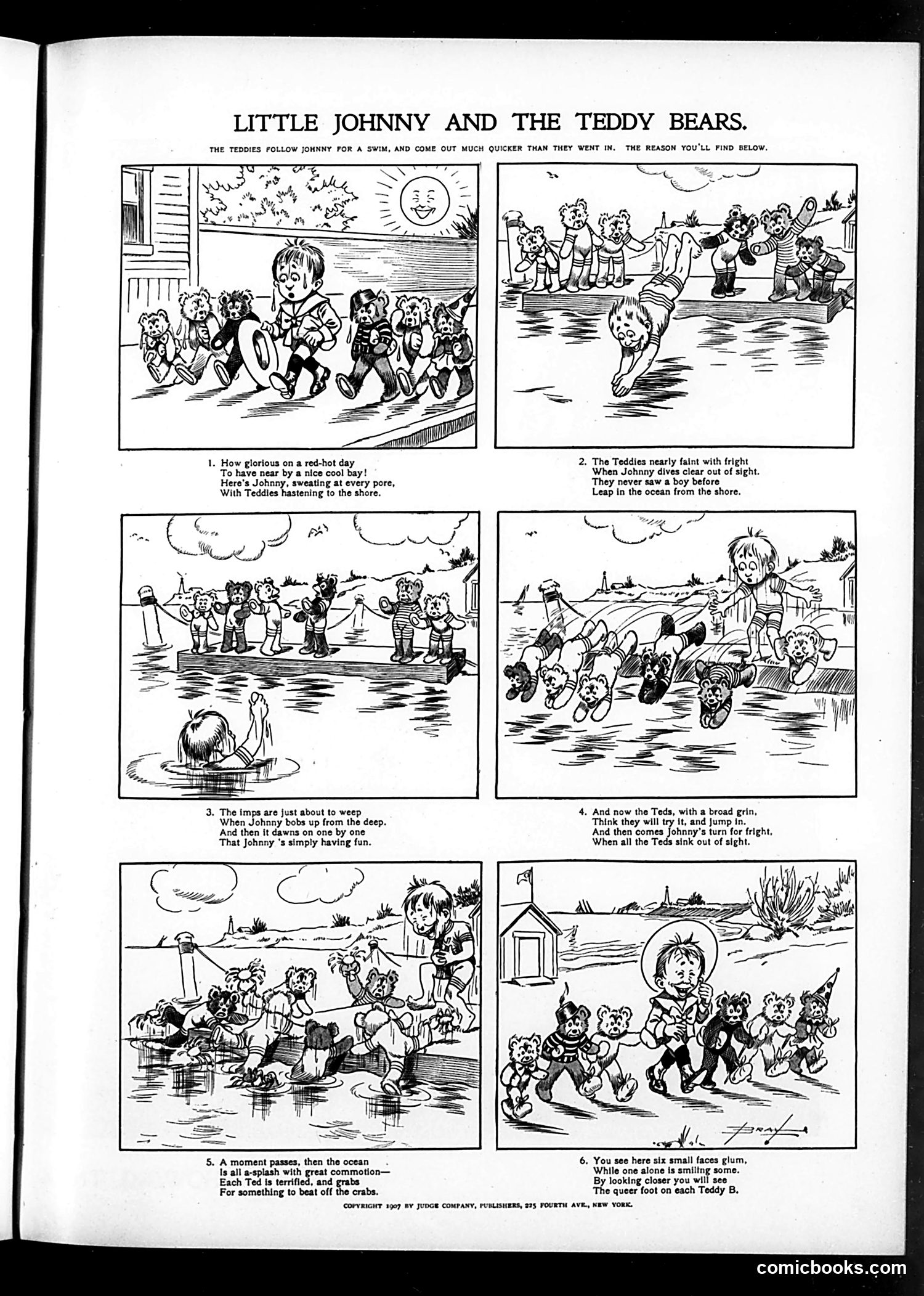
This is a children's comic strip featuring "Little Johnny" (a popular character of the era) and teddy bears—toys named after President Theodore Roosevelt, whose nickname was "Teddy." The strip plays on the absurdity of toy bears mimicking human behavior. The humor centers on the bears' comic incompetence: they eagerly follow Johnny into the ocean for a swim but panic when they realize they'll sink (being stuffed toys). Johnny finds this hilarious. The final panel reveals the joke's visual punchline—each teddy bear has a distinctively odd foot visible in the illustration, emphasizing their nature as manufactured objects attempting human activities. The satire gently mocks both the teddy bear craze that swept America after Roosevelt's 1902 bear-hunting incident, and children's naive assumptions that toys function like living creatures. It's lighthearted social commentary on consumer culture and childhood imagination.
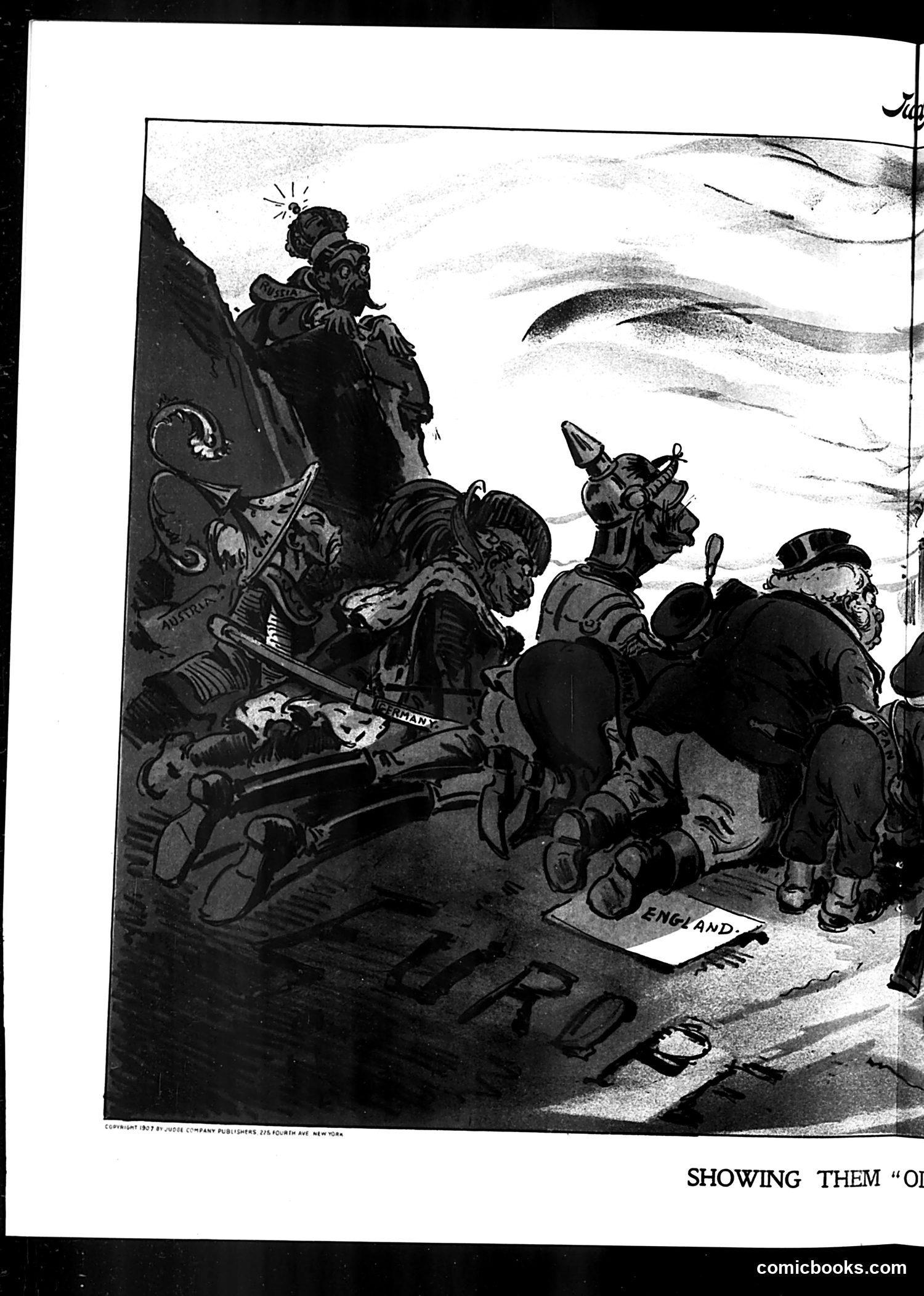
This appears to be a satirical cartoon from *Judge* magazine depicting military or political figures in a confrontational scene. The image shows what appear to be German military officers (identifiable by their spiked helmets) on the left side, contrasting with figures on the right labeled "ENGLAND." The cartoon seems to reference international tensions, likely from the early 20th century given the military uniforms and styling. The satirical point appears to be about military posturing or diplomatic conflict between Germany and England. However, without a visible date or clearer caption, I cannot definitively identify the specific historical moment or provide complete context for modern readers. The bottom text reading "SHOWING THEM" suggests commentary on demonstrating power or superiority to rivals.
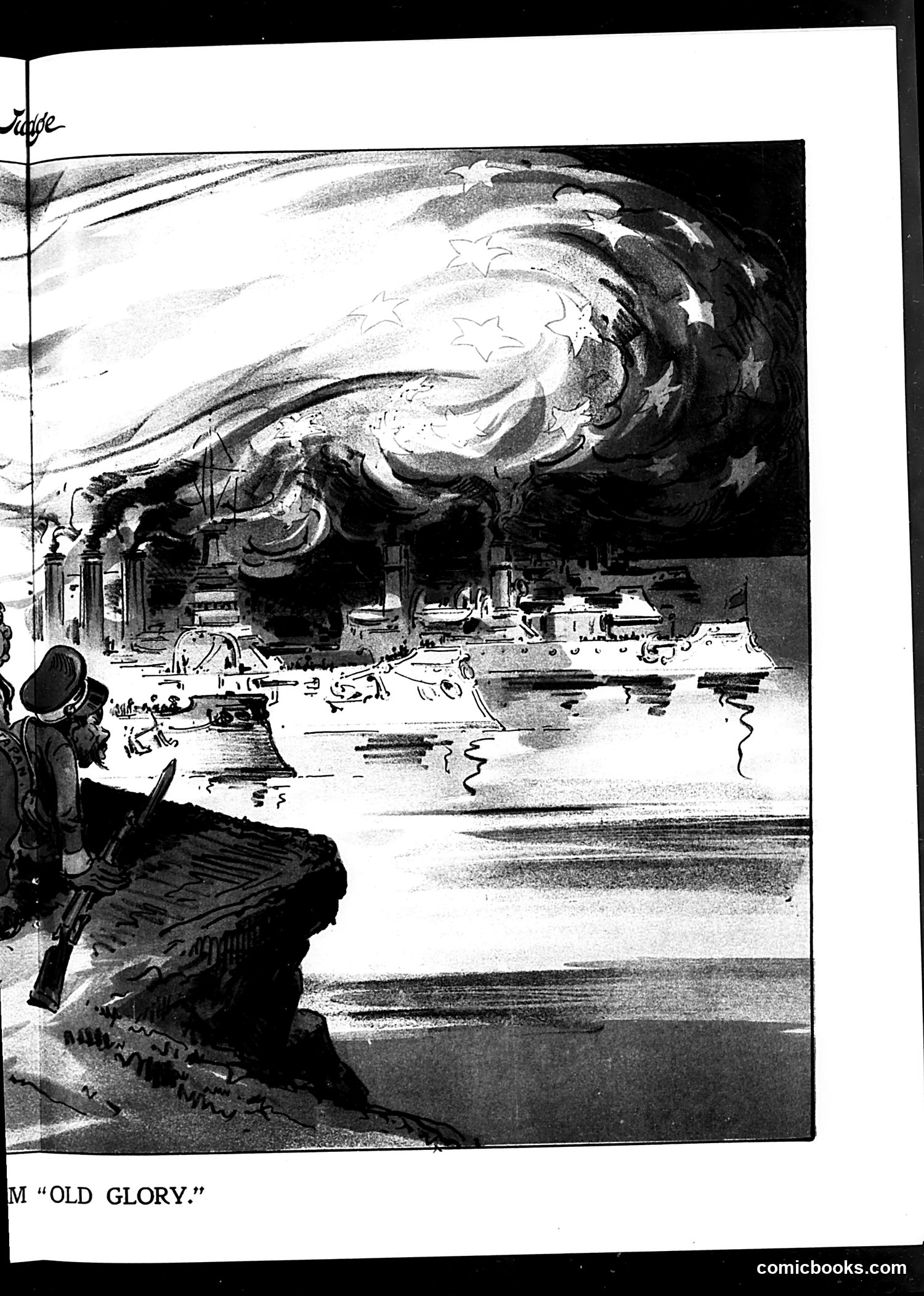
This appears to be a patriotic illustration titled "Old Glory," referring to the American flag. The image shows a figure in period costume observing a dramatic scene: industrial ships or naval vessels on water beneath a turbulent sky filled with stars and swirling clouds. The composition suggests a commentary on American industrial or military power, with the "Old Glory" title invoking national pride. The dramatic, somewhat chaotic sky and the figure's observational stance suggest this may be satirizing American expansionism, industrial might, or military ambitions—possibly from the early 20th century when Judge magazine was active. Without additional context or visible date, the specific historical reference remains unclear, though the styling suggests commentary on contemporary American power and national identity.
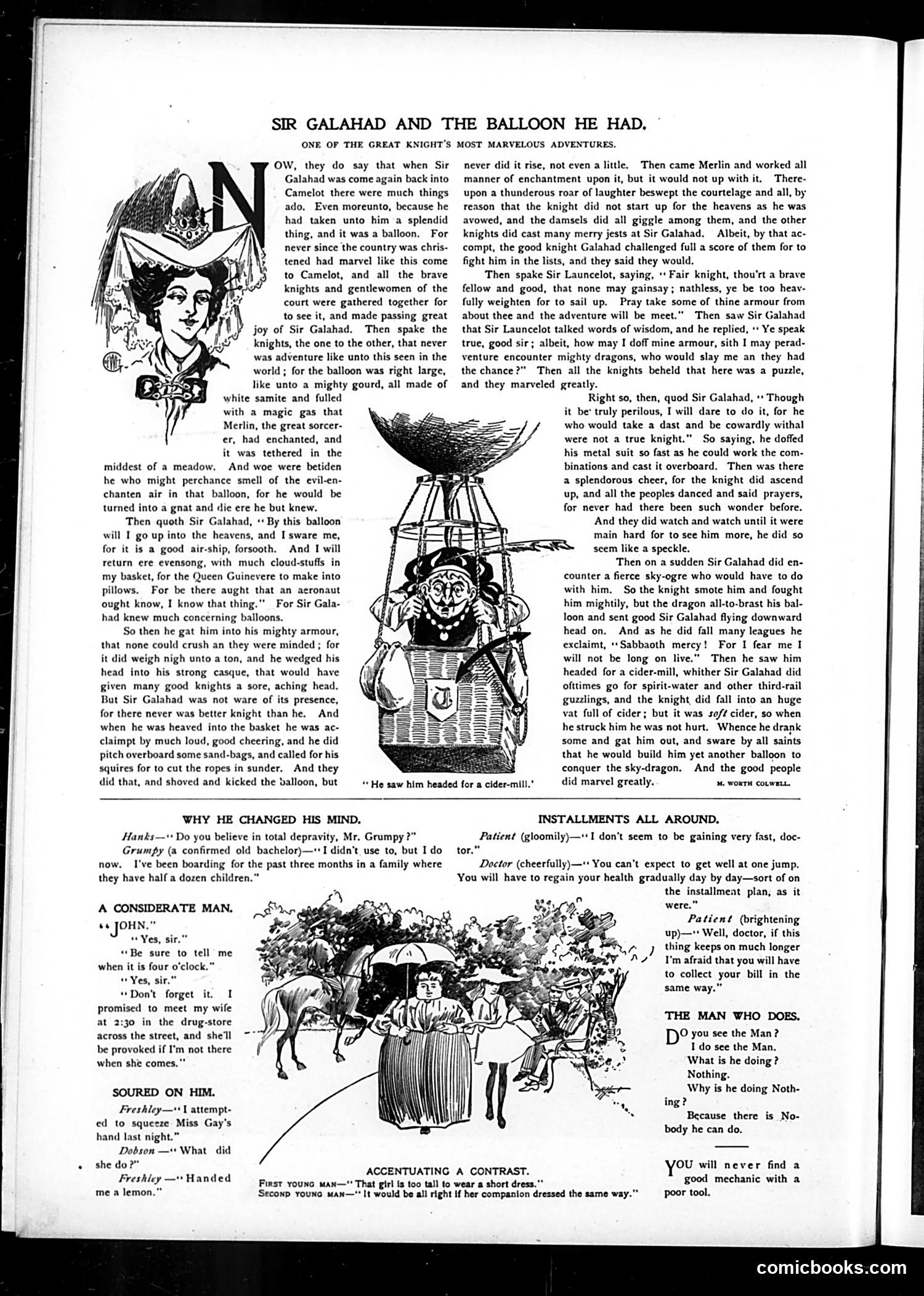
This is a mock-medieval parody published in *Judge*, a satirical magazine. The text mocks both chivalric romance literature and contemporary fascination with hot air balloons—a genuinely novel technology in the late 19th century. The joke is straightforward: Sir Galahad, encumbered by heavy medieval armor, cannot achieve liftoff in his balloon. His peers mock him until Sir Launcelot suggests he simply remove the armor. This is satirical commentary on the clash between tradition and progress—the armor (old ways) prevents advancement. Only by abandoning the cumbersome past can one achieve modern innovation. The archaic, pseudo-Arthurian language ("quoth," "forsooth," "nathless") heightens the absurdity of applying medieval romance conventions to contemporary technology. The illustration shows the basket with the weighty armored knight, emphasizing the visual joke. The satire targets those clinging to outdated practices while attempting modern pursuits—a common theme in *Judge's* social commentary during the industrial age.
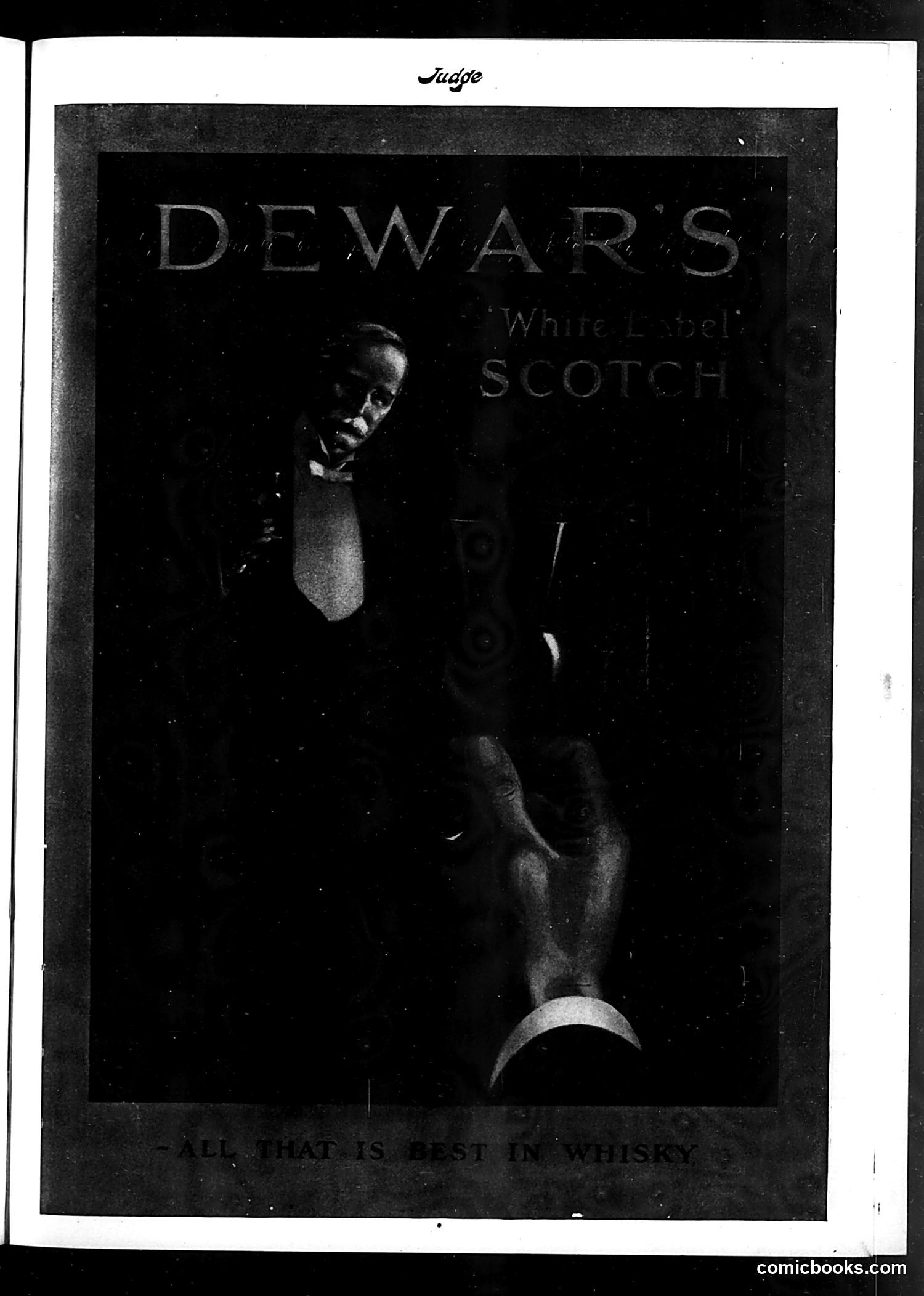
This appears to be a **Dewar's Scotch whisky advertisement** rather than a political cartoon. The image shows a man in formal attire (tuxedo and bow tie) in dramatic lighting, holding what appears to be a glass or decanter. The text reads "DEWAR'S White Label SCOTCH" at the top and "ALL THAT IS BEST IN WHISKY" at the bottom—standard advertising copy emphasizing product quality. The page header simply says "Judge," identifying it as from the satirical magazine. This is a commercial advertisement using dramatic, moody photography typical of 1920s-30s luxury goods marketing, designed to associate Dewar's with sophistication and elegance. It's not satirical commentary but rather straightforward product promotion.
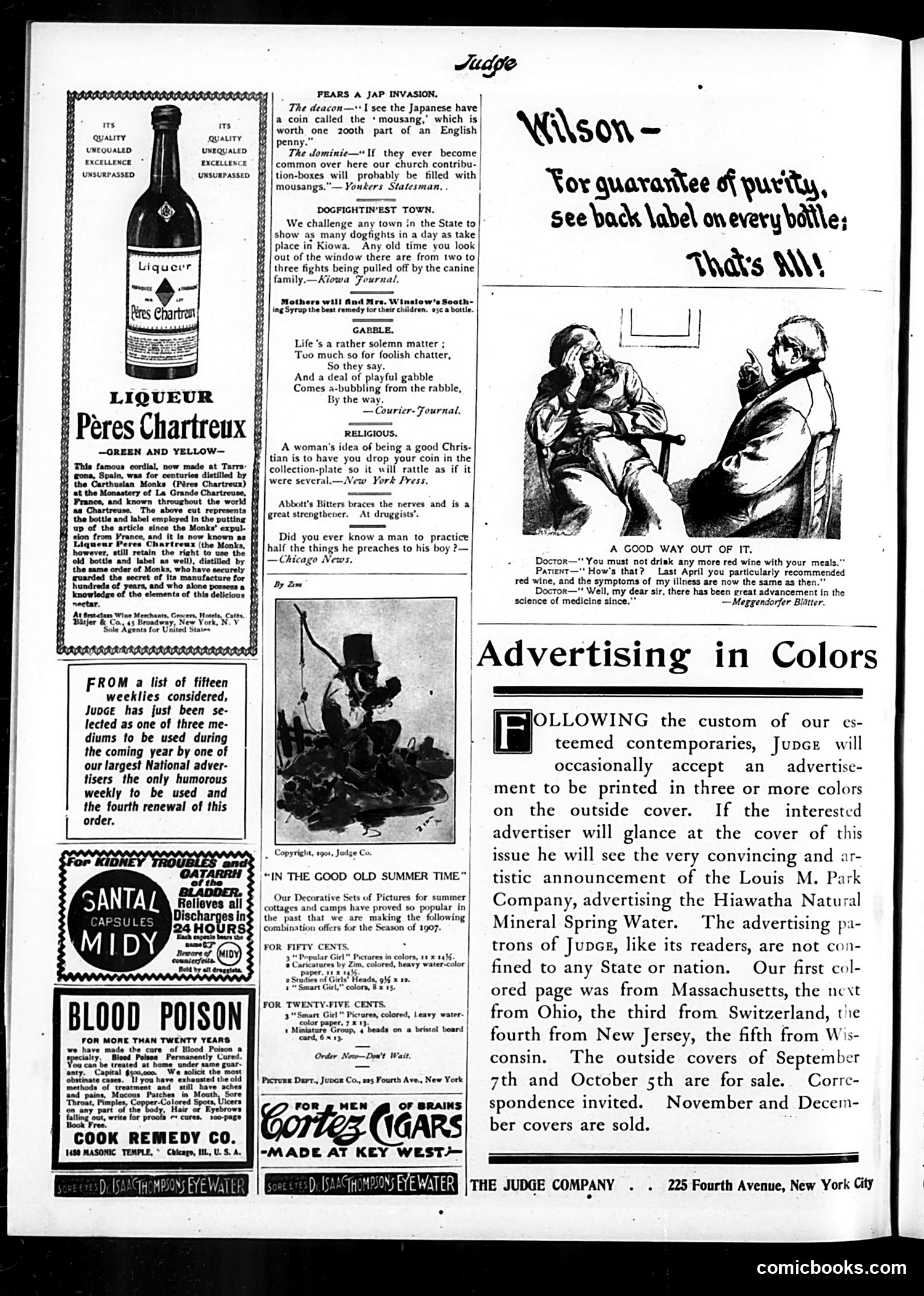
This page is primarily **advertising and editorial content** from Judge magazine, circa 1906-1907. **Main Cartoons:** The page contains several short humorous items rather than large political cartoons. Notable jokes include: 1. **"Fears a Jap Invasion"** — A joke about Japanese coins ("mousang") and church collection boxes, reflecting early-1900s American anxieties about Japanese immigration and economic competition. 2. **"A Good Way Out of It"** — A doctor comedically contradicts his prior medical advice by claiming medicine has "advanced" since last year, poking fun at medical practice and doctors' convenient reversals. The **central illustration** labeled "In the Good Old Summer Time" shows what appears to be children or figures in a casual summer scene. **Context:** This reflects Judge's role as a humorous weekly for middle-class American readers. The Japanese reference captures genuine period concerns about Asian immigration, while the doctor joke satirizes professional incompetence — common Judge targets. The page is otherwise dominated by advertisements for liqueurs, patent medicines, and services typical of the era.
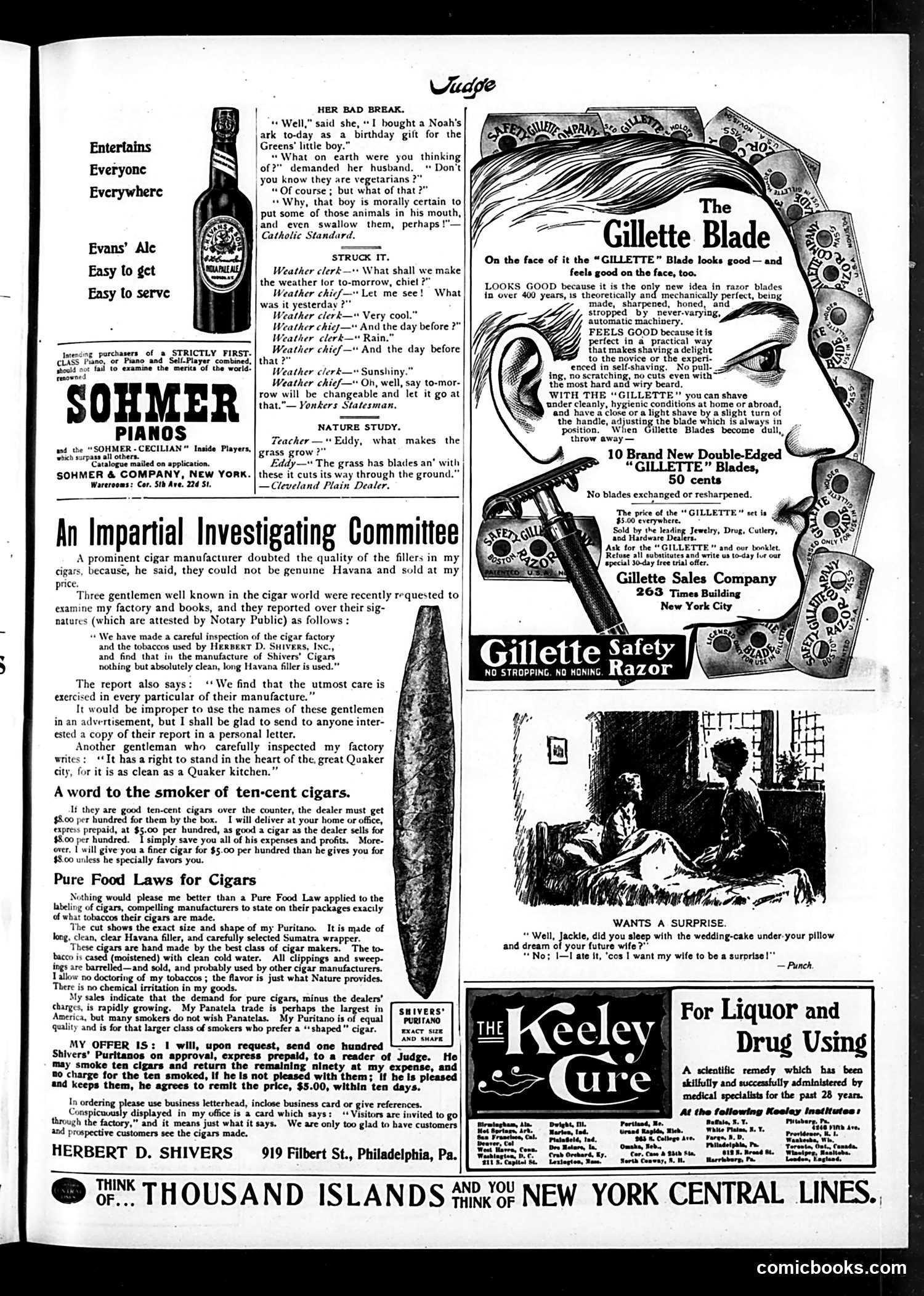
This page is primarily **advertising**, not political satire. The main content consists of multiple product advertisements interspersed with brief humorous anecdotes. The cartoon humor includes: 1. **"Well, said she"** — A joke about vegetarian parents receiving a Noah's Ark toy, with the father worried the child will eat the toy animals. This satirizes extreme vegetarianism as absurdly stringent. 2. **"Struck It"** — A weather bureau comedy where clerks lazily repeat "changeable" weather rather than actually forecasting. 3. **"Nature Study"** — A child's innocent misunderstanding that grass "blades" cut through ground like knife blades. The advertisements dominate: Sohmer Pianos, Evans' Ale, Gillette Razor blades, Herbert D. Shivers' cigars, The Keeley Cure (addiction treatment), and New York Central Lines. These reflect early 20th-century consumer products and social concerns (alcoholism treatment was heavily advertised during Prohibition era discussions). The page reflects Judge's mixed editorial-advertising model rather than sustained satirical commentary.
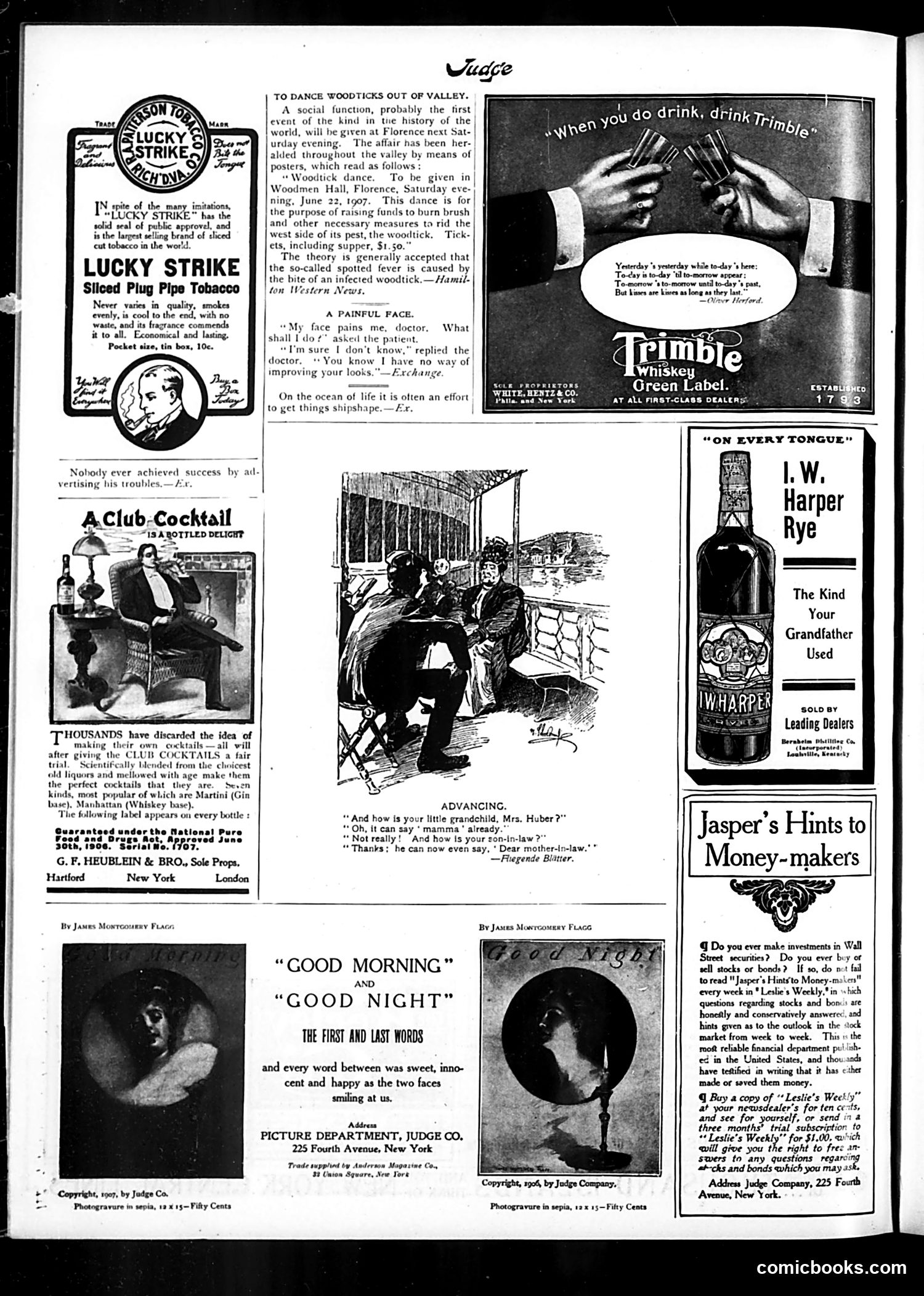
This page from *Judge* (circa 1907) mixes satirical content with period advertising. ## Main Cartoon The central cartoon titled "ADVANCING" depicts a grandmother asking about her grandchild, with the punchline revealing the son-in-law has learned to say "Dear mother-in-law"—satirizing the stereotypical tension between men and their in-laws. This reflects early 20th-century domestic humor tropes. ## Notable Content A brief article announces an actual "Woodtick dance" in Florence (location unclear) fundraiser to eliminate woodticks from the area, believed to carry spotted fever. Judge treats this real event as amusing social oddity. The page is dominated by **advertisements** for period products: Lucky Strike tobacco, Club Cocktail mixers, I.W. Harper Rye whiskey, and *Leslie's Weekly* financial advice column ("Jasper's Hints to Money-makers"). Two full-page portrait photographs labeled "Good Morning" and "Good Night" appear bottom-left and center, credited to artist James Montgomery Flagg, promoting the Picture Department. The content reflects pre-Prohibition advertising standards and early-1900s middle-class concerns.
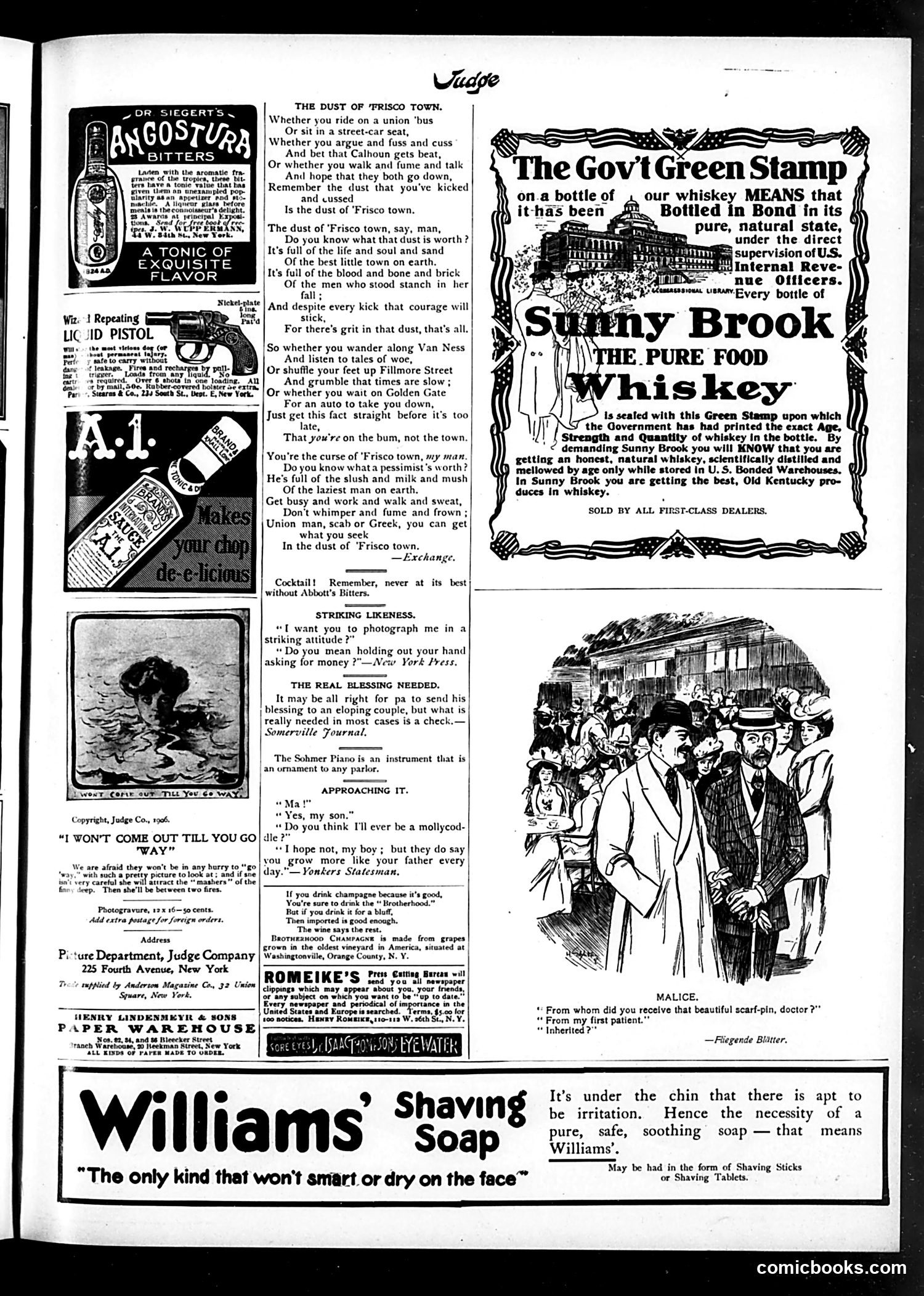
This page from *Judge* magazine contains primarily **advertisements and humorous filler content** rather than political cartoons with clear satirical targets. The main substantial piece is a poem titled "The Dust of Frisco Town," which celebrates San Francisco's resilience and entrepreneurial spirit—likely written following the 1906 earthquake and fire. It contrasts optimistic, hardworking citizens against pessimists and complainers, praising the city's reconstruction. The rest of the page consists of period advertisements (Angostura Bitters, Williams' Shaving Soap, Sunny Brook Whiskey) interspersed with generic jokes about photography, elopement blessings, and romantic mishaps. These require no specific historical knowledge to understand. The "Malice" section at bottom contains two brief quips: one about a doctor's gift origins, another about inherited property—both simple wordplay rather than satire of identifiable figures or events. This appears to be a typical issue page mixing promotional content with light humor rather than pointed political commentary.
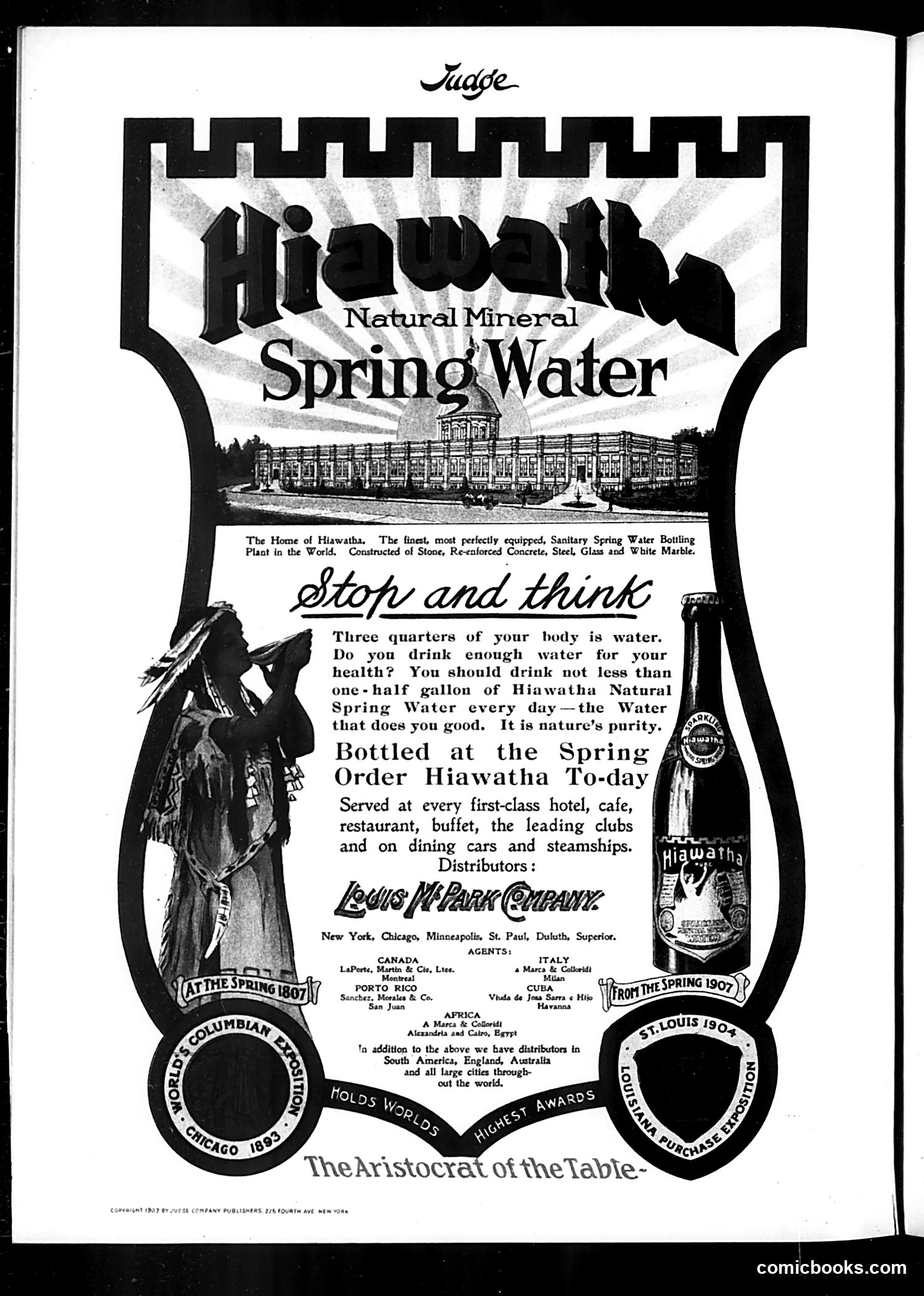
This is a full-page advertisement for Hiawatha Natural Mineral Spring Water, not a political cartoon. The page uses the "Native American" branding common to early 20th-century commerce—the product name invokes Longfellow's poem about an Indigenous hero, and imagery of a Native American figure appears decoratively on the bottle label. The ad employs typical health claims of the era: asserting that drinking spring water promotes wellness, recommending half a gallon daily. It emphasizes the bottling plant's modern facilities and the water's "nature's purity," and lists prestigious distribution across North America, Europe, and beyond. The decorative medallions reference world's fairs where the product apparently won awards (Chicago 1893, St. Louis 1904). This reflects how bottled spring water was marketed as a luxury commodity to the wealthy clientele of "first-class hotels" and "leading clubs."