
A complete issue · 16 pages · 1907
Judge — July 27, 1907
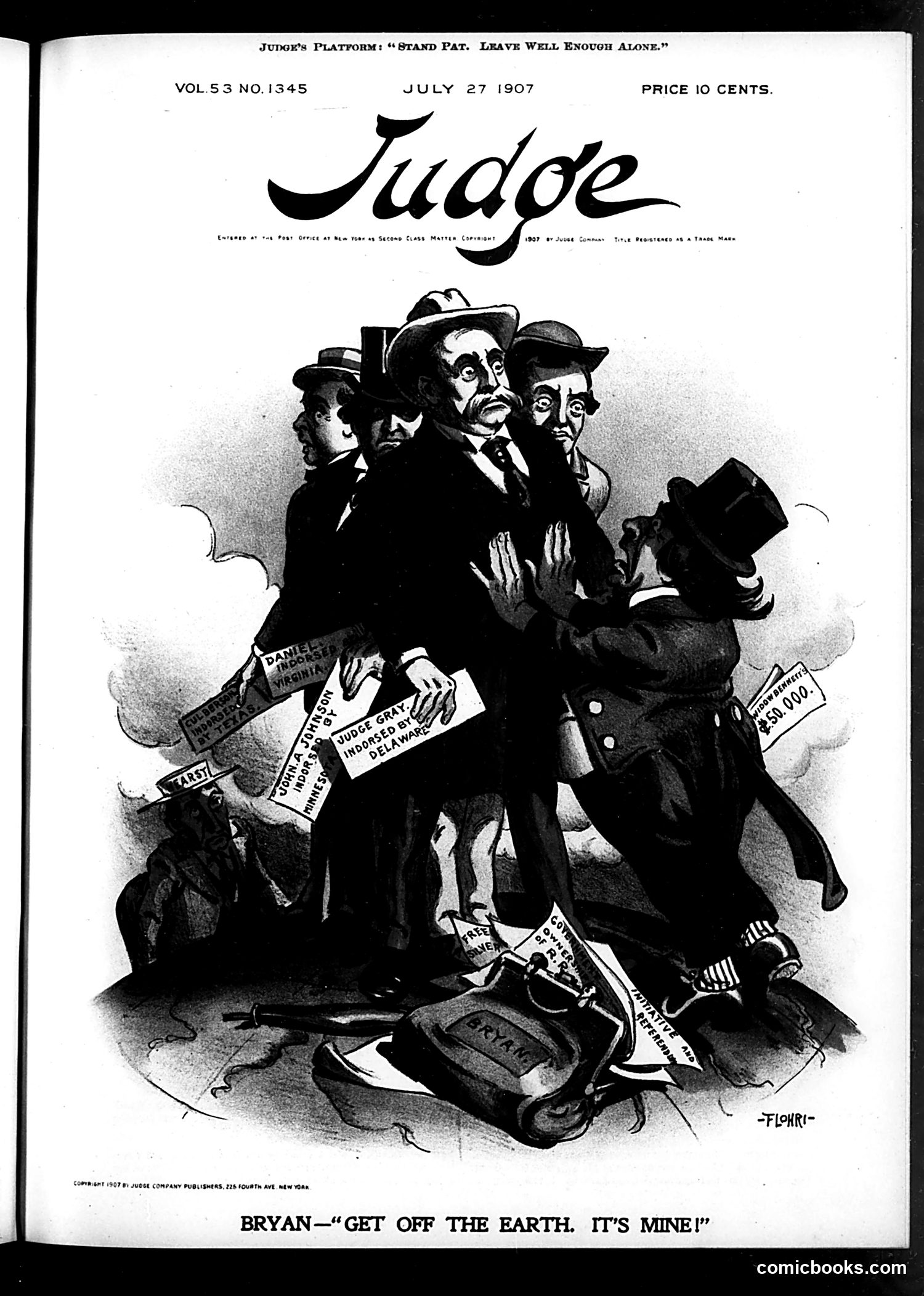
This cartoon satirizes **William Jennings Bryan**, the three-time Democratic presidential candidate. The caption "GET OFF THE EARTH, IT'S MINE!" depicts Bryan as a persistent, unwanted presence clinging to political relevance. The figure is surrounded by what appear to be **judicial or political documents** labeling various states and legal matters, suggesting Bryan's continued involvement in national political disputes despite electoral defeats. The cartoon mocks Bryan's refusal to fade from politics after losing presidential races (1896, 1900, 1904). The exasperated tone suggests Judge magazine's Republican editors viewed him as an annoying, overstaying figure who wouldn't accept his electoral rejection and withdraw from public life. The satirical message: Bryan should accept defeat and disappear from politics.
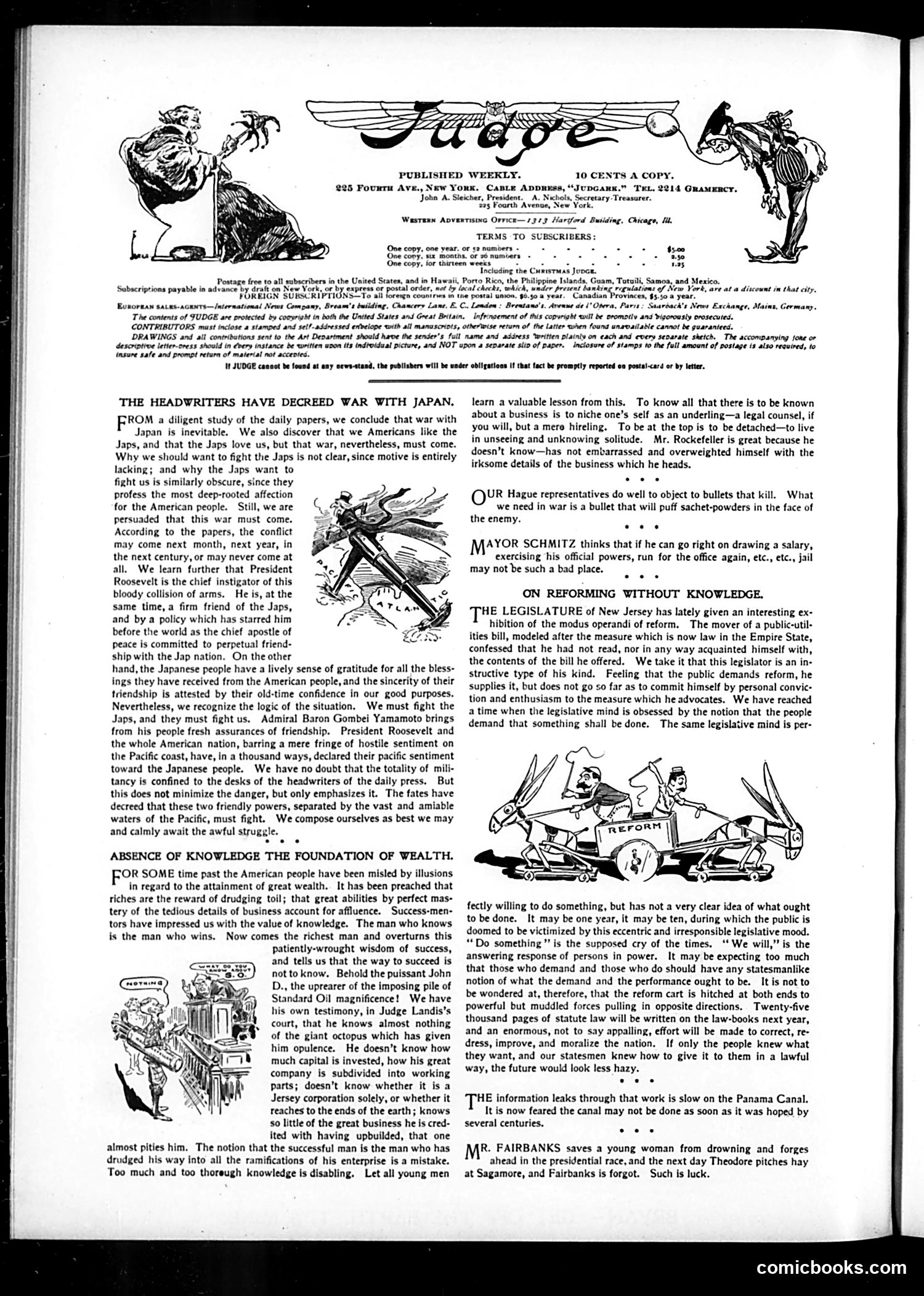
This page contains three distinct editorial cartoons critiquing American politics and leadership: 1. **"The Headwriters Have Decreed War with Japan"** - A large cartoon depicting conflict with Japan, accompanying text questioning why America should fight when Japan poses no direct threat to the U.S. 2. **"Mayor Schmitz"** - A brief item mocking a mayor who draws a salary while exercising official powers, suggesting this represents corruption or abuse of office. 3. **"On Reforming Without Knowledge"** - The main cartoon shows legislators attempting reform without understanding what they're reforming. The text criticizes a New Jersey legislator who admitted not reading a bill he was trying to pass, satirizing careless lawmaking. The page's overarching theme critiques ignorance in governance—whether regarding foreign policy, municipal leadership, or legislative action. The cartoons employ visual exaggeration and pointed wit typical of Judge's satirical approach.
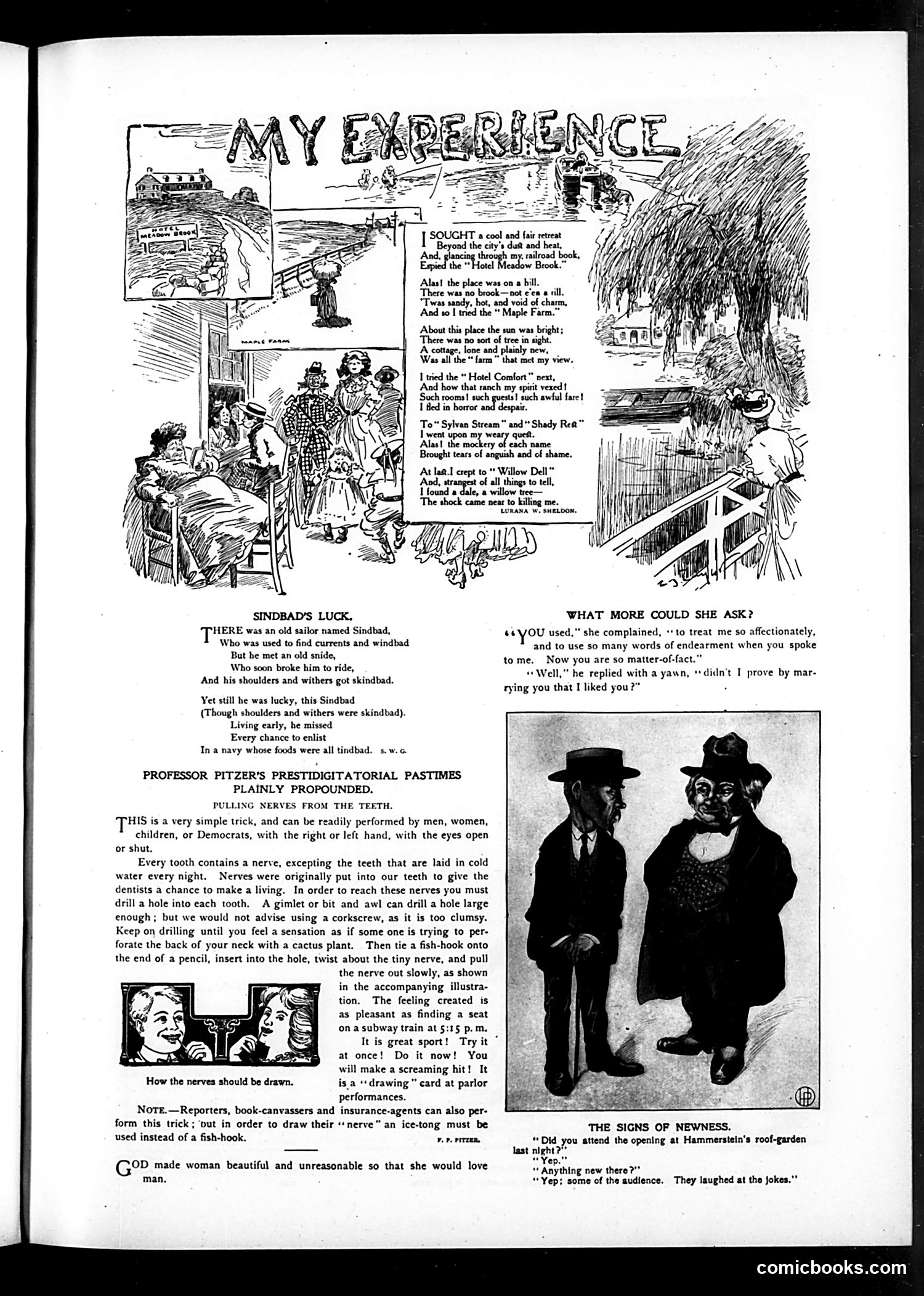
The page features a poem titled "My Experience" describing someone's unsuccessful search for rural peace—visiting "Hard Meadow Brook," "Maple Farm," and "Hotel Comfort," each disappointing. The narrator eventually finds solace at "Willow Dell." Below this is "Sindbad's Luck," a poem about an unlucky man whom fortune finally favors. "Professor Pitzer's Prestidigitatorial Pastimes" explains a parlor trick involving tooth nerves and fish-hooks—presented as entertainment for "Democrats, with the right of left hand." The bottom cartoon, "The Signs of Newness," depicts two men in bowlers discussing a theatrical opening at Hammerstein's roof-garden, with one noting the audience "laughed at the jokes"—likely satirizing either the venue or contemporary theater. These pieces appear to be general humor and entertainment content rather than pointed political satire.
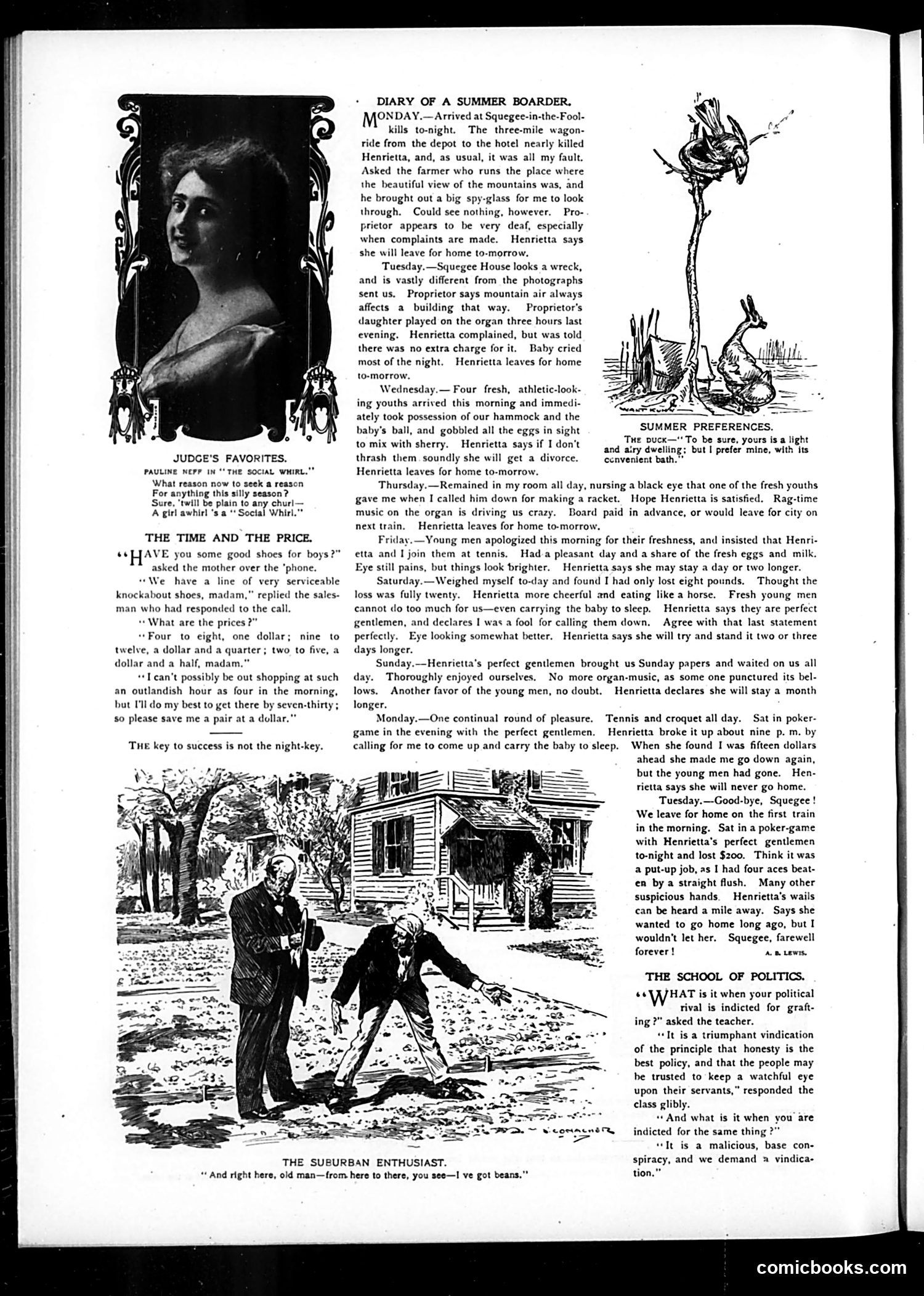
This page contains three distinct pieces: 1. **"Diary of a Summer Boarder"** — A humorous narrative about a woman named Henrietta staying at a rural boarding house, documenting social interactions with young men and domestic chaos (organ-playing, egg-stealing). The satire targets summer boarders' pretensions and romantic entanglements. 2. **"The Suburban Enthusiast"** — A cartoon showing a man gesturing expansively to another, with the caption "And right here, old man—from here to there, you see—I've got leased." The joke mocks suburban property owners boasting about land they don't truly own. 3. **"The School of Politics"** — A dialogue satirizing political corruption, discussing indictment for graft and defending dishonesty as policy, mocking both corrupt politicians and their apologetics.
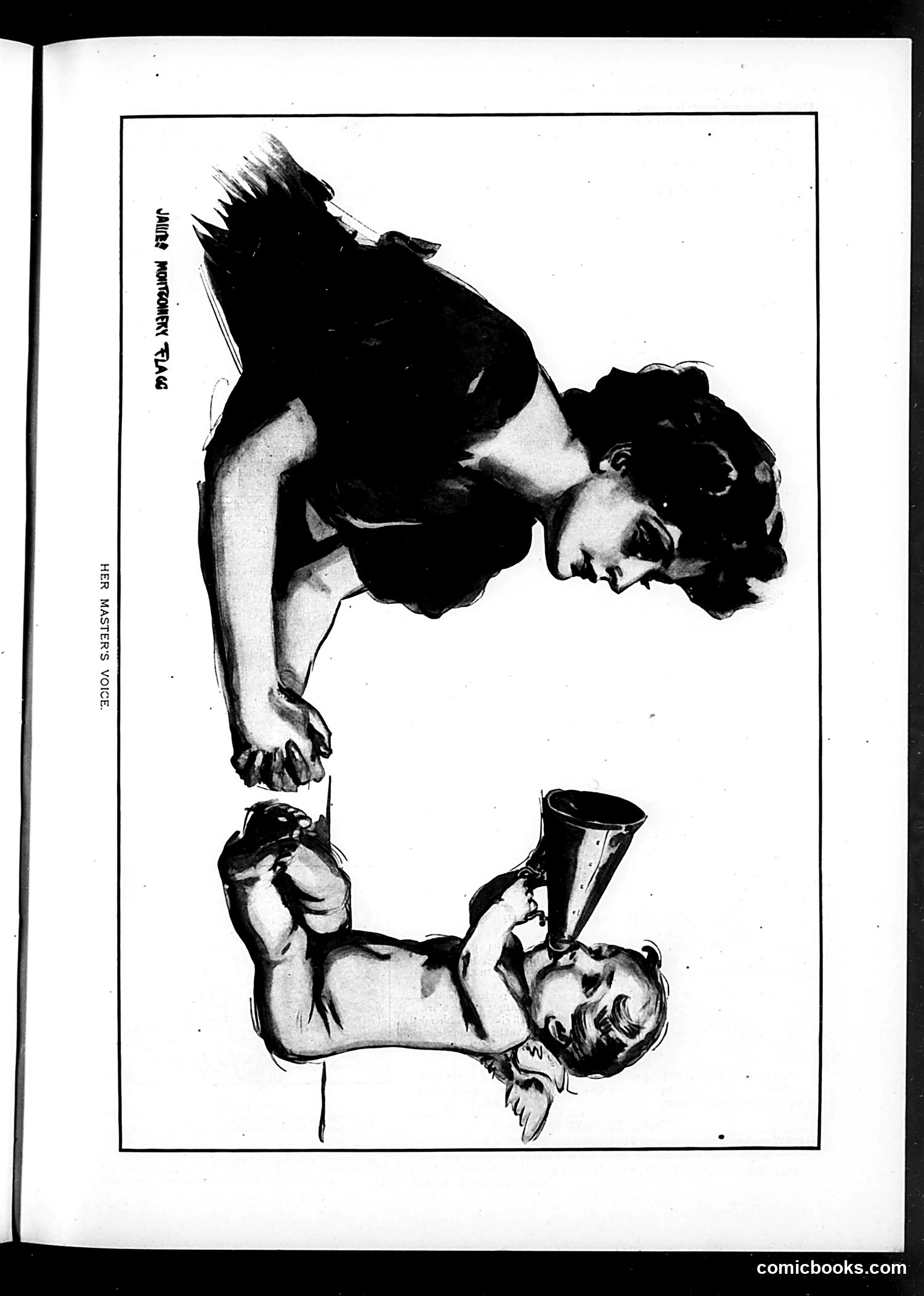
This page from *Judge* magazine contains a black-and-white illustration labeled "Her Master's Voice" showing an adult woman bending down attentively toward a small child holding what appears to be a megaphone or speaking trumpet. The caption "Her Master's Voice" is a satirical reference suggesting the woman is obediently heeding the child's commands—inverting normal authority relationships. This likely critiques either: 1. **Parental dynamics** of the era, mocking how indulgent parents catered to children's demands, or 2. **Gender dynamics**, suggesting women were controlled by even the smallest male figures The artwork style and *Judge*'s satirical focus suggest social commentary on family structure or power relationships, though without additional context or date information, the specific target remains somewhat unclear.
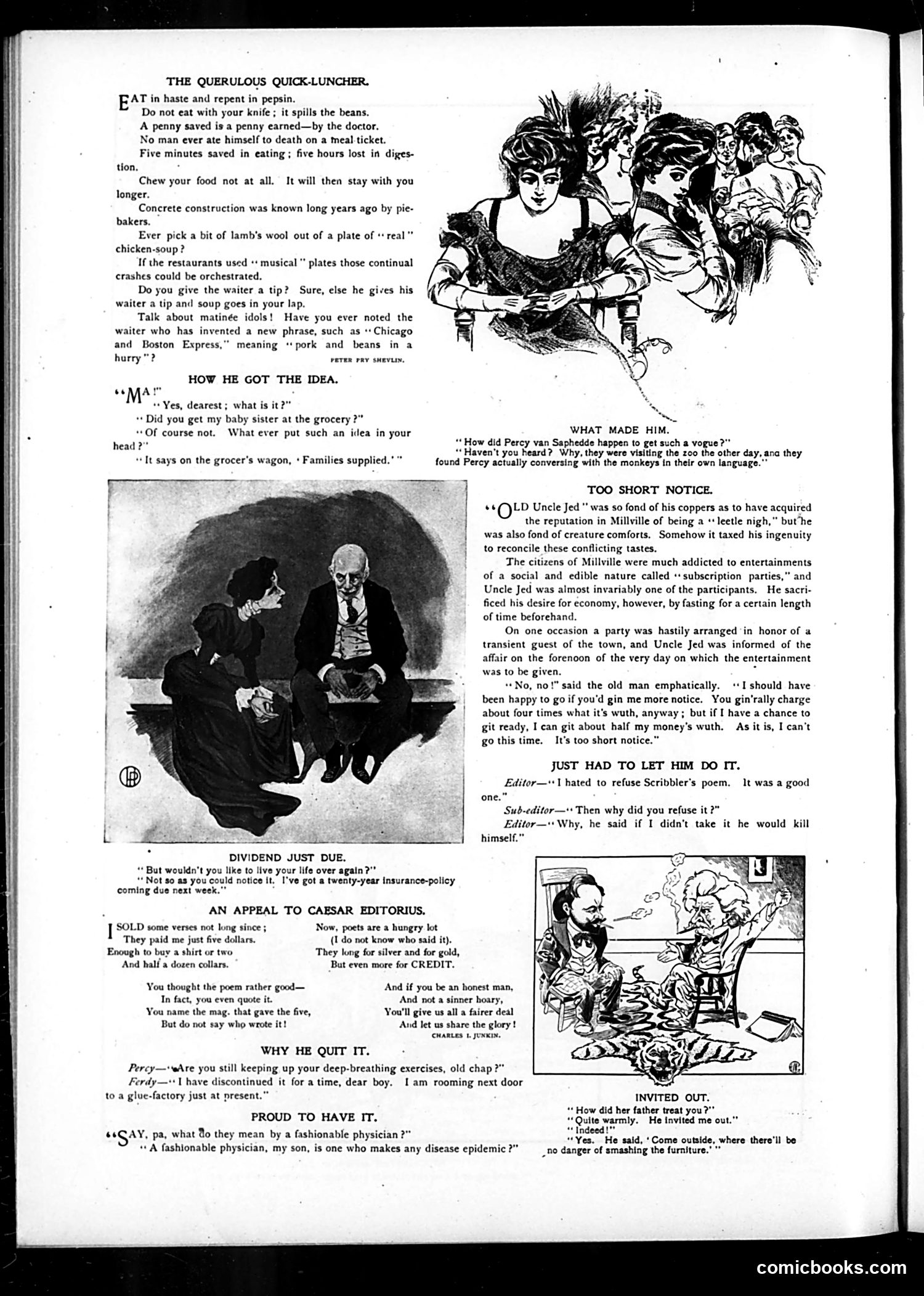
This page from *Judge* magazine contains several humorous short pieces satirizing early 20th-century American life: **"The Querulous Quick-Luncher"** mocks rushed dining culture and indigestion—a common complaint of the era. The opening aphorisms ("Eat in haste and repent in pepsin") satirize both hasty eating habits and over-reliance on digestive remedies. **"How He Got the Idea"** jokes about a grocer's wagon advertising "Families supplied," which the husband misunderstands as selling babies—a dark humor play on the phrase's ambiguity. **"Too Short Notice"** satirizes Uncle Jed's penny-pinching: he won't attend a subscription party (potluck social) without advance notice to "fast" beforehand, calculating he'll recoup half his food costs through restraint. The remaining pieces mock poets' financial struggles, insurance policies, and social pretension. Throughout, the satire targets working-class economics, health fads, restaurant culture, and the publishing industry—typical concerns of early-century urban American readers.
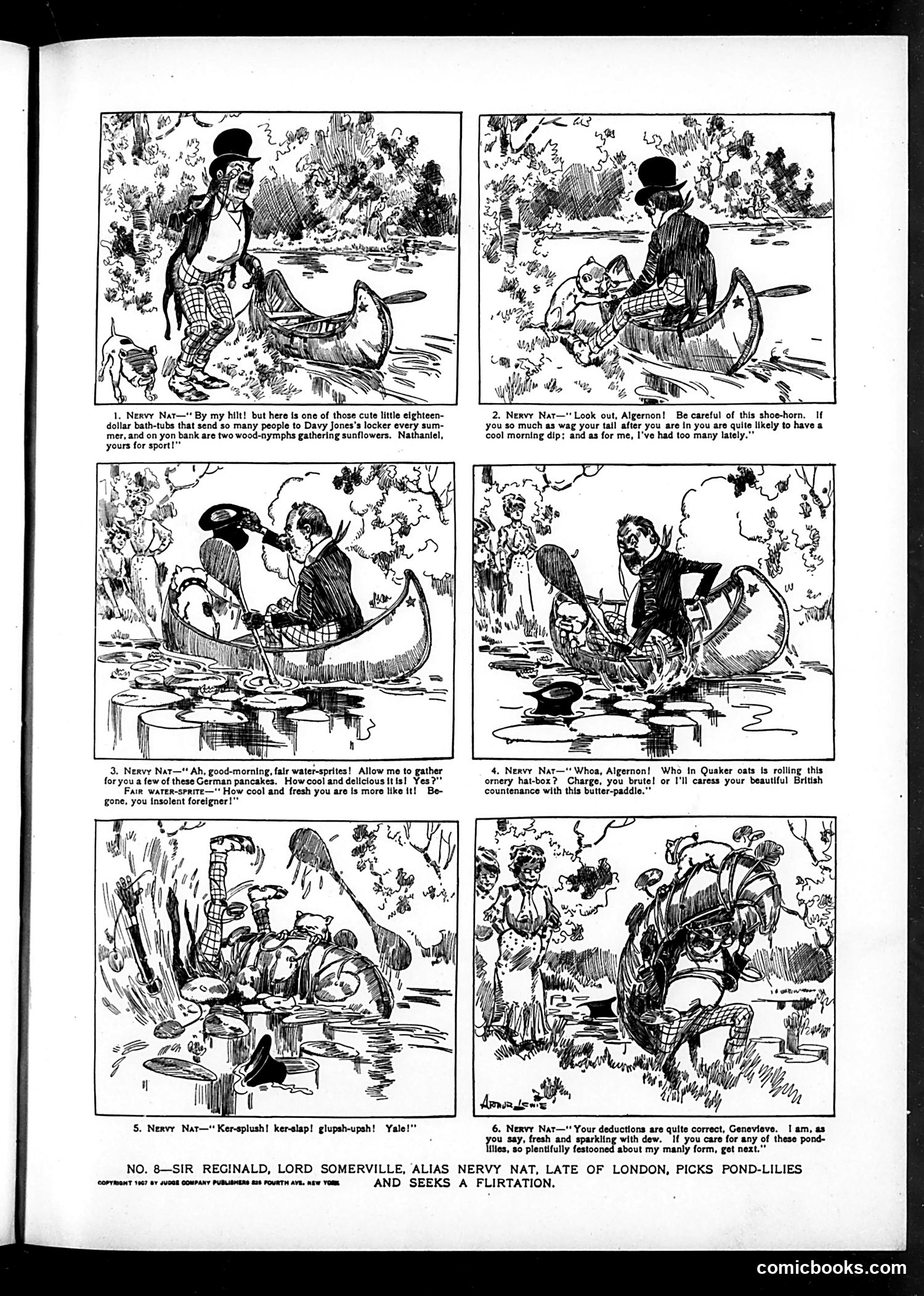
This six-panel comic satirizes a British aristocrat—Sir Reginald, Lord Somerville, nicknamed "Nervy Nat"—a pretentious upper-class Londoner vacationing abroad. The humor targets his affected mannerisms and bumbling attempts at flirtation. In each panel, Nervy Nat encounters water-based mishaps while trying to impress women ("fair water-sprites," "Genevieve"). He makes grandiose, flowery declarations ("fresh and sparkling with dew") that fall flat, gets dunked repeatedly in boats and bathtubs, and physically collides with obstacles. His companion Algernon (seemingly a dog) suffers collateral damage. The satire mocks British class pretension—his ornate speech, theatrical gestures, and assumption that charm and eloquence will work universally. Instead, he's repeatedly humiliated by practical reality. The "foreigner" insult from a water-sprite suggests he's abroad, making his failures even more embarrassing. The comic ridicules the type of vain, incompetent British gentleman popular in American satirical magazines of the era.
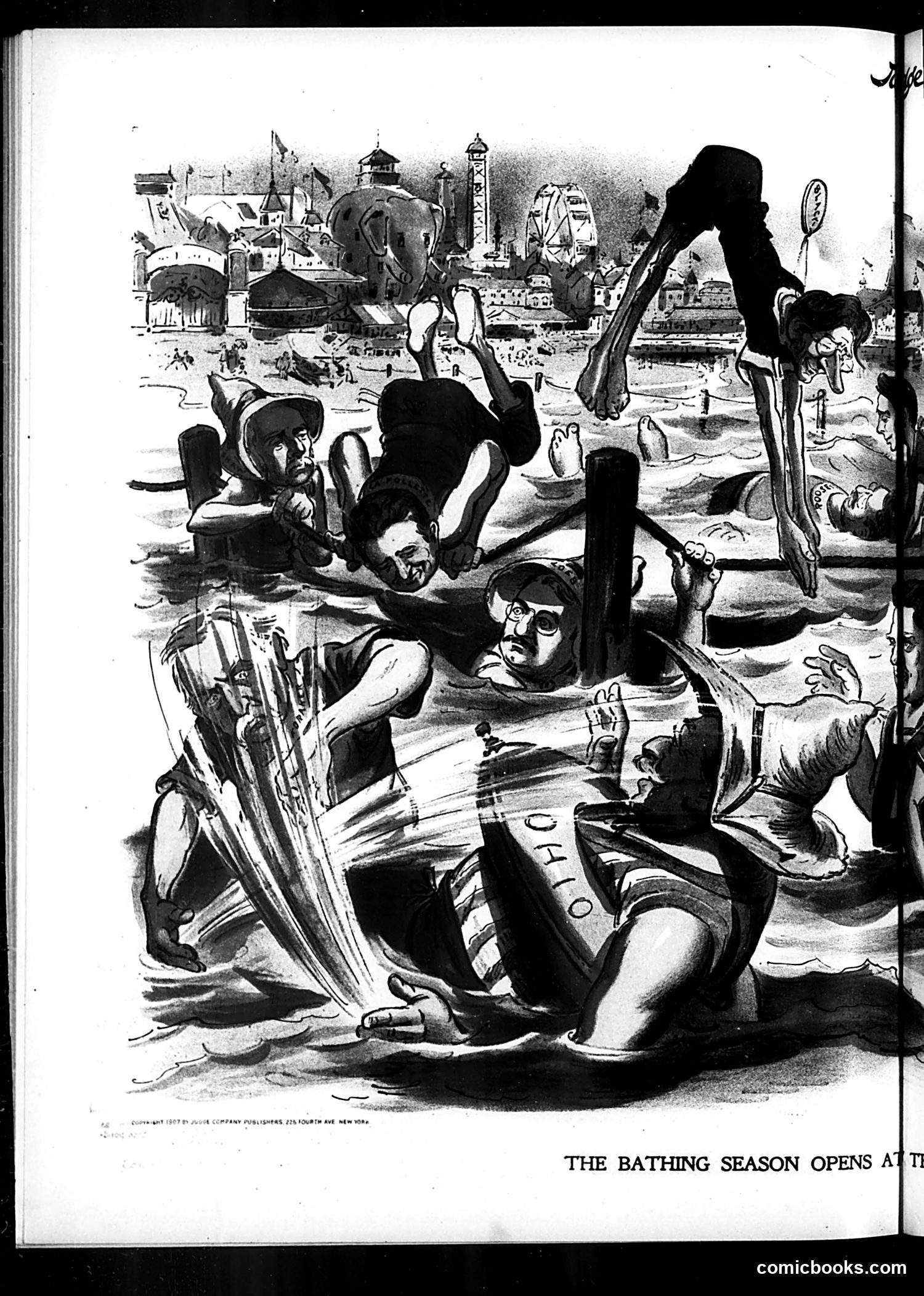
This satirical cartoon depicts a crowded beach scene with people in various states of distress or awkward poses in the water and sand. The title indicates this is about the opening of bathing season at an unspecified location (text is cut off). The humor appears to target the chaos and indecorum of public beach culture—people tumbling about ungracefully, appearing uncomfortable or ridiculous in their bathing attire. The background shows an amusement park or seaside resort with carnival attractions, suggesting this critiques the commercialization and crowded nature of popular leisure destinations. The exaggerated, somewhat undignified poses of the beachgoers likely satirize both Victorian-era bathing costume awkwardness and the general spectacle of mass public recreation. The cartoon mocks middle-class attempts at fashionable seaside leisure.
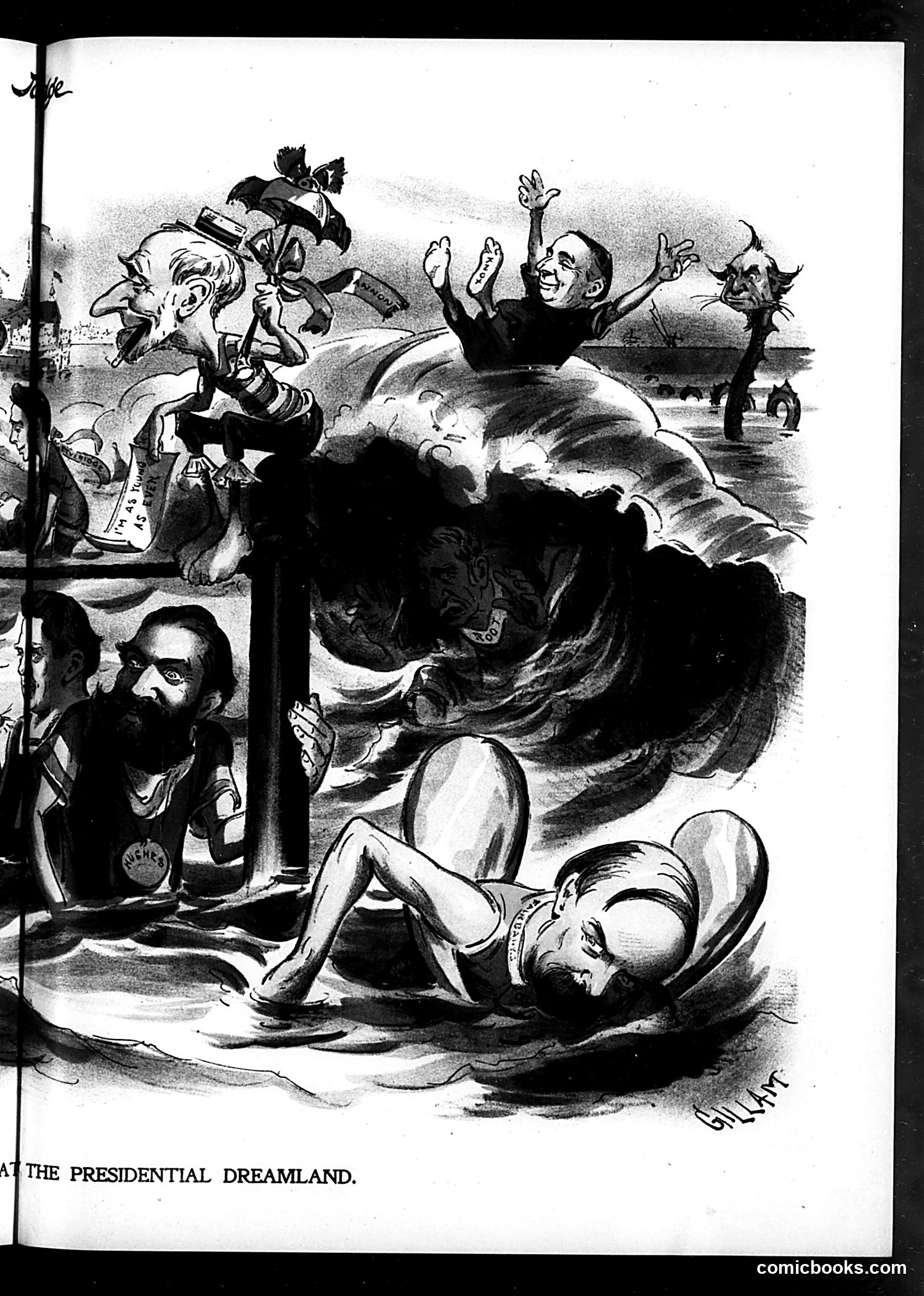
This political cartoon satirizes presidential ambitions and fantasies. The title suggests depicting politicians' unrealistic dreams of the presidency. The composition shows a sleeping figure in the foreground, presumably dreaming the scene above. In the dream sequence, various caricatured figures appear—some with exaggerated features typical of period political satire—engaged in celebratory or chaotic activity around what appears to be a presidential or governmental setting. The cartoon likely mocks multiple candidates' inflated hopes for high office, or critiques the gap between political ambitions and reality. The "dreamland" framing device—showing sleeping delusion versus waking truth—was a common satirical approach in Judge magazine. Without clearer identification of specific figures or a visible date, the exact political moment remains unclear, but the overall message concerns the fantasies driving presidential politics.
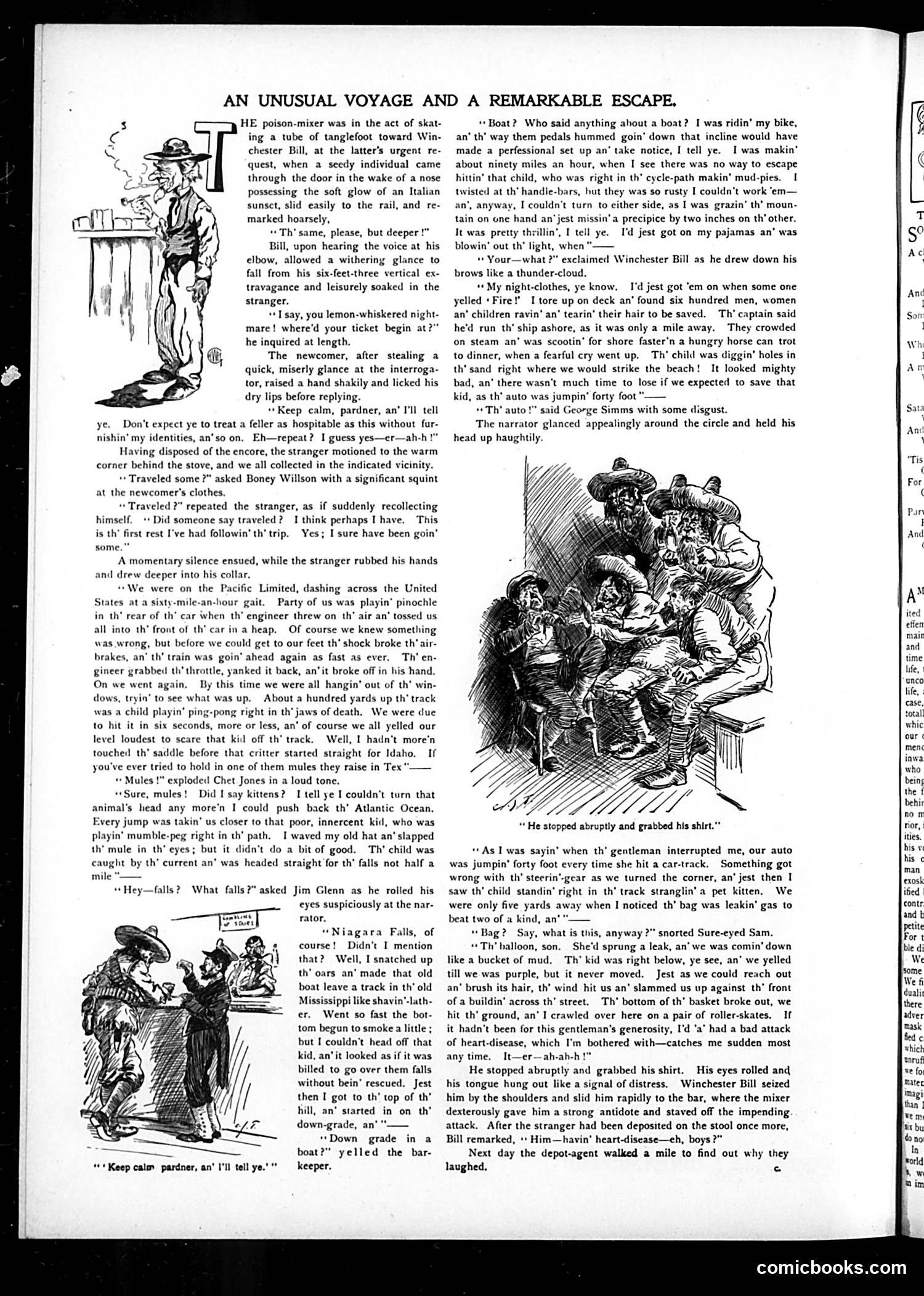
This is a tall-tale story in the style of American frontier humor. A disheveled stranger in a Western saloon recounts an increasingly absurd adventure: a runaway train, a child in danger near Niagara Falls, a mule he couldn't control, and somehow a boat involved in a "down-grade." The humor relies on the narrator's contradictions and wild exaggerations—he keeps adding impossible details (a boat on land, Niagara Falls near Mississippi) that other characters in the bar catch and mock. Winchester Bill, Boney Willson, and Jim Glenn are fictional saloon patrons who interrupt with skeptical remarks. The joke is the classic "liar's tale" tradition: the storyteller makes increasingly ludicrous claims while maintaining earnestness, and the audience's disbelief is part of the comedy.
This page contains two main satirical pieces: **"The Fairbanks Cocktail"** (upper left) appears to be a political jab at Vice President James Sherman Fairbanks, suggesting his name has become synonymous with a weak, diluted drink—"gin or whiskey swished with ice" requiring "a cherry, just to have it nice." The poem satirizes him as ineffectual, joking that even a governor or mayor could ignore his influence. The closing line ominously warns that mixing such drinks "may unmake a president," likely referencing contemporary political anxieties. **"Murder as a Pastime"** (main text) is a philosophical essay arguing that the most interesting people maintain internal contradictions—being outwardly benevolent while harboring violent impulses. The author uses this duality to explain why oysters are palatable (contrasting hard shell with soft interior) and claims that truly dynamic individuals, unlike "all of one strain," possess multiple selves. This reflects early-20th-century fascination with psychological complexity and the performative nature of public personas. The page also includes advertisements for Parker's Tar Soap and food-related articles.
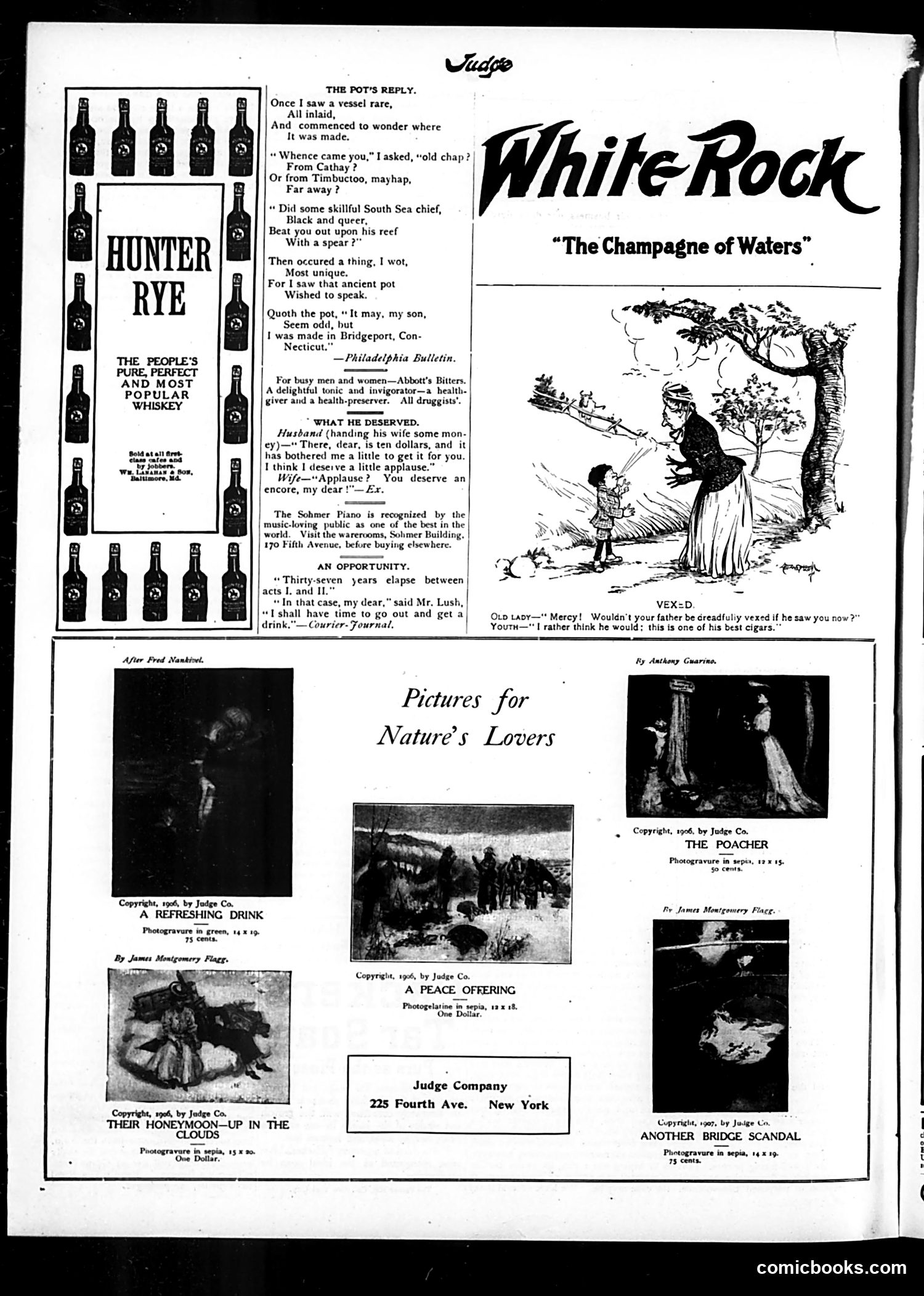
This page primarily contains **advertisements and product promotions** rather than political satire. The dominant feature is a **White Rock water advertisement** ("The Champagne of Waters") with a pastoral illustration showing a child and elderly woman by a tree. The left side features a **Hunter Rye whiskey ad** and various short humor pieces and jokes typical of Judge magazine's format—lightweight social commentary rather than sharp satire. "The Pot's Reply" is a mild joke about an ornate vessel that turns out to be mass-produced in Connecticut, mocking American commercialism disguised as exotic craftsmanship. The page also advertises **photographic prints** available from Judge Company, featuring images by James Montgomery Flagg (a well-known illustrator of the era) with titles like "The Poacher" and "Another Bridge Scandal." Overall, this appears to be a **typical interior page mixing advertisements, light humor, and product promotion**—representative of how Judge sustained itself financially while maintaining its satirical brand.
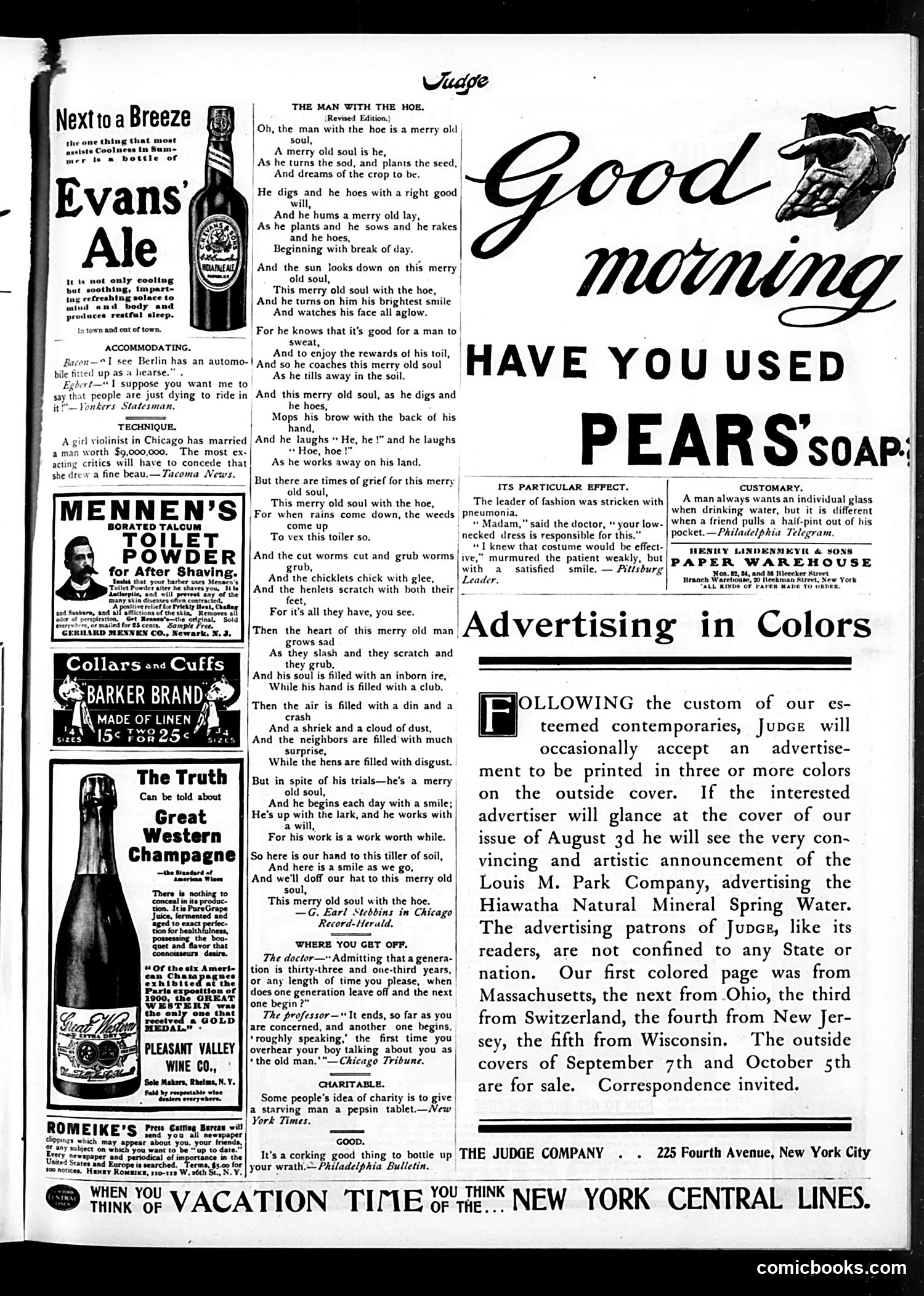
This page parodies the famous 1899 painting/poem "The Man with the Hoe" by Jean-François Millet, which depicted rural labor as grinding, dehumanizing toil. Judge's satirical revision transforms the farmer into a cheerful, contented worker who enjoys his labor despite minor agricultural setbacks (pests, weeds, rain). The satire appears to mock both socialist interpretations of Millet's work (which portrayed farming as exploitation) and overly romantic celebrations of rural life. By presenting the farmer as perpetually happy despite genuine hardships—his "inborn ire" at crop damage quickly forgotten—the piece ridicules idealized nostalgia for agrarian work. The poem's structure mirrors the original while inverting its grim tone, suggesting Judge's conservative skepticism toward either romanticizing or tragically characterizing manual labor. It's fundamentally a joke about competing narratives regarding working-class contentment. The page is otherwise filled with period advertisements and miscellaneous humor columns.
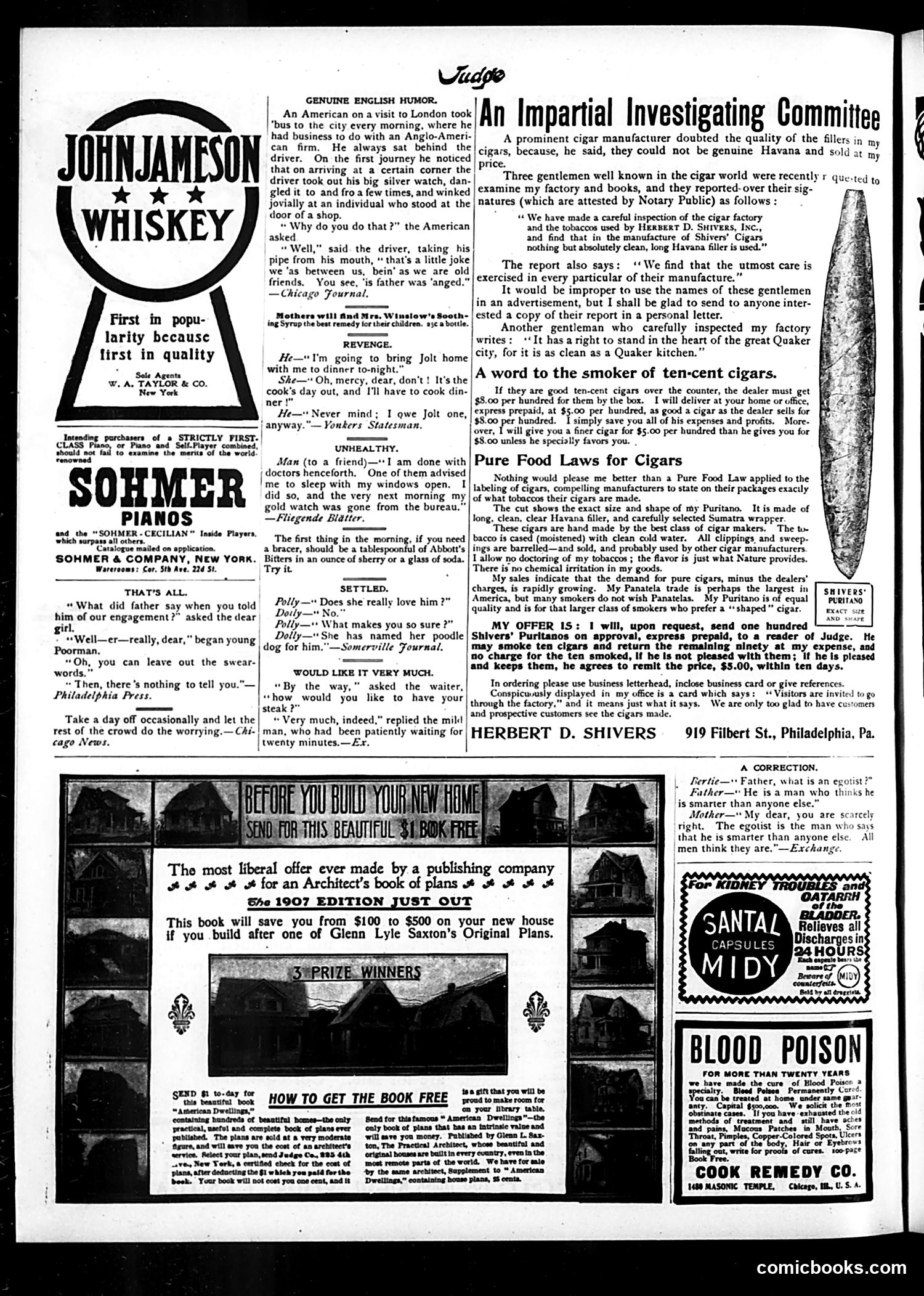
This page is primarily **advertisements and humor anecdotes**, not political satire. The main content includes: **The Cartoons/Humor:** Several brief joke columns with no political meaning—just period humor about relationships and misunderstandings. For example, one jokes about a man patient who waited 20 minutes for a doctor's advice, only to be told to sleep with windows open, then lost his watch that night. **The Satire:** The largest piece is Herbert D. Shivers' advertisement for cigars, which **satirizes the cigar industry's deceptive practices**. Shivers claims his $5 cigars are superior to competitors' $8 versions, and invites skeptics to inspect his factory. The humor lies in framing this as an "Impartial Investigating Committee"—when it's obviously just marketing. He's mocking competitors who use inferior fillers while charging premium prices, suggesting the industry routinely deceives consumers about quality. **Context:** Early 1900s consumer skepticism about product quality and advertising honesty.
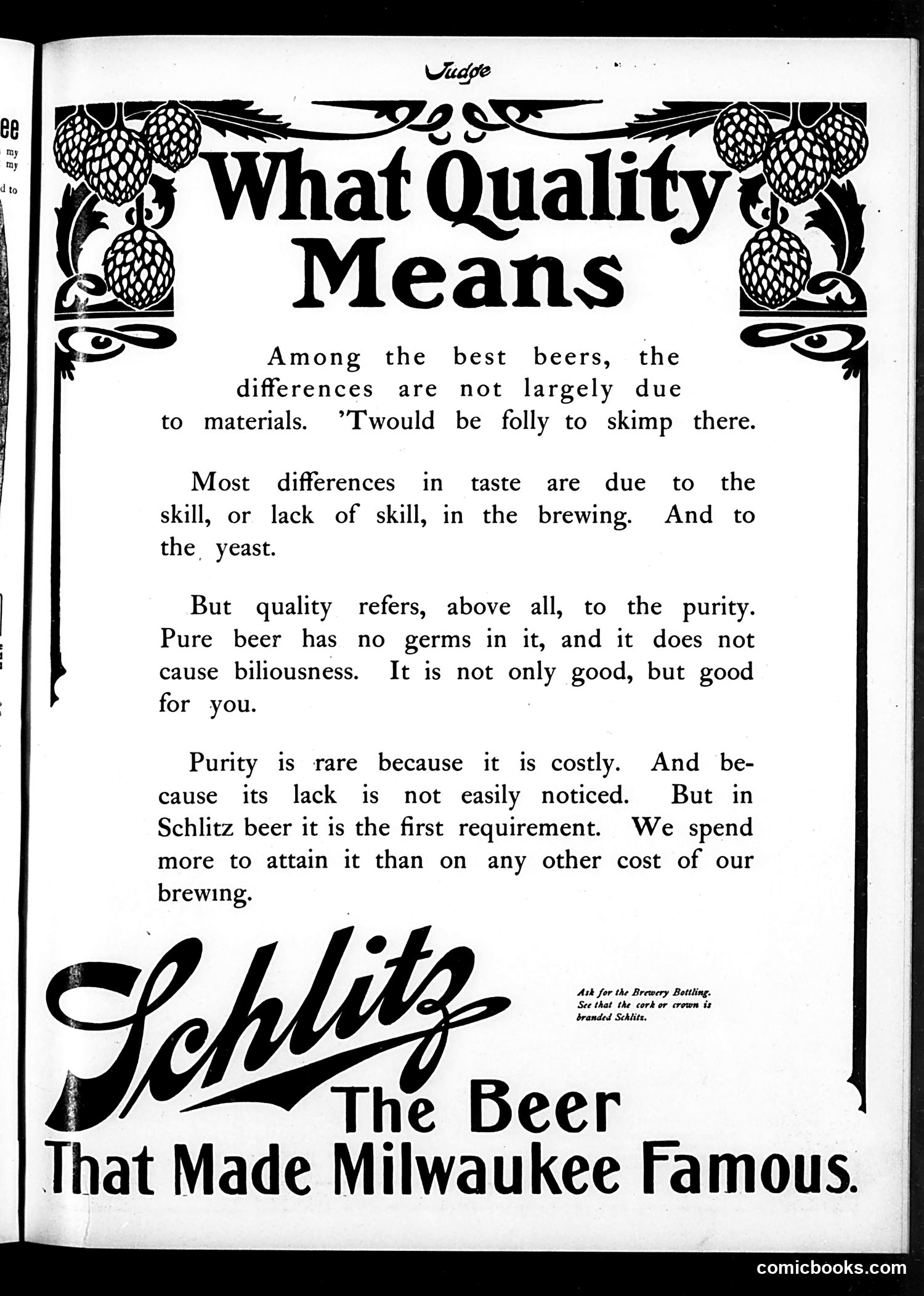
This is a **Schlitz beer advertisement**, not a political cartoon. The page promotes Schlitz brewing by explaining what "quality" means in beer production. The ad argues that beer quality depends primarily on **purity**—the absence of germs that cause illness ("biliousness")—rather than expensive ingredients. Schlitz claims to prioritize purity above all else, spending more on achieving it than on any other production cost. The appeal is both practical and health-conscious: pure beer is presented as not merely enjoyable but actually beneficial to health. This reflects early 20th-century marketing that emphasized scientific purity and sanitation as selling points. The decorative hop illustrations reinforce the brewing theme. The slogan "The Beer That Made Milwaukee Famous" positions Schlitz as representing Milwaukee's brewing reputation and excellence.
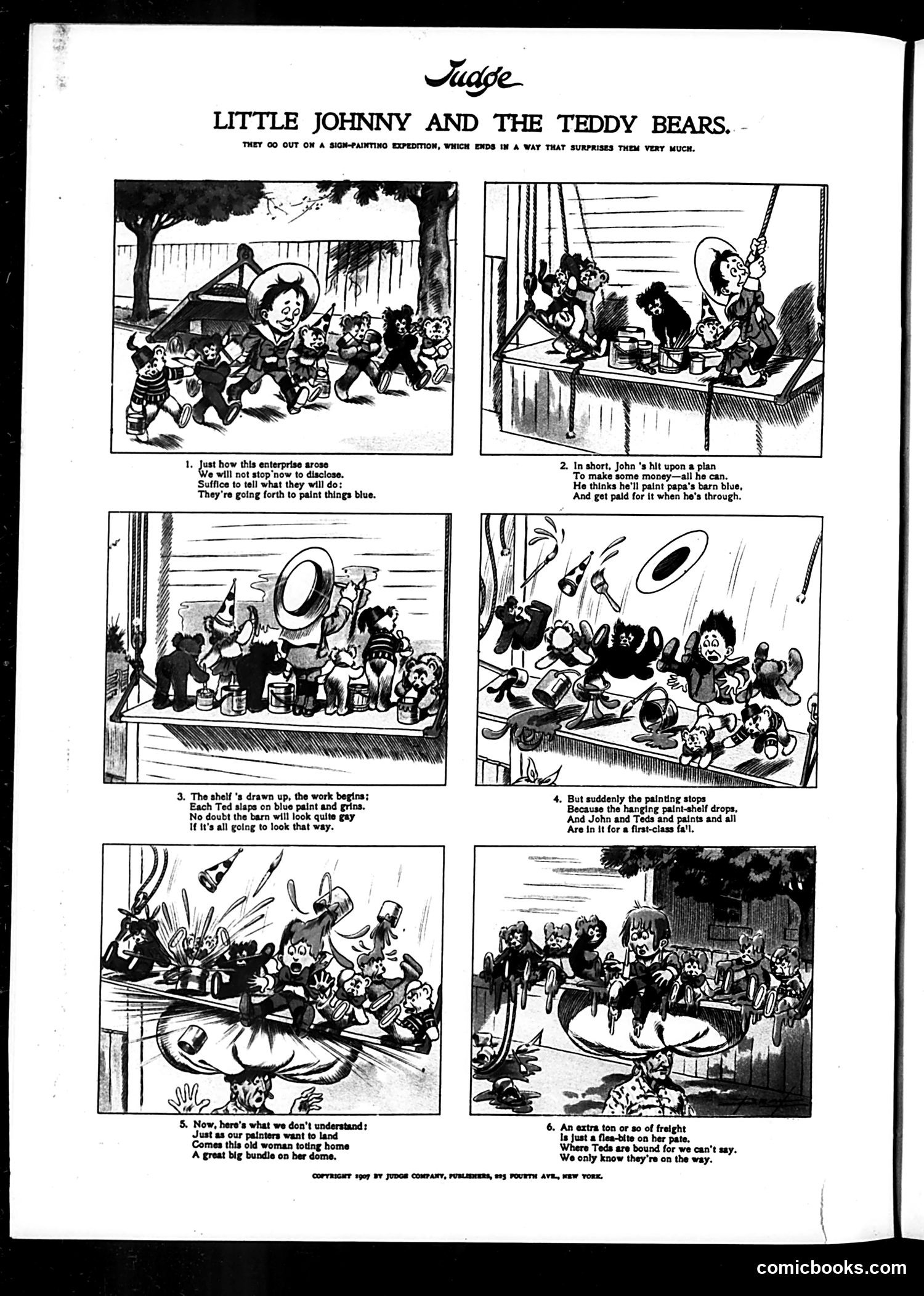
This comic strip depicts a slapstick mishap involving a boy and anthropomorphic teddy bears attempting to paint a barn. The bears are likely references to "Teddy Bears"—a popular toy craze inspired by President Theodore Roosevelt's hunting exploits, which had exploded in popularity around 1906-1907. The humor is straightforward physical comedy: Johnny and the bears plan to earn money painting a barn blue, but their suspended paint shelf catastrophically collapses, sending them plummeting. The final panel introduces absurdist confusion when an elderly woman carrying an enormous bundle arrives, and the narrator expresses bewilderment about whether she's somehow involved in their fate. The satire appears to mock the teddy bear craze's ubiquity by treating the toys as real characters in an ordinary situation, subverting expectations through unexpected chaos. The dated drawing style and sentimental verse-captions are typical of Judge magazine's approach to humor.