
Judge, 1907-07-27 · page 2 of 16
Judge — July 27, 1907 — page 2: what you’re looking at
What you’re looking at
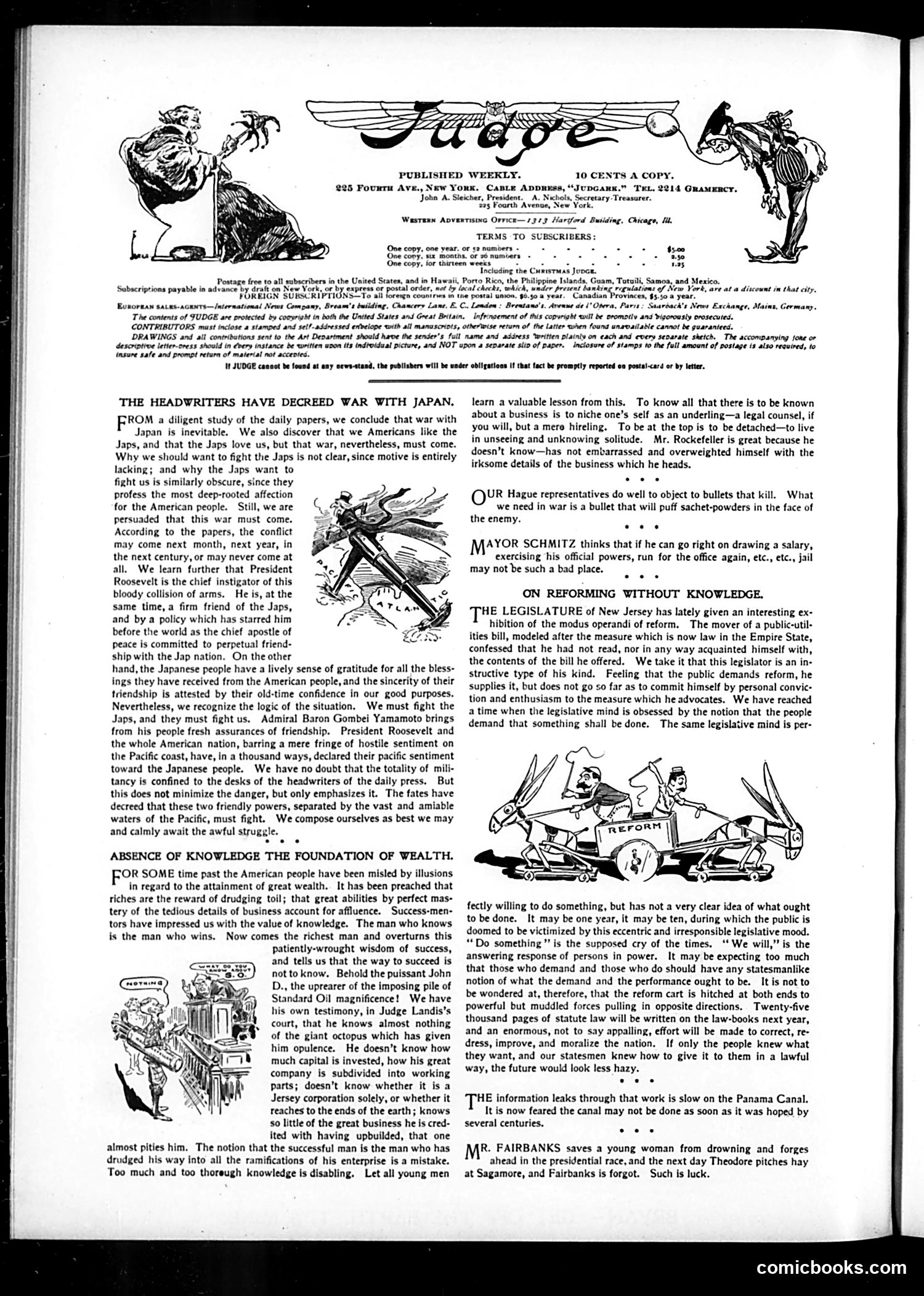
This page contains three distinct editorial cartoons critiquing American politics and leadership: 1. **"The Headwriters Have Decreed War with Japan"** - A large cartoon depicting conflict with Japan, accompanying text questioning why America should fight when Japan poses no direct threat to the U.S. 2. **"Mayor Schmitz"** - A brief item mocking a mayor who draws a salary while exercising official powers, suggesting this represents corruption or abuse of office. 3. **"On Reforming Without Knowledge"** - The main cartoon shows legislators attempting reform without understanding what they're reforming. The text criticizes a New Jersey legislator who admitted not reading a bill he was trying to pass, satirizing careless lawmaking. The page's overarching theme critiques ignorance in governance—whether regarding foreign policy, municipal leadership, or legislative action. The cartoons employ visual exaggeration and pointed wit typical of Judge's satirical approach.
📄 Transcribed text from this page (OCR, searchable)
Machine-transcribed from the original scan — historical spelling and the odd misread are preserved.
— ar SEB mss —Sf\ LL 4 aS PUBLISHED WEEKLY. 10 CENTS A COPY. 225 Founrm Ave., New York. Cane Appress,“Jupcanx.” Tex. 2214 Gramercy. John A. Sleicher, President. A. N ls, Secretary Treasurer. 225 Fourth Aver w York. Wasraan Apvexrisinc Orrice—1313 Hartford Building, Chicage, lik TERMS TO SUBSCRIBERS: One copy, one year. or s2 numbers- Ove copy, sux months. of 26 numvers + One copy, for thirteen weeks and in Hawaii, Porto Ric Eon The contents of FUDGE are protected by cooyright in both the United States and Great Britain. CONTRIBUTORS must inclose a stamped and self-aSdressed ertoeiope ‘aith all manascriots, otherwise return of the Latter when found unavailable cannot be ge: RAM SALES-AGENTS—International Newt Company, Bream’s building, Chancery Lane, E.C. London: Brestame's, Avenue del" Otera, Paris Tncloding the Cunistuas Juoce. Goam, Totuili, Samoa, and Mexico. ting regulations of Now Vor’, are at a discount i that city. nadian Provinces, $50 8 year. Sauréach's News Exchange, Mains, Germany. Infringement of this copyright will be promptly and Pigorously orosecuted. teed. DRAWINGS and all contribations sent to the Art Department should have the sender’s full name and adéress Wwritten plainly on each and every separate sketch. The accompanying Jore or descriptive letter-oress should in insure safe and prompt retarn of matertal not accepted. instance be writien upon tts indroidual picture, and NOT upon a separate slio of paper. Inciosure of stamps to the fall amount of postage (3 also required, to MW JUDGE cancot be found at any sews-stand, the publishers will be wader obligations if that fact be promptly reported on postal-card or by letter. ‘THE HEADWRITERS HAVE DECREED WAR WITH JAPAN. ROM a diligent study of the daily papers, we conclude that war with Japan is inevitable. We also discover that we Americans like the Japs, and that the Japs love us, but that war, nevertheless, must come. Why we should want to fight the Japs is not clear, since motive is entirely lacking; and why the Japs want to fight us is similarly obscure, since they profess the most deep-rooted affection for the American people. Still, we are persuaded that this war must come. According to the papers, the conflict may come next month, next year, in the next century, or may never come at all. We learn further that President Roosevelt is the chief instigator of this bloody collision of arms. He is, at the same time, a firm friend of the Japs, and by a policy which has starred him before the world as the chief apostle of peace is committed to perpetual friend- ship with the Jap nation. On the other hand, the Japanese people have a lively sense of gratitude for all the bless- ings they have received from the American people, and the sincerity of their triendship is attested by their old-time confidence in our good purposes. Nevertheless, we recognize the logic of the situation. We must fight the Japs, and they must fight us. Admiral Baron Gombei Yamamoto brings from his people fresh assurances of friendship. President Roosevelt and the whole American nation, barring a mere fringe of hostile sentiment on the Pacific coast, have, in a thousand ways, declared their pacific sentiment toward the Japanese people. We have no doubt that the totality of mili- tancy is confined to the desks of the headwriters of the daily press. But this does not minimize the danger, but only emphasizes it. The fates have decreed that these two friendly powers, separated by the vast and amiable waters of the Pacific, must fight. We compose ourselves as best we may and calmly await the awful struggle. ABSENCE OF KNOWLEDGE THE FOUNDATION OF WEALTH. For SOME time past the American people have been misled by illusions in regard to the attainment of great wealth. It has been preached that riches are the reward of drudging toil; that great abilities by perfect mas- tery of the tedious details of business account for affluence. Success-men- tors have impressed us with the value of knowledge. The man who knows is the man who wins. Now comes the richest man and overturns this patiently-wrought wisdom of success, and tells us that the way to succeed is not to know. Behold the puissant John D., the uprearer of the imposing pile of Standard Oil magnificence! We have his own testimony, in Judge Landis’s court, that he knows almost nothing of the giant octopus which has given him opulence. He doesn’t know how much capital is invested, how his great company is subdivided into working parts; doesn’t know whether it is a Jersey corporation solely, or whether it reaches to the ends of the earth; knows so little of the great business he is cred- ited with having upbuilded, that one almost pities him. The notion that the successful man is the man who has drudged his way into all the ramifications of his enterprise is a mistake. Too much and too thoreugh knowledge is disabling. Let all young men learn a valuable lesson from this. To know all that there is to be known about a business is to niche one’s self as an underling—a legal counsel, if you will, but a mere hireling. To be at the top is to be detached—to live in unseeing and unknowing solitude. Mr. Rockefeller is great because he doesn’t know—has not embarrassed and overweighted himself with the irksome details of the business which he heads. QQUR Hague representatives do well to object to bullets that Kill. What we need in war is a bullet that will puff sachet-powders in the face of the enemy. eee MAYOR SCHMITZ thinks that if he can go right on drawing a salary, exercising his official powers, run for the office again, etc., etc., jail may not be such a bad place. ON REFORMING WITHOUT KNOWLEDGE. THE LEGISLATURE of New Jersey has lately given an interesting ex- hibition of the modus operandi of reform, The mover of a public-util- ities bill, modeled after the measure which is now law in the Empire State, confessed that he had not read, nor in any way acquainted himself with, the contents of the bill he offered. We take it that this legislator is an in- structive type of his kind. Feeling that the public demands reform, he supplies it, but does not go so far as to commit himself by personal convic- tion and enthusiasm to the measure which he advocates. We have reached a time when the legislative mind is obsessed by the notion that the people demand that something shall be done. The same legislative mind is per- fectly willing to do something, but has not a very clear idea of what ought to be done. It may be one year, it may be ten, during which the public is doomed to be victimized by this eccentric and irresponsible legislative mood. “Do something’ is the supposed cry of the times. ‘We will,” is the answering response of persons in power. It may be expecting too much that those who demand and those who do should have any statesmanlike notion of what the demand and the performance ought to be. It is not to be wondered at, therefore, that the reform cart is hitched at both ends to powerful but muddled forces pulling in opposite directions. Twenty-five thousand pages of statute law will be written on the law-books next year, and an enormous, not to say appalling, effort will be made to correct, re- dress, improve, and moralize the nation. If only the people knew what they want, and our statesmen knew how to give it to them in a lawful way, the future would look less hazy. THE information leaks through that work is slow on the Panama Canal. It is now feared the canal may not be done as soon as it was hoped by several centuries, R. FAIRBANKS saves a young woman from drowning and forges ahead in the presidential race,and the next day Theodore pitches hay at Sagamore, and Fairbanks is forgot. Such is luck. comicbooks.com