
Judge, 1907-07-27 · page 11 of 16
Judge — July 27, 1907 — page 11: what you’re looking at
What you’re looking at
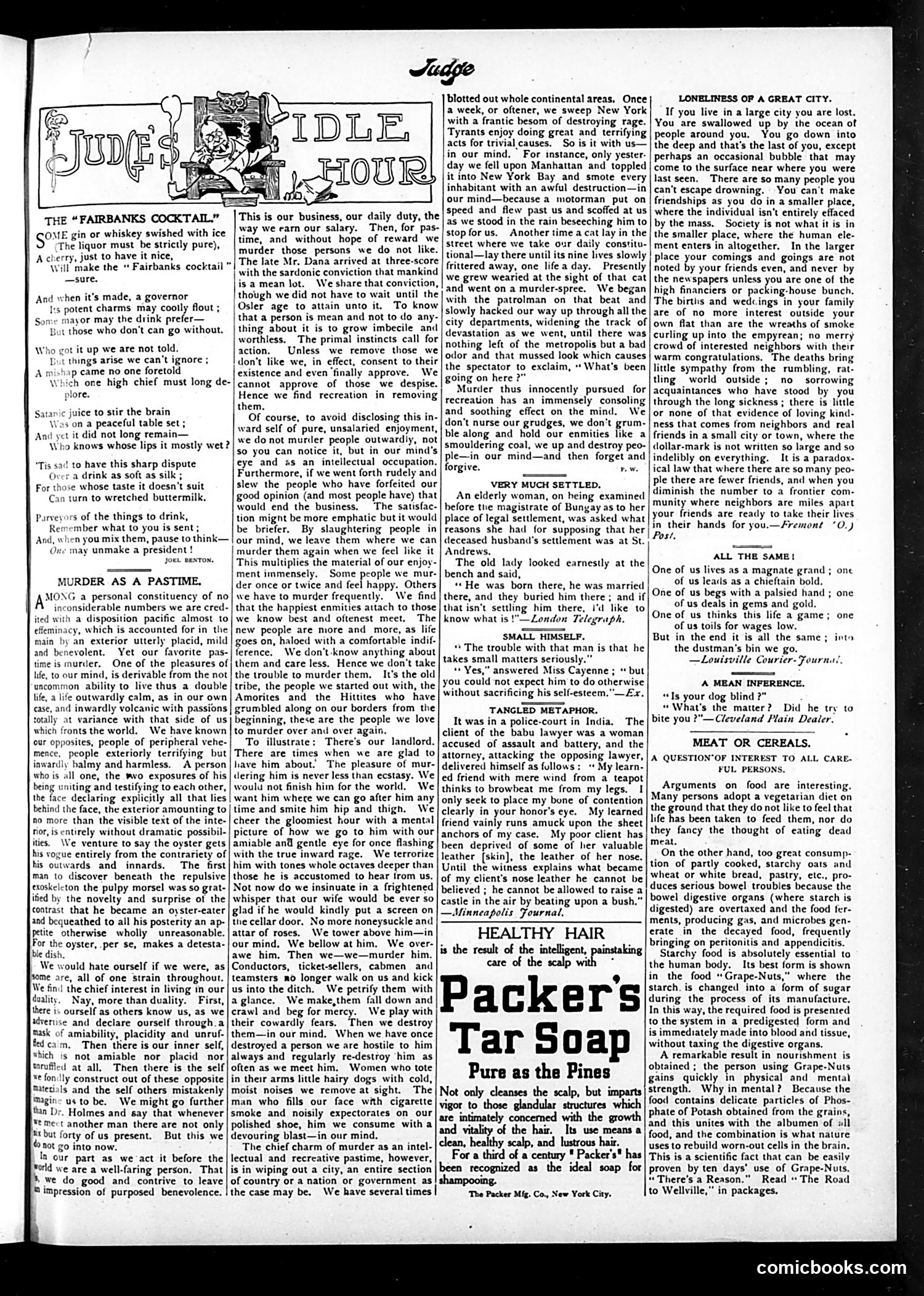
This page contains two main satirical pieces: **"The Fairbanks Cocktail"** (upper left) appears to be a political jab at Vice President James Sherman Fairbanks, suggesting his name has become synonymous with a weak, diluted drink—"gin or whiskey swished with ice" requiring "a cherry, just to have it nice." The poem satirizes him as ineffectual, joking that even a governor or mayor could ignore his influence. The closing line ominously warns that mixing such drinks "may unmake a president," likely referencing contemporary political anxieties. **"Murder as a Pastime"** (main text) is a philosophical essay arguing that the most interesting people maintain internal contradictions—being outwardly benevolent while harboring violent impulses. The author uses this duality to explain why oysters are palatable (contrasting hard shell with soft interior) and claims that truly dynamic individuals, unlike "all of one strain," possess multiple selves. This reflects early-20th-century fascination with psychological complexity and the performative nature of public personas. The page also includes advertisements for Parker's Tar Soap and food-related articles.
📄 Transcribed text from this page (OCR, searchable)
Machine-transcribed from the original scan — historical spelling and the odd misread are preserved.
‘THE “FAIRBANKS COCKTAIL.” OME gin or whiskey swished with ice SON The liquor must be strictly pure), I) A cherry, just to have it nice, Will make the “Fairbanks cocktail” —sure. ‘And when it's made, a governor Irs potent charms may coolly flout ; mayor may the drink prefer— Son ; those who don’t can go without. got it up we are not told. { things arise we can't ignore ; shap came no one foretold Which one high chief must long de- plore. Satanic juice to stir the brain \Vas on a peaceful table set Ani yet it did not long remain Who knows whose lips it mostly wet? ‘Tis sad to have this sharp dispute Over a drink as soft as silk For those whose taste it doesn't suit Can turn to wretched buttermilk. Purveyors of the things to drink, Remember what to you is sent; And, when you mix them, pause to think— One may unmake a president ! JOEL BENTON. MURDER AS A PASTIME. MONG a personal constituency of no inconsiderable numbers we are cred- J with a disposition pacific almost to efieminacy, which is accounted for in the main by an exterior utterly placid, mild and benevolent. Yet our favorite pas- time is murder. One of the pleasures of life, to our mind, is derivable from the not uncommon ability to live thus a double life, a life outwardly calm, as in our case, and inwardly volcanic with passions totally at variance with that side of us which fronts the world. We have known our opposites, people of peripheral vehe- mence, people exteriorly terrifying but inwardly balmy and harmless. A person who is all one, the wvo exposures of his being uniting and testifying to each other, the face declaring explicitly all that lies behind the face, the exterior amounting to no more than the visible text of the inte- For, is entirely without dramatic possibil- ities, We venture to say the oyster gets his vogue entirely from the contrariety of his outwards and innards. The first man to discover beneath the repulsive exoskeleton the pulpy morsel was so grat- ified by the novelty and surprise of the contrast that he became an oyster-eater and bequeathed to all his posterity an ap- Petite otherwise wholly unreasonable. For the oyster, .per se, makes a detesta- ble dish We would hate ourself if we were, as , all of one strain throughout. the chief interest in living in our Nay, more than duality. First, there is ourself as others know us, as we advertise and declare ourself through.a nask of amiability, placidity and unruf- fed calm. Then there is our inner self, shich is not amiable nor placid nor ‘aruffied at all, Then there is the self *e fonilly construct out of these opposite atetials and the self others mistakenly imagin: us to be. We might go further tan Dr. Holmes and say that whenever *tmect another man there are not only Sx but forty of us present. But this we not go into now. In our part as we act it before the Norld we are a well-faring person. That 4, we do good and contrive to leave S impression of purposed benevolence. wie This is our business, our daily duty, the way we earn our salary. Then, for pas- time, and without hope of reward we murder those persons we do not like. The late Mr. Dana arrived at three-score with the sardonic conviction that mankind is a mean lot. We share that conviction, though we did not have to wait until the Osler age to attain unto it. To know that a person is mean and not to do any- thing about it is to grow imbecile and worthless. The primal instincts call for action. Unless we remove those we don't like we, in effect, consent to their existence and even ‘finally approve. We cannot approve of those we despise. Hence we find recreation in removing them, Of course, to avoid disclosing this in- ward self of pure, unsalaried enjoyment, we do not murder people outwardly, not so you can notice it, but in our mind's eye and ss an intellectual occupation. Furthermore, if we went forth rudely and slew the people who have forfeited our good opinion (and most people have) that would end the business, The satisfac- tion mignt be more emphatic but it would be briefer. By slaughtering people in our mind, we leave them where we can murder them again when we feel like it This multiplies the material of our enjoy- ment immensely, Some people we mur- der once or twice and feel happy. Others we have to murder frequently. We find that the happiest enmities attach to those we know best and oftenest meet, The new people are niore and more, as life goes on, haloed with a comfortable indif- ference. We don’t-know anything about them and care less. Hence we don't take the trouble to murder them. It’s the old tribe, the people we started out with, the Amorites and the Hittites who have grumbled along on our borders from the beginning, these are the people we love to murder over and over again. To illustrate: There's our landlord. There are times when we are glad to have him about. The pleasure of mur- dering him is never less than ecstasy. We would not finish him for the world. We want him where we can go after him any time and smite him hip and thigh, We cheer the gloomiest hour with a mental picture of how we go to him with our amiable and gentle eye for once flashing with the true inward rage. We terrorize him with tones whole octaves deeper than those he is accustomed to hear trom us. Not now do we insinuate in a frightened whisper that our wife would be ever so glad if he would kindly put a screen on the cellar door. No more noneysuckle and attar of roses. We tower above him—in our mind. We bellow at him. We over- awe him, Then we—we—murder him. Conductors, ticket-sellers, cabmen and teamsters no longer walk on us and kick us into the ditch. We petrify them with aglance. We make,them fall down and crawl and beg for mercy. We play with their cowardly fears. Then we destroy them—in our mind. When we have once destroyed a person we are hostile to him always and regularly re-destroy ‘him as often as we meet him, Women who tote in their arms little hairy dogs with cold, moist noises we remove at sight. The man who fills our face with cigarette smoke and noisily expectorates on our polished shoe, him we consume witha devouring blast—in our mind. The chief charm of murder as an intel- lectual and recreative pastime, however, is in wiping out a city, an entire section of country or a nation or government as the case may be. We have several times blotted out whole continental areas, Once a week, or oftener, we sweep New York with a frantic besom of destroying rage. Tyrants enjoy doing great and terrifying acts for trivial causes. So is it with us— in our mind. ° For instance, only yester- day we fell upon Manhattan ‘and toppled it into New York Bay and smote every inhabitant with an awful destruction—in our mind—because a motorman put on speed and flew past us and scoffed at us as we stood in the rain beseeching him to stopforus, Another time a cat lay in the street where we take our daily constitu- tional—lay there until its nine lives slowly frittered away, one lifea day. Presently we grew wearied at the sight of that cat and went on a murder-spree. We began with the patrolman on that beat and slowly hacked our way up through all the city departments, widening the track of devastation as we went, until there was nothing left of the metropolis but a bad odor and that mussed look which causes the spectator to exclaim, What's been going on here ?” Murder thus innocently pursued for recreation has an immensely consoling and soothing effect on the mind. We don’t nurse our grudges, we don't grum- ble along and hold our enmities like a smouldering coal, we up and destroy peo- ple—in our mind—and then forget and forgive. new. VERY MUCH SETTLED, An elderly woman, on heing examined before the magistrate of Bungay as to her place of legal settlement, was asked what reasons she had for supposing that her | deceased husband's settlement was at St. Andrews. The old lady looked earnestly at the bench and said, *He was born there, he was married there, and they buried him there ; and if that isn’t settling him there, I'd like to know what is !"—London Telegraph. SMALL HIMSELF. * The trouble with that man is that he takes small matters seriously.” + Yes," answered Miss Cayenne; “but you could not expect him to do otherwise without sacrificing his self-esteem."—Ex. TANGLED METAPHOR. It was in a police-court in India, The client of the babu lawyer was a woman accused of assault and battery, and the attorney, attacking the opposing lawyer, delivered himself as fullows : My learn- ed friend with mere wind from a teapot thinks to browbeat me from my legs. I only seek to place my bone of contention clearly in your honor’s eye. My learned friend vainly runs amuck upon the sheet anchors of my case. My poor client has been deprived of some of her valuable leather [skin], the leather of her nose. Until the witness explains what became of my client's nose leather he cannot be believed ; he cannot be allowed to raise a castle in the air by beating upon a bush.” —AMinneapolis Fournal. HEALTHY HAIR is the result of the intelli kin, ee SCI ae a Packer's Tar Soap Pure as the Pines Not only cleanses the scalp, but imparts vigor to those glandular structures which are intimately concemed with the growth and vitality of the hair. Its use means a clean, healthy scalp, and lustrous hair. For a third of a century " Packer's" has been ized as the ideal soap for ‘The Packer Mig. Co., New York City, LONELINESS OP A GREAT CITY. If you live in a large city you are lost. You are swallowed up by the ocean of people around you. You go down into the deep and that's the last of you, except perhaps an occasional bubble that may come to the surface near where you were last seen. There are so many people you can't escape drowning. You can't make friendships as you do in a smaller place, where the individual isn’t entirely effaced by the mass. Society is not what it is in the smaller place, where the human ele- ment enters in altogether. In the larger place your comings and goings are not noted by your friends even, and never by the newspapers unless you are one of the high financiers or packing-house bunch. The births and wedcings in your family are of no more interest outside your own flat than are the wreaths of smoke curling up into the empyrean; no merry crowd of interested neighbors with their warm congratulations. The deaths bring little sympathy from the rumbling, rat- tling world outside ; no sorrowing acquaintances who have stood by you through the long sickness ; there is little or none of that evidence of loving kind- ness that comes from neighbors and real friends in a small city or town, where the dollar-mark is not written so large and so indelibly on everything. It is a paradox- ical law that where there are so many peo- ple there are fewer friends, and when you diminish the number to a frontier com- munity where neighbors are miles apart your friends are ready to take their lives in their hands for you.—Fremont ‘O.) Post. ALL THE SAME! One of us lives as a magnate grand ; one One of us begs with a palsied hand ; one of us deals in gems and gold. One of us thinks this life a game; one of us toils for wages low. But in the end it is all the same; into the dustman’s bin we go. —Louisville Courier-Fournal. A MEAN INFERENCE, “Is your dog blind 2” “ What's the matter? Did he try to bite you "Cleveland Plain Dealer. MEAT OR CEREALS. A QUESTION*OF INTEREST TO ALL CARE- FUL PERSONS. Arguments on food are interesting. Many persons adopt a vegetarian diet on the ground that they do not like to feel that life Fas been taken to feed them, nor do they fancy the thought of eating dead meat. On the other hand, too great consump- tion of partly cooked, starchy oats and wheat or white bread, pastry, etc., pro- duces serious bowel troubles because the bowel digestive organs (where starch is digested) are overtaxed and the food fer- ments, producing gas, and microbes gen- erate in the decayed food, frequently bringing on peritonitis and appendicitis. Starchy food is absolutely essential to the human body. Its best form is shown in the food “Grape-Nuts,” where the starch. is changed into a form of sugar during the process of its manufacture. In this way, the required food is presented to the system in a predigested form and is immediately made into blood and tissue, without taxing the digestive organs. A remarkable result in nourishment is obtained ; the person using Grape-Nuts gains quickly in physical and mental strength. Why in mental? Because the food contains delicate particles of Phos- phate of Potash obtained from the grains, and this unites with the albumen of all food, and the combination is what nature uses to rebuild worn-out cells in the brain. This is a scientific fact that can be easily proven by ten days’ use of Grape-Nuts. “There's a Reason.” Read “ The Road to Wellville,” in packages. comicbooks.com