
A complete issue · 16 pages · 1907
Judge — May 18, 1907
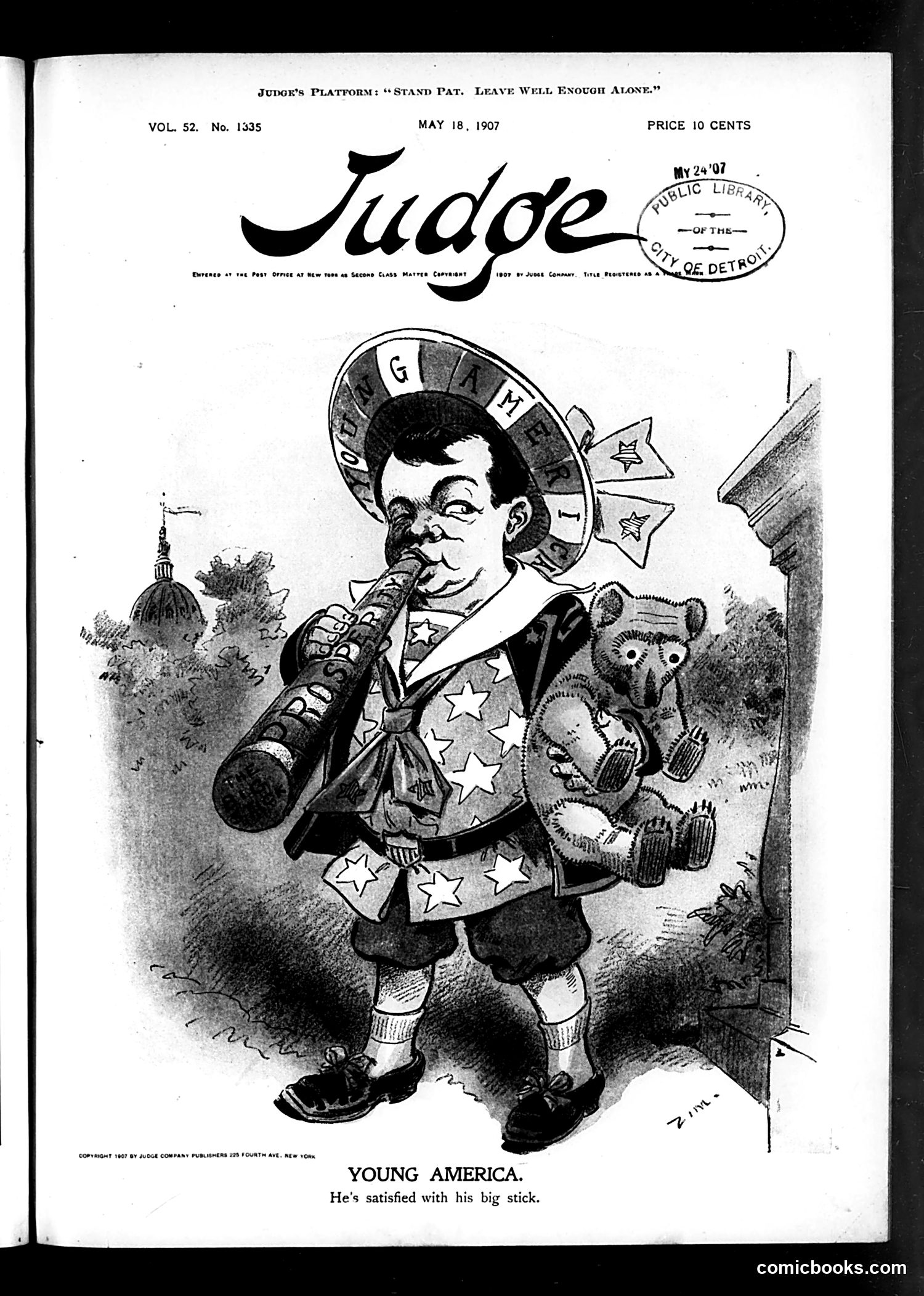
This political cartoon depicts a child-figure representing the United States playing a large bugle or horn labeled "PLOIEM" (unclear from OCR), wearing a stars-and-stripes outfit and a halo inscribed "YOUNG AMERICA." The child holds a teddy bear. The caption reads: "He's satisfied with his big stick." This references Theodore Roosevelt's "big stick" diplomacy—his foreign policy emphasizing military power and intervention. The cartoon appears satirical, portraying American interventionism as childish behavior: a young nation playing with toys and making noise rather than conducting mature statecraft. The Capitol building visible in the background anchors the scene in Washington politics. The satire critiques Roosevelt-era American imperialism as juvenile posturing.
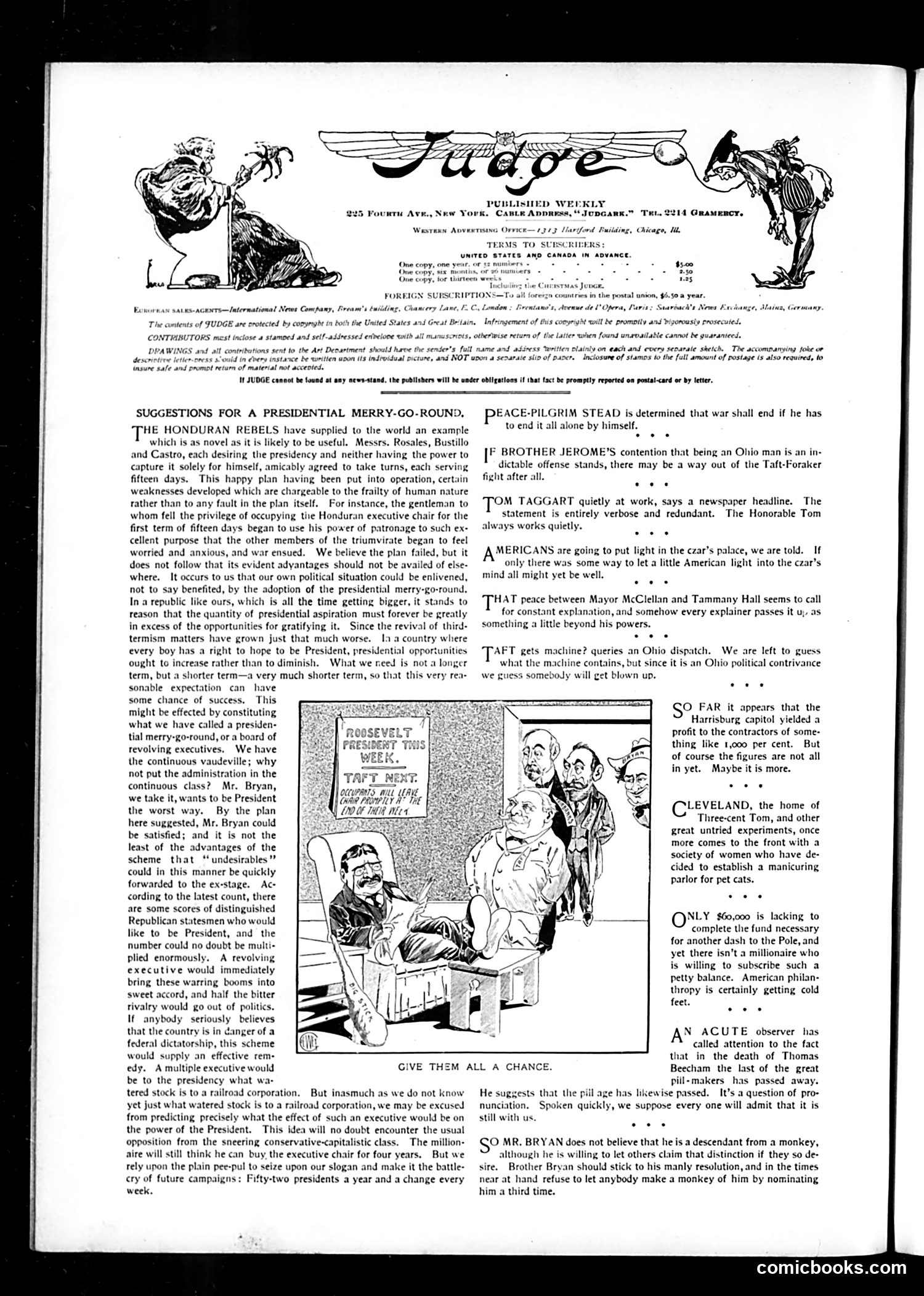
This page contains political commentary rather than a primary cartoon. The main illustration shows figures gathered around what appears to be a bed or table, labeled "GIVE THEM ALL A CHANCE," likely referencing Theodore Roosevelt's presidential ambitions or administrative decisions. The text critiques various political figures and situations, including references to "Brother Jerome," Ohio politics, Mayor McClellan and Tammany Hall (New York City corruption), and discussion of the "pill age" having passed—suggesting outdated political remedies. The commentary appears skeptical of proposed executive or administrative schemes, warning against federal overreach. Without clearer date information visible, the exact historical moment is uncertain, though the references suggest early 20th-century American politics and Progressive Era debates about presidential power.
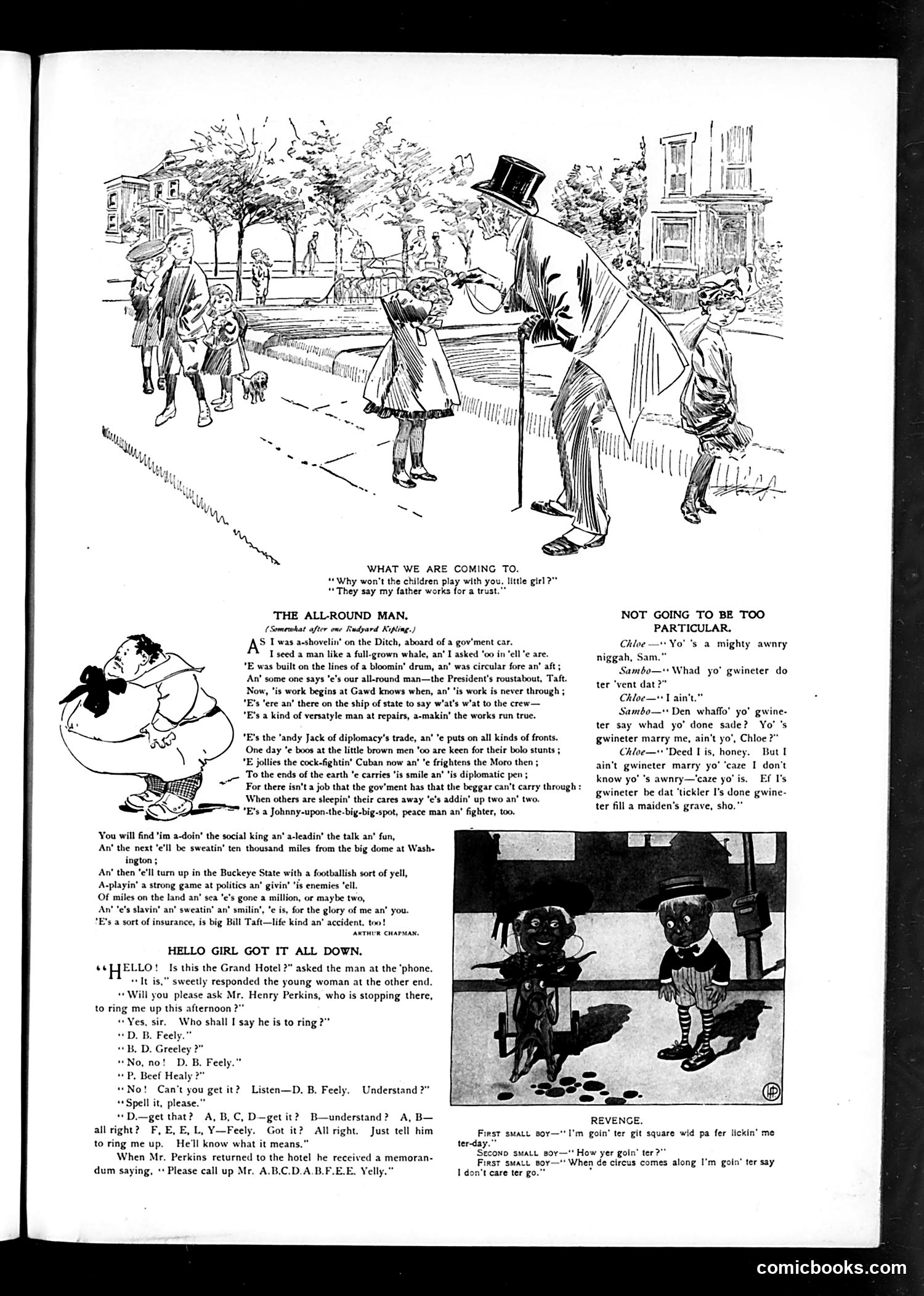
The top illustration depicts a gentleman in a top hat avoiding children at play, with the caption "Why won't the children play with you, little girl?" answered by "They say my father works for a trust." This satirizes **anti-trust sentiment** of the Progressive Era, likely early 1900s. Children ostracize a peer whose father works for a monopolistic "trust"—vast corporate combines that dominated American business and faced public outcry and regulation. The accompanying poem "The All-Round Man" sarcastically celebrates a political operative skilled in diplomacy, legal maneuvering, and manipulation—suggesting criticism of professional politicians. Below, "Hello Girl Got It All Down" depicts a telephone operator relaying a message, likely mocking miscommunication or the emerging role of women in business. The "Revenge" cartoon shows small boys plotting, reflecting contemporary concerns about urban youth and childhood mischief.
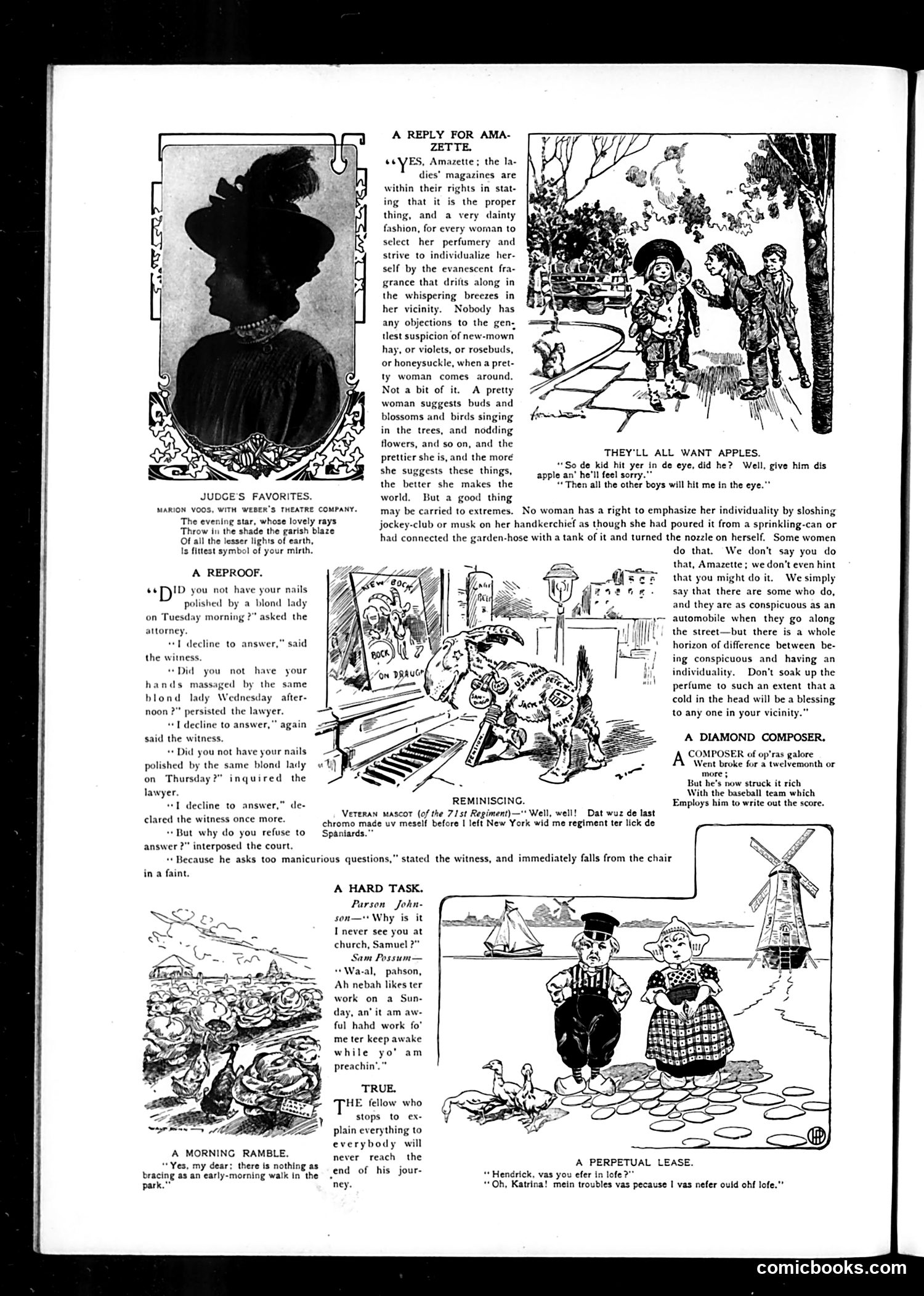
This page contains several satirical pieces and cartoons typical of early 20th-century Judge magazine humor: **"A Reply for Amazette"** addresses a woman reader's question about perfume and individualism, arguing that excessive perfume use is not truly individualistic but rather conspicuous and off-putting. **"A Reproach"** mocks a lawyer through courtroom dialogue, playing on the repetitive nature of legal questioning. **"Reminiscing"** features a veteran mascot making a humorous comment about military service. **"A Diamond Composer"** appears to be a brief joke about baseball scoring. **"A Hard Task"** and **"A Morning Ramble"** are short humorous dialogues or observations about everyday life. **"A Perpetual Lease"** depicts a domestic dispute between two figures, with one mentioning age-related troubles and refusing to renew commitment. The page represents typical early-1900s American humor: wordplay, domestic situations, and gentle social commentary.
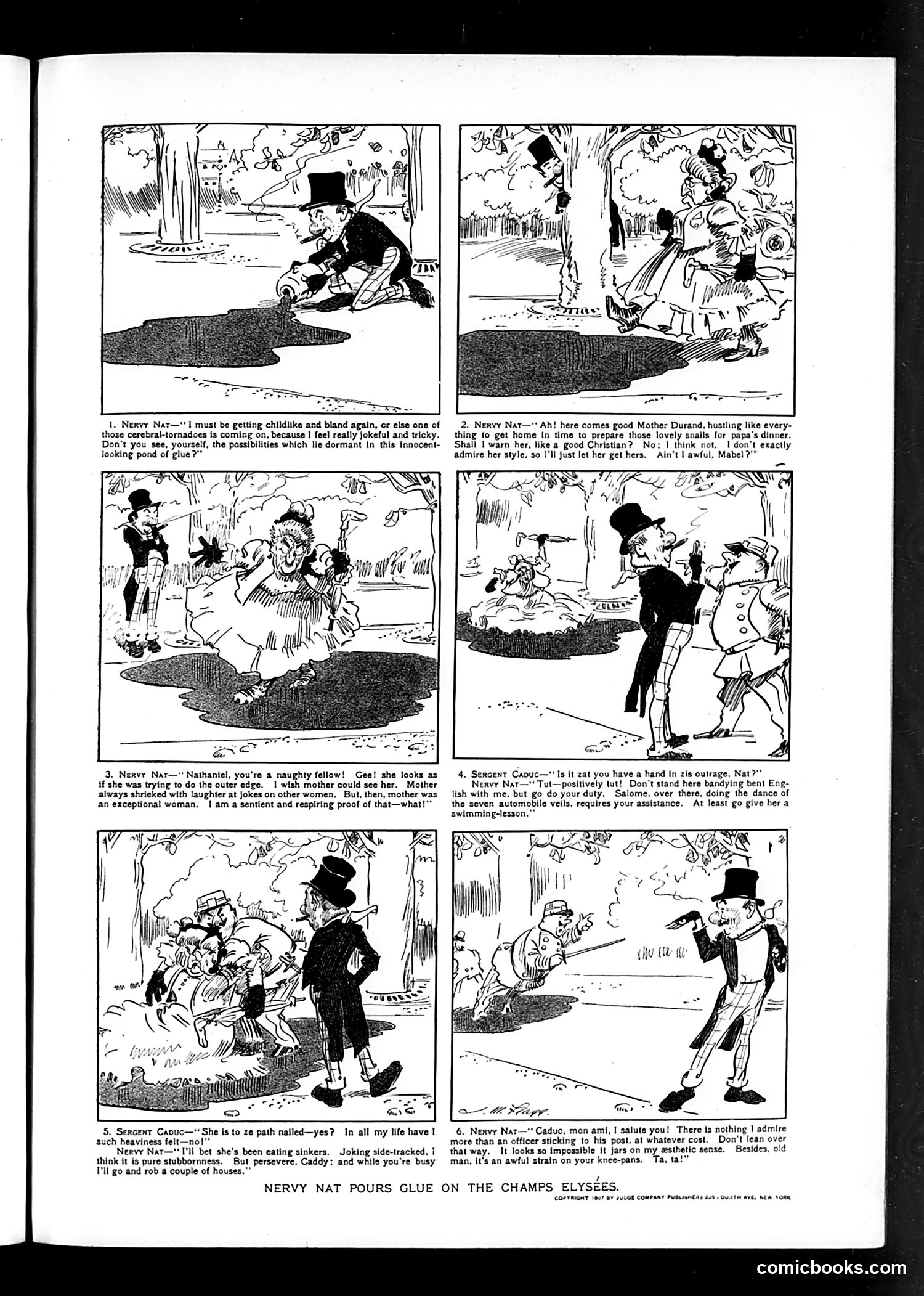
This comic strip follows a character named "Nervy Nat" through various mishaps on the Champs-Élysées in Paris. The humor centers on Nat's awkward social interactions and physical comedy: he encounters a woman (possibly "Mother Durand"), gets mistaken for a naughty fellow by Sergeant Caduc, and struggles with Parisian etiquette and activities like automobile rides and swimming lessons. The satire appears to target American tourists abroad—their cluelessness, social gaffiness, and inability to navigate foreign customs. "Nervy Nat" represents the stereotypical bumbling American abroad, causing embarrassment through his behavior. The repeated references to his "nerve" and impropriety suggest Judge magazine was poking fun at American tourists' brazen rudeness compared to European standards of conduct.
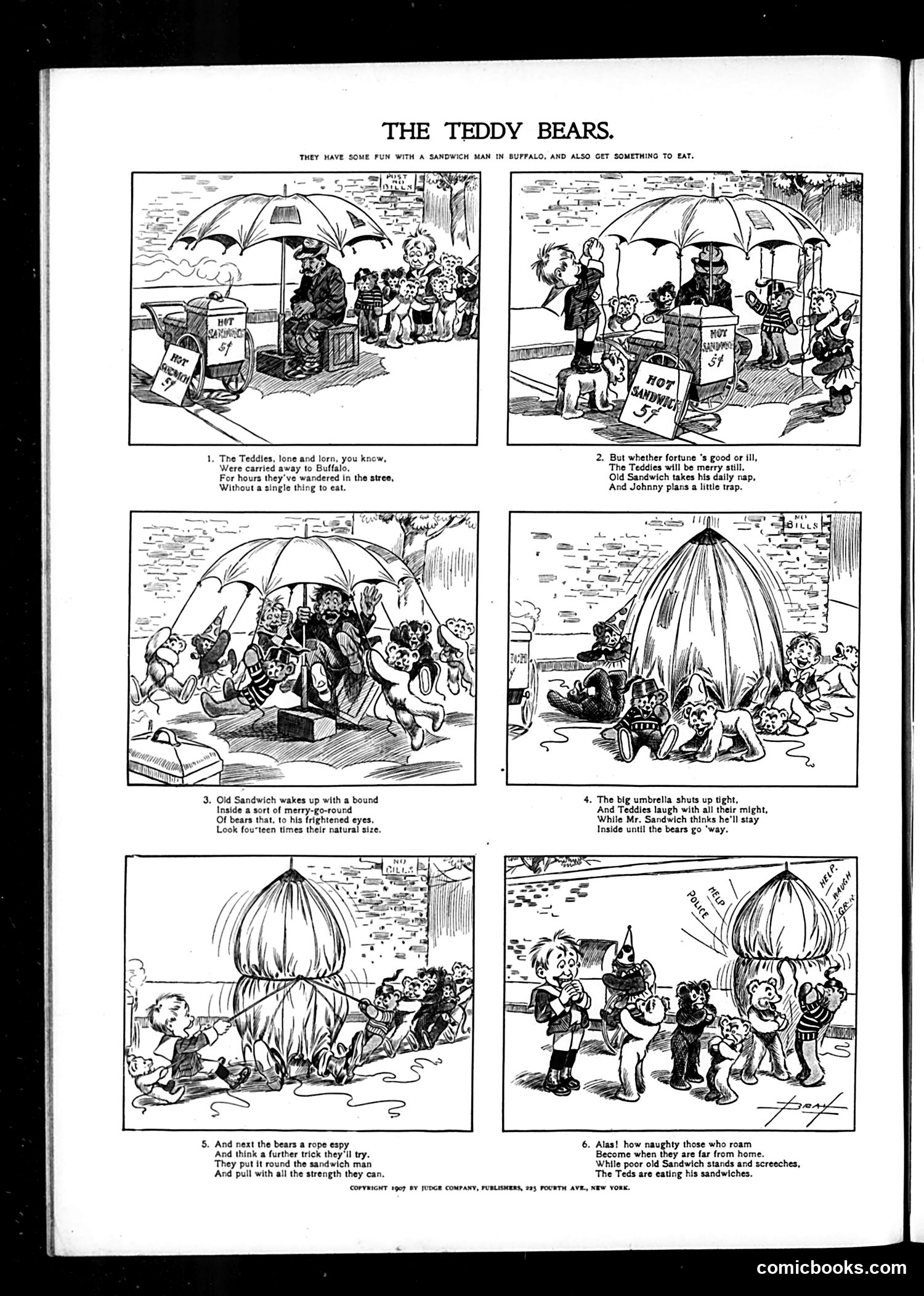
This is a whimsical comic strip exploiting the popularity of "Teddy Bears"—stuffed toys named after President Theodore Roosevelt, who had become a cultural phenomenon following a 1902 hunting incident. The strip depicts anthropomorphized teddy bears causing mischief to a "sandwich man" (street vendor) in Buffalo. The humor is straightforward slapstick: the bears encounter a sleeping vendor, play pranks on him with an umbrella, use a rope to spin him around, and ultimately steal his sandwiches. There's mild moralization in the final panel about misbehavior "far from home," but this is largely a lighthearted children's story capitalizing on teddy bear mania rather than political satire. The 1907 date and Judge magazine context indicate this reflects the toy's widespread cultural dominance in the early 1900s.
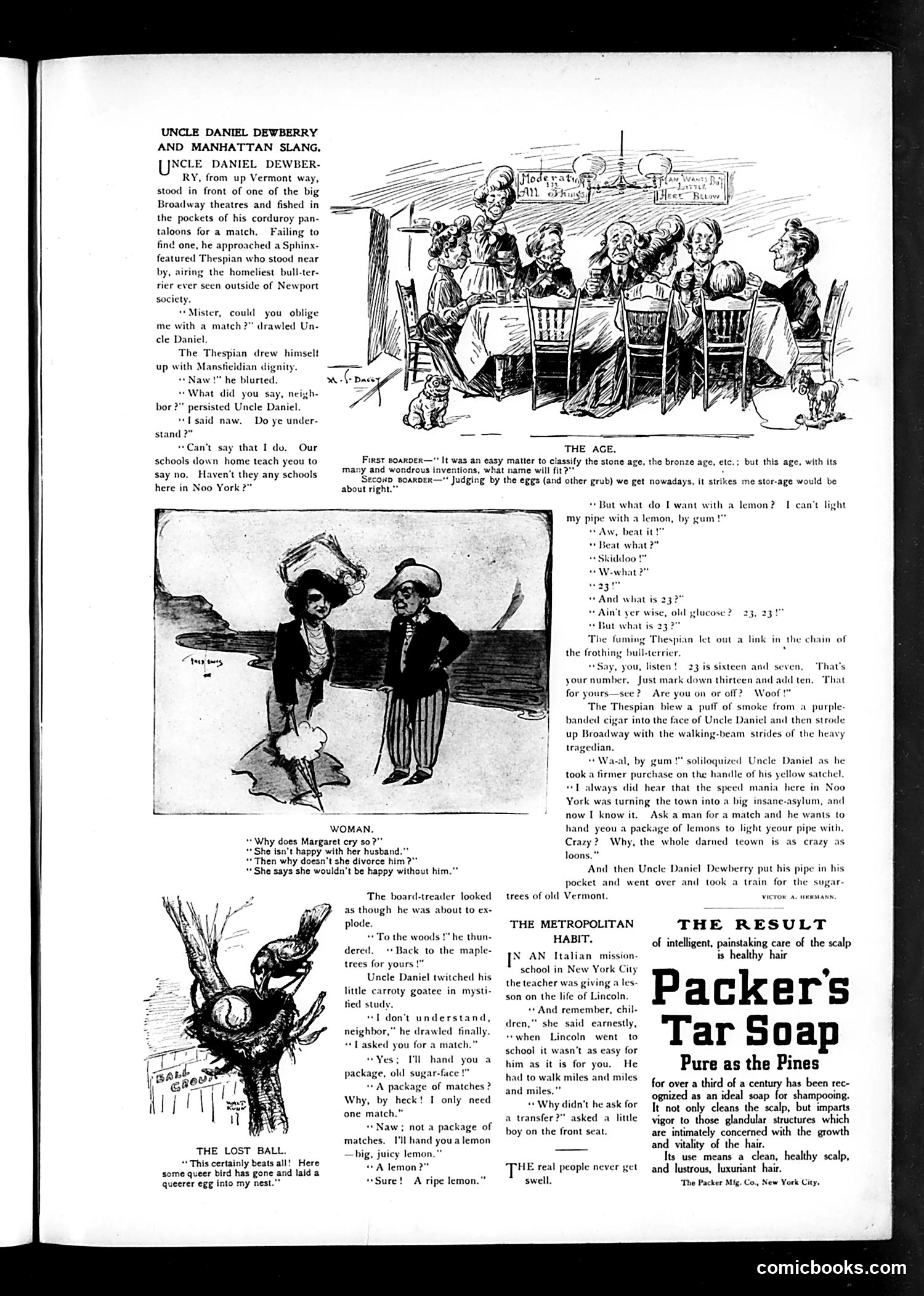
This satirical story contrasts rural Vermont simplicity with New York City's bewildering modern slang and pace. Uncle Daniel, a country visitor, asks a Broadway actor for a match. The actor responds with urban slang—"Naw!" and incomprehensible phrases like "skiddoo" and "23"—that completely baffle the straightforward Vermonter. The joke targets **1900s Manhattan's rapid urbanization and the "speed mania"** that Daniel observes: even a simple request for a match becomes a cryptic mathematical riddle. The Thespian represents the affected, fast-talking city dweller speaking an impenetrable dialect to ordinary people. The accompanying cartoon "The Age" satirizes modern industrial society's trivial concerns (lemons for lighting pipes, eggs quality), suggesting the era lacks noble purpose compared to historical "ages." The page demonstrates *Judge* magazine's consistent theme: rural American bewilderment at urban modernity and incomprehensible city culture.
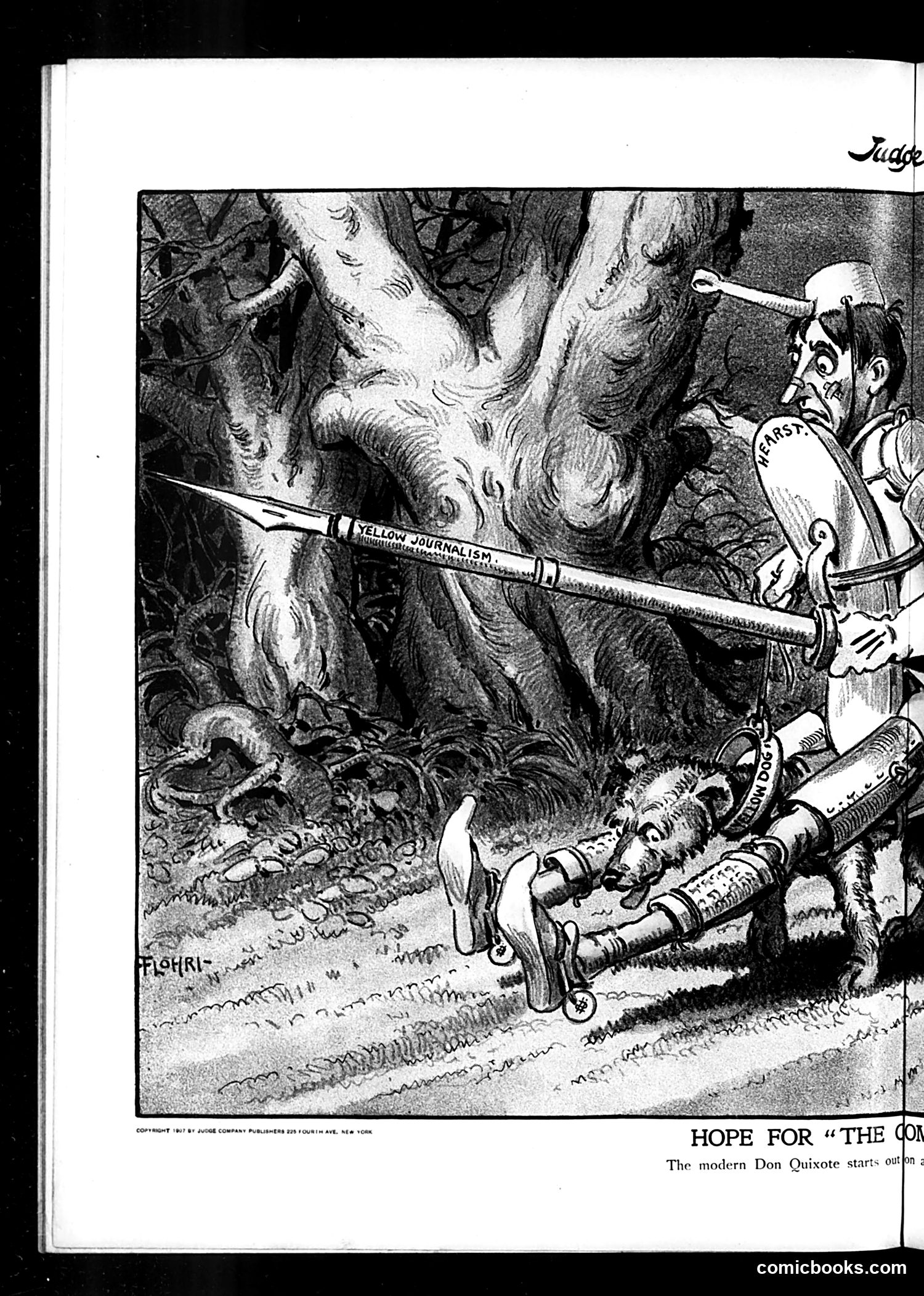
This Judge magazine cartoon depicts a modern "Don Quixote" figure wielding a syringe labeled "YELLOW JOURNALISM" as a lance, attacking what appears to be a grotesque monster or demon. The cartoon satirizes sensationalist newspaper practices by comparing them to Cervantes' delusional knight tilting at windmills. The figure on the right, labeled "PARSANALIA" (likely referencing a publisher or editor), represents those promoting yellow journalism. The monster likely symbolizes corruption, moral decay, or societal ills that yellow journalism claims to combat but actually perpetuates. The satire suggests that crusaders against yellow journalism are themselves delusional—fighting imaginary enemies with ineffective weapons, just as Don Quixote mistook windmills for giants. The cartoon critiques both sensationalist media and self-righteous reformers opposing it.
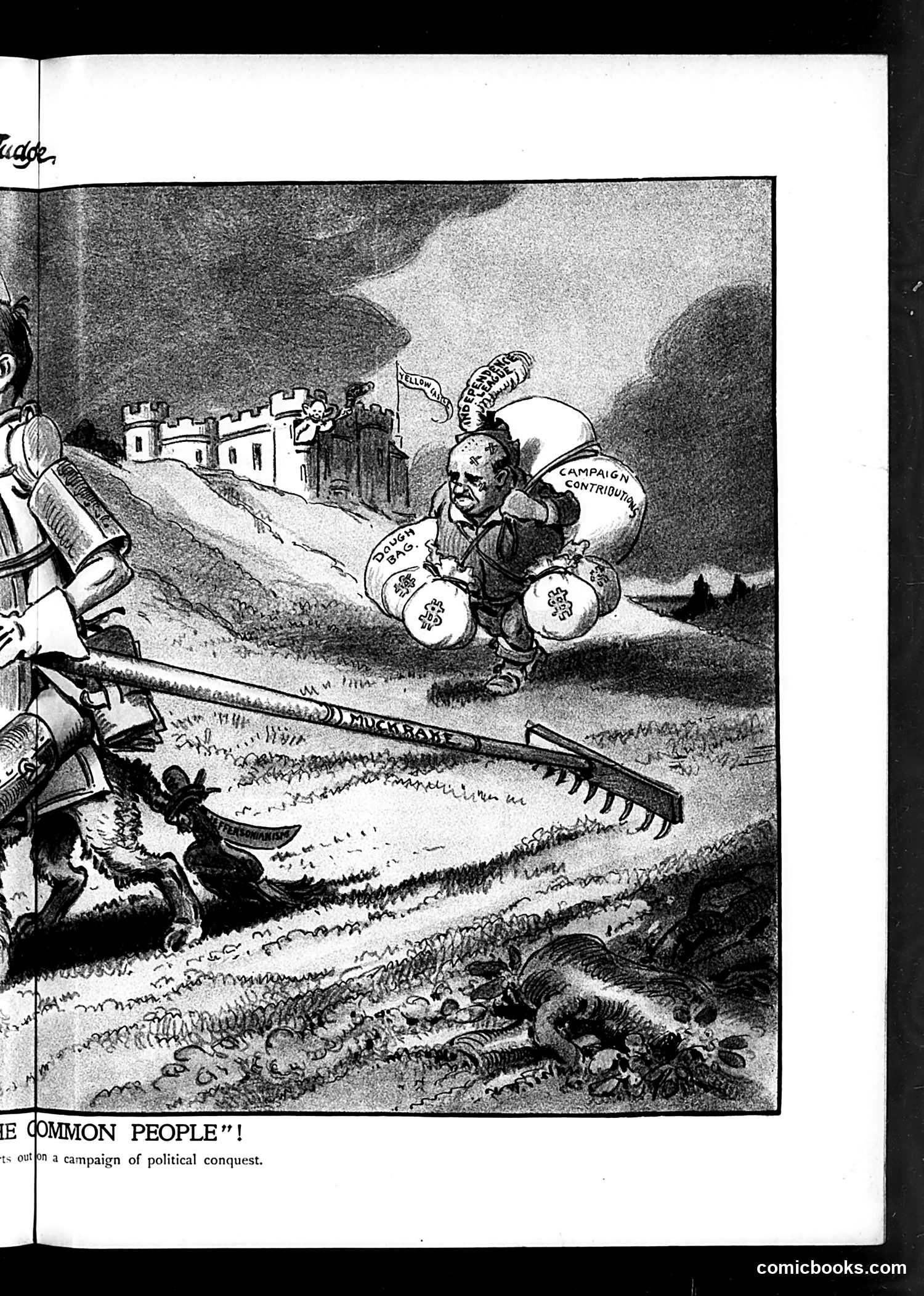
This political cartoon satirizes a political figure (depicted as a bloated man carrying large sacks labeled "PATRON," "CAMPAIGN CONTRIBUTIONS," and similar terms suggesting financial corruption) who is literally burdened by money bags while approaching fortified structures in the background. The title "THE COMMON PEOPLE" appears to be ironic—the cartoon critiques how politicians claim to represent ordinary citizens while actually being weighed down by campaign finances and patronage. The fortified castle-like buildings suggest political power or entrenched interests. The artillery and military imagery in the foreground indicate this "campaign of political conquest" operates through force rather than genuine democratic representation. The overall message appears to criticize the corruption of electoral politics by wealthy donors and patronage systems, suggesting politicians serve moneyed interests rather than the actual common people.
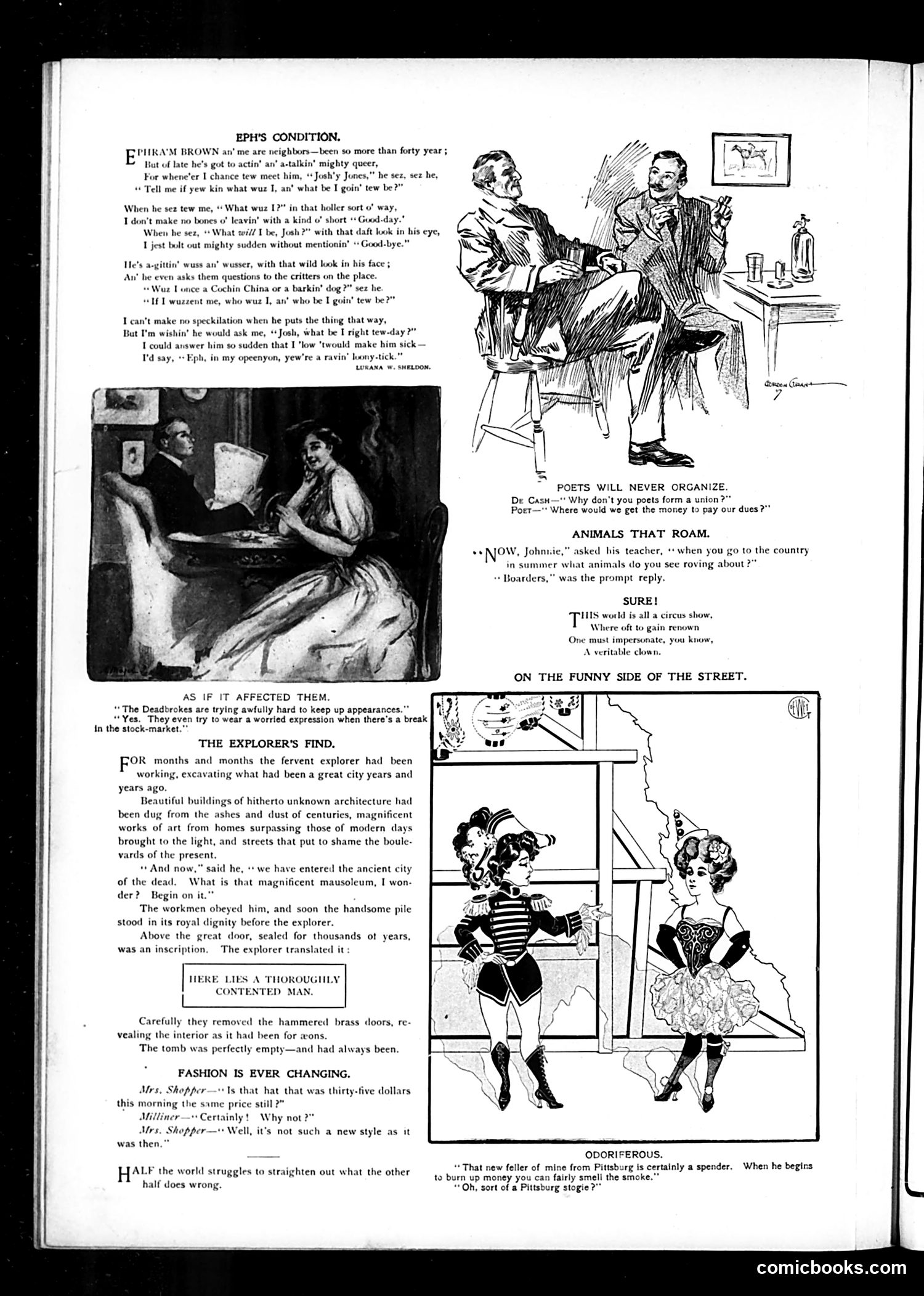
This page contains multiple satirical pieces reflecting early 20th-century American concerns: **"Eph's Condition"** depicts a rural neighbor experiencing what appears to be an existential or mental crisis—repeatedly asking philosophical questions ("What was I? What will I be?") that suggest either philosophical mania or mental illness. The humor lies in the narrator's exasperation with these unanswerable questions. **"Poets Will Never Organize"** is a brief class commentary: poets are too poor to afford union dues, satirizing both struggling artists and the labor organization movement of the era. **"The Explorer's Find"** is an ironic story about discovering an ancient tomb inscribed "Here lies a thoroughly contented man"—but finding it empty. The satire suggests that contentment is illusory or impossible to achieve/preserve. **"Fashion Is Ever Changing"** and **"Odoriferous"** are brief jokes about women's fashion vanity and nouveau-riche spending habits, respectively—typical upper-class mockery of social climbers. The cartoons employ period-appropriate visual humor and colloquial dialect common to Judge's satirical style.
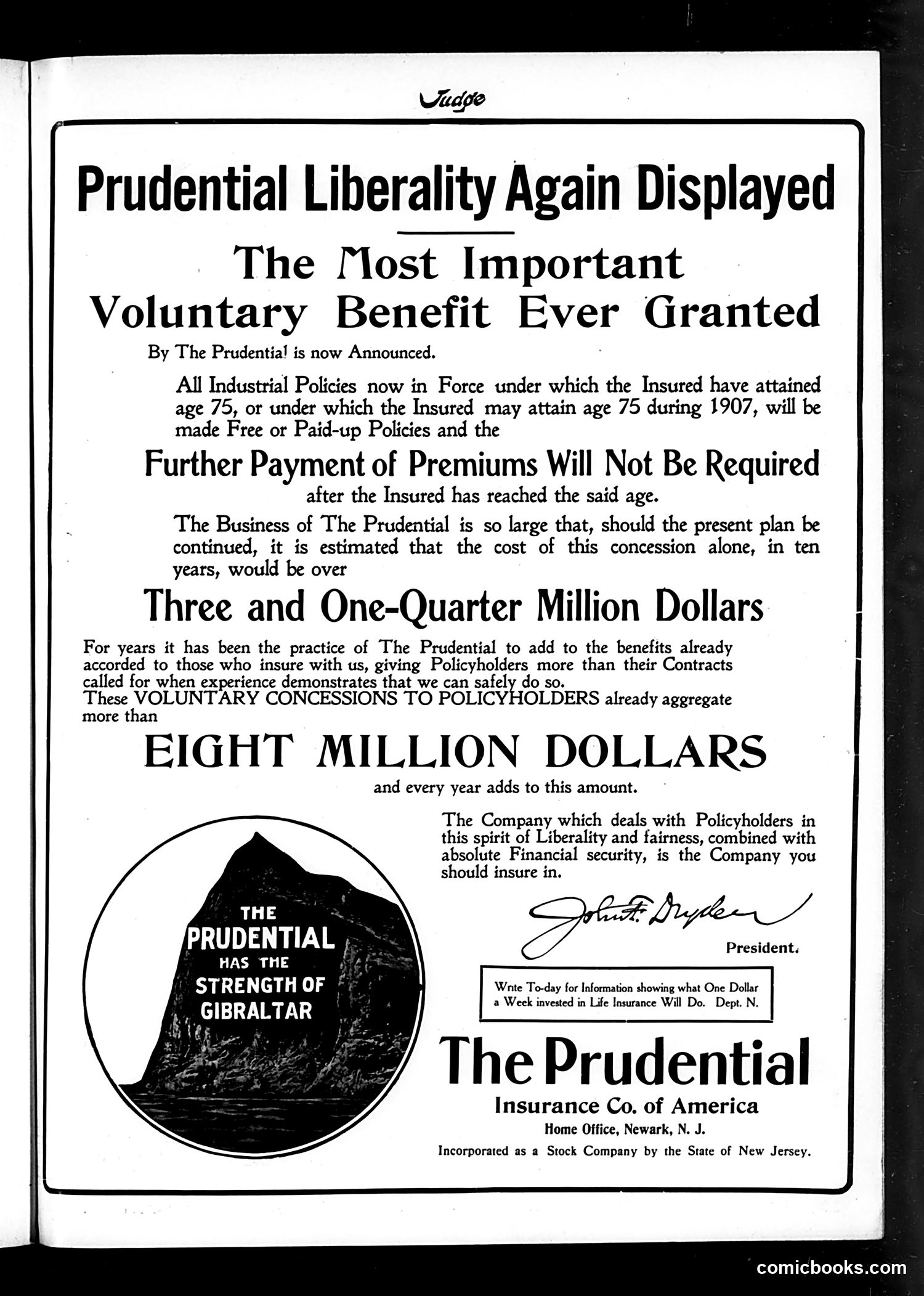
This is **primarily an advertisement**, not satire or editorial cartoon. The Prudential Insurance Company is announcing a major policy benefit: policyholders reaching age 75 will have their premiums waived going forward. The page uses Judge magazine's platform to promote corporate "liberality"—claiming the company has voluntarily granted over $8 million in extra benefits to policyholders beyond their contracts. The estimated cost of this new age-75 waiver alone would be $3.25 million over ten years. The Gibraltar imagery (a rock formation representing strength and stability) is a standard insurance company metaphor for financial security, not satirical commentary. **Context for modern readers**: This appears to be genuine corporate messaging leveraging a respected satirical publication's credibility. Whether Judge's editors found irony in advertising a profit-driven company's "voluntary" generosity is unclear from the page itself.
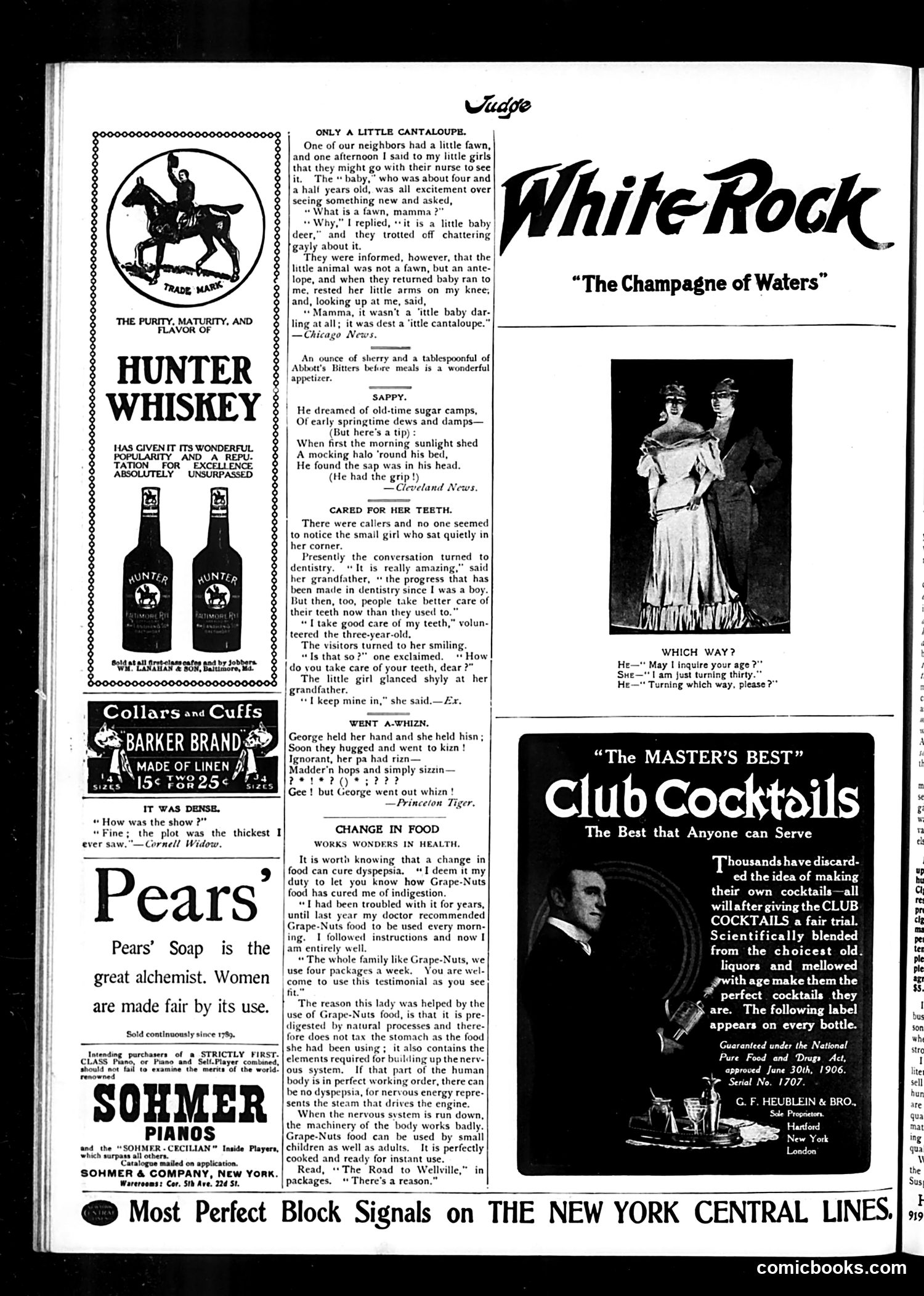
This page is primarily **advertisements and humor anecdotes** rather than political satire. The content includes: **Main Features:** - Several short, gentle humor pieces about children's misunderstandings (a child calling an antelope a "cantaloupe," another child explaining she keeps her teeth "in") - Advertisements for consumer goods: Hunter Whiskey, Pears' Soap, Sohmer Pianos, Barker Brand Collars, and Grape-Nuts cereal - A White Rock water advertisement featuring two women **The Satire/Humor:** The jokes rely on **innocent malapropisms and childish logic**—typical early-20th-century "cute kid" humor. There's no identifiable political commentary. The ads use common era appeals: Pears' Soap claims to make "women fair," whiskey emphasizes "purity" and "flavor," and Grape-Nuts promises health benefits. **Overall:** This appears to be a typical Judge magazine miscellany page—lighthearted domestic humor mixed with period advertising, reflecting early 1900s consumer culture and genteel family entertainment.
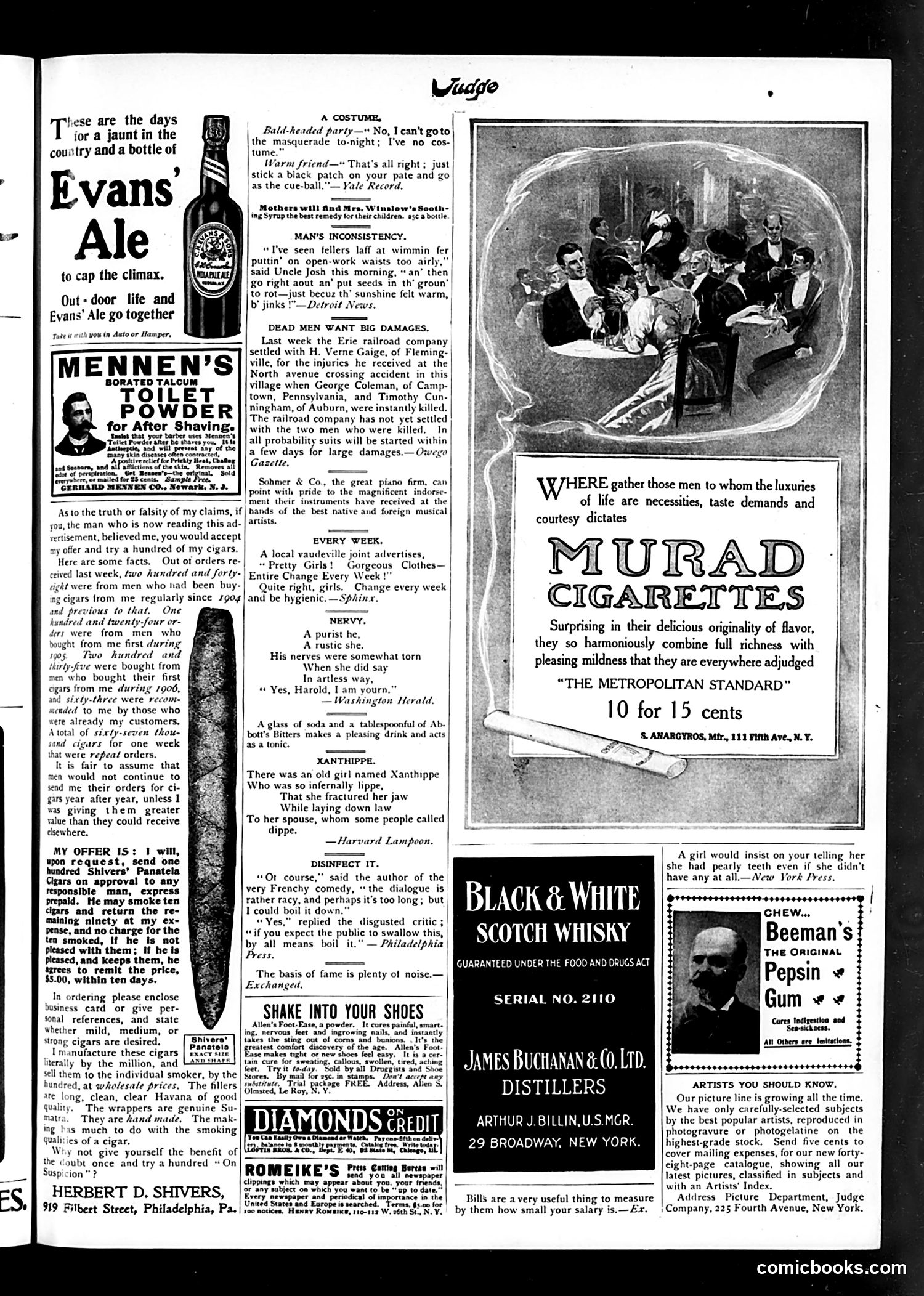
This page is primarily **advertisements mixed with short humor pieces**—typical Judge magazine filler content. The main illustrated cartoon (center-right) shows well-dressed men dining together, accompanying a **Murad Cigarettes advertisement**. The image depicts the luxurious lifestyle cigarette marketing promised to affluent consumers. Scattered throughout are brief comic anecdotes: - A **bald man joke**: When invited to a masquerade without a costume, a friend suggests he wear a black patch and go "as the cue-ball"—visual humor about baldness. - **Gender satire**: A man laughs at women wearing revealing waists in summer, then complains about dirt from plowing—hypocrisy about women's fashion choices. - A railroad **injury settlement item** noting deadmen receive no damages (dark legal humor). - Various product endorsements (Evans' Ale, Mennen's talcum powder, Sohmer pianos). The page reflects early 20th-century advertising culture targeting middle-to-upper-class male readers with cigarettes, alcohol, and grooming products, interspersed with genteel humor about fashion, gender relations, and daily life.
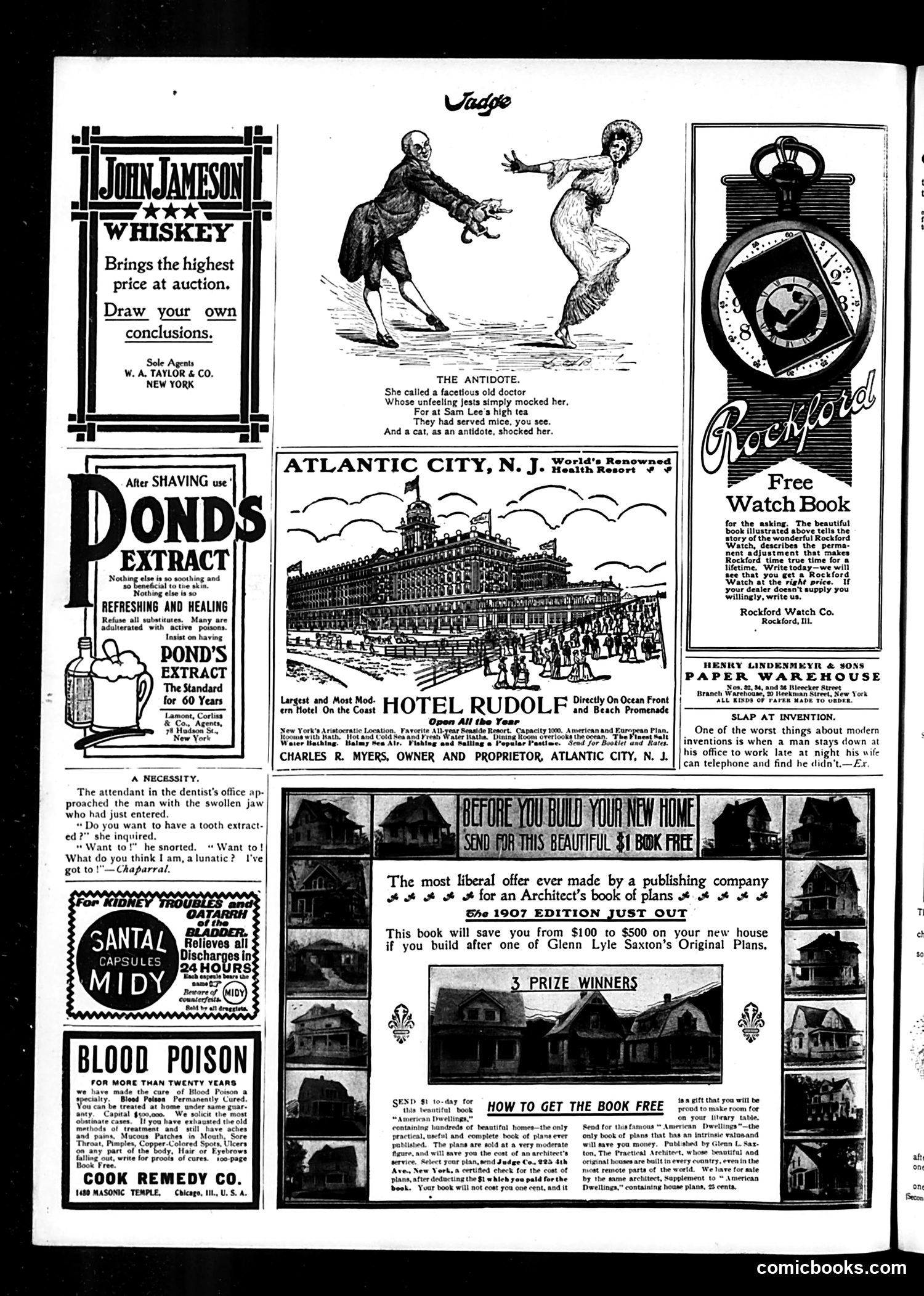
This page is primarily **advertising with one satirical cartoon**. ## The Main Cartoon: "The Antidote" The illustrated joke depicts a woman who ate mice at "Sam Lee's high tea" and consulted a mocking doctor. His "antidote" was to present her with a cat—the implication being that a cat would frighten her as much as the mice did, thereby shocking her out of her distress. This is absurdist humor playing on the ironic notion that the "cure" is as bad as the ailment. ## The Advertisements The page features typical early-1900s patent medicines and products: Dond's Extract (post-shaving balm), Santal Capsules Midy (kidney/bladder remedy), and Cook Remedy Co.'s blood poison treatment—all making dubious medical claims typical of the era. The Hotel Rudolf advertisement and architectural book offer represent legitimate commercial content. The John Jameson Whiskey ad at top sardonically notes it "brings the highest price at auction," inviting readers to draw conclusions about its quality or its buyers' judgment.
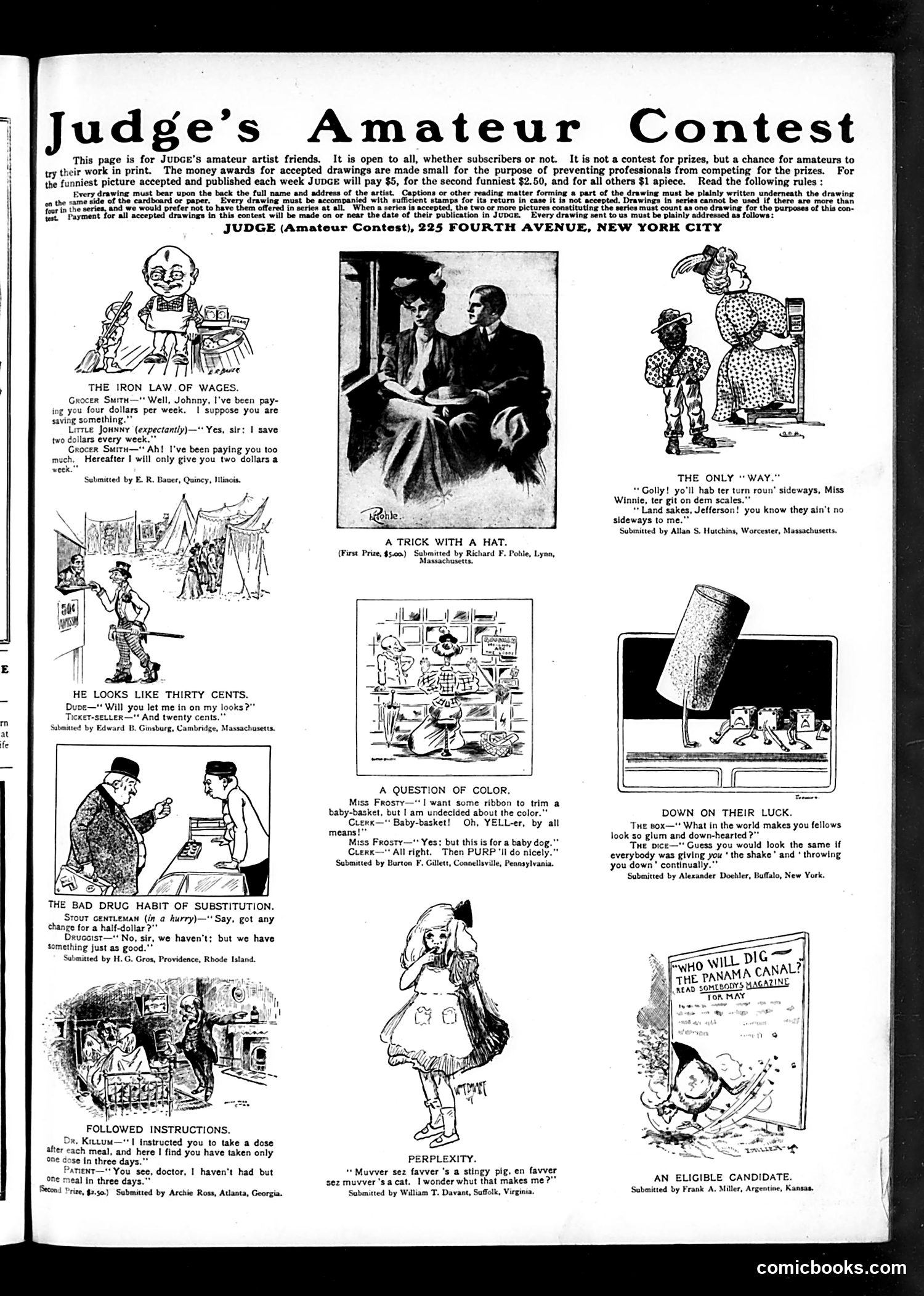
This page showcases amateur cartoons submitted to *Judge* magazine's weekly contest. The cartoons use simple wordplay and social satire typical of early 20th-century humor: **Notable cartoons include:** - **"The Iron Law of Wages"**: A grocer deduces that if a boy saves money, he's overpaid, so cuts his wages—satirizing flawed economic logic. - **"A Question of Color"**: A clerk makes puns on dog-related colors ("YELL-er" for yellow dog, "PURP" for purple) when a woman asks about ribbon for a baby dog—absurdist humor. - **"The Only Way"**: A racist caricature of an overweight Black woman who claims she has "no sideways"—reflecting the era's offensive stereotyping. - **"Down on Their Luck"**: Dice complain about being "shaken" and "thrown down"—personifying gambling implements. The page reflects *Judge*'s satirical style: economic critique, puns, and unfortunately, period racial stereotypes that modern readers will find offensive.
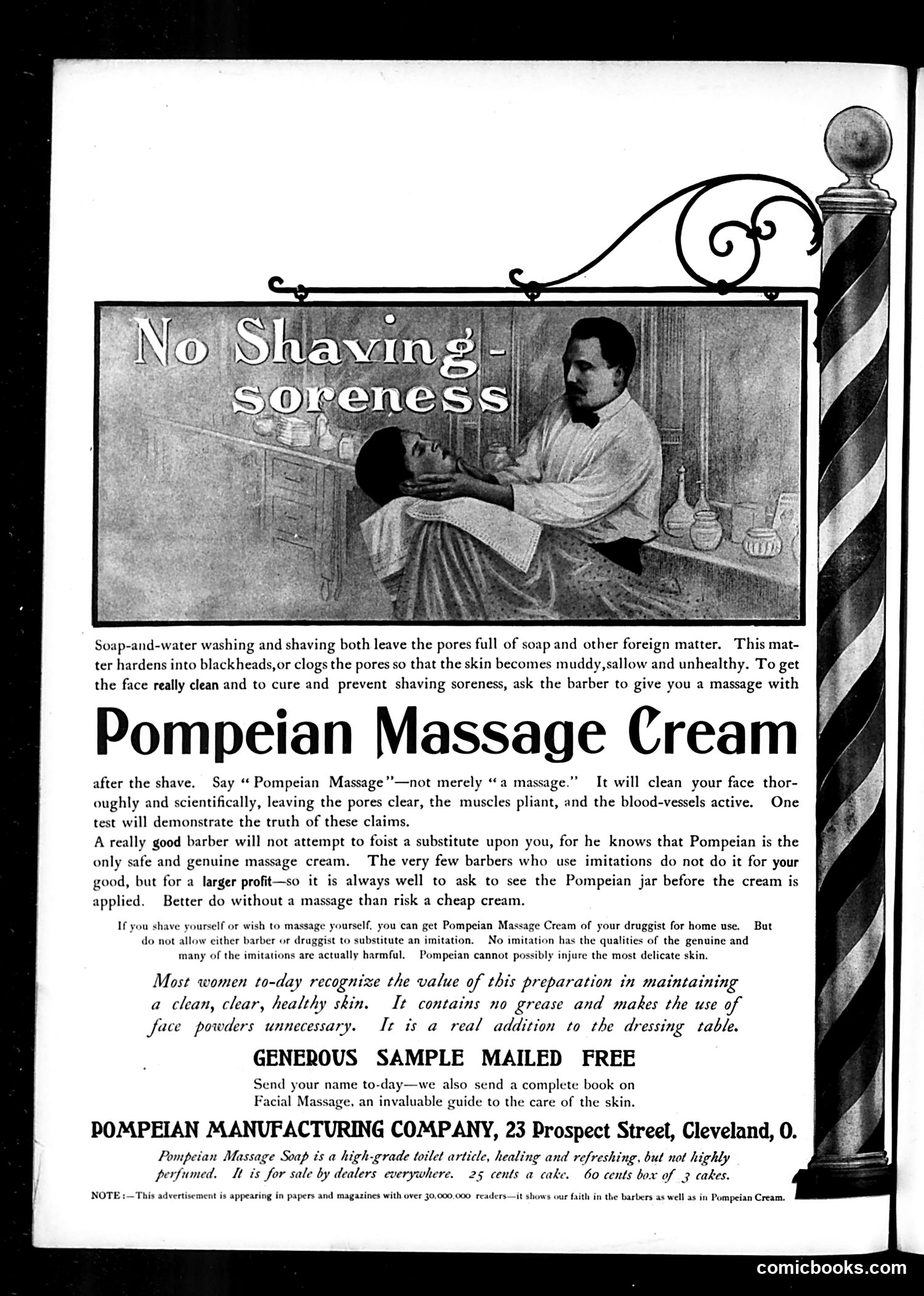
This is primarily a **product advertisement**, not political satire. It appeared in *Judge* magazine and promotes Pompeian Massage Cream for post-shave facial care. The illustration shows a barber applying massage cream to a customer's face, demonstrating the product's use. The ad's pitch claims that soap clogs pores with residue, causing blackheads and soreness—massage cream solves this scientifically. Notably, the advertisement **warns against counterfeit products**, cautioning customers to verify they're getting genuine Pompeian (not cheaper imitations) and advising barbers not to substitute. This suggests early 20th-century concerns about product fraud. The ad also **markets to women**, noting they recognize the cream's value for maintaining "clean, clear, healthy skin" without grease, positioning it as a beauty necessity beyond just post-shave care. There is **no political or satirical content** visible—this is straightforward commercial advertising using early mass-media distribution.