
Judge, 1907-05-18 · page 10 of 16
Judge — May 18, 1907 — page 10: what you’re looking at
What you’re looking at
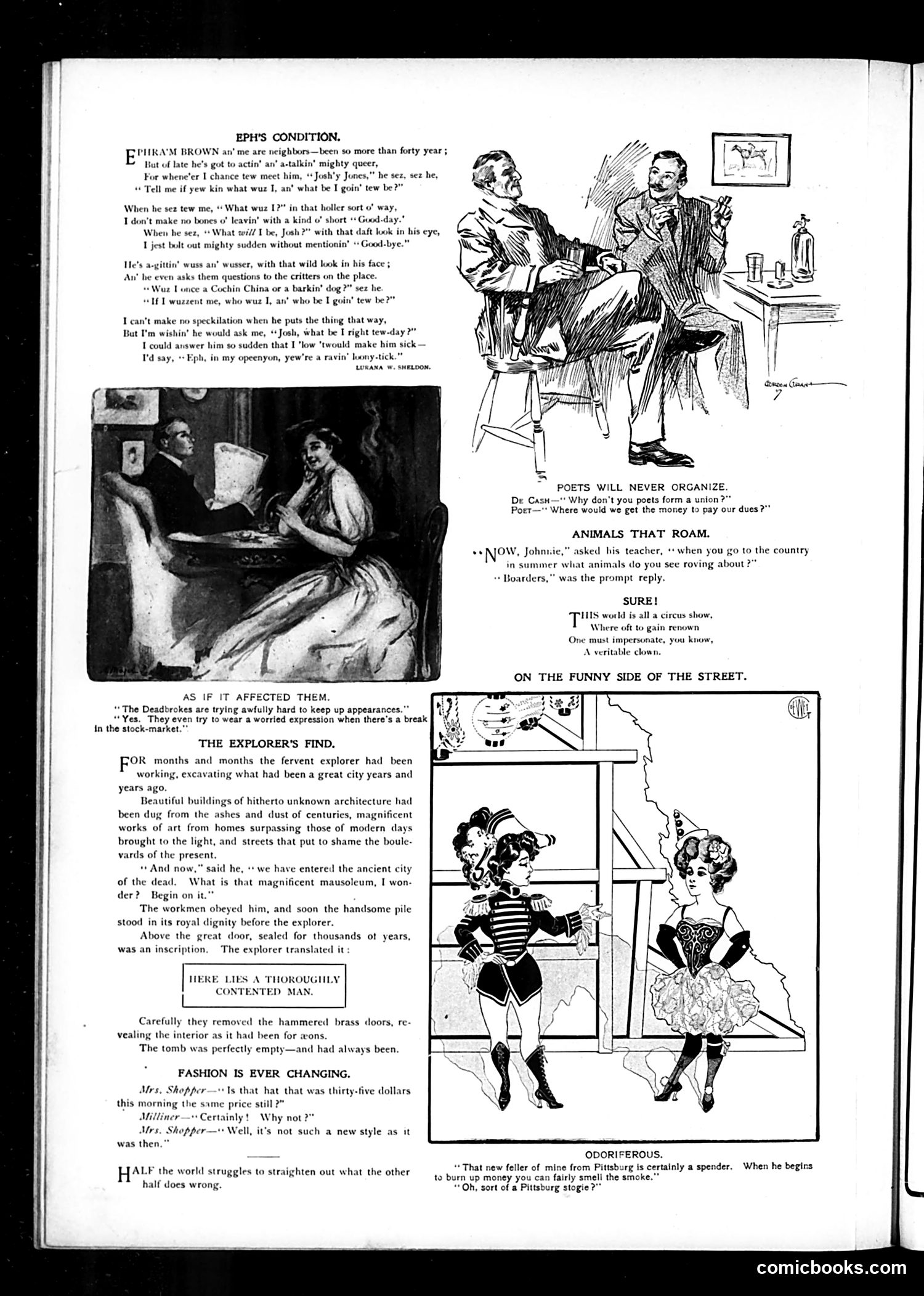
This page contains multiple satirical pieces reflecting early 20th-century American concerns: **"Eph's Condition"** depicts a rural neighbor experiencing what appears to be an existential or mental crisis—repeatedly asking philosophical questions ("What was I? What will I be?") that suggest either philosophical mania or mental illness. The humor lies in the narrator's exasperation with these unanswerable questions. **"Poets Will Never Organize"** is a brief class commentary: poets are too poor to afford union dues, satirizing both struggling artists and the labor organization movement of the era. **"The Explorer's Find"** is an ironic story about discovering an ancient tomb inscribed "Here lies a thoroughly contented man"—but finding it empty. The satire suggests that contentment is illusory or impossible to achieve/preserve. **"Fashion Is Ever Changing"** and **"Odoriferous"** are brief jokes about women's fashion vanity and nouveau-riche spending habits, respectively—typical upper-class mockery of social climbers. The cartoons employ period-appropriate visual humor and colloquial dialect common to Judge's satirical style.
📄 Transcribed text from this page (OCR, searchable)
Machine-transcribed from the original scan — historical spelling and the odd misread are preserved.
EPH’S CONDITION. EPHRA'M BROWN an’ me are neighbors—been 20 more than forty year; But of late he's got to actin’ an’ a-talkin’ mighty queer, For whene'er I chance tew meet him, ‘ Josh'y Jones," he sez, sez he, “Tell me if yew kin what wuz I, an’ what be I goin’ tew be?” When he sez tew me, “ What wuz 1?" in that T don't make no bones leavin’ with a kind o° short **C When he sez, “What toil! I be, Josh 2" with that daft look in his eye, 1 jest bolt out mighty sudden without mentionin’ ++ Good-bye." ittin’ wuss an’ wusser, with that wild look in his face ; sks them questions to the critters on the place. e a Cochin China or a barkin’ dog?” sez he. “TET wuzzent me, who wuz I, an’ who be T goin’ tew b speckilation when he puts the thing that way, he would ask me, ‘Josh, what be I right tew-day 2” nswer him so sudden that I "low 'twould make him sick— Eph, in my opeenyon, yew're a ravin' luony-tick.” LURAMA W. SHELDON. POETS WILL NEVER ORGANIZE. De Cast—** Why don’t you poets form a union?” Poer—* Where would we get the money to pay our dues?” ANIMALS THAT ROAM. +s NOW, Johnnie,” asked his teacher, «when you go to the country in summer what animals do you see roving about ?” ++ Boarders,” was the prompt reply. SURE! IIIS world is all a circus show, Where oft to gain renown One must impersonate, you know, A veritable clown. ON THE FUNNY SIDE OF THE STREET. AS IF IT AFFECTED THEM. “The Deadbrokes are trying awfully hard to keep up appearances.”* “Yes. They even try to wear a worried expression when there's a break In the stock-market."" ‘THE EXPLORER’S FIND. OR months and months the fervent explorer had been working, excavating what had been a great city years and years ago. Beautiful buildings of hitherto unknown architecture had been dug from the ashes and dust of centuries, magnificent works of art from homes surpassing those of modern days brought to the light, and streets that put to shame the boule- vards of the present. + And now, he, “we have entered the ancient city of the dead, What is that magnificent mausoleum, I won- der? Begin on it.” The workmen obeyed him, and soon the handsome pile stood in its royal dignity before the explorer. Above the great door, sealed for thousands ot years, was an inscription. The explorer translated it HERE LIES A THOROUGHLY CONTENTED MAN. Carefully they removed the hammered brass doors, re- vealing the interior as it had been for wons. The tomb was perfectly empty—and had always been. FASHION IS EVER CHANGING. Mrs. Shopper—«'s that hat that was thirty-five dollars this morning the same price still 2" Milliner—« Certainly! Why not 2" Mrs. Shopper—“ Well, it’s not such a new style as it was then,” ODORIFEROUS. “That new feller of mine from Pittsburg is certainly a spender. When he begins to burn up money you can fairly smell the smoke.” HALE the world struggles to straighten out what the other half does wrong. “Oh, sort of a Pittsburg stogie ?” comicbooks.com