
A complete issue · 16 pages · 1907
Judge — April 20, 1907
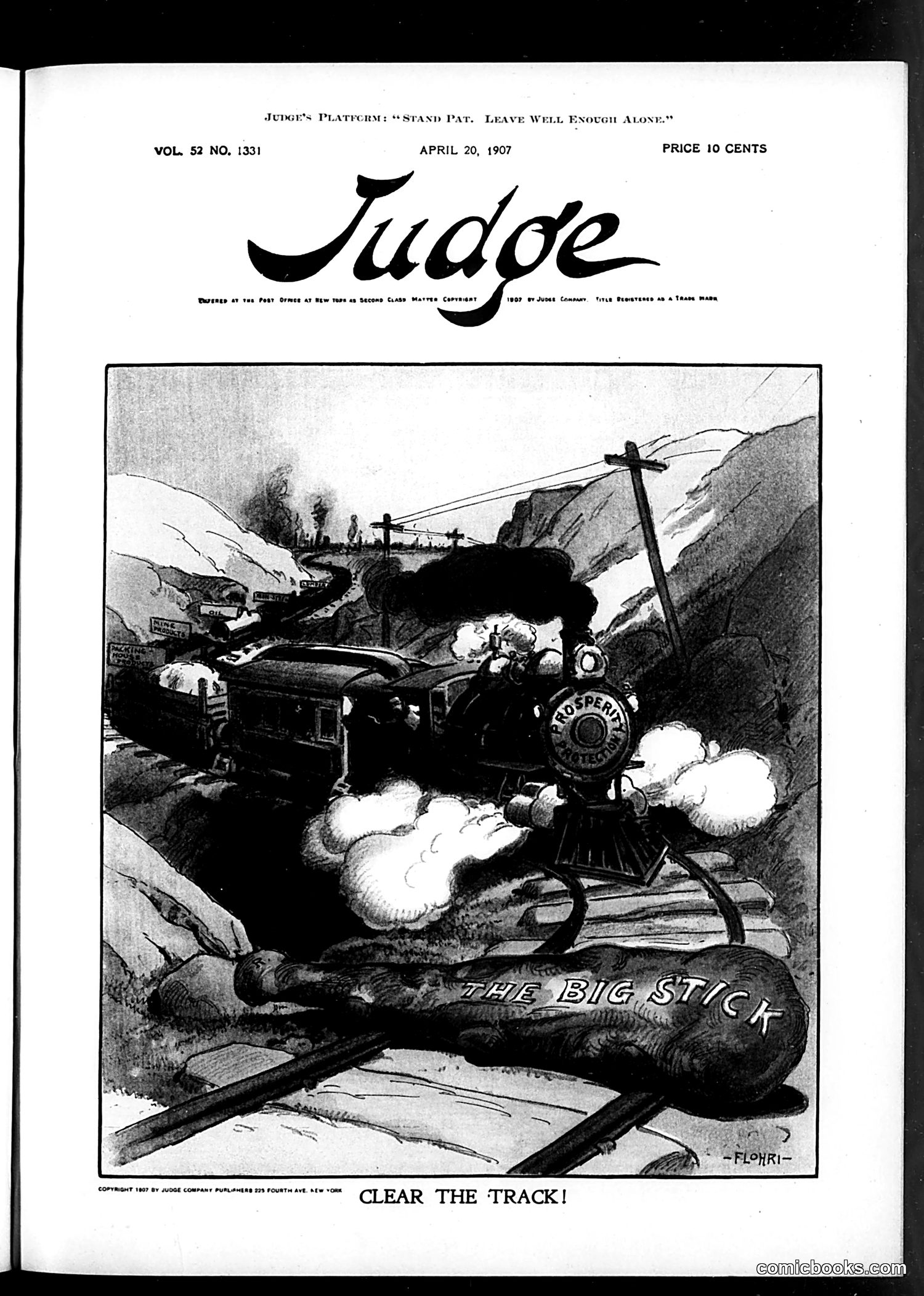
This political cartoon depicts a locomotive labeled "Prosperity" barreling down railroad tracks toward an oncoming train. The cartoon satirizes railroad safety concerns or possibly Theodore Roosevelt's aggressive "trust-busting" policies—the locomotive appears to represent unstoppable economic or political force. The title "Clear the Track!" suggests warnings being ignored or an inevitable collision. The dramatic composition, with the steam engine producing heavy smoke and the rocky terrain, emphasizes the danger and chaos of uncontrolled momentum. Without additional context from the April 1907 date, the exact political target remains unclear, though it likely references contemporary railroad regulation debates or Roosevelt-era economic policies that contemporaries viewed as recklessly destabilizing.
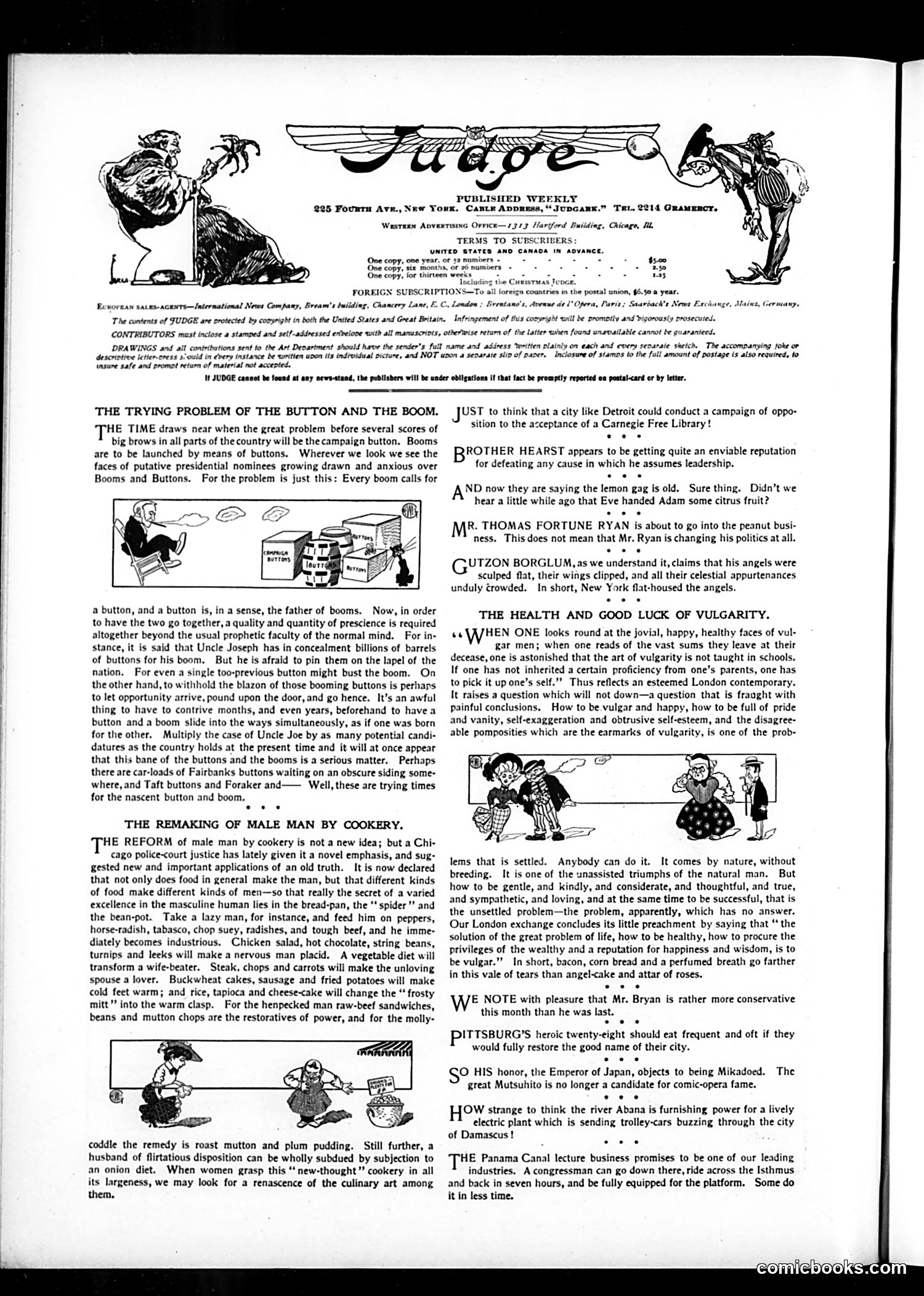
This page contains three separate satirical pieces: 1. **"The Trying Problem of the Button and the Boom"** - A commentary on presidential campaign buttons and "booms" (grassroots movements). The satire suggests these promotional items are ubiquitous and somewhat absurd, with the joke that buttons necessarily precede booms in political campaigns. 2. **"The Remaking of Male Man by Cookery"** - This section mocks the idea that cooking reform could improve masculine character. It sarcastically suggests that teaching men to cook (through bread, spider, pepper, etc.) could restore "power" and create a "renaissance of the culinary arts among" men—likely poking fun at early 20th-century domestic reform movements. 3. **Brief political/social commentary items** covering diverse topics: Carnegie libraries, Brother Hearst, Thomas Fortune Ryan, and various international news items. The cartoons appear illustrative rather than the primary focus.
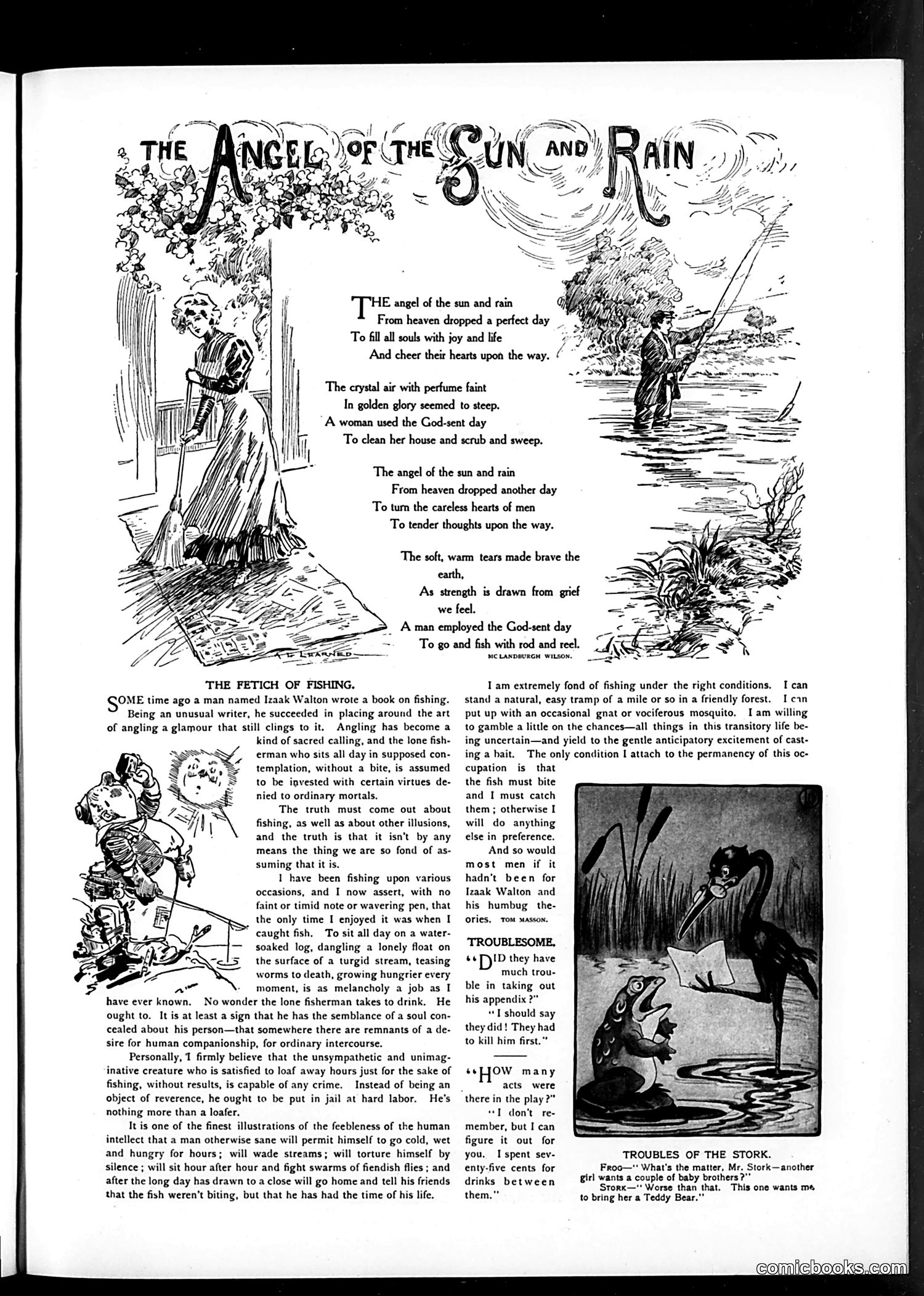
This page contains two distinct pieces: **"The Angel of the Sun and Rain"** (top): A sentimental poem with decorative illustrations about divine comfort during hardship. It reflects late 19th/early 20th-century sentimentalism and offers no apparent satire—it's sincere inspirational verse. **"The Fetich of Fishing"** (bottom): A humorous essay mocking fishing as a pastime. The author argues that fishermen are delusional—they endure discomfort, boredom, and failure while convincing themselves they're engaged in noble sport. The satire targets the peculiar self-deception of hobbyists who rationalize unpleasant experiences as worthwhile. Two small cartoons ("Troublesome" and "Troubles of the Stork") accompany dialogue, though their specific satirical targets are unclear from this excerpt. The page demonstrates Judge's mix of sentimental content and gentle social satire.
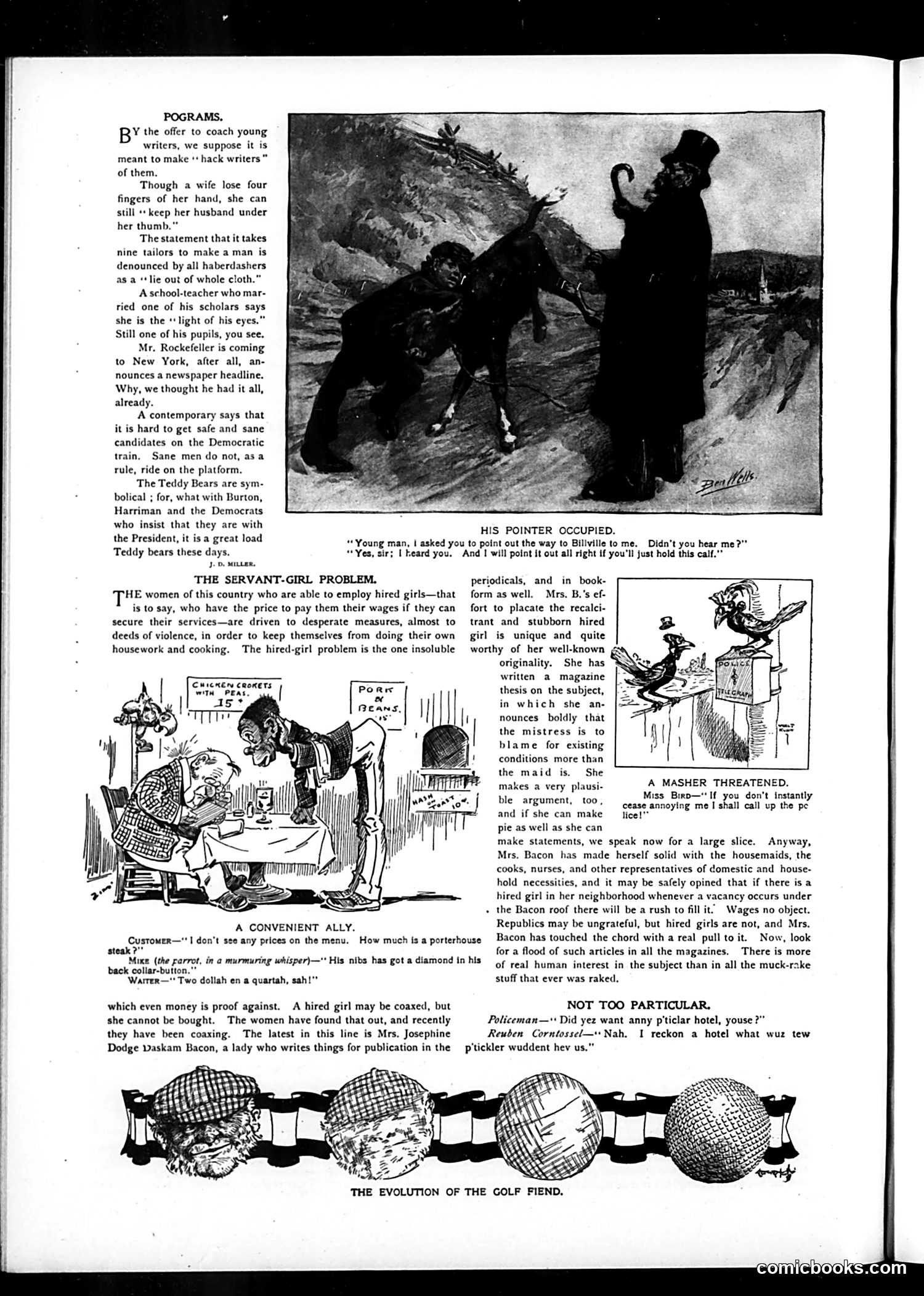
The page contains three distinct satirical pieces: **"Pograms"** (top): References antisemitic pogroms, mocking political figures. The text mentions Rockefeller and the Democratic party's presidential candidates, suggesting contemporary 1900s political criticism. **"The Servant-Girl Problem"** (middle): Satirizes the common complaint about domestic servants being unreliable. The cartoon shows employers frustrated with hired girls who demand better wages and conditions. The satire targets employers' unreasonable expectations while maids seek fair treatment—a genuine labor issue of the era. **"A Convenient Ally"** (small cartoon): A brief exchange about a diamond, likely criticizing wealthy pretension. **"No Particulars"** (bottom left): Brief dialogue mocking a hotel experience. **"The Evolution of the Golf Fiend"** (bottom): Shows golf ball designs' progression, satirizing the growing golf obsession among American men. The page reflects early 1900s American social anxieties about labor, wealth, and leisure.
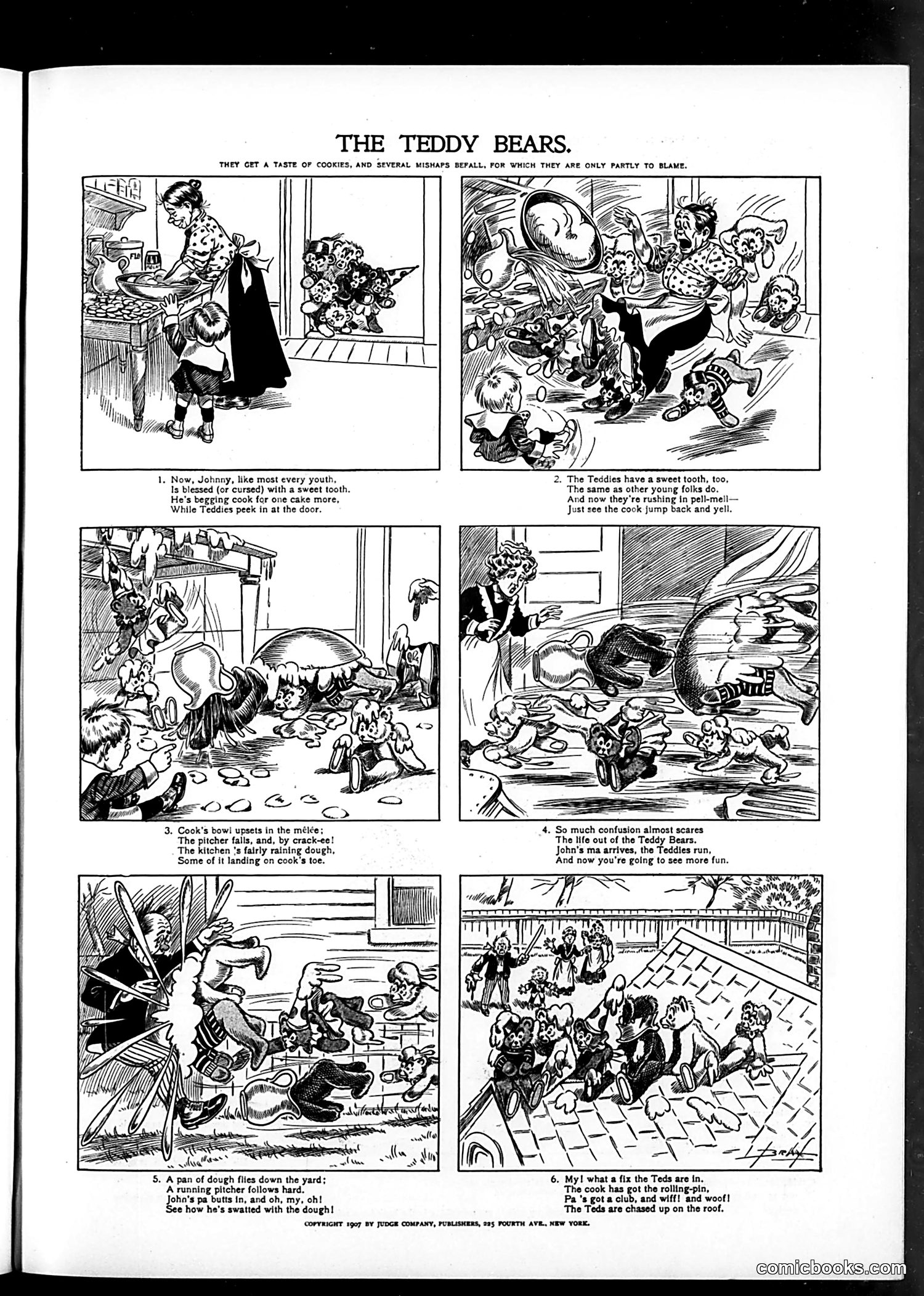
This is a humorous children's comic strip rather than political satire. It depicts the chaos that ensues when teddy bears—likely referencing the popular "teddy bear" toys named after President Theodore Roosevelt—invade a kitchen and household. The narrative shows: a mother and child discovering the bears, the bears ransacking the kitchen, overturning bowls and scattering dough, a cook being frightened, and finally the bears being chased across a rooftop. The humor derives from the bears' mischievous behavior causing domestic mayhem. The strip appears designed for family entertainment in Judge magazine, playing on the contemporary popularity of teddy bears as toys. There's no apparent political commentary—it's simply comedic chaos presented through sequential panels.
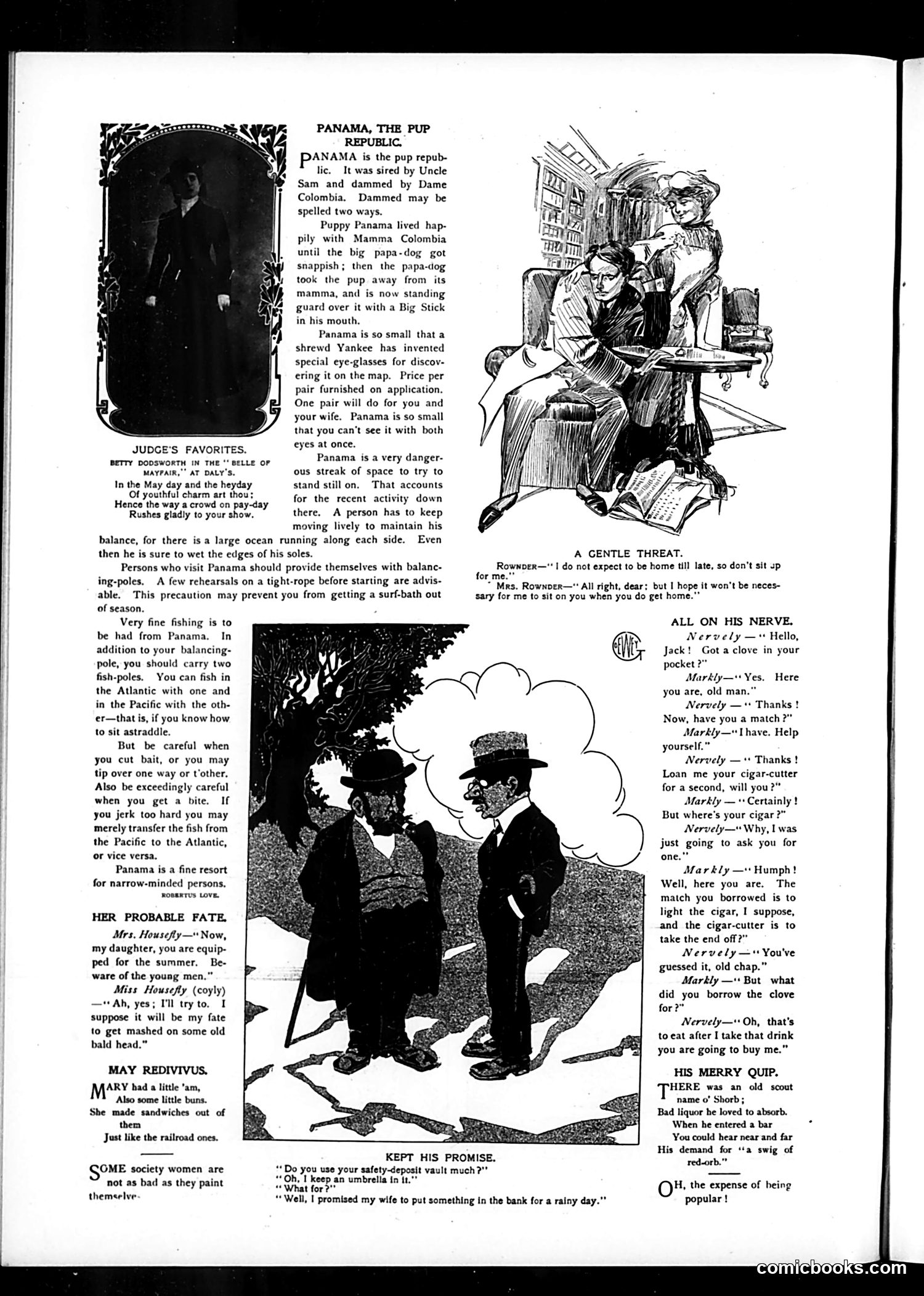
This page from *Judge* contains satirical commentary on Panama, presented through humorous exaggeration typical of early 20th-century American humor. **"Panama, the Pup Republic"** is the main satirical piece. It mocks Panama as a newly independent nation created through U.S. intervention. The language—"sired by Uncle Sam" and "dammed by Dame Colombia"—references America's role in Panama's 1903 separation from Colombia. "Uncle Sam" with his "Big Stick" alludes to Theodore Roosevelt's imperialist foreign policy doctrine. The jokes about Panama's tiny size and precarious geography (surrounded by oceans, metaphorically impossible to balance on) satirize both the nation's vulnerability and American anxiety about controlling this strategically important territory for the canal project. The remaining content consists of lighter comedic vignettes about society figures and relationships—typical Judge filler material with no apparent political significance.
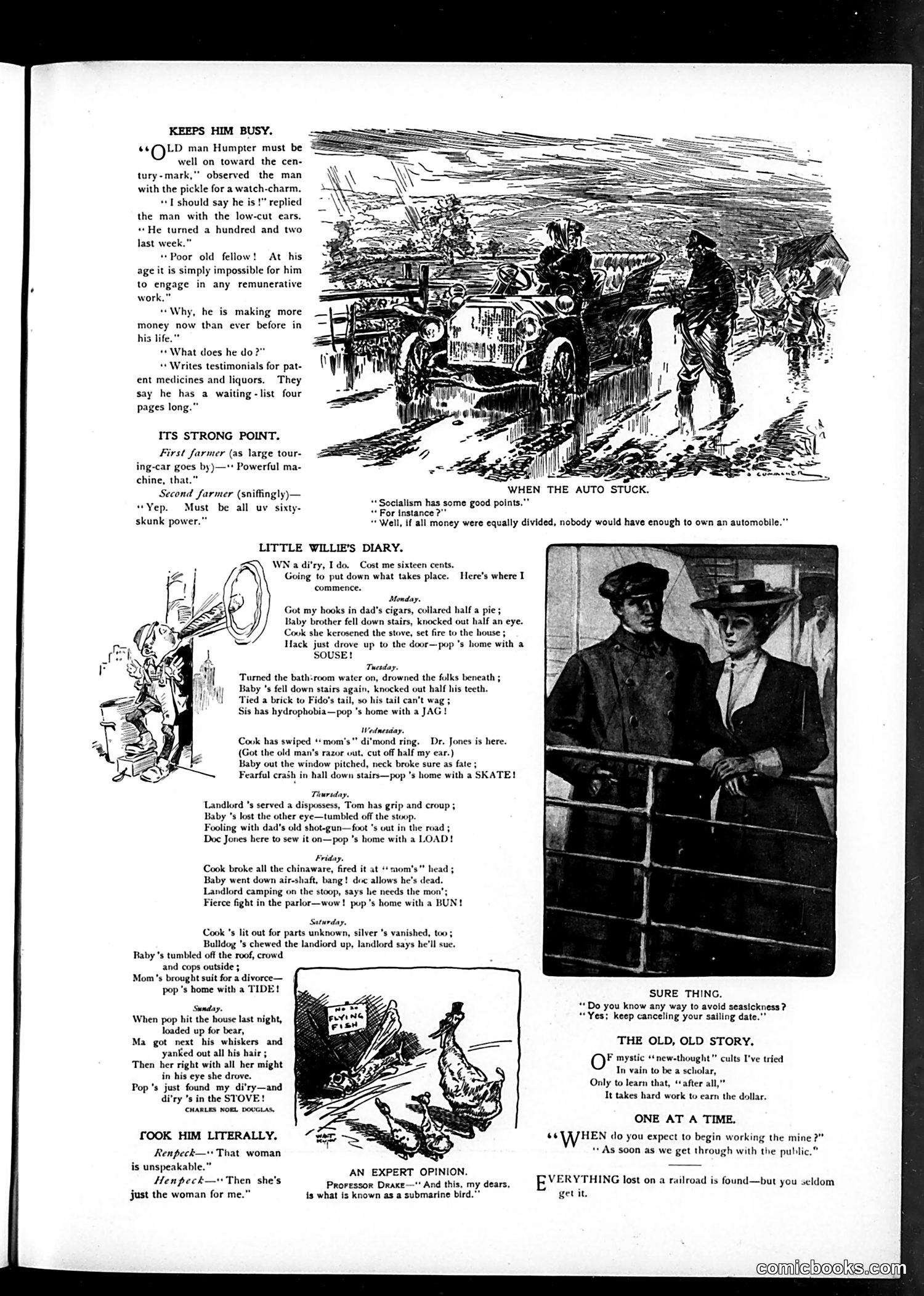
This page contains several satirical pieces mocking early 20th-century American life: **"Keeps Him Busy"** ridicules the elderly and patent medicine industry—an elderly man named Humpter makes money writing false testimonials for dubious medicines and liquors, exploiting his age as credibility. **"When the Auto Stuck"** satirizes wealth inequality, suggesting that if money were divided equally, no one could afford automobiles anyway—a dig at both automobiles as luxury goods and economic disparity. **"Little Willie's Diary"** is darkly comic domestic chaos: a child chronicles weekly disasters (fires, drowning, broken bones, lost eyes, parental drunkenness marked as "SOUSE," "JAG," "SKATE," "LOAD," "BUN," "TIDE") where each day ends with father arriving home intoxicated. The humor relies on exaggerated slapstick violence and alcoholism—period comedic conventions now recognized as disturbing. The remaining items are brief jokes about marriage ("Henpeck"), seasickness, hard work, and railroad lost-and-found—typical light humor of the era.
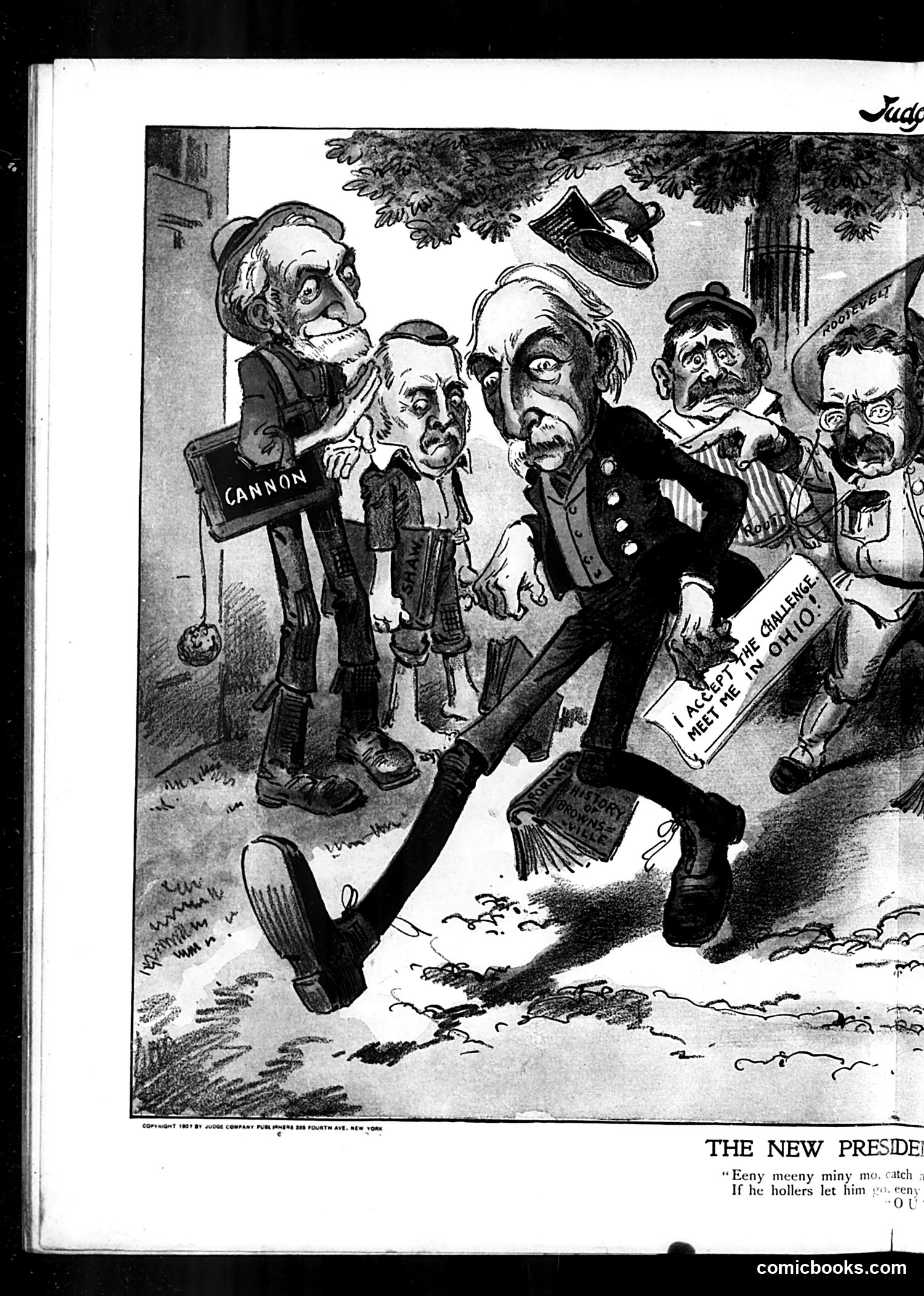
This is a satirical cartoon titled "The New President," showing a figure being juggled or tossed around by several caricatured men in military and formal dress. The image appears to reference the nursery rhyme "Eeny, meeny, miny, moe" (partially visible in the caption), suggesting the new president is being treated as a plaything or is insignificant. The cartoon satirizes political manipulation—depicting military or governmental figures controlling a weak or powerless president. Without the date visible, the specific historical context is unclear, but the imagery suggests criticism of institutional forces (possibly military leaders or political machines) wielding actual power while a figurehead president holds the title. The exaggerated caricatures and physical comedy emphasize the powerlessness of the presidency in this satirist's view.
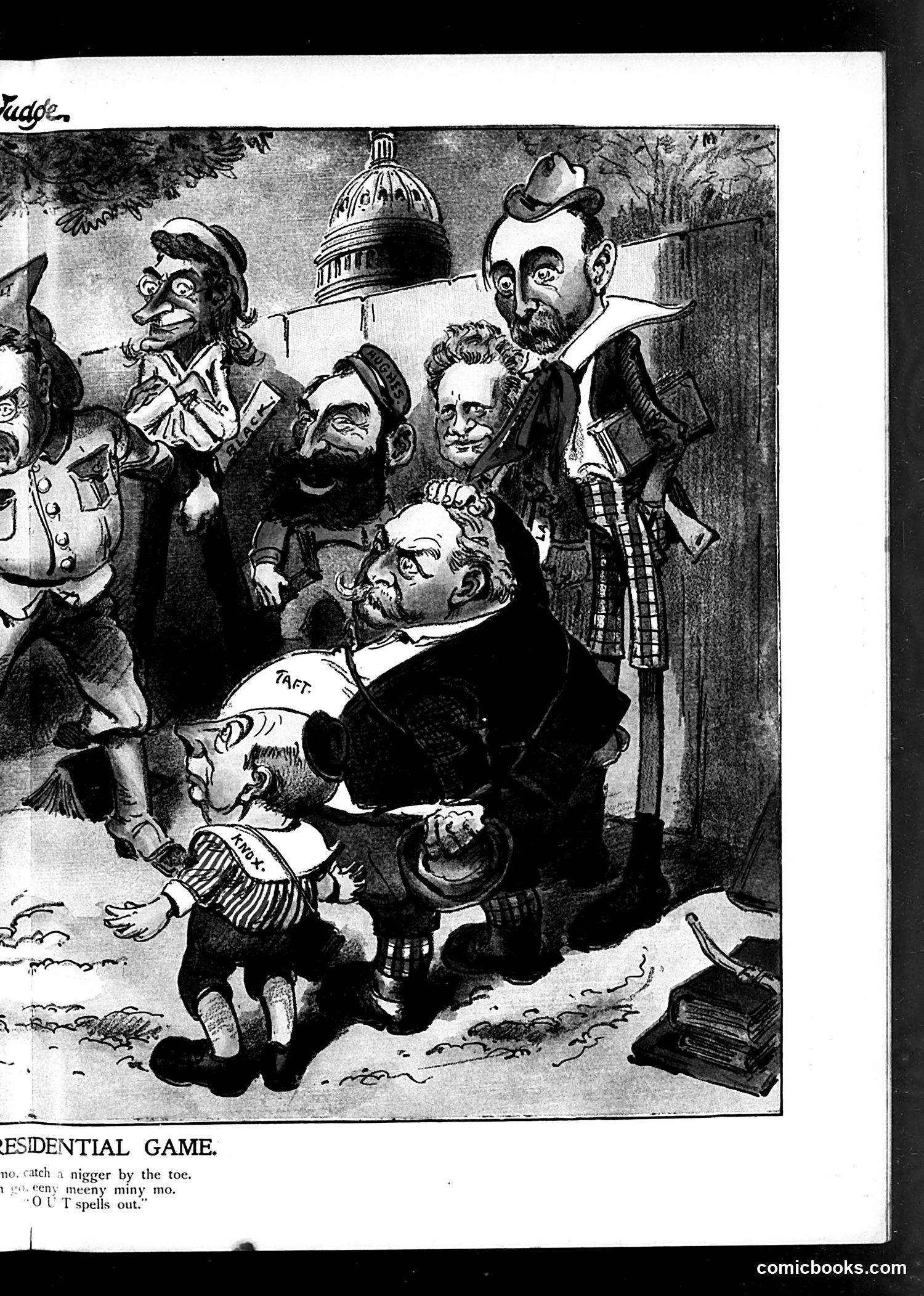
This political cartoon satirizes a presidential election through the children's counting-out rhyme "Eeny, meeny, miny, moe." The Capitol building appears in the background, establishing the government setting. The cartoon depicts several caricatured political figures gathered around, with one seated figure labeled "TAFT" being pointed at during the counting process. The satire suggests the presidential selection process is reduced to child's play—random chance rather than serious deliberation. Without being able to definitively identify all figures or the specific election date, this appears to critique how presidential candidates are chosen, implying the process is arbitrary or absurd. The juvenile rhyme contrasts sharply with the gravity of selecting a national leader, which was likely Judge magazine's intended satirical point.
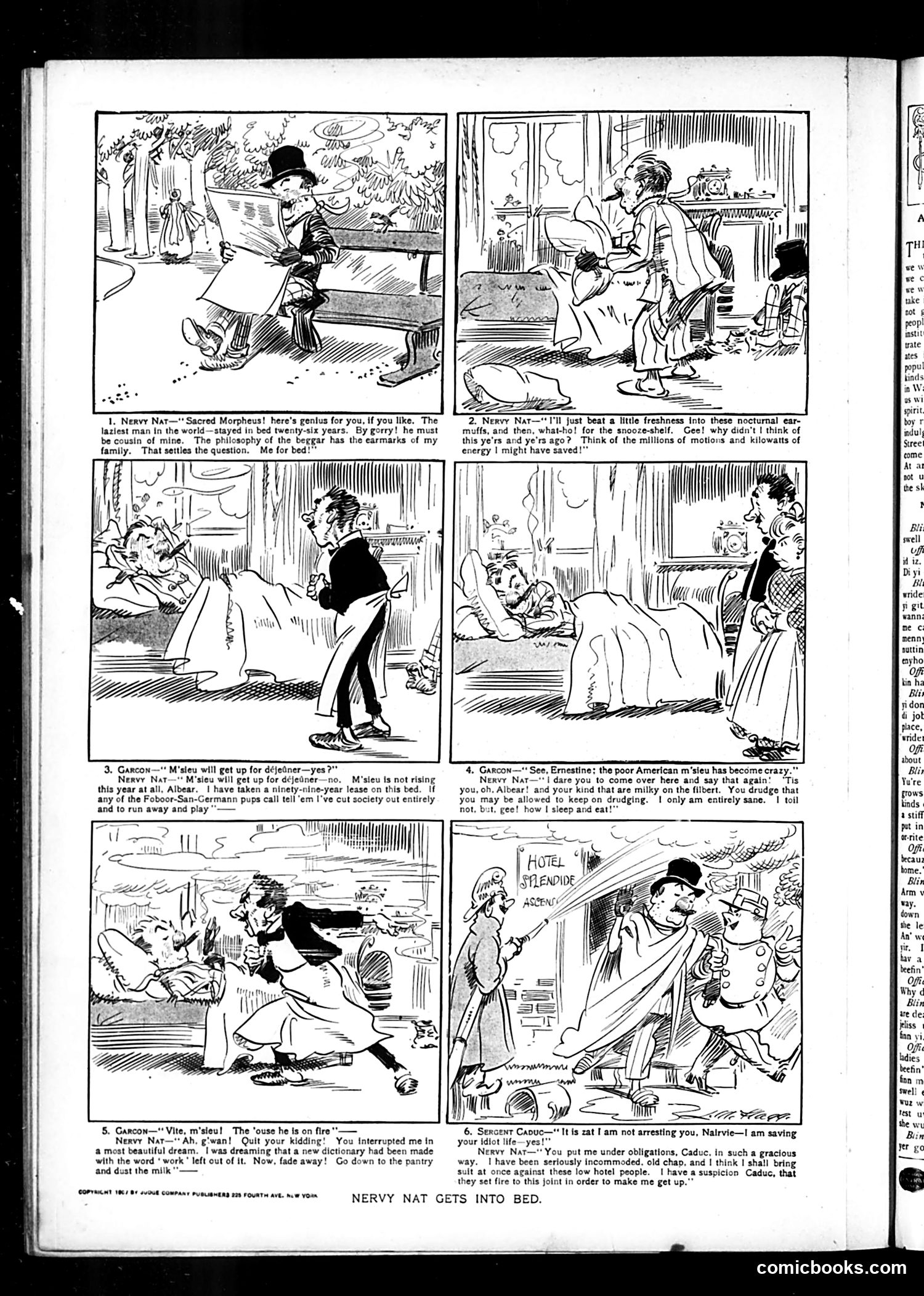
This comic strip satirizes extreme laziness through the character Nervy Nat, a wealthy American man who has leased a bed for 99 years and refuses to leave it under any circumstances—not even for meals, social obligations, or a hotel fire. The humor targets both Nat's pathological idleness and the French servants' exasperation with him. Nat speaks in affected pseudo-French slang ("m'sieu," "gorry"), suggesting he's an American abroad. The satire critiques privileged leisure culture: Nat celebrates avoiding "work" entirely and dreams of dictionaries without that word. The final panel, where a police sergeant rescues him from the burning hotel only to have Nat threaten legal action, peaks the absurdity—the lazy American views even rescue as an imposition and blames his hosts for the fire, assuming they set it deliberately to force him from bed. The comic reflects early-1900s American anxieties about idle wealth and the "ugly American" abroad.
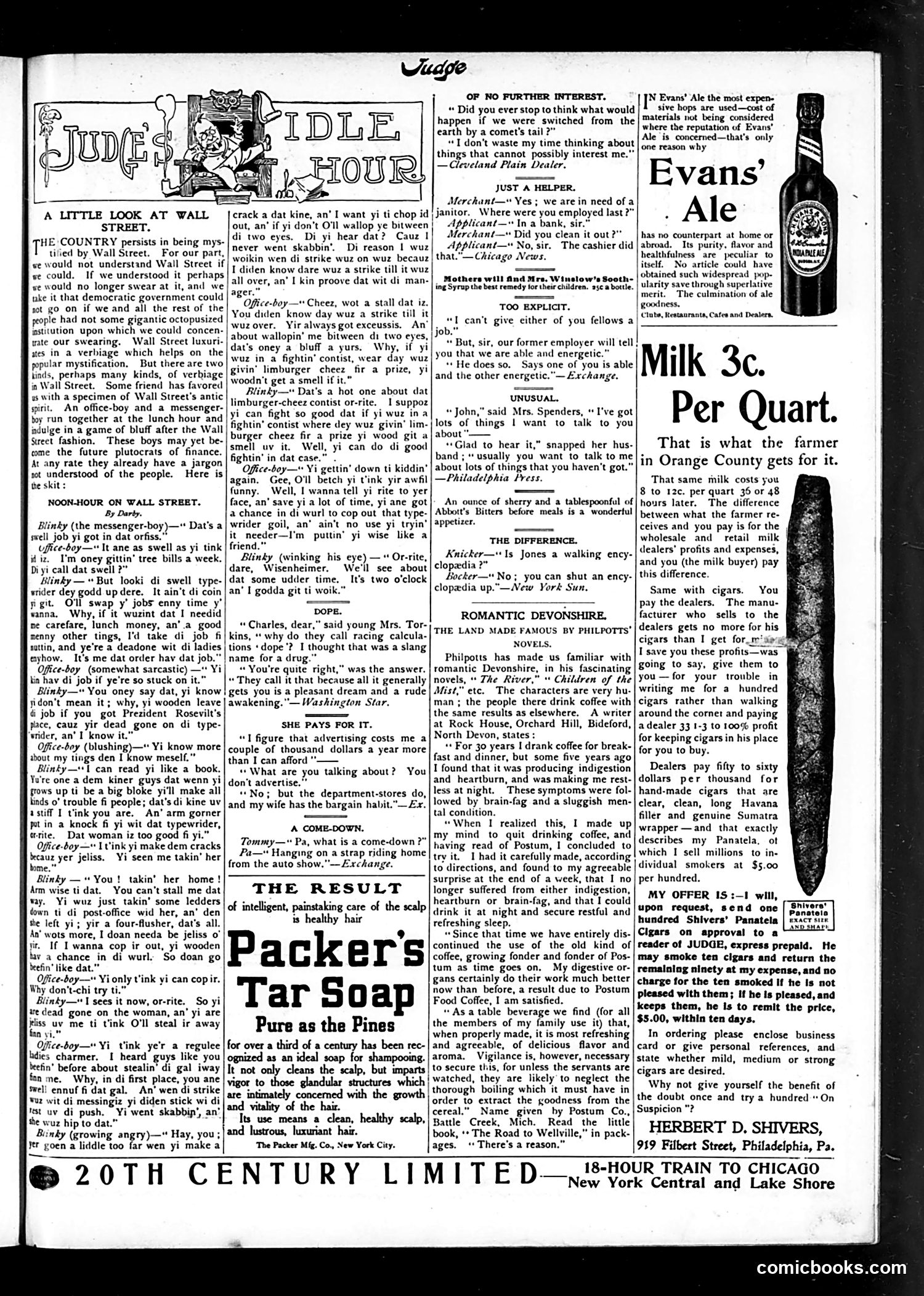
This page contains a satirical article titled "A Little Look at Wall Street" that mocks Wall Street's deliberately obscure jargon and mystifying language. The piece presents a dialogue between two young office workers—a messenger boy and an office boy—who engage in boastful "bluff" using exaggerated slang and street dialect to mimic how Wall Street professionals conduct business. The satire's point: Judge suggests that Wall Street insiders deliberately use incomprehensible jargon to confuse the public and maintain their power, while even lowly office workers ape this pretentious style. By reproducing their dialogue in heavy phonetic dialect, the magazine ridicules both the financial establishment's opacity and working-class attempts to mimic elite behavior. The broader context reflects early 20th-century American distrust of Wall Street's mysterious operations and power over the economy. The page also includes various advertisements and other brief humor pieces typical of Judge's format.
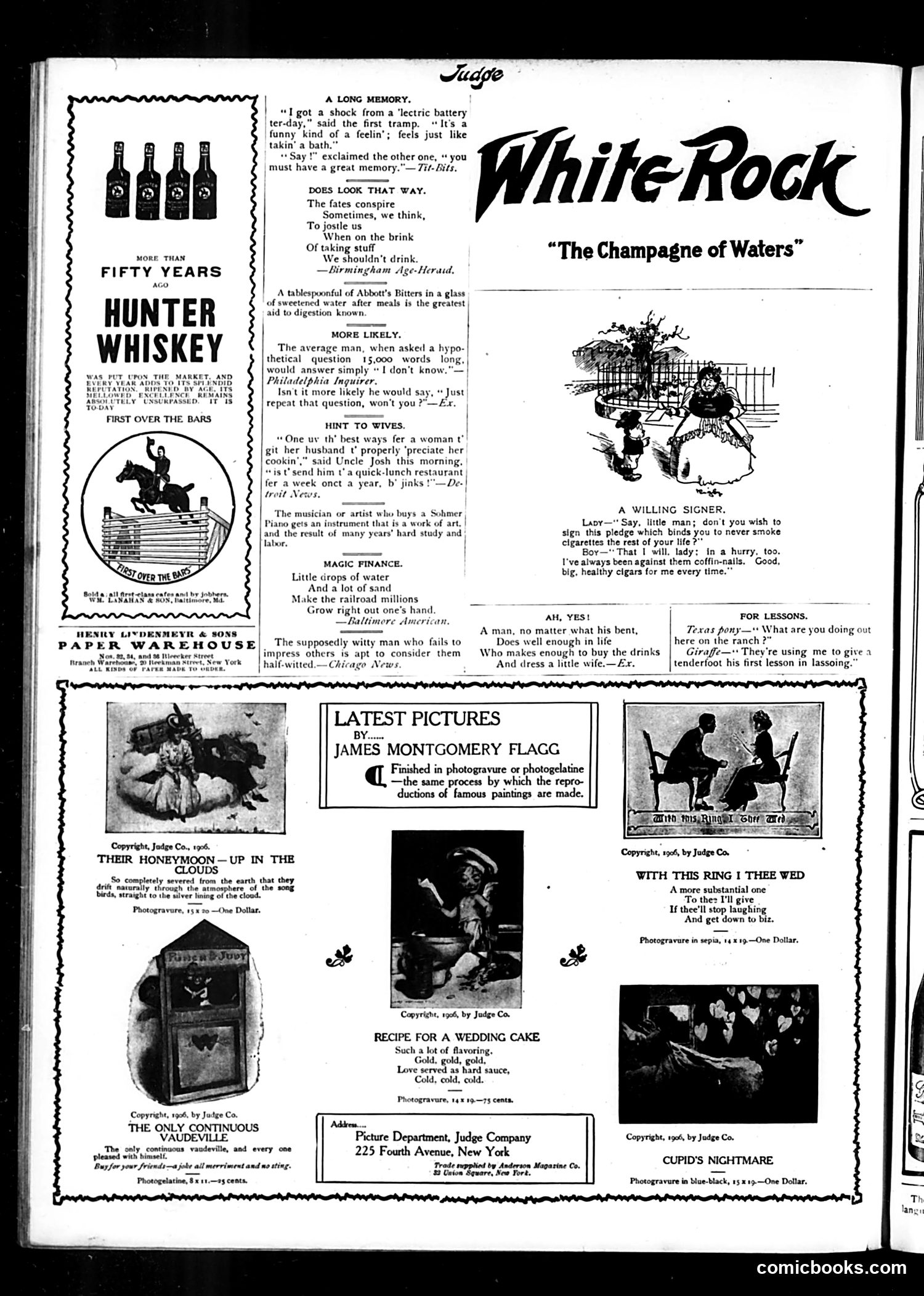
This page from Judge (circa 1906) mixes short humor pieces with advertisements and art reproductions. The cartoons and jokes reflect early 1900s American social attitudes: **Short Jokes:** Include working-class humor (tramps discussing electric shocks), domestic stereotypes (wives improving husbands through deprivation), and gentle mockery of masculine pretension (the "tenderfoot" learning to lasso with a giraffe's help). **Advertisements:** Hunter Whiskey and White Rock mineral water dominate, selling products through appeals to tradition and health—common marketing for the era. **Art Reproductions:** James Montgomery Flagg's photogravure images address romance and marriage with titles like "Cupid's Nightmare" and "With This Ring I Thee Wed," suggesting satirical commentary on matrimony as obligation rather than joy. The overall tone is lighthearted social satire typical of Judge—poking fun at marriage, drinking, masculine vanity, and class differences without serious political intent.
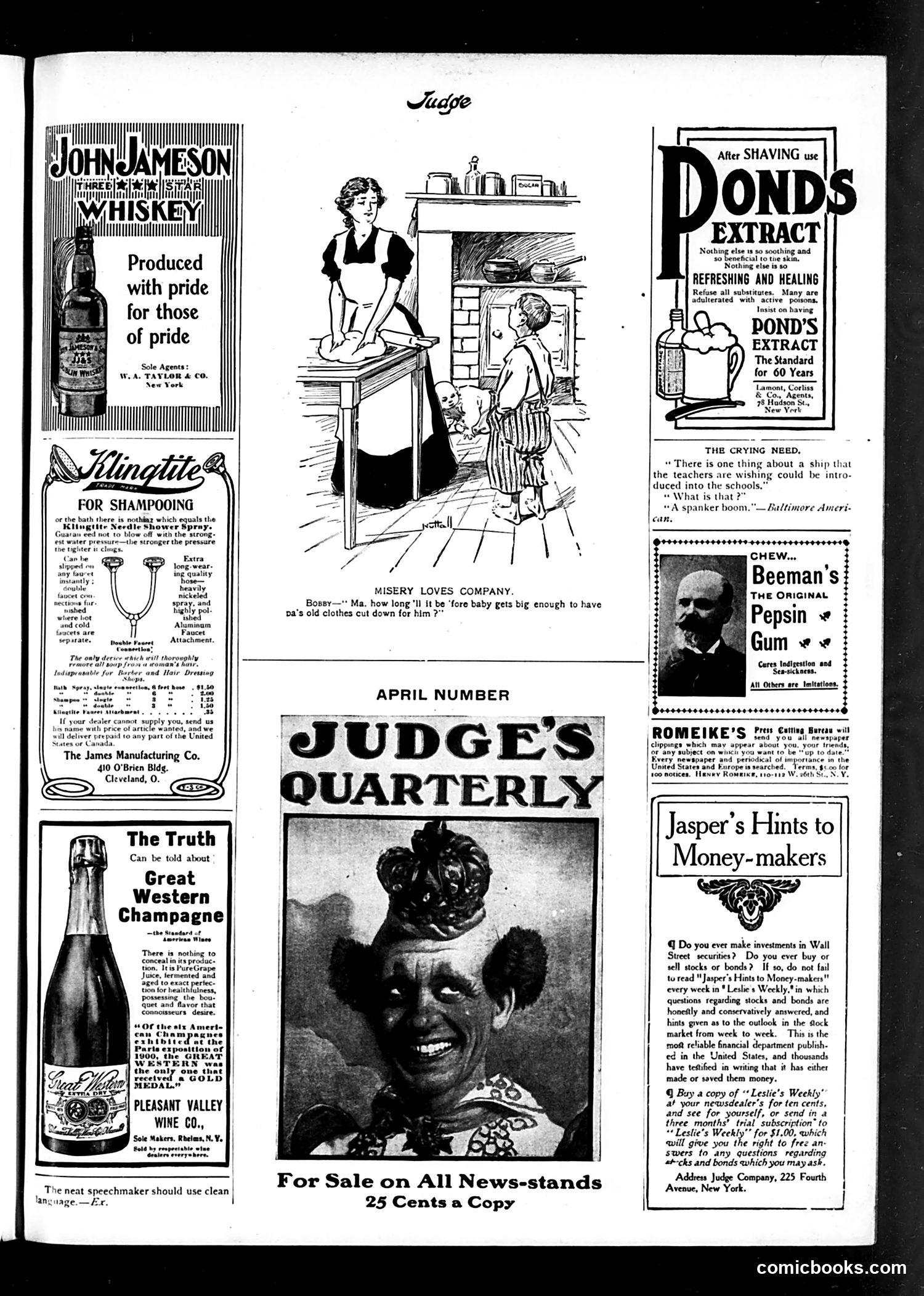
This is primarily a **title/cover page** for Judge's April issue, not a political cartoon page. The central image shows a grotesque caricatured face with exaggerated features—likely a generic "fool" or simpleton figure typical of Judge's satirical visual style, though the specific target is unclear without additional context. The page is **dominated by advertisements** for period products (whiskey, shampoo, champagne, extract, gum) mixed with small humor items. One joke references introducing a "spanker boom" (ship terminology) to schools as discipline. Another depicts class anxiety: a poor mother asks how long until her baby grows big enough to wear her husband's hand-me-downs. The "Jasper's Hints to Money-makers" section advertises Leslie's Weekly's financial advice column, suggesting investment guidance was a popular feature. **Overall**: This is a commercial/advertising-heavy publication page with minimal satirical content—typical of early 1900s magazine layout mixing editorial matter with revenue-generating ads.
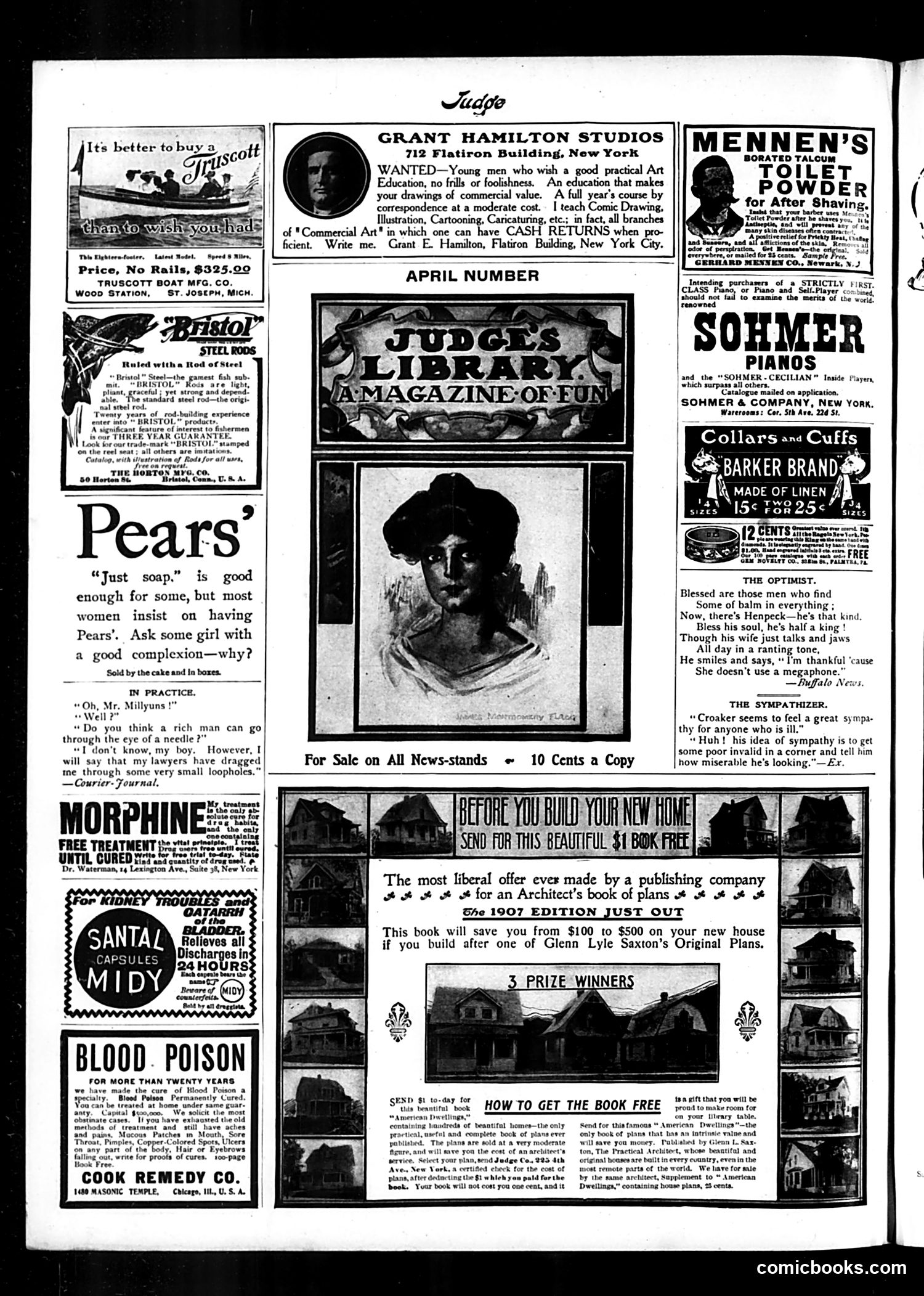
This page is primarily **advertising and filler content** rather than satirical cartoons. The dominant feature is a large advertisement for Glenn Lyle Saxton's 1907 architectural house-plan book, occupying the bottom half. The small editorial content includes two brief humorous items: "The Optimist" (about a henpecked husband who remains cheerful) and "The Sympathizer" (mocking false sympathy), both generic joke fillers typical of the era. Notable advertisements include Grant Hamilton's art correspondence school (teaching commercial art and cartooning), Mennen's talcum powder, Sohmer pianos, and various patent medicines—morphine treatment, blood poison cures, and kidney remedies. These ads reflect early 1900s pharmaceutical marketing before regulation, when dubious health claims were commonplace. The page lacks political satire or significant cultural commentary, serving primarily as a revenue vehicle through advertisements aimed at middle-class readers seeking self-improvement education, home construction guidance, and proprietary medicines.
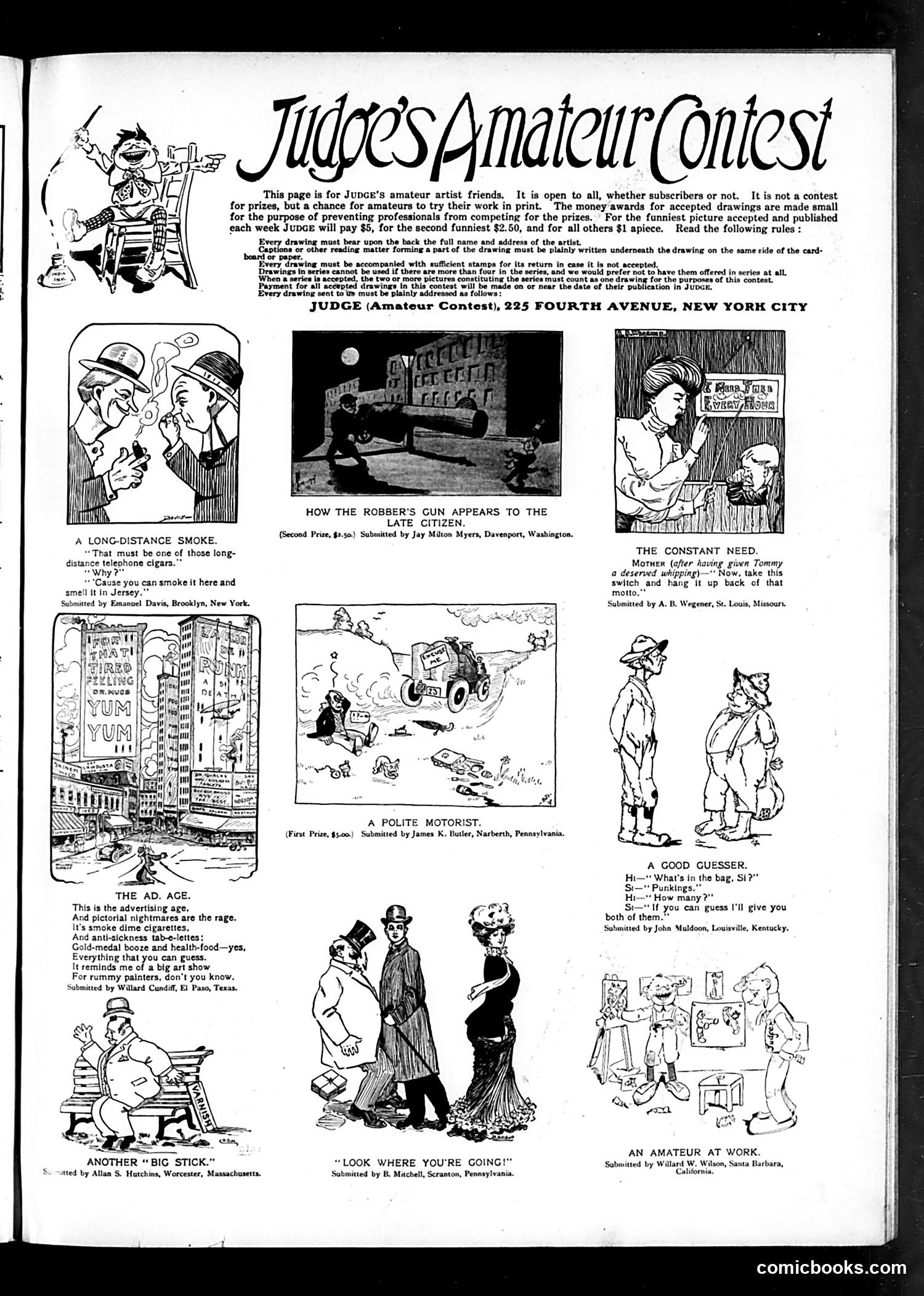
This page showcases Judge magazine's weekly amateur cartoon competition, offering small cash prizes ($5 for best, $2.50 for second, $1 for others) to encourage amateur artists. The cartoons reflect early 20th-century American humor and social commentary: - **"Long-Distance Smoke"**: jokes about poor quality cigars and regional differences (New York vs. New Jersey) - **"The Ad Age"**: satirizes the explosion of advertising and commercialism, comparing cluttered ads to bad art exhibitions - **"Polite Motorist"**: depicts early automobile culture and traffic dangers - **"Constant Need"**: domestic humor about corporal punishment (switching/spanking children) - **"Look Where You're Going"**: depicts flirtation and distracted pedestrians - **"Robber's Gun"**: depicts crime/violence from victim's perspective The cartoons are gentle, domestic satire typical of mainstream 1910s-era magazines—focused on everyday life, advertising culture, new technologies (automobiles, telephones), and family dynamics rather than political issues.
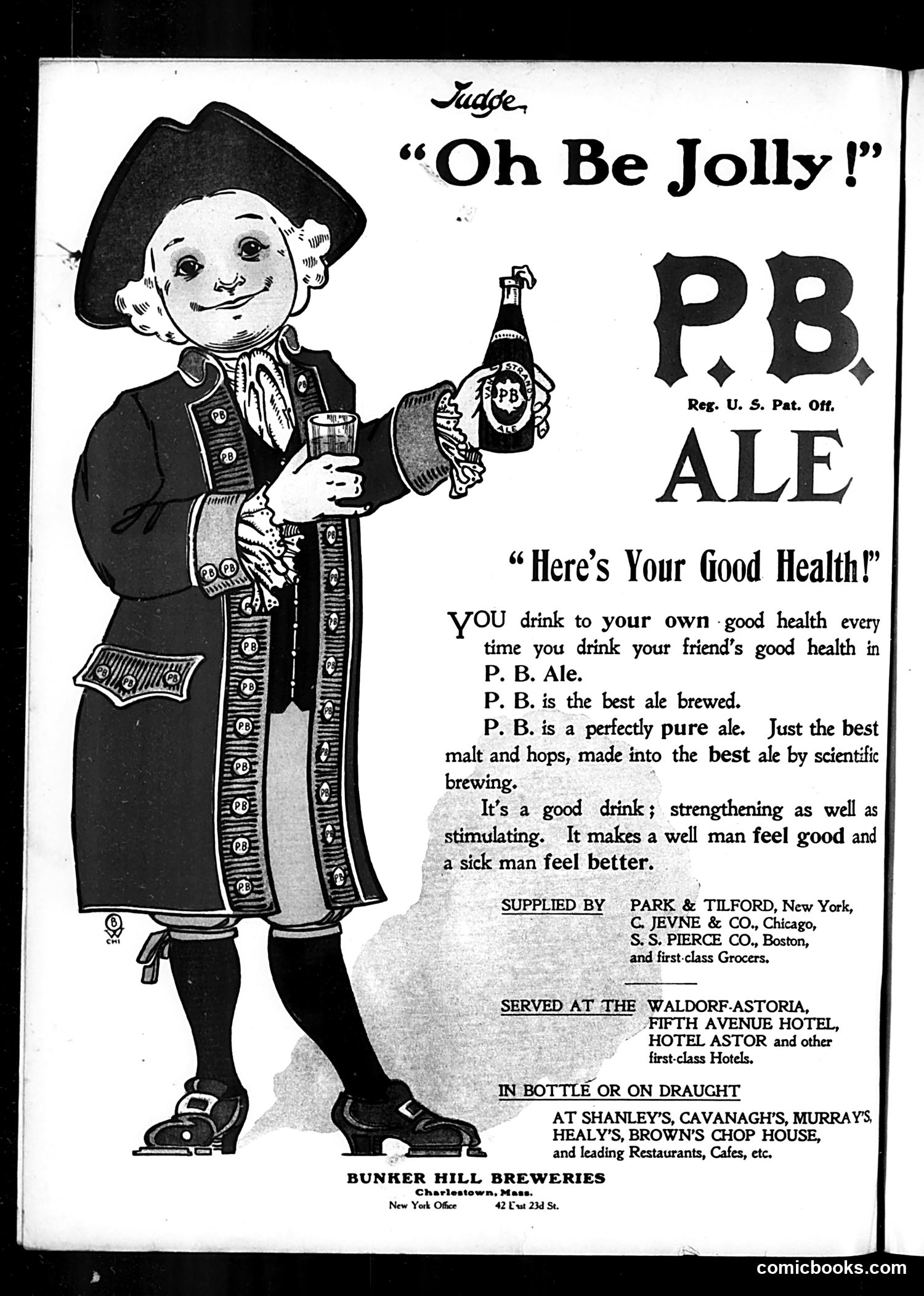
This is primarily a **full-page advertisement**, not political satire. It advertises P.B. Ale from Bunker Hill Breweries (Charlestown, Massachusetts), appearing in *Judge*, a satirical magazine. The cartoon depicts a jolly, rotund figure in colonial Dutch dress holding a beer bottle and glass—a mascot character personifying the ale brand. The "Oh Be Jolly!" slogan and illustration are pure marketing: the character embodies convivial drinking culture. The ad copy claims health benefits ("strengthening," making "a sick man feel better"), which reflects pre-Prohibition era advertising practices when alcoholic beverages were marketed with quasi-medicinal claims. Distribution is listed at upscale hotels (Waldorf-Astoria, Hotel Astor) and restaurants, positioning P.B. Ale as a premium product. This represents **early 20th-century commercial advertising** rather than editorial commentary—using Judge's pages for paid promotion to the magazine's affluent readership.