
A complete issue · 16 pages · 1907
Judge — February 23, 1907
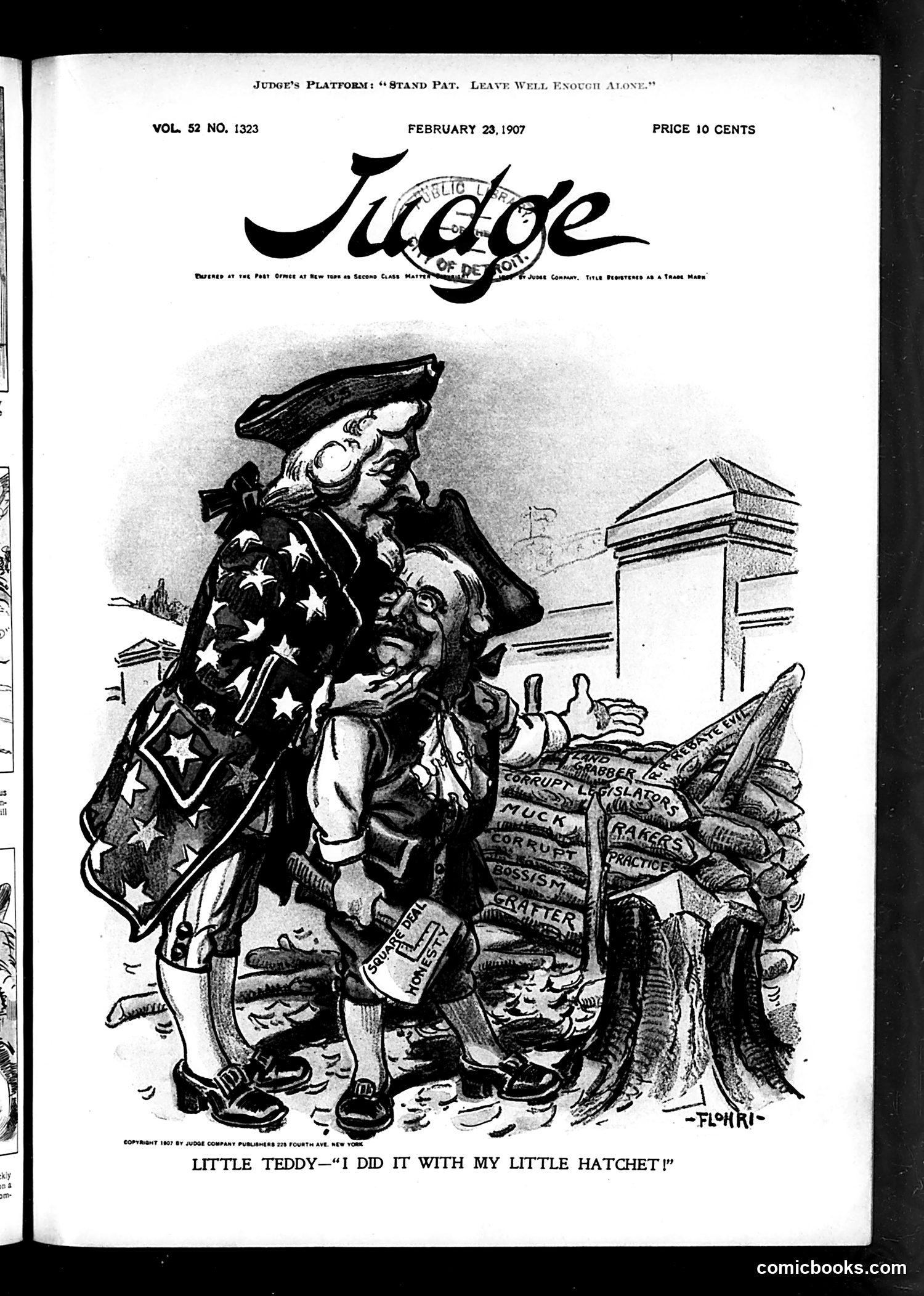
This 1907 *Judge* cartoon satirizes President Theodore Roosevelt's aggressive trustbusting policies. The figure in the star-spangled cloak represents Uncle Sam or America itself, while the smaller figure ("Little Teddy") is Roosevelt, depicted as a child wielding a hatchet—referencing the George Washington cherry-tree legend. The pile of wood at their feet bears labels reading "MUCK," "GRAFT," "BOSSISM," "PRIVILEGE," and other terms representing corporate corruption and political abuses. Roosevelt's "hatchet" represents his lawsuits and regulatory actions against monopolies and industrial trusts. The cartoon's title suggests Roosevelt is boasting about his accomplishments in "chopping down" corruption, though the satirical tone implies *Judge* may have viewed his methods as overly aggressive or theatrical.
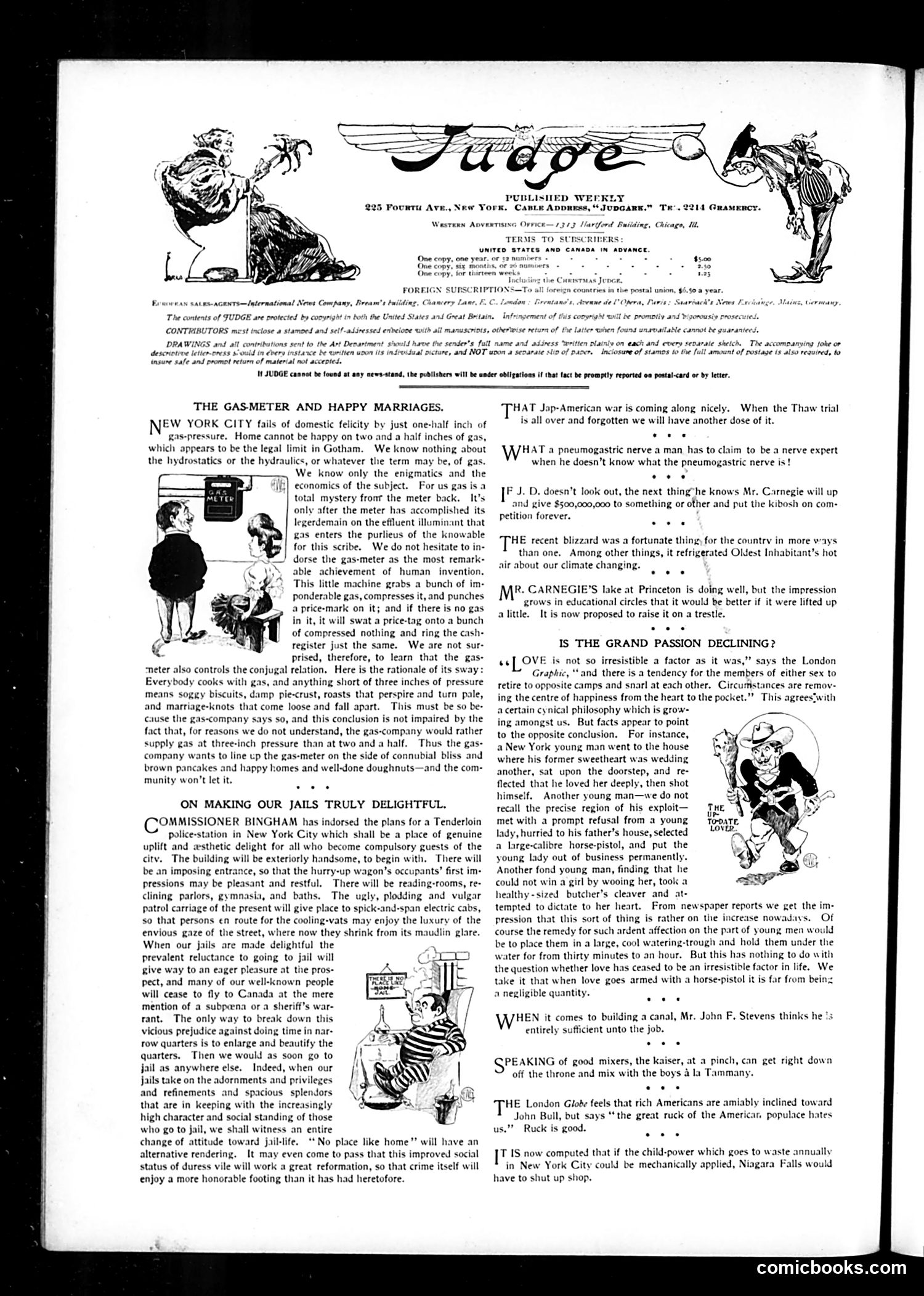
This page combines editorial commentary with satirical illustrations. The main articles mock contemporary social issues: **"The Gas Meter and Happy Marriages"** ridicules New York's gas consumption limits and their impact on domestic life, using a humorous illustration of a couple struggling with rationing. **"On Making Our Jails Truly Delightful"** sarcastically supports Commissioner Bingham's plan to beautify prisons with aesthetic improvements—the satire suggests this is misguided priorities when prisons should focus on punishment, not comfort. The scattered short quips target various topics: a Jap-American war prediction, Carnegie's Princeton lake, and the "grand passion" supposedly declining among young New Yorkers. The cartoons use exaggeration and irony to critique government policies and social trends. Without specific dates visible, the gas rationing suggests WWI-era America, though exact context remains unclear.
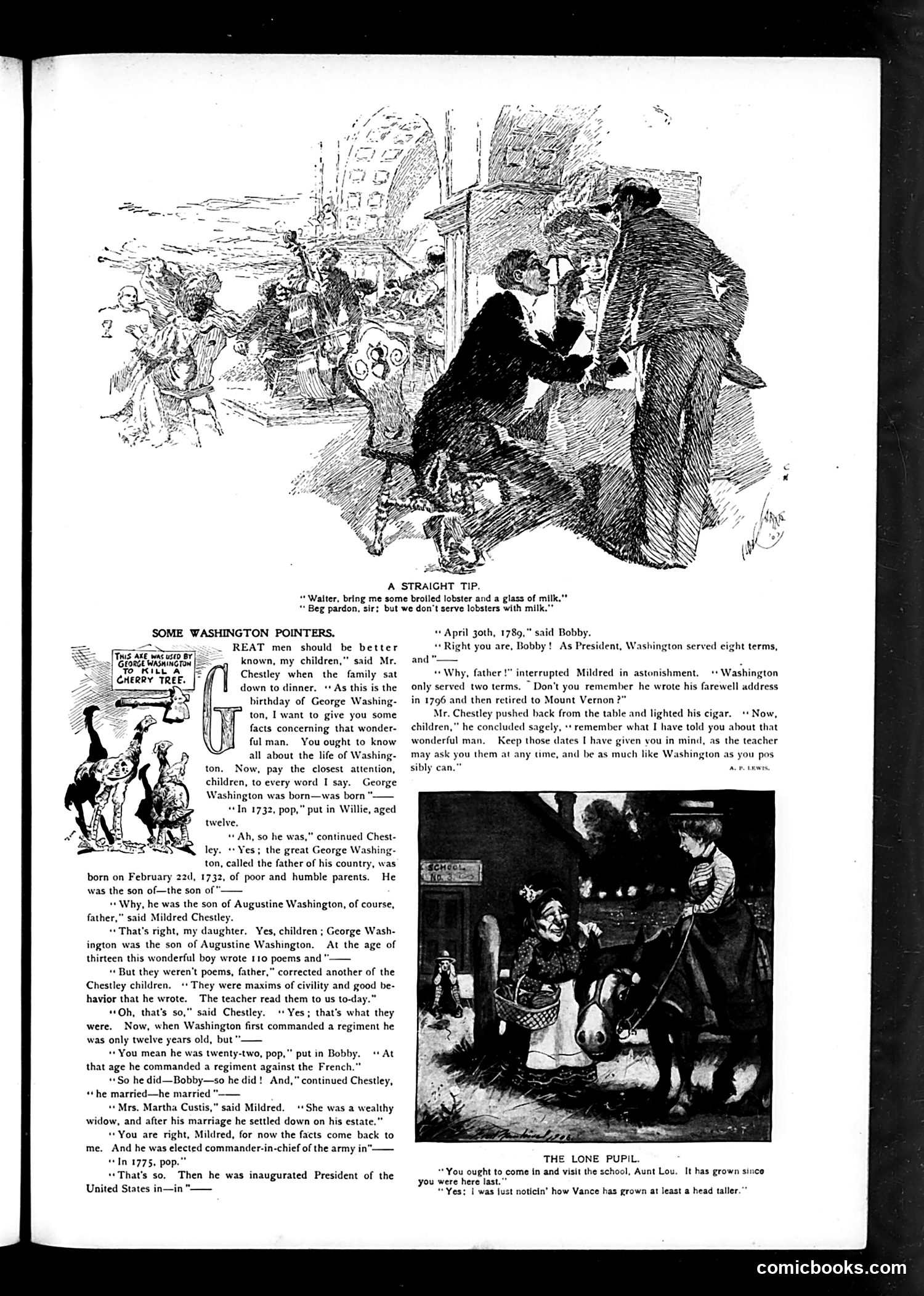
This Judge page presents a dialogue about George Washington's life and achievements, apparently timed to his birthday (February 22). The main cartoon shows a street scene where a man (likely representing a teacher or authority figure) lectures children about Washington's humble origins, military service, and presidency. The satire appears to target how Washington's biography was being presented to children—emphasizing his legendary status while glossing over complex details. The text mocks overly romanticized accounts, with characters correcting exaggerations (like the cherry tree story). A secondary illustration labeled "The Lone Pupil" shows a classroom scene, likely satirizing educational methods or student attention spans when learning patriotic history. The overall point seems to critique how American civic education simplified and mythologized historical figures.
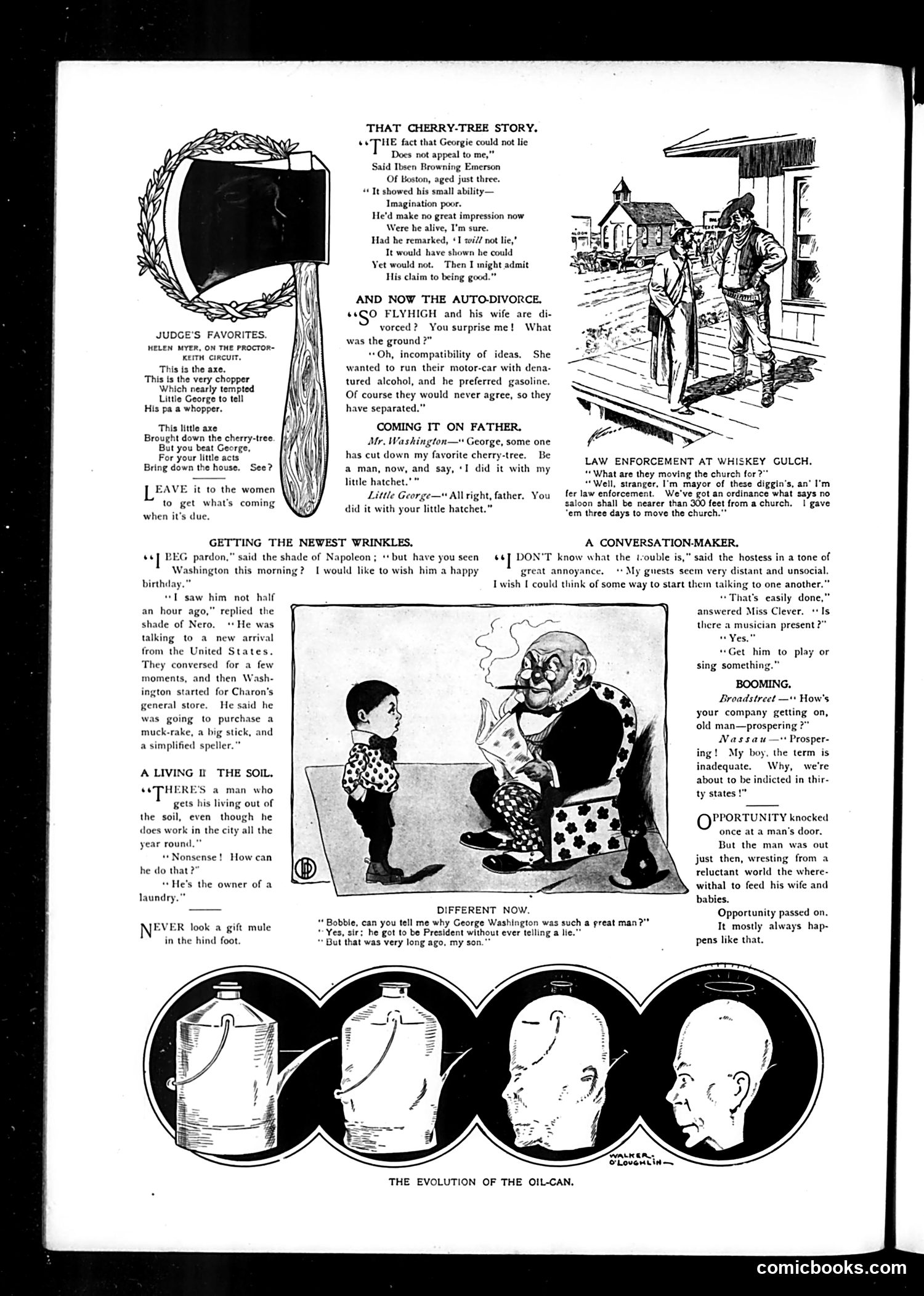
This satirical page contains several unrelated humor pieces typical of early 20th-century Judge magazine: **"That Cherry-Tree Story"** mocks the famous (likely apocryphal) anecdote of young George Washington confessing to cutting down his father's cherry tree, suggesting modern children lack such moral imagination. **"And Now the Auto-Divorce"** satirizes marital discord caused by incompatible automobile preferences—one spouse wanting a motorcar with alcohol fuel, the other gasoline. **"The Evolution of the Oil-Can"** presents four progressive drawings of oil cans, though the satirical point is unclear from the image alone. Other brief humor pieces include "Judge's Favorites," "Getting the Newest Wrinkles," and "A Conversation-Maker," typical of the magazine's miscellaneous joke format. The content reflects early automobile-era anxieties and nostalgia for older American values.
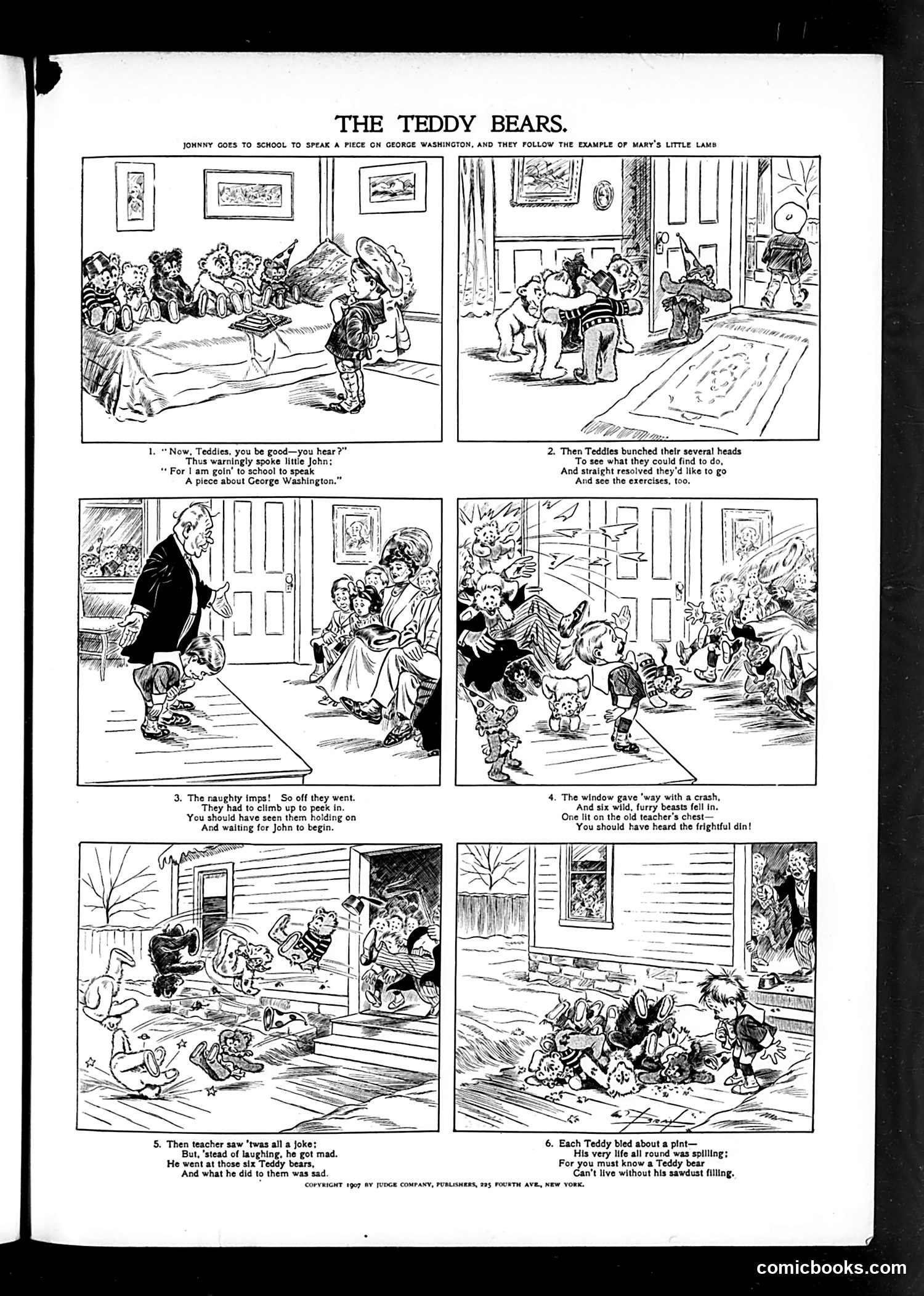
This is a humorous children's story comic strip titled "The Teddy Bears," published by Judge Company (copyright 1907). The narrative follows stuffed bear toys that come to life, mimicking the then-popular "Mary's Little Lamb" format. The story appears to be a gentle satire of early-1900s schooling and childhood behavior rather than political commentary. Johnny is assigned to speak about George Washington at school, and the teddy bears "follow the example" by becoming mischievous—climbing through windows, disrupting a classroom, and creating havoc with a schoolteacher and students. The humor targets typical childhood chaos and unruly behavior in educational settings, reflecting period attitudes toward discipline and decorum in schools.
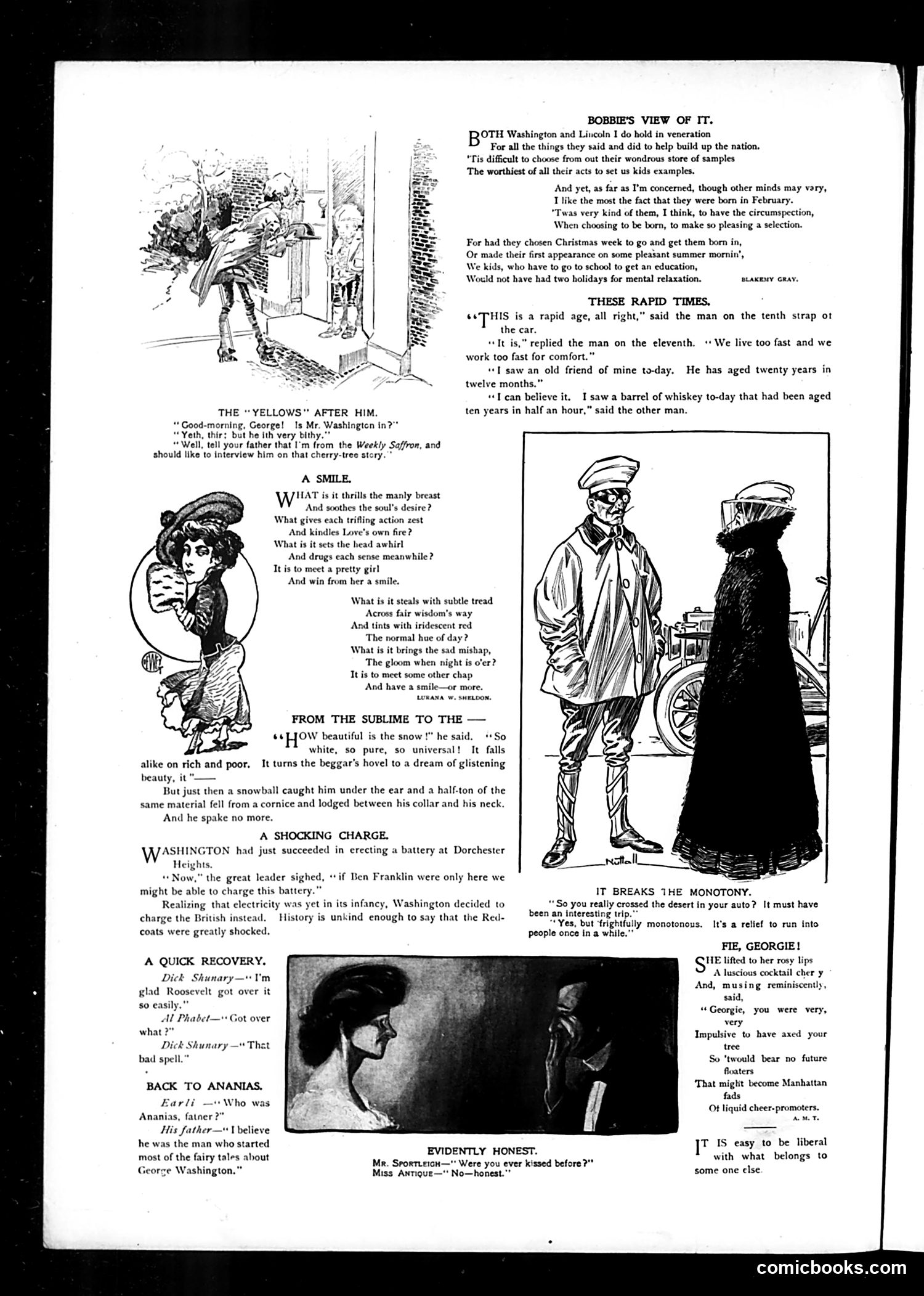
This page from *Judge* magazine uses satire to comment on early 20th-century American life and politics. **"Bobbie's View of It"** mocks the veneration of Washington and Lincoln by presenting a child's refreshingly honest perspective: he appreciates them primarily because their February births create school holidays. The satire critiques how Americans mythologize historical figures while missing practical concerns. **"These Rapid Times"** satirizes modern anxieties about industrialization and speed—men on a crowded streetcar joke about aging rapidly and whiskey being artificially aged, capturing contemporary fears about life moving too fast. **"The 'Yellows' After Him"** appears to mock sensationalist "yellow journalism" (represented by "Weekly Saffron") pursuing Washington for interviews about the cherry-tree legend—suggesting media obsession with trivial historical anecdotes. **Other brief sketches** address romance, nature romanticization interrupted by reality, and courtship social norms. The page reflects turn-of-the-century urban American humor: crowded transit, rapid social change, journalistic excess, and evolving gender relations.
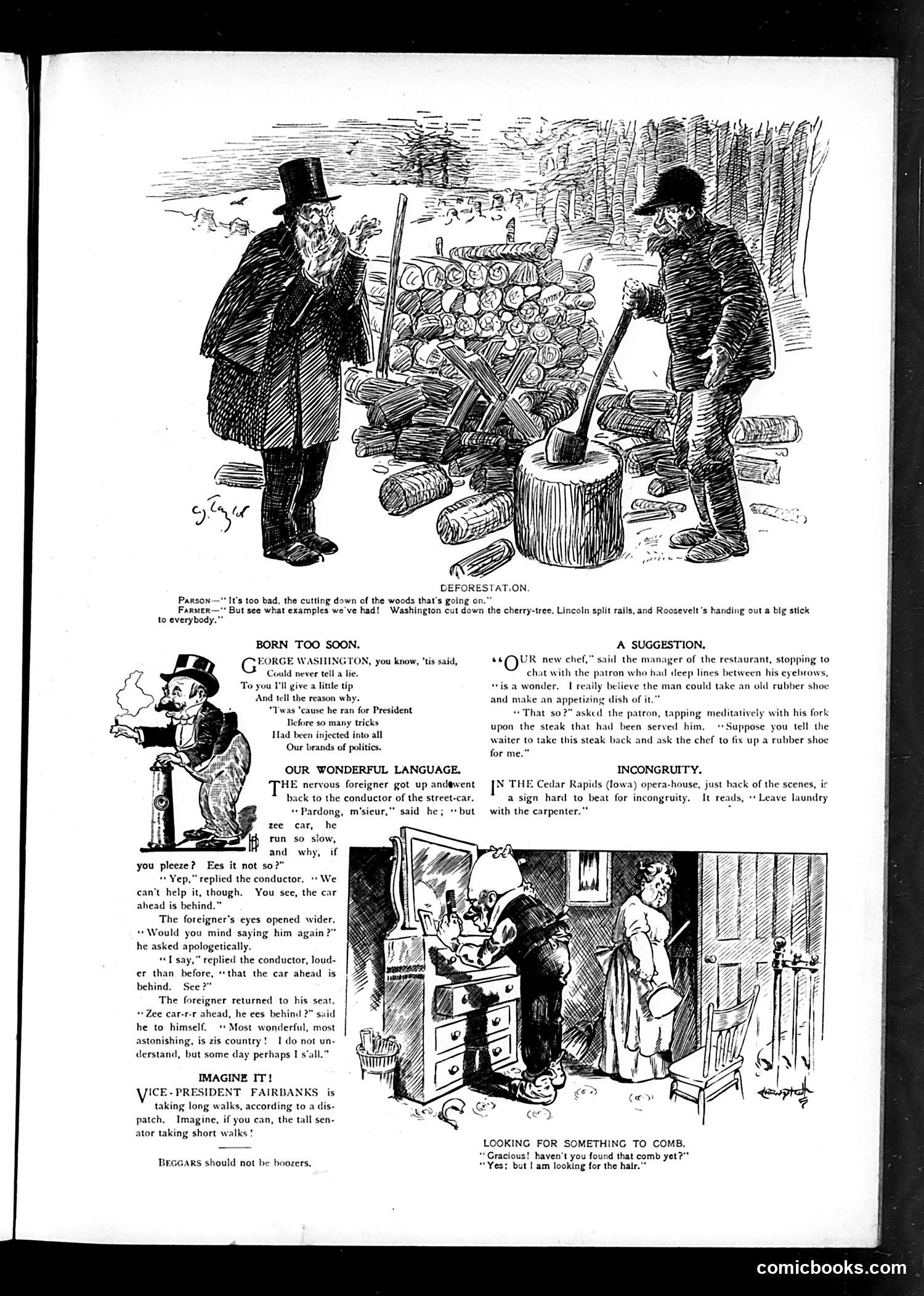
This page contains several satirical pieces mocking American politics and society: **"Deforestation"** (top): A visual pun comparing three presidents' legacies. It suggests Theodore Roosevelt—known for his "big stick" diplomacy—is recklessly handing out axes for deforestation, just as Washington "cut down" the cherry tree and Lincoln "split rails." The joke critiques Roosevelt's aggressive policies through the metaphor of literal tree-cutting. **"Born Too Soon"**: Satirizes how dishonesty has infected American politics. It nostalgically contrasts George Washington's legendary honesty with modern political corruption, implying contemporary politicians could never match historical standards of integrity. **"Our Wonderful Language"**: A humor piece about American English confusing a foreigner—the conductor says "the car ahead is behind," creating logical paradox that amuses through linguistic absurdity. **Minor pieces** mock Vice-President Fairbanks, restaurant food quality, and other everyday American follies. The overall tone is gentle satirical commentary on political decline, linguistic peculiarity, and social absurdities.
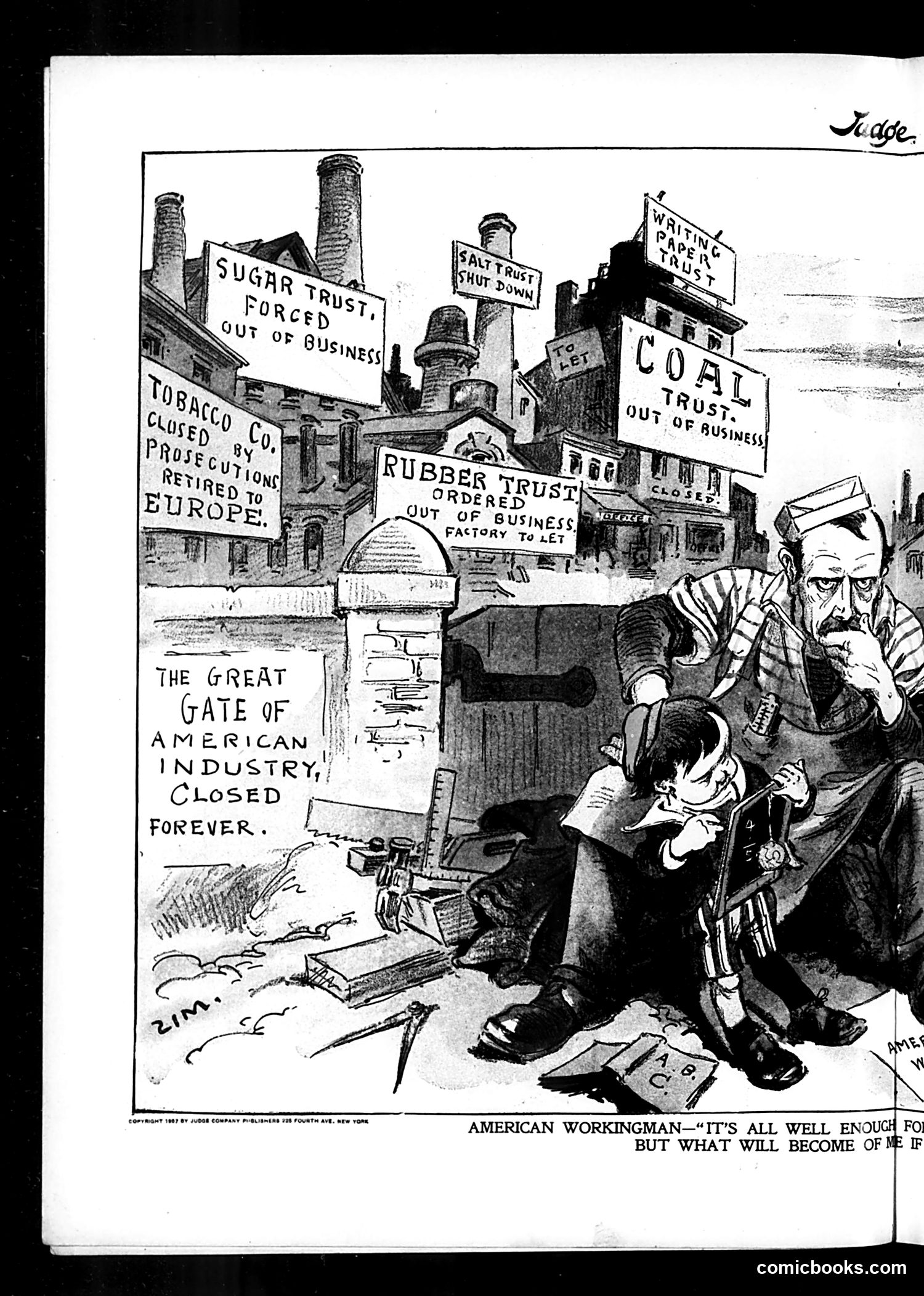
This editorial cartoon depicts the closure of American industrial factories during what appears to be an early 20th-century economic crisis. Industrial buildings with smokestacks display signs announcing various trusts—Sugar, Salt, Rubber, Coal, and Tobacco—forced out of business. The caption reads "The Great Gate of American Industry, Closed Forever." On the right, a distressed workingman with a child represents the American laborer facing unemployment and destitution. The cartoon critiques the collapse of major industrial monopolies (trusts) and their devastating impact on ordinary workers. The accompanying text fragment ("It's all well enough for...but what will become of me if...") emphasizes the worker's vulnerability when big business fails, suggesting anxiety about economic instability and the fate of those dependent on industrial employment.
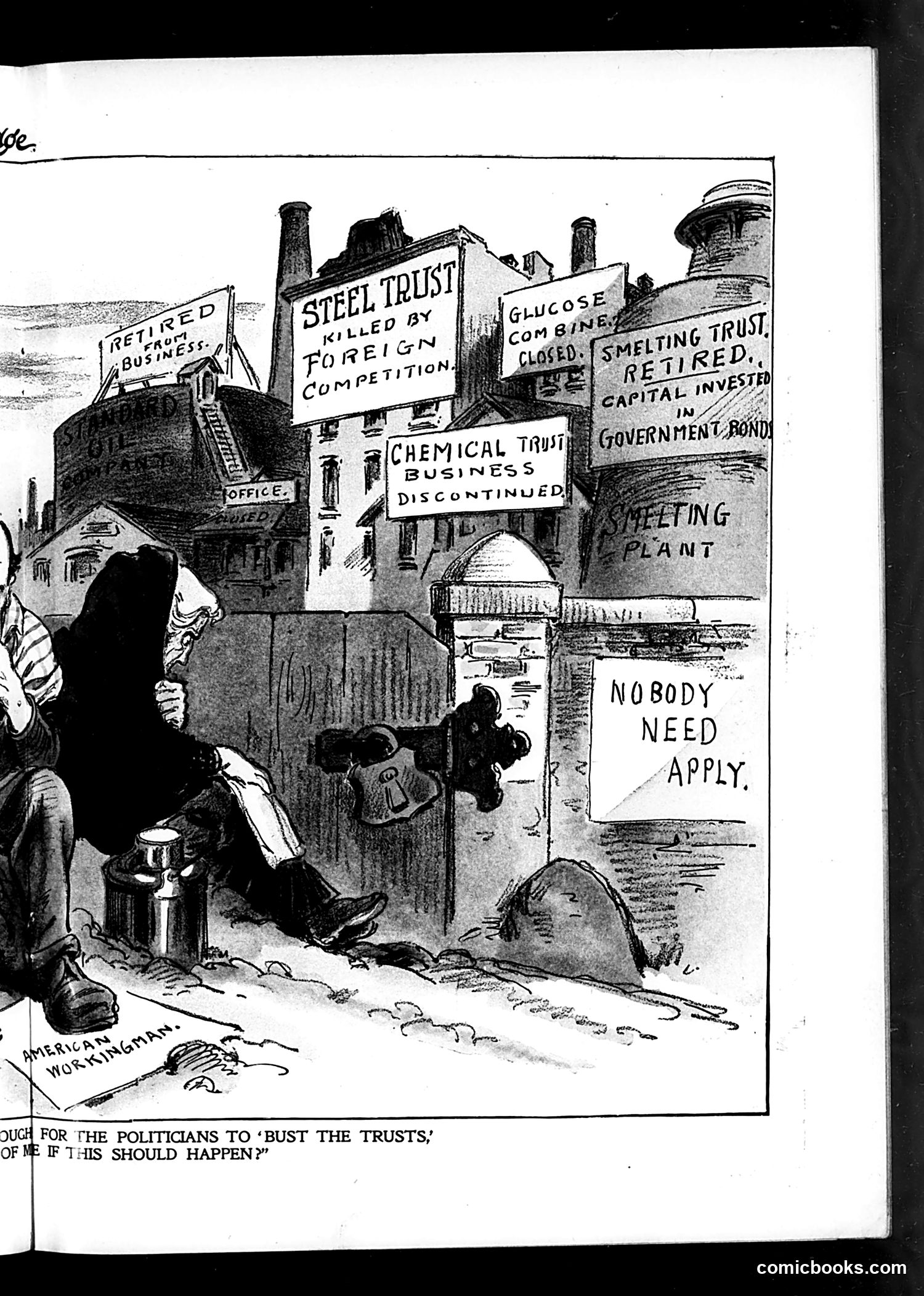
This satirical cartoon critiques the ineffectiveness of anti-trust efforts during the Progressive Era. An impoverished "American Workingman" sits outside factories bearing signs indicating defunct or retired industrial monopolies: Steel Trust, Chemical Trust, Glucose Trust, and Smelting Trust—all "killed by foreign competition," "closed," or "retired." The caption sardonically questions whether politicians can actually dissolve these trusts. The cartoon's point: despite politicians' rhetoric about busting monopolies, the trusts either collapse naturally through market forces or remain operational, while the ordinary worker remains unemployed ("Nobody Need Apply") and suffering. This reflects early 20th-century anxieties about corporate consolidation, worker exploitation, and the gap between political promises and economic reality.
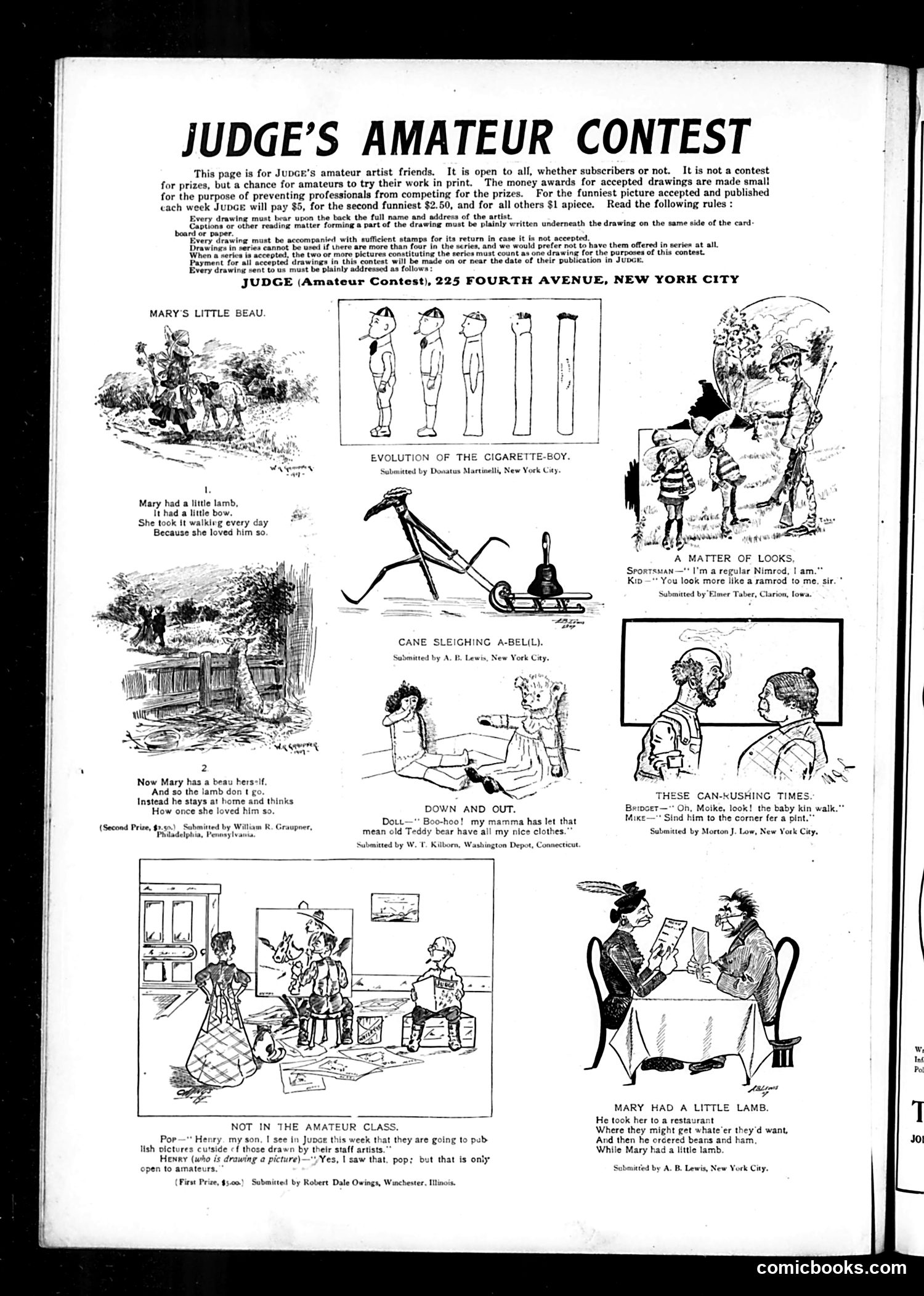
This is a **contest submission page** for amateur cartoonists, not political satire. Judge magazine invited amateur artists to submit humorous drawings for publication and small monetary prizes ($5 for the funniest, $2.50 for second place, $1 for others). The page displays various amateur submissions playing on nursery rhymes and domestic humor: - **"Mary's Little Lamb"** variations reimagine the classic poem with romantic and comedic twists - **"Evolution of the Cigarette Boy"** shows a figure progressively elongating—satirizing thin fashion or cigarette smoking's effects - **"Cane Sleighing"** and **"Down and Out"** depict everyday scenes with wordplay captions - **"Matter of Looks"** and **"These Can-Rushing Times"** offer quick-joke format cartoons The bottom includes a meta-joke: a father points out Judge publishes amateur work, and his son (drawing his own picture) responds sarcastically that amateurs can submit. This reflects early 20th-century middlebrow humor emphasizing puns, domestic situations, and gentle ridicule rather than political commentary.
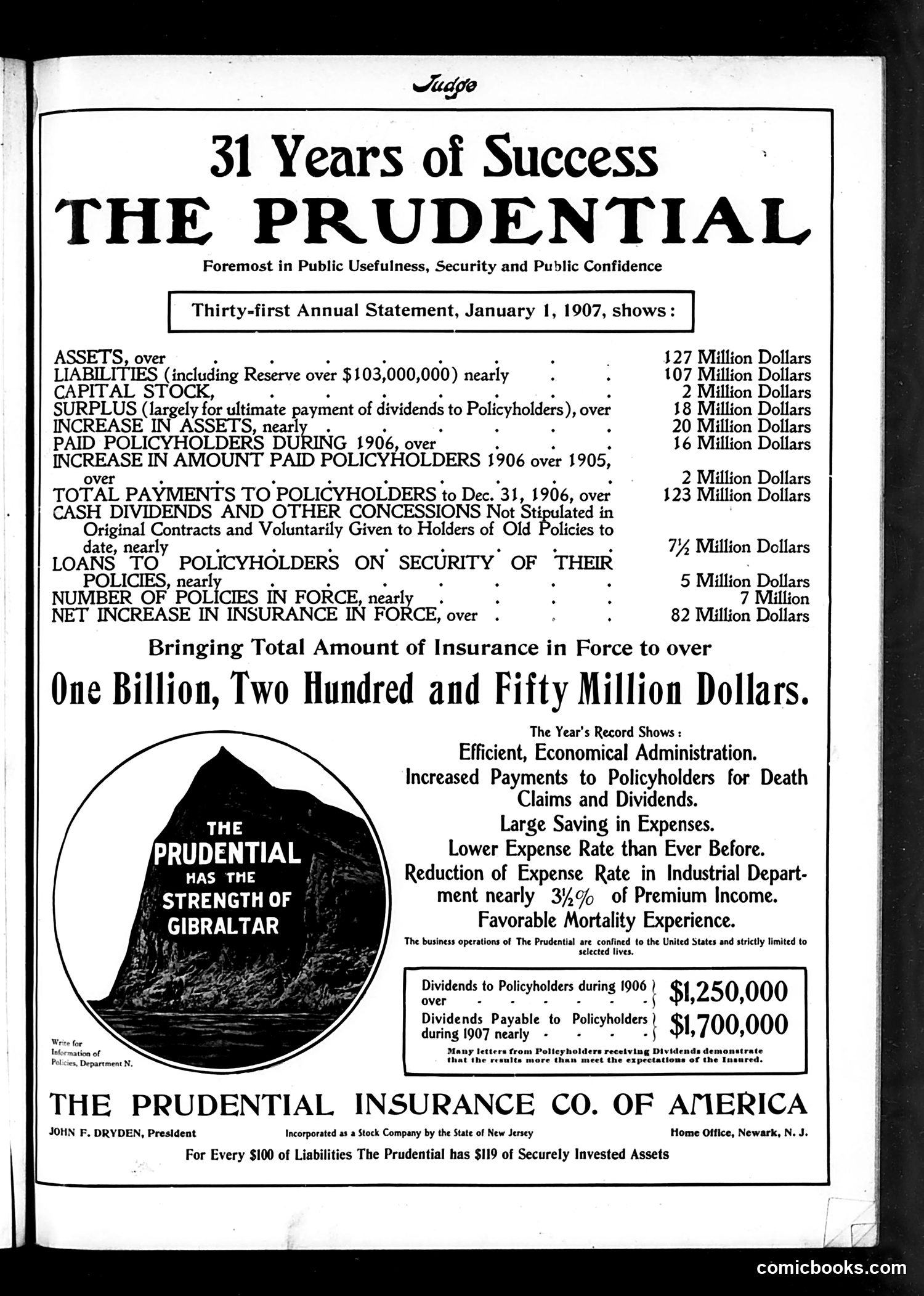
This is **not a satirical cartoon but corporate advertising**—a full-page promotional statement for The Prudential Insurance Company of America, published in Judge magazine's January 1907 issue. The page presents The Prudential's financial achievements: $127 million in assets, over $1.25 billion in insurance in force, and $1.25 million in dividends paid to policyholders in 1906. The only visual element is a Gibraltar rock illustration with text claiming "THE PRUDENTIAL HAS THE STRENGTH OF GIBRALTAR"—a metaphor for financial stability and security. The advertising emphasizes trustworthiness through specific metrics: efficient administration, increased payouts, expense reduction, and favorable mortality rates. The closing line ("For Every $100 of Liabilities The Prudential has $119 of Securely Invested Assets") quantifies financial reliability to reassure potential customers. This represents early 20th-century corporate image-building through Judge's pages, targeting affluent readers who purchased insurance.
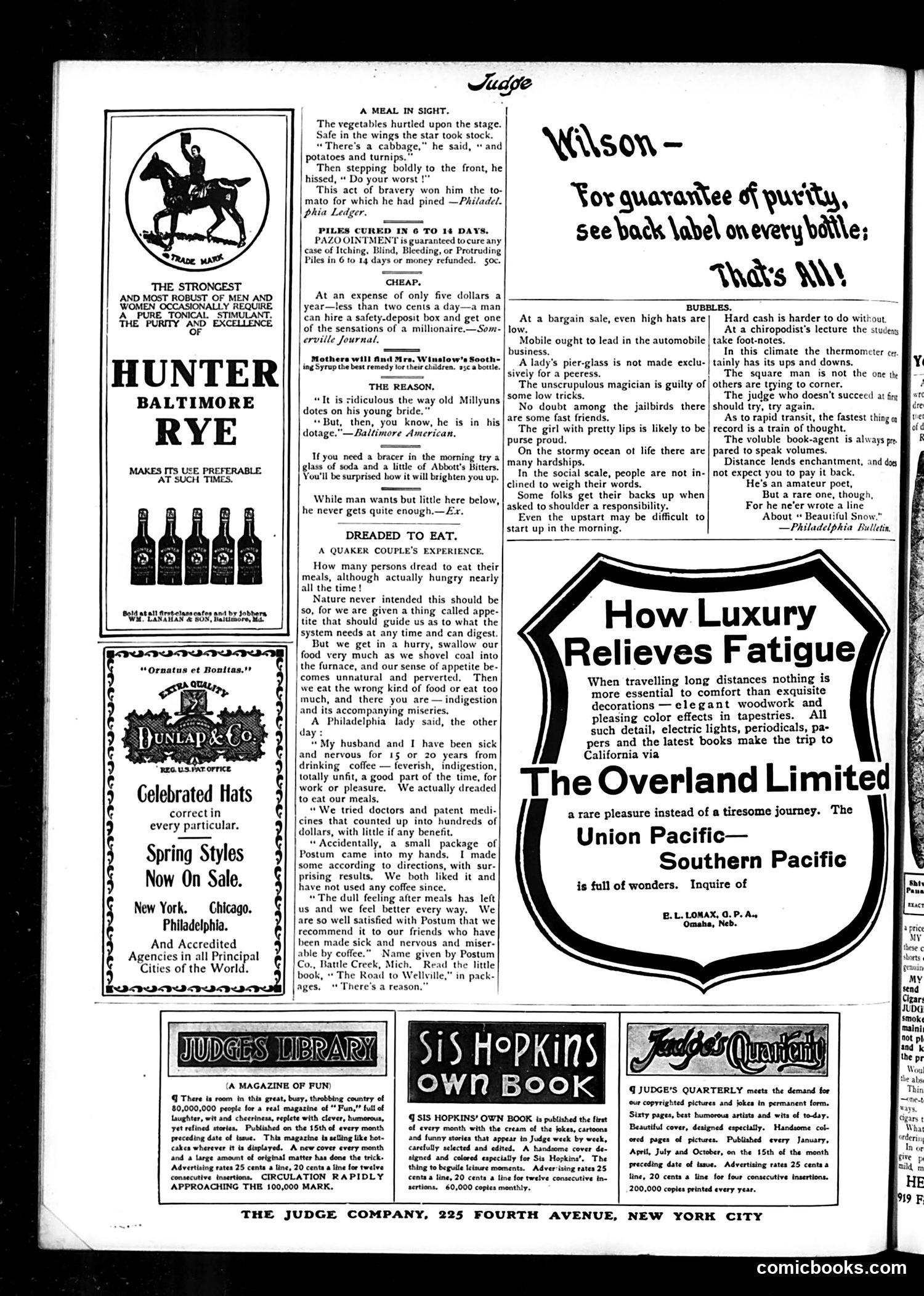
This page is primarily **advertising and filler content** rather than political satire. It contains: **Main advertisements:** - Hunter Baltimore Rye whiskey (top left) - Dunlap & Co. celebrated hats - The Overland Limited railroad (center-right) - Judge's Library, Sis Hopkins Own Book, and Judge's Quartet (bottom) **Filler content** includes: - "A Meal in Sight" — a brief theatrical anecdote about an actor facing thrown vegetables - Various humorous one-liners and aphorisms (about old men marrying young women, bracer drinks, etc.) - "Dreaded to Eat" — a testimonial for Postum cereal coffee substitute, describing a couple's digestive troubles from regular coffee - "Wilson" — an endorsement for Wilson's purity products **No significant political cartoons or satire** appear on this page. The humor is light, domestic, and largely self-promotional for Judge's other products. The page reflects early 20th-century advertising and genteel humor conventions.
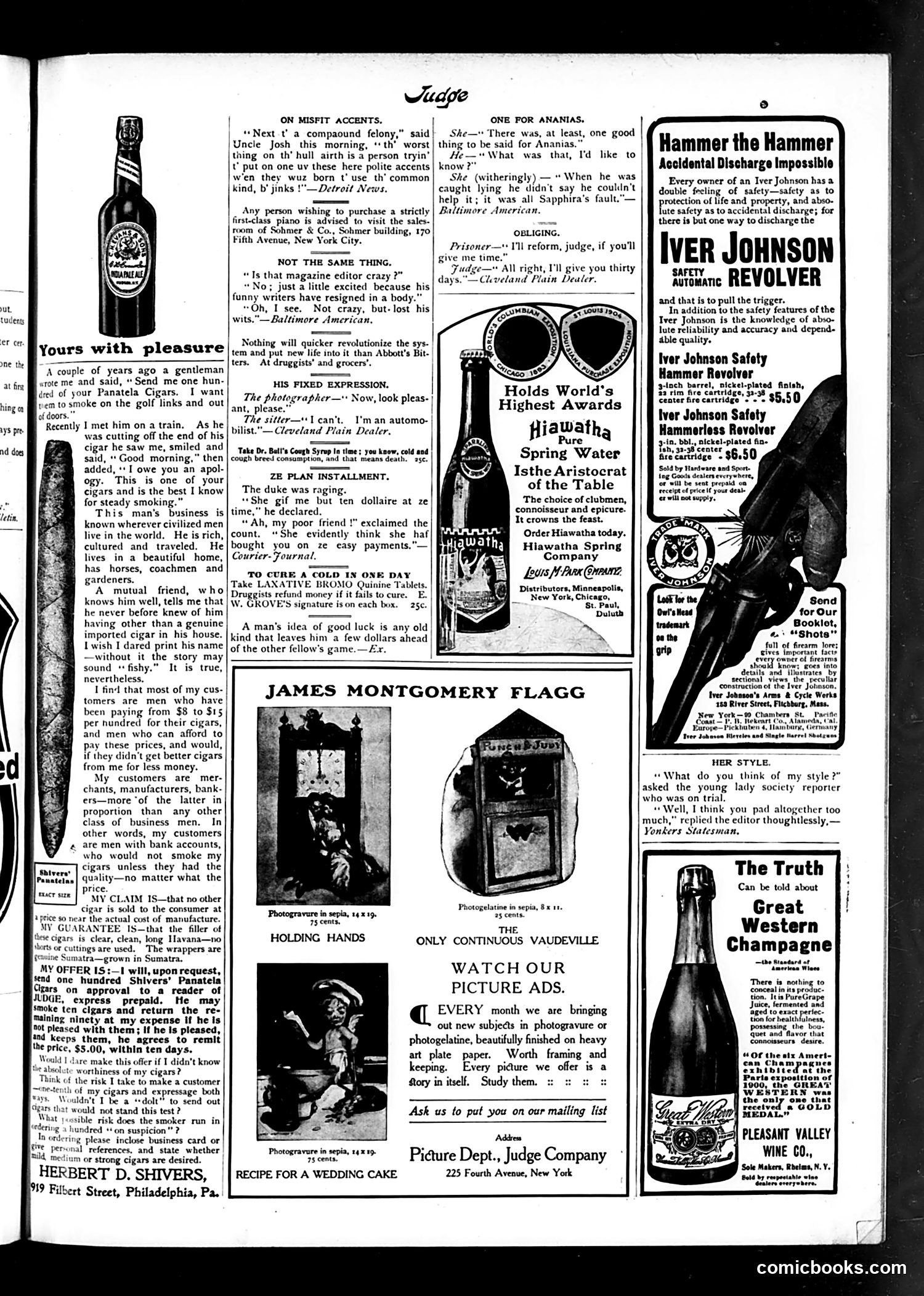
This page is primarily **advertising and humor content** rather than political cartoons. The main elements are: **Advertisements:** The page features multiple product ads (Iver Johnson revolvers, Hiawatha Spring Water, champagne, cigars by Herbert D. Shivers) with period illustrations. **Humor Section:** Several brief jokes and anecdotes, including: - Uncle Josh's complaint about people adopting fake "polite accents" - A photographer's joke about an automobilist who can't smile - A joke about a European duke (likely mocking immigrant speech patterns and financial naivety) **Social Commentary:** The humor relies on early 1900s stereotypes—rustic American dialect humor, immigrant caricatures, and gender dynamics. The cigar advertisement's lengthy testimonial reflects turn-of-century marketing tactics targeting wealthy businessmen. The page reflects *Judge*'s mix of satirical content and commercial advertising, with humor aimed at middle/upper-class readers. No specific political figures are identifiable.
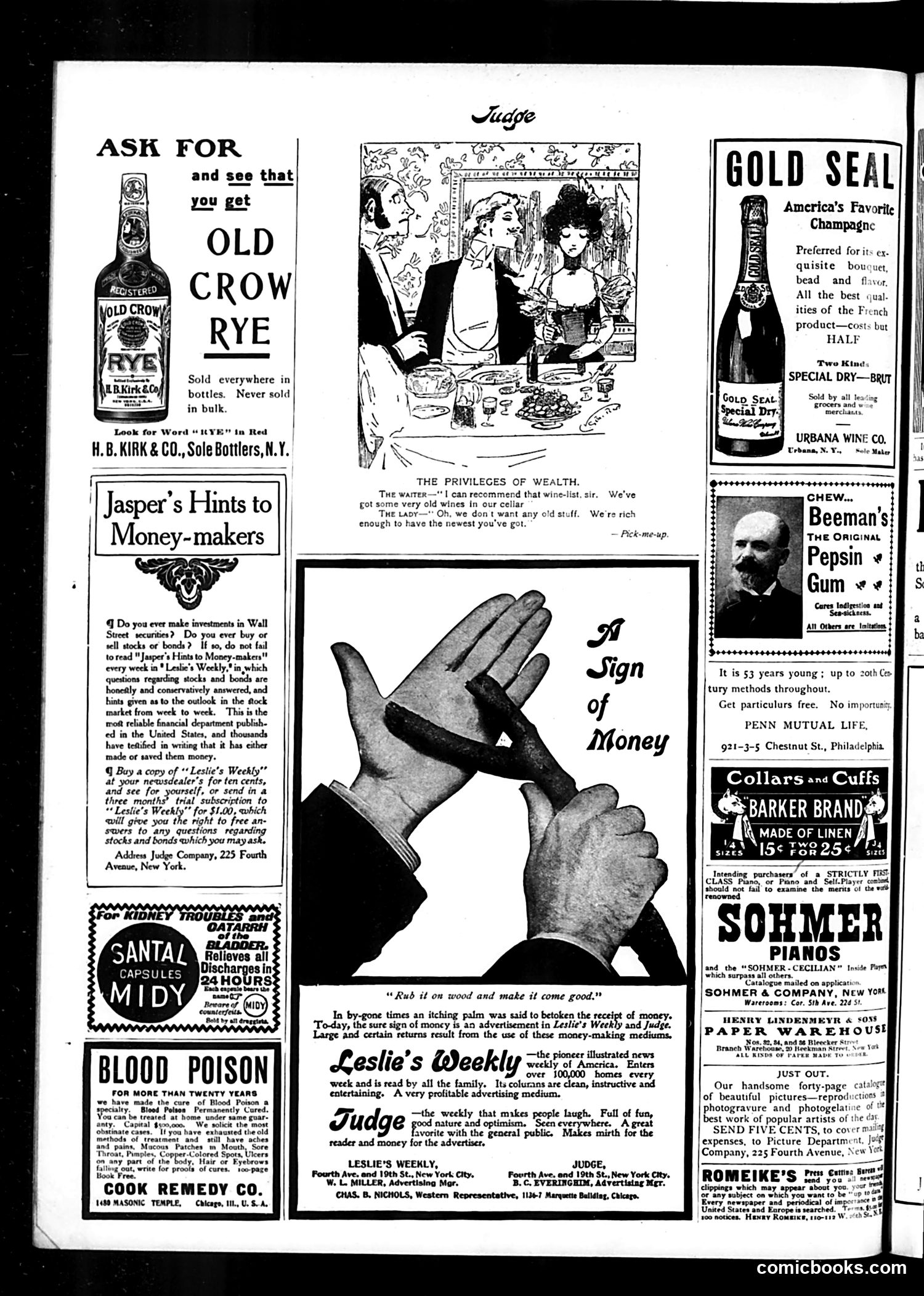
This page from *Judge* magazine is primarily **advertising** with one central cartoon and accompanying commentary. ## Main Cartoon: "A Sign of Money" The large illustration depicts a hand with the caption "Rub it on wood and make it come good." This is a satirical commentary on **advertising's perceived magical properties**. The accompanying text explains that historically, an "itching palm" signaled receipt of money—but in modern times, the real sign of money is simply **advertising in *Leslie's Weekly* and *Judge*** magazines. ## The Satire The joke is self-promotional: both publications are literally arguing that their own advertising spaces are the surest path to wealth. The hand image implies money-making is almost magical, but the real "magic" is simply buying ad space in these magazines. This is tongue-in-cheek commentary on how advertising has become the engine of commercial success. The rest of the page contains typical period advertisements for alcohol, medical remedies, financial advice, and consumer goods—ironically proving the satire's point about advertising's pervasiveness and perceived power.
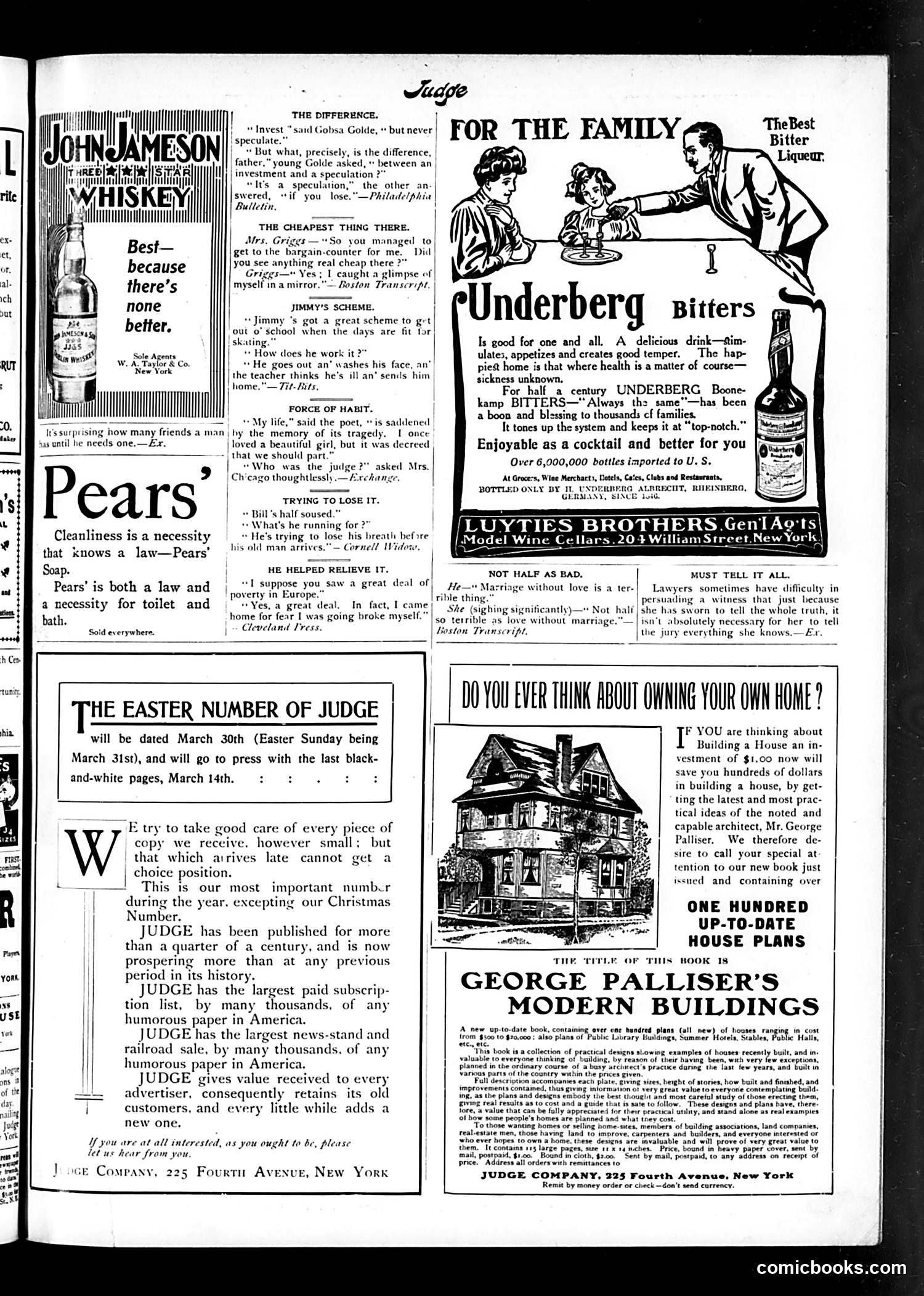
This page from Judge magazine (a major American satirical publication) contains primarily **short humor pieces and advertisements** rather than political cartoons. The humor relies on **turn-of-the-century American social commentary**: jokes about financial speculation vs. investment, schoolboys dodging class, vanity, and romantic disappointment. The "Jimmy's Scheme" piece satirizes students' priorities (preferring skating to school). Several jokes mock human weakness—drunkenness, poverty-tourism, marital discord—typical of period humor. The advertisements promote **consumer goods marketed as lifestyle improvements**: whiskey sold as "best because there's none better," Pears' Soap (emphasizing cleanliness as moral necessity), and Underberg Bitters (medicinal alcohol marketed as family health tonic). These ads reflect early-1900s commercial culture where spirits and patent medicines were openly advertised in mainstream publications. The page lacks overtly political content; instead it targets universal human foibles through gentle satire aimed at Judge's middle-class readership.
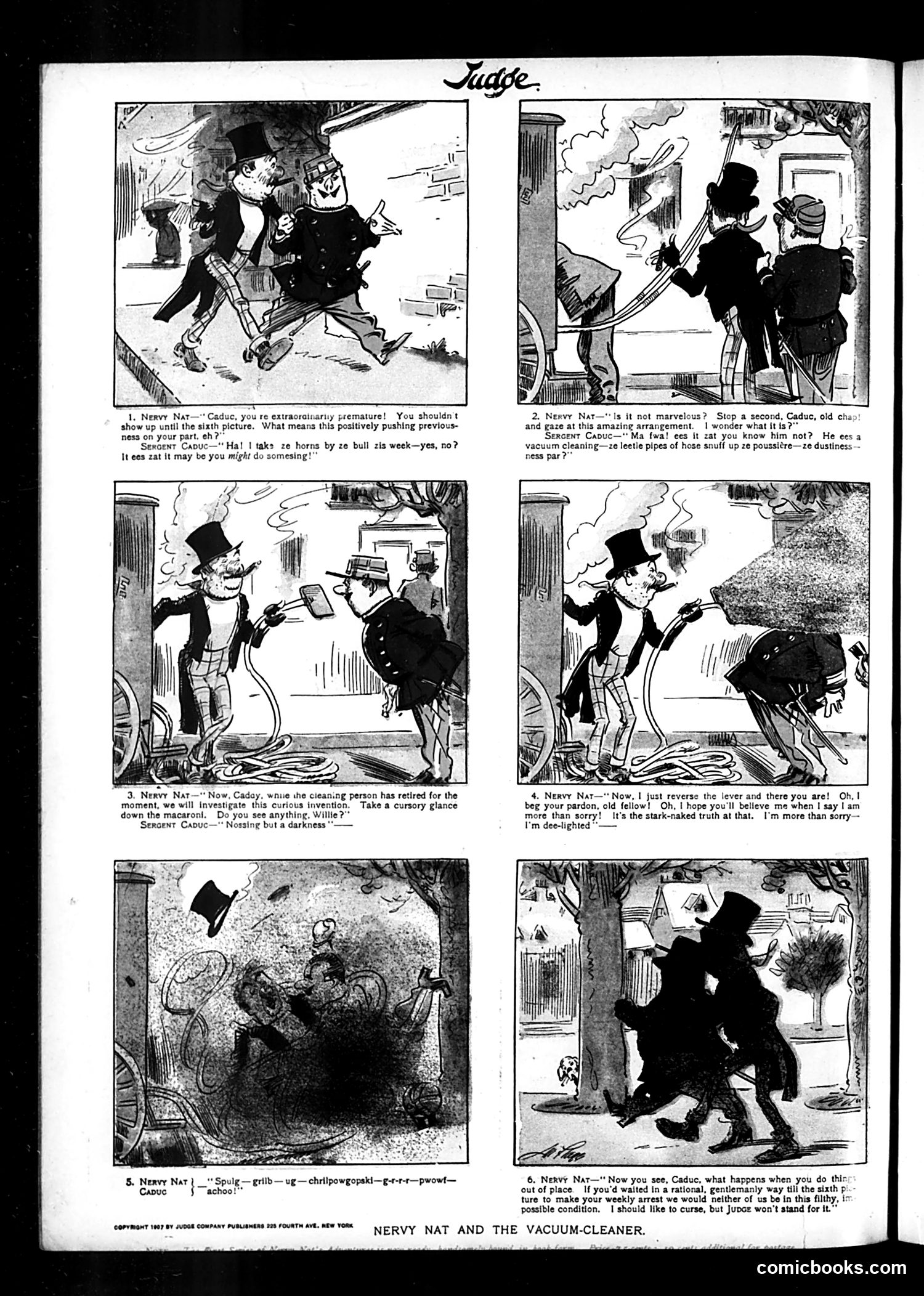
This is a slapstick comic strip featuring two characters: "Nervy Nat" and "Sergeant Caduc" (a French-accented police officer, suggested by the dialect). The humor centers on a vacuum cleaner—a relatively new household technology in the early 1900s. The joke: Nat demonstrates the vacuum to Caduc, who is skeptical and impatient. When Nat reverses the lever (panel 4), the vacuum operates in reverse, explosively sucking up dust and debris instead of cleaning. This traps both men in a cloud of filth. The satire mocks both new technology and the French character's exasperation with Nat's incompetence. Caduc complains at the end that if Nat had simply waited until "the sixth picture" (as apparently expected in comic conventions), they could have avoided the mess—a meta-joke about comic strip formulas. The strip's humor derives from physical comedy and character frustration rather than political commentary.