
A complete issue · 16 pages · 1907
Judge — January 5, 1907
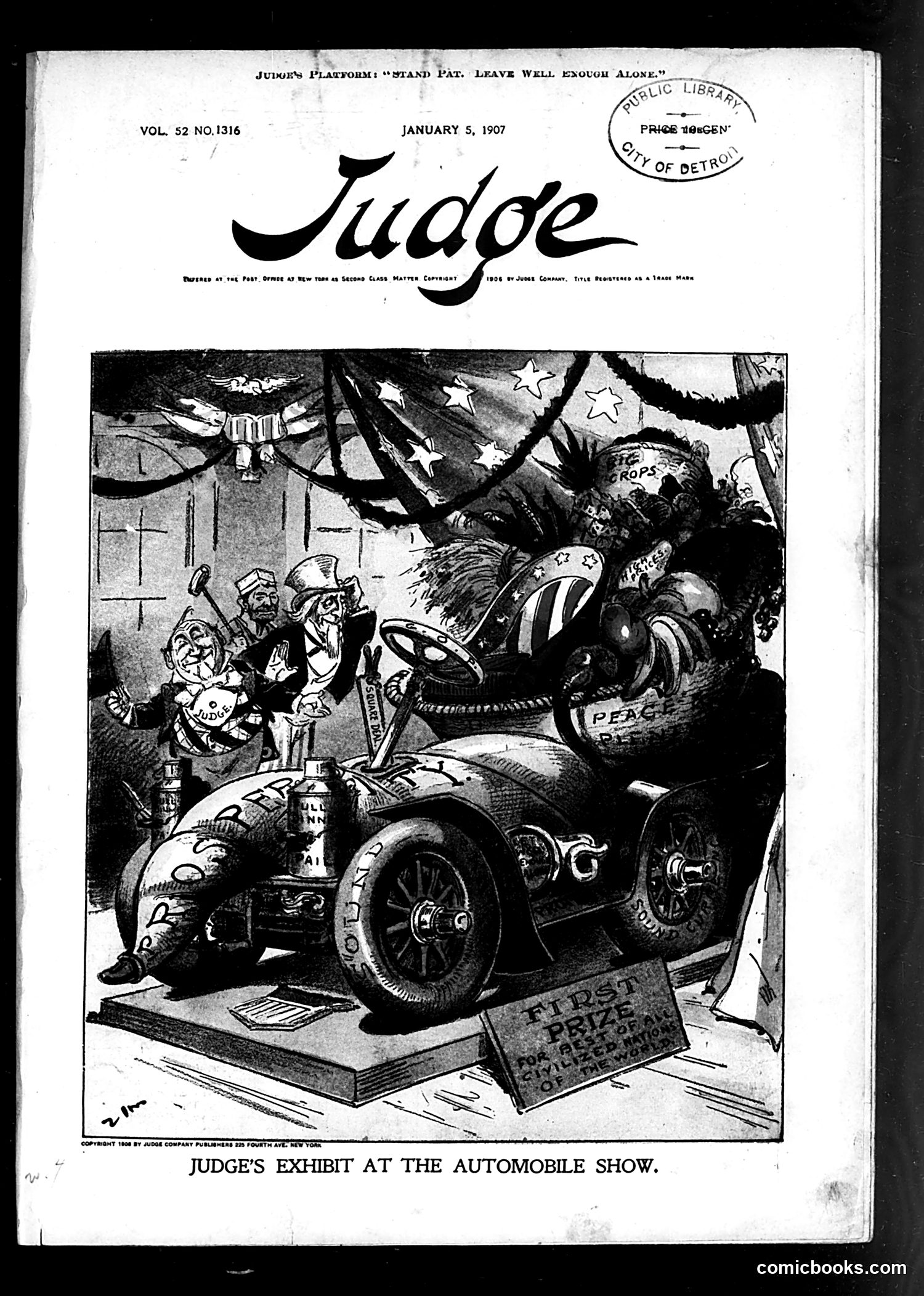
This satirical cartoon depicts judges examining a race car displayed as a "First Prize" winner at an automobile exhibition. The judges, wearing official attire, scrutinize the vehicle with skeptical expressions while various symbolic figures representing social issues—labeled "Peace," "Crops," and other concerns—crowd around or appear compromised by the automobile's presence. The satire appears to criticize judicial judgment and priorities in the Progressive Era. It suggests judges are awarding prizes to automobiles (symbols of modern commercialism and industrial progress) while overlooking or neglecting more serious social and economic concerns like peace and agricultural welfare. The cartoon mocks the apparent disconnect between what gets celebrated and what deserves actual attention.
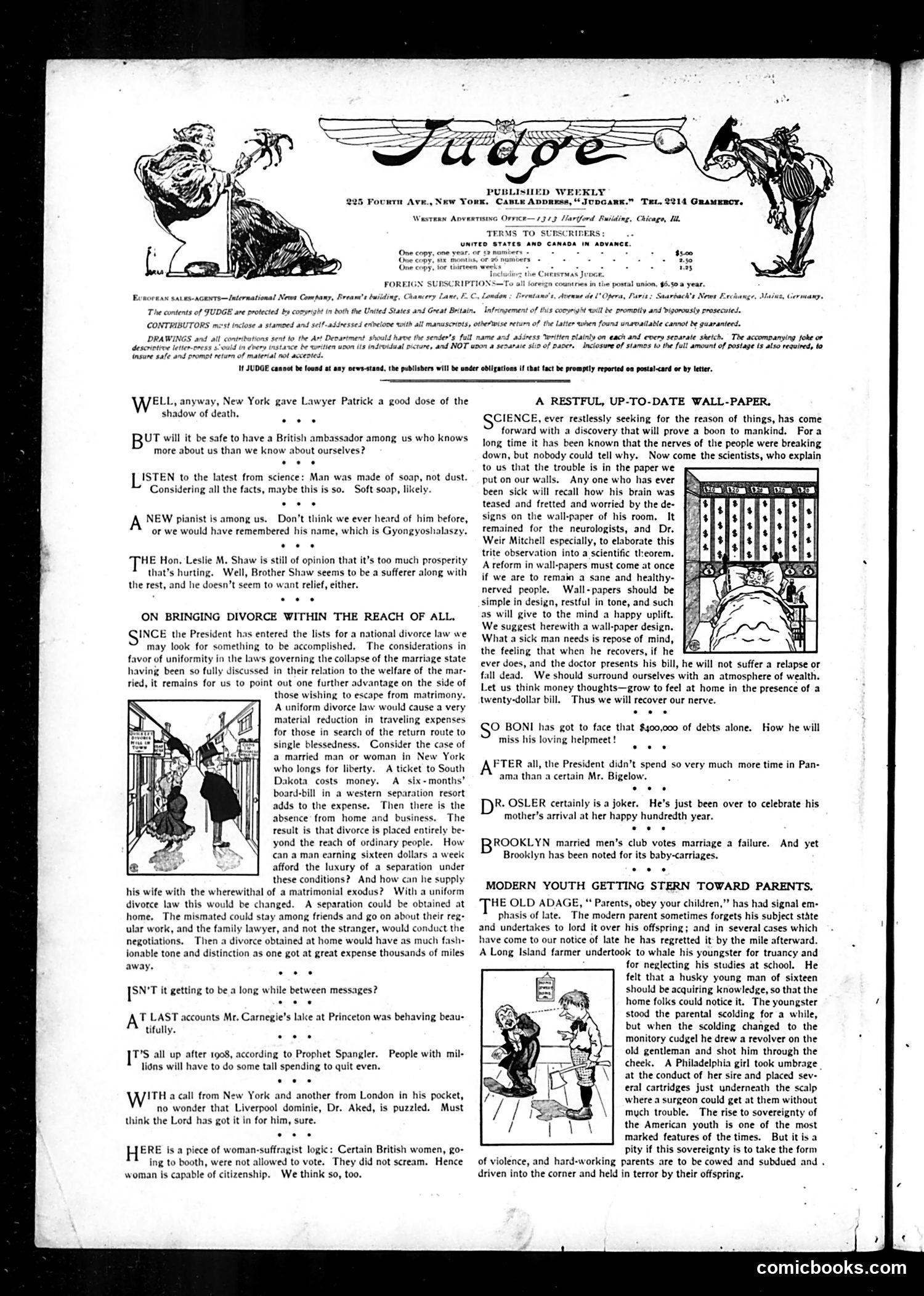
This page contains several satirical commentary pieces typical of early 20th-century Judge magazine. The main cartoon depicts a couple at a doorway, illustrating an article titled "ON BRINGING DIVORCE WITHIN THE REACH OF ALL," which argues for uniform national divorce laws to make divorce more accessible and affordable—currently expensive and restricted to the wealthy. The page also includes brief humorous commentaries on contemporary topics: Patrick (likely a public figure), a British ambassador, a new pianist, Leslie M. Shaw (appears to be a political figure), and references to Carnegie's behavior at Princeton and Prophet Spangler's predictions about financial spending. The overall tone satirizes social inequality, suggesting that divorce accessibility should not depend on wealth—a progressive position for the era.
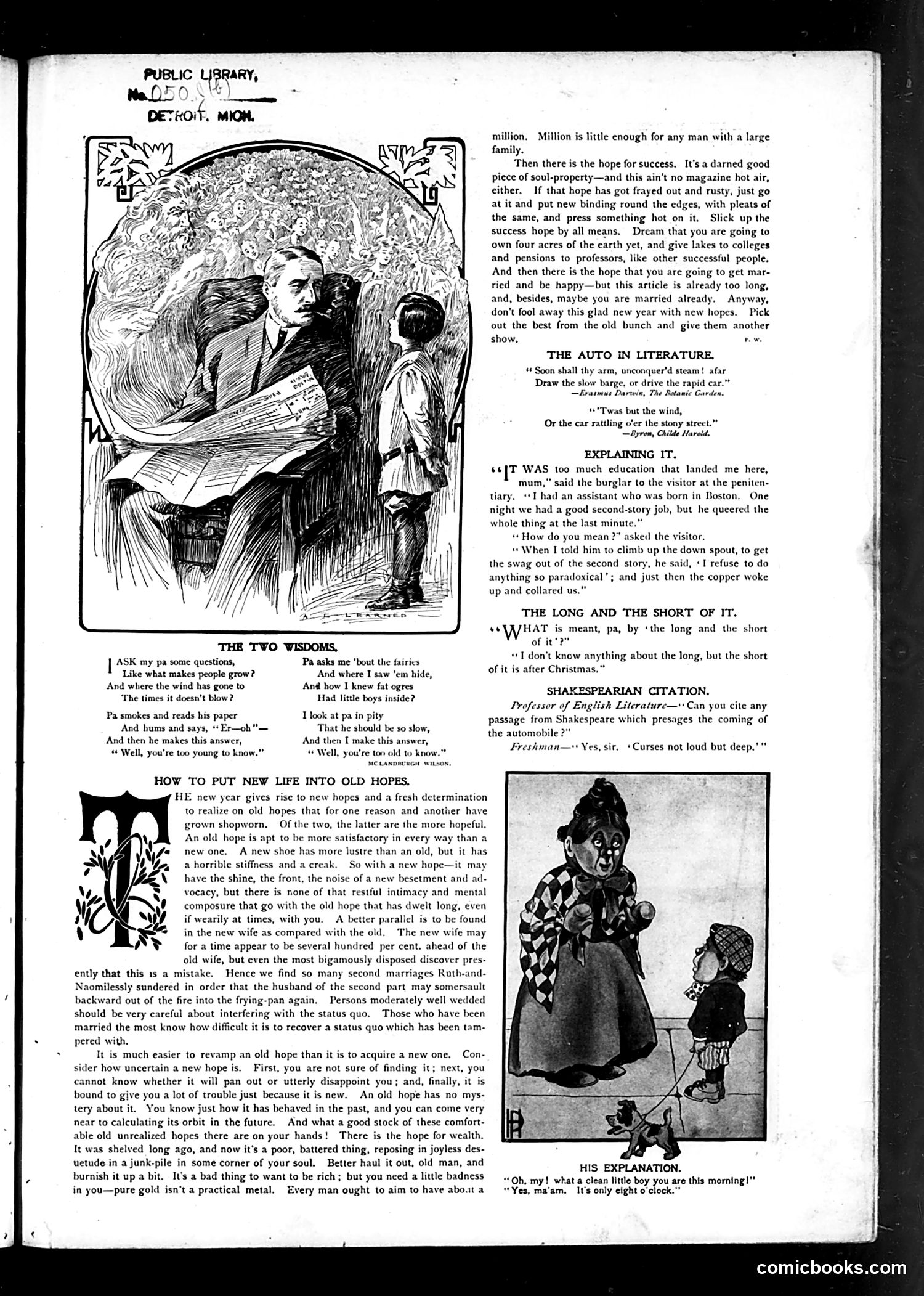
This page contains several distinct items: **"The Two Wisdoms"** (top left): A poem contrasting childlike curiosity with adult concerns, illustrated with a sketch of what appears to be a father figure and child. **"The Auto in Literature"** section: Literary quotes about automobiles, suggesting early 1900s fascination with this new technology. **"How to Put New Life into Old Hopes"** (main article): A lengthy essay about renewing one's optimism and expectations in the new year, addressing the psychological difficulty of maintaining hope and the challenges of second marriages. **"His Explanation"** (bottom right): A small cartoon showing a boy explaining to his mother why he's late, with the caption "Oh my! what a clean little boy you are this morning!" / "Yes, ma'am. It's only eight o'clock." The page reflects early 1900s concerns about modernization, psychology, and domestic life.
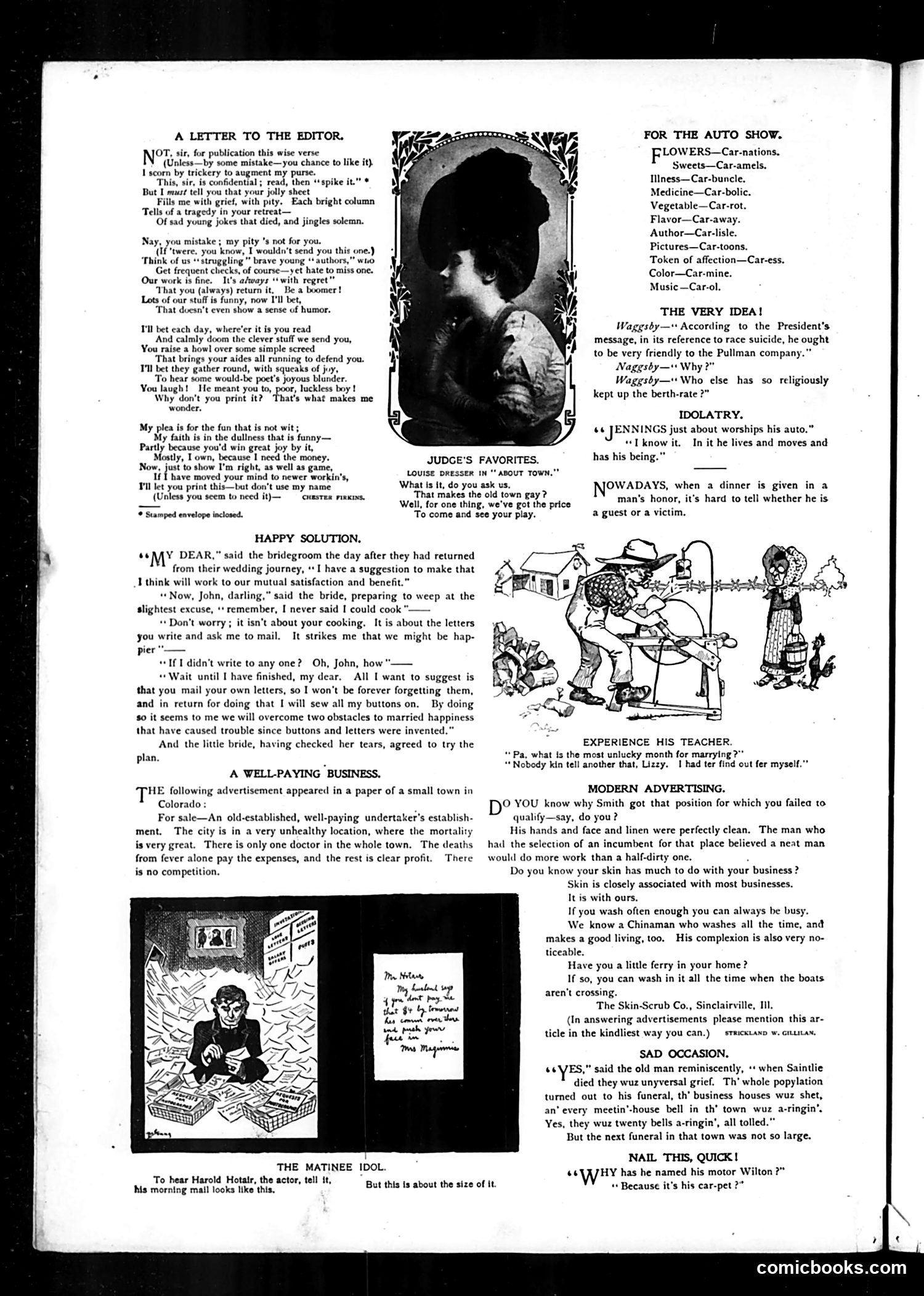
This page contains primarily **humorous short pieces and advertisements** rather than political cartoons. The content includes: **"The Matinee Idol"** - A joke about actor Harold Hepry's morning mail resembling the size of a carpet, mocking celebrity fan mail culture. **"Modern Advertising"** - Social commentary on the importance of personal cleanliness and appearance for business success, referencing a Chinese laundryman's spotless reputation. This reflects early 20th-century attitudes about hygiene and professional respectability. **Various brief jokes** about automobile naming conventions, dinner guests (victims vs. guests), and general domestic humor. The page is typical Judge fare: **light satire on American social manners, commerce, and celebrity culture**, without specific political commentary. Most references are now-obscure period details rather than timeless satire.
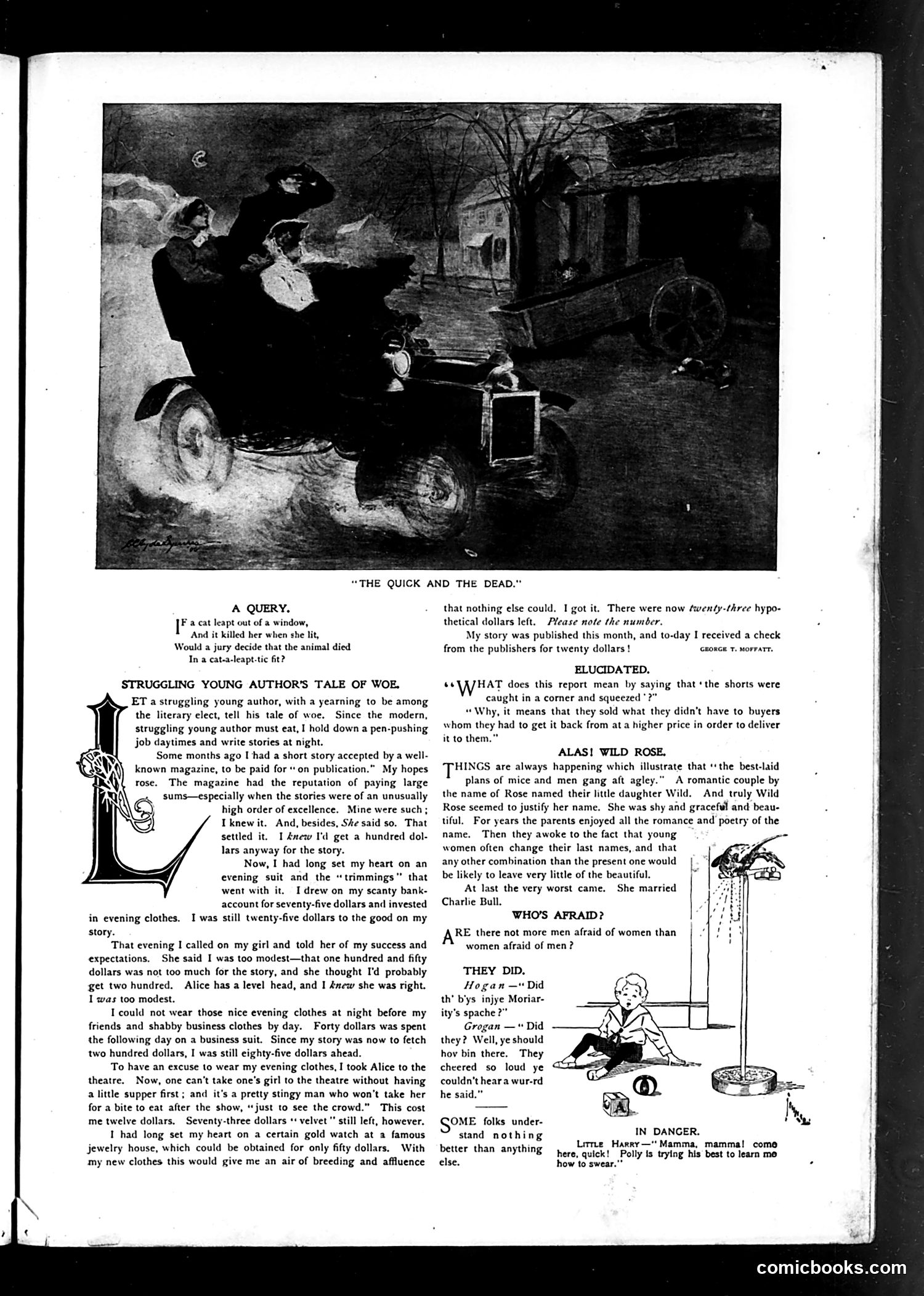
The main image, captioned "The Quick and the Dead," depicts an early automobile racing recklessly past a horse-drawn cart on a rural road. This satirizes the dangerous collision between new automotive technology and traditional transportation during the early 1900s automobile boom. The text sections are literary contributions rather than political satire: "A Query" discusses a cat's legal status, while "Struggling Young Author's Tale of Woe" recounts an aspiring writer's financial struggles and modest success selling a story for twenty dollars. Other brief segments address social observations about name changes after marriage and fear of women. The page emphasizes Judge's mixed content of visual satire, humor, and literary pieces typical of early-20th-century American periodicals.
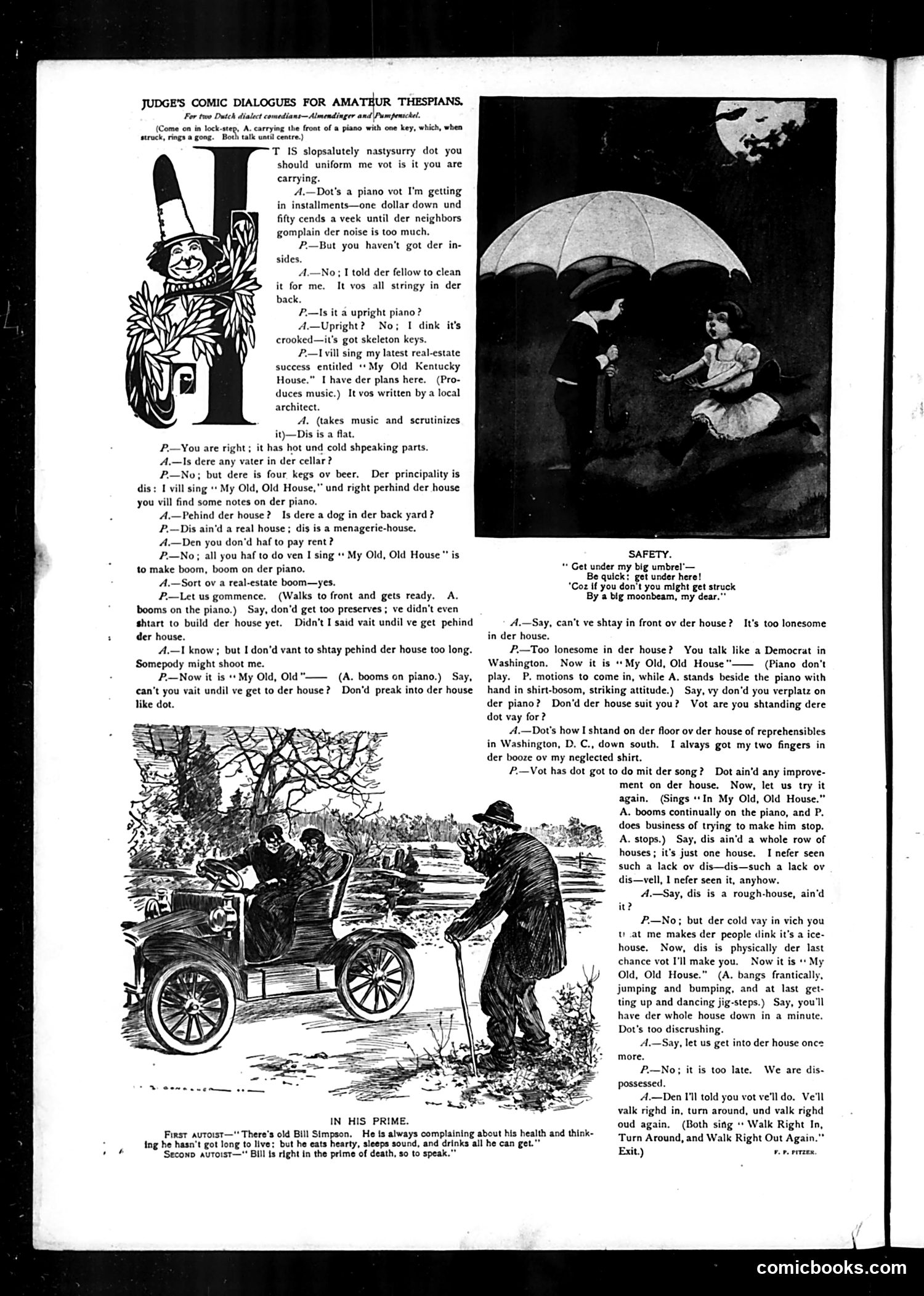
This page features ethnic comedy sketches in the "Dutch dialect" style popular in early 20th-century American vaudeville. Two performers (labeled A and P) speak in exaggerated German-accented English ("slopsalutely," "vot," "dink"), a common theatrical stereotype of German immigrants. The main sketch mocks both the characters' ignorance and the real-estate boom. They perform a song called "My Old, Old House" while one bangs a broken piano to create sound effects—the physical comedy relies on slapstick and malapropisms. References to "Democrats in Washington" and "reprehensibles" suggest light political jabs typical of Judge magazine's satirical tone. The secondary cartoon "In His Prime" jokes darkly about an elderly hypochondriac (Bill Simpson) constantly complaining about his health while actually thriving. The "Safety" caption features a woman offering umbrella shelter from "moonbeams"—absurdist humor common to the era. This represents mainstream American entertainment's casual ethnic stereotyping of the period.
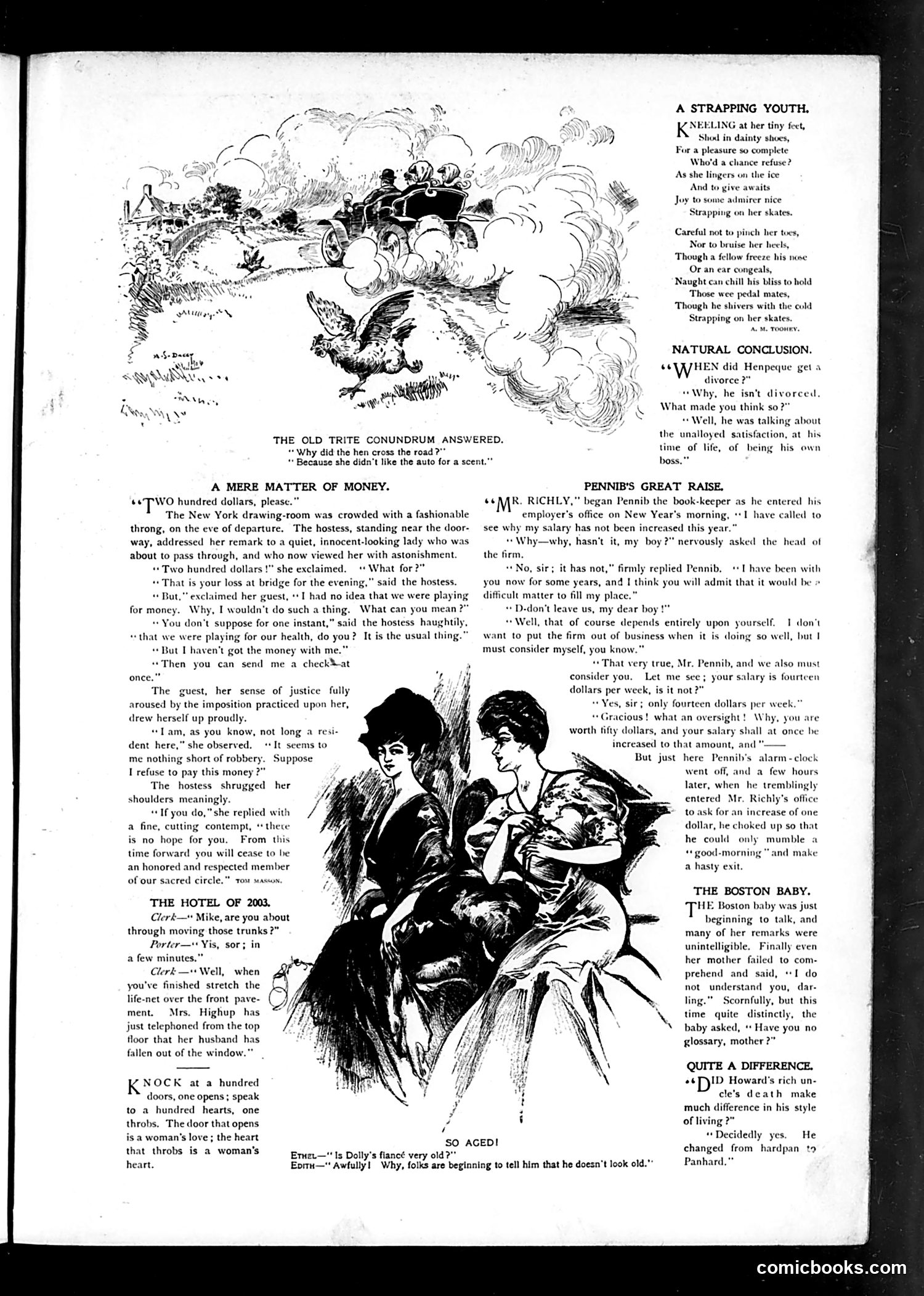
This page contains several satirical pieces reflecting early 20th-century American social concerns: **"A Mere Matter of Money"** mocks wealthy society's casual gambling culture. A hostess demands $200 from an innocent guest for bridge losses, then threatens social ostracism when the guest refuses to pay. The satire targets the hypocrisy of the wealthy elite who frame compulsive gambling as normal social behavior while punishing those who resist. **"The Hotel of 2003"** is futuristic satire predicting reckless wealth and negligence—a hotel clerk matter-of-factly discusses a guest falling from a window, suggesting future society will be morally indifferent to such tragedies. **"Pennib's Great Raise"** satirizes exploitative employment practices. An underpaid bookkeeper ($14/week) demands a raise, threatening to leave. His employer dramatically "grants" him $50/week—but the satire suggests this pittance was always deserved, highlighting employers' calculated stinginess. Minor pieces mock aging suitors, Boston accents, and automobile safety hazards. The cartoons collectively critique Gilded Age excess, economic inequality, and social pretension.
This page appears to be rotated 90 degrees. When reoriented, it shows what looks like a theatrical or entertainment scene with figures in formal dress. The visible text "PRO BONO" (Latin for "for the public good") suggests satirical commentary on public-spirited claims or hypocrisy. The caricatured faces and theatrical setting indicate this is likely satirizing entertainment industry figures or wealthy patrons claiming philanthropic motives. The ornate interior details and formal attire suggest upper-class society being mocked. However, without clearer text identification or readable bylines visible in this image quality, I cannot definitively identify which specific public figures or events are being targeted. The satire appears to critique performative charity or self-interested "public service" among the elite, a common Judge magazine theme.
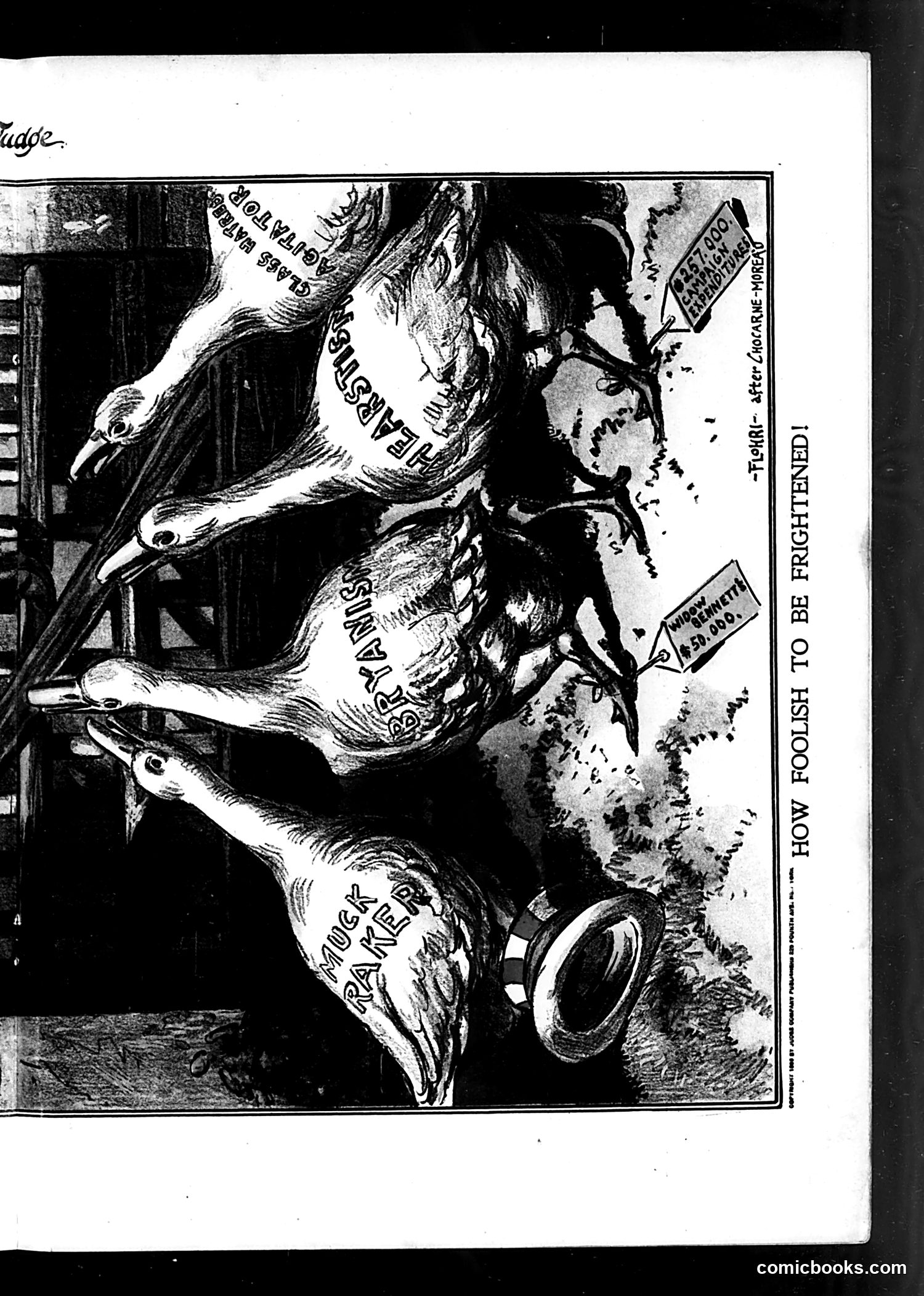
This political cartoon appears to satirize financial fraud or embezzlement. The image shows geese (representing duped investors or the public) being plucked of their feathers—a visual metaphor for being fleeced of money. The geese wear labels suggesting they're victims of schemes or scams. A figure (likely representing a fraudster or corrupt businessman) operates the scheme. The title "HOW FOOLISH TO BE FRIGHTENED" suggests ironic commentary on investors who were warned but ignored danger signs. This reflects Judge magazine's typical satirical approach to exposing financial corruption and gullibility during the Gilded Age or Progressive Era, when such schemes were common and scandals frequent. The exact scheme referenced is unclear from the visible text.
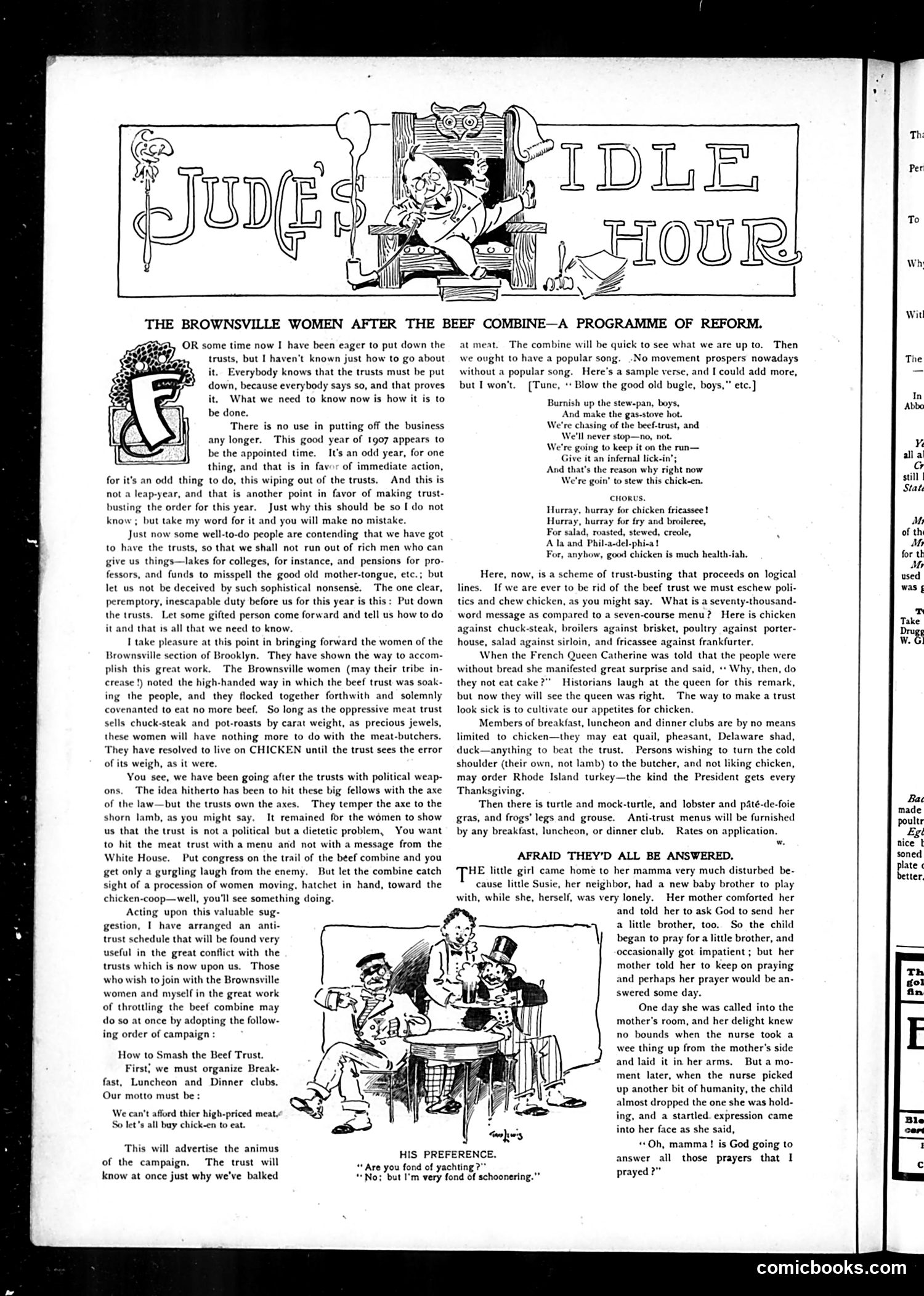
This 1907 Judge article satirizes anti-trust reform efforts by celebrating Brooklyn women who boycotted beef to protest the "beef trust"—corporate monopolies controlling meat prices. The satire works on multiple levels: the author mocks political solutions to trusts as ineffective ("hitting big fellows with the axe of the law—but the trusts own the axes"), then praises women's consumer activism as the real solution. The cartoon depicts ordinary people—mothers, children—choosing chicken over beef as political action. The piece is both genuinely impressed by this grassroots tactic and gently mocking of how modest it is: women armed with "hatchets" toward "the chicken-coop" versus powerful corporate interests. The proposed "campaign" of breakfast clubs singing pro-chicken songs reflects the absurdist humor—treating domestic meal-planning as revolutionary activism. This reflects early-1900s trust-busting debates and women's emerging economic power as consumers.
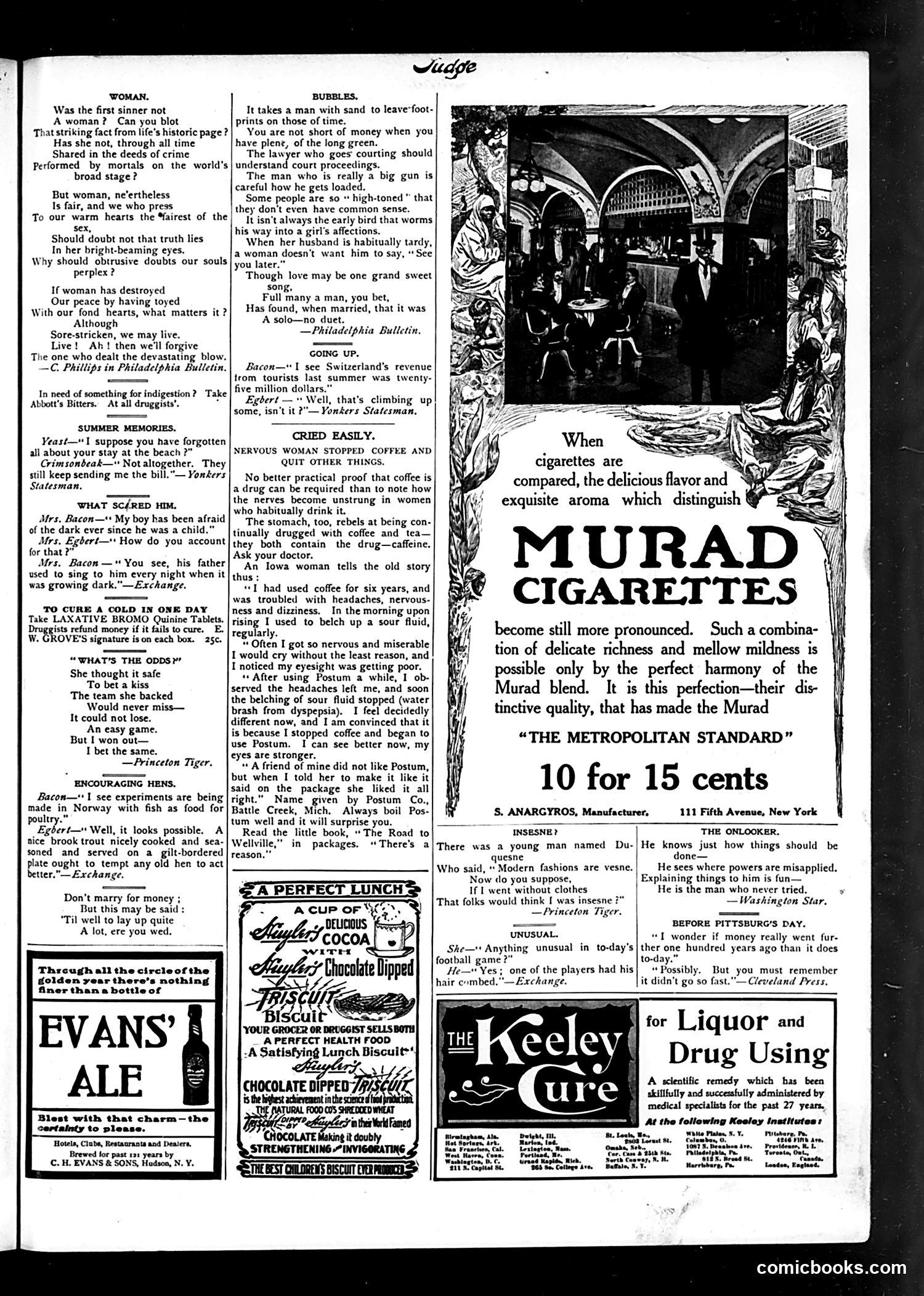
This page from *Judge* (a satirical American magazine) mixes editorial humor with period advertisements. The main content includes: **Editorial Humor ("Mudge" section):** Brief, cynical observations on relationships, ambition, and human nature—typical satirical quips targeting bourgeois pretension and romantic folly. **Sidebar jokes** feature characters named Bacon and Egbert exchanging witty exchanges about beach bills, father's terrible singing, Norwegian fish for poultry, and Swiss tourism—light social satire with no specific political target. **Advertisements** dominate the lower half: Murad cigarettes (emphasizing "delicate richness"), Evans Ale, Huyler's cocoa and biscuits, and a "Keeley Cure" for alcohol/drug addiction—reflecting early 1900s consumer culture and social anxieties. **A prominent anecdote** about an Iowa woman quitting coffee due to nervousness reflects period anxieties about caffeine and women's "delicate" constitutions—a common health concern of the era. The page reflects *Judge*'s formula: satirize everyday middle-class life while advertising consumer products to that same audience.
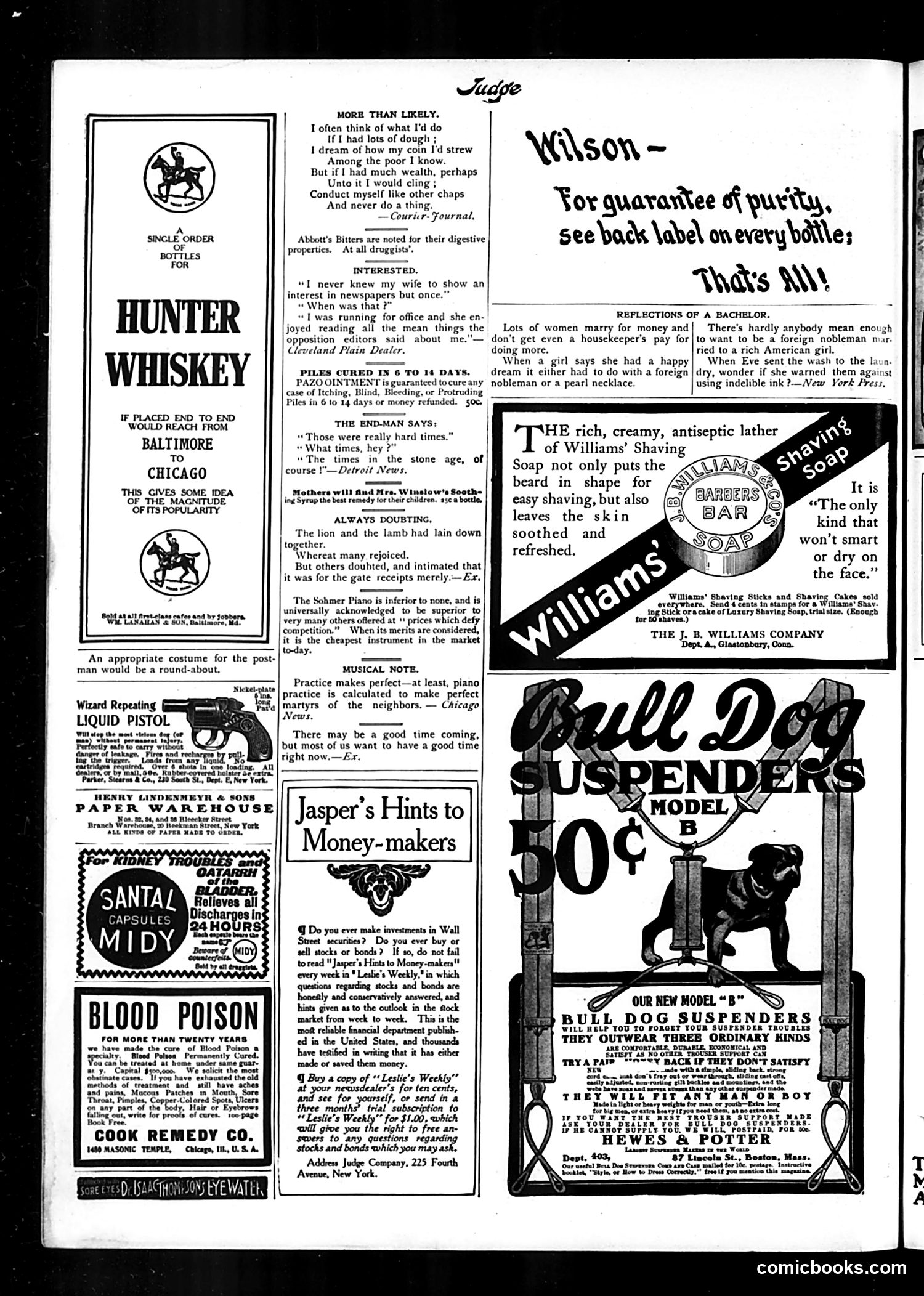
This page is primarily **advertising**, typical of Judge magazine's format. The satirical content consists of brief humorous columns rather than visual cartoons. The **text humor** includes social commentary: - A poem about daydreaming of wealth while admitting one would likely become stingy like everyone else - A husband noting his wife only reads newspapers to enjoy negative coverage of his political opponents - Jokes about the "hard times" of the Stone Age and skepticism about the biblical lion-and-lamb reconciliation (suggesting doubt about miraculous claims) - "Bachelor reflections" mocking women who marry for money but receive poor treatment, and poking fun at foreign nobleman fantasies The **advertisements** reflect early 1900s concerns: Hunter Whiskey (promoting volume/popularity), blood poison treatments (likely syphilis), a liquid pistol toy, piano quality, and Williams' Shaving Soap. The satire targets everyday human nature—greed, hypocrisy, courtship motives, and consumer gullibility—rather than specific political figures or events.
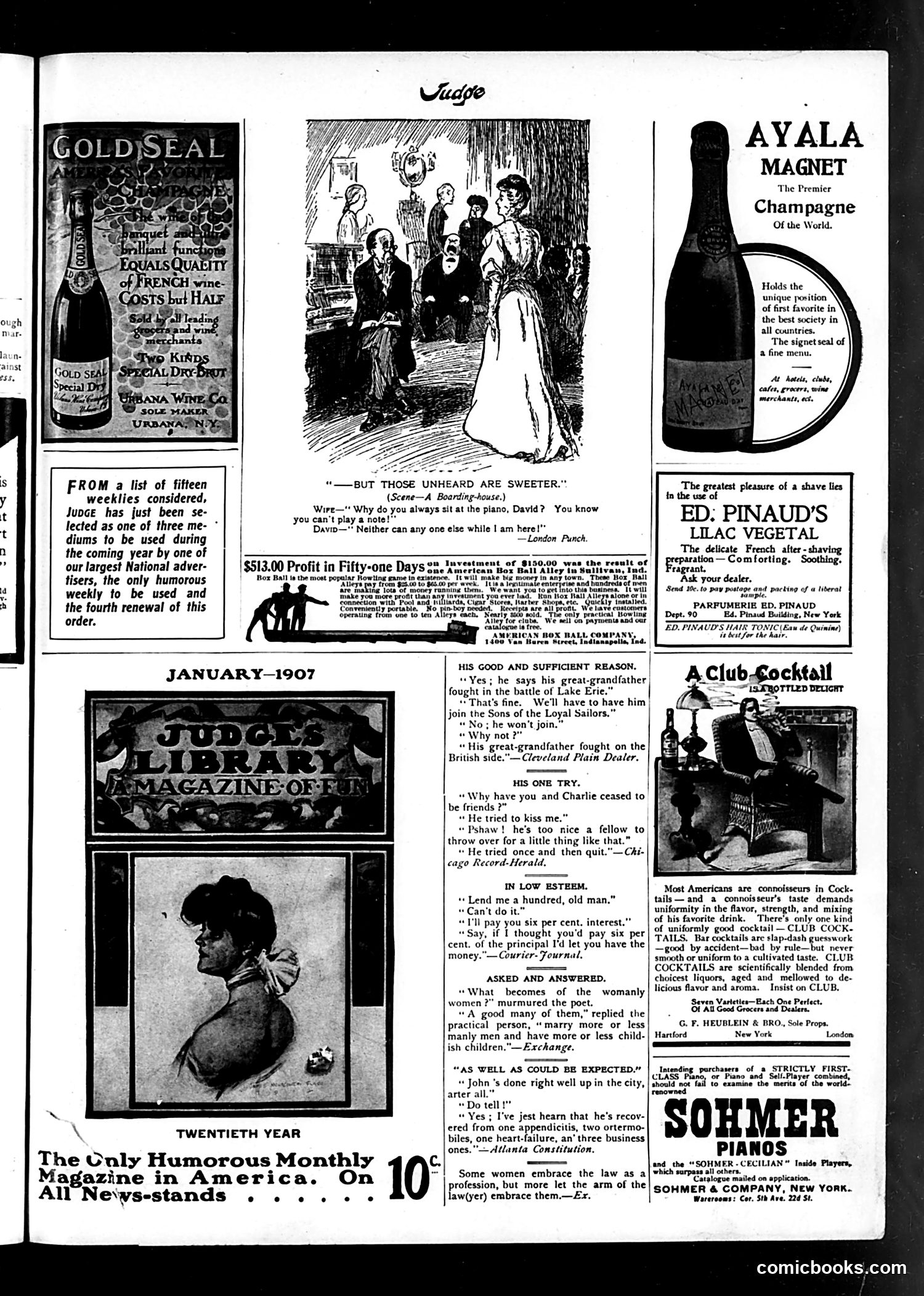
This page from *Judge* (January 1907) is primarily **advertisements and humorous short jokes** rather than political cartoons. The central cartoon shows a boarding-house scene where a man sits at the piano claiming he plays badly—the joke being he keeps others from playing (and bothering everyone with worse music). This is a mild domestic humor piece from *London Punch*. The page is dominated by **period product advertisements**: Gold Seal wine, Ayala champagne, Ed. Pinaud's shaving products, Box Ball alleys, Club Cocktails, and Sohmer pianos. These ads reflect turn-of-the-century consumer goods. The scattered short jokes mock everyday situations: military lineage claims, failed friendships, loan refusals, and health mishaps. None reference specific political figures or events. The masthead announces *Judge*'s "twentieth year" as "the only humorous monthly magazine in America," claiming recognition as an advertising medium—essentially a self-promotional page emphasizing the magazine's credibility and reach among affluent readers who bought champagne, pianos, and cocktails.
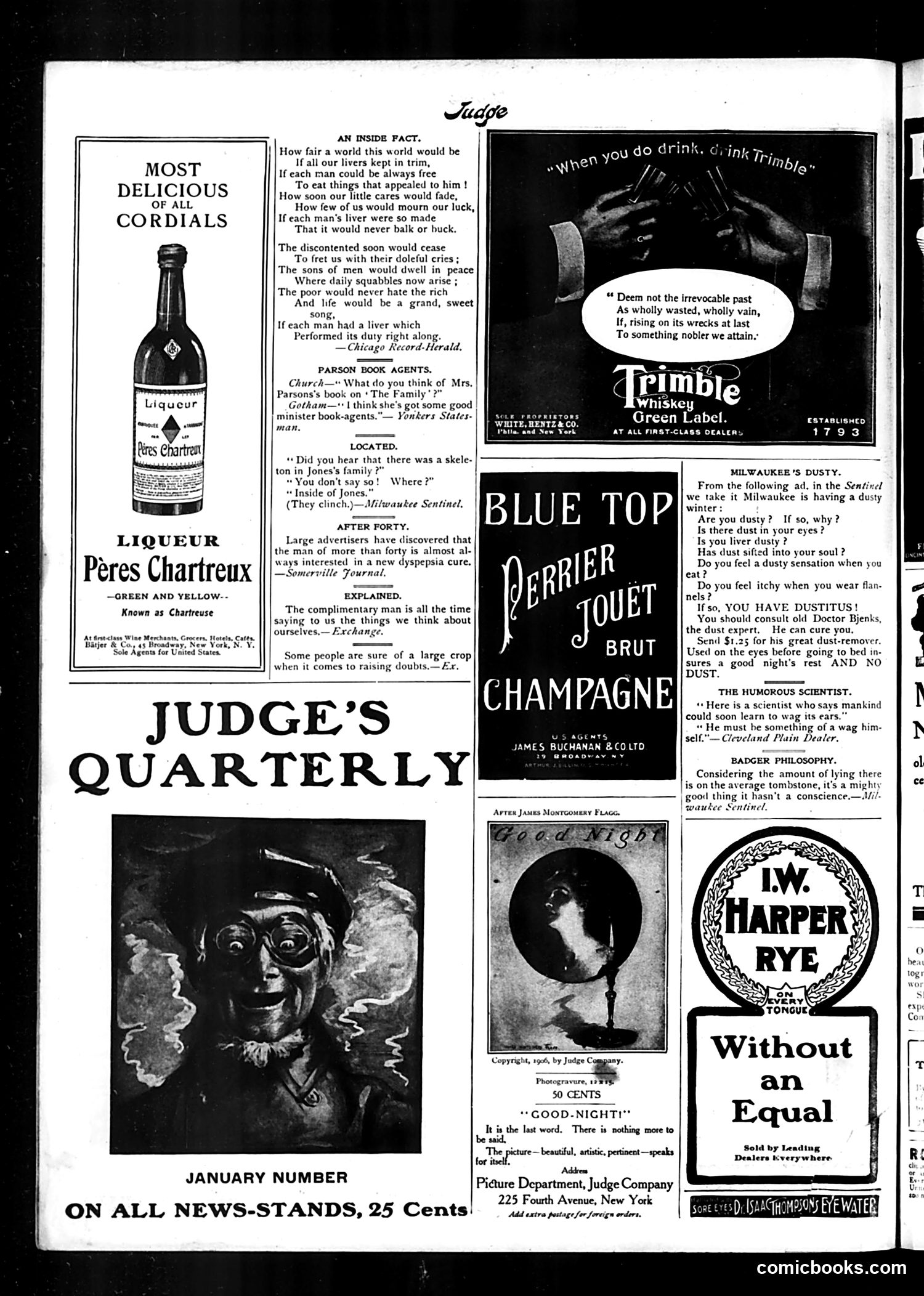
This page is primarily **advertising and filler content** rather than political satire. It consists of: **Main advertisements** for alcoholic beverages (Chartreuse liqueur, Perrier-Jouët champagne, I.W. Harper rye whiskey, Trimble whiskey) — typical for Judge magazine's revenue model. **"Judge's Quarterly"** announcement for the January number at 25 cents. **Small humorous items and jokes** filling space, including: - A poem about liver health ("if each man's liver were so made / That it would never balk or buck") - Brief anecdotes about parsons, skeletons in families, and advertisers targeting dyspeptic men over forty - A "Milwaukee's Dusty" satire mocking a local dust-removal advertisement - Commentary on tombstone lying and scientific ear-wagging The **social context**: these snippets reflect turn-of-century American preoccupations with digestive health, domestic propriety, and advertising excess—typical Judge magazine fare. The page shows how satirical magazines subsidized their content through liquor advertising during the pre-Prohibition era.
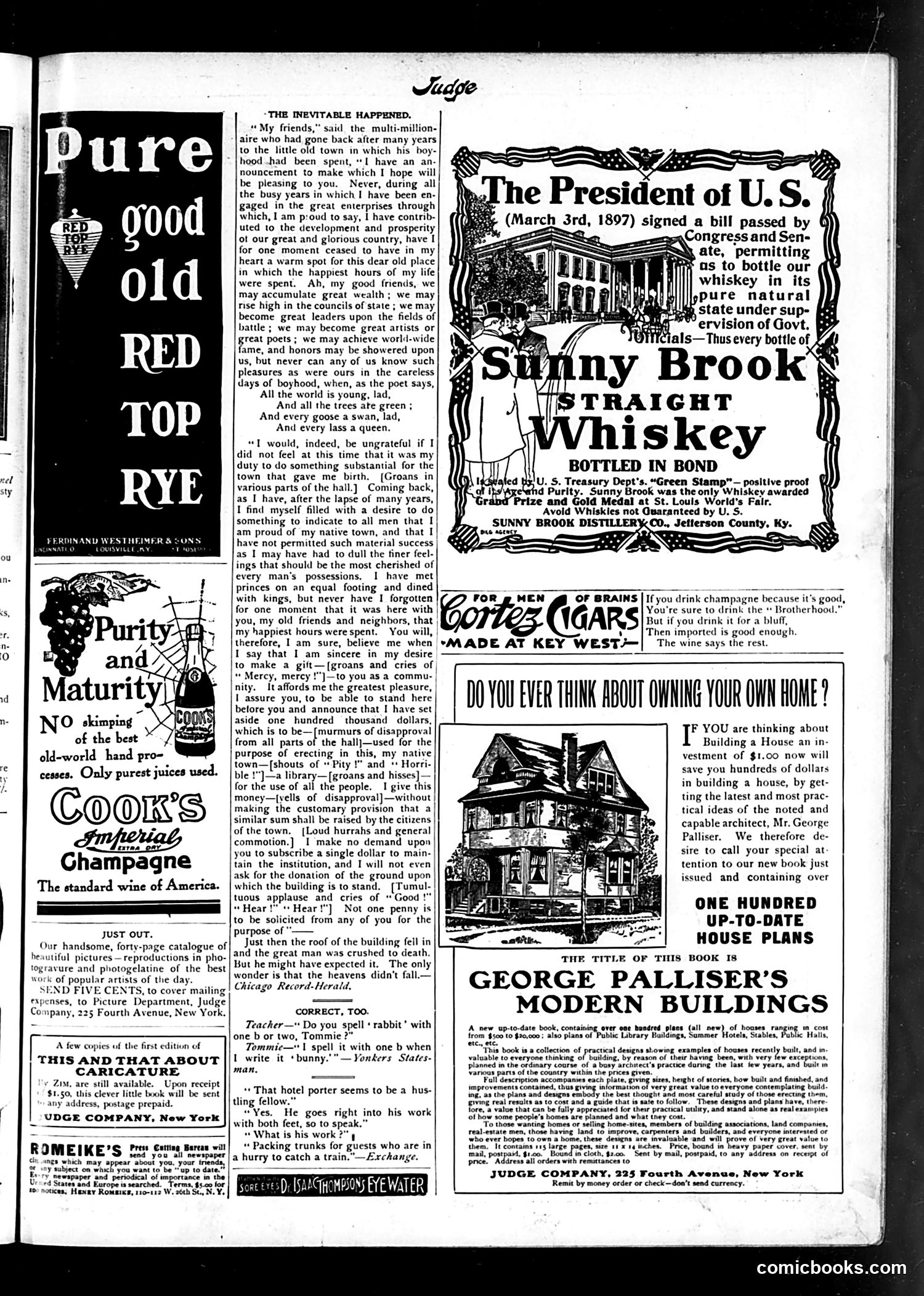
This text piece satirizes wealthy industrialists of the Gilded Age who return to their hometowns seeking acclaim through philanthropic gestures. The millionaire's speech perfectly captures the self-congratulatory tone of such figures: he boasts of dining with kings and influencing national development, then announces a "generous" gift of $100,000 for a public library. The satire's humor lies in the *audience reaction*—constant groans, cries of "Mercy!" and "Pity!"—revealing public skepticism toward such displays. The townspeople recognize his rhetoric as hollow: the donation benefits his ego more than the community. By publishing the speech with these interruptions, Judge mocks how wealthy philanthropists used public gifts as monuments to themselves while often extracting tax benefits or naming rights, presenting charity as personal achievement rather than genuine community service.
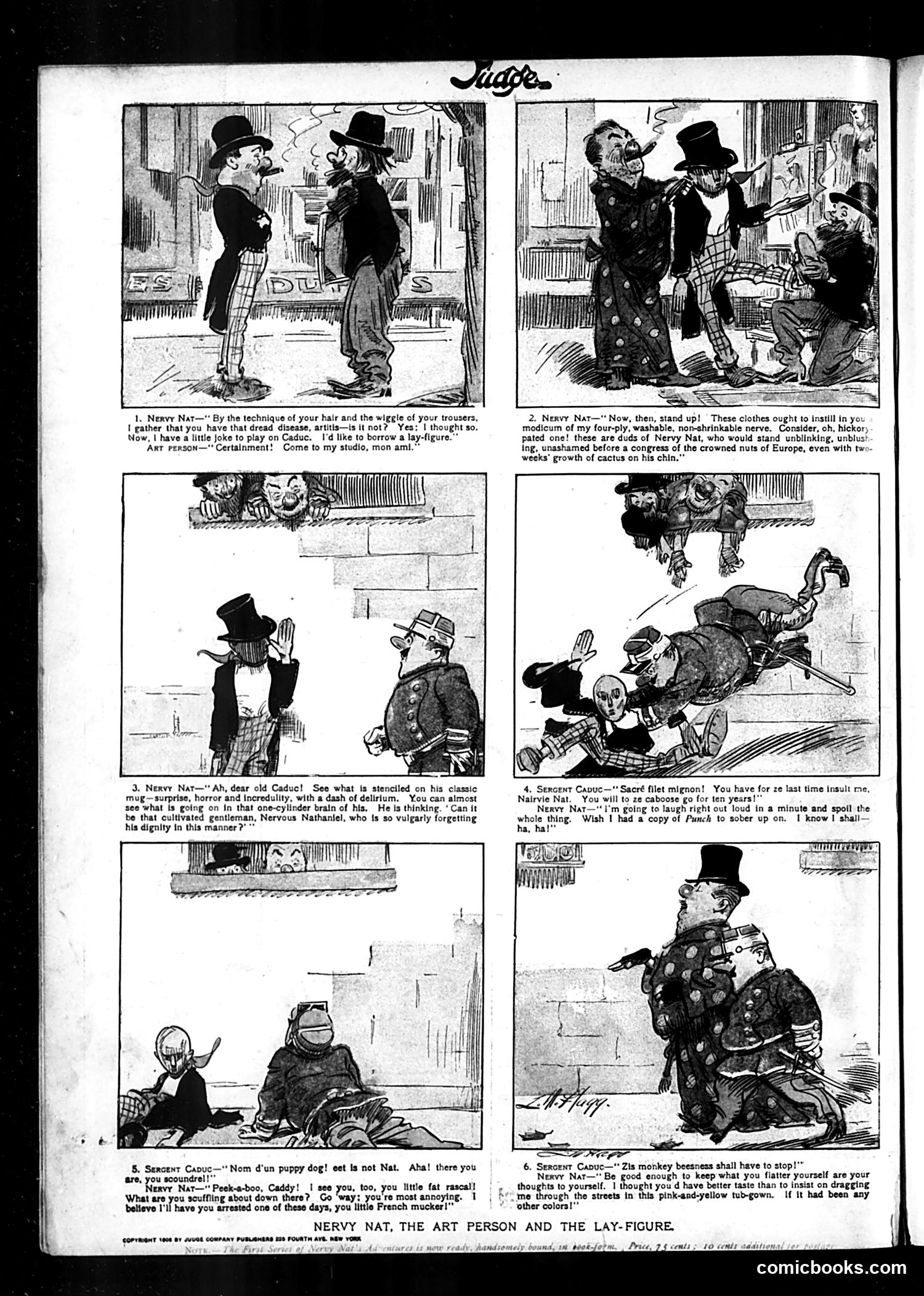
This is a six-panel comic strip satirizing a character named "Nervy Nat," an irreverent American art student or bohemian type. The strip depicts his pranks involving a French art instructor (Caduc) and a lay-figure—a wooden artist's mannequin used in studios for drawing practice. The humor centers on Nervy Nat's deliberate disrespect: he borrows the lay-figure to mock Caduc's appearance, dresses it in outlandish clothes, and generally torments the exasperated French instructor with pranks and insults. The strip plays on period stereotypes of "artistic" Americans as undisciplined pranksters, contrasted against dignified (if easily flustered) European authority figures. The satire mocks American irreverence toward Old World formality, while Caduc's fractured English ("sacré," "beesness") reinforces ethnic caricature typical of 1908 Judge humor.