
Judge, 1907-01-05 · page 6 of 16
Judge — January 5, 1907 — page 6: what you’re looking at
What you’re looking at
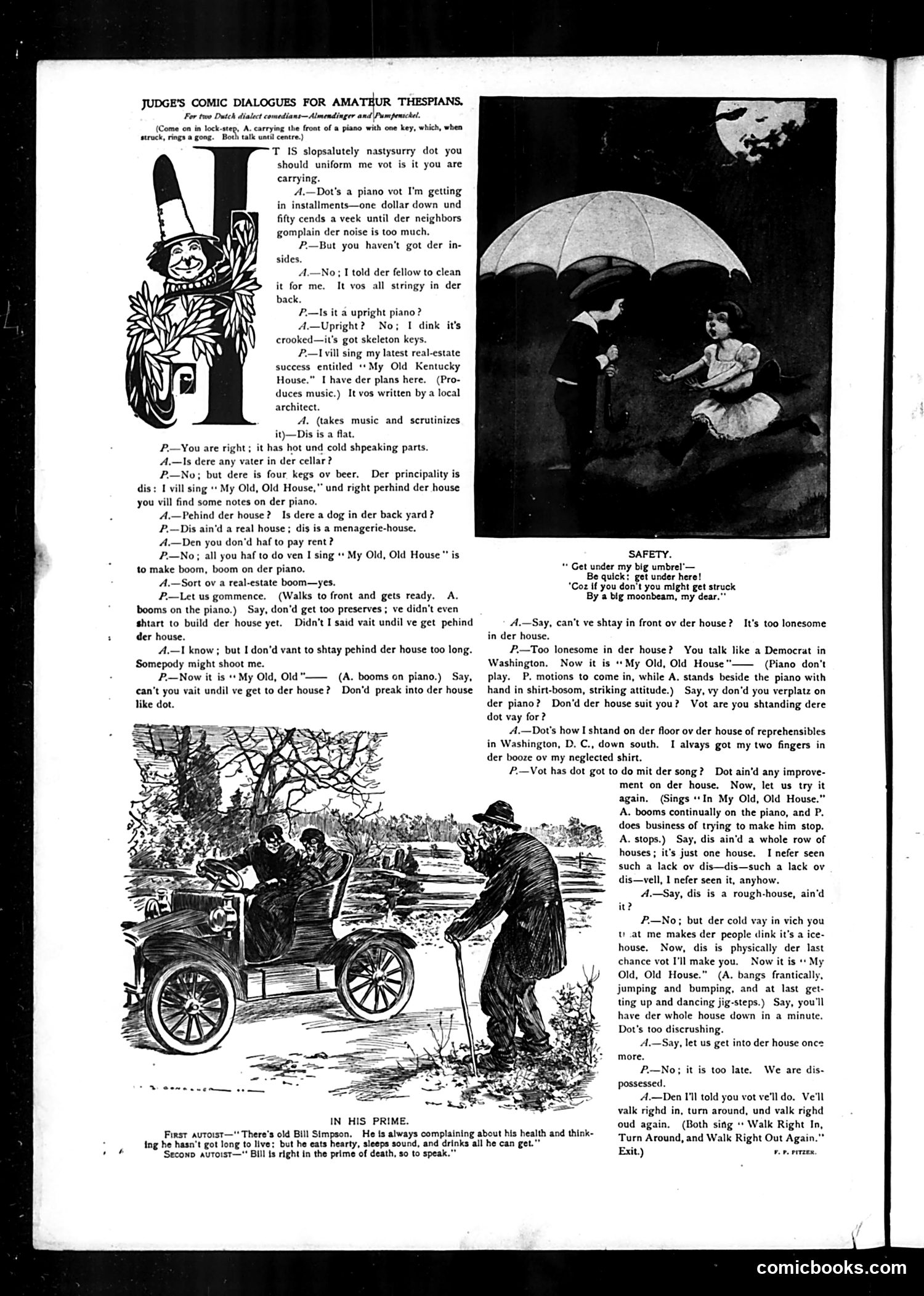
This page features ethnic comedy sketches in the "Dutch dialect" style popular in early 20th-century American vaudeville. Two performers (labeled A and P) speak in exaggerated German-accented English ("slopsalutely," "vot," "dink"), a common theatrical stereotype of German immigrants. The main sketch mocks both the characters' ignorance and the real-estate boom. They perform a song called "My Old, Old House" while one bangs a broken piano to create sound effects—the physical comedy relies on slapstick and malapropisms. References to "Democrats in Washington" and "reprehensibles" suggest light political jabs typical of Judge magazine's satirical tone. The secondary cartoon "In His Prime" jokes darkly about an elderly hypochondriac (Bill Simpson) constantly complaining about his health while actually thriving. The "Safety" caption features a woman offering umbrella shelter from "moonbeams"—absurdist humor common to the era. This represents mainstream American entertainment's casual ethnic stereotyping of the period.
📄 Transcribed text from this page (OCR, searchable)
Machine-transcribed from the original scan — historical spelling and the odd misread are preserved.
JUDGE'S COMIC DIALOGUES FOR AMATHUR THESPIANS, For two Dutch dialect comedians—Almendinger im penachel. (Come on in lock-step, A. carrying the front of a piano with one key, which, when struck, rings a gong. Both talk until centre.) T IS slopsalutely nastysurry dot you should uniform me vot is it you are carrying. A.—Dot's a piano vot I'm getting in installments—one dollar down und fifty cends a veek until der neighbors gomplain der noise is too much, P.—But you haven't got der in- sides. -No; I told der fellow to clean it for me. It vos all stringy in der back. P.—Is it a upright piano? A—Upright? No; I dink it's crooked—it's got skeleton keys. P.—Lvill sing my latest real-estate success entitled «My Old Kentucky House.” I have der plans here. (Pro- duces music.) It vos written by a local architect. A. (takes music and scrutinizes it)—Dis is a flat. P—You are right; it has hot und cold shpeaking parts. Is dere any vater in der cellar? >No; but dere is four kegs ov beer. Der principality is dis: I vill sing «* My Old, Old House,” und right perhind der house you vill find some notes on der piano. A.—Pehind der house? Is dere a dog in der back yard? P.—Dis ain‘d a real house ; dis is a menagerie-house. A.—Den you don‘d haf to pay rent? P.—No; all you haf to do ven I sing «* My Old, Old House" is to make boom, boom on der piano. A.—Sort ov a real-estate boom—yes. P—Let us gommence. (Walks to front and gets ready. A. booms on the piano.) Say, don'd get too preserves ; ve didn’t even shtart to build der house yet. Didn't I said vait undil ve get pehind der house. A.—I know ; but I don’d vant to shtay pehind der house too long. Somepody might shoot me. P—Now it is “My Old, Old"—— (A. booms on piano.) Say, can't you vait undil ve get to der house? Don'd preak into der house like dot. an ree IN HIS PRIME. First autoist—"' There's old Bill Simpson. ‘Second autoist—"' Bill {s right in the prime of death, so to speak.” He is always complaining about his health and think- Ing he hasn't got long to live: but he eats hearty, sleeps sound, and drinks all he can get." SAFETY. " Get under my big umbre!” Be quick? get under here! *Coz if you don't you might get struck By a big moonbeam, my dear." A.—Say, can’t ve shtay in front ov der house? It's too lonesome in der house. P.—Too lonesome in der house? You talk like a Democrat in Washington. Now it is “My Old, Old House"—— (Piano don't play. P. motions to come in, while A. stands beside the piano with hand in shirt-bosom, striking attitude.) Say, vy don‘d you verplatz on der piano? Don'd der house suit you? Vot are you shtanding dere dot vay for? A.—Dot's how I shtand on der floor ov der house of reprehensibles in Washington, D. C., down south. I alvays got my two fingers in der booze ov my neglected shirt. P.—Vot has dot got to do mit der song? Dot ain’d any improve- ment on der house. Now, let us try it again. (Sings “In My Old, Old House.” A. booms continually on the piano, and P. does business of trying to make him stop. A. stops.) Say, dis ain'’d a whole row of houses ; it’s just one house. Inefer seen such a lack ov dis—dis—such a lack ov dis—vell, I nefer seen it, anyhow. A.—Say, dis is a rough-house, ain'd it? P.—No; but der cold vay in vich you ty at me makes der people dink it’s a ice- house. Now, dis is physically der last chance vot I'll make you. Now it is * My Old, Old House.” (A. bangs frantically, jumping and bumping, and at last get- ting up and dancing jig-steps.) Say, you'll have der whole house down in a minute. Dot's too discrushing. A.—Say, let us get into der house once more. P.—No; possessed. A.—Den I'll told you vot ve'll do, Ve'll valk righd in, turn around, und valk righd oud again, (Both sing * Walk Right In, Turn Around, and Walk Right Out Again.” Exit.) it is too late. We are dis- vom prrzex. comicbooks.com