
Judge, 1907-01-05 · page 3 of 16
Judge — January 5, 1907 — page 3: what you’re looking at
What you’re looking at
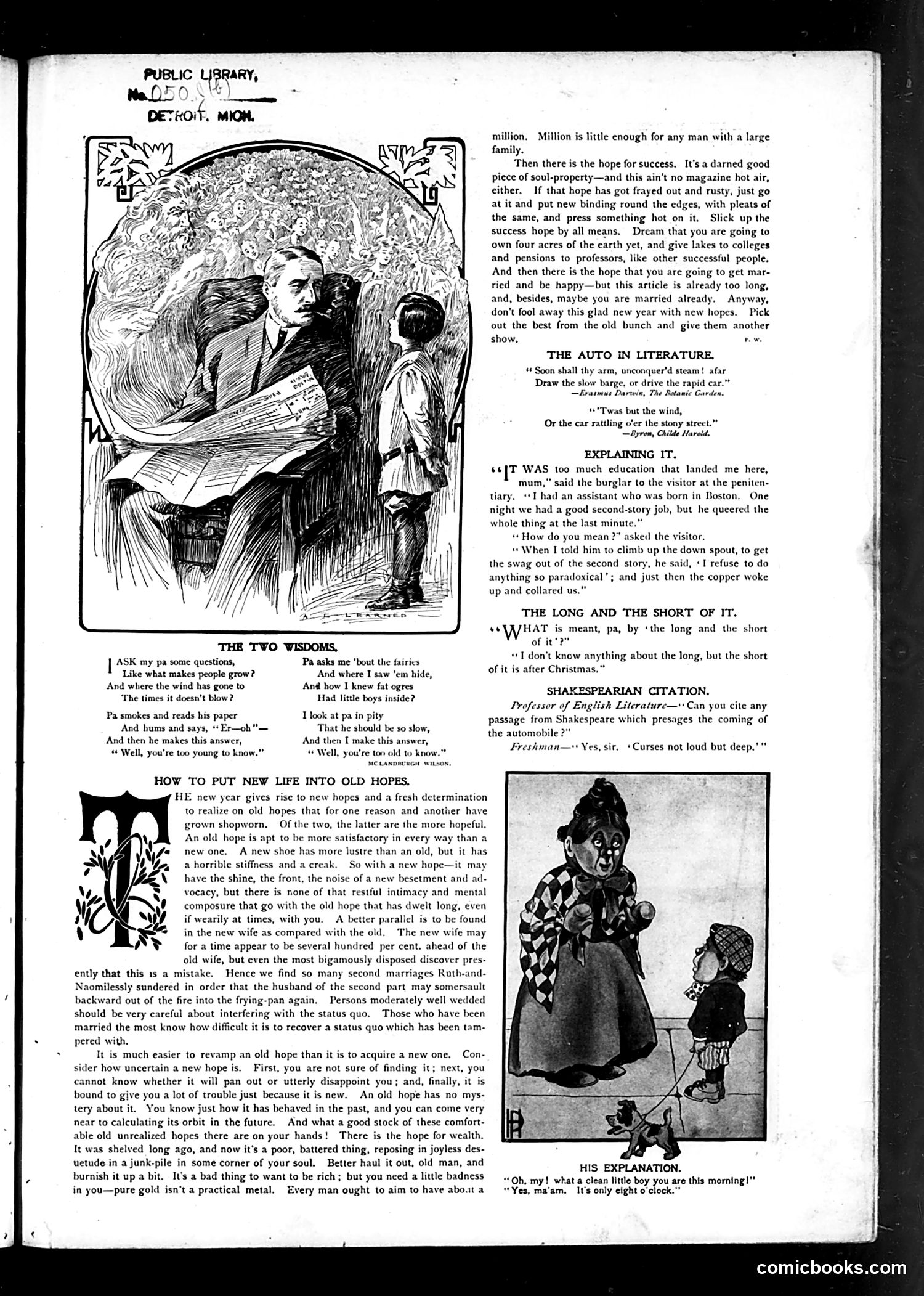
This page contains several distinct items: **"The Two Wisdoms"** (top left): A poem contrasting childlike curiosity with adult concerns, illustrated with a sketch of what appears to be a father figure and child. **"The Auto in Literature"** section: Literary quotes about automobiles, suggesting early 1900s fascination with this new technology. **"How to Put New Life into Old Hopes"** (main article): A lengthy essay about renewing one's optimism and expectations in the new year, addressing the psychological difficulty of maintaining hope and the challenges of second marriages. **"His Explanation"** (bottom right): A small cartoon showing a boy explaining to his mother why he's late, with the caption "Oh my! what a clean little boy you are this morning!" / "Yes, ma'am. It's only eight o'clock." The page reflects early 1900s concerns about modernization, psychology, and domestic life.
📄 Transcribed text from this page (OCR, searchable)
Machine-transcribed from the original scan — historical spelling and the odd misread are preserved.
PUBLIC LIBRARY mOMG Pa asks me ‘bout the fairies And where I saw ‘em hide, And how I knew fat ogres Had little boys inside? [ 455 my pa some questions, Like what makes people grow? ‘And where the wind has gone to The times it doesn't blow? I look at pa in pity That he should be so slow, And then I make this answer, “Well, you're ton old to know." MCLANDAUEGH WILSON. HOW TO PUT NEW LIFE INTO OLD HOPES. HE new year gives rise to new hopes and a fresh determination to realize on old hopes that for one reason and another have grown shopworn, Of the two, the latter are the more hopeful. An old hope is apt to be more satisfactory in every way than a new one. A new shoe has more lustre than an old, but it has a horrible stiffness and a creak, So with a new hope—it may have the shine, the front, the noise of a new besetment and ad- vocacy, but there is none of that restful intimacy and mental composure that go with the old hope that has dwelt long, even if wearily at times, with you. A better parallel is to be found in the new wife as compared with the old. The new wife may for a time appear to be several hundred per cent. ahead of the old wife, but even the most bigamously disposed discover pres- ently that this 1s a mistake. Hence we find so many second marriages Ruth-and- Naomilessly sundered in order that the husband of the second part may somersault backward out of the fire into the frying-pan again, Persons moderately well wedded should be very careful about interfering with the status quo, Those who have been married the most know how difficult it is to recover a status quo which has been tam- pered with. It is much easier to revamp an old hope than it is to acquire a new one. Con- sider how uncertain a new hope is. First, you are not sure of finding it; next, you cannot know whether it will pan out or utterly disappoint you; and, finally, it is bound to give you a lot of trouble just because it is new. An old hope has no mys- tery about it. You know just how it has behaved in the past, and you can come very near to calculating its orbit in the future. And what a good stock of these comfort- able old unrealized hopes there are on your hands! There is the hope for wealth. It was shelved long ago, and now it’s a poor, battered thing, reposing in joyless des- uetude in a junk-pile in some corner of your soul. Better haul it out, old man, and burnish it up a bit. It’s a bad thing to want to be rich; but you need a little badness in you—pure gold isn't a practical metal. Every man ought to aim to have about a Pa smokes and reads his paper And hums and says, Er—oh"— And then he makes this answer, “Well, you're too young to know." x million. family. Then there is the hope for success. It's a darned good piece of soul-property—and this ain't no magazine hot air, either. If that hope has got frayed out and rusty, just go at it and put new binding round the edges, with pleats of the same, and press something hot on it. Slick up the success hope by all means. Dream that you are going to own four acres of the earth yet, and give lakes to colleges and pensions to professors, like other successful people. And then there is the hope that you are going to get mar- ried and be happy—but this article is already too long, and, besides, maybe you are married already. Anyway, don't fool away this glad new year with new hopes. Pick out the best from the old bunch and give them another show, Million is little enough for any man with a large THE AUTO iN LITERATURE. “Soon shall thy arm, unconquer’d steam! afar Draw the slow barge, or drive the rapid car. Erasmus Darwin, The Botanic Garden, «Twas but the wind, Or the car rattling o'er the stony street." — Byrom, Childe Harold. EXPLAINING IT. 46] T WAS too much education that landed me here, mum,” said the burglar to the visitor at the peniten- tiary. “Thad an assistant who was born in Boston. One night we had a good second-story job, but he queered the whole thing at the last minute.” + How do you mean 2” asked the visitor. “When I told him to climb up the down spout, to get the swag out of the second story, he said, ‘I refuse to do anything so paradoxical’; and just then the copper woke up and collared us.” THE LONG AND THE SHORT OF IT. S6\JHAT is meant, pa, by ‘the long and the short wire I don’t know anything about the long, but the short of it is after Christmas.” SHAKESPEARIAN CITATION. Professor of English Literature—Can you cite any passage from Shakespeare which presages the coming of the automobile ?” Freshman—« Yes, sir. ‘Curses not loud but deep." HIS EXPLANATION. “Oh, my! what a clean little boy you are this morning!" Yes, ma'am. It's only eight o'clock.” comicbooks.com