
A complete issue · 16 pages · 1906
Judge — December 15, 1906
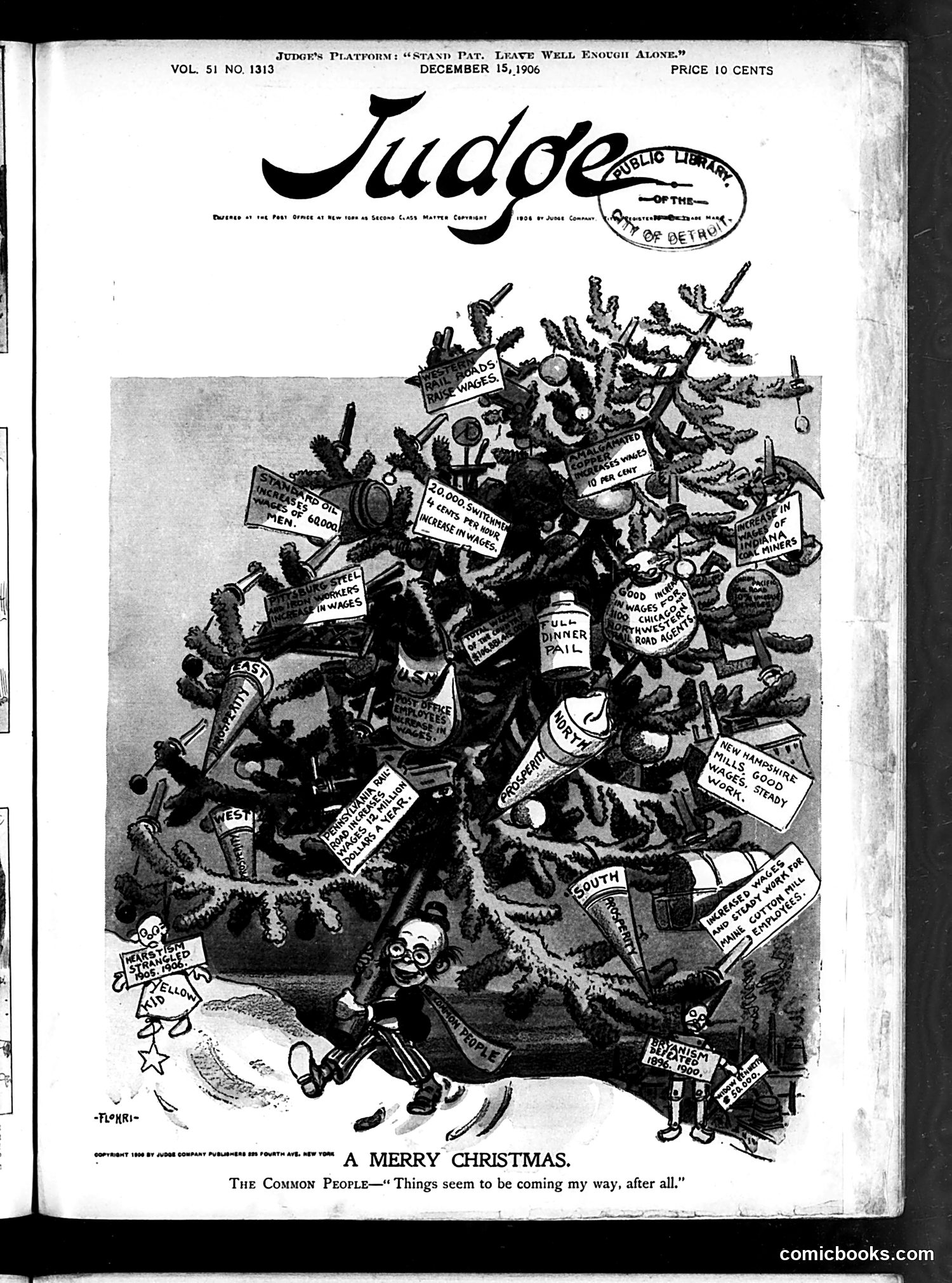
This cartoon depicts "The Common People" optimistically climbing a chaotic pile of industrial and labor-related demands. The figure at the bottom—representing the average worker—navigates past tangled signs referencing wages, working conditions, steel workers' demands, railroad workers' concerns, and various employment issues of the early 1900s. The satire suggests that working-class Americans faced a confusing maze of competing labor disputes and economic pressures during the Progressive Era. The Christmas caption—"Things seem to be coming my way, after all"—appears ironic, implying the common person's naive hope amid genuine hardship and labor unrest. The cartoon critiques both the complexity of industrial problems and the working person's limited ability to navigate them.
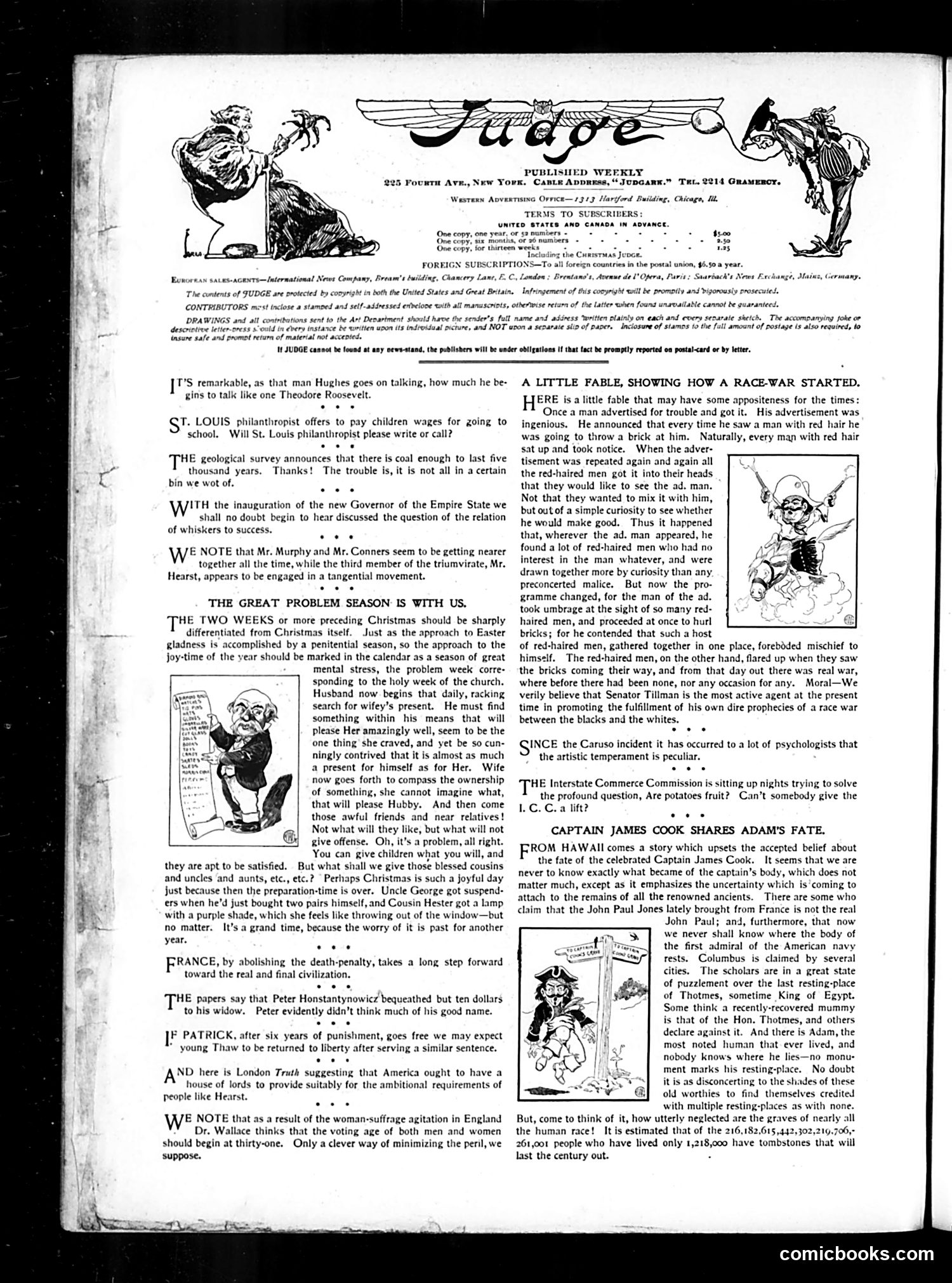
This page contains several short satirical commentaries and editorial cartoons typical of Judge's weekly format. The main cartoon "A Little Fable, Showing How a Race-War Started" depicts a man advertising that he'll throw bricks at anyone with red hair. The satire mocks how small provocations and individual prejudices can escalate into larger group conflicts—a commentary on racial or ethnic tensions of the era. Additional brief items mock contemporary figures and situations: a philanthropist offering low wages, geological surveys, and political appointments. The cartoons use exaggeration and absurdist humor to critique social hypocrisy, class exploitation, and how minor incidents can balloon into major disputes through mob mentality—suggesting Judge's skepticism toward sensationalism and prejudice-driven conflict. The specific historical context and identities of some referenced figures remain unclear from this page alone.
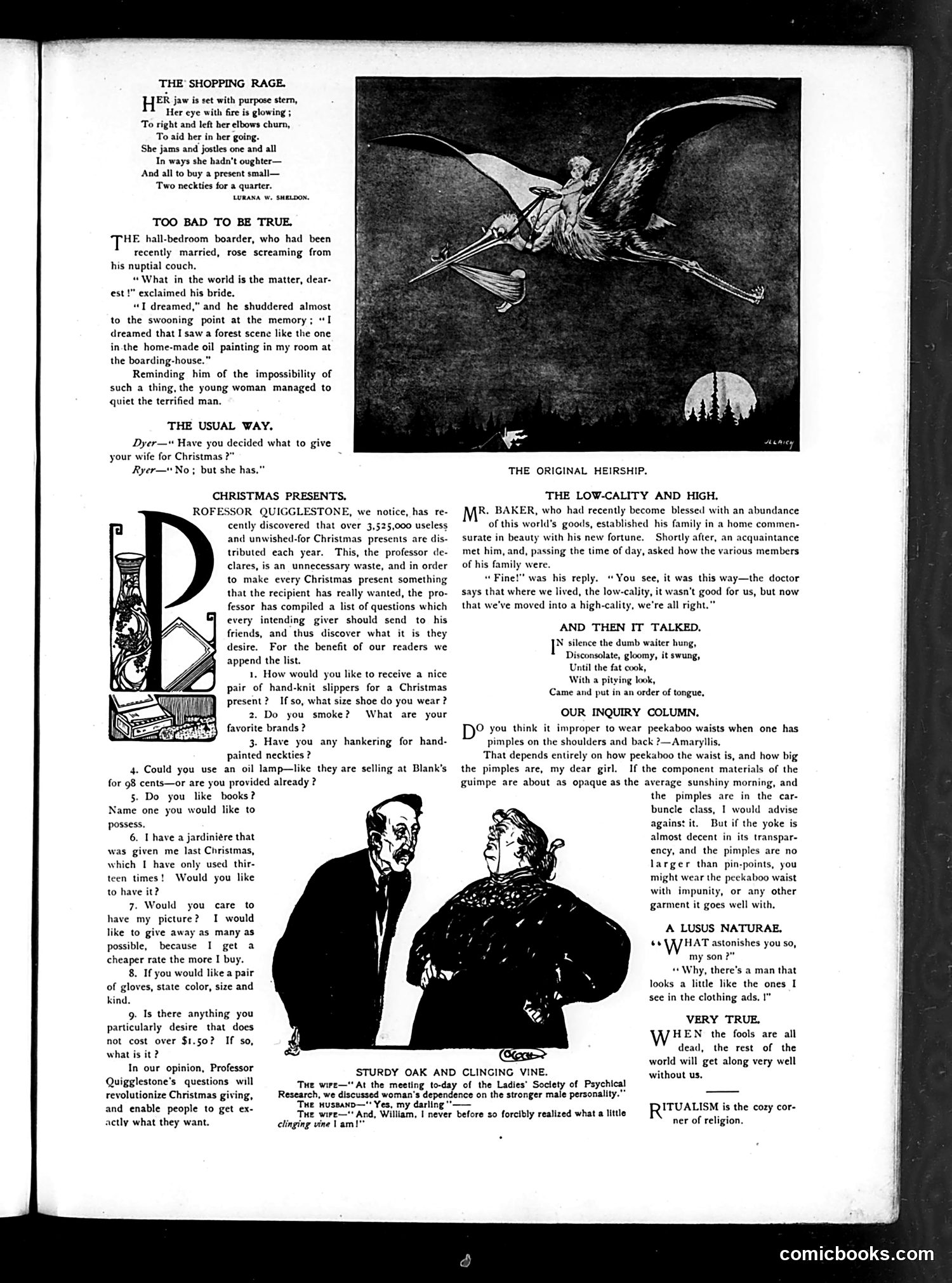
This page contains several satirical pieces and an advice column rather than a single cohesive political cartoon. The main illustrated cartoon, "STURDY OAK AND CLINGING VINE," depicts a husband and wife at a Ladies' Society of Psychical Research meeting. The satire targets contemporary gender dynamics and the emerging pseudoscience of psychical research (spiritualism). The "sturdy oak" husband represents traditional masculinity, while the "clinging vine" wife represents dependent femininity. The joke mocks both the husband's claimed independence and the wife's psychological dependence on the "stronger male personality"—suggesting such relationship dynamics are theatrical rather than genuine. The other content includes humorous advice columns and lists of Christmas gift suggestions, reflecting early 20th-century consumer culture and domestic life satire.
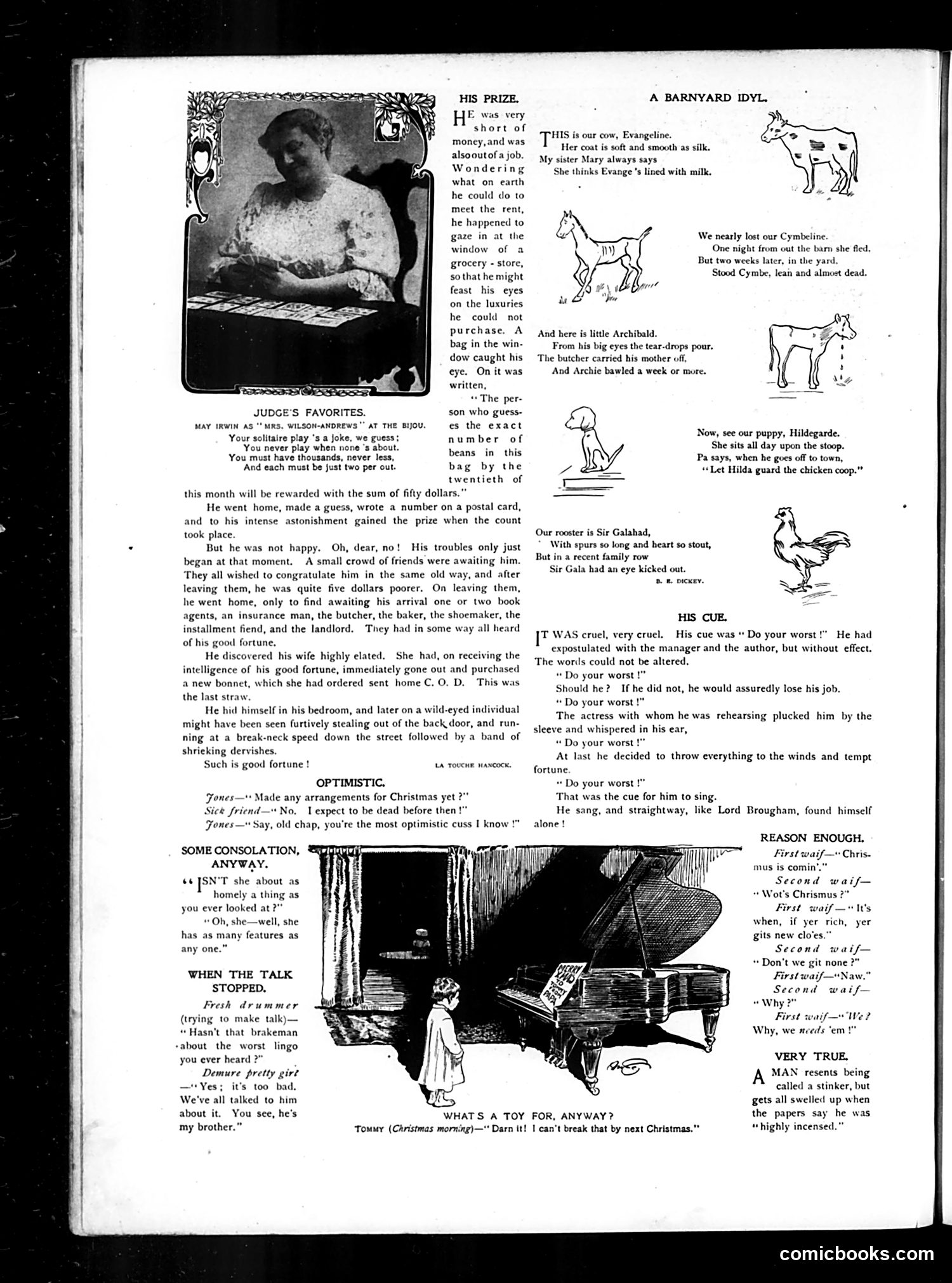
The page contains several discrete satirical pieces rather than one unified cartoon. **"His Prize"** (top left): Shows a man examining lottery winnings, illustrating the story of someone who won money but struggled to spend it wisely—a commentary on sudden fortune and poor decision-making among the working class. **"A Barnyard Idyl"** (right): A humorous illustrated poem about farm animals, apparently unrelated to political satire. **"His Cue"** and other sections present domestic comedies and wordplay jokes typical of Judge's humor. **"What's a Toy for, Anyway?"** (center): A piano scene satirizing Christmas gift-giving, suggesting impractical or absurd present choices. The page demonstrates Judge's mix of social satire, domestic humor, and illustrated jokes rather than focused political commentary on specific events or figures.
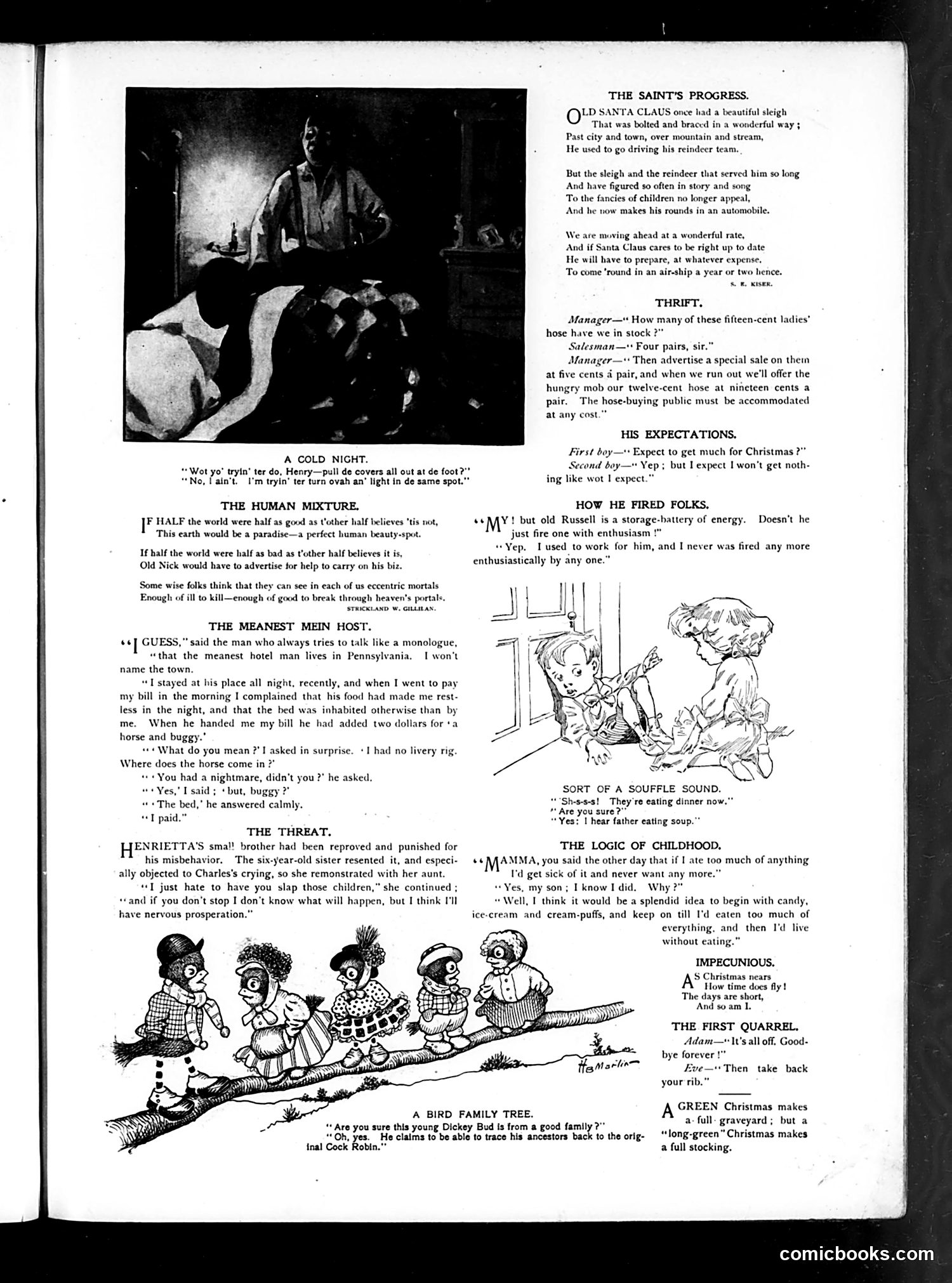
This page contains miscellaneous humor pieces and illustrations rather than focused political cartoons. The content includes: **"A Cold Night"** - A domestic scene joke about heating arrangements. **"A Bird Family Tree"** - A cartoon showing five bird characters in a line, with a caption joking that "young Dickey Bud" traces his ancestry back to the original "Cock Robin," referencing the nursery rhyme. **Various humorous sections** titled "The Saint's Progress," "Thrift," and "His Expectations" — brief satirical pieces about Christmas preparations, retail sales tactics, and children's holiday hopes. The overall tone is genteel, family-oriented satire typical of Judge's era, focusing on domestic life, social customs, and consumer culture rather than sharp political commentary. No specific political figures or events appear referenced on this page.
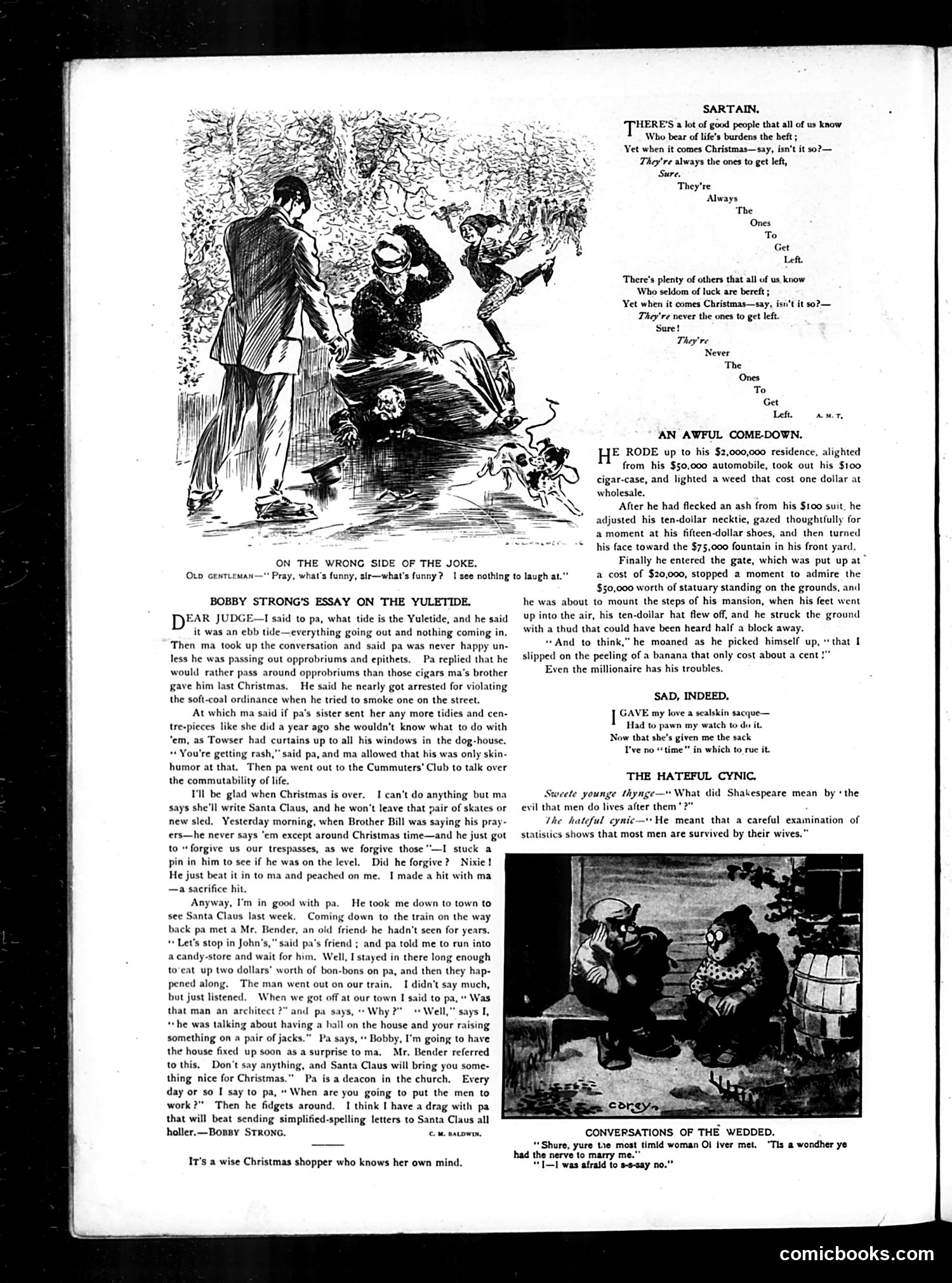
This page contains three satirical pieces typical of early 20th-century American humor: **"On the Wrong Side of the Joke"** (top cartoon): An elegantly dressed gentleman asks a street beggar to explain what's funny—the joke being that the wealthy man, despite his refinement, fails to understand humor while the poor man possesses it. Social commentary on class blindness. **"Bobby Strong's Essay on the Yuletide"**: A child's humorous letter describing his family's cynicism about Christmas. His father makes dark jokes about "ebb tide" (money flowing out), complains about terrible cigars from relatives, and his brother proves unforgiving despite prayer. The satire targets adult hypocrisy during the holiday season and consumerism. **"An Awful Come-Down"**: A wealthy man obsesses over expensive possessions (mansion, automobile, cigar case, suit) while his actual necktie costs only ten dollars and shoes fifteen dollars—the joke being his pathetic attempt at thrift amid extravagance. Mocks nouveau riche pretension and economic anxiety. The overall theme: hypocrisy and class consciousness during Christmas.
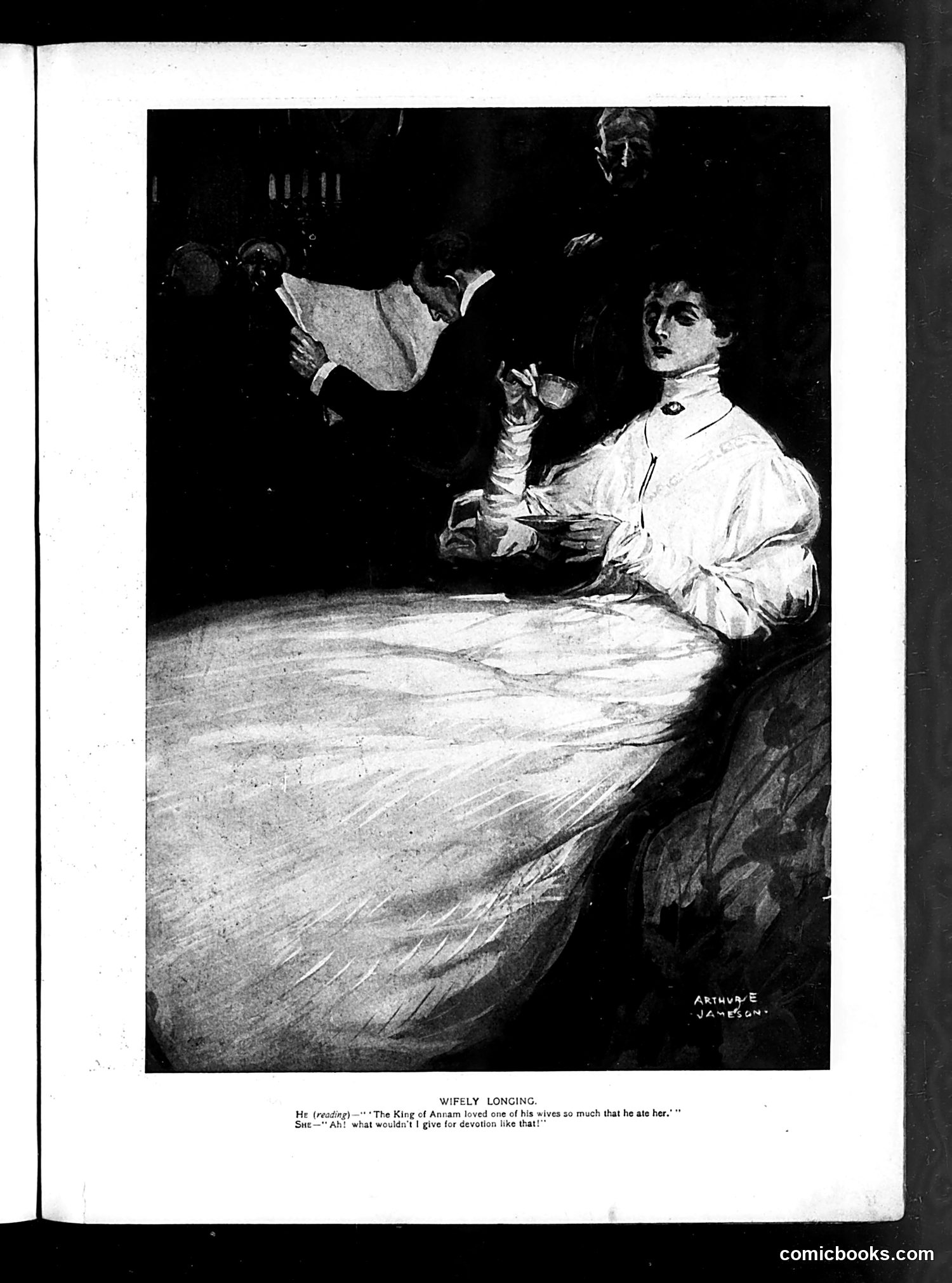
This cartoon satirizes extreme marital devotion through dark humor. It depicts a woman gazing wistfully at a scene showing the King of Annam (a French colonial territory in Vietnam) with his wife, referencing a literal or legendary account of the king consuming his beloved spouse as the ultimate expression of love. The joke mocks contemporary expectations of wifely sacrifice and devotion by presenting cannibalism as the logical extreme—the woman's envious exclamation "what wouldn't I give for devotion like that!" absurdly suggests she'd welcome such fatal commitment from her own husband. The satire critiques both the romanticization of self-sacrificial love and Western fascination with exotic (and often exaggerated or fabricated) accounts of non-Western royal behavior, which Judge's audience would have found simultaneously shocking and titillating.
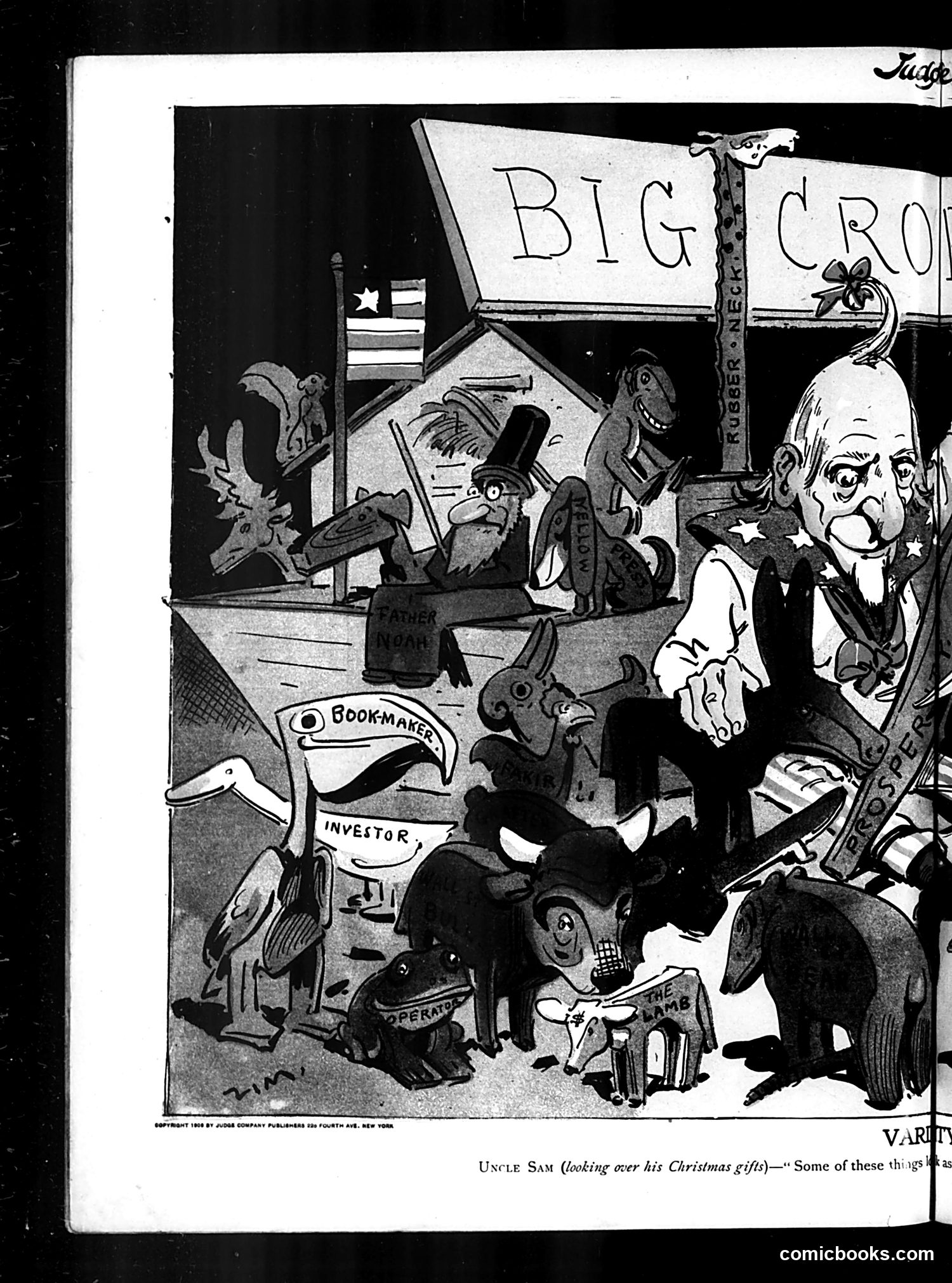
This Judge magazine cartoon depicts Uncle Sam examining Christmas gifts—likely representing problematic investments or financial schemes. The exaggerated caricatured figures in the circus-like "Big Crowd" setting appear to represent financial operators and speculators. Visible labels include "Bookmaker," "Investor," and "Operator," suggesting the cartoon satirizes fraudulent or questionable financial practices. The exotic animals and carnival atmosphere reinforce the sense of this being a con or scam. The figure on the right, drawn with crude caricature typical of the era, likely represents a specific financial operator or politician involved in schemes that affected ordinary Americans. The satire criticizes how citizens were being duped by dubious financial ventures—a recurring theme in Judge's social commentary on American commerce and politics.
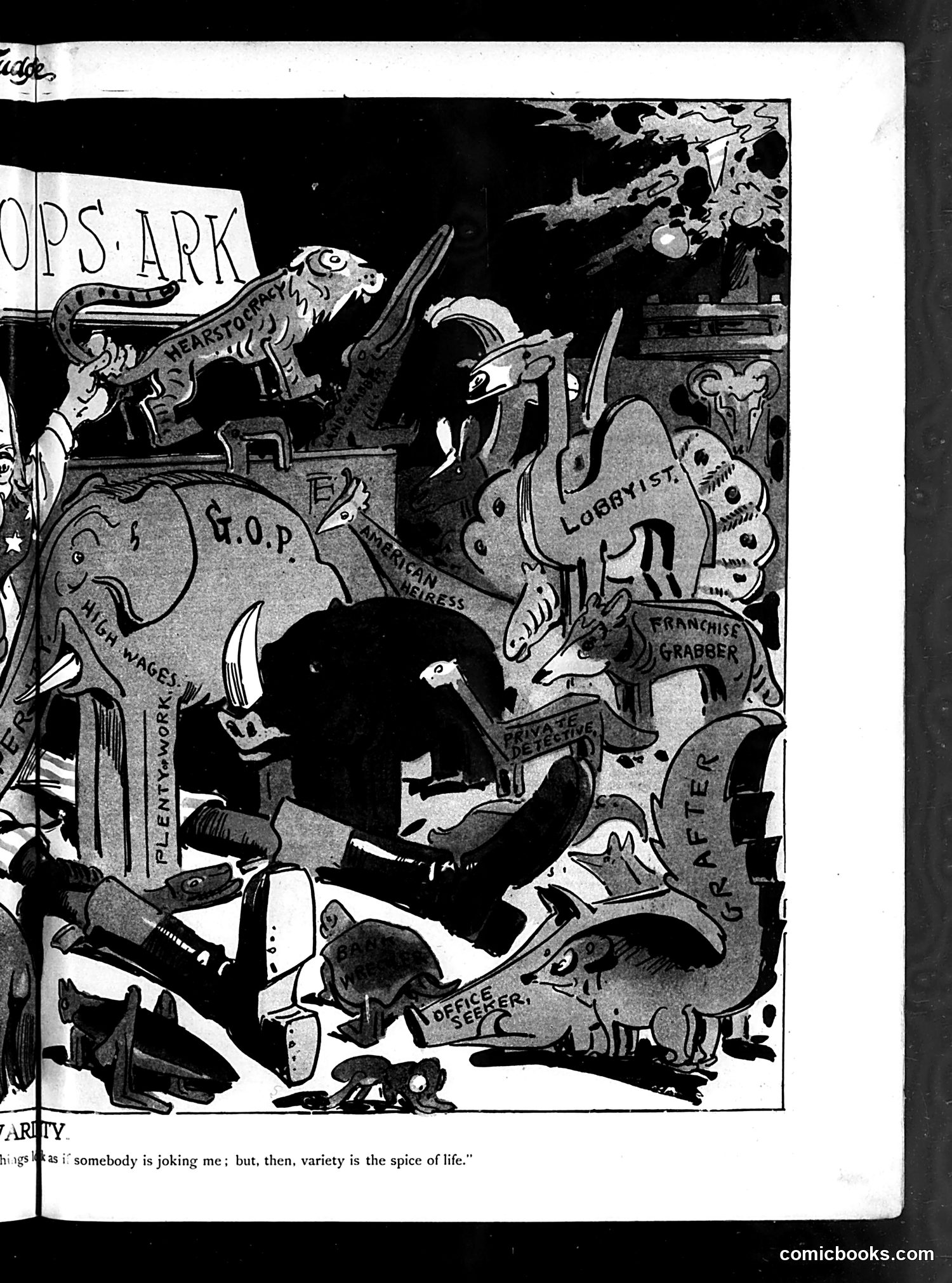
This is a satirical cartoon depicting the Republican Party (G.O.P.) as a chaotic beast surrounded by various political pressures and internal conflicts. The elephant—the traditional GOP symbol—appears overwhelmed and beleaguered by labeled antagonists including "Lobbyist," "Franchise Grabber," "Private Citizen," and references to "High Wages" and other economic concerns. The cartoon satirizes the party's struggle to manage competing interests: business lobbies, labor issues, and public demands. The creatures attacking or clinging to the elephant represent different factions pulling the party in conflicting directions. The caption suggests ironic acceptance of political chaos—implying that despite these contradictions, variety keeps politics interesting. This appears to be early-20th-century commentary on Republican Party fragmentation during the Progressive Era, when the party faced significant internal divisions over economic policy and regulation.
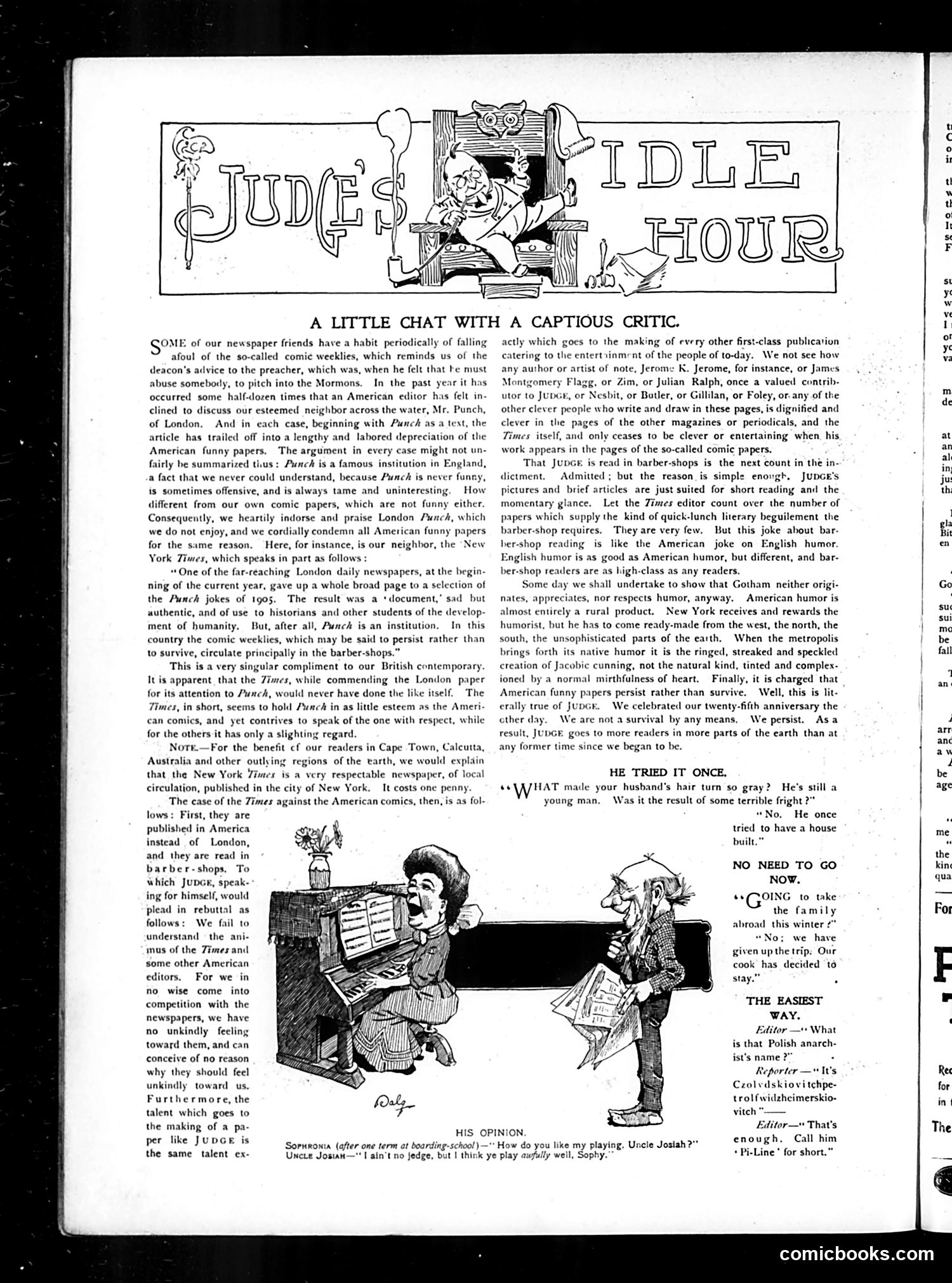
This page is Judge magazine's satirical defense against criticism from *The New York Times*. The Times had recently praised London's *Punch* magazine while dismissing American comic weeklies as mere "barber-shop" reading—implying they're lowbrow and disposable. Judge's editor responds with pointed irony: he notes that the Times itself shows no real respect for *Punch*, merely using it to appear cultured while dismissing American competitors. The rebuttal argues that Judge employs the same caliber of talent (naming Jerome K. Jerome and James Montgomery Flagg) as any "first-class publication." The cartoon at bottom depicts an Uncle Josiah figure praising a girl's piano playing as "awful"—a visual joke about untrained judgment, perhaps mirroring the Times's own critical credibility. The core satire: American newspapers display snobbish cultural insecurity, praising British institutions reflexively while dismissing homegrown talent.
This page from *Judge* magazine contains several short humorous pieces and advertisements typical of early 20th-century American satire. **"Teddy's Tour"** appears to be the main cartoon-related content. It celebrates President Theodore Roosevelt's forthcoming visit to Panama, likely during his inspection of the Canal construction. The poem uses Roosevelt's famous direct, no-nonsense character as satire—depicting him arriving to cut through bureaucratic "red tape" and demand accountability. References to "Gordian knots" (cutting through complexity) and "pink-tea function" (mocking effete formality) emphasize Roosevelt's reputation for aggressive, hands-on leadership and impatience with ceremony. The other pieces are brief joke columns poking fun at everyday situations: a schoolteacher's European travels, marital finances, medical pretension, and age misrepresentation—standard *Judge* humor targeting middle-class anxieties and vanity. The remainder consists largely of period advertisements for soap, pianos, cigars, and patent medicines—typical magazine filler of the era.
This page from *Judge* (a satirical weekly) contains mostly **advertisements and entertainment content** rather than political cartoons with social commentary. **Main Content:** The top features **"The Worldly Poet,"** a light verse celebrating winners over losers—likely satirizing sentimental poetry that romanticizes failure. It's purely humorous wordplay, not political satire. Below are **several domestic humor jokes** ("Receipted Bills at Last," "A Logical Pace") about married life and mundane situations—standard magazine filler of the era. The **bulk of the page advertises Judge Company's photogravure pictures** ("With This Ring I Thee Wed," "The Poacher," etc.), offering story pictures for children and promotional engagement ring photos. There's also advertising for **Hunter Whiskey** and **Barker Brand collars**. **For modern readers:** This represents how early 1900s magazines blended satire, domestic humor, and commerce. The content is primarily commercial rather than politically pointed—reflecting *Judge's* evolution toward lifestyle magazine rather than hard-hitting social commentary.
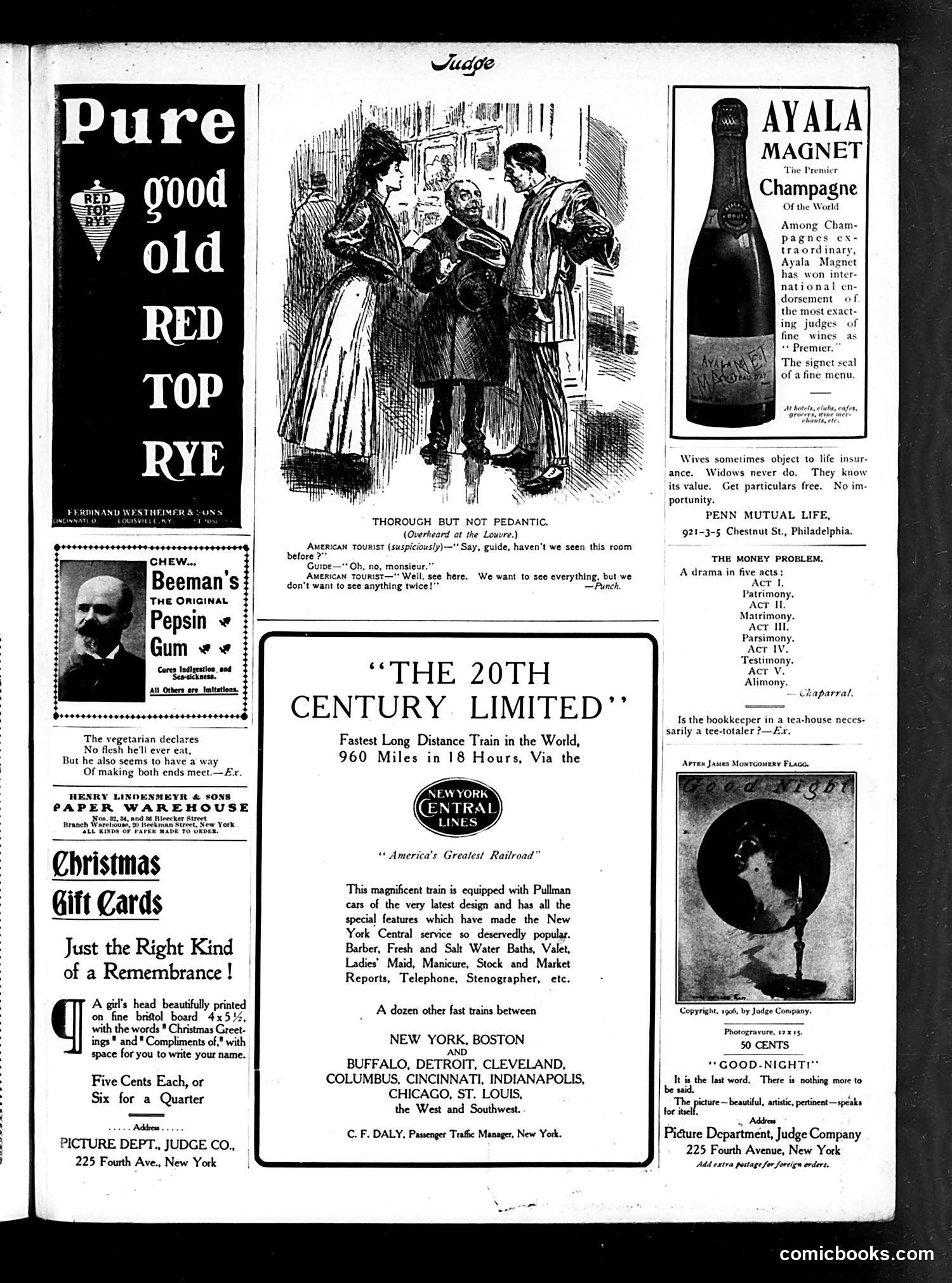
This page from *Judge* magazine consists primarily of **advertisements and filler content** rather than substantive editorial material. The main cartoon, "Thorough but Not Pedantic," depicts an **American tourist at the Louvre in Paris** complaining to a French guide that they've seen the same room twice. The joke satirizes American tourists' obsessive desire to "see everything" efficiently while avoiding repetition—mocking both their impatience and literal-mindedness about sightseeing. The page's dominant feature is a large advertisement for the **"20th Century Limited" train**, promoted as "America's Greatest Railroad" by the New York Central Lines. This reflects the era's fascination with modern rail travel and luxury transportation. Other content includes a brief joke about vegetarians ("making both ends meet") and advertisements for chewing gum, champagne, life insurance, and Christmas gift cards—typical commercial fare for a satirical magazine of this period. The page offers little political or social commentary beyond gentle mockery of American tourists abroad.
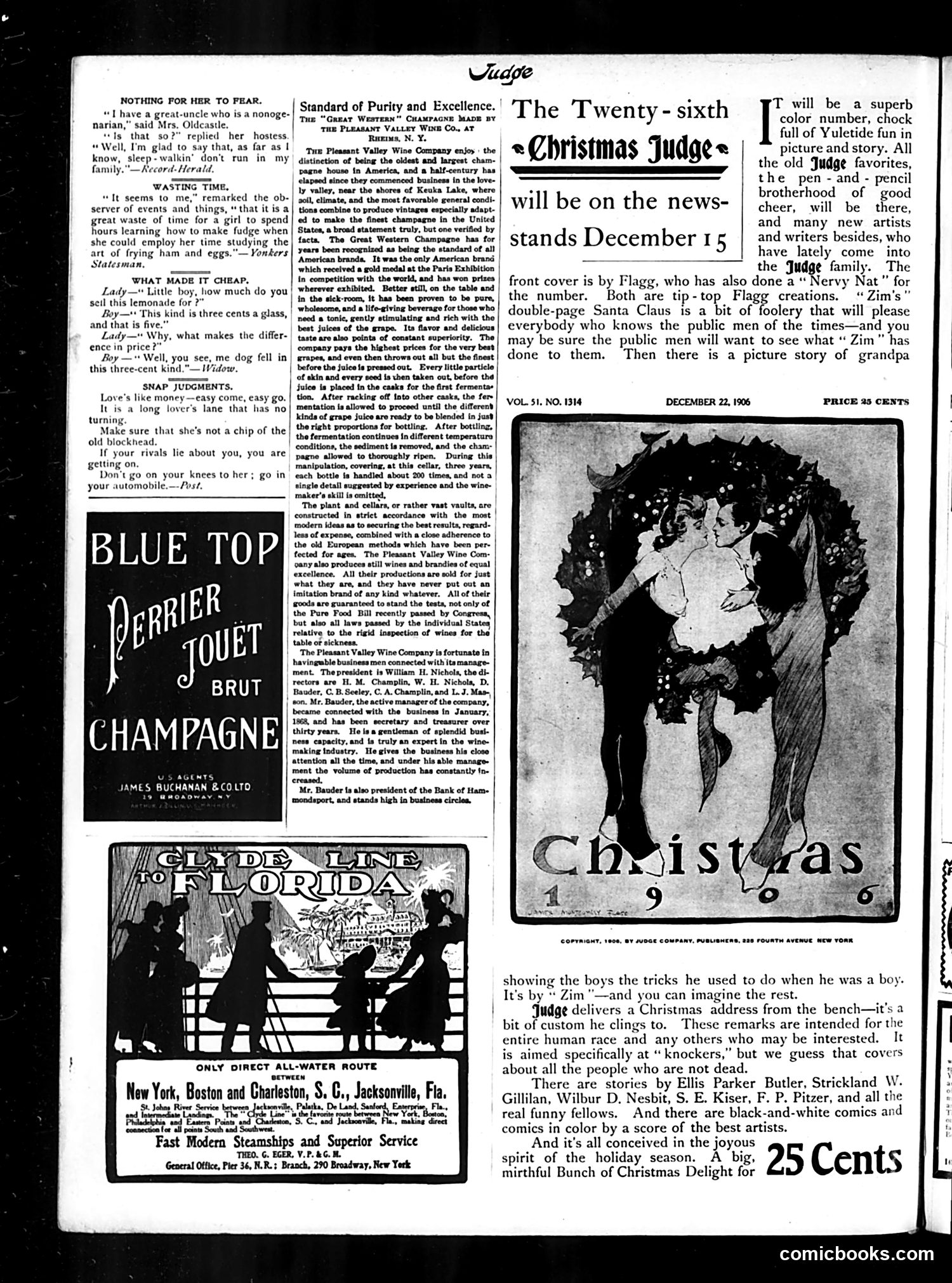
This page is primarily **advertising and holiday content** rather than political satire. The dominant feature is the "Twenty-sixth Christmas Judge" cover announcement, featuring a festive illustration of Santa Claus and children. The small items under "Snap Judgments" are light social humor about romance and courtship (typical Judge fare)—nothing politically pointed. The longer champagne advertisement for Pleasant Valley Wine Company occupies substantial space with detailed production claims. The page includes scattered short jokes about domestic life: one about a nonagenarian who doesn't sleepwalk, another about a girl wasting time learning to make fudge when she could study cooking, and a boy's lemonade pricing scheme. **Context for modern readers**: This reflects early 1900s concerns (food safety, wine quality standards following recent Pure Food legislation) and gender expectations (girls learning domestic skills). The overall tone is lighthearted, consumer-focused holiday material.
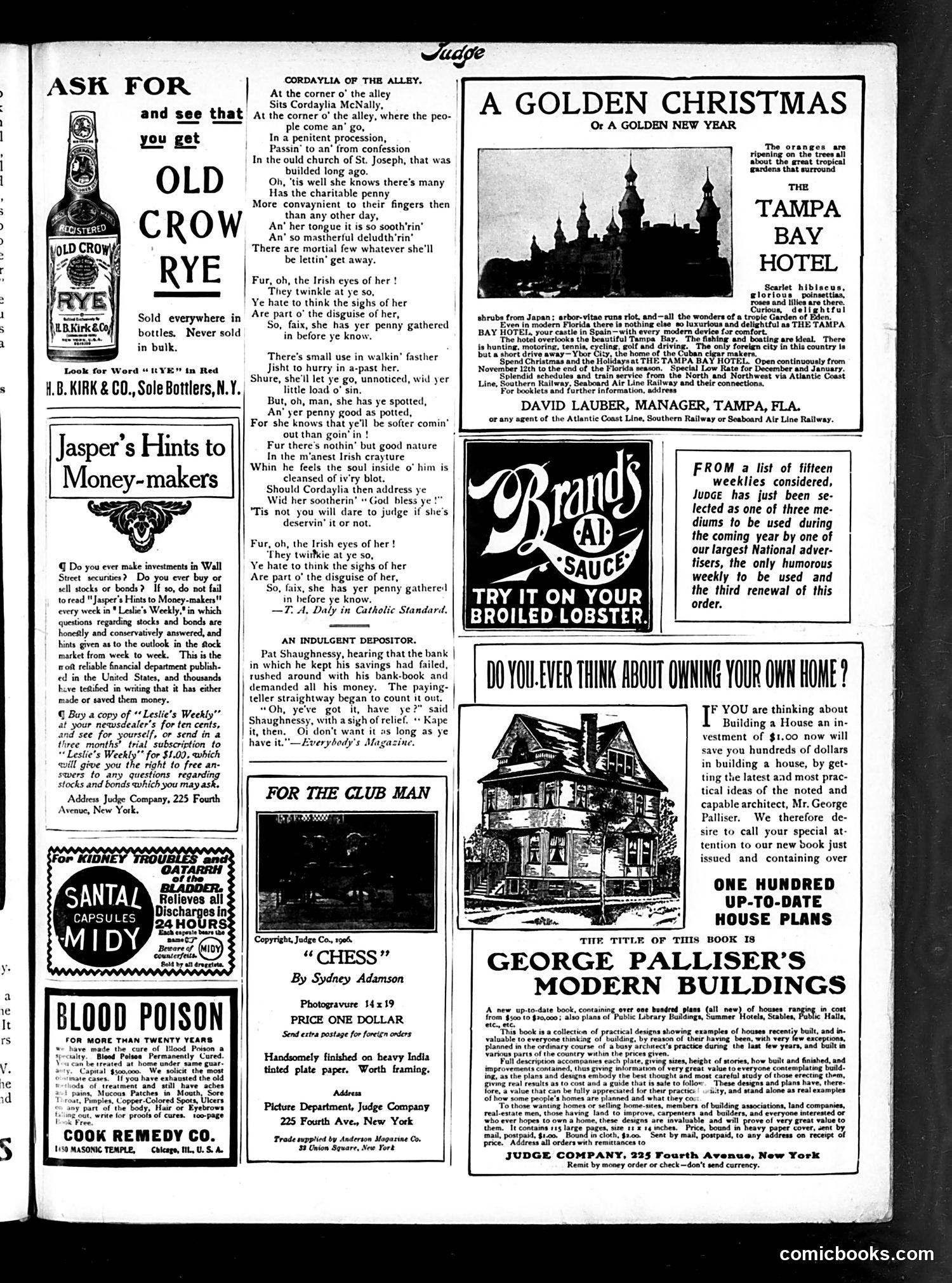
This page from *Judge* magazine is primarily **advertising and light humor** rather than political satire. **Main Content:** The page features several advertisements (Old Crow Rye, investment advice, medical remedies) mixed with humorous verse and stories. The "Cordaylia of the Alley" poem depicts an Irish Catholic woman who skillfully solicits charitable donations from church-goers using charm and flattery—playing on stereotypes of Irish immigrants and Catholic devotion. The humor relies on the "shrewd beggar" trope common in early-20th-century American humor. "An Indulgent Depositor" is a brief anecdote about an Irish immigrant (Pat Shaughnessy) who, upon learning his bank failed, discovers his money is actually safe—the joke being his trusting, naive relief. **Context for Modern Readers:** These pieces reflect early-1900s attitudes toward Irish Catholic immigrants as charming but somewhat unsophisticated outsiders. The humor depends on ethnic stereotypes rather than complex political commentary. The magazine balances satire with commercial advertising, suggesting it served a middle-class readership interested in both entertainment and investment tips.
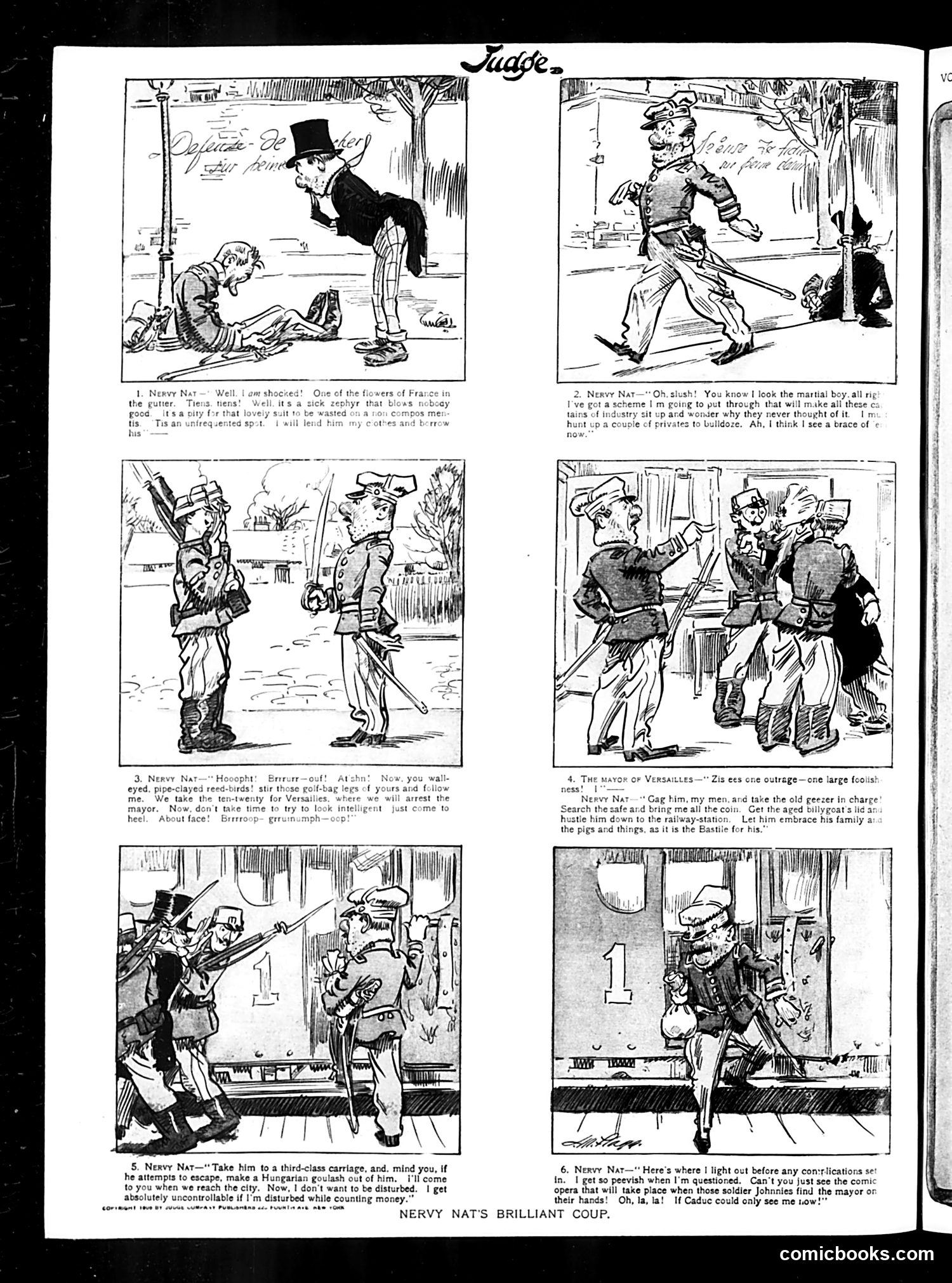
This is a comic strip satirizing military incompetence and bureaucratic absurdity, likely from the early 20th century. "Nervy Nat" appears to be a clever civilian who outwits military officers through audacious schemes. The narrative follows Nat's plan to kidnap or transport a high-ranking military official (possibly a mayor or general) by disguising himself as a soldier and exploiting military confusion. The satire targets: officers who are easily fooled by uniforms, the rigid hierarchy of military transport ("third-class carriage"), and soldiers' lack of awareness. The recurring joke is that Nat repeatedly succeeds through sheer nerve and quick thinking while authority figures remain oblivious. References to "Hungarian goulash," "Versailles," and the officer's obsession with "counting money" suggest wartime profiteering and bureaucratic corruption. The humor relies on readers finding military pomposity ridiculous and celebrating the clever everyman outsmarting officials.