
Judge, 1906-12-15 · page 10 of 16
Judge — December 15, 1906 — page 10: what you’re looking at
What you’re looking at
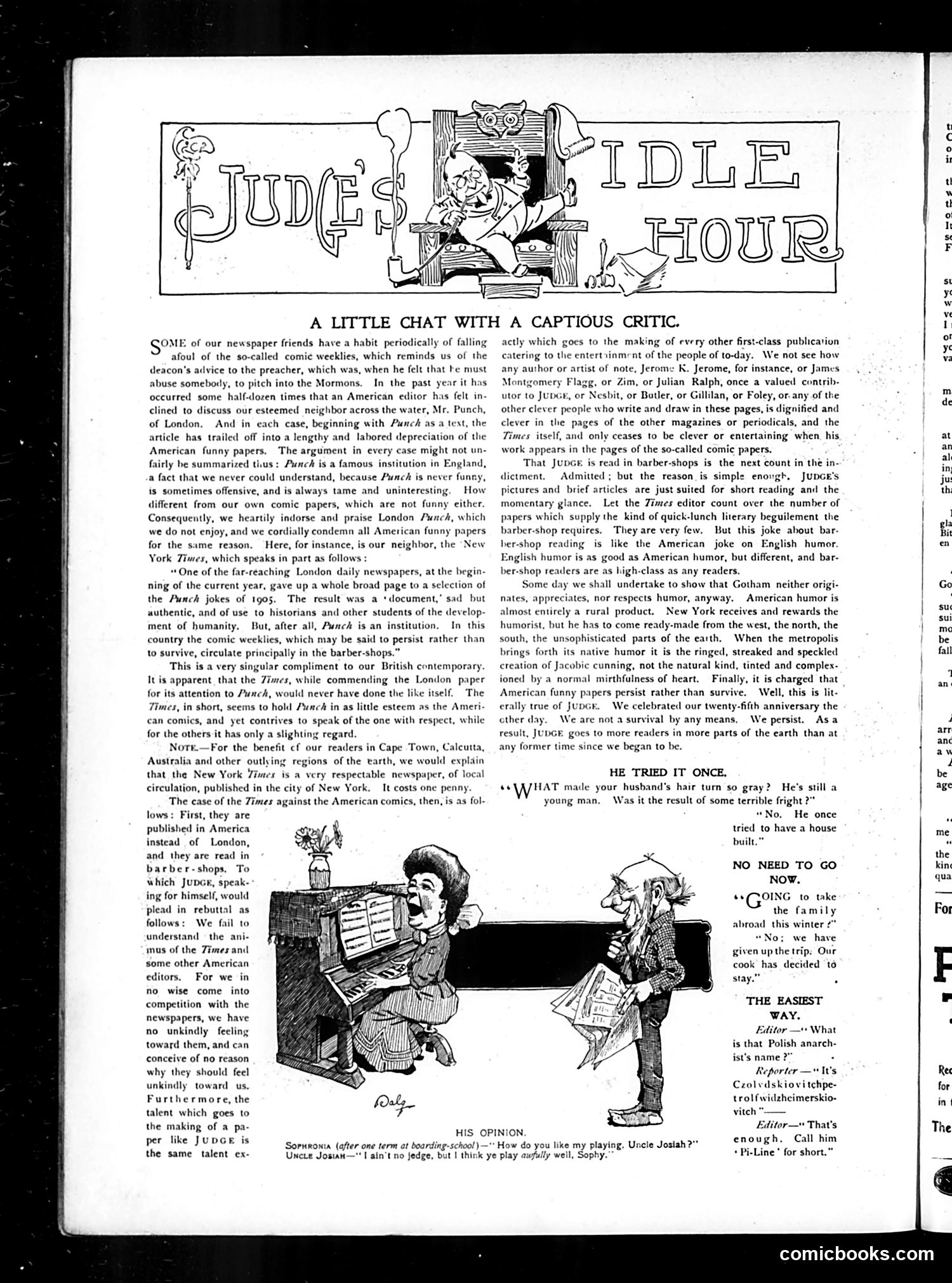
This page is Judge magazine's satirical defense against criticism from *The New York Times*. The Times had recently praised London's *Punch* magazine while dismissing American comic weeklies as mere "barber-shop" reading—implying they're lowbrow and disposable. Judge's editor responds with pointed irony: he notes that the Times itself shows no real respect for *Punch*, merely using it to appear cultured while dismissing American competitors. The rebuttal argues that Judge employs the same caliber of talent (naming Jerome K. Jerome and James Montgomery Flagg) as any "first-class publication." The cartoon at bottom depicts an Uncle Josiah figure praising a girl's piano playing as "awful"—a visual joke about untrained judgment, perhaps mirroring the Times's own critical credibility. The core satire: American newspapers display snobbish cultural insecurity, praising British institutions reflexively while dismissing homegrown talent.
📄 Transcribed text from this page (OCR, searchable)
Machine-transcribed from the original scan — historical spelling and the odd misread are preserved.
OME: of our newspaper friends have a habit periodically of fall afoul of the so-called comic weeklies, which reminds us of the deacon's advice to the preacher, which was, when he felt that Fe must abuse somebody, to pitch into the Mormons. In the past year it has occurred some half-dozen times that an American editor has felt in- clined to discuss our esteemed neighbor across the water, Mr. Punch, of London, And in each case, beginning with Punch as atest, the article has trailed off into a lengthy and labored depreciation of the American funny papers, The argument in every case might not un- fairly be summarized thus: Punch is a famous institution in England, a fact that we never could understand, because Punch is never fun is sometimes offensive, and is always tame and uninteresting. How different from our own comic papers, which are not funny either. Consequently, we heartily indorse and praise London Punch, which we do not enjoy, and we cordially condemn all American funny papers for the same reason. Here, for instance, is our neighbor, the New York Times, which speaks in part as follows : “One of the far-reaching London daily newspapers, at the begin- ning of the current year, gave up a whole broad page to a selection of the Punch jokes of 1905. The result was a ‘document,’ sad but authentic, and of use to historians and other students of the develop- ment of humanity, But, after all, Punch is an institution. In this country the comic weeklies, which may be said to persist rather than to survive, circulate principally in the barber-shops.”” This is a very singular compliment to our British contemporary. It is apparent that the Zimes, while commending the London paper for its attention to Punch, would never have done the like itself. The Times, in short, seems to hol Punch in as little esteem as the Ameri- can comics, and yet contrives to speak of the one with respect, while for the others it has only a slighting regard. Nore.—For the benefit cf our readers in Cape Town, Calcutta, Australia and other outlying regions of the earth, we would explain that the New York Yimes is a very respectable newspaper, of local circulation, published in the city of New York. It costs one penny. The case of the Zimes against the American comics, then, is as fol- lows: First, they are published in America instead of London, and they are read in barber-shops. To which JupGe, speak- ing for himself, would plead in rebuttal as follows: We fail to understand the ani- mus of the Zimes and some other American editors. For we in no wise come into competition with the newspapers, we have no unkindly feeling toward them, and can conceive of no reason why they should feel unkin Furthermore, the talent which goes to the making of a pa- per like JUDGE is the same talent ex- ly toward us. Uncte Josian—"'I ain't no jedge, HIS OPINION. Sornnonia (after one term at boarding-schoo!)—"* How do you like my playing. Uncle Josiah?” I think ye play aufully well, Sophy. actly which to the making of every other first-class publication catering to the entertainment of the people of to-day. We not see how any author of artist of note, Jerome K. Jerome, for instance, or James Montgomery Flagg, or Zim, or Julian Ralph, once a valued contrib- utor to JUDGE, or Nesbit, or Batler, or Gillilan, or Foley, or-any of the other clever people who write and draw in these pages, is dignified and clever in the pages of the other magazines or periodicals, and the Times itself, and only ceases to be clever or entertaining when. his work appears in the pages of the so-called comic papers. That JunGr. is read in barber-shops is the next count in the in- dictment. Admitted ; but the reason is simple enongh. JUDGE'S pictures and brief articles are just suited for short reading and the momentary glance. Let the Zimes editor count over the number of papers which supply the kind of quick-lunch literary beguilement the barber-shop requires. They are very few. But this joke about bar- her-shop reading is like the American joke on English humor. English humor is as good as American humor, but different, and bar- ber-shop readers are as high-class as any readers. Some day we shall undertake to show that Gotham neither origi- nates, appreciates, nor respects humor, anyway. American humor is almost entirely a rural product. New York receives and rewards the humorist, but he has to come ready-made from the west, the north, the south, the unsophisticated parts of the earth. When the metropolis brings forth its native humor it is the ringed, streaked and speckled creation of Jacobic cunning, not the natural kind, tinted and complex- ioned by a normal mirthfulness of heart. Finally, it is charged that American funny papers persist rather than survive. Well, this is lit- erally true of JUDGE. We celebrated our twenty-fifth anniversary the other day. We are not a survival by any means, We persist. Asa result, JUDGE goes to more readers in more parts of the earth than at any former time since we began to be. HE TRIED IT ONCE. 46\A/JHAT made your husband's hair turn so gray? He's still a young man, Was it the result of some terrible fright ?” “No, He once tried to have a house built.” NO NEED TO GO Now. oe OING to take G the family abroad this winter ¢” “No; we have given up the trip. Our cook has decided t6 stay.” " THE EASIEST WAY. Editor — What is that Polish anarch- ist's name 2?” . Reporter —" It's Czolvdskiovitchpe- trolfwidzheimerskio- viteh "—— Editor— That's enough, Call him + Pi-Line' for short. me the kin qua For Rec for in The comicbooks.com