
Judge, 1906-12-15 · page 6 of 16
Judge — December 15, 1906 — page 6: what you’re looking at
What you’re looking at
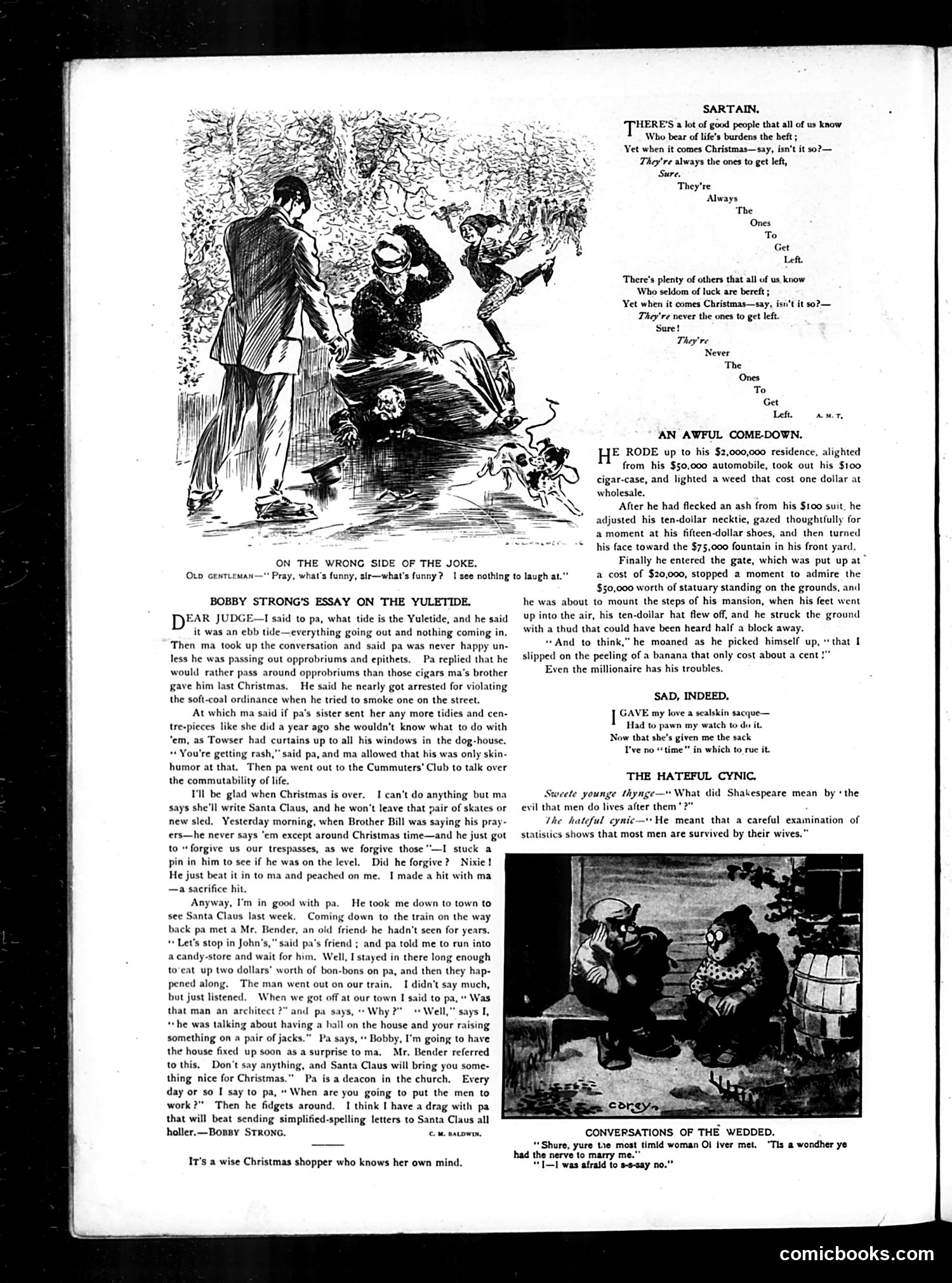
This page contains three satirical pieces typical of early 20th-century American humor: **"On the Wrong Side of the Joke"** (top cartoon): An elegantly dressed gentleman asks a street beggar to explain what's funny—the joke being that the wealthy man, despite his refinement, fails to understand humor while the poor man possesses it. Social commentary on class blindness. **"Bobby Strong's Essay on the Yuletide"**: A child's humorous letter describing his family's cynicism about Christmas. His father makes dark jokes about "ebb tide" (money flowing out), complains about terrible cigars from relatives, and his brother proves unforgiving despite prayer. The satire targets adult hypocrisy during the holiday season and consumerism. **"An Awful Come-Down"**: A wealthy man obsesses over expensive possessions (mansion, automobile, cigar case, suit) while his actual necktie costs only ten dollars and shoes fifteen dollars—the joke being his pathetic attempt at thrift amid extravagance. Mocks nouveau riche pretension and economic anxiety. The overall theme: hypocrisy and class consciousness during Christmas.
📄 Transcribed text from this page (OCR, searchable)
Machine-transcribed from the original scan — historical spelling and the odd misread are preserved.
ON THE WRONG SIDE OF THE JOKE. Orb cenrieman—" Pray, what's funny, sir—what's funny ? BOBBY STRONG'S ESSAY ON THE YULETIDE. DEAR JUDGE—I said to pa, what tide is the Yuletide, and he said it was an ebb tide—everything going out and nothing coming in. Then ma took up the conversation and said pa was never happy un- less he was passing out opprobriums and epithets. Pa replied that he would rather pass around opprobriums than those cigars ma’s brother gave him last Christmas, He said he nearly got arrested for violating the soft-coal ordinance when he tried to smoke one on the street. At which ma said if pa’s sister sent her any more tidies and cen- tre-pieces like she did a year ago she wouldn't know what to do with ‘em, as Towser had curtains up to all his windows in the dog-house. “You're getting rash,” said pa, and ma allowed that his was only skin- humor at that. Then pa went out to the Cummuters’ Club to talk over the commutability of life. I'll be glad when Christmas is over. I can’t do anything but ma says she'll write Santa Claus, and he won't leave that pair of skates or new sled. Yesterday morning, when Brother Bill was saying his pray- ers—he never says ‘em except around Christmas time—and he just got to “forgive us our trespasses, as we forgive those"—I stuck a pin in him to see if he was on the level. Did he forgive? Nixie! He just beat it in to ma and peached on me. I made a hit with ma —a sacrifice hit. Anyway, I'm in good with pa, He took me down to town to see Santa Claus last week. Coming down to the train on the way back pa meta Mr. Bender, an old friend: he hadn't seen for years. “+ Let's stop in John’s,” said pa’s friend ; and pa told me to run into a candy-store and wait for him. Well, I stayed in there long enough to’eat up two dollars’ worth of bon-bons on pa, and then they hap- The man went out on our train, I didn’t say much, but just listened, When we got off at our town I said to pa, Was that man an architect ?” and pa says, ** Why?” + Well,” says I, ‘she was talking about having a hall on the house and your raising something on a pair of jacks.” Pa says, « Bobby, I'm going to have the house fixed up soon as a surprise toma. Mr. Bender referred to this, Don't say anything, and Santa Claus will bring you some- thing nice for Christmas.” Pa is a deacon in the church. Every day or so I say to pa, * When are you going to put the men to work?” ‘Then he fidgets around. I think I have a drag with pa that will beat sending simplified-spelling letters to Santa Claus all holler.—Bonsy STRONG. pened along. cm, BALDWIN, I1’s a wise Christmas shopper who knows her own mind. I see nothing to SARTAIN. THERE'S 2 lot of good people that all of us know Who bear of life’s burdens the heft ; Yet when it comes Christmas—say, isn't it so?— They're always the ones to get left, Sure. They're Always The Ones To Get Left. There's plenty of others that all uf us. know Who seldom of luck are bereft ; Yet when it comes Christmas—say, i They're never the ones to get left. Sure! They're Never The Ones To Get Left. AN AWFUL COME-DOWN. HE RODE up to his $2,000,000 residence, alighted from his $50,000 automobile, took out his $100 cigar-case, and lighted a weed that cost one dollar at wholesale, After he had flecked an ash from his $100 suit, he adjusted his ten-doilar necktie, gazed thoughtfully for a moment at his fifteen-dollar shoes, and then turned his face toward the $75,000 fountain in his front yard. Finally he entered the gate, which was put up at” a cost of $20,000, stopped a moment to admire the $50,000 worth of statuary standing on the grounds, and he was about to mount the steps of his mansion, when his feet went up into the air, his ten-dollar hat flew off, and he struck the ground with a thud that could have been heard half a block away. **And to think,” he moaned as he picked himself up, slipped on the peeling of a banana that only cost about a cent !”* Even the millionaire has his troubles. ugh at." that 1 SAD, INDEED. [ GAVE my love a sealskin sacque— Had to pawn my watch to do it. Now that she’s given me the sack T’ve no “time” in which to rue it. THE HATEFUL CYNIC. Sweete younge thynge— What did Shakespeare mean by ‘the evil that men do lives after them" ?” the hateful cynic— He meant that a careful examination of statistics shows that most men are survived by their wives.” CONVERSATIONS OF THE WEDDED. “Shure, yure tae most timid woman Ol iver met. “Tis a wondher ye had the nerve to marry me.” “II was afraid to s-e-say no.” comicbooks.com