
Judge, 1906-12-15 · page 4 of 16
Judge — December 15, 1906 — page 4: what you’re looking at
What you’re looking at
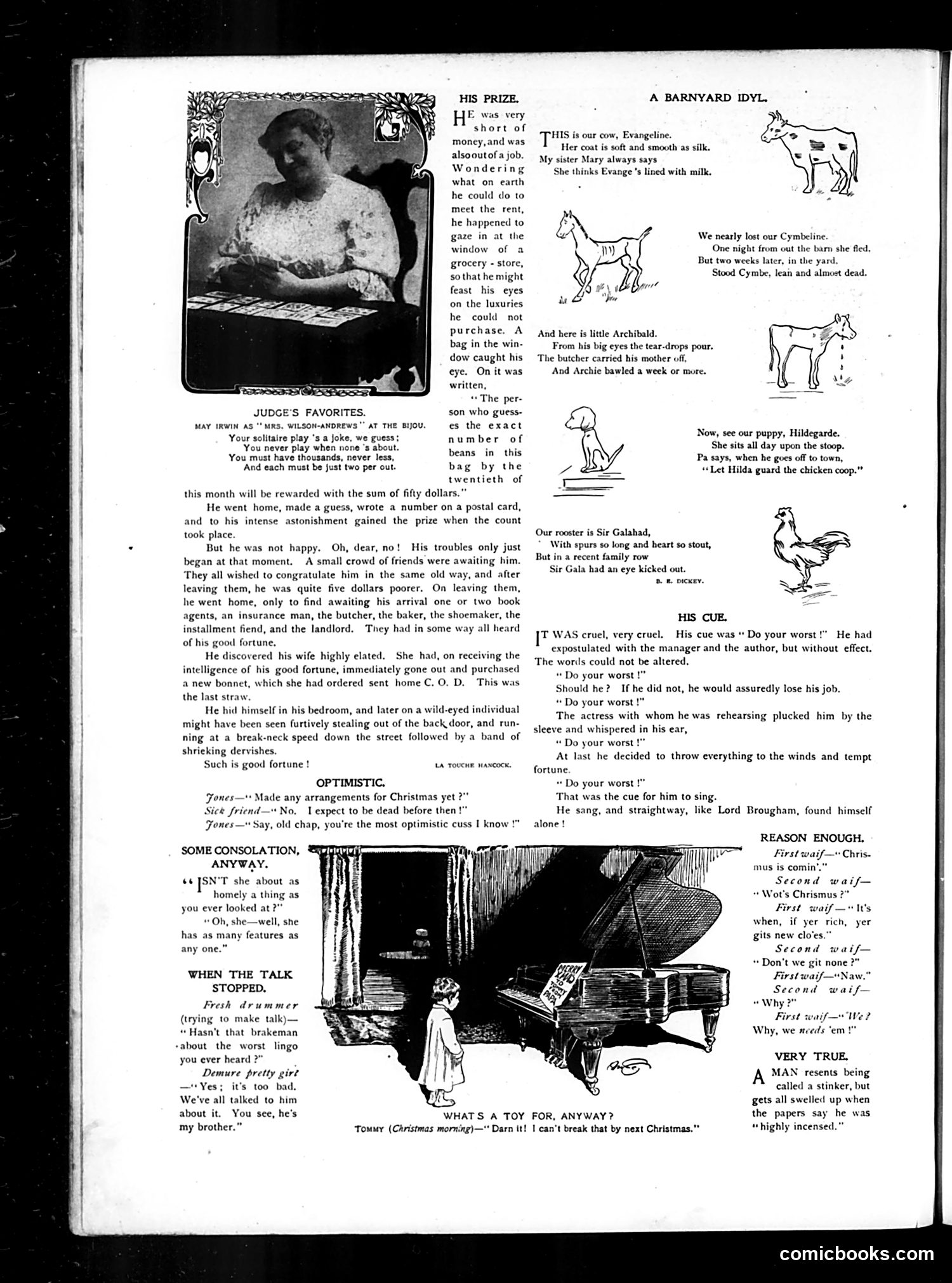
The page contains several discrete satirical pieces rather than one unified cartoon. **"His Prize"** (top left): Shows a man examining lottery winnings, illustrating the story of someone who won money but struggled to spend it wisely—a commentary on sudden fortune and poor decision-making among the working class. **"A Barnyard Idyl"** (right): A humorous illustrated poem about farm animals, apparently unrelated to political satire. **"His Cue"** and other sections present domestic comedies and wordplay jokes typical of Judge's humor. **"What's a Toy for, Anyway?"** (center): A piano scene satirizing Christmas gift-giving, suggesting impractical or absurd present choices. The page demonstrates Judge's mix of social satire, domestic humor, and illustrated jokes rather than focused political commentary on specific events or figures.
📄 Transcribed text from this page (OCR, searchable)
Machine-transcribed from the original scan — historical spelling and the odd misread are preserved.
HIS PRIZE. HE was very short of money, and was alsooutofa job. Wondering what on earth he could do to meet the rent, he happened to gaze in at the window of a grocery - store, so that he might feast his eyes on the luxuries he could not purchase. A bag in the win- dow caught his eye. On it was written, “The per- son who guess- es the exact number of beans in this bag by the twentieth of JUDGE'S FAVORITES. MAY IRWIN AS "MRS, WILSON-ANDREWS " AT THE BIJOU. Your solitaire play ‘s a joke, we guess; You never play when none 's about. You must have thousands, never less, ‘And each must be just two per out. this month will be rewarded with the sum of fifty dollars.”" He went home, made a guess, wrote a number on a postal card, and to his intense astonishment gained the prize when the count took place. But he was not happy. Oh, dear, no! His troubles only just began at that moment. A small crowd of friends were awaiting him. They all wished to congratulate him in the same old way, and after leaving them, he was quite five dollars poorer. On leaving them, he went home, only to find awaiting his arrival one or two book agents, an insurance man, the butcher, the baker, the shoemaker, the installment fiend, and the landlord. They had in some way all heard of his good fortune. He discovered his wife highly elated, She had, on receiving the intelligence of his good fortune, immediately gone out and purchased a new bonnet, which she had ordered sent home C.O. D, This was the last straw. He hid himself in his bedroom, and later on a wild-eyed individual might have been seen furtively stealing out of the back door, and run- ning at a break-neck speed down the street followed by a band of shrieking dervishes. Such is good fortune ! La ToveMEE HANCOCK. OPTIMISTIC. Fones—** Made any arrangements for Christmas yet 2 Sick friend— No. Lexpect to be dead before then !"" Fones—" Say, old chap, you're the most optimistic cuss 1 know !" SOME CONSOLATION, ANYWAY. T she about as homely a thing as you ever looked at?” « Oh, she—well, she has as many features as any one. WHEN THE TALK STOPPED. Fresh drummer (trying to make talk)— “Hasn't that brakeman sabout the worst lingo you ever heard 2 Demure pretty girt —"Yes; it’s too bad. We've all talked to him about it. You see, he’s my brother.” WHATS A TOY FOR, ANYWAY? Tommy (Christmas morning)—" Darn it! | can't break that by next Christmas."* A BARNYARD TIS is our cow, Evangeline. Her coat is soft and smooth as silk. My sister Mary always says She thinks Evange’s lined with milk. We nearly lost our Cymbeline. One night from out the barn she fled, But two weeks later, in the yard. Stood Cymbe, leai and almost dead. And here is little Archibald. From his big eyes the tear-drops pour. The butcher carried his mother off, And Archie bawled a week or more. Now, see our puppy, Hildegarde. She sits all day upon the stoop. Pa says, when he goes off to town, “Let Hilda guard the chicken coop.” vAN Our rooster is Sir Galahad, With spurs so long and heart so stout, But in a recent family row Sir Gala had an eye kicked out. 2m pickeY. HIS CUE. T WAS cruel, very cruel. His cue was " Do your worst!" He had expostulated with the manager and the author, but without effect. ‘The words could not be altered, “Do your worst !" Should he? If he did not, he would assuredly lose his job. + Do your worst !" The actress with whom he was rehearsing plucked him by the sleeve and whispered in his ear, * Do your worst !” At last he decided to throw everything to the winds and tempt fortune. * Do your worst !" That was the cue for him to sing. He sang, and straightway, like Lord Brougham, found himself alone! REASON ENOUGH. First waif—« Chris mus is comin’, Second waif— + Wot's Chrismus ? First waif —« Ws when, if yer rich, yer gits new clo’es.” Second + Don’t we git none ? Firstw Second waif— “Why First waif—" Why, we needs ‘em waif— VERY TRUE. A MAN resents being called a stinker, but gets all swelled up when the papers say he was “highly incensed.” comicbooks.com