
A complete issue · 16 pages · 1906
Judge — December 1, 1906
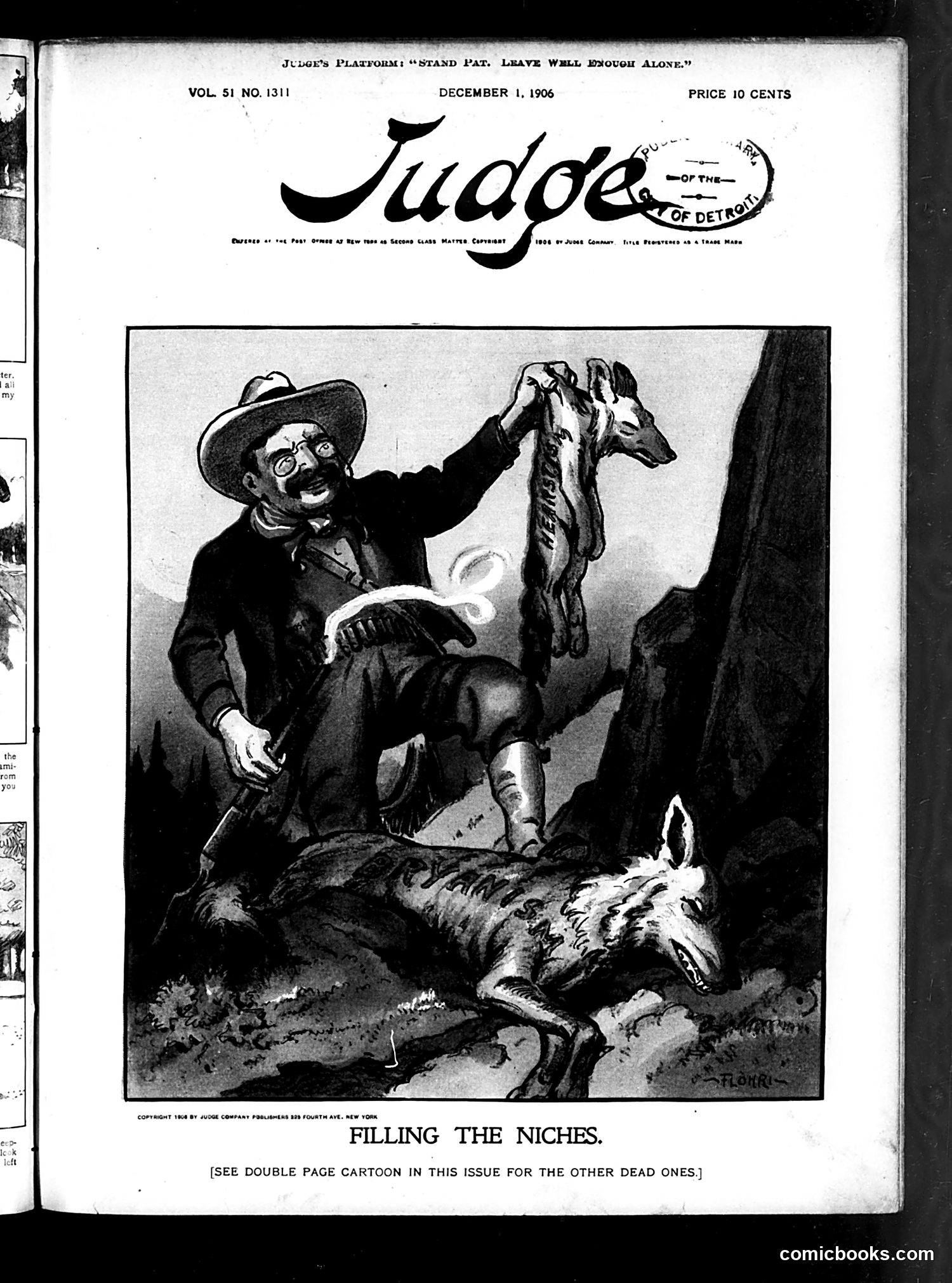
This December 1906 *Judge* cartoon satirizes what appears to be big-game hunting, likely commentary on wealthy sportsmen or industrialists. The caricatured figure with exaggerated mustache and cowboy hat holds up freshly killed game—a deer and what appears to be a wild boar or similar animal—posed triumphantly over the carcasses. The title "Filling the Niches" suggests the cartoon critiques trophy hunting or the display of kills as status symbols. The theatrical pose and grotesque characterization mock the vanity of hunters seeking to showcase their conquests. This likely reflects Progressive Era concerns about conservation and the excess of gilded-age wealth spent on leisure hunting expeditions.
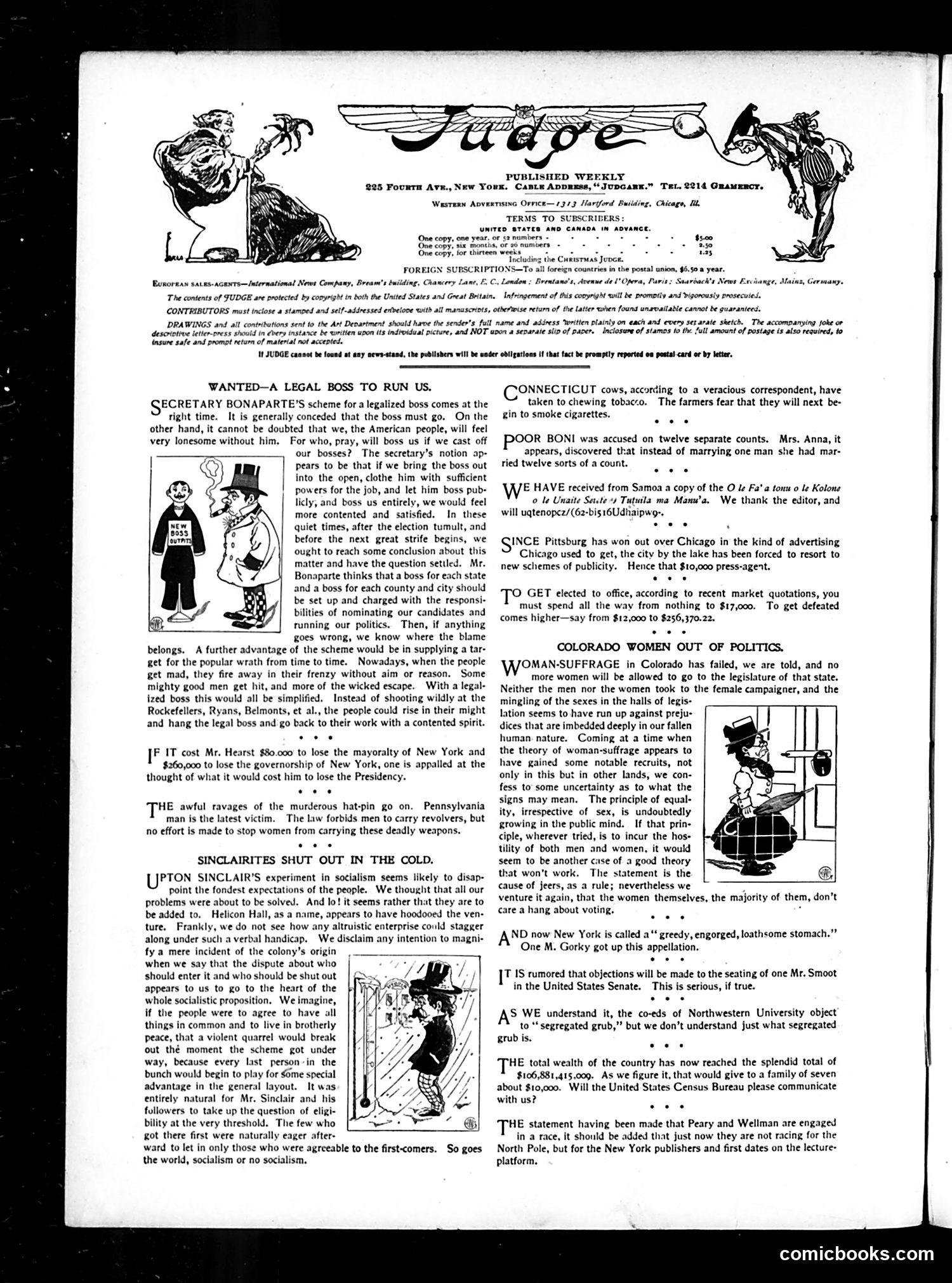
The page contains several political commentary pieces typical of early 20th-century satirical journalism: **"Wanted—A Legal Boss to Run Us"** criticizes Secretary Bonaparte's proposal for a "legalized boss" to govern states, arguing Americans prefer self-governance despite recognizing they need leadership. **"Colorado Women Out of Politics"** mocks Colorado's failure to expand women's suffrage, suggesting the state's rejection contradicts claims about women's natural abilities and raises questions about equality theory. Other brief items satirize contemporary issues: Upton Sinclair's socialism, the Pennsylvania murder epidemic, New York's financial strain, and campus segregation debates. The cartoons employ caricature and ironic commentary typical of Judge's political humor, targeting government inefficiency, social hypocrisy, and emerging progressive debates. The illustrations reinforce text through exaggerated character depictions.
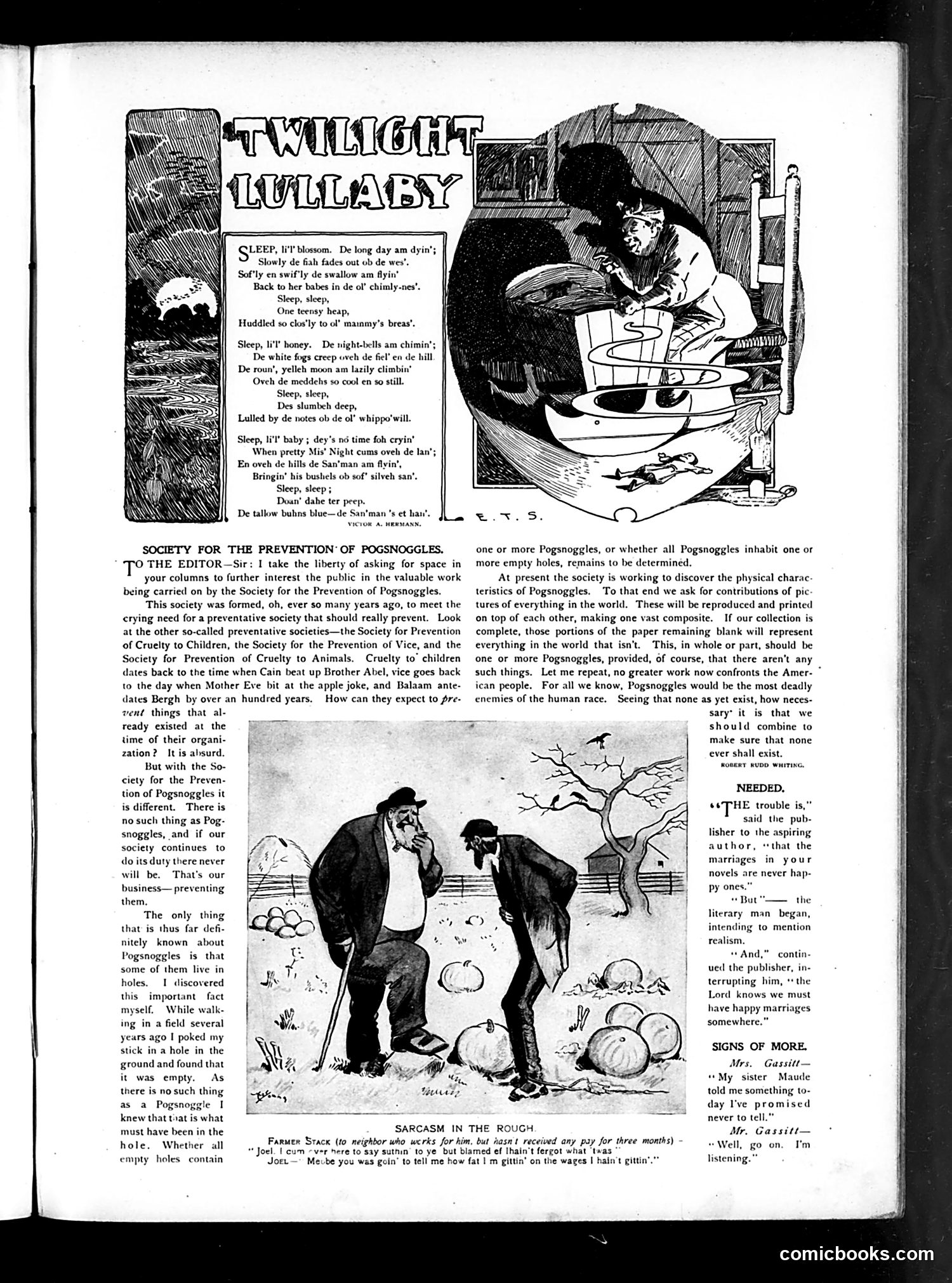
**Top illustration:** A lullaby poem set to an evocative image of a witch-like figure tending a cradle. The verse uses archaic dialect ("Sleep, li'l honey") and supernatural imagery, suggesting a darkly humorous take on nursery rhymes. The artistic style emphasizes the grotesque. **Bottom cartoon:** Titled "Sarcasm in the Rough," it depicts two well-dressed men examining farm produce, with dialogue about a farmer's poor pay. The farmer's caption sarcastically complains about wages while the urban gentlemen survey his crops—likely satirizing the economic disparity between farmers and city dwellers during the early 20th century, a period of agricultural hardship and labor tensions. The letter section addresses the "Society for the Prevention of Pogsnoggles"—an invented organization, suggesting meta-satirical commentary on reform movements.
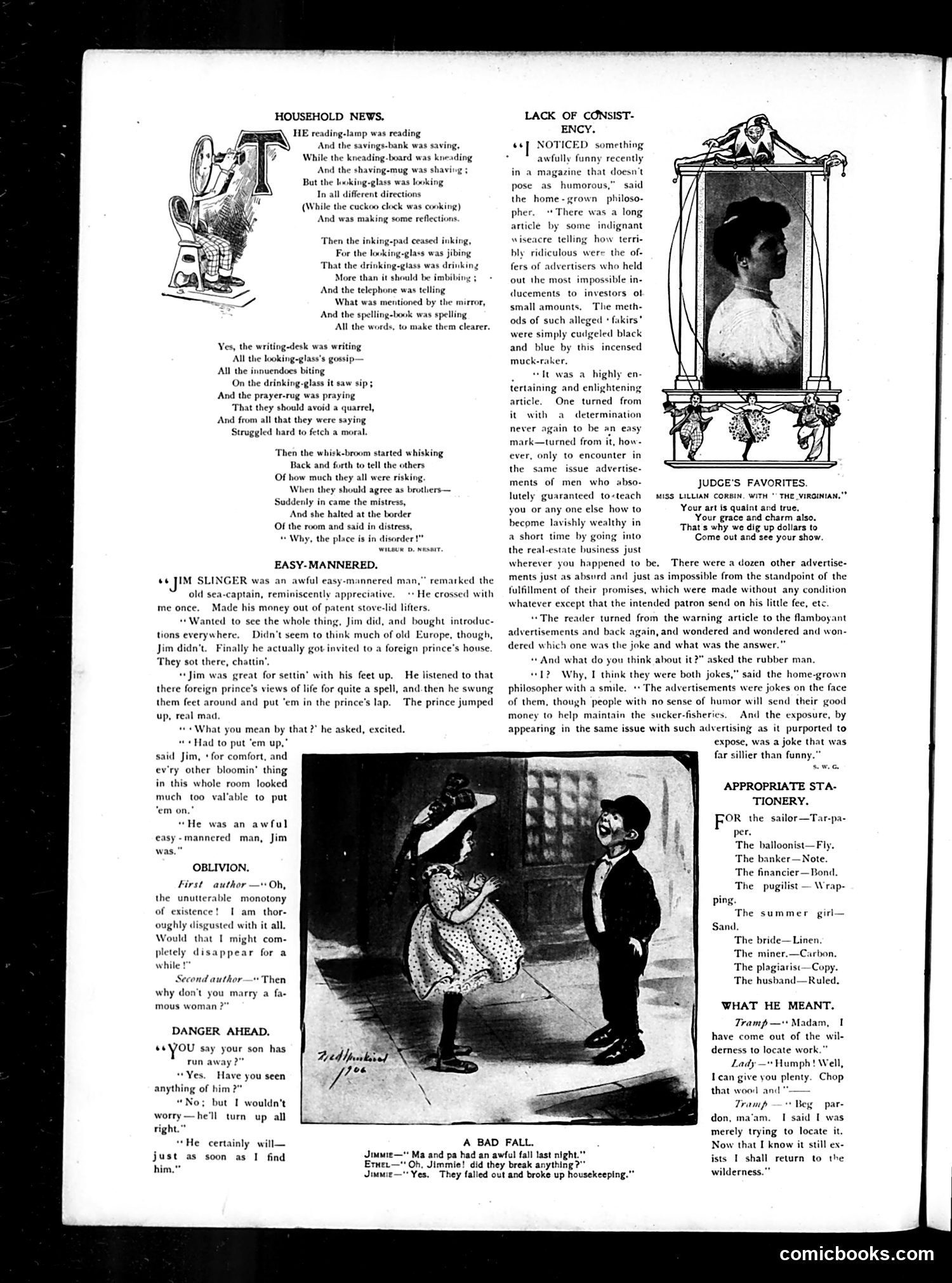
This page contains mostly humorous household poems and short comedic pieces rather than political cartoons. The notable content includes: **"Easy-Mannered"** - A story about Jim Slinger, a sea captain who was invited to a foreign prince's house. The joke centers on Jim being socially awkward despite good intentions, ultimately offending his host by calling the ornate room "awful easy to be an easy mannered man, Jim was." **"A Bad Fall"** illustration shows a domestic comedy scene where someone has fallen, with dialogue suggesting they "broke up housekeeping." The page also includes lighter content like "Appropriate Stationery" (pun-based job descriptions) and "What He Meant" (misunderstandings between a Tramp and Lady). This appears to be general humor content rather than political satire, typical of Judge magazine's entertainment focus.
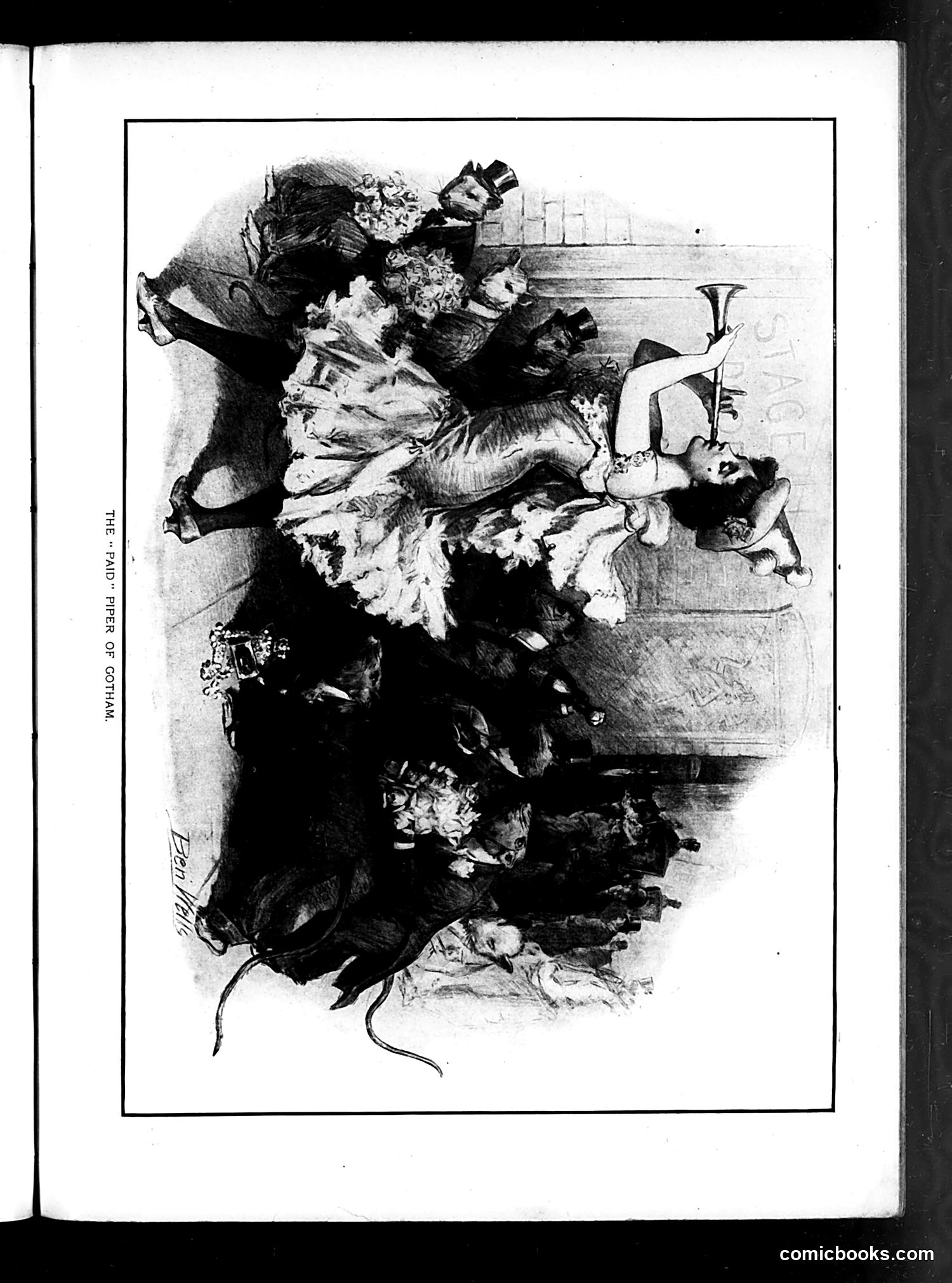
I can see this is a satirical illustration from *Judge* magazine, but the image is rotated and the OCR text provided doesn't clearly correspond to visible text on the page. The cartoon appears to depict a social or political scene with multiple figures in period dress (possibly late 19th or early 20th century), arranged in what seems to be a crowded, chaotic composition. One figure notably holds what appears to be a trumpet or horn. Without legible text or caption clearly identifying the specific figures and event being satirized, I cannot confidently explain which political or social issue this cartoon addresses. To provide accurate historical context, I would need clearer source text or caption information identifying the subjects and date of publication.
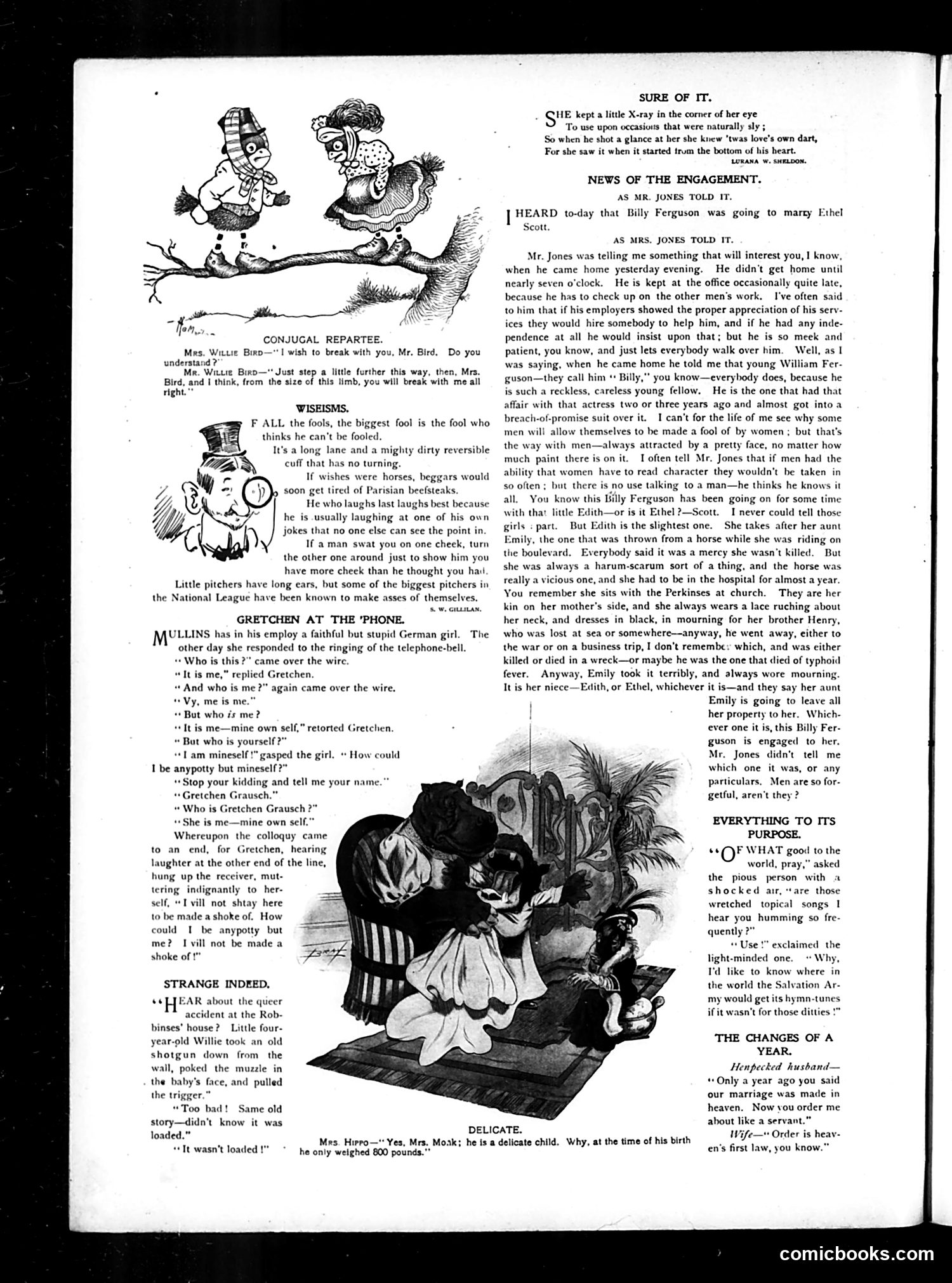
This page contains several satirical pieces typical of early 20th-century American humor: **"Conjugal Repartee"**: A husband-wife joke playing on the double meaning of "break with"—Mrs. Bird threatens to leave Mr. Bird, who responds by positioning her on a tree limb, suggesting she'll literally break it instead. **"Gretchen at the Phone"**: A ethnic humor piece mocking a German immigrant servant girl's broken English and circular logic when answering a telephone. The joke relies on her inability to understand the distinction between "me" and her actual name—humor based on immigrant speech patterns. **"Strange Indeed"**: Dark humor about a child playing with an unloaded shotgun—the punchline being the irony that it *wasn't* loaded, making the accident seem absurd. **"Delicate Child"**: A brief joke implying an overweight child is called "delicate." The long "News of the Engagement" section satirizes how gossip transforms simple news through retelling—Mr. Jones' brief announcement becomes Mrs. Jones' elaborate, digressive story full of character judgments and tangents. These pieces reflect period attitudes including ethnic stereotyping and casual dark humor.
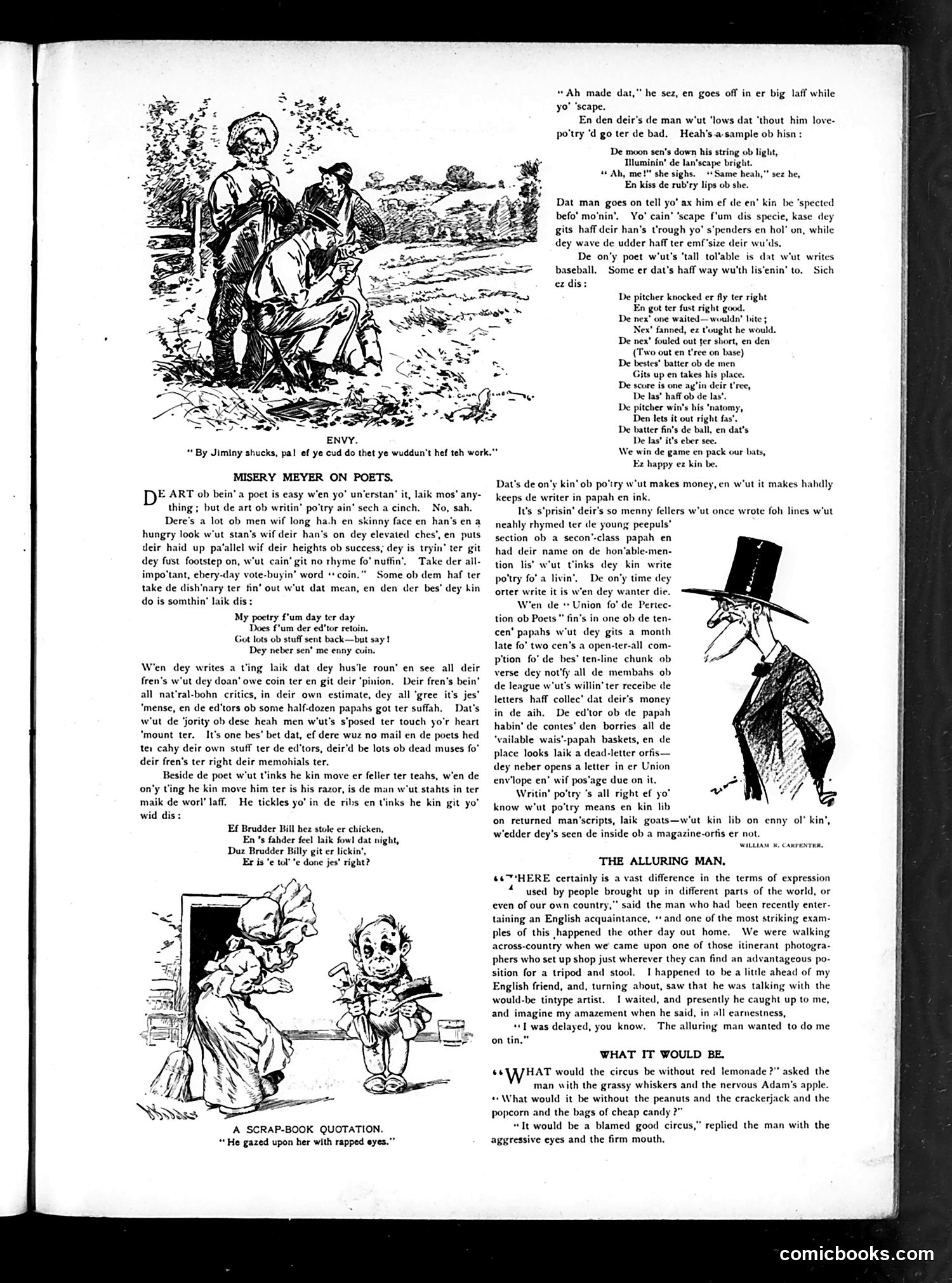
This page contains two satirical pieces from *Judge* magazine mocking American poetry and poets. **"ENVY"** (top illustration): Two rural figures discuss work and aspiration—one expressing envy that the other has skills he lacks. The dialect and setting suggest working-class commentary on social inequality. **"Misery Meyer on Poets"** (main text, in exaggerated African-American dialect): A character critiques contemporary poets as pretentious failures. Meyer mocks: - Aspiring poets with grandiose postures but no talent or income - Their desperate attempts to get published and win praise - Sentimental "love poetry" that's overwrought and tedious - The only "worthwhile" poetry being baseball commentary—practical, popular, and vivid The satire targets the pretension of unsuccessful literary aspirants and the magazine's skepticism toward "high art" versus vernacular entertainment. The dialect humor was typical of period *Judge* content, though offensive by modern standards. **"A Scrap-Book Quotation"** (bottom): A visual joke about a common typo—"rapped eyes" instead of "rapt."
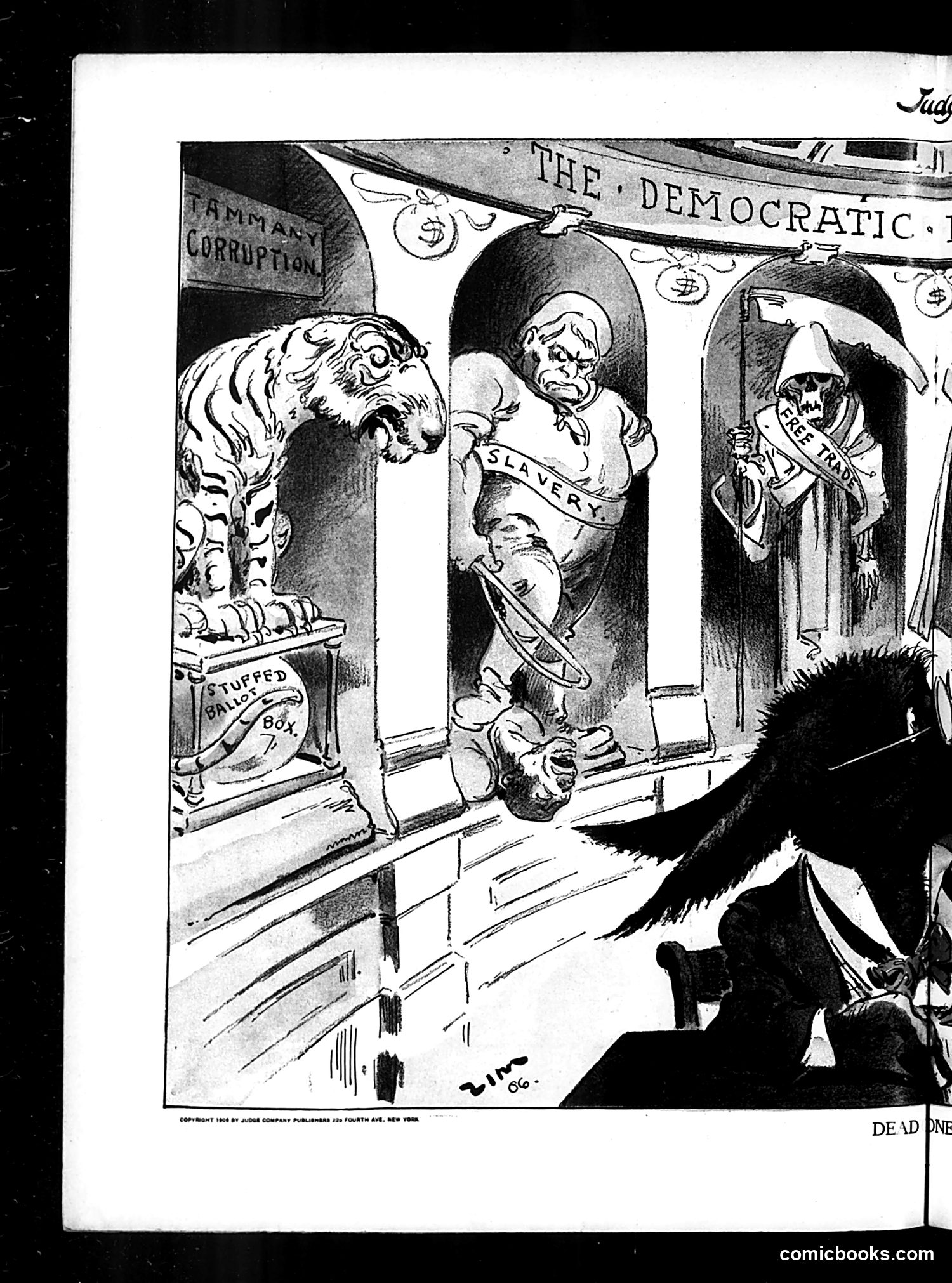
This Judge magazine cartoon depicts "The Democratic Party" as a storefront display window containing three allegorical figures representing internal party problems. The left shows a stuffed ballot box labeled "STUFFED BALLOT BOX," the center displays a blindfolded figure labeled "SLAVERY," and the right shows a hooded figure labeled "FREE TRADE" (likely referring to trade policy disputes). Above hangs a sign reading "TAMMANY CORRUPTION." The cartoon satirizes the Democratic Party as corrupted by machine politics (Tammany Hall), electoral fraud, the slavery question, and divisive trade policy debates. An observer peers into the window, viewing these symbolic "exhibits" of Democratic dysfunction. This appears to be late-19th-century satire critiquing the party's vulnerability to urban political machines and unresolved ideological conflicts.
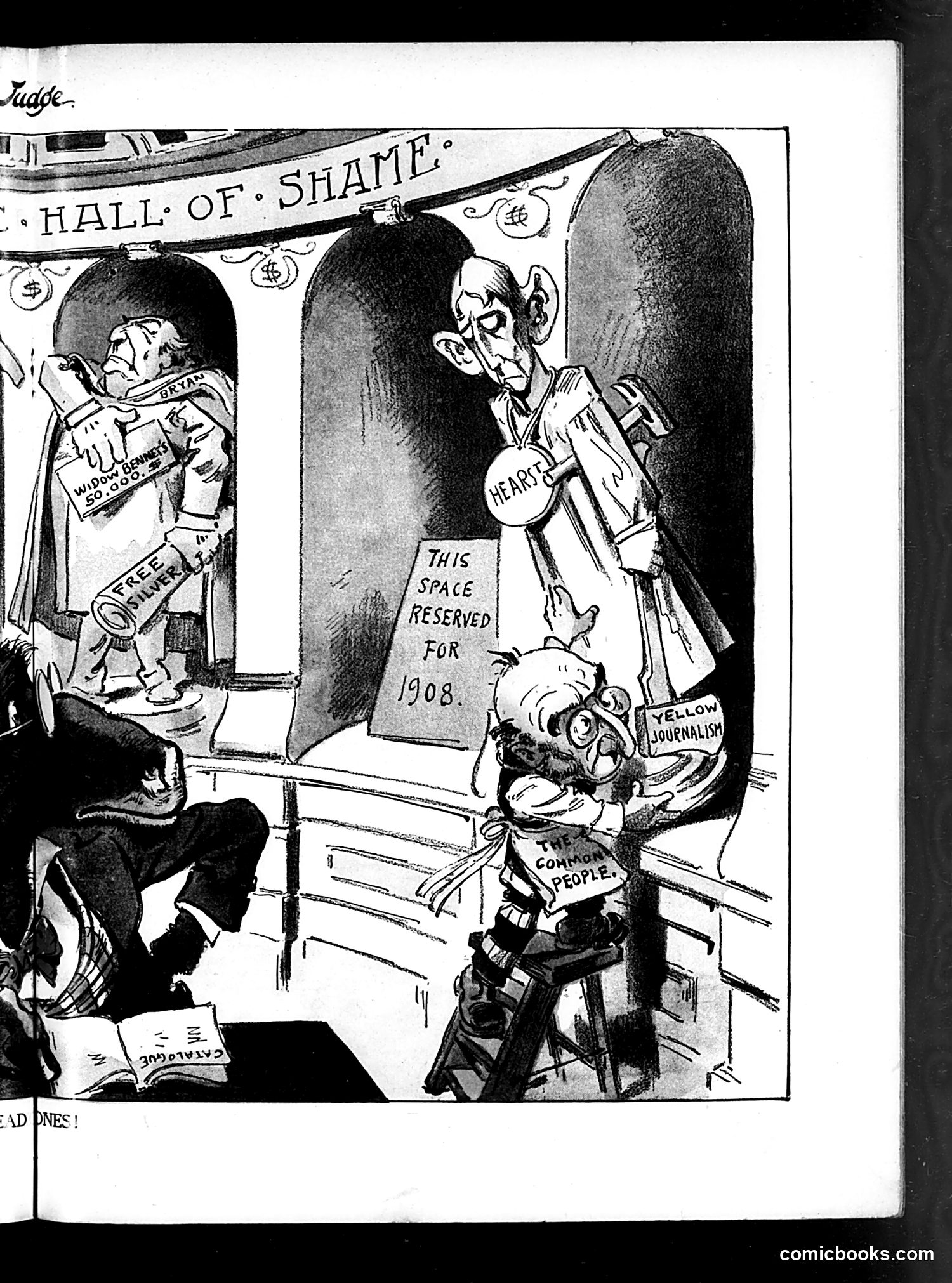
This political cartoon depicts a "Hall of Shame" featuring caricatured figures with exaggerated facial features. Two prominent figures appear to be politicians or public officials holding items labeled with words like "HEART" and what appears to be "WIDOWS & ORPHANS" relief funds. A placard reads "THIS SPACE RESERVED FOR 1908," suggesting an anticipated future scandal or shameful figure. The cartoon satirizes corruption related to charitable funds—implying that public officials were misappropriating money meant for widows, orphans, and other vulnerable groups. References to "Yellow Journalism" and "Common People" indicate the piece critiques both unethical media practices and the exploitation of ordinary citizens' charitable donations by those in power. The 1908 date suggests this mocked a specific political figure or scandal anticipated before that election year.
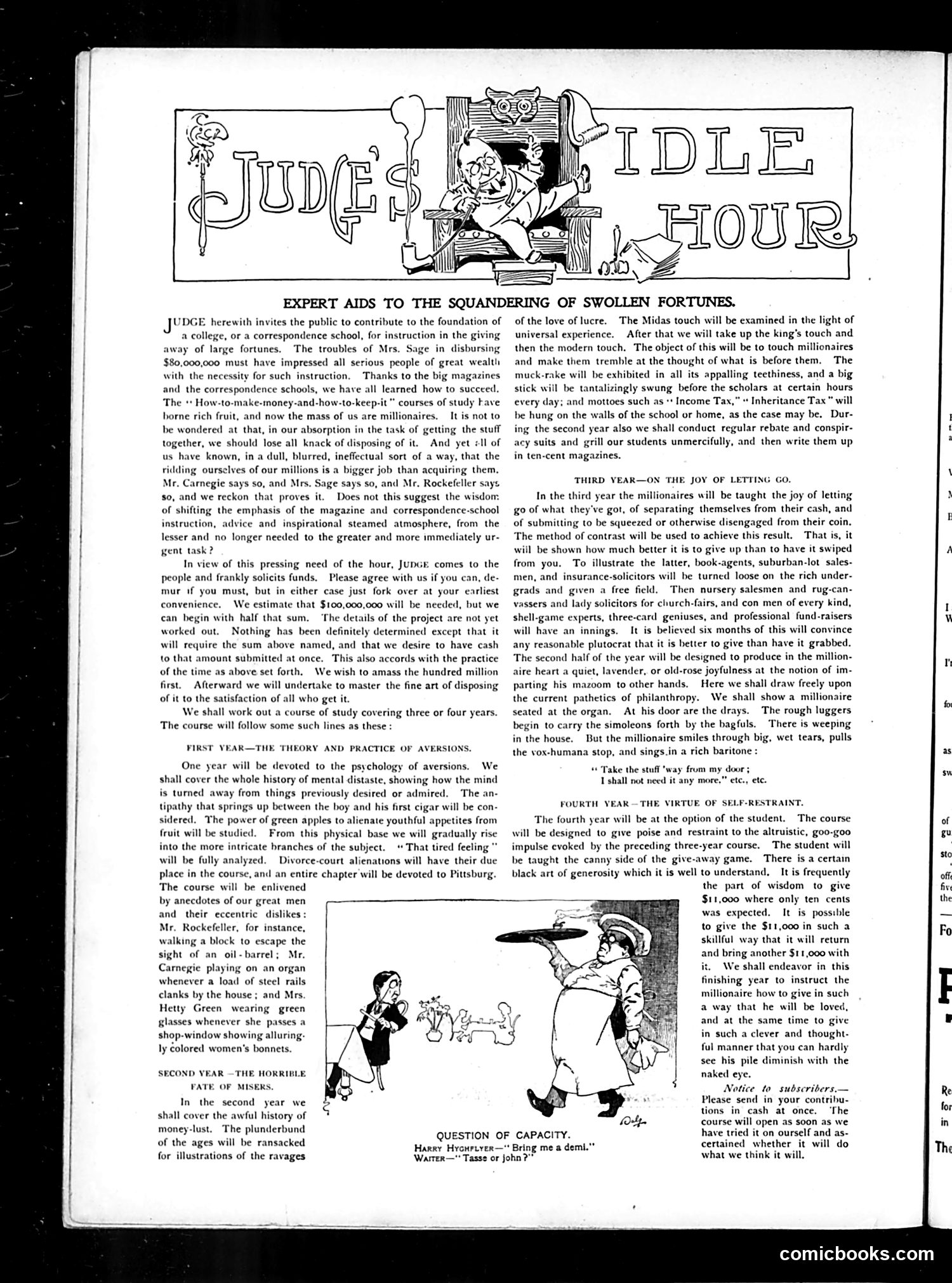
This satirical piece mocks the difficulty wealthy industrialists face in giving away fortunes. It references **Mrs. Sage** (widow of railroad magnate Russell Sage), **Carnegie**, and **Rockefeller**—gilded-age tycoons who publicly struggled with philanthropic obligations. The joke: Judge proposes a absurd "correspondence school" to teach the rich how to *spend* money, mirroring the "how-to-succeed" business courses then popular. The satire targets the irony that men who mastered *acquiring* wealth couldn't master *disposing* of it charitably. The curriculum includes teachings on "psychology of aversions" and touches to millionaires by reformers wielding the "muck-rake" (reference to **Upton Sinclair**-style muckraking journalism) and the "big stick" (likely referencing **Theodore Roosevelt**'s aggressive regulatory approach). The embedded cartoon shows a wealthy man seemingly unable to give away money despite generosity being thrust upon him—visualizing the satirical premise that even spending becomes a learned skill for the ultra-rich.
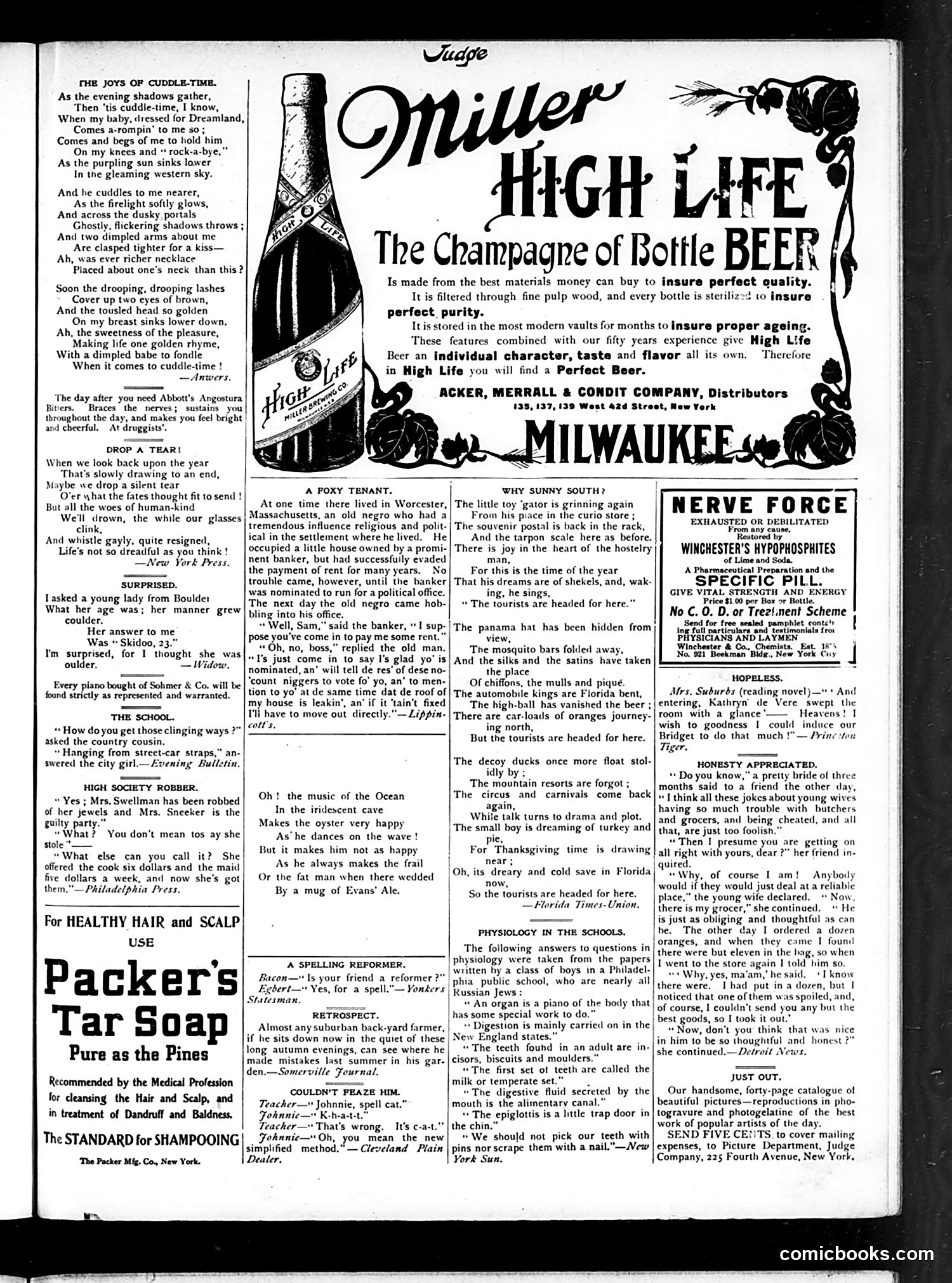
This page from Judge magazine (a major American satirical publication) is primarily an **advertising and humor miscellany** rather than political cartoons. The main content includes: **Poetry & Humor**: Sentimental verse about "cuddle-time" with babies, followed by light jokes about young women, city life, and social embarrassment—typical Judge fare mixing sentimentality with gentle mockery. **Notable Satire**: "A Foxy Tenant" depicts an elderly Black man in Worcester, Massachusetts who has avoided paying rent for years by leveraging his political influence—he promises to deliver Black voters' support to his landlord (a banker running for office) in exchange for forgiveness of debt. The satire targets both tenant manipulation and landlord political desperation, though the racial dialect stereotyping reflects the era's conventions. **Advertisements**: High Life Beer ("Champagne of Bottle Beer"), Packer's Tar Soap, and piano ads dominate the page—standard commercial content for Judge. The page reflects early 20th-century American humor: sentimental domesticity, light social satire, and casual racial stereotyping typical of the period.
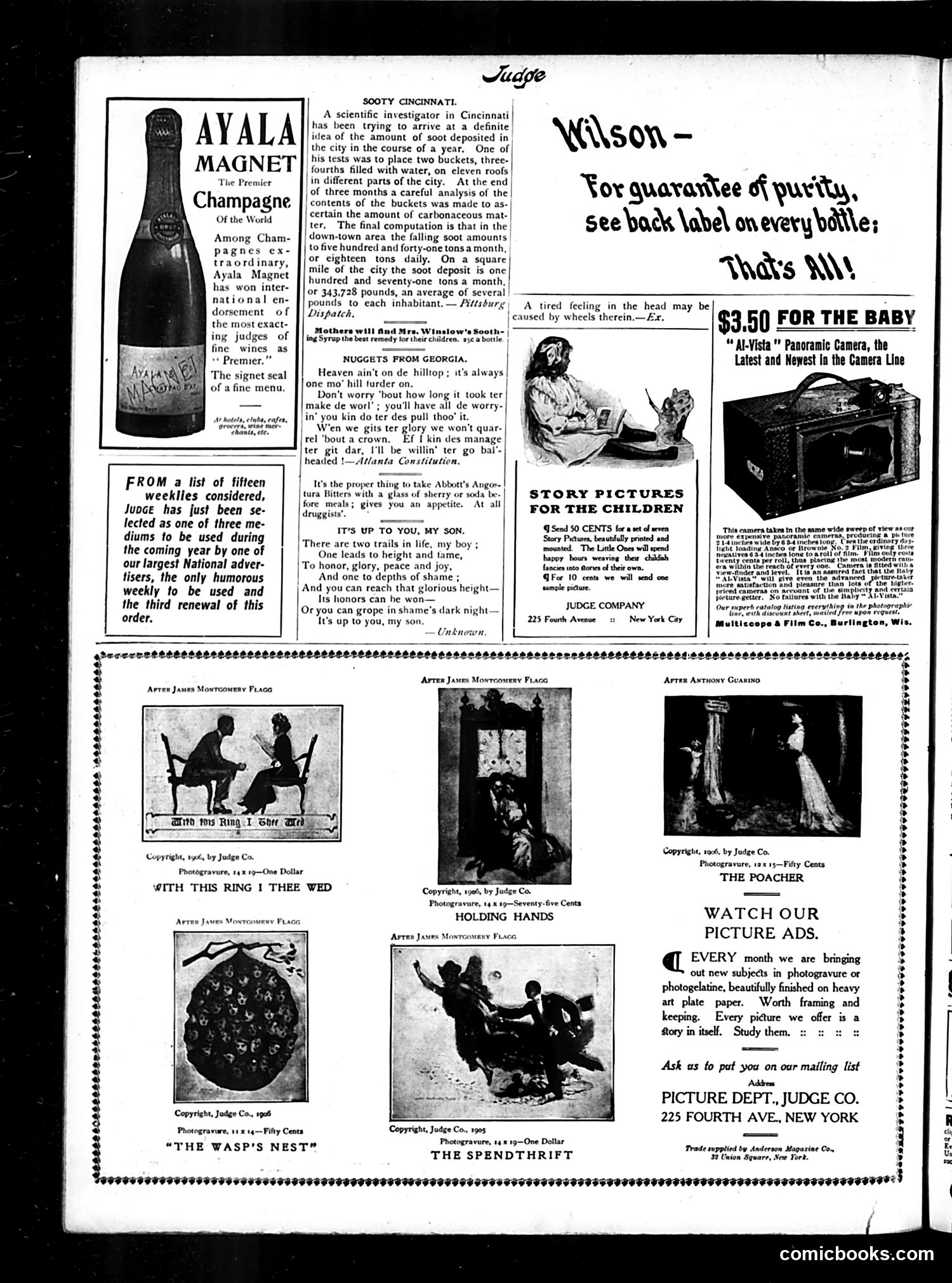
This page is primarily **advertising and product announcements** rather than political satire or editorial cartoons. Key elements: **"Sooty Cincinnati"** - A brief news item satirizing Cincinnati's industrial pollution. Scientists measured soot accumulation (341 tons monthly in downtown), mocking the city's grimy conditions—a common Progressive Era critique of industrial urban centers. **"Nuggets from Georgia"** - Humorous folk sayings in dialect, poking gentle fun at rural Southern wisdom and speech patterns, typical of early-1900s "cornpone" humor. **Multiple product advertisements** - Ayala Magnet Champagne, Wilson whiskey, Abbott's Angostura Bitters, and an "Al-Vista" camera all use editorial-style copy to sell products. **Picture advertisements** - The bottom half showcases Judge Company's photogravure picture sets, featuring reproductions of romantic/dramatic scenes ("With This Ring I Thee Wed," "The Poacher") targeting middle-class home decoration. The page reflects 1906 **commercial publishing**: blending light humor, product promotion, and cultural commentary without heavy political content.
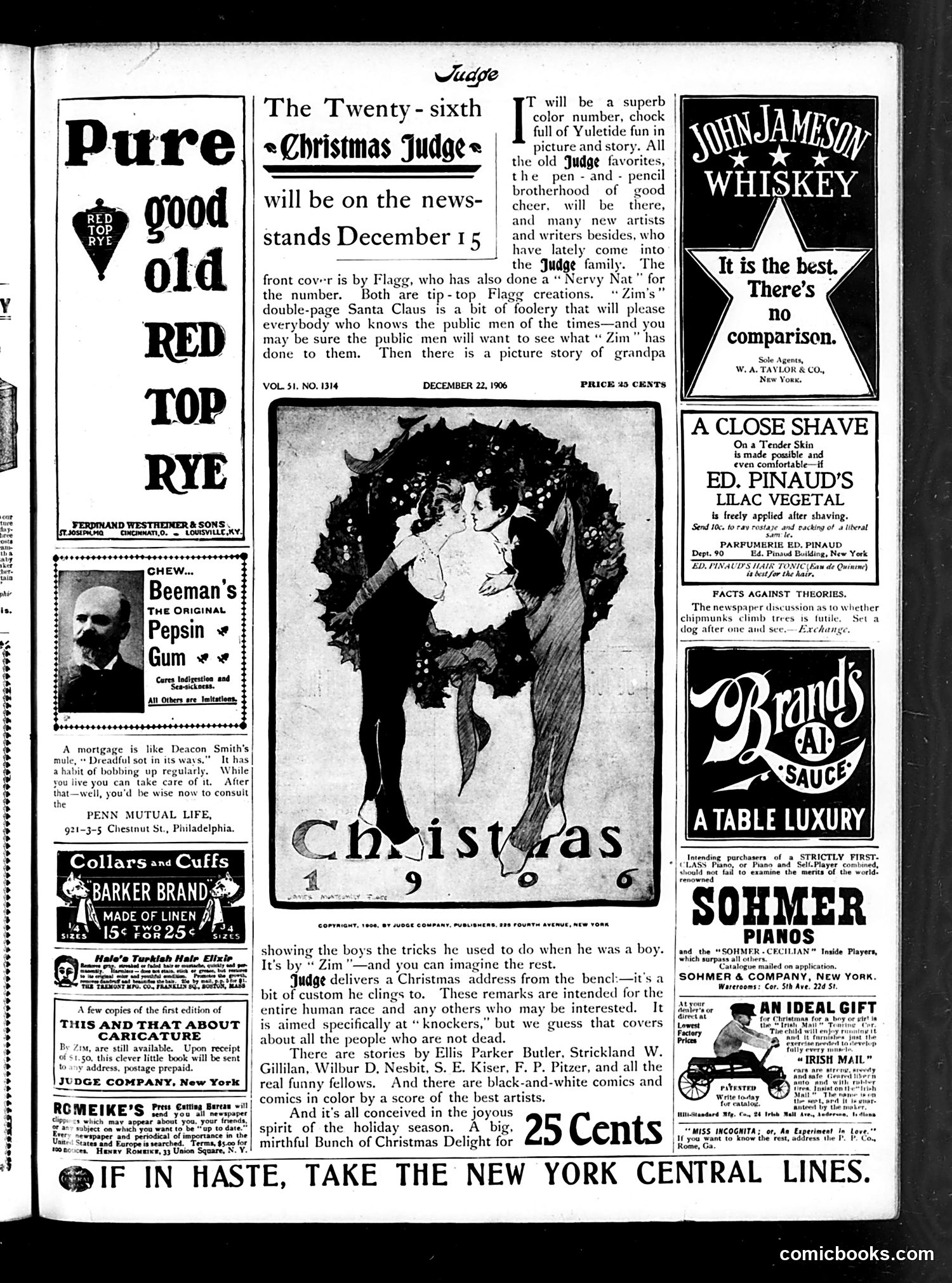
This page primarily promotes the upcoming "Twenty-sixth Christmas Judge" special issue (arriving December 15), featuring color illustrations and holiday-themed stories and comics by popular contributors including "Zim" (Eugene Zimmerman), Ellis Parker Butler, and others. The editorial describes it as containing a "Christmas address from the bench" aimed at "knockers" (complainers/critics), framed as advice for "the entire human race." The central illustration shows Santa emerging from a Christmas wreath—a festive cover design typical of holiday magazine issues of this era. The remainder is vintage advertising: Beeman's Pepsin Gum, hair products, life insurance, shirt collars, whiskey, shaving cream, piano manufacturers, and other period products. This mix of editorial content with commercial advertisements was standard for Judge, a satirical magazine that relied on advertising revenue. The $0.25 price point indicates this was an affordable luxury item for early-20th-century readers.
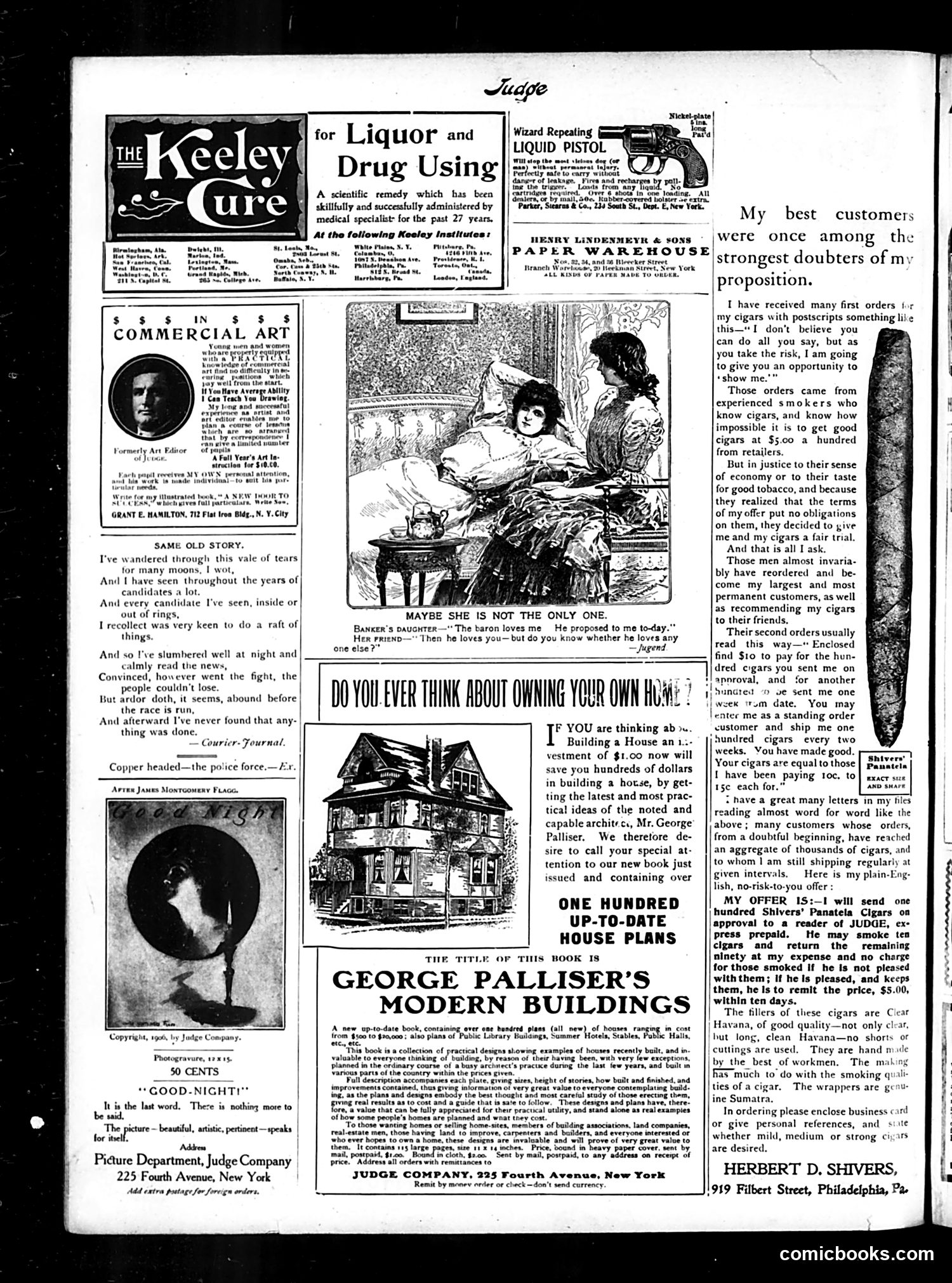
This page is primarily **advertising and promotional content** rather than political satire. The main elements include: **"The Keeley Cure"** advertisement at top-left promotes a medical treatment for "Liquor and Drug Using"—a legitimate (if dubious by modern standards) therapeutic service that operated in the early 1900s. **The central illustration** depicts a domestic scene titled "Maybe She Is Not the Only One," showing a woman with a male visitor while another woman enters—a mild marital scandal joke typical of the era's humor about infidelity. **The poem "Same Old Story"** expresses cynicism about political candidates who promise reforms before elections but accomplish nothing afterward—timeless political commentary. **The bulk of the page** advertises George Palliser's architectural book of house plans and Herbert D. Shivers' cigar business, with Shivers explaining his direct-mail marketing strategy to skeptical customers. The page reflects early-1900s concerns: medical quackery, domestic propriety, political disappointment, and emerging mail-order commerce.
This page is primarily **advertising and light humor**, not political satire. The main content includes: **Advertisements:** Old Crow Rye whiskey, Tampa Bay Hotel (a luxury resort), the Overland Limited train, and various patent medicines (Santal Capsules for venereal disease, Cook Remedy for blood poison). **Humor pieces:** Short jokes and quips, including: - A pun about "woman/woo-man/wimmen" (playing on women's extravagance) - A joke about a Japanese laundry service's awkward phrasing ("wash our customers") - Observations about the Fat Men's association declining membership **"Jasper's Hints to Money-makers":** An advertisement for *Leslie's Weekly* financial advice column. The page reflects early-1900s concerns: stock market investing, women's consumer spending, turn-of-century tourism to Florida, and patent medicines (including those for treating sexually-transmitted infections). There is **no significant political cartoon or satire** on this page—it's a typical Judge magazine advertising section with filler humor.
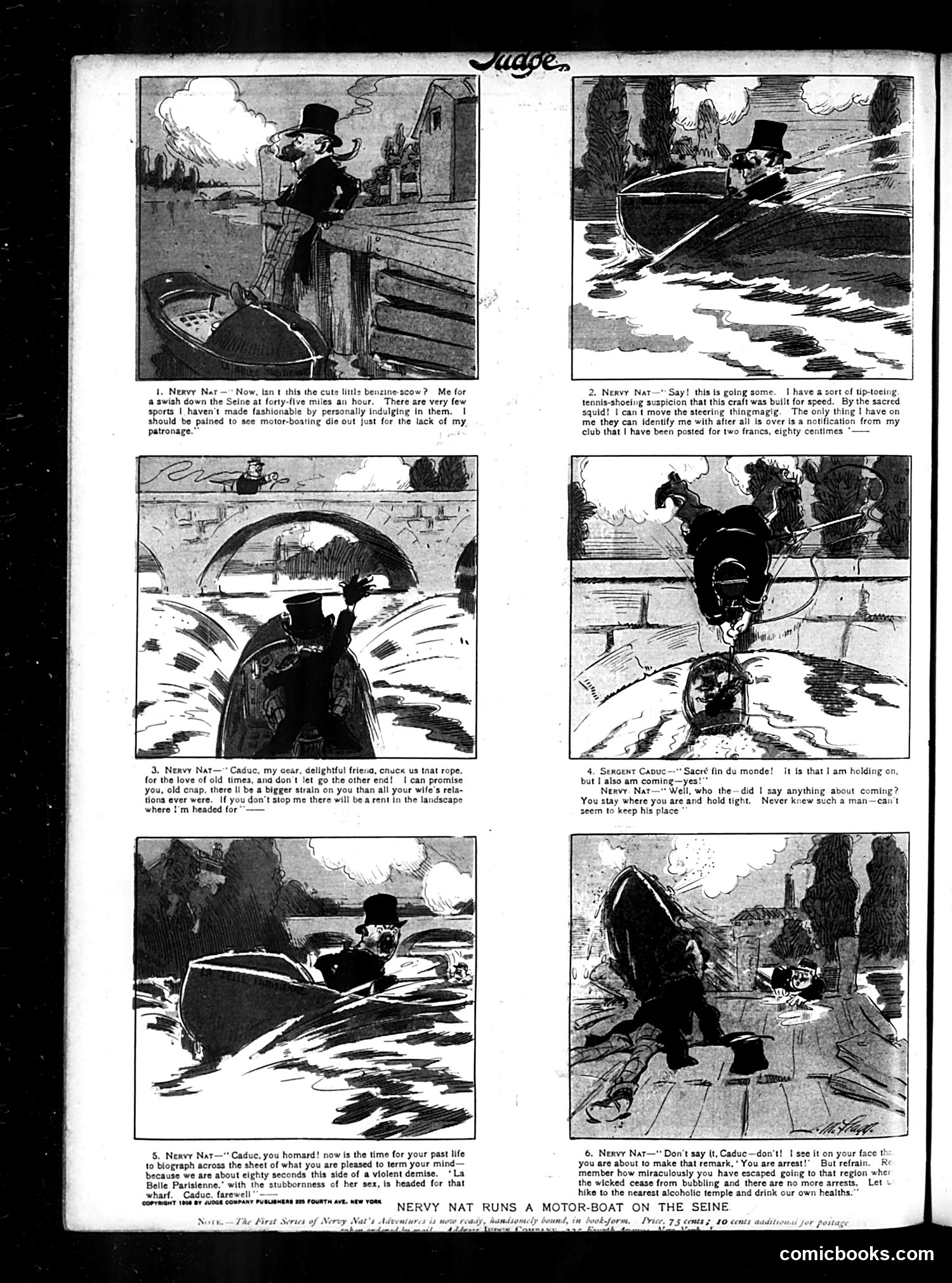
This is a six-panel comic strip satirizing a wealthy American tourist ("Nervy Nat") who rents a speedboat on the Seine River in Paris. The humor centers on Nat's combination of arrogance and incompetence: he boasts about single-handedly making sports fashionable through his patronage, then immediately proves unable to operate the boat's steering mechanism. The satire targets upper-class American pretension and the stereotype of wealthy Americans abroad as bumbling dilettantes. Nat's companion Caduc (likely French, given the name) becomes inadvertently caught in the chaos as the uncontrollable boat heads toward disaster. The joke culminates in Nat's absurd concern about a club fine rather than the impending crash—mocking his misplaced priorities. The references to Paris locations (the Seine, Belle Parisienne) and French characters ground this in early 20th-century American attitudes toward European tourism.