A complete issue · 16 pages · 1906
Judge — November 10, 1906
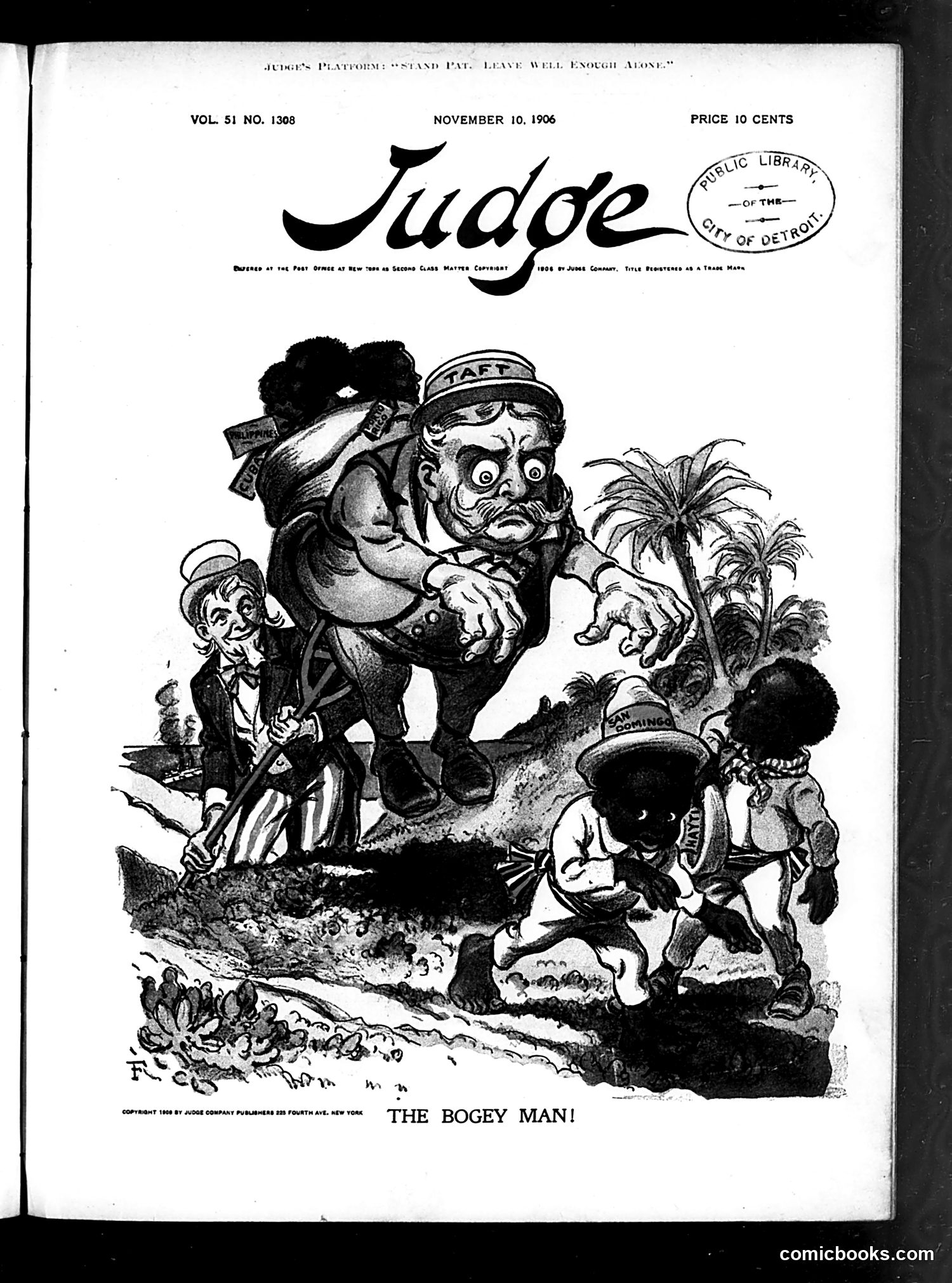
This political cartoon depicts a large, menacing figure labeled "TAFT" (William Howard Taft, President-elect) as a bogey man frightening smaller figures representing colonial peoples or territories—likely Filipino, Cuban, and other populations under American imperial control. The cartoon satirizes American imperialism and the anxieties it provoked. Taft, who had served as governor-general of the Philippines, embodied U.S. expansionism. The caricatured figures fleeing in terror suggest the cartoon mocks either: (1) fears among colonized peoples about Taft's policies, or (2) American anxieties about the "bogey" of imperial overreach itself. The tropical setting with palm trees emphasizes foreign colonial contexts where America was exercising control.
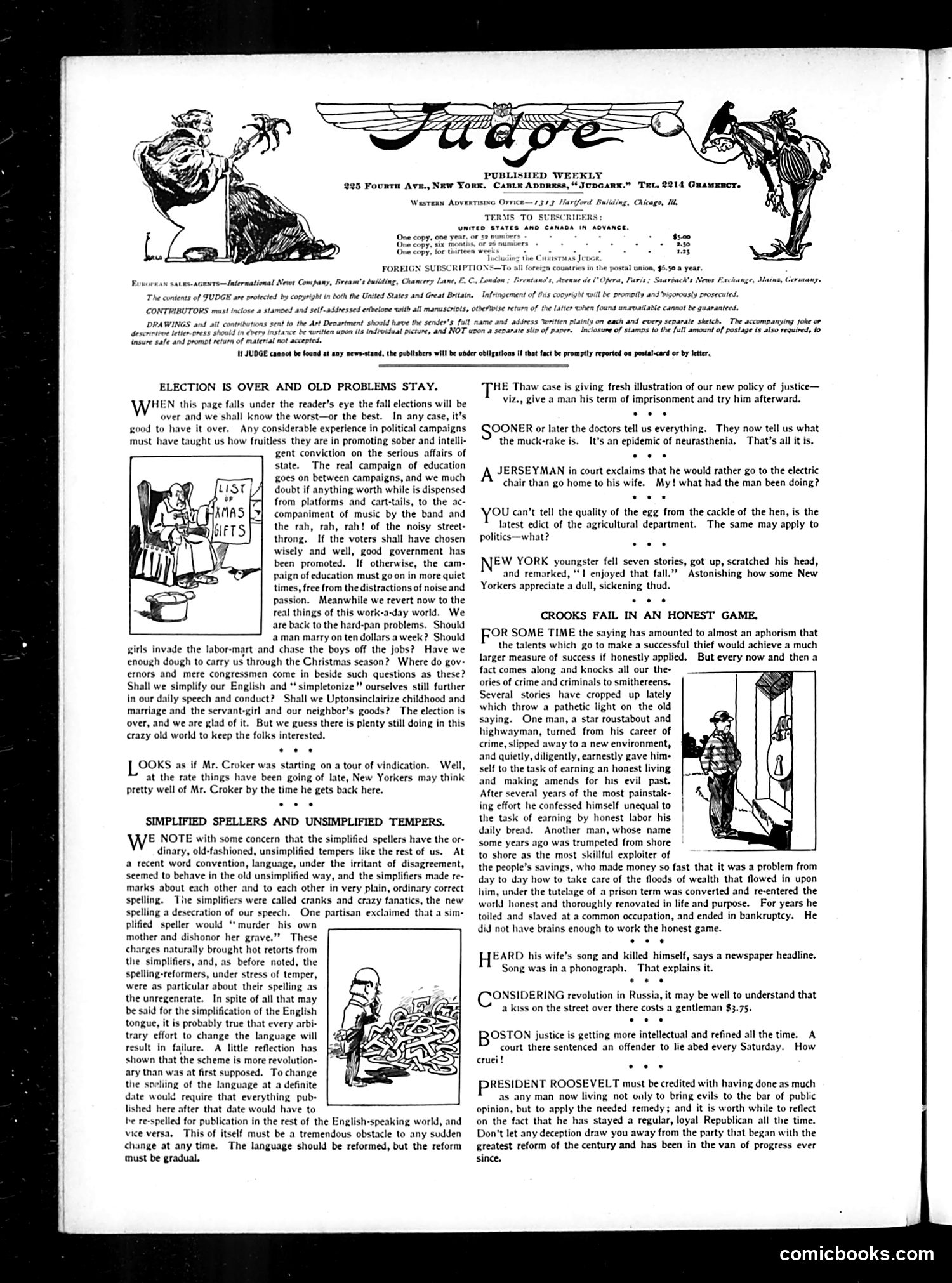
This page contains editorial commentary rather than cartoon satire. The main illustrated piece (left side) shows a figure labeled "LIST" with text about "MISFITS," likely criticizing political candidates or incompetent officials selected during election season. The right column contains brief satirical observations on contemporary issues: judicial sentencing practices, agricultural policy, New York youth culture, crime and reformation, and Russian revolution commentary. One item mocks a newspaper headline about a man killing himself after hearing his wife sing. The final piece praises President Roosevelt for maintaining Republican loyalty while addressing public concerns—typical Progressive-era political commentary. The illustrations are small vignettes supporting these brief editorial jabs, using visual humor to reinforce textual satire about governance, social behavior, and current events, rather than being standalone cartoons.
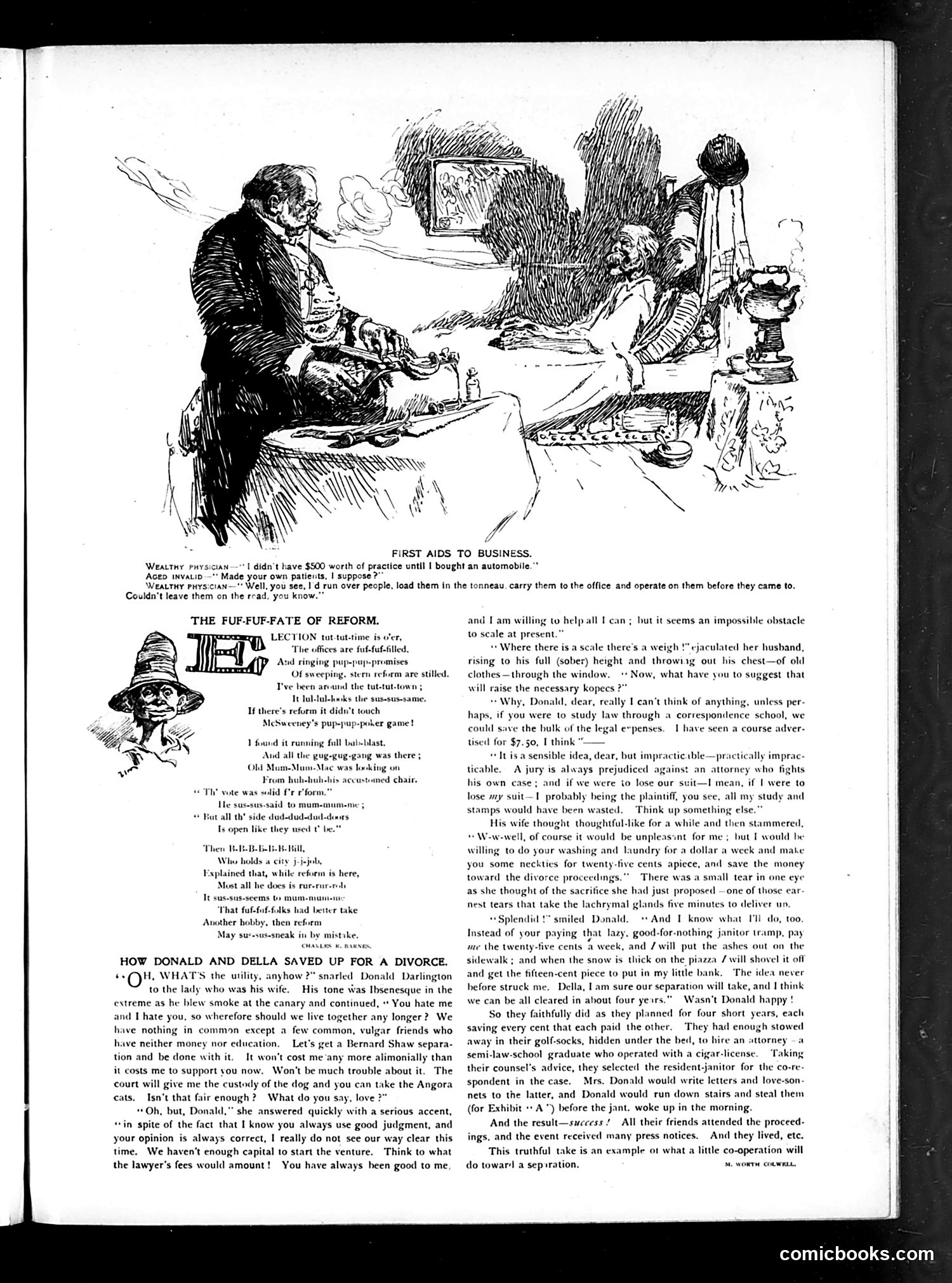
The page contains satirical commentary on business and divorce in early 20th-century America. **"First Aids to Business"** mocks wealthy physicians dispensing dubious advice to struggling businessmen—suggesting that rich professionals offer impractical counsel disconnected from actual commerce. **"The Fuf-Fuf Rate of Reform"** appears to critique ineffective bureaucratic reform efforts, though the specific target is unclear from the visible text. **"How Donald and Della Saved Up for a Divorce"** satirizes a middle-class couple meticulously saving money over four years specifically to afford a lawyer's fees for their divorce proceedings. The narrative tone suggests Judge found this both financially absurd and socially telling—that ordinary Americans must scrimp and save merely to legally dissolve their marriage. The story emphasizes the prohibitive cost of legal separation for working people. The overall thrust critiques wealth disparities and the legal system's expense.
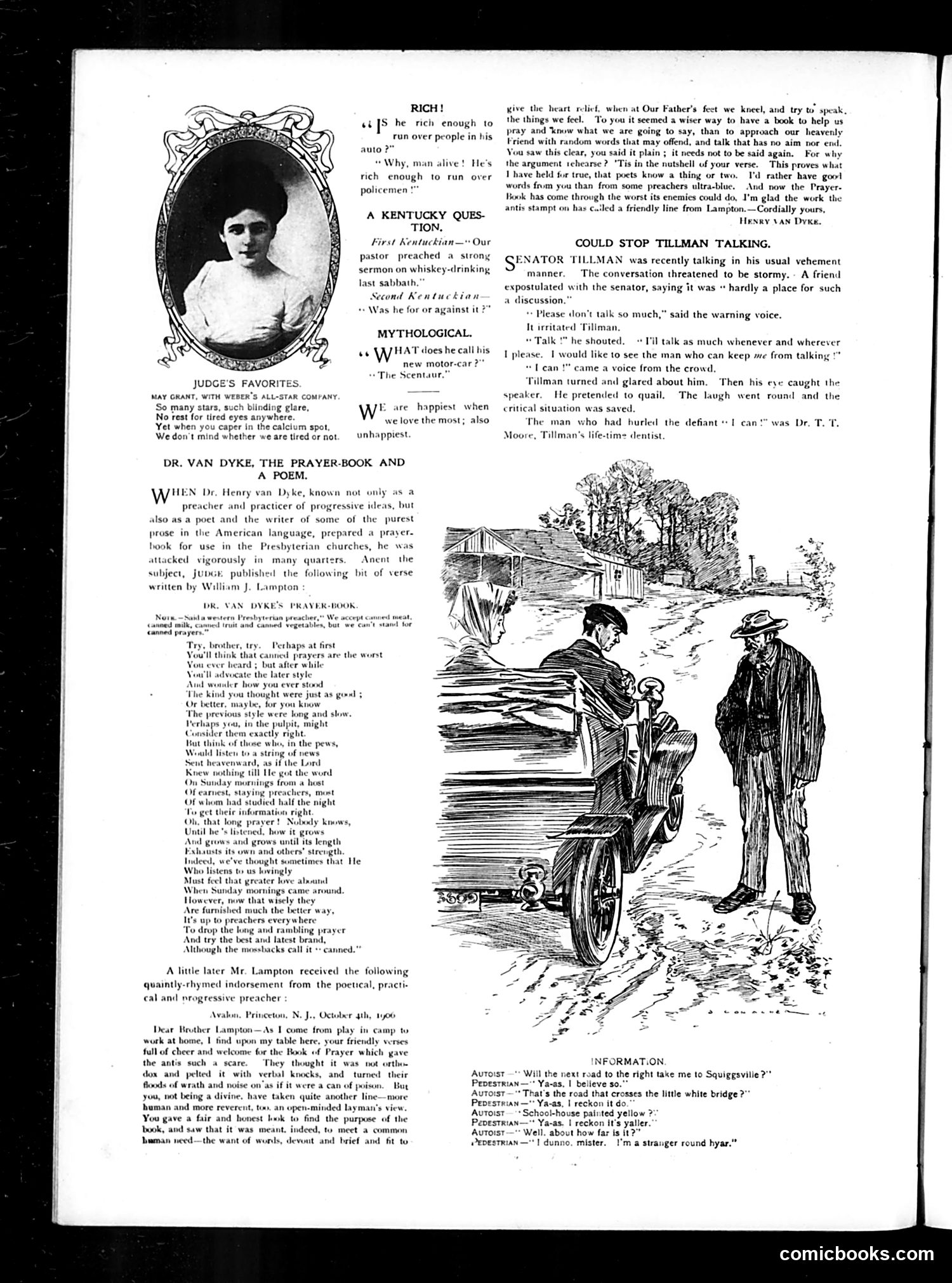
This Judge magazine page contains three distinct sections: **Top section**: A humorous debate about wealth and poetry. The joke satirizes wealthy patrons' pretentious views—a rich man asks if he's wealthy enough to "run over people in his auto," suggesting the wealthy believe money exempts them from basic morality. **Middle section**: "A Kentucky Question" mocks Senator Tillman, depicting him as loudmouthed and argumentative. The anecdote shows him shouting "I can!" when told not to talk so much, and being out-argued by dentist Dr. T.T. Moore—satirizing Tillman as verbose and quarrelsome. **Right illustration**: Shows two men with an early automobile, discussing directions. The dialogue humorously captures the confusion of early motorists unfamiliar with roads and bridges. Overall, the page satirizes wealth, political bombast, and the novelty of automobiles.
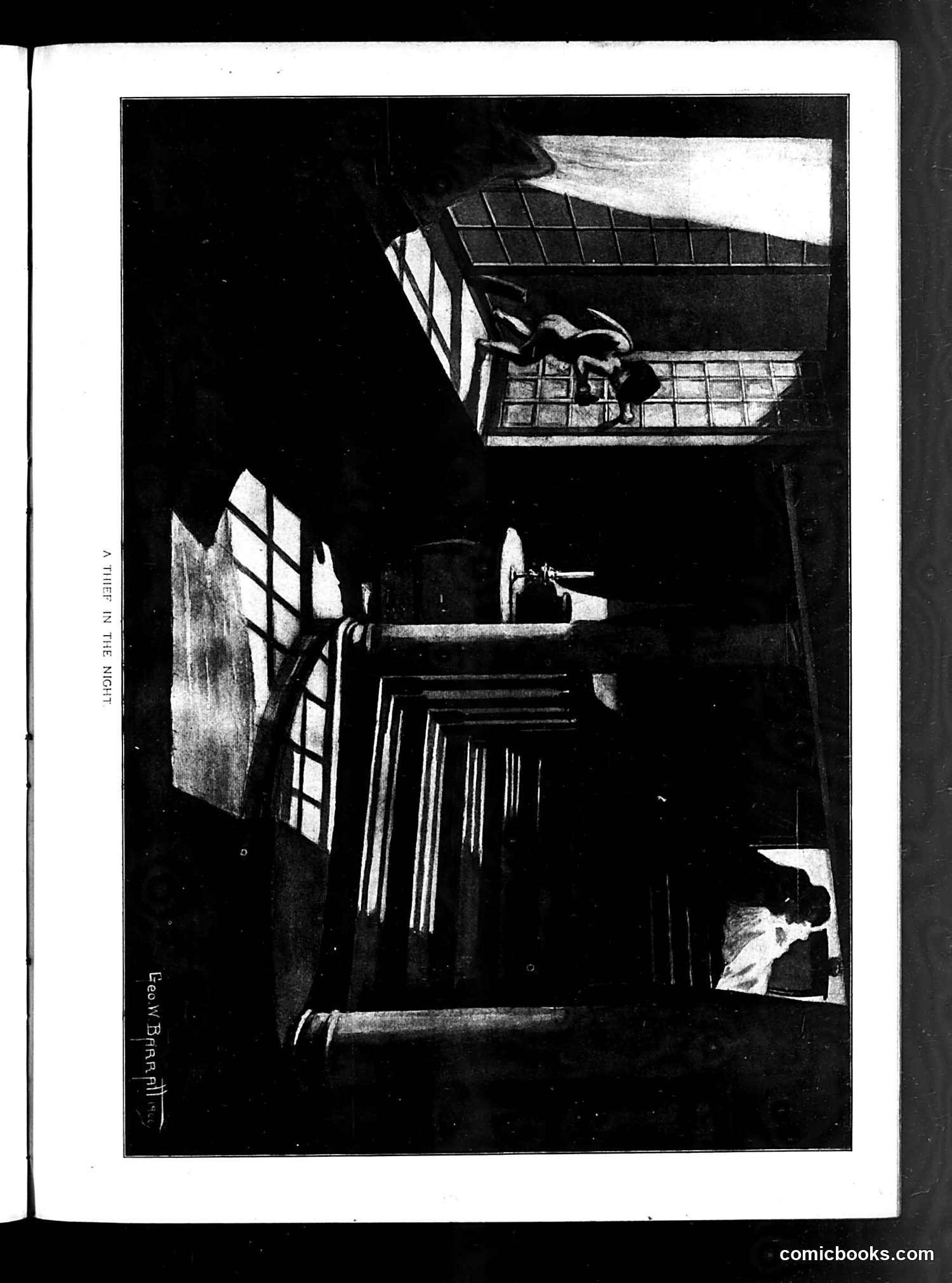
I can see this is a black and white photograph or illustration from *Judge* magazine showing an interior architectural scene with dramatic lighting through windows and gridded skylights. The image appears to be rotated 90 degrees on the page. However, I cannot clearly identify specific political figures, caricatures, or satirical subjects from the image alone. The OCR text provided is blank or illegible, which would normally explain the cartoon's meaning, context, and targets. Without legible text or clearly identifiable subjects, I cannot accurately explain what political or social commentary this page conveys to a modern reader. To provide accurate historical interpretation as requested, I would need either clearer OCR text or more visible identifying details in the image itself.
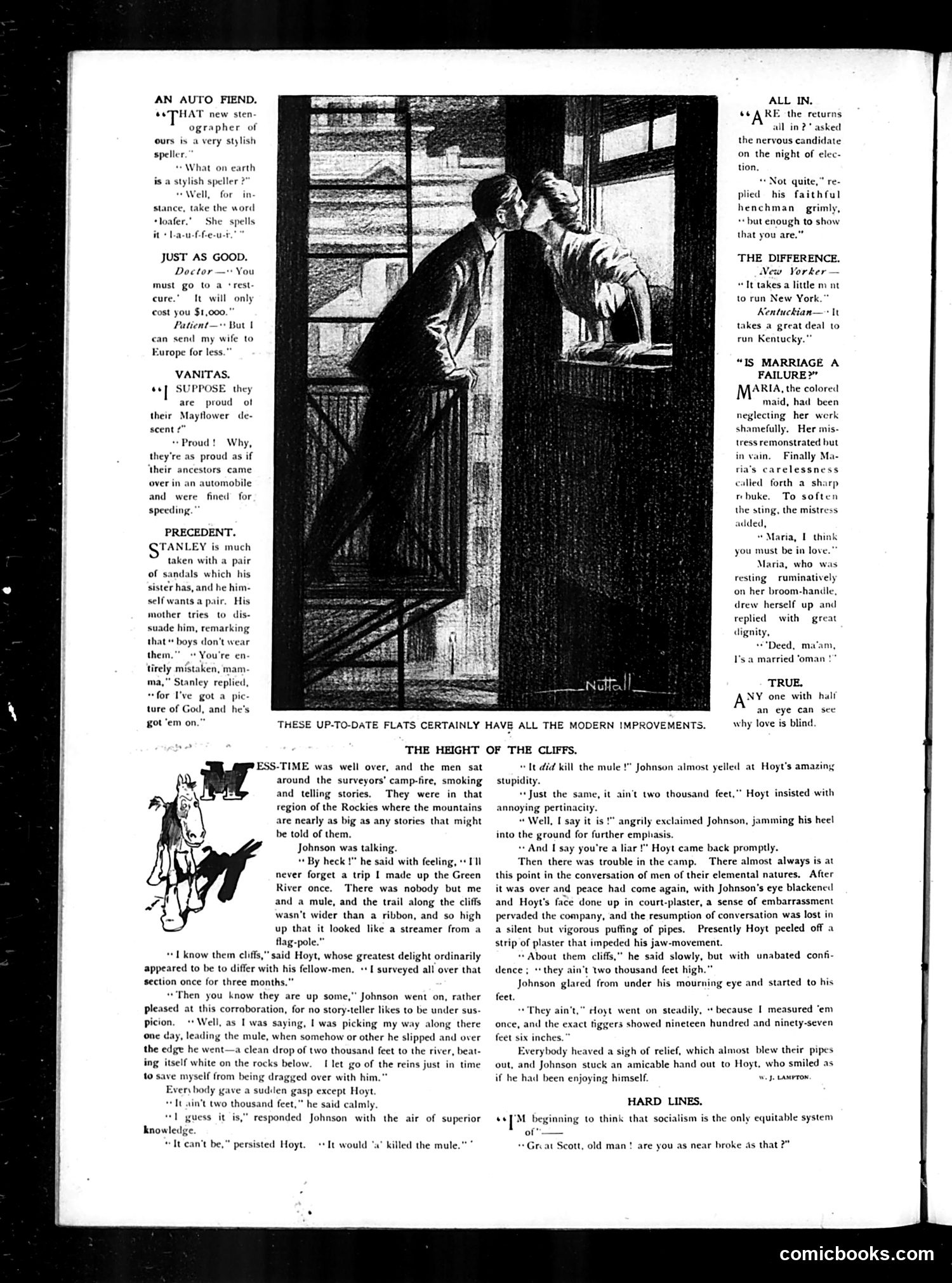
This page contains multiple brief satirical jokes typical of early 20th-century *Judge* magazine, plus a longer humorous story. **The short jokes** mock contemporary social pretensions and absurdities: a stenographer who misspells fashionably, doctors overcharging for rest cures, wealthy Americans bragging about Mayflower ancestry (ironically compared to arriving by automobile), and a boy wanting sandals because he saw God wearing them in a picture. **"The Height of the Cliffs"** is the main story—a tall-tale contest between two surveyors in the Rocky Mountains. Johnson describes a harrowing incident where his mule fell two thousand feet off a cliff. His rival Hoyt systematically contradicts him, insisting the drop couldn't be that high "because it would've killed the mule." The joke's appeal lies in Hoyt's absurd logic: Johnson claims the mule *did* die, but Hoyt won't concede the height. The story ends in a fistfight—satirizing masculine stubbornness and competitive one-upmanship among frontier types.
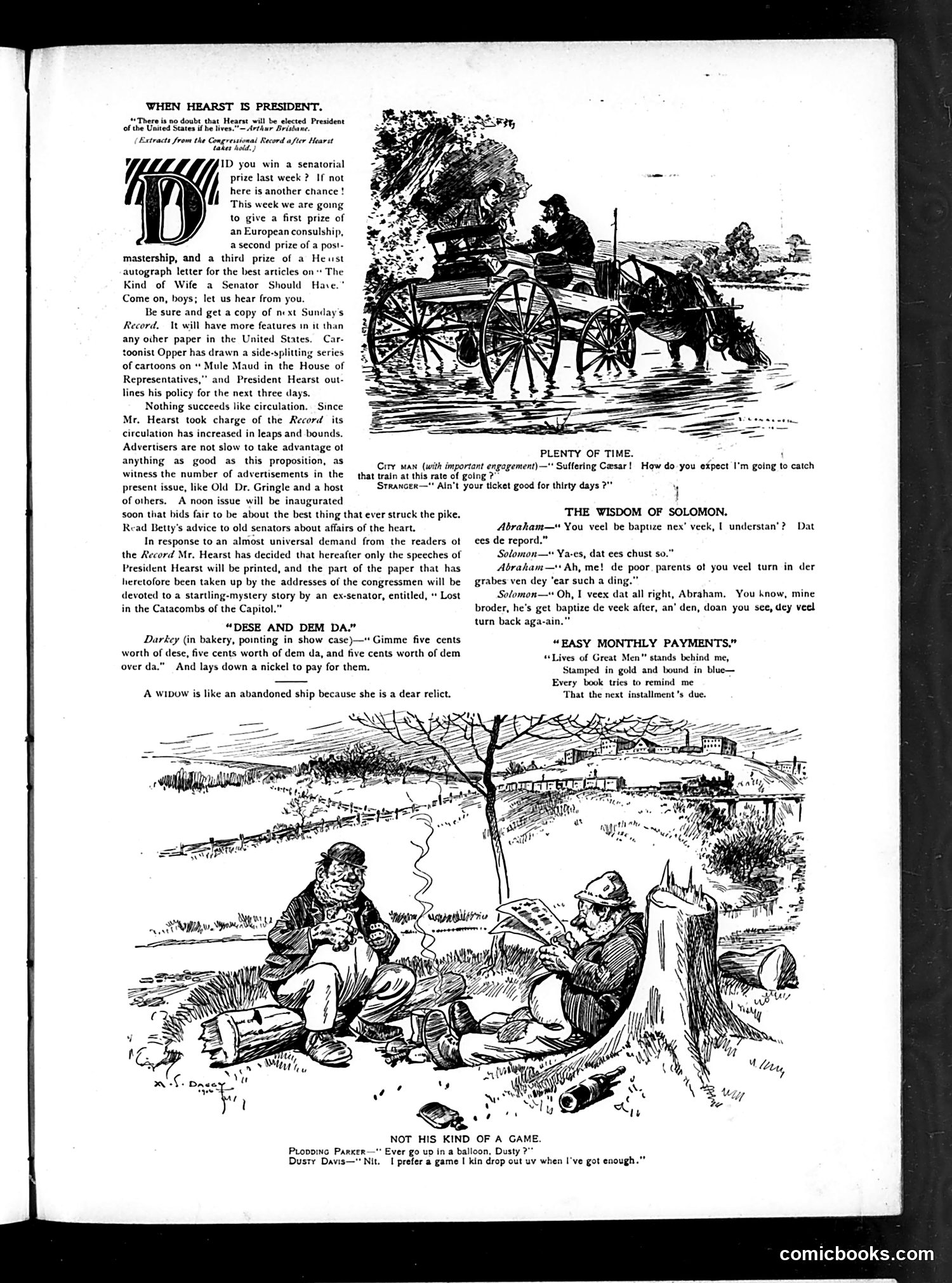
This page satirizes William Randolph Hearst's growing media power and ambitions. The headline quotes Arthur Brisbane predicting Hearst will become president, which Judge treats as absurdly dangerous. The satire depicts a fictional future where Hearst controls the *Congressional Record*, turning it into his personal propaganda sheet. The magazine mocks how he'd replace actual congressional speeches with his own policies and mystery stories, illustrating media consolidation's threat to democracy. The page also ridicules Hearst's yellow journalism tactics—using sensational content and circulation gimmicks (contests offering consulships and autographed letters) to sell papers. The various comic strips below are filler typical of Hearst's publications. Judge's point: Hearst's newspaper empire gave him dangerous political influence, and his celebrity-driven approach to news threatened legitimate governance. The satire warns readers about letting media moguls shape national discourse.
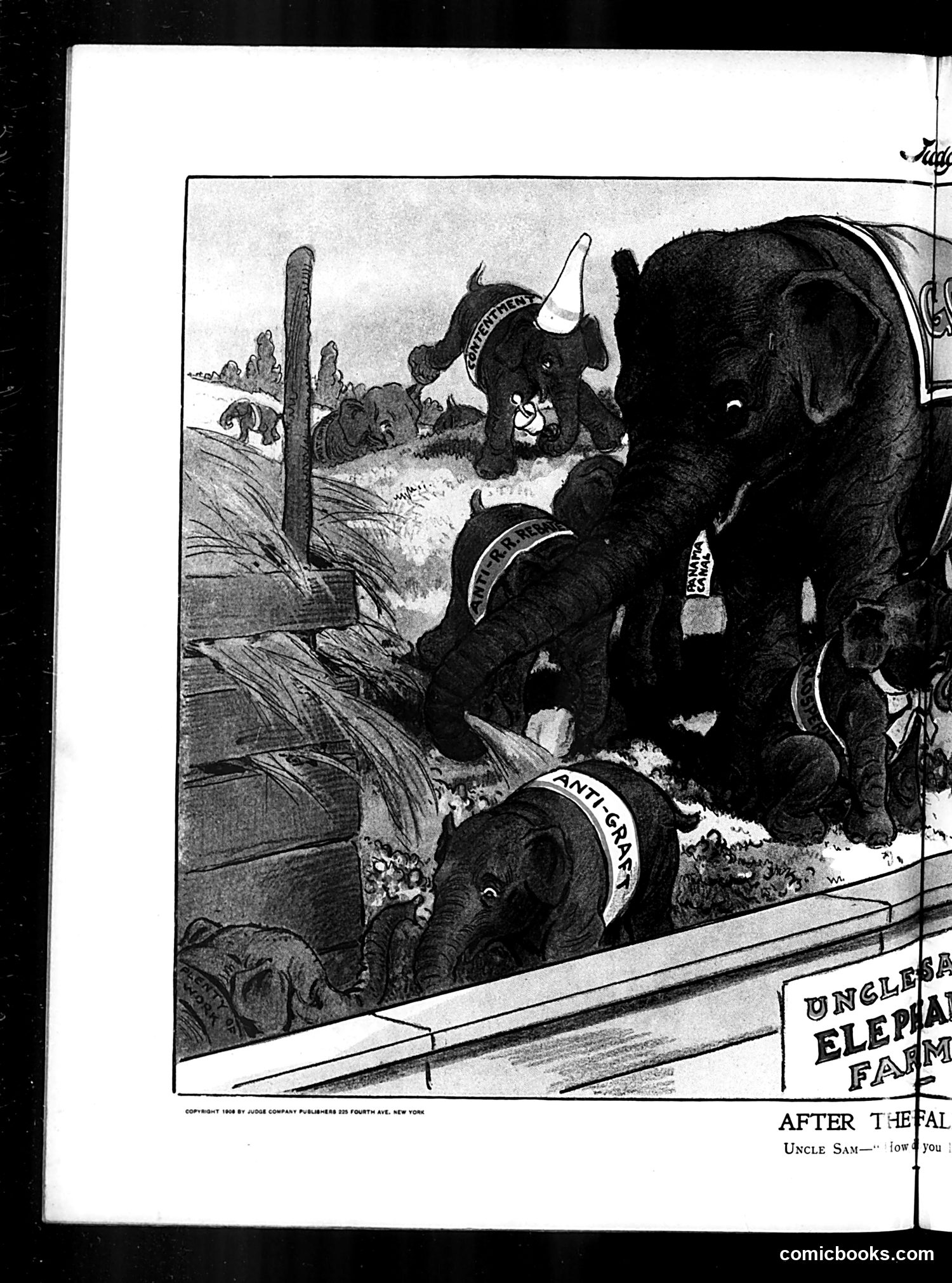
This appears to be a page from **Judge magazine** showing a cartoon titled "UNCLE SAM'S ELEPHANT FARM" (partially visible at bottom). The image depicts several elephants wearing decorative blankets/coverings in what looks like a farmyard or enclosure setting. The cartoon likely uses elephants as a symbol of the **Republican Party** (the GOP's traditional mascot), suggesting commentary on Republican political operations or policies under Uncle Sam's (America's) management. The "farm" metaphor may satirize how the party or government "manages" or "corrals" Republicans. However, without the complete caption text and full date, **the specific political event or target remains unclear**. The OCR text is largely unreadable, preventing precise identification of the satirical point or historical context.
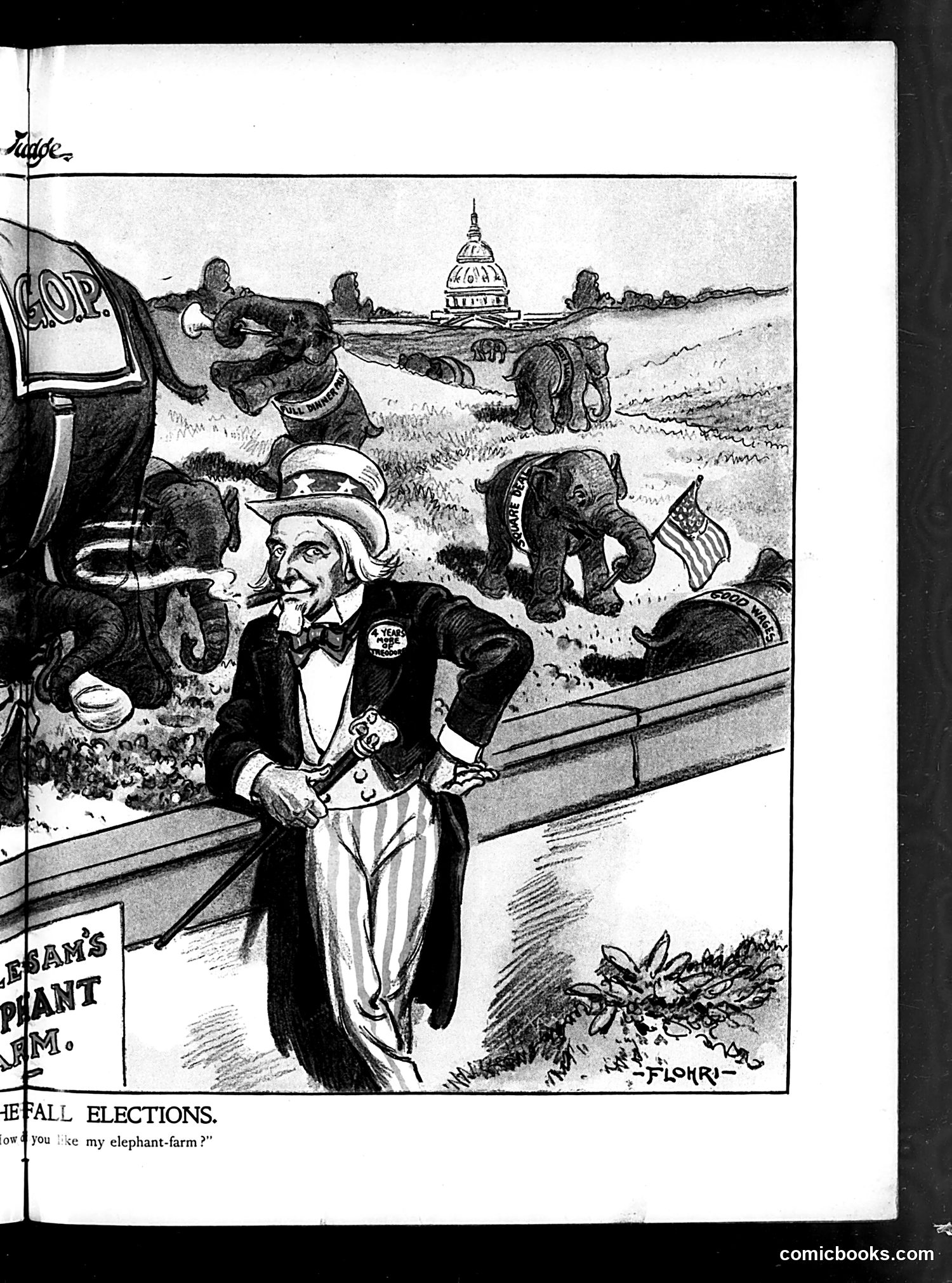
This cartoon titled "The Fall Elections" depicts Uncle Sam (the tall figure in top hat and patriotic attire) presenting his "elephant-farm" to viewers. The elephants represent the Republican Party (the GOP elephant is a standard symbol). The cartoon appears to be election-related satire, likely from the late 19th or early 20th century, with the Capitol building visible in the background. Uncle Sam is essentially asking voters if they approve of the Republican "farm" — his stewardship or management of the party's electoral prospects. The specific political context — which election cycle, which issues — remains unclear without a date or additional text. The satire suggests commentary on Republican electoral prospects or party management during a particular fall election period.
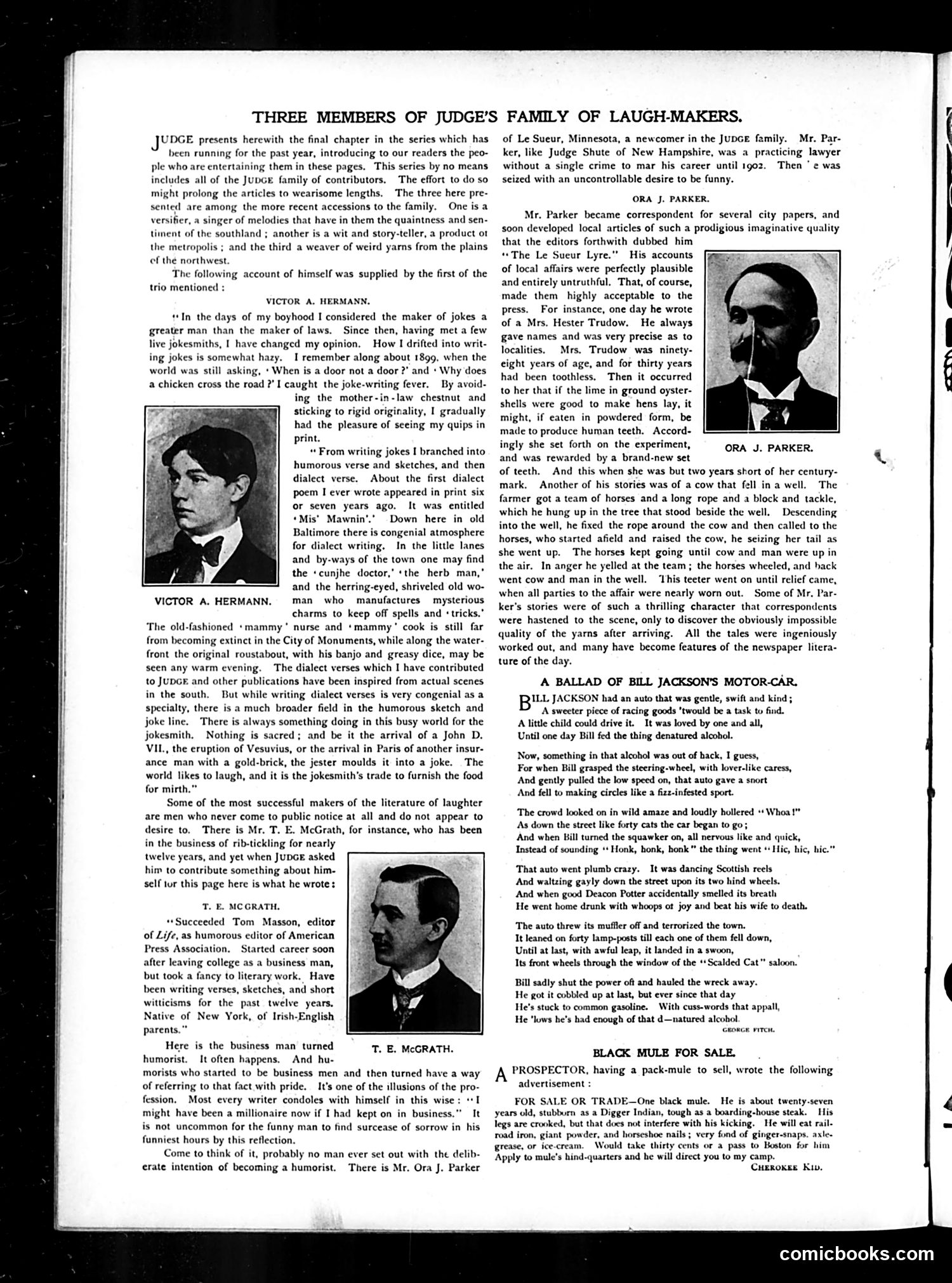
This page introduces three humor writers for Judge magazine. The three portraits show **Victor A. Hermann** (a Baltimore-based dialect poet who writes humorous verse about Southern life, inspired by local characters), **T. E. McGrath** (a former business man turned editor of the American Press Association's humor section), and **Ora J. Parker** (a Minnesota newspaperman known for imaginative local reporting). The text celebrates these "laugh-makers" as part of Judge's creative team. Hermann discusses how he drifted into joke-writing around 1899 and specialized in dialect verse capturing authentic Southern speech and characters. McGrath is presented as a reluctant contributor who briefly describes his career shift from business to humor writing. The page represents Judge's effort to profile its contributors—essentially 1900s-era promotional journalism celebrating the magazine's creative staff.
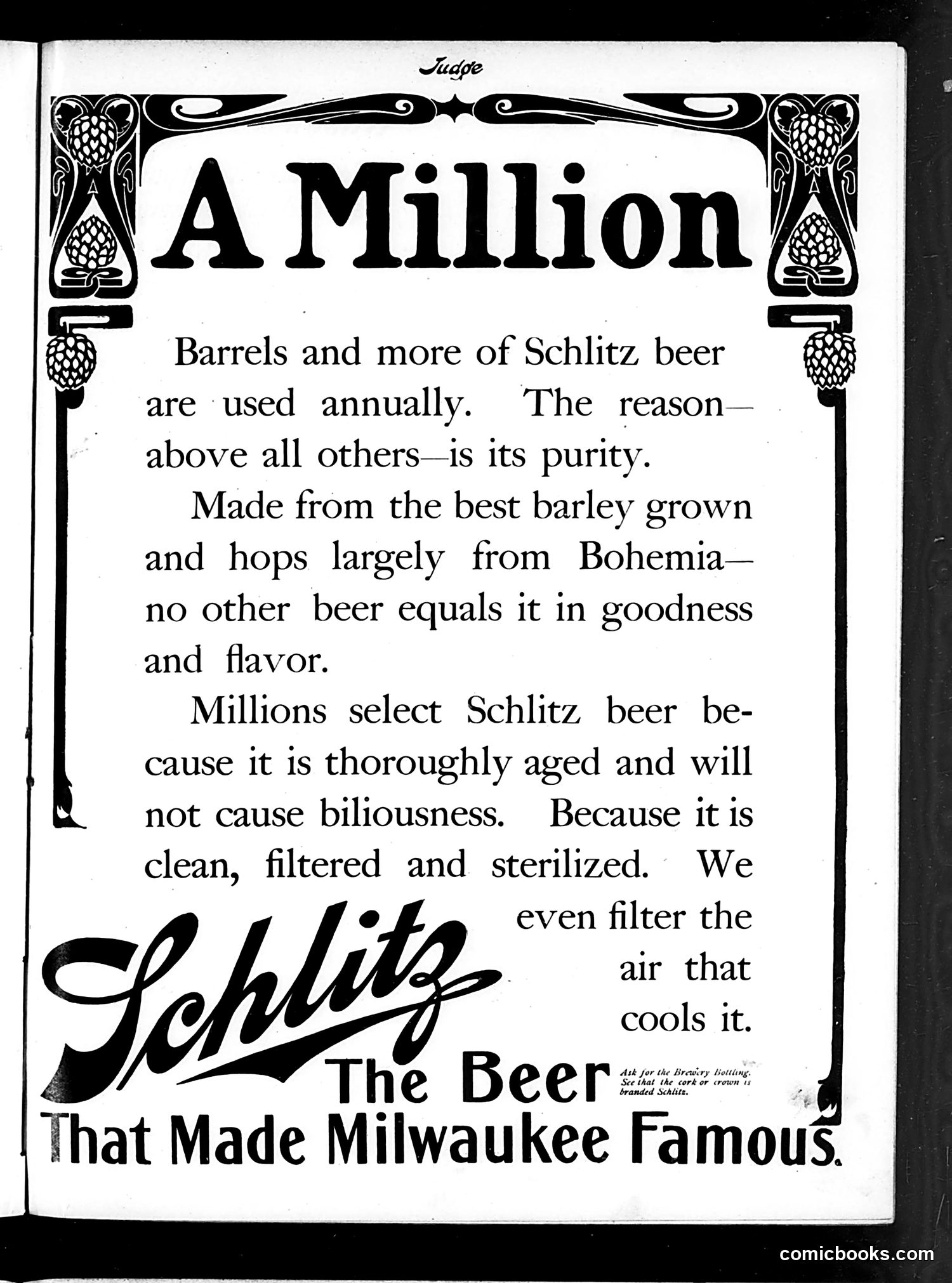
This page is **advertising, not satire or editorial content**. It's a full-page advertisement for Schlitz beer, a major Milwaukee brewery. The ad makes marketing claims typical of early 20th-century beer advertising: purity, quality ingredients (Bohemian hops), thorough aging, and filtration. The claim that it "will not cause biliousness" addresses a genuine concern about beer quality and digestion in that era. The phrase "The Beer That Made Milwaukee Famous" became Schlitz's famous slogan, reflecting Milwaukee's identity as a major brewing center. The decorative Art Nouveau borders with hops imagery reinforce the premium positioning. There is no political cartoon or satire present—this is straightforward product advertising placed in Judge magazine.
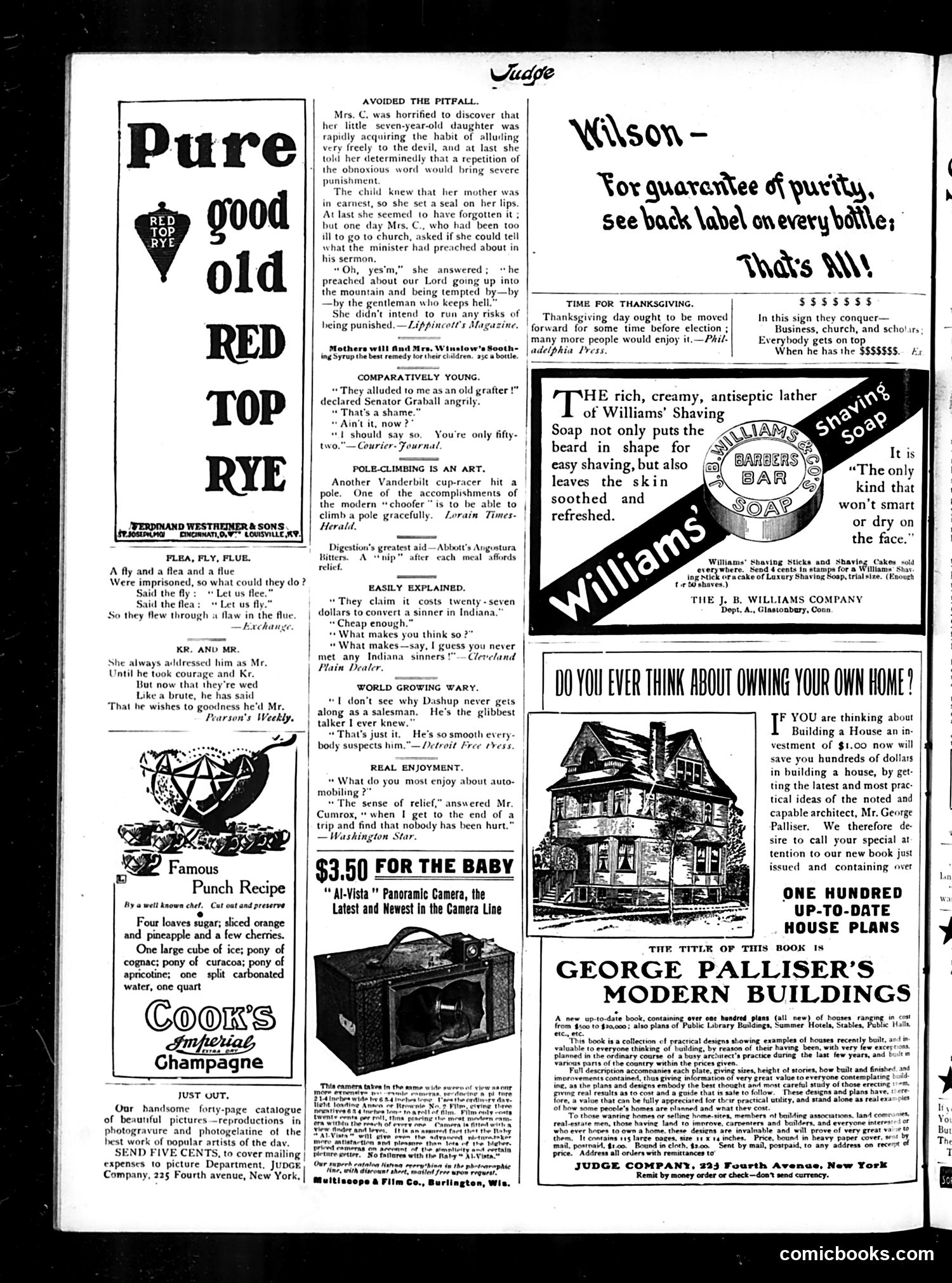
This page is **primarily advertising**, not political satire. The main content includes: **Advertisements:** - Red Top Rye whiskey (Wernemann Westheimers & Sons) - Wilson's Shaving Soap (Williams' Barber's Bar) - Cook's Imperial Champagne - Al-Vista Panoramic Camera ($3.50) - George Palliser's Modern Buildings (house plans book) **Humorous filler pieces** titled "Judge" include brief jokes and anecdotes about everyday situations—avoiding church, addressing etiquette ("Mr." vs "Kr."), explaining cheap soup, and discussing automobiles. These are gentle domestic humor rather than political commentary. The page reflects early 20th-century consumer culture and domestic life, with advertising dominating the layout alongside light, non-partisan comedic content.
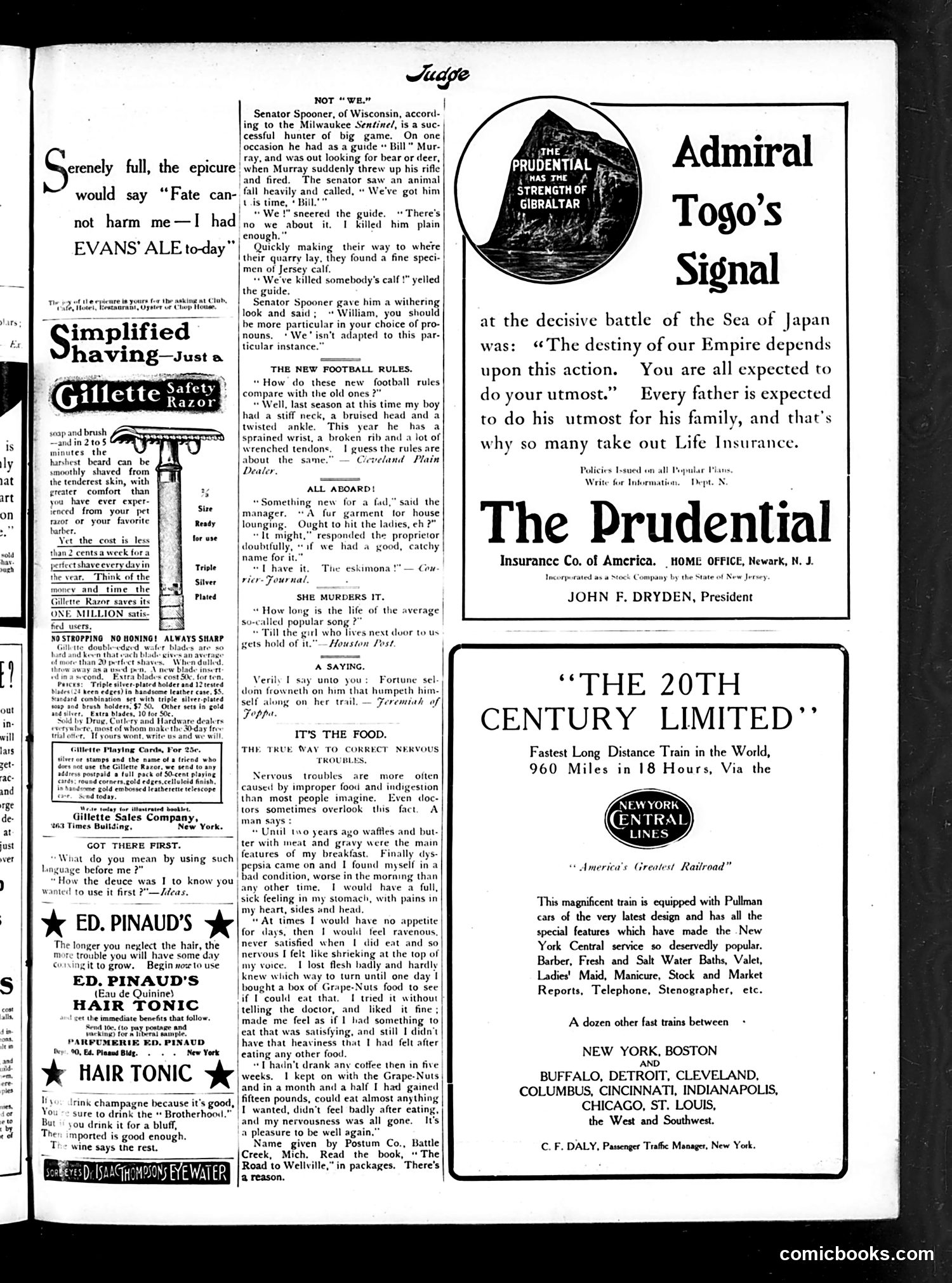
This page contains primarily **advertisements and short humorous anecdotes** rather than political cartoons requiring historical context. The main satirical content includes: **"NOT 'WE'"** – A joke mocking Senator Spooner of Wisconsin for claiming credit ("we") when his guide actually shot what turned out to be a calf, not game. The humor targets pretentious claim-taking. **Football rules joke** – Satirizes how "new" safety rules haven't actually reduced injuries; the boy still gets equally hurt. **Other brief jokes** about language etiquette, popular songs, and nervous troubles. The page is dominated by **product advertisements**: Gillette razors, Evans Ale, Ed. Pinaud's Hair Tonic, and notably a **New York Central "20th Century Limited" train advertisement** emphasizing speed and luxury amenities (Pullman cars, dining, telegraph service). For modern readers: this represents typical early 1900s magazine content—light social satire mixed with heavy advertising, reflecting the era's consumer culture and genteel humor focused on social pretension rather than political commentary.
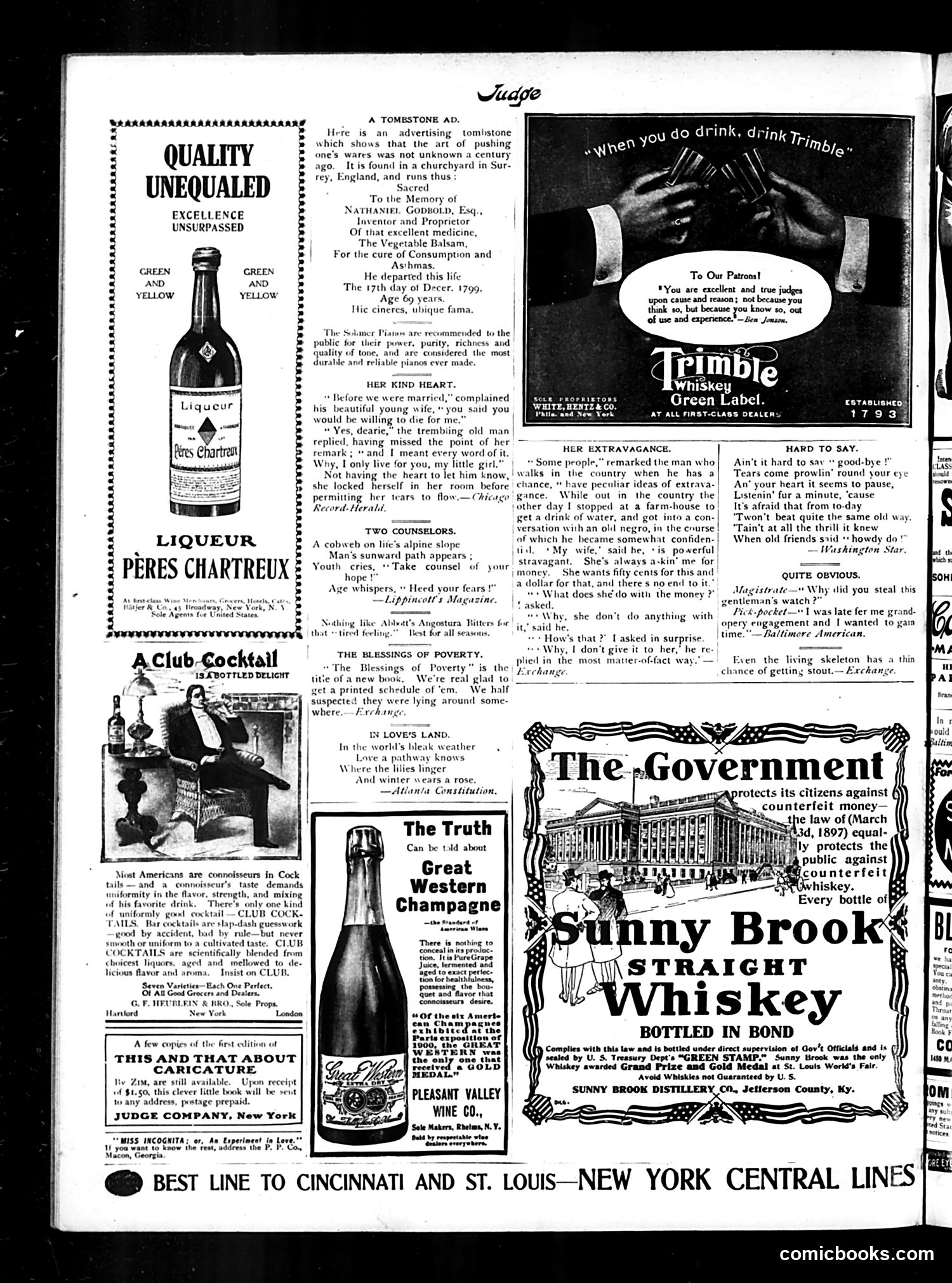
This page is primarily **advertising** for alcoholic beverages and related products, typical of early 1900s Judge magazine. The satire is light and scattered rather than focused on a single cartoon. **Key content:** 1. **"Tombstone Ad"** — A humorous historical note about a 1799 English gravestone advertising a patent medicine ("Vegetable Balsam"), satirizing how shameless commercial promotion was even then. 2. **Multiple liquor ads** — Péres Chartreux liqueur, Great Western Champagne, Club Cocktails, Sunny Brook Whiskey, and Trimble Whiskey dominate the page. The government notice about counterfeit whiskey suggests this was a real enforcement concern. 3. **Scattered humor pieces** — Brief jokes about marriage, poverty, and extravagance fill space between ads, typical of Judge's format. **The satire:** These ads implicitly mock Americans' drinking culture and advertising's aggressive marketing tactics—even for patent medicines. The "government protects against counterfeit whiskey" notice adds irony: whiskey was so profitable, counterfeiting was a problem worth federal notice.
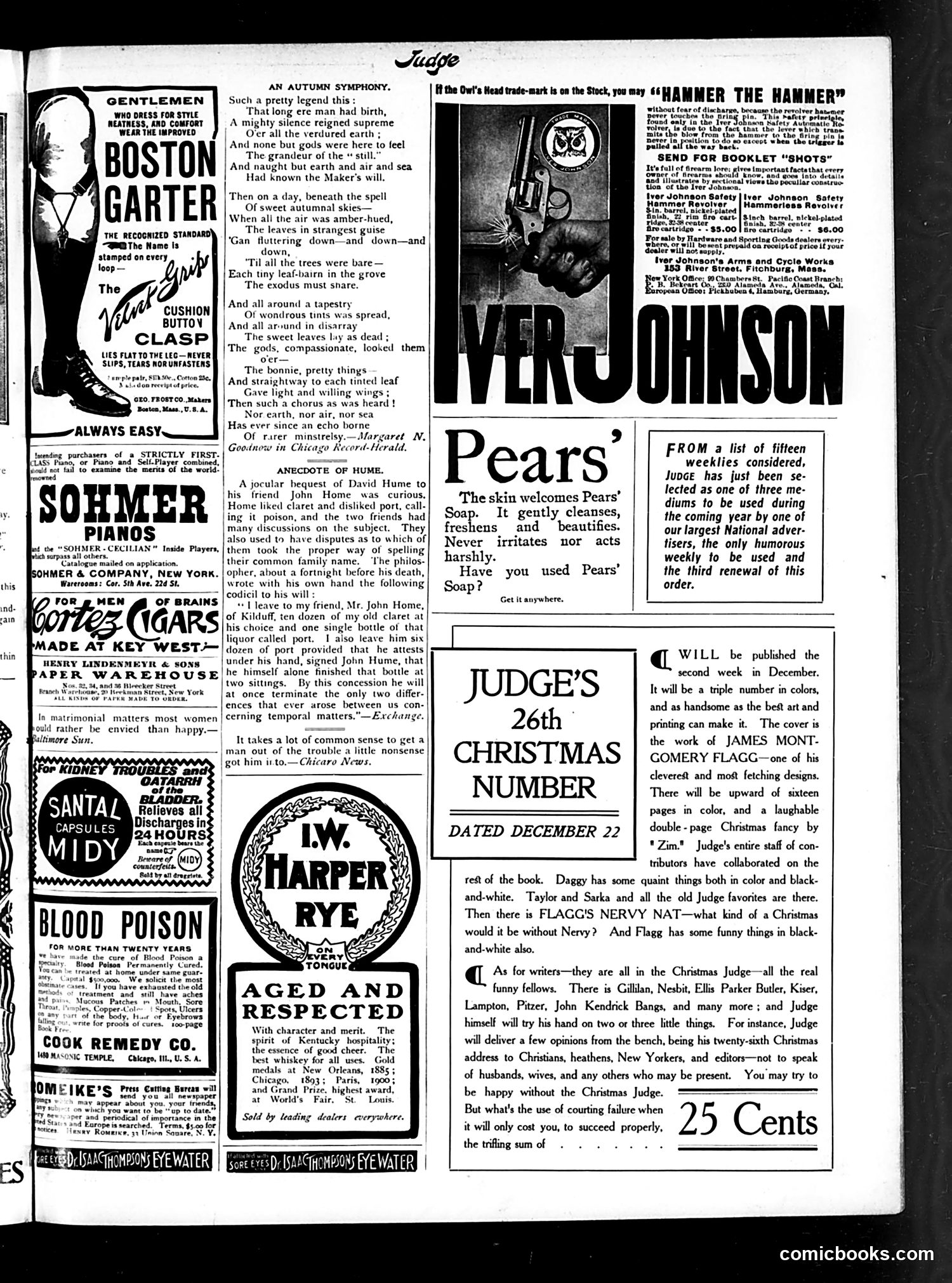
This page is primarily **advertising and filler content** rather than political satire. The main elements include: **"An Autumn Symphony"** — A sentimental poem about falling autumn leaves receiving "wings" from compassionate gods, representing nature's beauty. It's a conventional Romantic-era nature piece. **Advertisements** dominate the page: Boston Garter (men's clothing), Sohmer Pianos, Cortes Cigars, Santal Capsules (for treating blood poison/syphilis), and I.W. Harper Rye Whiskey. The latter emphasizes its prestigious international awards. **"Anecdote of Hume"** — A humorous story about Scottish philosopher David Hume's will, where he bequeaths port wine to his friend John Home (who despises port) only if Home drinks it himself in two sittings—a clever joke about their long-standing disagreement. **No significant political cartoons or satire appear** on this page. It's a typical Judge issue from the turn-of-the-century, mixing light literary content with commercial advertising.