
Judge, 1906-11-10 · page 10 of 16
Judge — November 10, 1906 — page 10: what you’re looking at
What you’re looking at
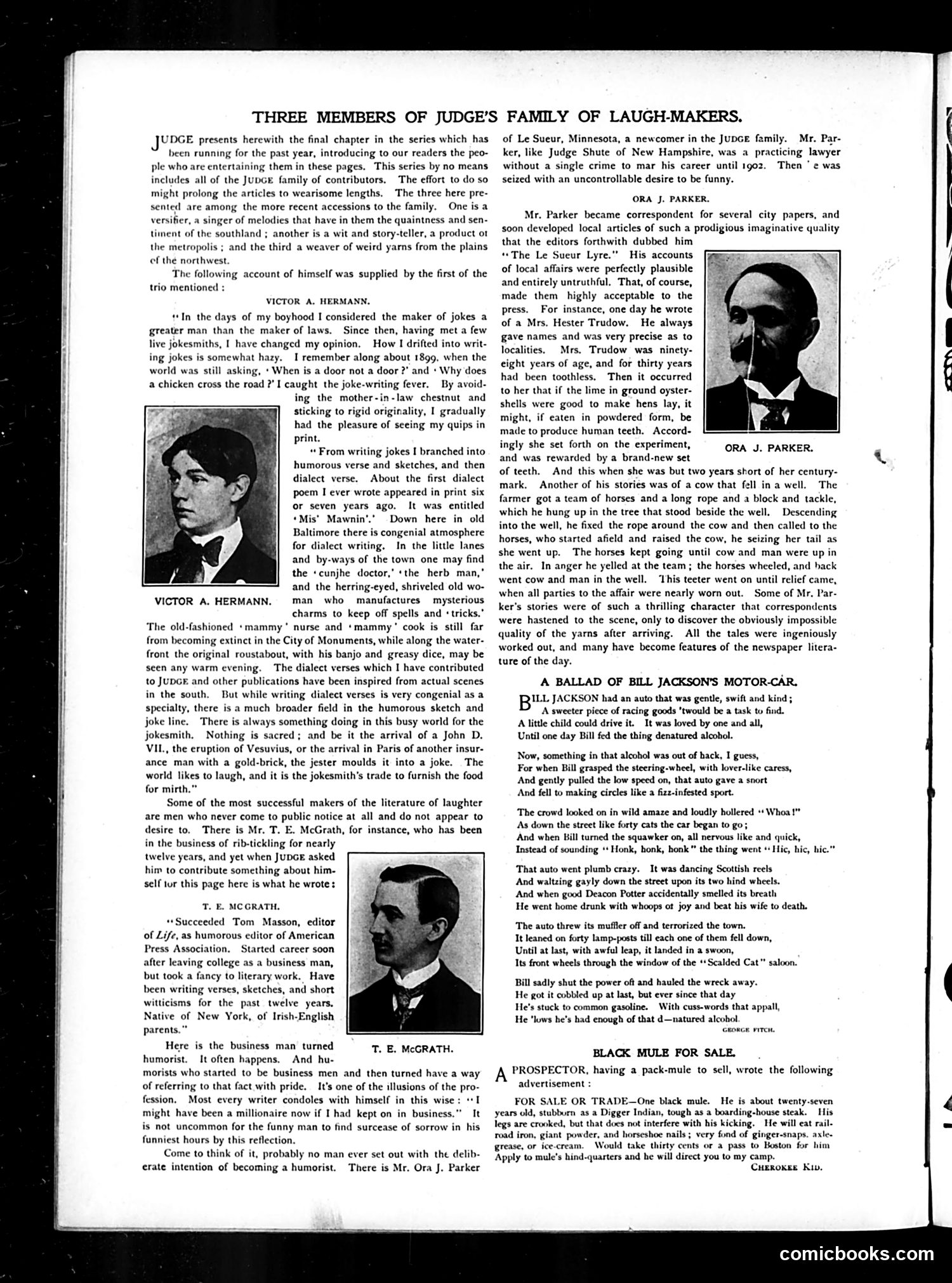
This page introduces three humor writers for Judge magazine. The three portraits show **Victor A. Hermann** (a Baltimore-based dialect poet who writes humorous verse about Southern life, inspired by local characters), **T. E. McGrath** (a former business man turned editor of the American Press Association's humor section), and **Ora J. Parker** (a Minnesota newspaperman known for imaginative local reporting). The text celebrates these "laugh-makers" as part of Judge's creative team. Hermann discusses how he drifted into joke-writing around 1899 and specialized in dialect verse capturing authentic Southern speech and characters. McGrath is presented as a reluctant contributor who briefly describes his career shift from business to humor writing. The page represents Judge's effort to profile its contributors—essentially 1900s-era promotional journalism celebrating the magazine's creative staff.
📄 Transcribed text from this page (OCR, searchable)
Machine-transcribed from the original scan — historical spelling and the odd misread are preserved.
THREE MEMBERS OF JUDGE’S FAMILY OF LAUGH-MAKERS. UDGE presents herewith the final chapter in the series which has been running for the past year, introducing to our readers the peo- ple who are entertaining them in these pages. This series by no means 1 of the JUDGE family of contributors. The effort to do so might prolong the articles to wearisome lengths. The three here pre- | are among the more recent accessions to the family. One is a versifier, a singer of melodies that have in them the quaintness and sen- timent of the southland ; another is a wit and story-teller, a product ot the metropolis ; and the third a weaver of weird yarns from the plains of the northwest. The following account of himself was supplied by the first of the trio mentioned : includes a VICTOR A. HERMANN. In the days of my boyhood I considered the maker of jokes a greater man than the maker of laws. Since then, having met a few live jokesmiths, | have changed my opinion, How I drifted into writ- ing jokes is somewhat hazy. I remember along about 1899. when the world was still asking, * When is a door not a door 2" and + Why does achicken cross the road ?'I caught the joke-writing fever. By avoid- ing the mother-in-law chestnut and sticking to rigid originality, I gradually had the pleasure of seeing my quips in print. «From writing jokes I branched into humorous verse and sketches, and then dialect verse. About the first dialect poem I ever wrote appeared in print six or seven years ago. It was entitled *Mis’ Mawnin’.' Down here in old Baltimore there is congenial atmosphere for dialect writing. In the little lanes and by-ways of the town one may find the ‘cunjhe doctor,’ ‘the herb man,’ and the herring-eyed, shriveled old wo- man who manufactures mysterious charms to keep off spells and * tricks." The old-fashioned ‘mammy* nurse and *mammy' cook is still far from becoming extinct in the City of Monuments, while along the water- front the original roustabout, with his banjo and greasy dice, may be seen any warm evening. The dialect verses which I have contributed to JuDGE and other publications have been inspired from actual scenes in the south, But while writing dialect verses is very congenial as a specialty, there is a much broader field in the humorous sketch and joke line. There is always something doing in this busy world for the jokesmith, Nothing is sacred; and be it the arrival of a John D. VIL. the eruption of Vesuvius, or the arrival in Paris of another insur- ance man with a gold-brick, the jester moulds it into a joke. The world likes to laugh, and it is the jokesmith’s trade to furnish the food for mirth.” Some of the most successful makers of the literature of laughter are men who never come to public notice at all and do not appear to desire to. There is Mr. T. E. McGrath, for instance, who has been in the business of rib-tickling for nearly twelve years, and yet when JUDGE asked him to contribute something about him- self tur this page here is what he wrote: VICTOR A. HERMANN. T. B. MCGRATH, “Succeeded Tom Masson, editor of Life, as humorous editor of American Press Association. Started career soon after leaving college as a business man, but took a fancy to literary work. Have been writing verses, sketches, and short witticisms for the past twelve years. Native of New York, of Irish-English parents.” Here is the business man turned humorist. It often happens. And hu- morists who started to be business men and then turned have a way of referring to that fact with pride, It’s one of the illusions of the pro- fession, Most every writer condoles with himself in this wise: “T might have been a millionaire now if I had kept on in business.” It is not uncommon for the funny man to find surcease of sorrow in his funniest hours by this reflection. Come to think of it, probably no man ever set out with the delib- erate intention of becoming a humorist. There is Mr. Ora J. Parker T. E. McGRATH. of Le Sueur, Minnesota, a newcomer in the JUDGE family. Mr. Par- ker, like Judge Shute of New Hampshire, was a practicing lawyer without a single crime to mar his career until 1902. Then ‘ e was seized with an uncontrollable desire to be funny. ORA J. PARKER. Mr. Parker became correspondent for several city papers, and soon developed local articles of such a prodigious imaginative quality that the editors forthwith dubbed him «The Le Sueur Lyre." His accounts of local affairs were perfectly plausible and entirely untruthful. That, of course, made them highly acceptable to the press, For instance, one day he wrote of a Mrs. Hester Trudow. He always gave names and was very precise as to localities. Mrs. Trudow was ninety- eight years of age, and for thirty years had been toothless, Then it occurred to her that if the lime in ground oyster- shells were good to make hens lay, it might, if eaten in powdered form, be made to produce human teeth. Accord- ingly she set forth on the experiment, and was rewarded by a brand-new set of teeth. And this when she was but two years short of her century- mark. Another of his stories was of a cow that fell ina well, The farmer got a team of horses and a long rope and a block and tackle, which he hung up in the tree that stood beside the well. Descending into the well, he fixed the rope around the cow and then called to the horses, who started afield and raised the cow, he seizing her tail as she went up. The horses kept going until cow and man were up in the air. In anger he yelled at the team; the horses wheeled, and back went cow and man in the well. ‘This teeter went on until relief came, when all parties to the affair were nearly worn out. Some of Mr. Par- ker's stories were of such a thrilling character that correspondents were hastened to the scene, only to discover the obviously impossible quality of the yarns after arriving. All the tales were ingeniously worked out, and many have become features of the newspaper litera- ture of the day. A BALLAD OF BILL JACKSON'S MOTOR.CAR. ILL JACKSON had an auto that was gentle, swift and kind; A sweeter piece of racing goods ‘twould be a task to find. A little child could drive it. It was loved by one and all, Until one day Bill fed the thing denatured alcohol. Now, something in that alcohol was out of hack, I guess, For when Bill grasped the steering-wheel, with lover-like caress, And gently pulled the low speed on, that auto gave a snort And fell to making circles like a fizz-infested sport. ORA J. PARKER. ‘The crowd looked on in wild amaze and loudly hollered + Whoa!” As down the street like forty cats the car began to go; And when Bill turned the squawker on, all nervous like and quick, Instead of sounding ** Honk, honk, honk" the thing went “Hic, hic, hic." ‘That auto went plumb crazy. It was dancing Scottish reels And waltzing gayly down the street upon its two hind wheels. And when good Deacon Potter accidentally smelled its breath He went home drunk with whoops ot joy and beat his wife to death. The auto threw its mufiler off and terrorized the town. It leaned on forty lamp-posts till each one of them fell down, Until at last, with awful leap, it landed in a swoon, Its front wheels through the window of the ‘+Scalded Cat™ saloon. Bill sadly shut the power off and hauled the wreck away. He got it cobbled up at last, but ever since that day He's stuck to common gasoline. With cuss-words that appall, He ‘lows he’s had enough of that d—natured alcohol. Geoxce rrtcn, BLACK MULE FOR SALE. PROSPECTOR, having a pack-mule to sell, wrote the following advertisement : FOR SALE OR TRADE—One black mule. He is about twenty-seven years old, stubburn as a Digger Indian, tough as a boarding-house steak. His legs are crooked, but that does not interfere with his kicking. He will eat rail- road iron, giant powder, and horseshoe nails; very fond of ginger-snaps. axle grease, of ice-cream. Would take thirty cents or a pass to Boston for him Apply to mule’s hind-quarters and he will direct you to my camp. Cuzroxee Kin. comicbooks.com