
A complete issue · 16 pages · 1906
Judge — November 3, 1906
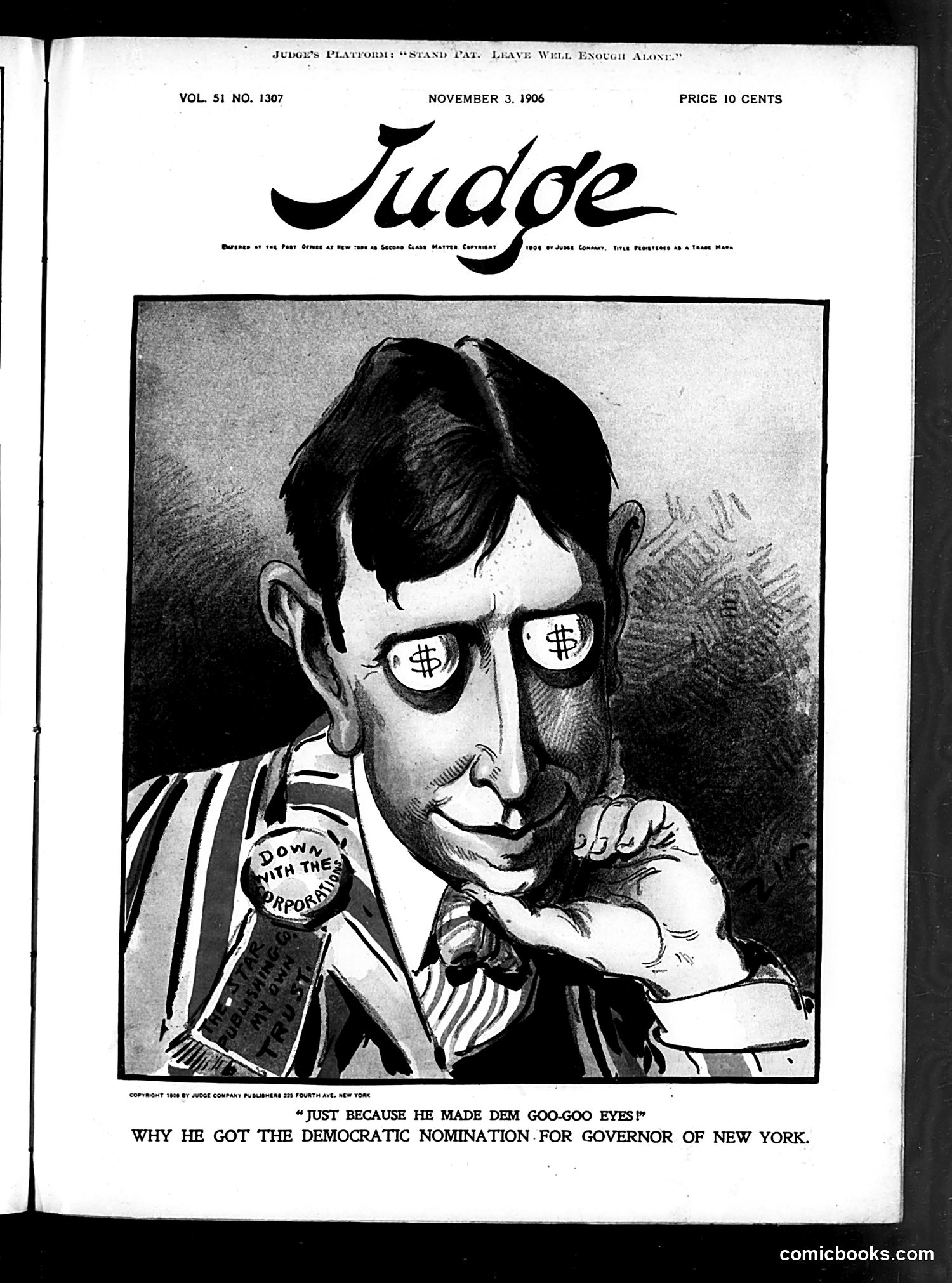
This political cartoon satirizes a Democratic nominee for New York Governor. The caricatured figure displays exaggerated features: dollar-sign eyes and a smug expression while smoking a cigar. He wears a badge reading "DOWN WITH THE CORPORATION" — an ironic contrast to his greedy appearance. The caption's joke is caustic: he received the nomination merely because he "made dem goo-goo eyes" (made false, appealing expressions), suggesting his anti-corporate platform was performative rather than genuine. The cartoon criticizes Democratic hypocrisy — portraying the candidate as a money-hungry politician who cynically adopted reform rhetoric to gain nomination, while his true interests lay in personal enrichment rather than genuine corporate reform.
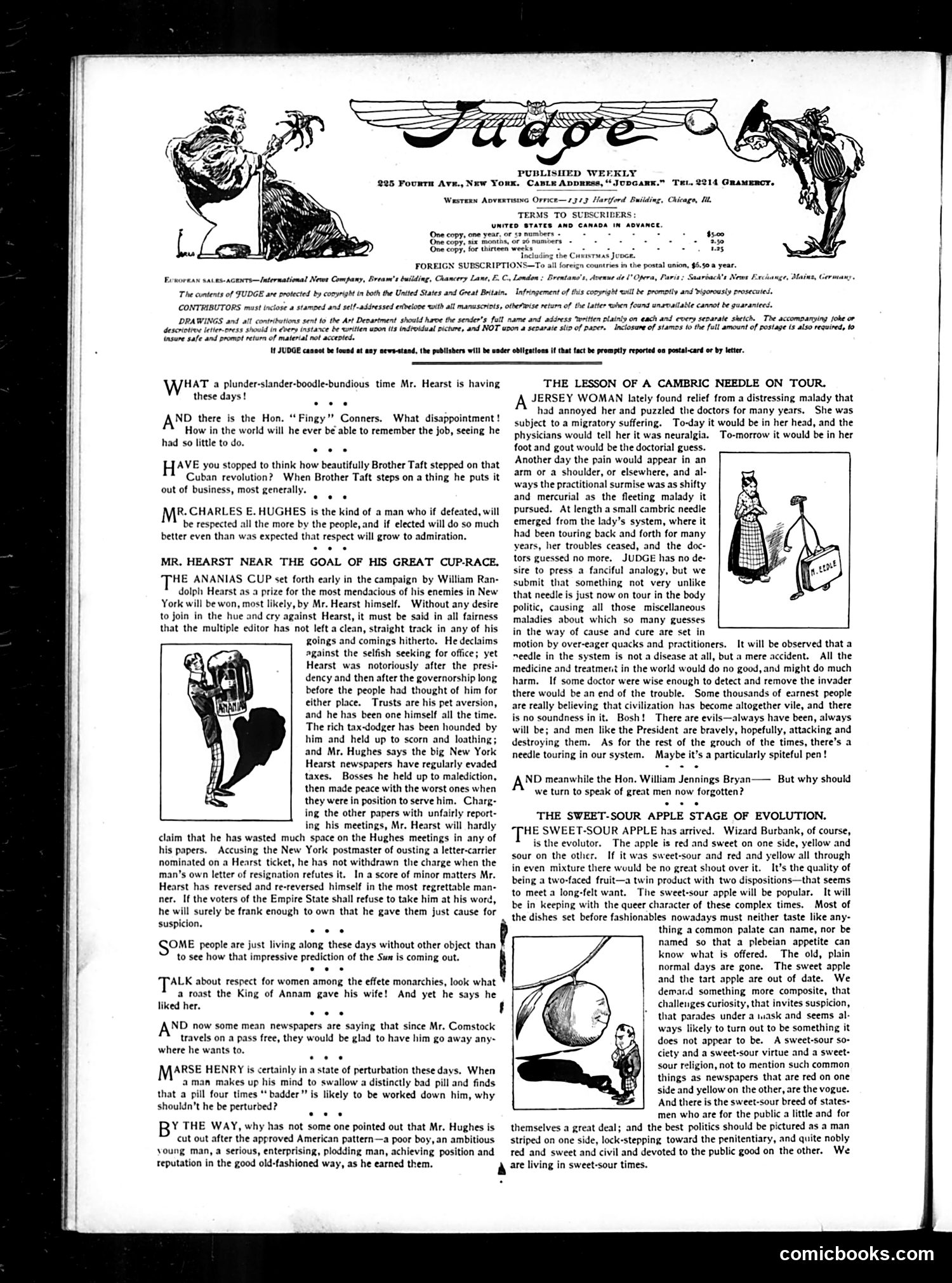
This page contains multiple satirical columns rather than illustrated cartoons. The main targets are: **William Randolph Hearst**: Criticized for his "plunder-slander-boodle-bundles" during the Cuban Revolution and for allegedly using his newspapers to manipulate public opinion. The text suggests Hearst exploited sensational coverage for personal gain. **Charles E. Hughes**: Praised ironically—if defeated, he'll respect the people's will; if elected, he'll do much better than expected (suggesting low expectations). **Mr. Hearst again**: Attacked for evading New York postmaster accusations and for his unethical journalism practices, particularly his "unfair" reporting against political opponents. The satirical tone suggests these are political attacks during what appears to be an early 20th-century election period. Without dates visible, the specific year remains unclear, but Hearst's Cuban coverage suggests the 1890s-1900s era.
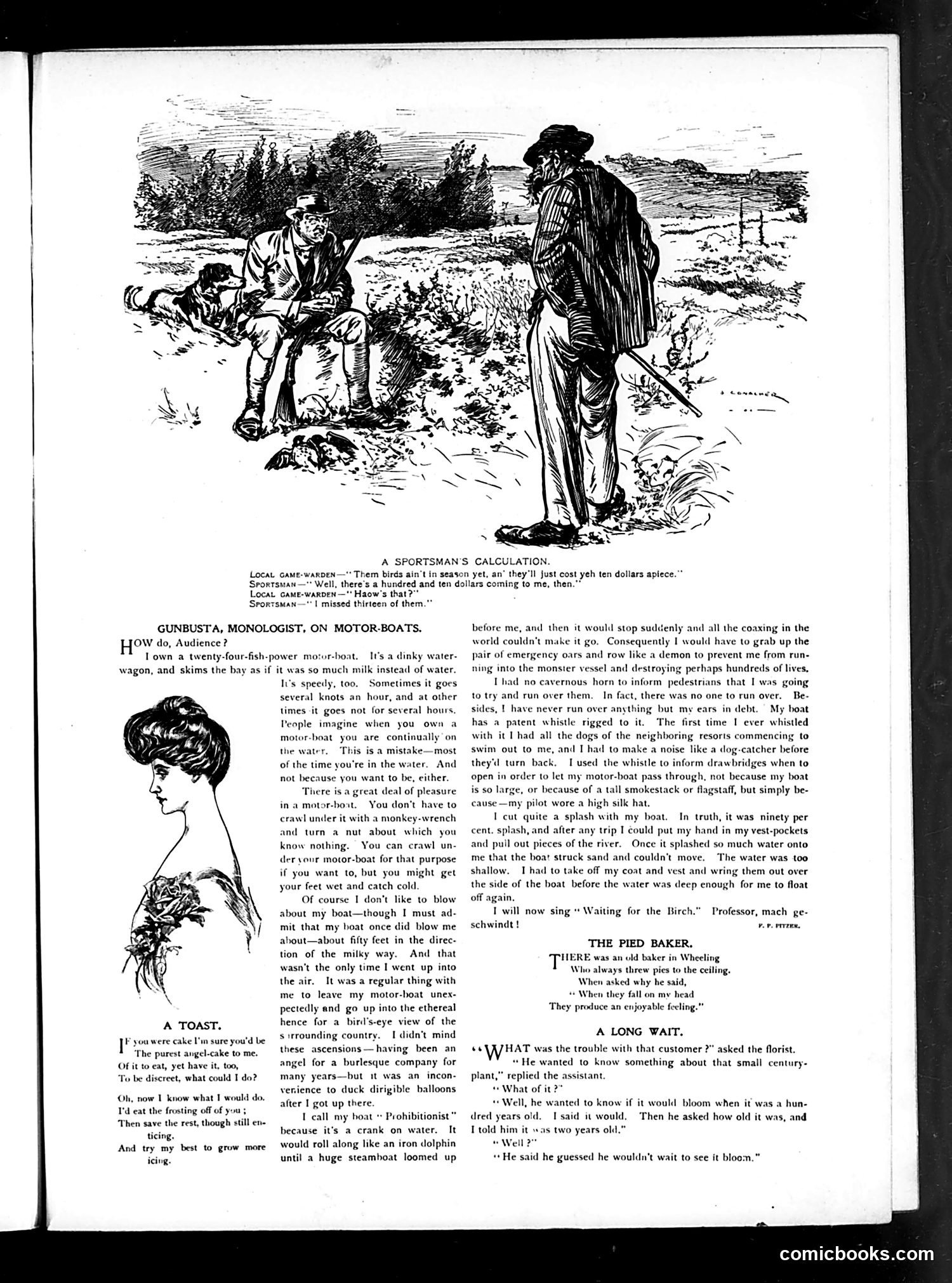
The top cartoon depicts a game warden confronting a sportsman about hunting violations. The warden notes that ten ducks cost ten dollars each in the market, while the sportsman claims he only shot thirteen—suggesting he killed far more than legal limits allowed. The joke satirizes wealthy hunters who poach game for sport rather than sustenance, calculating the monetary value of their illegal kills rather than respecting conservation laws. The accompanying text sections ("A Toast," "Gunbusta, Monologist, on Motor-Boats," "The Pied Baker," and "One Knot") contain humorous anecdotes and verse typical of Judge magazine's satirical content. These appear to mock various leisure activities and social pretensions of the era's upper classes.
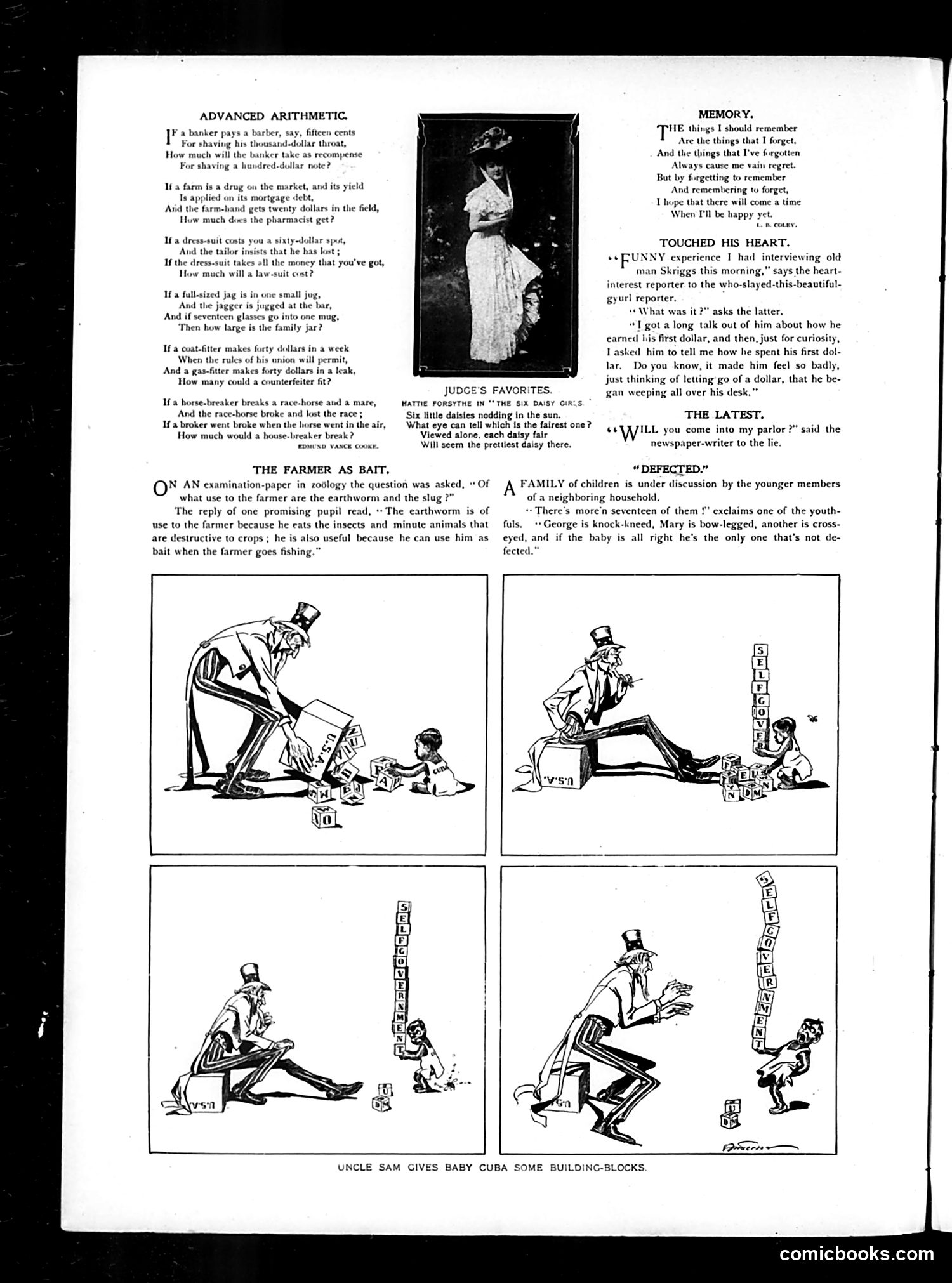
The main cartoon at bottom, titled "Uncle Sam Gives Baby Cuba Some Building-Blocks," depicts Uncle Sam (representing the U.S.) as an adult supervising a small child labeled "Cuba" playing with building blocks. The four-panel sequence shows the child struggling with the blocks, which progressively topple or collapse. This satirizes American intervention in Cuba's affairs, likely following the Spanish-American War (1898) or early Cuban independence period. The joke suggests the U.S. patronizes Cuba as an incompetent child unable to manage its own construction/governance without American supervision collapsing. It critiques U.S. imperial paternalism toward the Caribbean nation during the era of American expansionism.
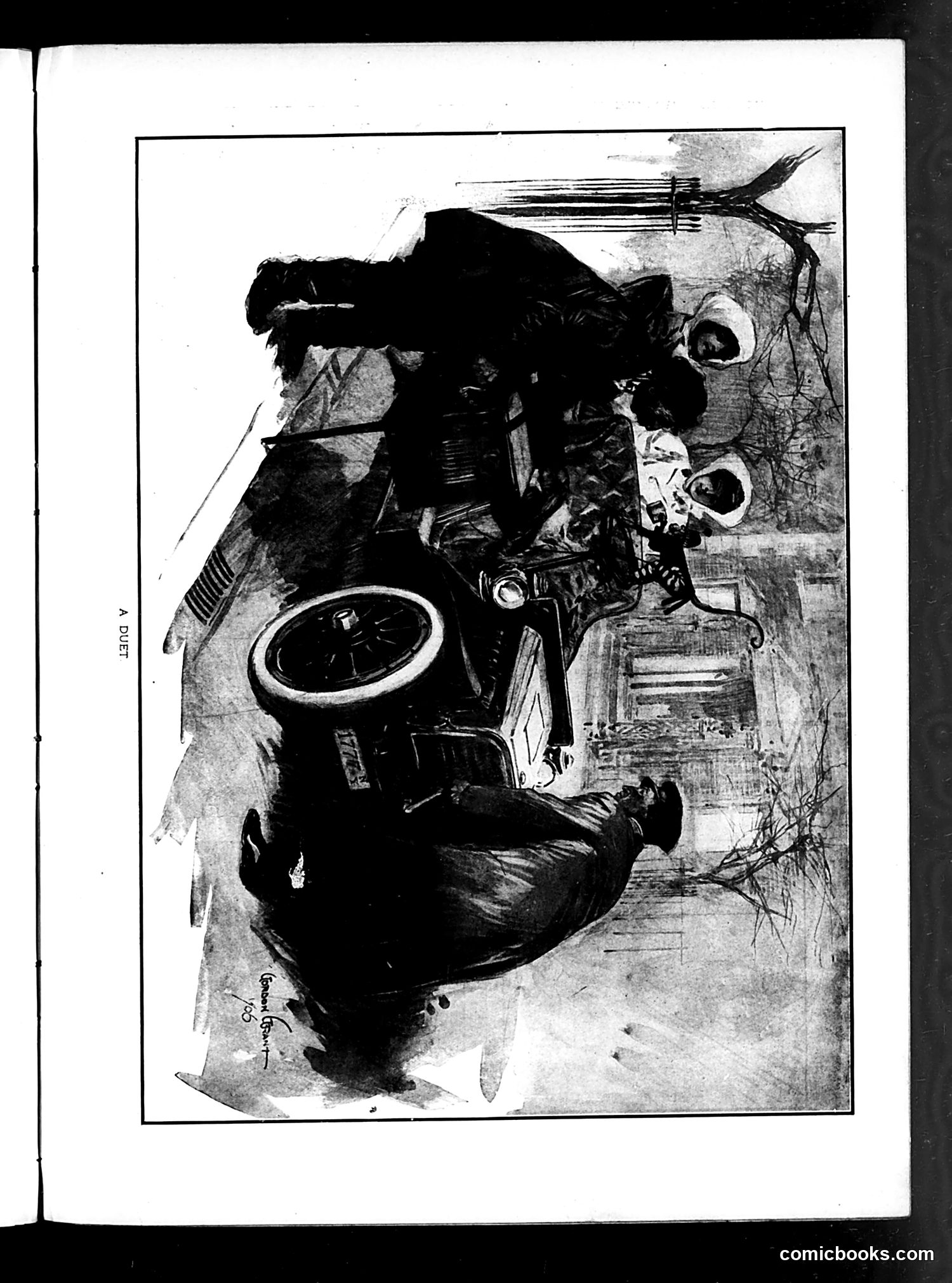
I can see this is a black and white illustration from *Judge* magazine, but the image is rotated 90 degrees, making it difficult to read clearly. The OCR text section appears blank or unreadable in the provided content. From what's visible when mentally rotating the image, this appears to be a political or social satire cartoon featuring figures in what looks like an early 20th-century setting, with detailed cross-hatching and ink work typical of *Judge*'s style. However, without legible text or a properly oriented view, I cannot reliably identify the specific figures, political references, or the cartoon's satirical point. To provide an accurate historical explanation, I would need either the text clearly visible or the image properly oriented.
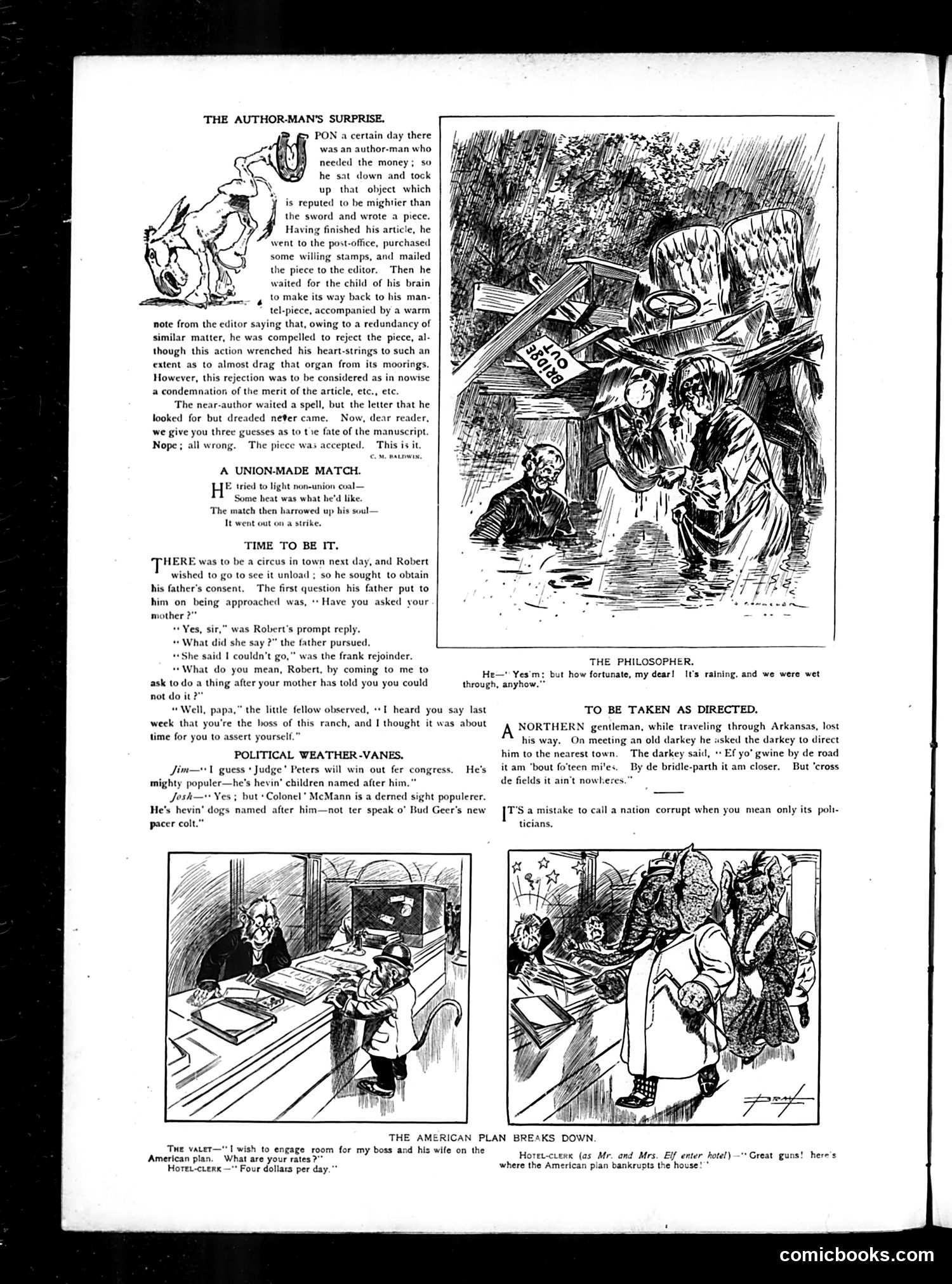
This page contains several satirical pieces typical of late-19th/early-20th-century American humor: **"The Author-Man's Surprise"** mocks struggling writers whose rejected manuscripts mysteriously disappear—implying editors simply discard unwanted submissions rather than returning them. **"A Union-Made Match"** jokes about labor strikes: a non-union match fails to light union coal, then "goes on strike" itself—wordplay on labor conflict. **"Time to Be It"** presents a boy's logic: having asked his mother and been refused the circus, he appeals to his father as "boss of the ranch," using the father's own words about authority against him—gentle domestic humor about parental consistency. **"Political Weather-Vanes"** satirizes politicians' popularity based on naming children/dogs after them rather than actual merit—criticizing superficial political support. **"The American Plan Breaks Down"** uses ethnic dialect humor (the "darkey" character reflects period racism) and concludes with a hotel joke: guests on the "American plan" (all-inclusive pricing) eat so much they bankrupt the establishment—a dig at American excess or the plan's poor economics.
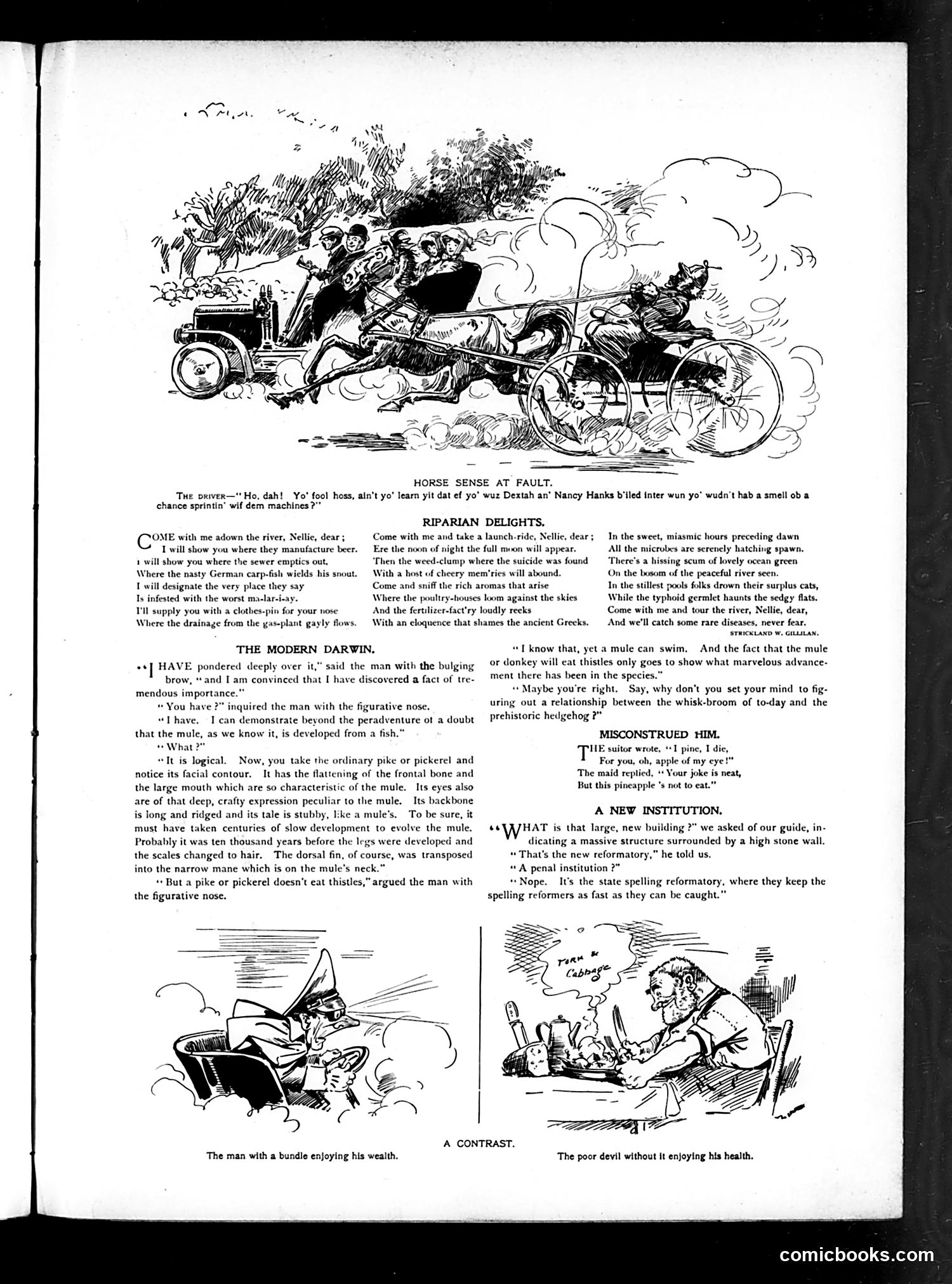
This page contains multiple satirical pieces typical of early 20th-century American humor: **"Horse Sense at Fault"** mocks a driver (depicted with racial dialect humor common to the era) who races an automobile against famous racehorses Dexter and Nancy Hanks, suggesting the machine cannot match animal speed. **"Riparian Delights"** is a darkly ironic poem satirizing polluted rivers—inviting someone on a "romantic" tour while cataloging industrial sewage, dead bodies, disease-carrying germs, and contamination. It's social criticism disguised as courtship verse, targeting urban environmental degradation. **"The Modern Darwin"** parodies pseudo-scientific evolutionary arguments, with two men debating whether mules evolved from fish, citing absurd anatomical "evidence" and logic. **"A New Institution"** jokes about a "spelling reformatory"—a facility ostensibly for reform but actually imprisoning spelling reformers themselves, mocking both institutional ineffectiveness and orthographic debates of the period. The bottom illustration contrasts wealthy and poor men, suggesting health derives from circumstances rather than wealth. The humor relies on period-specific references and dialect conventions now considered offensive.
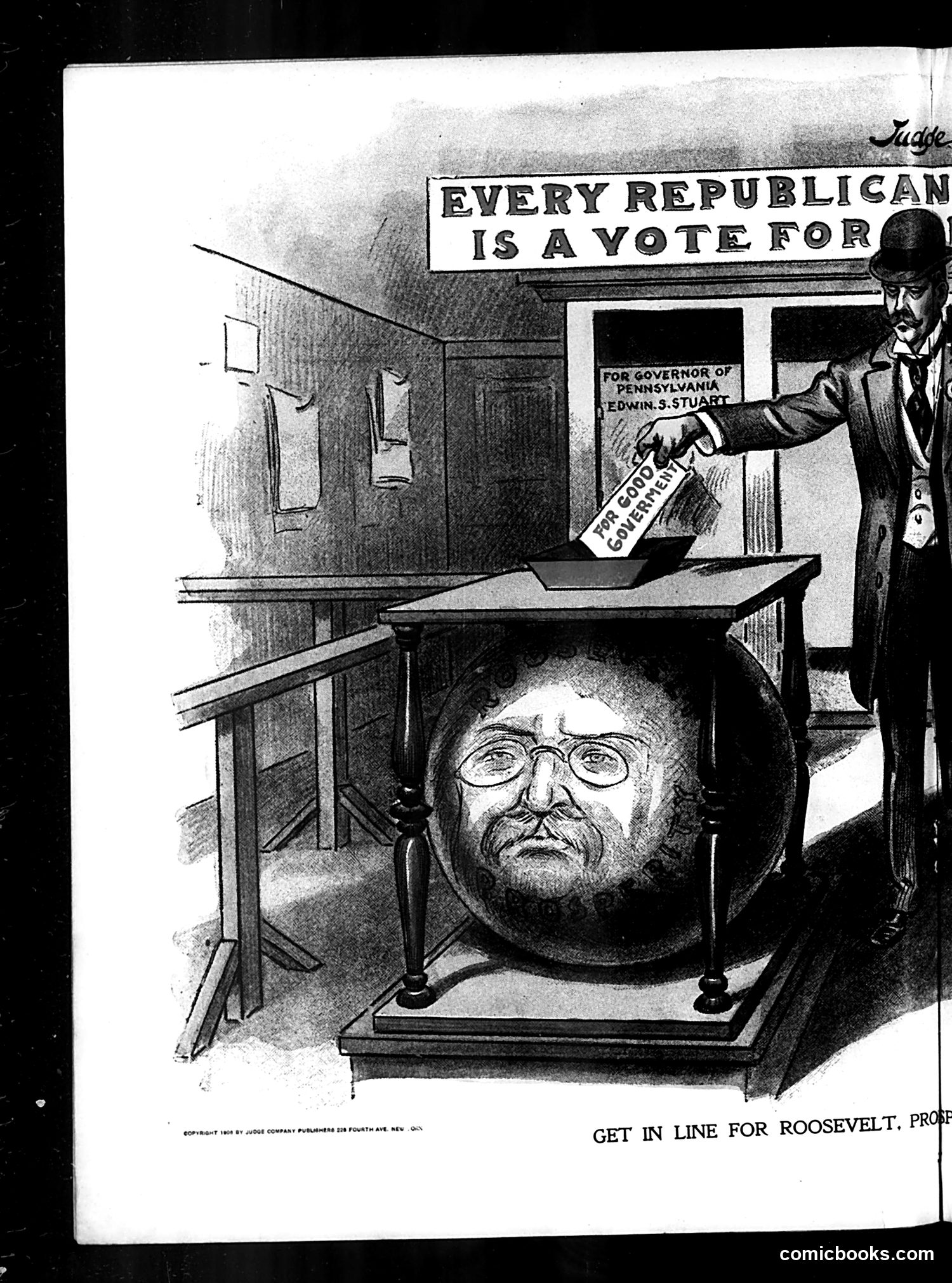
This 1908 Judge magazine cartoon satirizes Republican voting mechanics. A well-dressed man deposits a ballot labeled "FOR GOVERNOR OF PENNSYLVANIA" into a voting box that appears to be a human head wearing glasses. The headline "EVERY REPUBLICAN IS A VOTE FOR [Roosevelt]" suggests the cartoon mocks the idea that all Republican votes automatically benefit Theodore Roosevelt's political agenda, regardless of the specific office or candidate being voted for. The grotesque head in the ballot box likely represents the automaticity or blind obedience of Republican voters. The reference to Roosevelt and the 1908 Pennsylvania gubernatorial race indicates this critiques how party loyalty overrides independent judgment. The satire implies Republican voters lack individual agency—they're essentially interchangeable parts in a political machine.
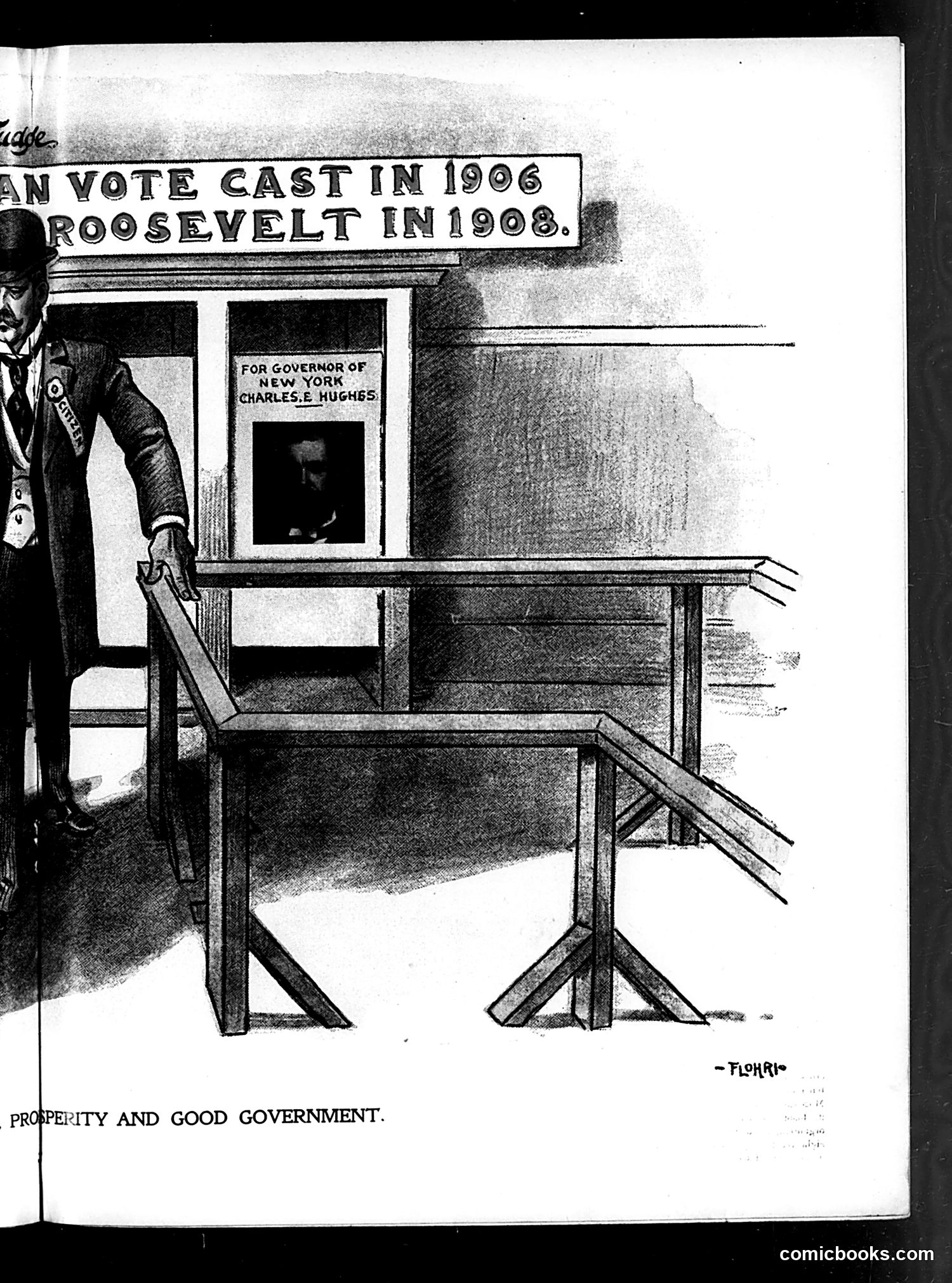
This cartoon satirizes voting patterns and political loyalty. The image shows a voting booth labeled "FOR GOVERNOR OF NEW YORK / CHARLES E. HUGHES" positioned beneath a banner reading "A VOTE CAST IN 1906 / ROOSEVELT IN 1908." A well-dressed man on the left appears to represent the voter or electorate. The cartoon's point—supported by the caption "PROPERTY AND GOOD GOVERNMENT"—suggests criticism of those who voted one way in 1906 but switched allegiance to Roosevelt by 1908, or conversely, those supporting Hughes while previously backing Roosevelt. The elevated booth structure emphasizes the contrast between these voting choices, satirizing inconsistent political support or the electorate's shifting priorities between property interests and broader governance concerns during this progressive-era period.
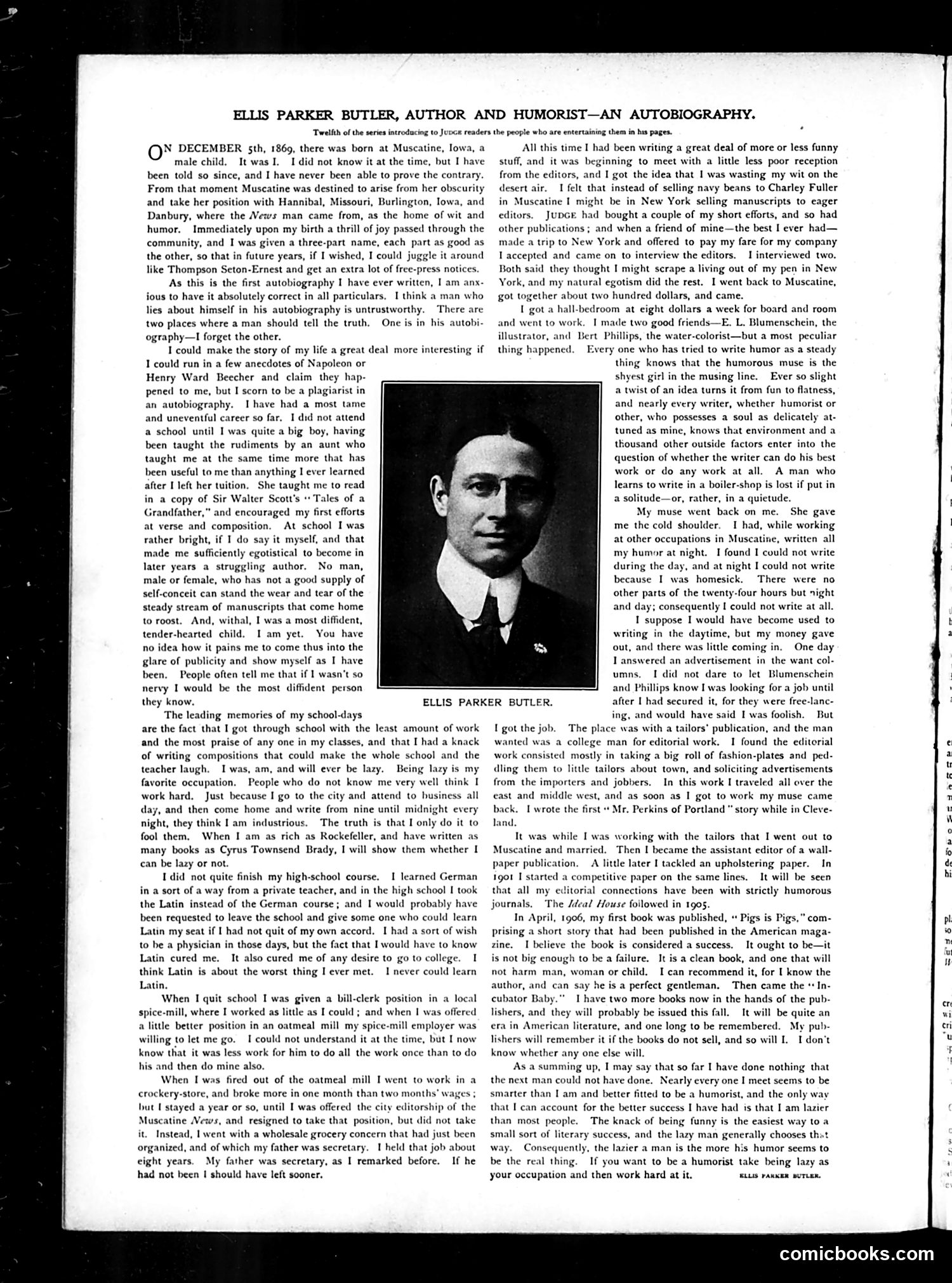
This is the **twelfth installment** of Judge magazine's series presenting autobiographies of notable humorists to readers. The page features **Ellis Parker Butler**, author and humorist, with his portrait photograph. Butler humorously recounts his birth in Muscatine, Iowa (December 5, 1869) and early life, joking that the town's obscurity ended with his arrival. He satirizes autobiography itself—claiming to tell absolute truth while admitting he could fabricate anecdotes about Napoleon or Henry Ward Beecher, but choosing not to. The text describes his path from teaching himself to write, to struggling as an author in New York, where Judge magazine and other publications began accepting his work. He mentions befriending illustrator E.L. Blumenschein and artist Bert Phillips. The satire targets **literary pretension** and the **struggling writer's life**—Butler mocks his own ego while explaining how one must possess sufficient self-conceit to survive constant manuscript rejections. The tone is self-deprecating humor about the difficulty of professional writing.
This page from *Judge* (a satirical weekly) contains miscellaneous humor and advertisements rather than a unified political cartoon. **"Flowers of Speech"** satirizes flowery, overwrought rhetoric in public discourse—politicians and journalists using melodramatic metaphors ("crumbs from the dissenters' table," "nailing lies to the mast," "thin end of the wedge") that sound impressive but obscure meaning. **"The Talk of the Day"** includes anecdotes mocking absurdity: a story about an Indian prince commissioning a portrait of his dead father (implying artists invent rather than observe), and jokes about a Cuban banker's theft and what occupies people after age 90. **"The Young Widow"** is a light poem describing an experienced, flirtatious woman—conventional Victorian-era humor about feminine mystery and calculation. The page is primarily filled with **advertisements** (Packer's Tar Soap, Herbert D. Shivers cigars) and humor columns typical of 1890s-era satirical magazines, reflecting contemporary social attitudes rather than specific political events.
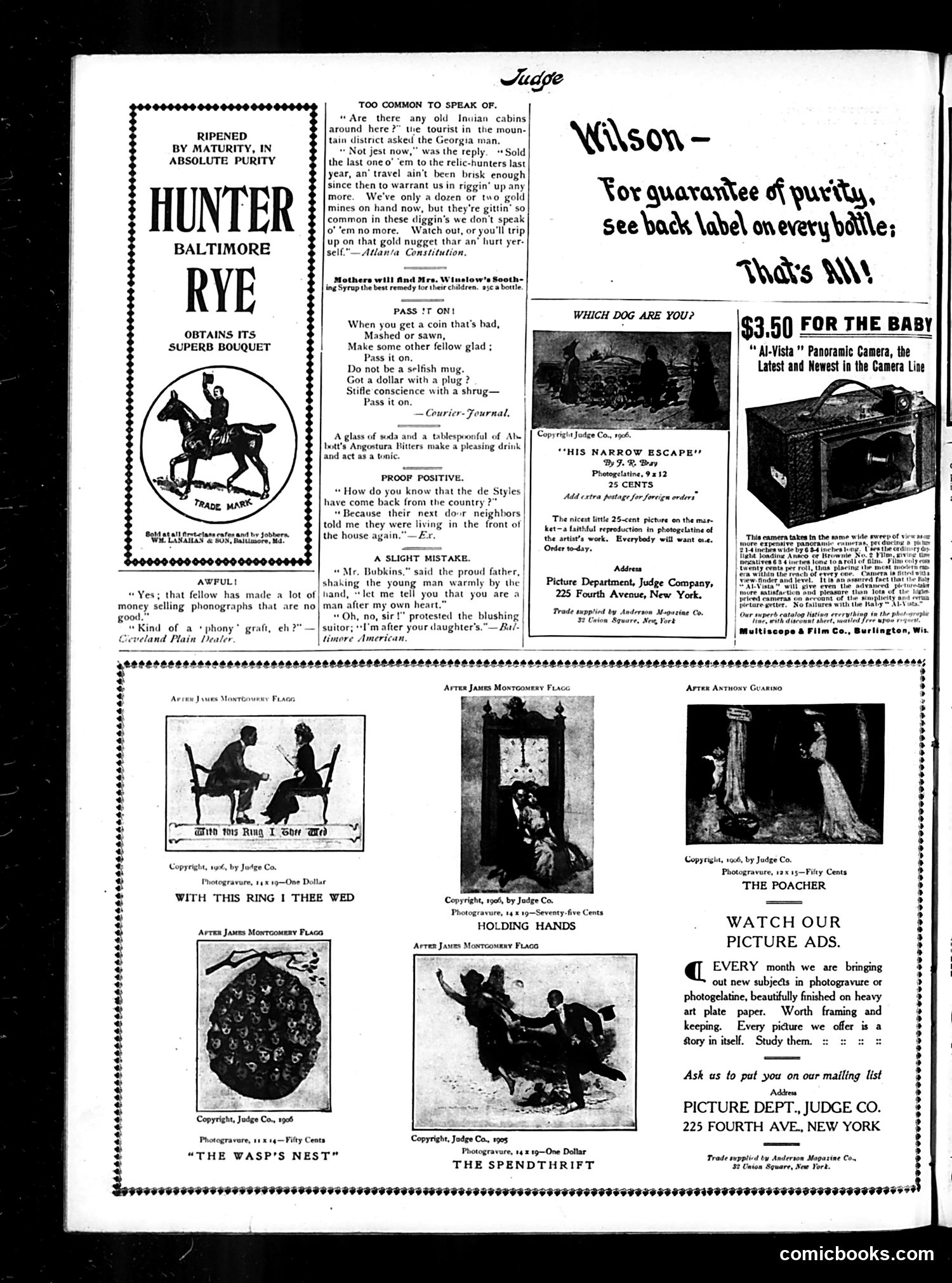
This page is primarily **advertising and product promotion**, not political satire. It features: **Main Advertisement:** Hunter Baltimore Rye whiskey, emphasizing "absolute purity" and its "superb bouquet." **Satirical Passages:** Brief humor pieces mock everyday absurdities—a Georgia man's joke about selling Indian cabin relics to tourists, advice to pass counterfeit coins to others, and a young suitor's awkward admission that he's courting the daughter, not befriending the father. **Picture Department Ads:** Judge Company sells photogravures and photogelatine prints of artwork, including works by James Montgomery Flagg and Anthony Guarino. Titles like "The Wasp's Nest," "Holding Hands," and "The Poacher" suggest sentimental or narrative scenes typical of early 1900s art prints. **Camera Advertisement:** An "Al-Vista" panoramic camera marketed as the "latest and newest." The page reflects early 1900s American commercial culture—whiskey promotion, mass-produced art prints, and emerging camera technology. The humor is gentle, observational satire about American social types rather than political commentary.
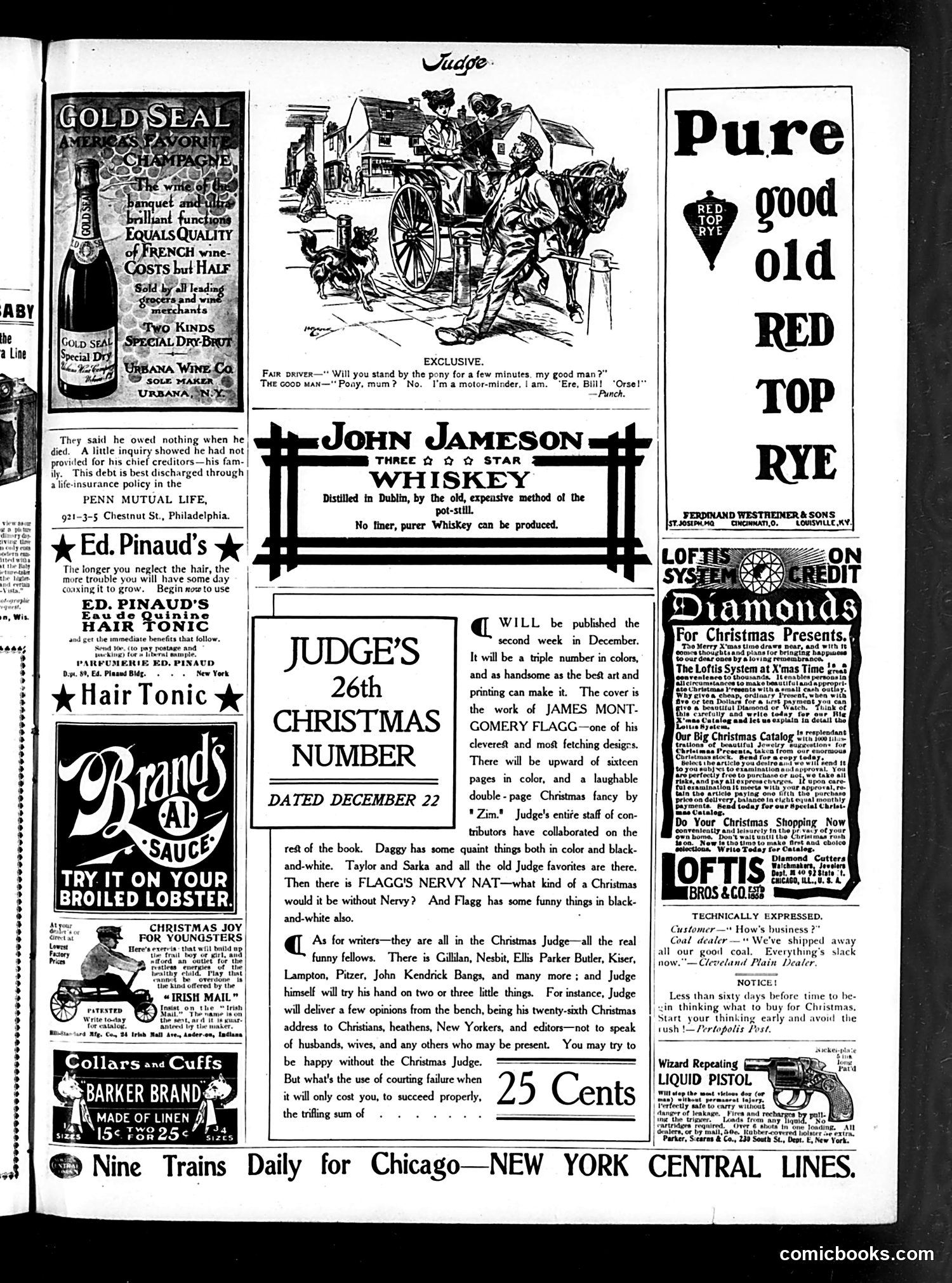
This is primarily an **advertising page** from Judge's 26th Christmas issue (dated December 22), with one small cartoon. ## The Cartoon The single cartoon depicts a social/technological shift: a woman addresses a man as "my good man," assuming he's a stable worker ("Will you stand by the pony?"). He corrects her—he's a "motor-minder," not a horse handler. The joke satirizes the rapid obsolescence of horse-drawn transport due to automobiles, and the comedic mismatch between old-fashioned assumptions and modern reality. Attribution to "Punch" suggests cross-publication humor. ## The Advertisements The page features typical early-1900s products: John Jameson whiskey, life insurance (Penn Mutual), hair tonic, collars, and coal delivery. These ads reflect contemporary consumer goods and concerns (life insurance as family protection, hair care as status). The prominent announcement promotes Judge's Christmas issue, highlighting contributors like James Montgomery Flagg and assuring readers of color illustrations and humor pieces—standard magazine marketing for the holiday season.
This page from Judge magazine is primarily **advertising and humorous filler content** rather than political cartoons. The main items include: **"Noah's Ark Party" anecdote**: A satirical joke about a New Jersey butcher whose friends threw him a party where guests brought live animals. The humor mocks the impracticality and chaos of such an event—stepping on turtles, colliding with goats—suggesting even if animals were docile, the concept remains ridiculous. **Advertisements**: Old Crow Rye whiskey, California railroad travel (the "Overland Limited"), and George Palliser's architecture book dominate the page. **Brief humorous items**: "Wise to His Job" jokes about commercial competition and door painting; "Pliny on Gems" ridicules ancient Roman tall tales; "Folk Lore" mocks rural superstitions about greasing railroad tracks. **"What to Eat" food magazine advertisement**: Promotes a national cooking publication. The page reflects early-20th-century American humor—light, domesticated satire focusing on social customs, consumer culture, and gentle mockery of rural or outdated practices rather than sharp political commentary.
This is primarily an **advertising page** from Judge magazine, not a cartoon or satirical content page. The page features multiple commercial advertisements alongside brief humorous snippets. The few jokes present are mild domestic humor: Uncle Josh's quip about "burning time" by hinting rather than speaking plainly; a New Zealand farm ad comically seeking a "capable girl" who can milk while the family has four "good-looking sons"; and observations about women knowing their husbands "like a book" (meaning his wallet). The advertisements promote pianos, candy, blood poison treatment, paper warehouses, and notably **the Keeley Cure**—a medical treatment for alcohol and drug addiction that was popular in the early 1900s, administered at various institutes across America. The page concludes with Leslie's Weekly announcing three major holiday issues (Thanksgiving, Christmas, New Year's) to attract advertisers, emphasizing circulation exceeding 100,000 copies per issue.
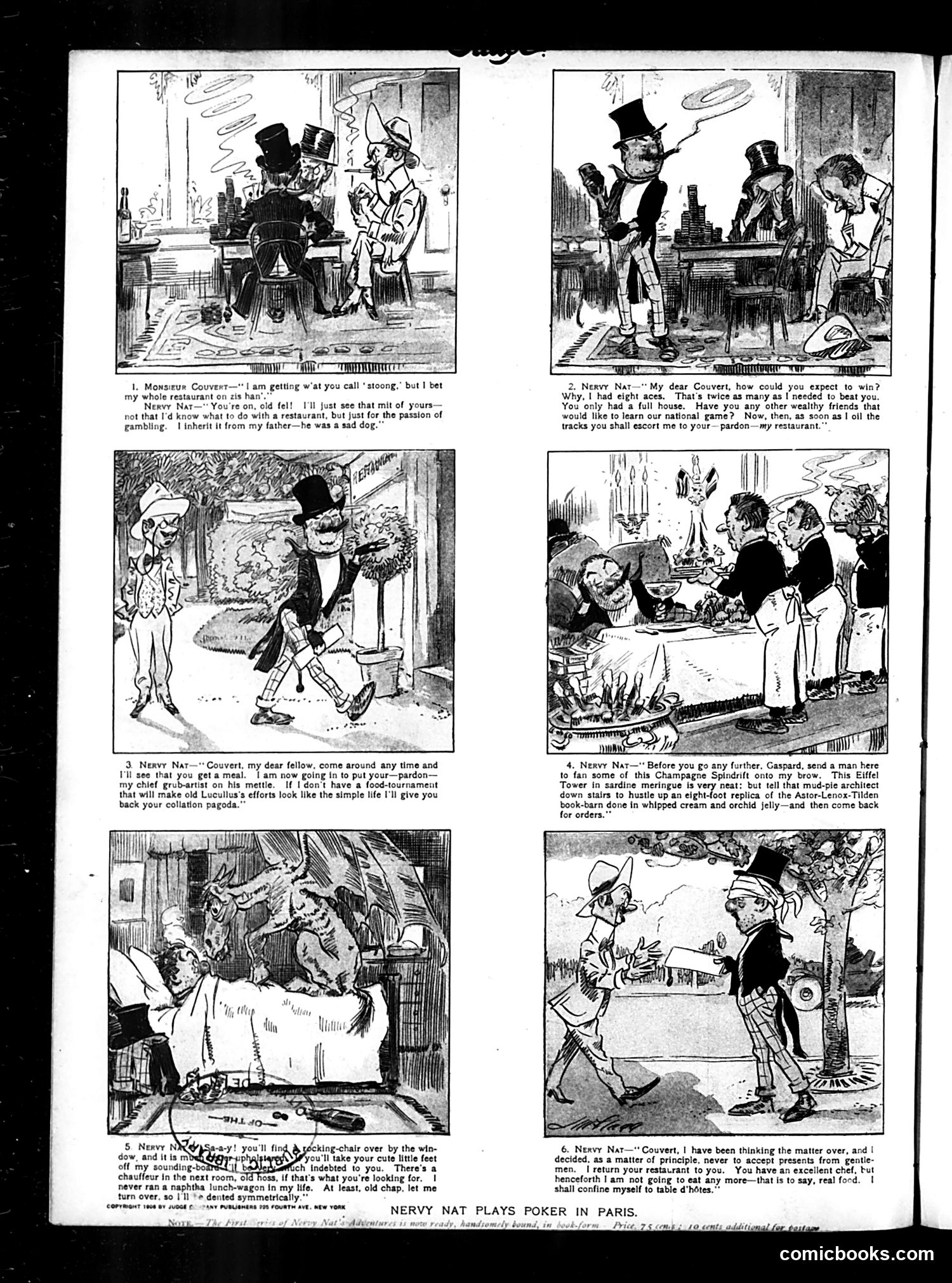
This six-panel comic follows an American character ("Nervy Nat") gambling with a French restaurateur named Couvert in Paris. The satire targets American brashness and materialism abroad. Nat wins Couvert's restaurant in a poker game, then comically exploits his victory—demanding extravagant meals with absurd specifications (eight-foot replicas in whipped cream, champagne fanning). His broken-English dialogue and casual attitude toward winning a business mock American arrogance. The humor pivots when Nat—claiming moral principle—returns the restaurant to Couvert, then insults French cuisine by announcing he'll eat only "table d'hotes" (cheap fixed menus) instead. This ending inverts expectations: having conquered the Frenchman materially, Nat defeats him culturally through philistine American indifference. The cartoon satirizes both American tourists' loud materialism and their casual contempt for European refinement.