
Judge, 1906-11-03 · page 2 of 16
Judge — November 3, 1906 — page 2: what you’re looking at
What you’re looking at
This page contains multiple satirical columns rather than illustrated cartoons. The main targets are: **William Randolph Hearst**: Criticized for his "plunder-slander-boodle-bundles" during the Cuban Revolution and for allegedly using his newspapers to manipulate public opinion. The text suggests Hearst exploited sensational coverage for personal gain. **Charles E. Hughes**: Praised ironically—if defeated, he'll respect the people's will; if elected, he'll do much better than expected (suggesting low expectations). **Mr. Hearst again**: Attacked for evading New York postmaster accusations and for his unethical journalism practices, particularly his "unfair" reporting against political opponents. The satirical tone suggests these are political attacks during what appears to be an early 20th-century election period. Without dates visible, the specific year remains unclear, but Hearst's Cuban coverage suggests the 1890s-1900s era.
📄 Transcribed text from this page (OCR, searchable)
Machine-transcribed from the original scan — historical spelling and the odd misread are preserved.
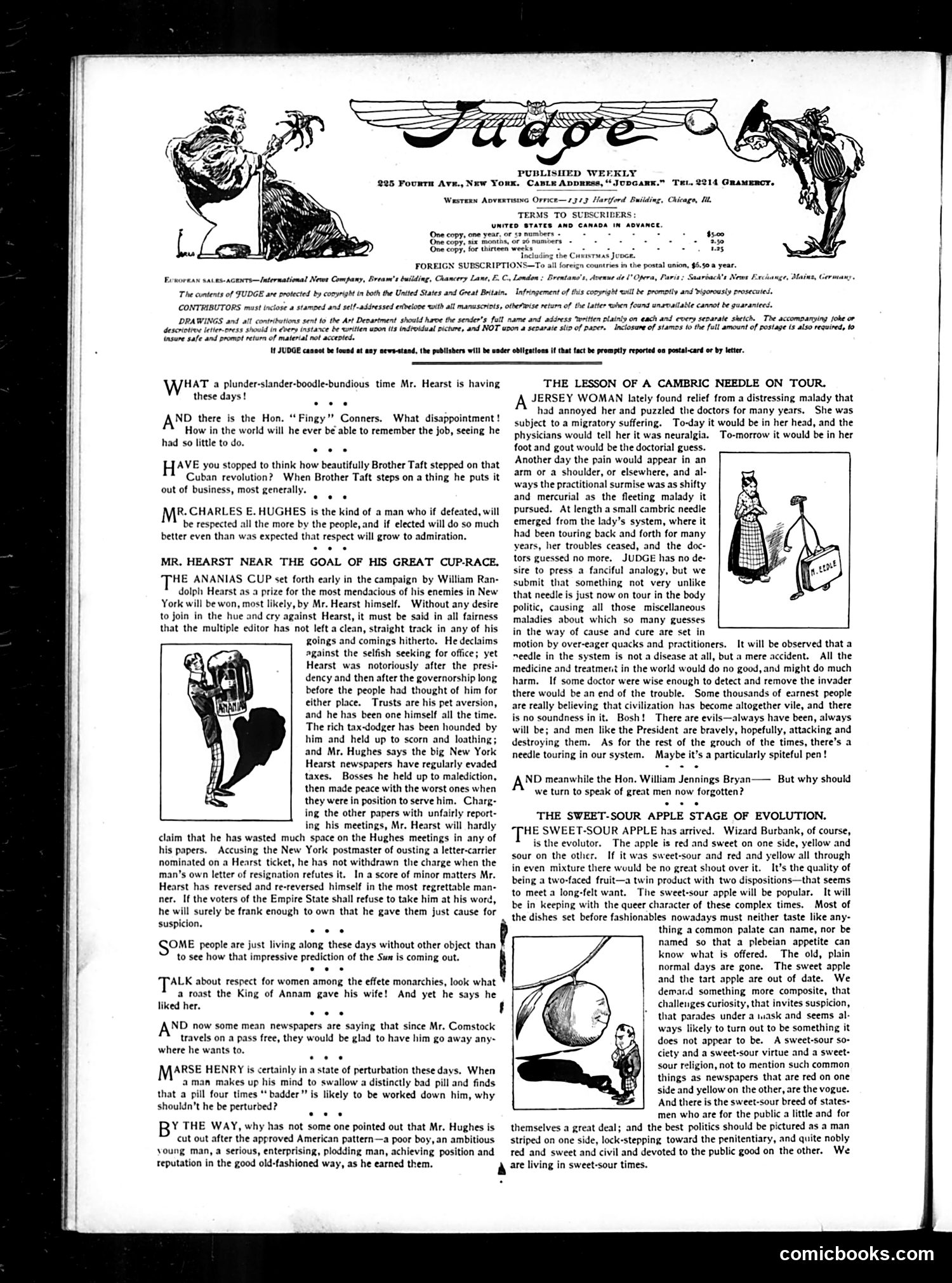
One copy, six mont KAN SALES-AGRNTS—/atermational News Company, Bream's building, Chancery Lane, E. Cy The cuntents of FUDGE are protected by conyright in both the United States and Great Brital Bow 225 Fourrm Ave., New Youx. C. Western Apvexrisixe C unireo star Ove copy, one year, or One copy, for thirteen weeks FOREIGN SUBSCRIPTIONS—To ail for 1313 Hartford Building, Chicago, Mt. TERMS TO SUPSCRIBERS: AND CANADA IN ADVANCE the Cusisraas Jepce. countries in the postal union, $5.50 a yea Sauréack London ; Brentano's, Avenue del" Opera, Pi frws Exchange, Bains, Germany, Infringement of this copyright will be promptly and Digorously prosecuted. CONTRIBUTORS must inciose a stamped and self-addressed entvelope with all manuscriots, othePivise return of the Latter when found unavailable cannot be guarantees. DRAWINGS and alt contributions sent to the Art Decartment should have the sender's fall name and address Ywritten plainly on each and every separate sketch. The accompanying foke or descriotive letler-oress should in ébery instance be writien upon its indrotdeal picture, and NOT upon a separate slip of paver. Inclosure of stamos to the full amount of postage (s also required, 10 tasure safe and promot return of material not accepted. tf JUDGE cannot be found at any sews-stand, the publishers will be under obligations if that fact be promptly reported oa postal-card or by letter. WHAT a plunder-slander-boodle-bundious time Mr. Hearst is having these days! ND there is the Hon. “Fingy’ Conners. What disappointment ! How in the world will he ever be able to remember the job, seeing he had so little to do. eee HAVE you stopped to think how beautifully Brother Taft stepped on that Cuban revolution? When Brother Taft steps on a thing he puts it out of business, most generally. R. CHARLES E. HUGHES is the kind of a man who if defeated, will be respected all the more by the people, and if elected will do so much better even than was expected that respect will grow to admiration. MR. HEARST NEAR THE GOAL OF HIS GREAT CUP-RACE. HE ANANIAS CUP set forth early in the campaign by William Ran- dolph Hearst as a prize for the most mendacious of his enemies in New York will be won, most likely, by Mr. Hearst himself. Without any desire to join in the hue and cry against Hearst, it must be said in all fairness that the multiple editor has not left a clean, straight track in any of his goings and comings hitherto. He declaims against the selfish seeking for office; yet Hearst was notoriously after the presi- dency and then after the governorship long before the people had thought of him for either place. Trusts are his pet aversion, and he has been one himself all the time. The rich tax-dodger has been hounded by him and held up to scorn and loathing; and Mr. Hughes says the big New York Hearst newspapers have regularly evaded taxes. Bosses he held up to malediction, then made peace with the worst ones when they were in position to serve him. Charg- ing the other papers with unfairly report- ing his meetings, Mr. Hearst will hardly claim that he has wasted much space on the Hughes meetings in any of his papers. Accusing the New York postmaster of ousting a letter-carrier nominated on a Hearst ticket, he has not withdrawn the charge when the man’s own letter of resignation refutes it. In a score of minor matters Mr. Hearst has reversed and re-reversed himself in the most regrettable man- ner. If the voters of the Empire State shall refuse to take him at his word, he will surely be frank enough to own that he gave them just cause for suspicion, we i SOME people are just living along these days without other object than to see how that impressive prediction of the Su is coming out. Talk about respect for women among the effete monarchies, look what a roast the King of Annam gave his wife! And yet he says he liked her. ' AND now some mean newspapers are saying that since Mr. Comstock travels on a pass free, they would be glad to have him go away any- where he wants to. Masse HENRY is certainly in a state of perturbation these days. When aman makes up his mind to swallow a distinctly bad pill and finds that a pill four times * badder”’ is likely to be worked down him, why shouldn't he be perturbed? wee Y THE WAY, why has not some one pointed out that Mr. Hughes is cut out after the approved American pattern—a poor boy, an ambitious young man, a serious, enterprising, plodding man, achieving position and reputation in the good old-fashioned way, as he earned them. a THE LESSON OF A CAMBRIC NEEDLE ON TOUR. A JERSEY WOMAN lately found relief from a distressing malady that had annoyed her and puzzled the doctors for many years. She was subject to a migratory suffering. To-day it would be in her head, and the physicians would tell her it was neuralgia. To-morrow it would be in her foot and gout would be the doctorial guess. Another day the pain would appear in an arm or a shoulder, or elsewhere, and al- ways the practitional surmise was as shifty and mercurial as the fleeting malady it pursued. At length a small cambric needle emerged from the lady’s system, where it had been touring back and forth for many years, her troubles ceased, and the doc- tors guessed no more. JUDGE has no de- sire to press a fanciful analogy, but we submit that something not very unlike that needle is just now on tour in the body politic, causing all those miscellaneous maladies about which so many guesses in the way of cause and cure are set in motion by over-eager quacks and practitioners. It will be observed that a needle in the system is not a disease at all, but a mere accident. All the medicine and treatment in the world would do no good, and might do much harm. If some doctor were wise enough to detect and remove the invader there would be an end of the trouble. Some thousands of earnest people are really believing that civilization has become altogether vile, and there is no soundness in it. Bosh! There are evils—always have been, always will be; and men like the President are bravely, hopefully, attacking and destroying them. As for the rest of the grouch of the times, there’s a needle touring in our system. Maybe it’s a particularly spiteful pen! AND meanwhile the Hon. William Jennings Bryan—— But why should we turn to speak of great men now forgotten? THE SWEET-SOUR APPLE STAGE OF EVOLUTION. HE SWEET-SOUR APPLE has arrived. Wizard Burbank, of course, is the evolutor. The apple is red and sweet on one side, yellow and sour on the other. If it was sweet-sour and red and yellow all through in even mixture there would be no great shout over it. It’s the quality of being a two-faced fruit—a twin product with two dispositions—that seems to meet a long-felt want. The sweet-sour apple will be popular. It will be in keeping with the queer character of these complex times. Most of the dishes set before fashionables nowadays must neither taste like any- thing a common palate can name, nor be named so that a plebeian appetite can know what is offered. The old, plain normal days are gone. The sweet apple and the tart apple are out of date. We demar.d something more composite, that challenges curiosity, that invites suspicion, that parades under a iask and seems al- ways likely to turn out to be something it does not appear to be. A sweet-sour so- ciety and a sweet-sour virtue and a sweet- ion, not to mention such common things as newspapers that are red on one side and yellow on the other, are the vogue. And there is the sweet-sour breed of states- men who are for the public a little and for themselves a great deal; and the best politics should be pictured as a man striped on one side, lock-stepping toward the penitentiary, and quite nobly red and sweet and civil and devoted to the public good on the other. We are living in sweet-sour times. comicbooks.com