
Judge, 1906-11-03 · page 10 of 16
Judge — November 3, 1906 — page 10: what you’re looking at
What you’re looking at
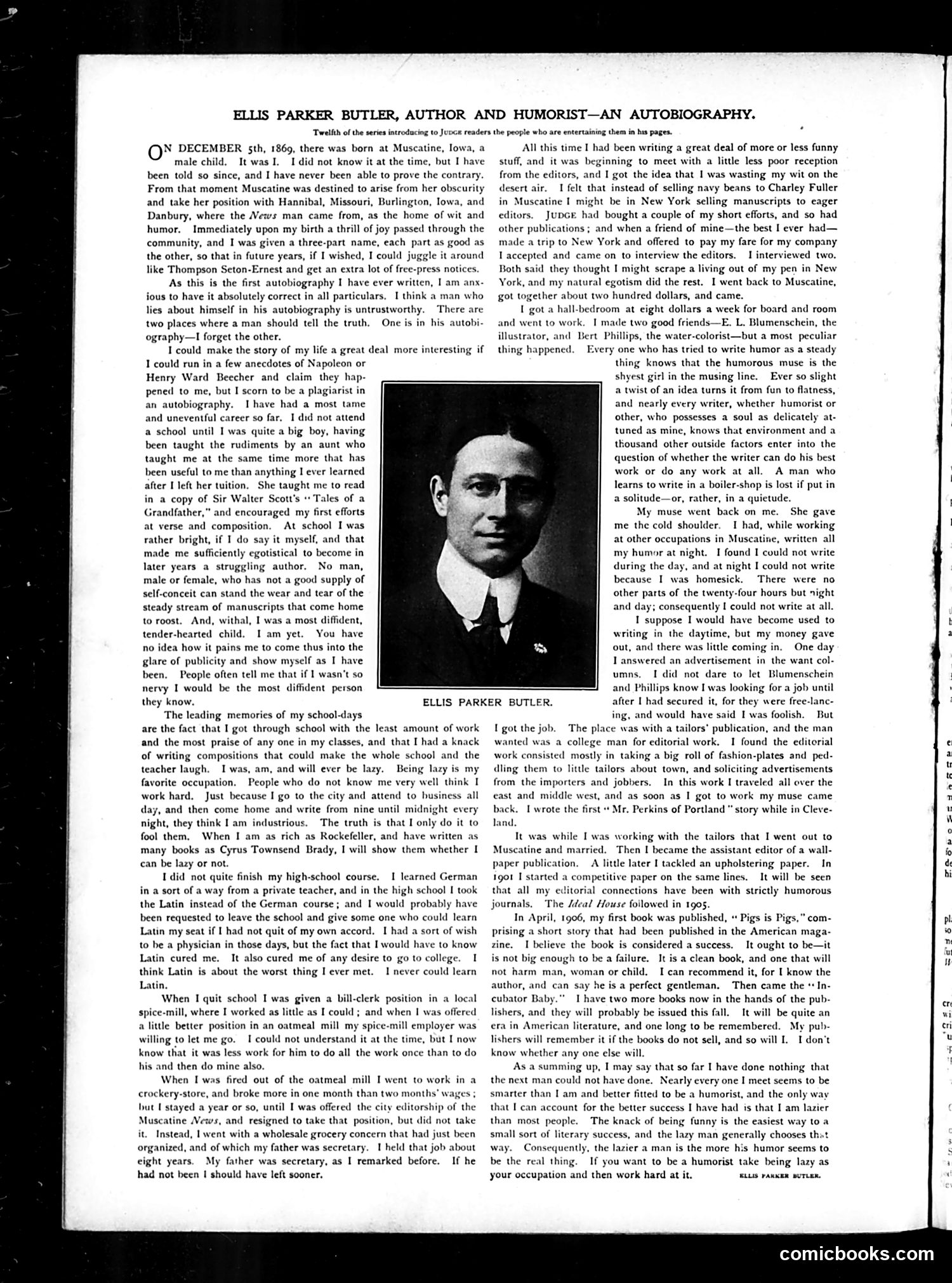
This is the **twelfth installment** of Judge magazine's series presenting autobiographies of notable humorists to readers. The page features **Ellis Parker Butler**, author and humorist, with his portrait photograph. Butler humorously recounts his birth in Muscatine, Iowa (December 5, 1869) and early life, joking that the town's obscurity ended with his arrival. He satirizes autobiography itself—claiming to tell absolute truth while admitting he could fabricate anecdotes about Napoleon or Henry Ward Beecher, but choosing not to. The text describes his path from teaching himself to write, to struggling as an author in New York, where Judge magazine and other publications began accepting his work. He mentions befriending illustrator E.L. Blumenschein and artist Bert Phillips. The satire targets **literary pretension** and the **struggling writer's life**—Butler mocks his own ego while explaining how one must possess sufficient self-conceit to survive constant manuscript rejections. The tone is self-deprecating humor about the difficulty of professional writing.
📄 Transcribed text from this page (OCR, searchable)
Machine-transcribed from the original scan — historical spelling and the odd misread are preserved.
ELLIS PARKER BUTLER, AUTHOR AND HUMORIST—AN AUTOBIOGRAPHY. Twelfth of the series introdacing to Juoce reader: CN DECEMBER sth, 1869, there was born at Muscatine, Iowa, a male child. It was I. I did not know it at the time, but I have been told so since, and I have never been able to prove the contrary. From that moment Muscatine was destined to arise from her obscurity and take her position with Hannibal, Missouri, Burlington, Iowa, and Danbury, where the Vews man came from, as the home of wit and humor. Immediately upon my birth a thrill of joy passed through the community, and I was given a three-part name, each part as good as the other, so that in future years, if I wished, I could juggle it around like Thompson Seton-Ernest and get an extra lot of free-press notices. As this is the first autobiography I have ever written, 1am anx- ious to have it absolutely correct in all particulars. I think a man who lies about himself in his autobiography is untrustworthy. There are two places where a man should tell the truth, One is in his autobi- ography—I forget the other. I could make the story of my life a great deal more interesting if I could run in a few anecdotes of Napoleon or Henry Ward Beecher and claim they hap- pened to me, but I scorn to be a plagiarist in an autobiography. Ihave had a most tame and uneventful career so far. I did not attend a school until Iwas quite a big boy, having been taught the rudiments by an aunt who taught me at the same time more that has been useful to me than anything I ever learned after I left her tuition. She taught me to read in a copy of Sir Walter Scott's + Tales of a randfather,” and encouraged my first efforts at verse and composition, At school I was rather bright, if I do say it myself, and that made me sufficiently egotistical to become in later years a struggling author. No man, male or female, who has not a good supply of self-conceit can stand the wear and tear of the steady stream of manuscripts that come home to roost. And, withal, I was a most diffident, tender-hearted child. I am yet. You have no idea how it pains me to come thus into the glare of publicity and show myself as I have been. People often tell me that if 1 wasn’t so L he people who are entertaining them in his pages. All this time I had been writing a great deal of more or less funny stuff, and it was beginning to meet with a little less poor reception from the editors, and I got the idea that I was wasting my wit on the desert air. I felt that instead of selling navy beans to Charley Fuller in Muscatine I might be in New York selling manuscripts to eager editors. JUDGE had bought a couple of my short efforts, and so had other publications ; and when a friend of mine—the best I ever had— made a trip to New York and offered to pay my fare for my company T accepted and came on to interview the editors. I interviewed two. Both said they thought I might scrape a living out of my pen in New York, and my natural egotism did the rest. I went back to Muscatine, got together about two hundred dollars, and came. I got a hall-bedroom at eight dollars a week for board and room and went to work. I made two good friends—E. L. Blumenschein, the illustrator, and Bert Phillips, the water-colorist—but a most peculiar Every one who has tried to write humor as a steady thing knows that the humorous muse is the shyest girl in the musing line. Ever so slight a twist of an idea turns it from fun to flatness, and nearly every writer, whether humorist or other, who possesses a soul as delicately at- tuned as mine, knows that environment and a thousand other outside factors enter into the question of whether the writer can do his best work or do any work at all. A man who learns to write in a boiler-shop is lost if put in a solitude. My muse went back on me. She gave me the cold shoulder. I had, while working at other occupations in Muscatine, written all my humor at night. I found I could not write during the day, and at night I could not write because I was homesick. There other parts of the twenty-four hours but night and day; consequently I could not write at all. I suppose I would have become used to writing in the daytime, but my money gave out, and there was little coming in. One day L answered an advertisement in the want col- umns. I did not dare to let Blumenschein and Phillips know I was looking for a job until thing happened. or, rather, in a quietude. were no nervy I would be the most diffident person they know. The leading memories of my school-days are the fact that I got through school with the least amount of work and the most praise of any one in my classes, and that I had a knack of writing compositions that could make the whole school and the teacher laugh. I was, am, and will ever be lazy. Being lazy is my favorite occupation. People who do not know me very well think I work hard, Just because I go to the city and attend to business all day, and then come home and write from nine until midnight every night, they think I am industrious. The truth is that I only do it to fool them, When I am as rich as Rockefeller, and have written as many books as Cyrus Townsend Brady, I will show them whether I can be lazy or not. I did not quite finish my high-school course. in a sort of a way from a private teacher, and in the high school | took the Latin instead of the German course; and I would probably have been requested to leave the school and give some one who could learn Latin my seat if I had not quit of my own accord. I had a sort of wish to be a physician in those days, but the fact that I would have to know Latin cured me. It also cured me of any desire to go to college. 1 think Latin is about the worst thing I ever met. I never could learn Latin. When I quit school I was given a bill-clerk position in a local spice-mill, where I worked as little as I could ; and when I was offered a little better position in an oatmeal mill my spice-mill employer was willing to let me go. I could not understand it at the time, but I now know that it was less work for him to do all the work once than to do his and then do mine also. When [was fired out of the oatmeal mill I went to work in a crockery-store, and broke more in one month than two months’ wages ; but U stayed a year or so, until I was offered the city editorship of the Muscatine News, and resigned to take that position, but did not take it. Instead, I went with a wholesale grocery concern that had just been organized, and of which my father was secretary. I held that job about eight years. My father was secretary, as I remarked before. If he had not been I should have left sooner. I learned German ELLIS PARKER BUTLER. after I had secured it, for they were free-lane- ing, and would have said I was foolish. But I got the job. The place was with a tailors’ publication, and the man wanted was a college man for editorial work. I found the editorial work consisted mostly in taking a big roll of fashion-plates and ped- dling them to little tailors about town, and soliciting advertisements from the importers and jobbers. In this work I traveled all over the cast and middle west, and as soon as I got to work my muse came back. Mr. Perkins of Portland" story while in Cleve- land. It was while I was working with the tailors that I went out to Muscatine and married. Then I became the assistant editor of a wall- A little later I tackled an upholstering paper. In It will be seen I wrote the first paper publication. 1got I started a competitive paper on the same lines. that all my editorial connections have been with strictly humorous journals. The /deal House followed in 1995. In April, 1906, my first book was published, « Pigs is Pig: prising a short story that had been published in the American maga- zine. I believe the book is considered a success. It ought to be—it is not big enough to be a failure. It is a clean book, and one that will not harm man, woman or child, I can recommend it, for | know the author, and can say he is a perfect gentleman. Then came the *+In- cubator Baby.” I have two more books now in the hands of the pub- lishers, and they will probably be issued this fall. It will be quite an era in American literature, and one long to be remembered. My pub- lishers will remember it if the books do not sell, and so will I. I don’t know whether any one else will. As a summing up, I may say that so far I have done nothing that the next man could not have done. Nearly every one I meet seems to be smarter than I am and better fitted to be a humorist, and the only way that I can account for the better success I have had is that I am lazier than most people. The knack of being funny is the easiest way to a small sort of literary success, and the lazy man generally chooses th» Consequently, the lazier a man is the more his humor seems to If you want to be a humorist take being lazy as RLLIS PARKER BUTLER. *com- way. be the real thing your occupation and then work hard at it. comicbooks.com