
A complete issue · 16 pages · 1906
Judge — October 27, 1906
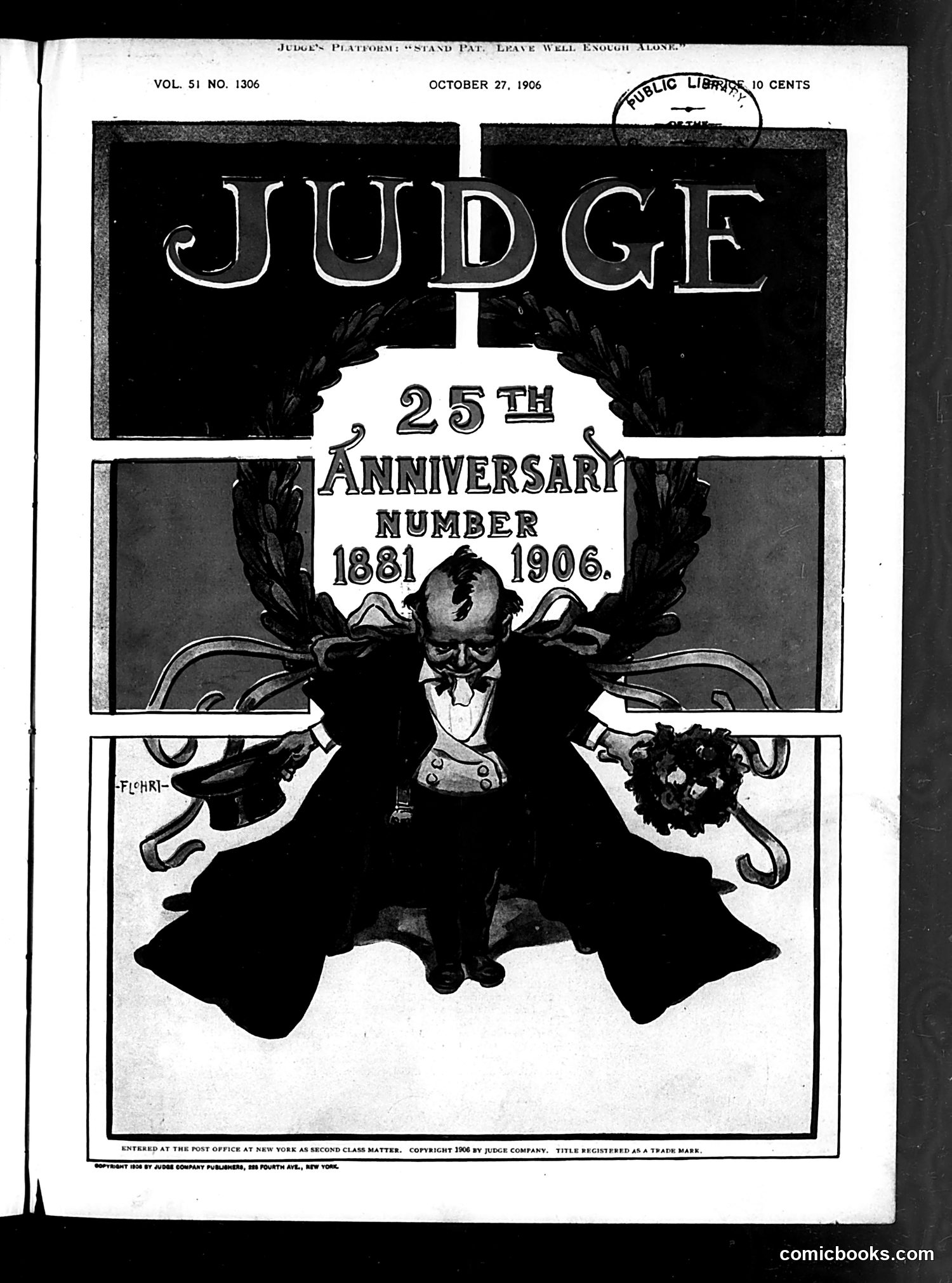
This is the cover of Judge's 25th anniversary special edition, celebrating the magazine's run from 1881-1906. The central figure appears to be a devil or mephistophelian character—likely personifying Judge itself or satirical commentary generally—depicted with wings, formal attire, and a gleeful expression. He holds what appears to be a torch and flowers, suggesting the magazine's role in "illuminating" social issues through humor and satire. The decorative elements (laurel wreaths, ornate scrollwork) frame this anniversary celebration, while the character's theatrical pose and costume emphasize Judge's identity as entertainment-driven political commentary. This cover essentially depicts Judge as a provocative, mischievous force in American public discourse over the past quarter-century.
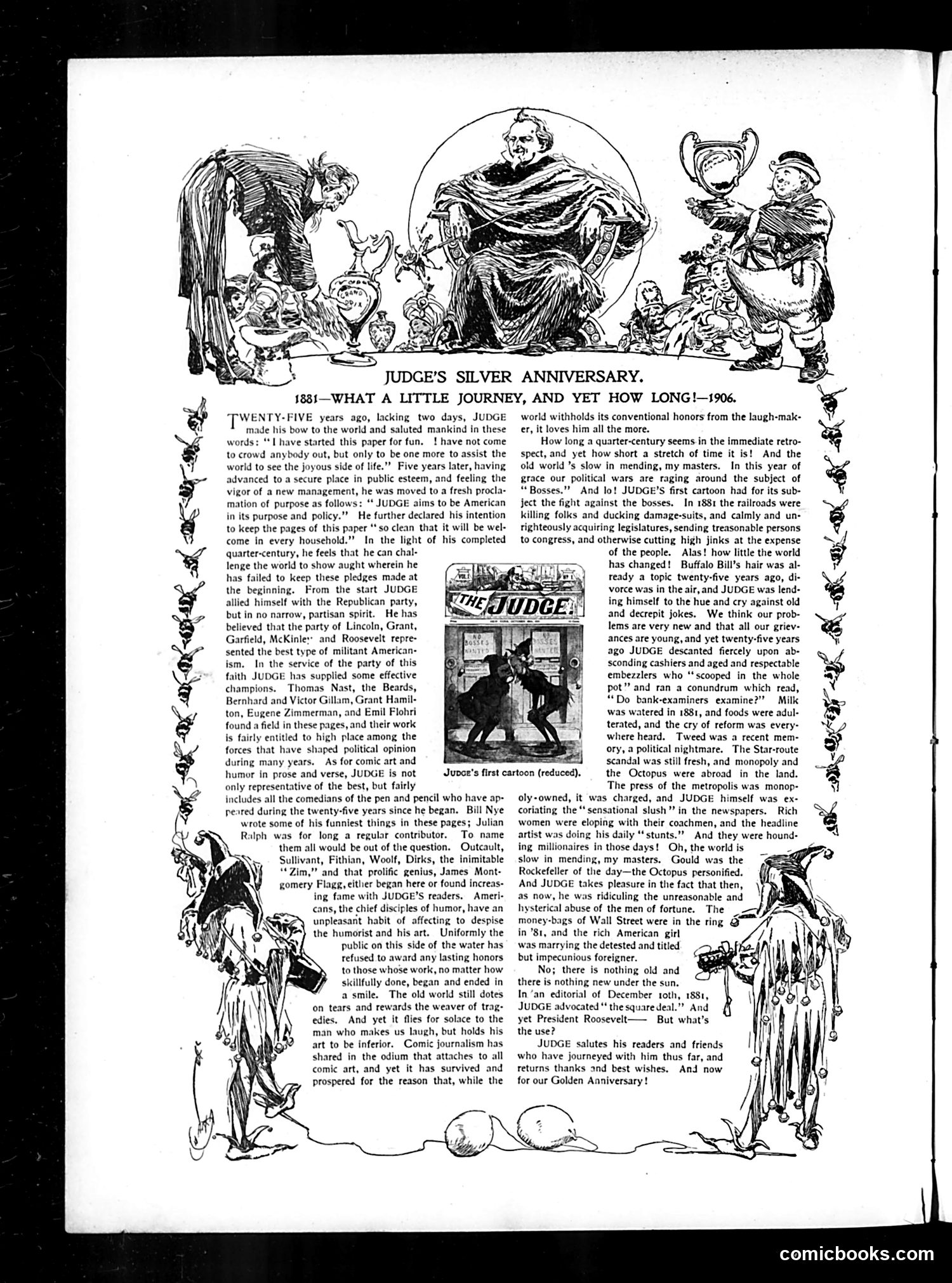
This celebratory piece marks Judge magazine's 25th anniversary. The central figure is the "Judge" character himself, surrounded by smaller figures representing various topics he's covered—politicians, social types, and satirical subjects from the magazine's quarter-century of publication. The text reflects on how the world has changed since 1881: Buffalo Bill's fame has faded, financial scandals (the Octopus) have emerged, women's rights issues have shifted, and monopolies dominate. The article notes Judge's role covering American politics through Lincoln's era through Roosevelt's presidency, satirizing political figures and social absurdities. The ornate border illustrations include allegorical and comedic figures, typical of Judge's visual style. This is essentially a self-congratulatory retrospective on the magazine's satirical commentary spanning a generation.
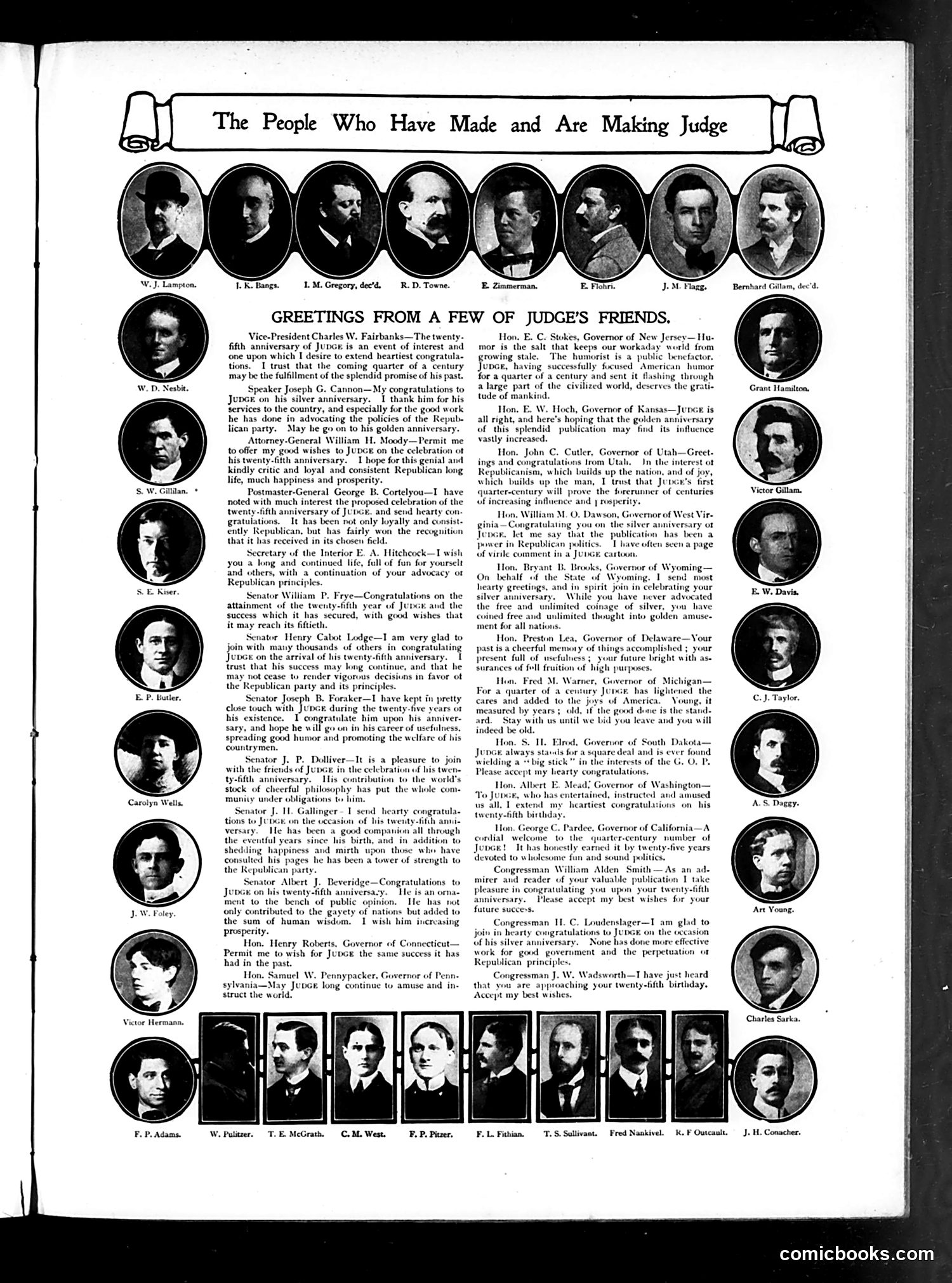
This page celebrates Judge magazine's 25th anniversary by featuring portraits of the publication's founders, editors, and contributors alongside congratulatory letters from various U.S. governors. The top row shows eight oval portraits of key figures in Judge's creation and leadership. Below, governors from New Jersey, Kansas, Utah, West Virginia, Michigan, Wyoming, South Dakota, California, and Washington send greetings praising Judge's role in American humor and Republican politics over the past quarter-century. The bottom section displays additional rectangular portraits, likely of cartoonists and writers who contributed to the magazine's success. This is essentially a commemorative, non-satirical page—a self-promotional celebration of Judge's influence and the prominent people associated with it.
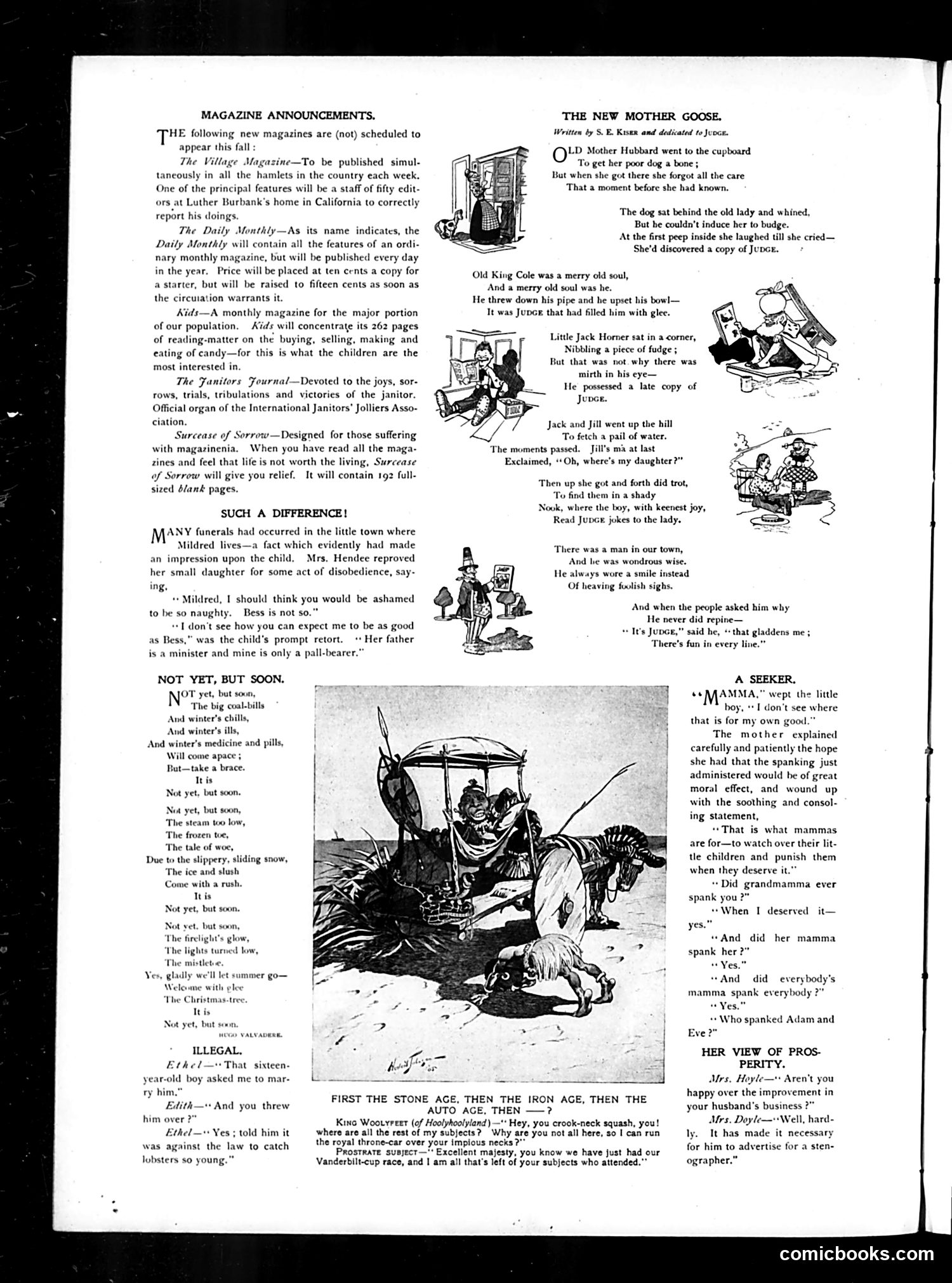
This page contains primarily **literary and humorous content rather than political satire**. The main elements include: **"The New Mother Goose"** - A poem by S.E. Kiser featuring traditional nursery rhyme characters (Old Mother Hubbard, Old King Cole, Jack Homer, Jack and Jill) in lighthearted verse. **"Not Yet, But Soon"** - A seasonal poem about winter's approach. **Magazine announcements** promoting upcoming publications like *The Hilltop Home*, *The Daily Monthly*, and *Kids* magazine. **"A Seeker"** and **"Her View of Prosperity"** - Brief humorous dialogue pieces about spanking children and business advertising, respectively. The large central illustration appears to show a winter scene with a person in a sleigh, but without clearer identification of specific figures, I cannot determine if it references particular political events or social commentary.
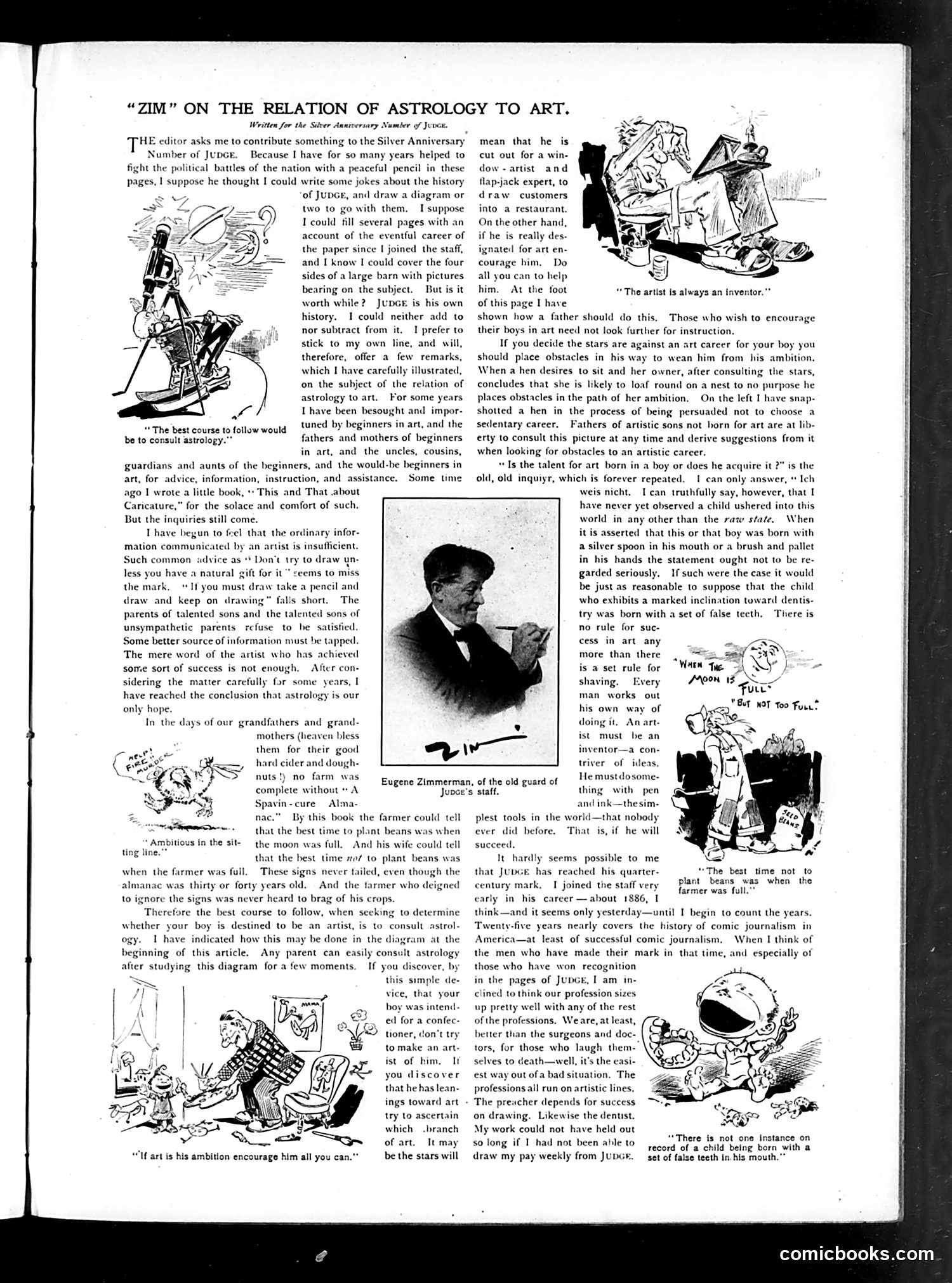
This page features an article by Eugene Zimmerman (the cartoonist "Zim") discussing whether parents should consult astrology when directing children toward artistic careers. The central photograph shows Zimmerman himself, identified as "the old guard of Judge's staff." The accompanying cartoons illustrate the article's argument: that talent for art cannot be predicted by birth charts or horoscopes—it must be discovered through observation of the child's natural inclinations. The sketches show various scenarios of parents and children, emphasizing that artistic ability emerges organically rather than being predetermined by astrological signs. The piece advocates for encouraging artistic talent when evident, rather than relying on superstition or predetermined notions about a child's destiny.
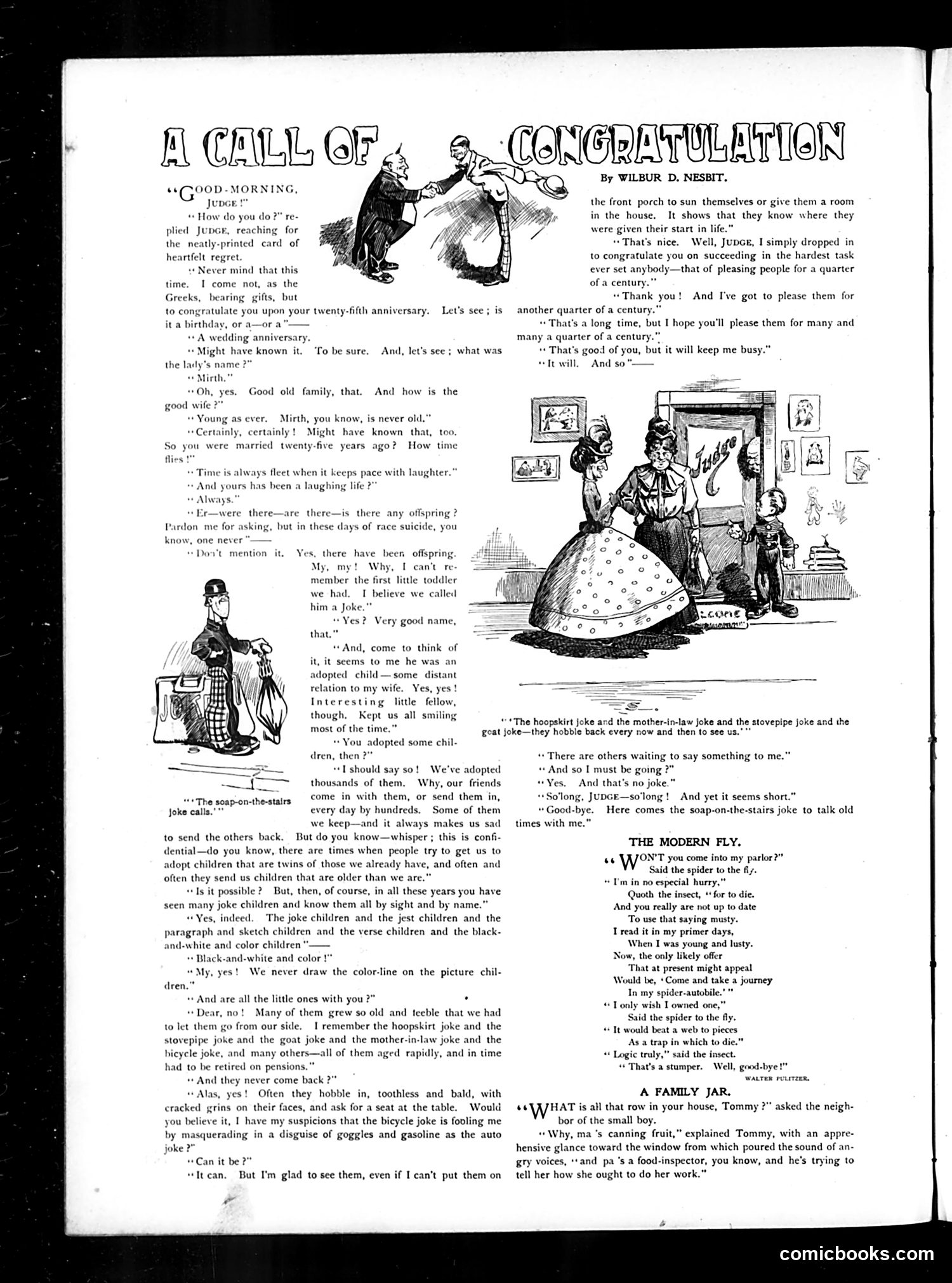
This satirical piece, by Wilbur D. Nesbit, uses an extended metaphor about "joke children" to comment on Judge magazine's editorial mission. Judge (personified as the speaker) congratulates himself on 25 years of successfully "pleasing people"—the magazine's core challenge. The conceit: Judge's jokes are his "adopted children." Some become classics (the hoopskirt joke, mother-in-law joke, bicycle joke) but eventually "age rapidly" and must be "retired on pensions"—old material that loses relevance. Some jokes even return in disguise (the bicycle joke "masquerading" as an auto joke), suggesting comedians recycle material. The satire gently mocks both magazine publishing and joke-telling: the difficulty of maintaining freshness, the lifespan of comedy, and how timely humor inevitably becomes dated. It's self-aware commentary on the magazine's own struggle to remain funny and relevant to readers.
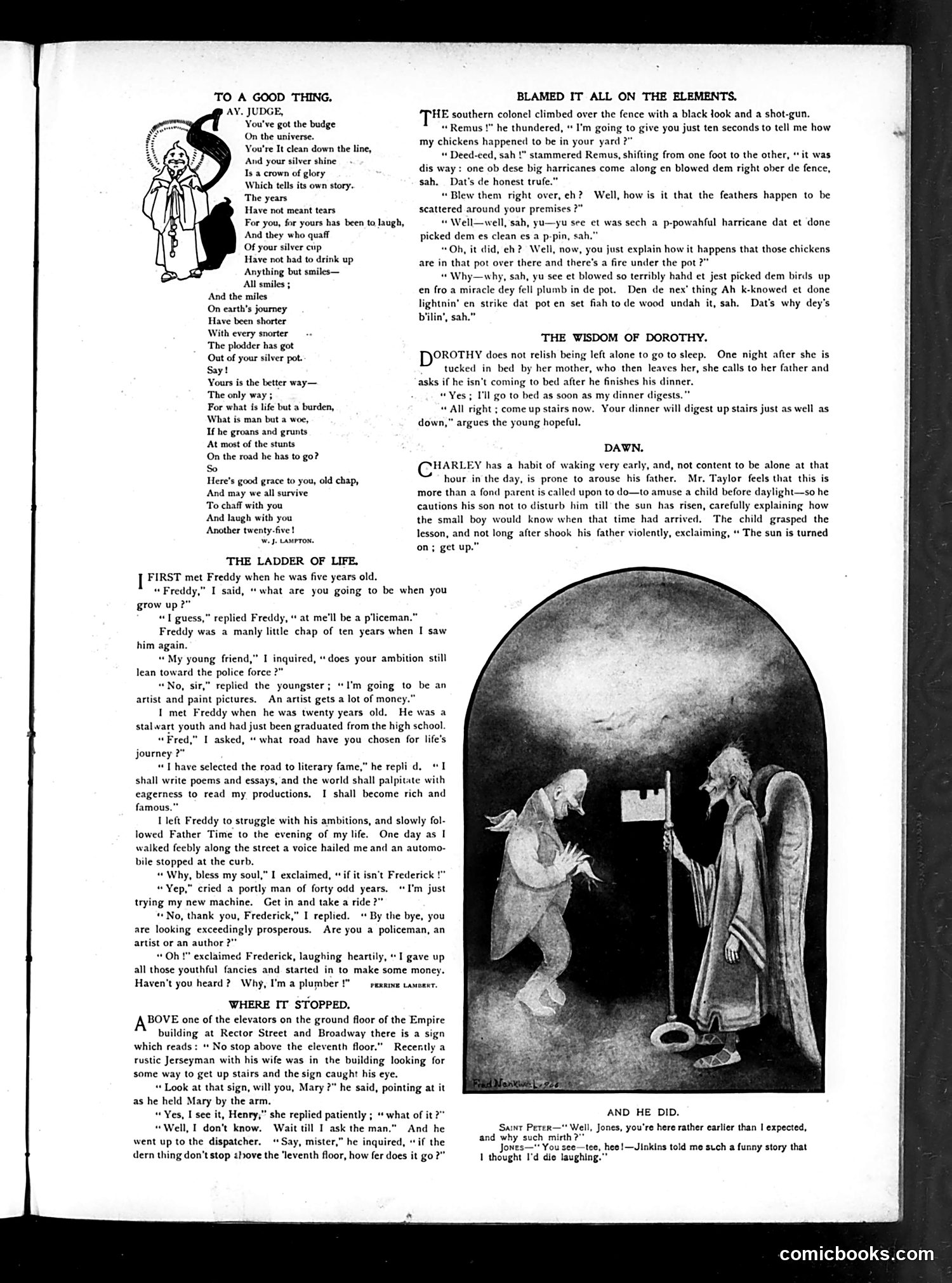
This page from *Judge* contains several humorous short stories and anecdotes targeting common social types and situations: **"Blamed It All on the Elements"** is a dialect humor piece featuring a Black character ("Remus") caught with stolen chickens, who blames a hurricane—then a lightning strike—for the increasingly implausible circumstances. This reflects the racist "dialect comedy" popular in early 20th-century American humor. **"The Wisdom of Dorothy"** and **"Dawn"** are gentle domestic humor sketches about children's literal-minded logic outwitting parental reasoning. **"The Ladder of Life"** satirizes youthful ambition's trajectory: a boy dreams of becoming a policeman, then an artist (for money), then a literary writer—mocking how young people's grandiose goals shift with age and circumstances. The page's opening poem "To a Good Thing" celebrates alcohol/drinking culture, addressing whiskey as a companion through life's burdens. Overall, the page reflects *Judge's* emphasis on satirizing social pretension, generational folly, and racial stereotypes typical of Gilded Age American humor.
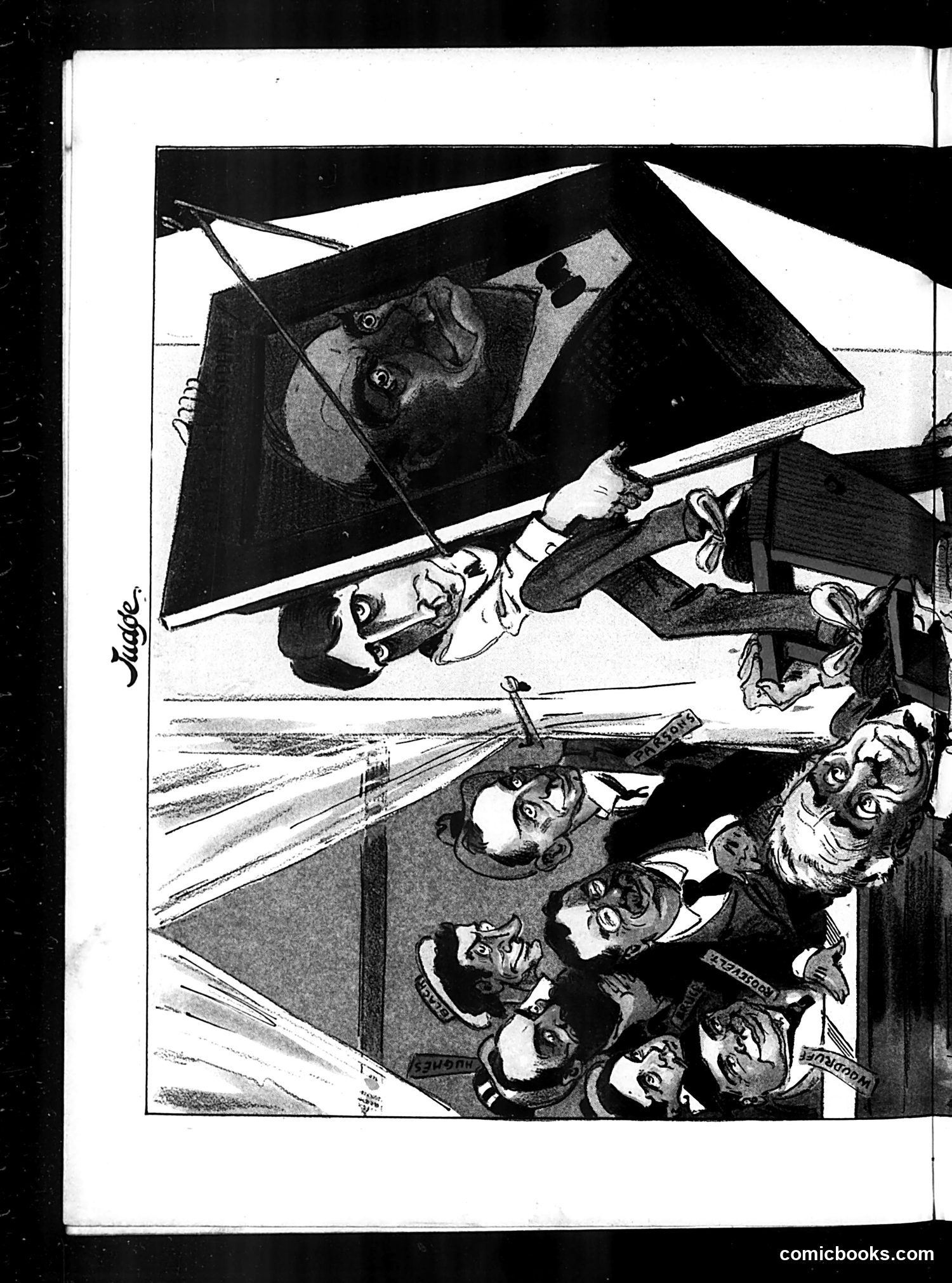
This appears to be a political cartoon from **Judge magazine** showing a scene viewed from above (rotated 90 degrees). The image depicts what seems to be a **public gathering or crowd scene**, with multiple figures with exaggerated facial features characteristic of period caricature work. A central figure at the top appears to be addressing or looking down at a group of people below. The cartoon likely satirizes a political event, public meeting, or social situation popular during the era Judge was published (roughly 1881-1940s). However, without visible text identifying specific figures or clear historical markers, I cannot definitively identify which political figures or events are being caricatured. The style suggests **early-to-mid 20th century American politics or society**, but determining the precise satirical target requires additional context beyond what's clearly legible here.
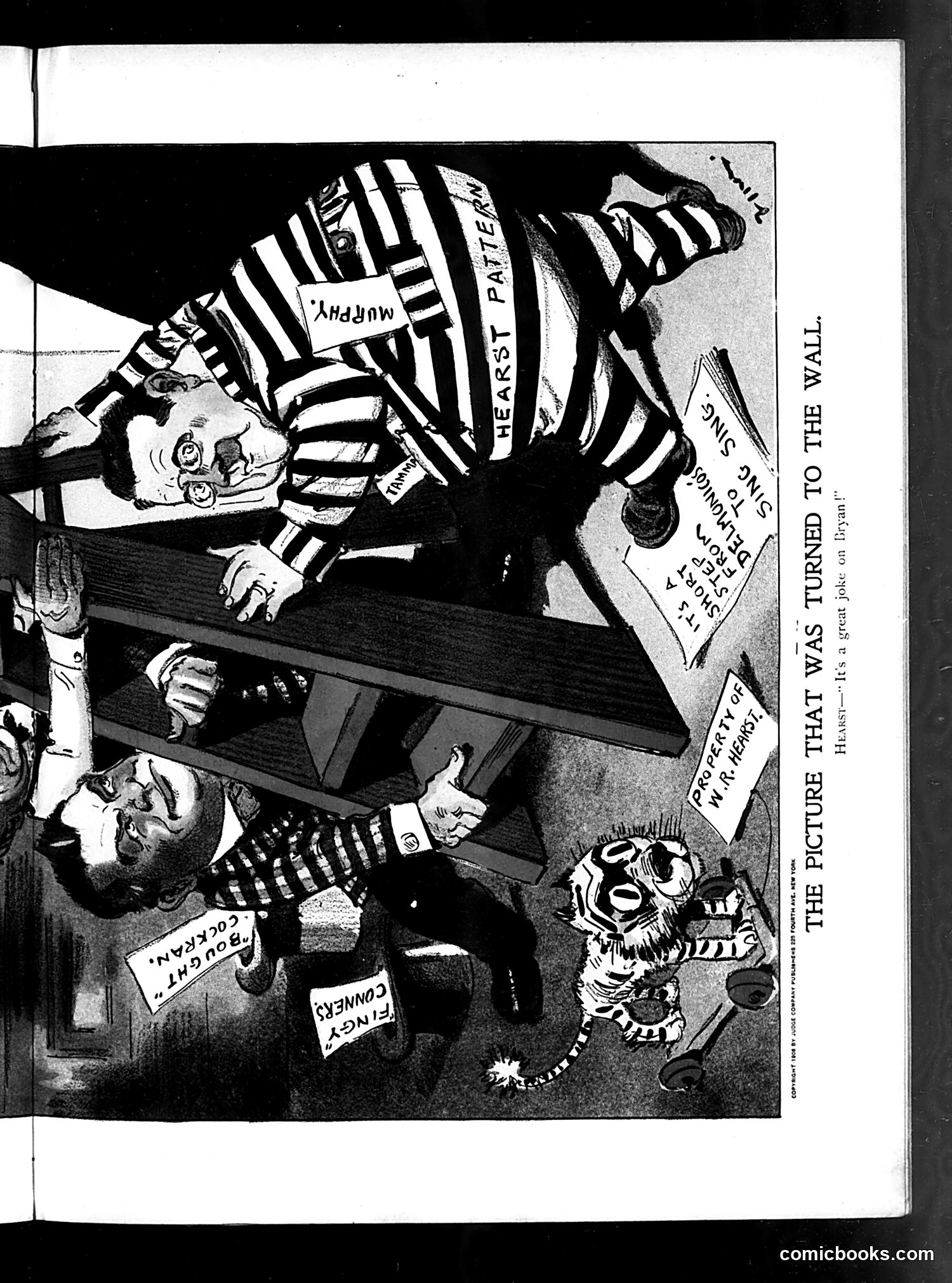
This Judge magazine cartoon satirizes political corruption, likely from the early 20th century. The image depicts a figure in striped prison garb labeled "HEARSE PATTERER" being turned toward a wall, with signs reading "CONDEMNED," "FINE PARDON," and references to criminal conduct. The cartoon appears to mock a politician or public figure who escaped justice through a presidential pardon despite clear wrongdoing—suggesting they should have faced prison time instead. The striped uniform and wall reference invoke execution or imprisonment imagery. The exact identities remain unclear without additional context, but this exemplifies Judge's typical approach: using grotesque caricature and dark humor to criticize political corruption and the abuse of executive clemency powers to shield the guilty from accountability.
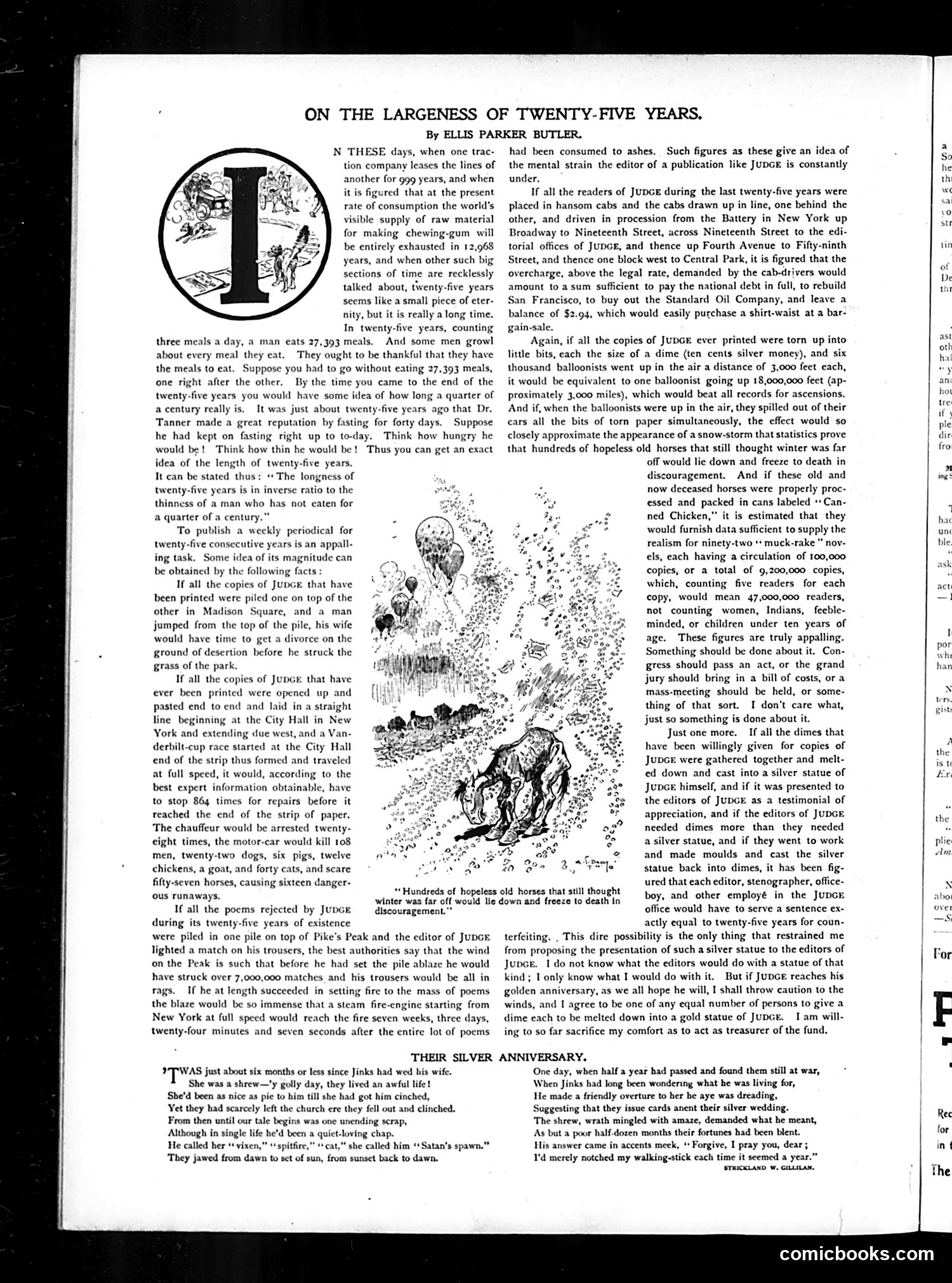
This is a humorous essay by Ellis Parker Butler celebrating *Judge* magazine's 25-year anniversary (the text refers to the magazine by name repeatedly). The central joke uses absurdist math to illustrate how long a quarter-century actually is. Butler employs exaggerated hypotheticals: if all *Judge* copies were stacked in Madison Square, a man jumping from the pile would fall longer than his wife needs for divorce; if pasted end-to-end from City Hall westward, a speeding car would need 864 repair stops before reaching the end; rejected poems piled on Pike's Peak would burn for weeks. The cartoon shows freezing horses—illustrating the brutal consequences of extreme conditions, reinforcing Butler's point about long time periods through visceral imagery. The satire targets both *Judge*'s own editorial burden (the mental strain of 25 years) and contemporary readers' sense of time, mocking how modern life casually discusses incomprehensibly long timescales (999-year leases, 12,968 years of gum consumption) while 25 years seems modest by comparison.
This page is primarily **advertising with humorous filler content**, typical of early 20th-century magazines. The main advertisements include Miller High Life beer, Murad cigarettes, Parker's Tar Soap, Evans' Ale, Sohmer Pianos, and Cortez Cigars. These ads occupy most of the space and represent the magazine's revenue. The short humor pieces are mild, disconnected jokes rather than political cartoons: - "His Preference": A doctor comedy about choosing throat vs. stomach medicine - "Wanted a Hall Tree": Wordplay confusion (mistaking a decorative hall tree for a plant cutting) - "An Understudy": A pun about an auto mechanic being an actor's replacement - Other brief quips about outdated social conventions and office humor These pieces require no historical context—they're timeless light comedy. There are **no identifiable political figures or satirical commentary** on this page. Judge here functions as an advertising vehicle with generic humor filler typical of the era, not as a platform for social or political satire.
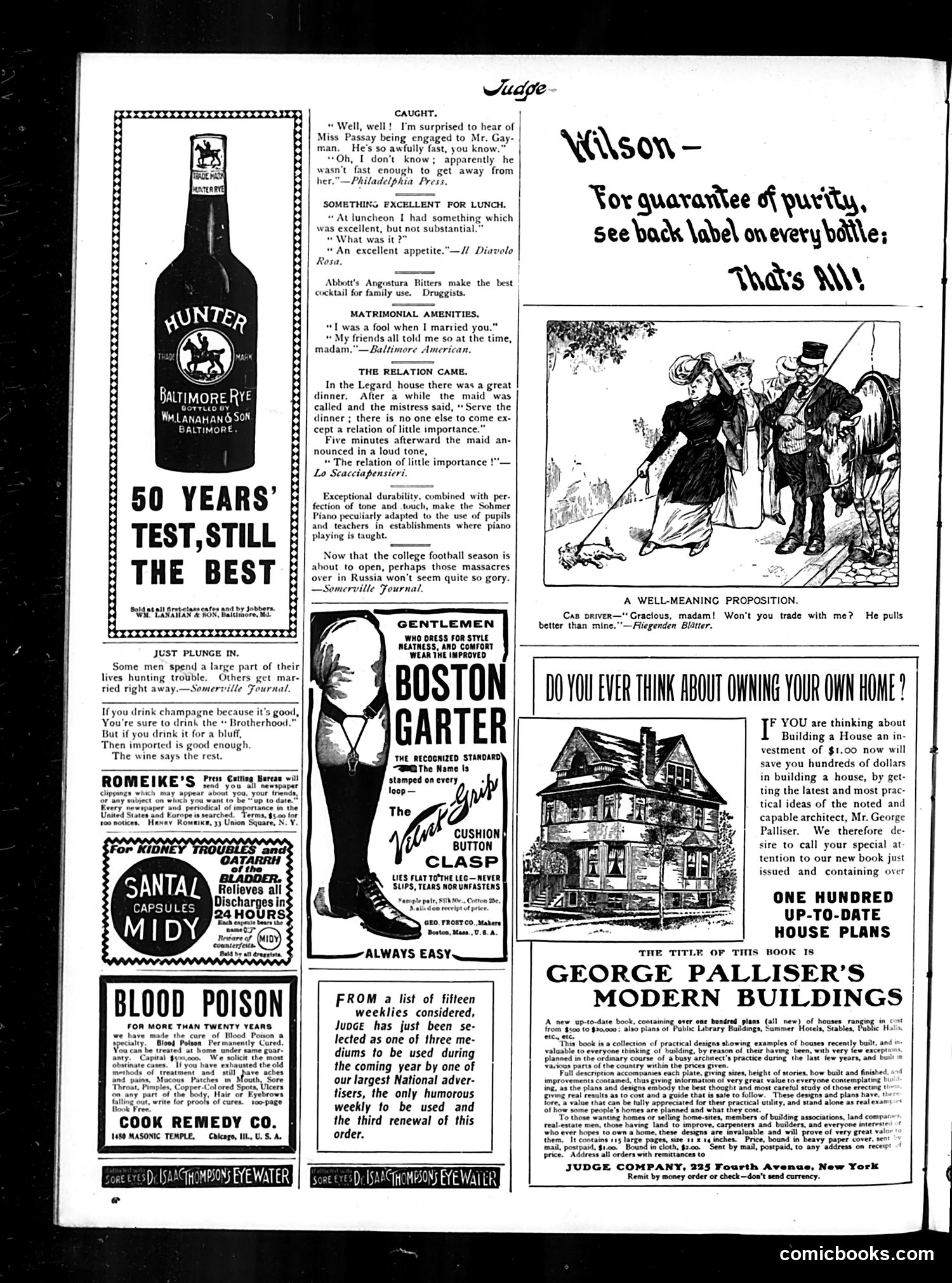
This page from *Judge* magazine is primarily **advertising and humor reprints** rather than original political satire. The content includes: **Main Cartoon ("A Well-Meaning Proposition"):** A cab driver propositions a woman, offering to trade horses because his pulls better. The humor is in the crude double entendre—the "proposition" is ostensibly innocent but sexually suggestive to contemporary readers. **Recurring Joke Format:** Multiple brief jokes about marriage, engagement, and relationships occupy the upper portion. These are reprinted from other publications (credited sources like *Philadelphia Press*, *Baltimore American*), typical of *Judge*'s format of collecting witticisms. **Advertisements:** The page is dominated by ads for whiskey (Hunter Baltimore Rye), garters, blood poison cure, and house plans—typical patent medicines and consumer goods of the era. **Social Context:** The matrimonial jokes reflect early 20th-century attitudes toward marriage as somewhat adversarial between spouses. References to "fast" women and marital foolishness reflect period anxieties about gender and courtship norms. This is a **commercial miscellany** rather than sophisticated political commentary.
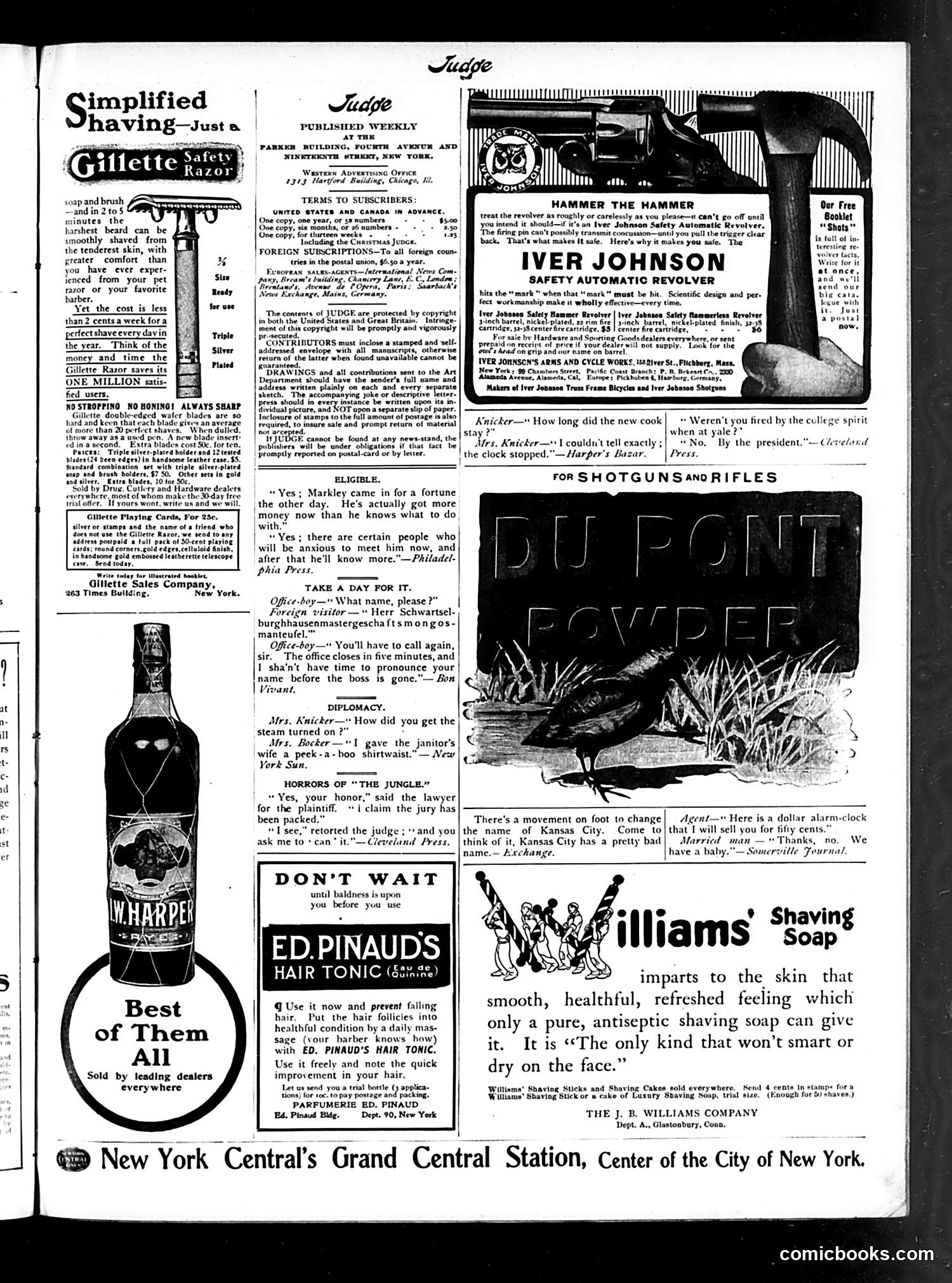
This is primarily an **advertising page** from Judge magazine, with minimal satirical content. The page features several product advertisements: Gillette Safety Razors, Iver Johnson Safety Automatic Revolvers, Ed. Pinaud's Hair Tonic, and Williams' Shaving Soap. There are two brief humorous anecdotes: 1. A dialogue about a new cook's brief employment, playing on the phrase "couldn't tell exactly" (the cook left so quickly, duration was unmeasurable) 2. A joke about Yale college spirit and being "fired by the president" The **Iver Johnson revolver ad** emphasizes safety features—notably that the firing pin cannot transmit concussion unless the trigger is deliberately pulled. This was a significant marketing point in the early 20th century, when accidental firearm deaths were common. The page reflects **turn-of-the-century consumer culture** and product standardization, with Judge serving as both satirical commentary *and* advertising vehicle for middle-class goods.
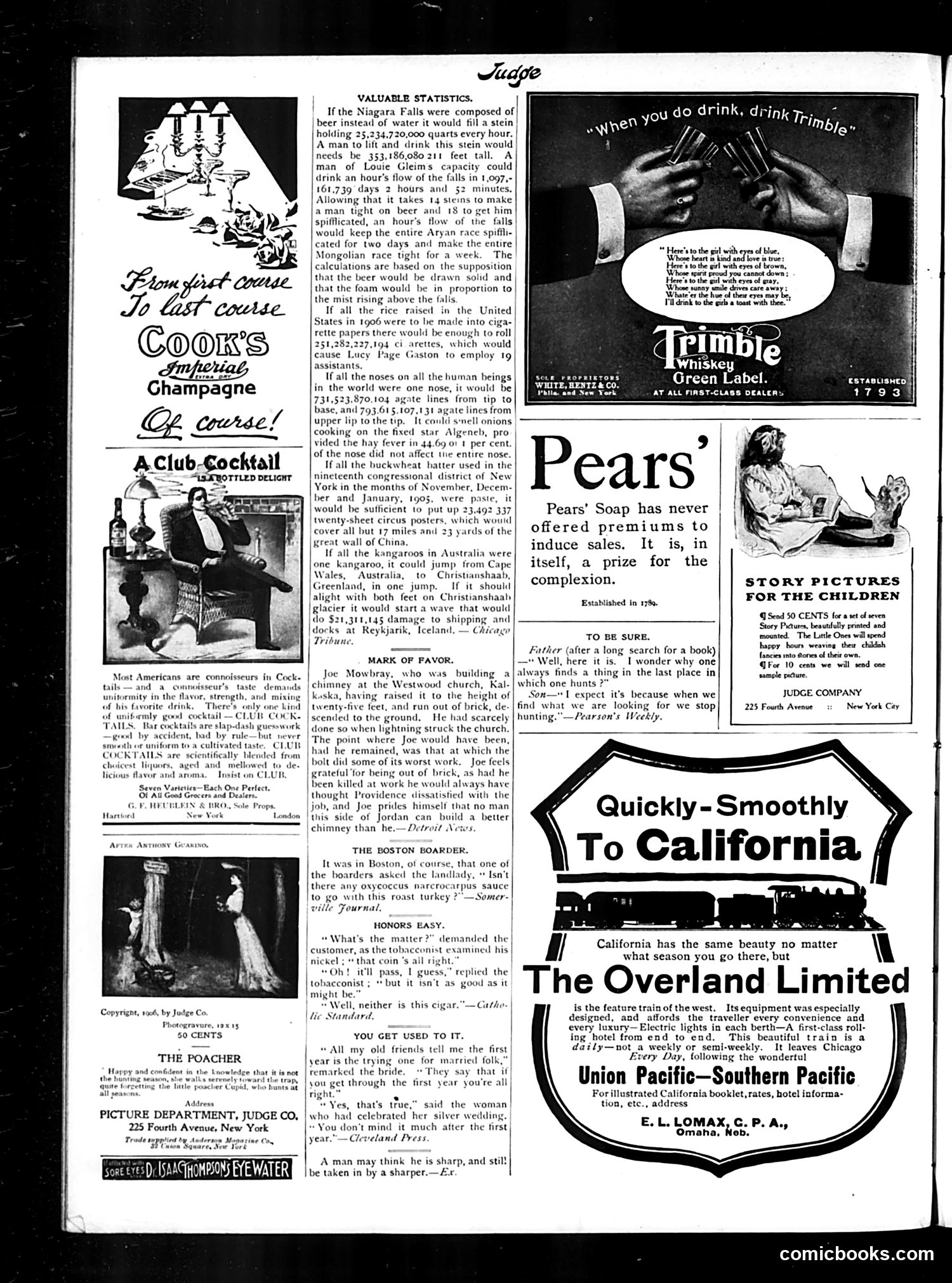
This page is primarily an **advertisement and humor magazine spread** from *Judge* magazine. The cartoons and jokes satirize American society circa 1906: **"Valuable Statistics"**: A mock-serious article that pokes fun at obsessive quantification. It combines absurd hypotheticals (Niagara Falls as beer, giant noses) with invented statistics—satirizing both public fascination with "impressive numbers" and pseudo-scientific showiness. **The jokes** (Mark of Favor, The Boston Boarder, Honors Easy, You Get Used to It) are brief, pun-heavy social humor typical of the era, mocking pretension (a Boston boarder using fancy Greek terms) and class differences. **Advertisements** for alcoholic beverages (champagne, Club Cocktails, Trimble Whiskey) and other products dominate the page—standard for *Judge*, which relied on liquor advertising revenue. The ads target middle/upper-class readers who could afford quality spirits. The overall tone reflects early 1900s American culture: mocking excess, pretension, and Boston snobbery while openly promoting alcohol consumption.
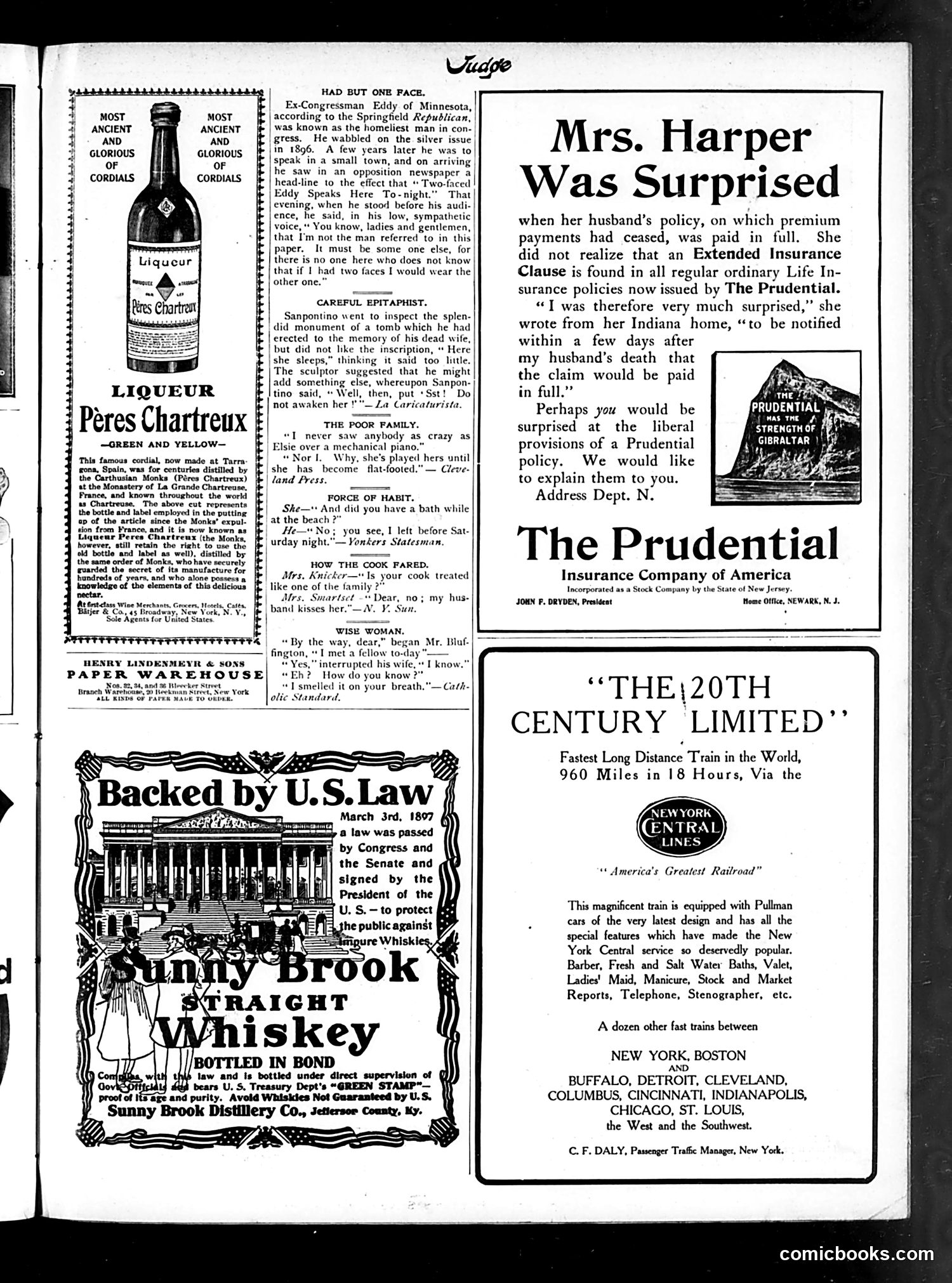
This page is primarily **advertisements with humorous short jokes** rather than political cartoons. The content includes: **Humorous Anecdotes:** - A joke about Ex-Congressman Eddy of Minnesota, known as "the homeliest man in congress," who responds to a newspaper calling him "Two-faced" by quipping he'd wear his other face if he had one—self-deprecating humor about his appearance. - Several brief domestic humor pieces (about mechanical pianos, bathing habits, cook treatment, etc.) typical of period comedy. **Advertisements:** - Liqueur Pères Chartreux (French cordial) - Sunny Brook Whiskey (emphasizing U.S. legal backing from 1897) - Prudential Insurance (highlighting extended coverage benefits) - The "20th Century Limited" train (New York Central's flagship service) The page reflects turn-of-the-century American advertising and light social satire—no significant political content or caricatures are present. It's typical filler material for Judge magazine circa early 1900s.
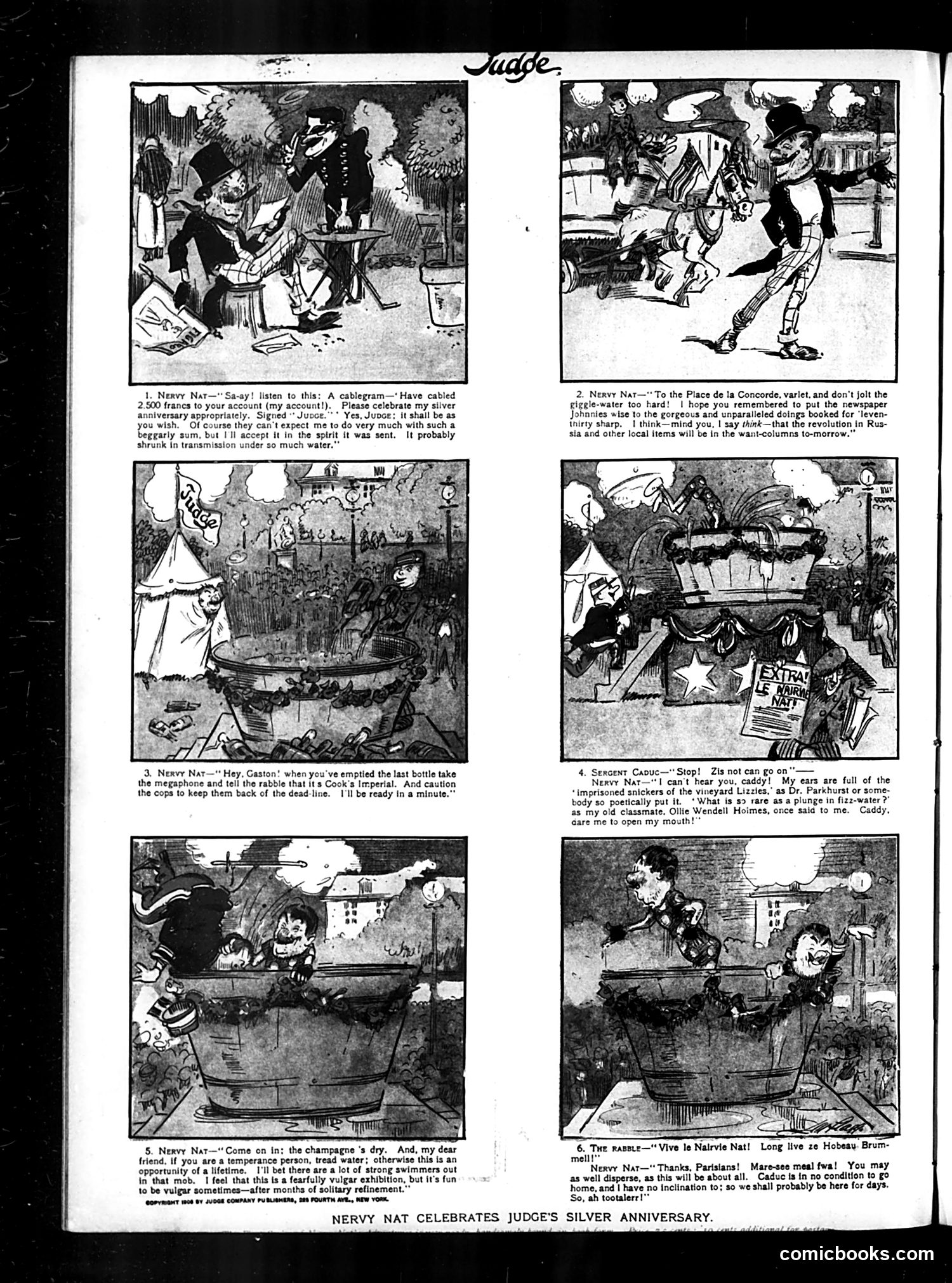
This multi-panel comic celebrates Judge magazine's 25th anniversary through the character "Nervy Nat," a wealthy, irreverent American abroad in Paris. The satire mocks Prohibition-era excess: Nat receives 2,500 francs to celebrate lavishly with champagne and "giggle-water" (slang for alcohol), treating the magazine's anniversary as an excuse for debauchery. The humor targets several things: American wealth and entitlement abroad, the absurdity of Prohibition (which people circumvented by drinking overseas), and Judge's own editorial pretensions versus actual vulgar behavior. References to "the vineyard Lizzies" and the French setting emphasize how Americans escaped Prohibition's constraints. The comic self-mockingly acknowledges its vulgarity while presenting drunken excess as entertainment. The Parisian crowd's celebration ("Vive le Nervy Nat!") suggests Judge's confident, irreverent editorial voice resonated with readers.