
Judge, 1906-10-27 · page 7 of 16
Judge — October 27, 1906 — page 7: what you’re looking at
What you’re looking at
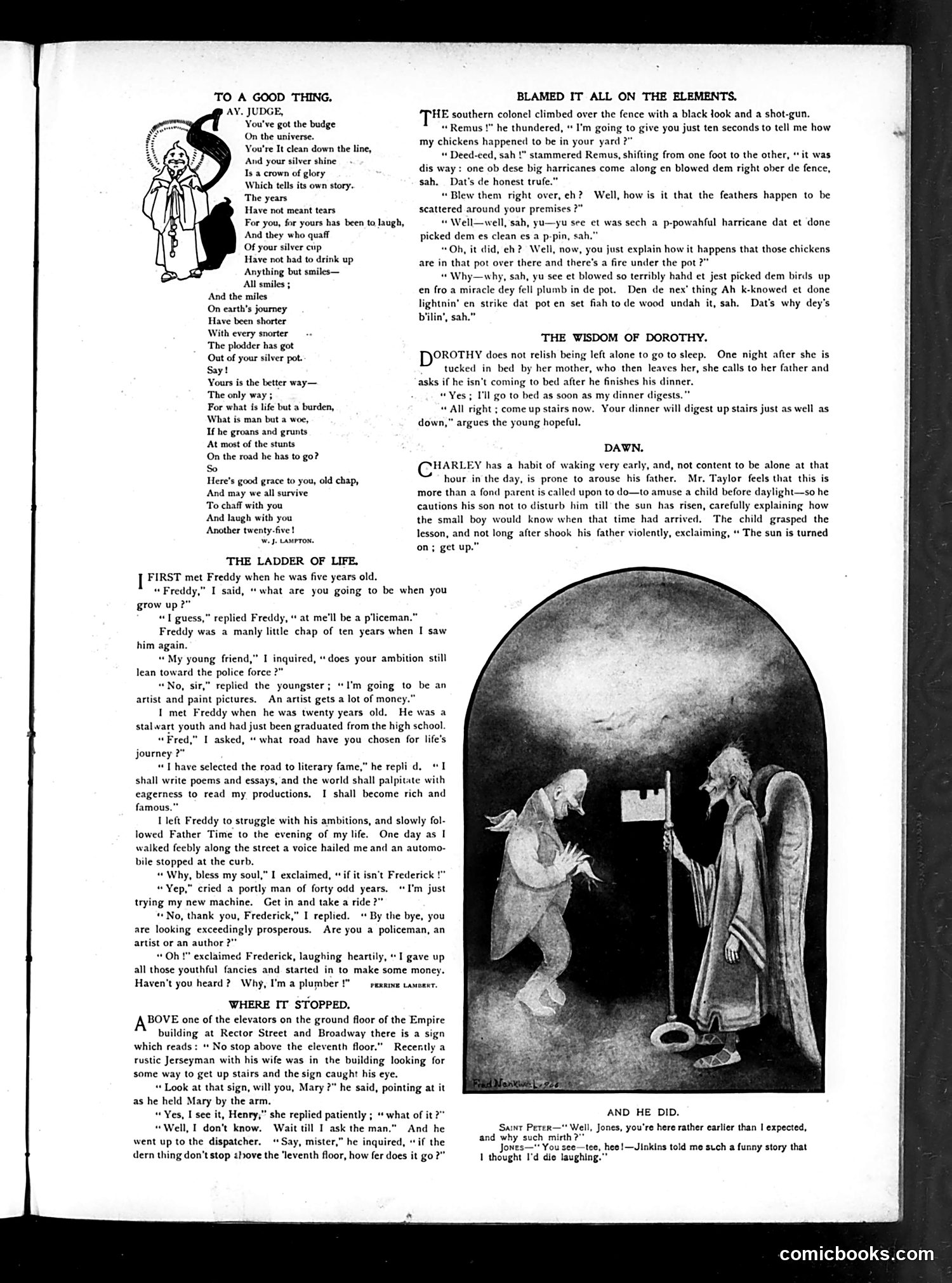
This page from *Judge* contains several humorous short stories and anecdotes targeting common social types and situations: **"Blamed It All on the Elements"** is a dialect humor piece featuring a Black character ("Remus") caught with stolen chickens, who blames a hurricane—then a lightning strike—for the increasingly implausible circumstances. This reflects the racist "dialect comedy" popular in early 20th-century American humor. **"The Wisdom of Dorothy"** and **"Dawn"** are gentle domestic humor sketches about children's literal-minded logic outwitting parental reasoning. **"The Ladder of Life"** satirizes youthful ambition's trajectory: a boy dreams of becoming a policeman, then an artist (for money), then a literary writer—mocking how young people's grandiose goals shift with age and circumstances. The page's opening poem "To a Good Thing" celebrates alcohol/drinking culture, addressing whiskey as a companion through life's burdens. Overall, the page reflects *Judge's* emphasis on satirizing social pretension, generational folly, and racial stereotypes typical of Gilded Age American humor.
📄 Transcribed text from this page (OCR, searchable)
Machine-transcribed from the original scan — historical spelling and the odd misread are preserved.
TO A GOOD THING. AY. JUDGE, You've got the budge On the universe. You're It clean down the line, And your silver shine Is a crown of glory Which tells its own story. The years Have not meant tears For you, for yours has been to laugh, And they who quaff Of your silver cup Have not had to drink up Anything but smiles— All smiles ; ‘And the miles On earth's journey Have been shorter With every snorter The plodder has got Out of your silver pot. Say! Yours is the better way— ‘The only way ; For what is life but a burden, What is man but a woe, If he groans and grunts At most of the stunts On the road he has to go? So Here's good grace to you, old chap, And may we all survive To chaff with you And laugh with you Another twenty-five! BLAMED IT ALL ON THE ELEMENTS. THE southern colonel climbed over the fence with a black look and a shot-gun. «Remus !" he thundered, «I'm going to give you just ten seconds to tell me how my chickens happened to be in your yard ?” Deed-ced, sah !" stammered Remus, shifting from one foot to the other, “it was dis way : one ob dese big harricanes come along en blowed dem right ober de fence, sah. Dat's de honest trufe.” “Blew them right over, eh? scattered around your premises ?” Well—well, sah, yu—yu see et was sech a p-powahful harricane dat et done picked dem es clean es a p-pin, sah.” “Oh, it did, eh? Well, now, you just explain how it happens that those chickens. are in that pot over there and there's a fire under the pot ?” “ Why—why, sah, yu see et blowed so terribly hahd et jest picked dem birds up en fro a miracle dey fell plumb in de pot. Den de nex’ thing Ah k-knowed et done lightnin’ en strike dat pot en set fiah tode wood undah it, sah. Dat's why dey’s Diilin’, sah.” Well, how is it that the feathers happen to be THE WISDOM OF DOROTHY. DOROTHY does not relish being left alone to go to sleep. One night after she is tucked in bed by her mother, who then leaves her, she calls to her father and asks if he isn’t coming to bed after he finishes his dinner. “Yes ; I'll go to bed as soon as my dinner digests.”" Alll right ; come up stairs now. Your dinner will digest up stairs just as well as ” argues the young hopeful. DAWN. CHARLEY has a habit of waking very early, and, not content to be alone at that hour in the day, is prone to arouse his father. Mr. Taylor feels that this is more than a fond parent is called upon to do—to amuse a child before daylight—so he cautions his son not to disturb him till the sun has risen, carefully explaining how the small boy would know when that time had arrived, The child grasped the lesson, and not long after shook his father violently, exclaiming, “ The sun is turned Ww. Je LAMPTON. ” on; get up. THE LADDER OF LIFE. | FIRST met Freddy when he was five years old. “Freddy,” I said, “what are you going to be when you grow up?” “T guess,” replied Freddy, « at me'll be a p'liceman.” Freddy was a manly little chap of ten years when I saw him again. “My young friend,” I inquired, “does your ambition still lean toward the police force 2” “No, sir,” replied the youngster; “I'm going to be an artist and paint pictures. An artist gets a lot of money.” I met Freddy when he was twenty years old. He was a stalwart youth and had just been graduated from the high school. “Fred,” I asked, “what road have you chosen for life's journey “ T have selected the road to literary fame,” he repli d. shall write poems and essays, and the world shall palpitate with eagerness to read my productions. I shall become rich and famous.” I left Freddy to struggle with his ambitions, and slowly fol- lowed Father Time to the evening of my life. One day as I walked feebly along the street a voice hailed me and an automo- bile stopped at the curb. “ Why, bless my soul,” I exclaimed, «if it isn’t Frederick !" “Yep,” cried a portly man of forty odd years. “I'm just trying my new machine. Get in and take a ride?” «No, thank you, Frederick,” I replied.“ By the bye, you are looking exceedingly prosperous. Are you a policeman, an artist or an author 2” “Oh!” exclaimed Frederick, laughing heartily, “I gave up all those youthful fancies and started in to make some money. Haven't you heard? Why, I'm a plumber !" WHERE IT STOPPED. BOVE one of the elevators on the ground floor of the Empire building at Rector Street and Broadway there is a sign which reads: “ No stop above the eleventh floor.” Recently a rustic Jerseyman with his wife was in the building looking for some way to get up stairs and the sign caught his eye. “ Look at that sign, will you, Mary ?” he said, pointing at it as he held Mary by the arm “Yes, I see it, Henry, PERRIN LAMDENT. AND HE DID. Sant Perer—" Well, Jones, you're here rather earlier than | expected, and why such mirth?” Jones—“' You see—tee, hee !—Jinkins told me such a funny story that 1 thought I'd die laughing. she replied patiently ; “ what of it 2” “Well, I don’t know. Wait till I ask the man.” And he went up to the dispatcher. “Say, mister,” he inquired, «if the dern thing don’t stop zhove the ‘leventh floor, how fer does it go?” comicbooks.com