
Judge, 1906-10-27 · page 10 of 16
Judge — October 27, 1906 — page 10: what you’re looking at
What you’re looking at
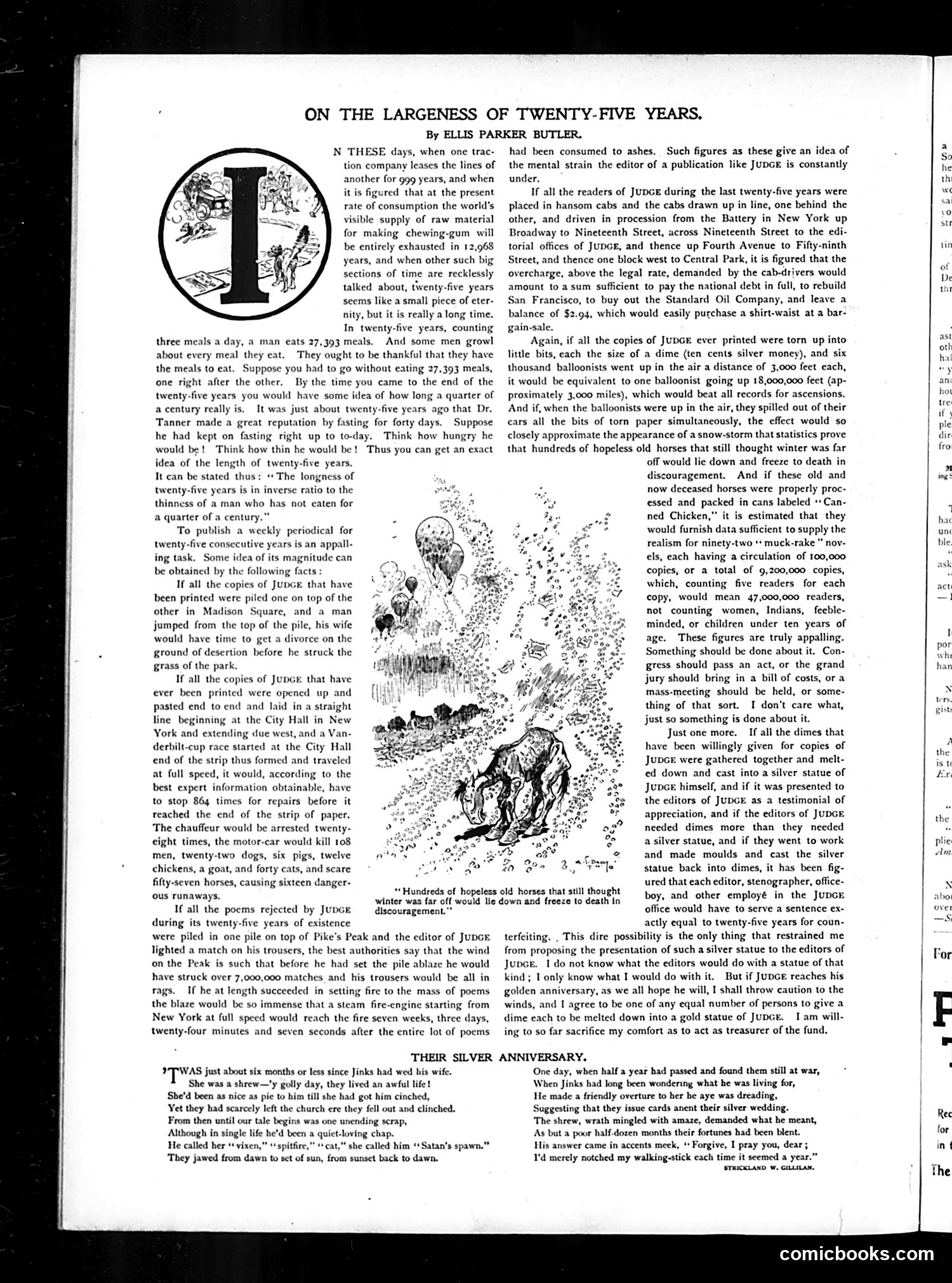
This is a humorous essay by Ellis Parker Butler celebrating *Judge* magazine's 25-year anniversary (the text refers to the magazine by name repeatedly). The central joke uses absurdist math to illustrate how long a quarter-century actually is. Butler employs exaggerated hypotheticals: if all *Judge* copies were stacked in Madison Square, a man jumping from the pile would fall longer than his wife needs for divorce; if pasted end-to-end from City Hall westward, a speeding car would need 864 repair stops before reaching the end; rejected poems piled on Pike's Peak would burn for weeks. The cartoon shows freezing horses—illustrating the brutal consequences of extreme conditions, reinforcing Butler's point about long time periods through visceral imagery. The satire targets both *Judge*'s own editorial burden (the mental strain of 25 years) and contemporary readers' sense of time, mocking how modern life casually discusses incomprehensibly long timescales (999-year leases, 12,968 years of gum consumption) while 25 years seems modest by comparison.
📄 Transcribed text from this page (OCR, searchable)
Machine-transcribed from the original scan — historical spelling and the odd misread are preserved.
ON THE LARGENESS OF TWENTY-FIVE YEARS. By ELLIS PARKER BUTLER, N THESE days, when one trac- tion company leases the lines of another for 999 years, and when it is figured that at the present rate of consumption the world’s visible supply of raw material for making chewing-gum v be entirely exhausted in 12,968 years, and when other such big sections of time are recklessly talked about, tiventy-five years seems like a small piece of eter- nity, but it is really along time. In twenty-five years, counting three meals a day, a man eats 27,393 meals. And some men growl about every meal they eat. They ought to be thankful that they have the meals to eat. Suppose you had to go without eating 27,393 meals, one right after the other. By the time you came to the end of the twenty-five years you would have some idea of how long a quarter of a century really is, It was just about twenty-five years ago that Dr. Tanner made a great reputation by fasting for forty days. Suppose he had kept on fasting right up to to-day. Think how hungry he would be! Think how thin he would be! Thus you can get an exact idea of the length of twenty-five years. It can be stated thus: «The longness of twenty-five years is in inverse ratio to the thinness of a man who has not eaten for a quarter of a century.” To publish a weekly periodical for twenty-five consecutive years is an appall- ing task. Some idea of its magnitude can be obtained by the following facts : If all the copies of JupGe that have been printed were piled one on top of the other in Madison Square, and a man jumped from the top of the pile, his wife would have time to get a divorce on the ground of desertion before he struck the grass of the park. If all the copies of JupGE that have ever been printed were opened up and pasted end to end and laid in a straight line beginning at the City Hall in New York and extending due west, and a Van- derbilt-cup race started at the City Hall end of the strip thus formed and traveled at full speed, it would, according to the best expert information obtainable, have to stop 864 times for repairs before it reached the end of the strip of paper. The chauffeur would be arrested twenty- eight times, the motor-car would kill 108 men, twenty-two dogs, six pigs, twelve chickens, a goat, and forty cats, and scare fifty-seven horses, causing sixteen danger- ous runaways, If all the poems rejected by JUDGE during its twenty-five years of existence were piled in one pile on top of Pike’s Peak and the editor of Jupcr lighted a match on his trousers, the best authorities say that the wind on the Peak is such that before he had set the pile ablaze he would have struck over 7,000,000 matches and his trousers would be all in rags. If he at length succeeded in setting fire to the mass of poems the blaze would be so immense that a steam fire-engine starting from New York at full speed would reach the fire seven weeks, three days, twenty-four minutes and seven seconds after the entire lot of poems discouragement.” “Hundreds of hopeless old horses that still thought winter was far off would lie down and freeze to death In had been consumed to ashes. Such figures as these give an idea of the mental strain the editor of a publication like JUDGE is constantly under. If all the readers of JuDGE during the last twenty-five years were placed in hansom cabs and the cabs drawn up in line, one behind the other, and driven in procession from the Battery in New York up Broadway to Nineteenth Street, across Nineteenth Street to the edi- torial offices of JUDGE, and thence up Fourth Avenue to Fifty-ninth Street, and thence one block west to Central Park, it is figured that the overcharge, above the legal rate, demanded by the cab-drivers would amount to a sum sufficient to pay the national debt in full, to rebuild San Francisco, to buy out the Standard Oil Company, and leave a balance of $2.94, which would easily purchase a shirt-waist at a bar- gain-sal Again, if all the copies of JuDGE ever printed were torn up into little bits, each the size of a dime (ten cents silver money), and six thousand balloonists went up in the air a distance of 3,000 fect each, it would be equivalent to one balloonist going up 18,000,000 fect (ap- proximately 3,000 miles), which would beat all records for ascensions. And if, when the balloonists were up in the air, they spilled out of their cars all the bits of torn paper simultaneously, the effect would so closely approximate the appearance of a snow-storm that statistics prove that hundreds of hopeless old horses that still thought winter was far off would lie down and freeze to death in discouragement. And if these old and now deceased horses were properly proc- essed and packed in cans labeled **Can- ned Chicken,” it is estimated that they would furnish data sufficient to supply the realism for ninety-two muck-rake " nov- els, each having a circulation of 100,000 copies, or a total of 9,200,000 copies, which, counting five readers for each copy, would mean 47,000,000 readers, not counting women, Indians, feeble- minded, or children under ten years of age. These figures are truly appalling. Something should be done about it. Con- gress should pass an act, or the grand jury should bring in a bill of costs, or a mass-meeting should be held, or some- thing of that sort. I don't care what, just so something is done about it. Just one more. If all the dimes that have been willingly given for copies of JUDGE were gathered together and melt- ed down and cast into a silver statue of JupcE himself, and if it was presented to the editors of JUDGE as a testimonial of appreciation, and if the editors of JuDGE needed dimes more than they needed a silver statue, and if they went to work and made moulds and cast the silver statue back into dimes, it has been fig- ured that each editor, stenographer, office- boy, and other employé in the JupcE office would have to serve a sentence ex- actly equal to twenty-five years for coun- terfeiting. . This dire possibility is the only thing that restrained me from proposing the presentation of such a silver statue to the editors of Jupce. I do not know what the editors would do with a statue of that kind; T only know what I would do with it. But if JuDGE reaches his golden anniversary, as we all hope he will, I shall throw caution to the winds, and I agree to be one of any equal number of persons to give a dime each to be melted down into a gold statue of JuDGE. I am will- ing to so far sacrifice my comfort as to act as treasurer of the fund. ‘THEIR SILVER ANNIVERSARY. ITT WAS just about six months or less since Jinks had wed his wife, She was a shrew—'y golly day, they lived an awful life! She'd been as nice as pie to him till she had got him cinched, Yet they had scarcely left the church ere they fell out and clinched. From then until our tale begins was one unending scrap, Although in single life he'd been a quiet-loving chap. He called her + vixen," *spitfire,"* cat," she called him ‘Satan's spawn.” ‘They jawed from dawn to set of sun, from sunset back to dawn. One day, when half a year had passed and found them still at war, When Jinks had long been wondering what he was living for, He made a friendly overture to her he aye was dreading, Suggesting that they issue cards anent their silver wedding. The shrew, wrath mingled with amaze, demanded what he meant, As but a poor half-dozen months their fortunes had been blent. His answer came in accents meek, ‘Forgive, I pray you, deat I'd merely notched my walking-stick each time it seemed a year. STRICKLAND W. GILLILAM. De thr ast oth ha "y an hot te if ple dir fro ing hac un ble ask act por wh ters. gist the is Ex abo | over —s For comicbooks.com