
Judge, 1906-10-27 · page 6 of 16
Judge — October 27, 1906 — page 6: what you’re looking at
What you’re looking at
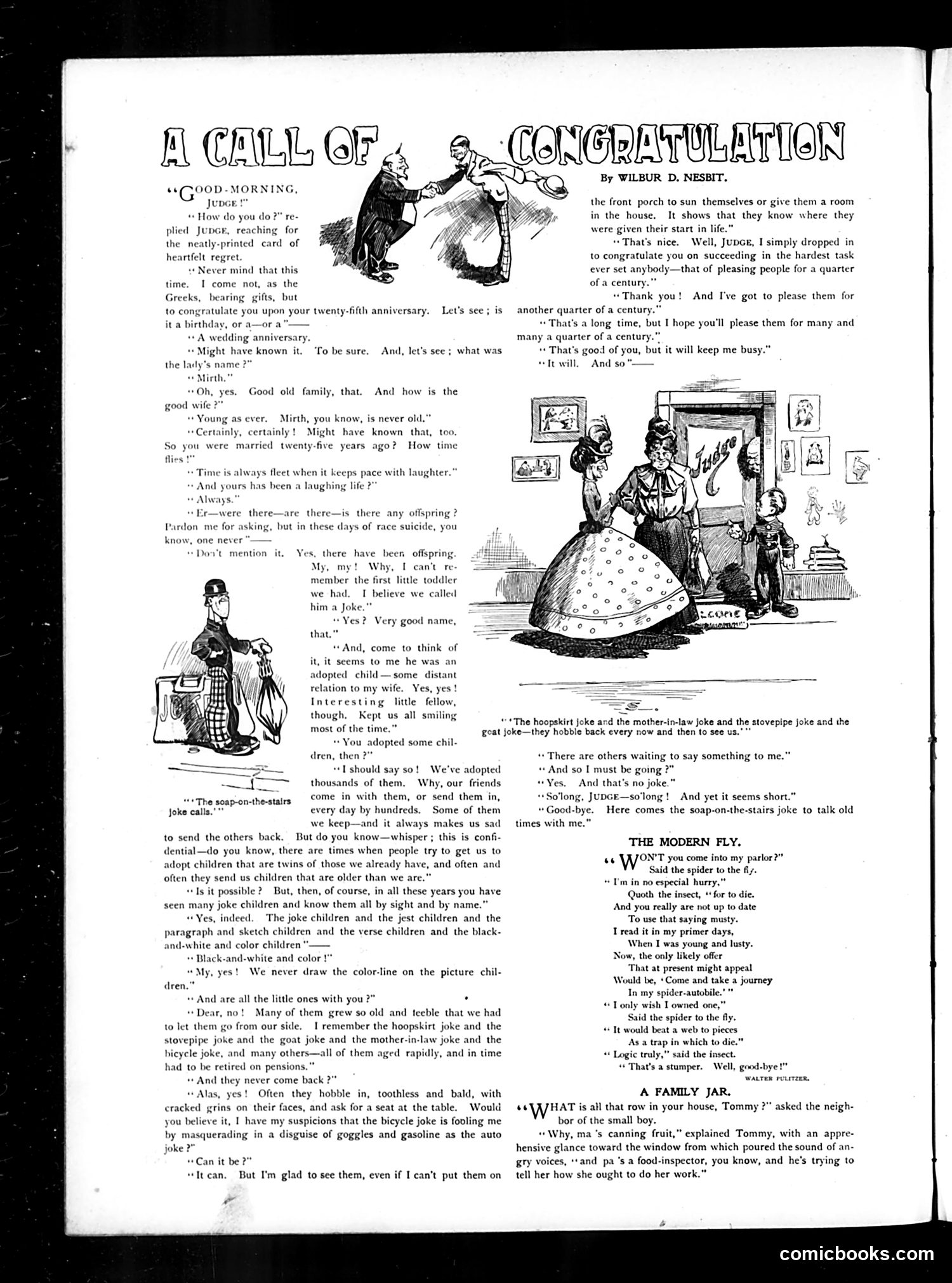
This satirical piece, by Wilbur D. Nesbit, uses an extended metaphor about "joke children" to comment on Judge magazine's editorial mission. Judge (personified as the speaker) congratulates himself on 25 years of successfully "pleasing people"—the magazine's core challenge. The conceit: Judge's jokes are his "adopted children." Some become classics (the hoopskirt joke, mother-in-law joke, bicycle joke) but eventually "age rapidly" and must be "retired on pensions"—old material that loses relevance. Some jokes even return in disguise (the bicycle joke "masquerading" as an auto joke), suggesting comedians recycle material. The satire gently mocks both magazine publishing and joke-telling: the difficulty of maintaining freshness, the lifespan of comedy, and how timely humor inevitably becomes dated. It's self-aware commentary on the magazine's own struggle to remain funny and relevant to readers.
📄 Transcribed text from this page (OCR, searchable)
Machine-transcribed from the original scan — historical spelling and the odd misread are preserved.
“eGgeeD- MORNING, Jupce “How do plied JupGr, reaching for the neatly-printed card of heartfelt regret + Never mind that this time. I come not, as the Greeks, bearing gifts, but to congratulate you upon your twenty-fifth anniversary, Let's see; is it a birthday, or a—or a"— ++ A wedding anniversary. “Might have known it. ‘To be sure. And, let's see; what was the lady’s name Mirth.” “Oh, yes. Good old family, that. And how is the good wife 2” “Young as ever. Mirth, you know, is never old.” “Certainly, certainly! Might have known that, too. So you were married twenty-five years ago? How time flies 1” + Time is always fleet when it keeps pace with laughter.” + And yours has been a laughing life?” + Always.” + Er—were there—are there—is there any offspring ? Pardon me for asking, but in these days of race suicide, you know, one never "— + Dov't mention it, Yes, there have been offspring My, my! Why, [can't re member the first little toddler we had. I believe we called him a Joke." “Yes? Very good name, that. “And, come to think of it, it seems to me he was an adopted child —some distant relation to my wife. Yes, yes ! Interesting little fellow, though. Kept us all smiling SINGRARDEAT eh By WILBUR D. NESBIT. the front porch to sun themselves or give them a room in the house. It shows that they know where they were given their start in life.” “That's nice. Well, JuDGE, I simply dropped in to congratulate you on succeeding in the hardest task ever set anybody—that of pleasing people for a quarter And I've got to please them for another quarter of a century «That's a long time, but I hope you'll please them for many and many a quarter of a century “« That's good of st will, And so ‘The hoopskirt joke and the mother-in-law joke and the stovepipe joke and the most of the time,” goat joke—they hobble back every now and then to see us."”" “You adopted some chil- dren, then “IT should say so! We've adopted thousands of them. Why, our friends <The sap aca come in with them, or send them in, Joke calls." "* every day by hundreds, Some of them we keep—and it always makes us sad to send the others back. But do you know—whisper ; this is confi- dential—do you know, there are times when people try to get us to adopt children that are twins of those we already have, and often and often they send us children that are older than we ar ++Is it possible? But, then, of course, in all these years you have seen many joke children and know them all by sight and by name.” ++ Yes, indeed. ‘The joke children and the jest children and the paragraph and sketch children and the verse children and the black- and-white and color children + Black-and-white and color “My, yes! We never draw the color-line on the picture chil- dren.” «And are all the little ones with you ?” * ‘Dear, no! Many of them grew so old and teeble that we had to let them go from our sid I remember the hoopskirt joke and the stovepipe joke and the goat joke and the mother-in-law joke and the hicyele joke, and many others—all of them aged rapidly, and in time had to be retired on pension + And the ever come bac! + Alas, yes! Often they hobble in, toothless and bald, with cracked grins on their faces, and ask for a seat at the table. Would you believe it, I have my suspicions that the bicycle joke is fooling me by masquerading in a disguise of goggles and gasoline as the auto “Can it be?” “Itcan, But I'm glad to see them, even if I can't put them on « There are others waiting to say something to me.” + And so I must be going ? “Yes. And that’s no joke.” So'long, JUDGE—so'long !_ And yet it seems short.” od-bye. Here comes the soap-on-the-stairs joke to talk old times with me. THE MODERN FLY. 66 YVONT you come into my parlor?” Said the spider to the fy. * T'm in no especial hurry,” Quoth the insect, + for to die. And you really are not up to date To use that saying musty. I read it in my primer days, When I was young and lusty. Now, the only likely offer at at present might appeal Would be, ‘Come and take a journey In my spider-autobile.” « Tonly wish T owned one, Said the spider to the fly. + It would beat a web to pieces As a trap in which to die. “« Logic truly,” said the insect. “That's a stumper. Well, good-bye!” A FAMILY JAR. Se YVHAT is all that row in your house, Tommy ?” asked the neigh- bor of the small boy. “Why, ma ‘s canning fruit,” explained Tommy, with an appr hensive glance toward the window from which poured the sound of an- gry voices, ‘and pa ‘s a food-inspector, you know, and he's trying to tell her how she ought to do her work. comicbooks.com